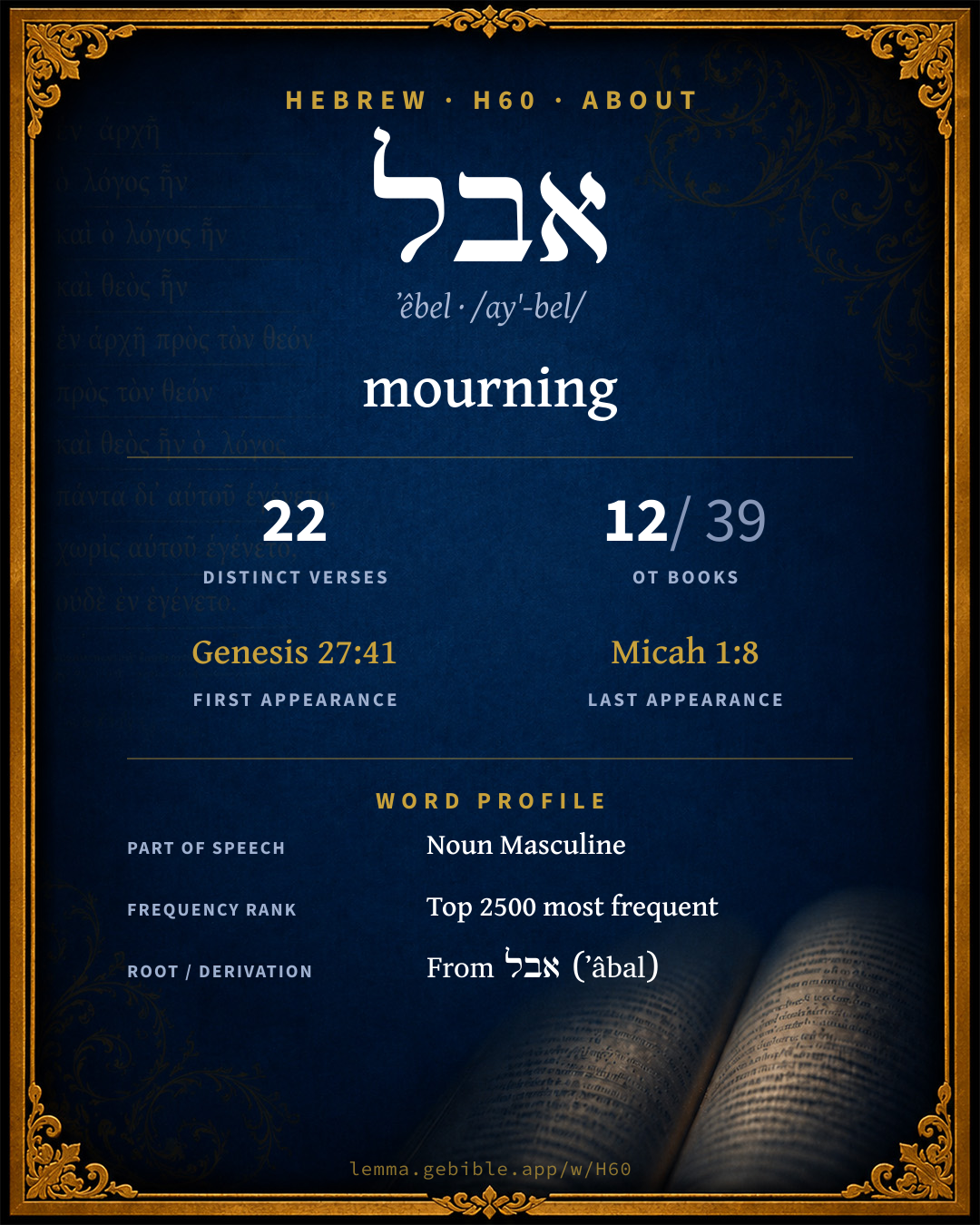
אֵ֫בֶל
mourning
‘mourning’ is one of 5 main senses fuller range ↓
Full lexicon entry — Brown-Driver-Briggs (BDB)
From Brown-Driver-Briggs (BDB)
Where this word appears
See every Absolute-state word in the Hebrew Bible →
Grammar key — what these labels mean
Part of speech
- Noun
- A naming word — a person, place, thing, or idea.
Noun type
- Common
- A common noun — a general class of person, place, or thing (“king,” “city,” “water”), not a specific name.
State
- Absolute
- The independent form of a noun, not bound to a following word.
- Construct
- A noun bound to a following noun in a possessive / “of” relationship (the construct chain).
Gender
- Masculine
- Grammatically masculine.
Number
- Singular
- One.
Grammatical forms
- Noun, Common, Masculine, Singular, Absolute 20 times (83%)
- Noun, Common, Masculine, Singular, Construct 4 times (17%)
Parsed forms decoded from the imported morphology (morphhb / Westminster Leningrad Codex — WLC text public domain, morphhb tagging CC BY 4.0), counted across 24 parsed occurrences — not distinct verses.
Every verse where H60 appears — 22 distinct verses across 12 books. Click any verse to open its interlinear word-by-word view. Verse text shown in the World English Bible for context — . Each verse’s Hebrew form is shown with its reference; the English is not keyword-highlighted, since the data carries no word-level English alignment. Use “Compare translations” on any verse to read it across multiple English versions. This concordance covers the Hebrew Bible; Septuagint (Greek Old Testament) occurrences are not indexed here.
Genesis 3 verses
- Genesis 27:41 אֵ֣בֶל n c ms cs Esau hated Jacob because of the blessing with which his father blessed him. Esau said in his heart, "The days of mourning for my father are at hand. Then I will kill my brother Jacob."
- Genesis 50:10 אֵ֖בֶל n c ms They came to the threshing floor of Atad, which is beyond the Jordan, and there they lamented with a very great and sore lamentation. He mourned for his father seven days.
- Genesis 50:11 הָ/אֵ֗בֶל אֵֽבֶל ptcl def.art + n c ms n c ms When the inhabitants of the land, the Canaanites, saw the mourning in the floor of Atad, they said, "This is a grievous mourning by the Egyptians." Therefore, the name of it was called Abel Mizraim, which is beyond the Jordan.
Deuteronomy 1 verse
2 Samuel 3 verses
- 2 Samuel 11:27 הָ/אֵ֗בֶל ptcl def.art + n c ms When the mourning was past, David sent and took her home to his house, and she became his wife, and bore him a son. But the thing that David had done displeased Yahweh.
- 2 Samuel 14:2 אֵ֗בֶל n c ms Joab sent to Tekoa, and fetched there a wise woman, and said to her, please act like a mourner, and put on mourning clothing, Please, and don't anoint yourself with oil, but be as a woman who has a long time mourned for the dead:
- 2 Samuel 19:2 לְ/אֵ֖בֶל prep + n c ms The victory that day was turned into mourning to all the people; for the people heard say that day, The king grieves for his son.
Esther 2 verses
- Esther 4:3 אֵ֤בֶל n c ms In every province, wherever the king's commandment and his decree came, there was great mourning among the Jews, and fasting, and weeping, and wailing; and many lay in sackcloth and ashes.
- Esther 9:22 וּ/מֵ/אֵ֖בֶל conj + prep + n c ms as the days in which the Jews had rest from their enemies, and the month which was turned to them from sorrow to gladness, and from mourning into a good day; that they should make them days of feasting and gladness, and of sending portions one to another, and gifts to the needy.
Job 1 verse
Ecclesiastes 2 verses
- Ecclesiastes 7:2 אֵ֗בֶל n c ms It is better to go to the house of mourning than to go to the house of feasting: for that is the end of all men, and the living should take this to heart.
- Ecclesiastes 7:4 אֵ֔בֶל n c ms The heart of the wise is in the house of mourning; but the heart of fools is in the house of mirth.
Isaiah 2 verses
- Isaiah 60:20 אֶבְלֵֽ/ךְ n c ms cs + sfx pers 2fs Your sun shall no more go down, neither shall your moon withdraw itself; for Yahweh will be your everlasting light, and the days of your mourning shall be ended.
- Isaiah 61:3 אֵ֔בֶל n c ms to appoint to those who mourn in Zion, to give to them a garland for ashes, the oil of joy for mourning, the garment of praise for the spirit of heaviness; that they may be called trees of righteousness, the planting of Yahweh, that he may be glorified.
Jeremiah 3 verses
- Jeremiah 6:26 אֵ֤בֶל n c ms Daughter of my people, gird you with sackcloth, and wallow yourself in ashes: make you mourning, as for an only son, most bitter lamentation; for the destroyer shall suddenly come on us.
- Jeremiah 16:7 אֵ֖בֶל n c ms neither shall men break [bread] for them in mourning, to comfort them for the dead; neither shall men give them the cup of consolation to drink for their father or for their mother.
- Jeremiah 31:13 אֶבְלָ֤/ם n c ms cs + sfx pers 3mp Then shall the virgin rejoice in the dance, and the young men and the old together; for I will turn their mourning into joy, and will comfort them, and make them rejoice from their sorrow.
Lamentations 1 verse
Ezekiel 1 verse
Amos 2 verses
- Amos 5:16 אֵ֔בֶל n c ms Therefore thus says Yahweh, the God of hosts, the Lord: "Wailing will be in all the broad ways; And they will say in all the streets, 'Alas! Alas!' And they will call the farmer to mourning, And those who are skillful in lamentation to wailing.
- Amos 8:10 לְ/אֵ֗בֶל כְּ/אֵ֣בֶל prep + n c ms prep + n c ms I will turn your feasts into mourning, And all your songs into lamentation; And I will make you wear sackcloth on all your bodies, And baldness on every head. I will make it like the mourning for an only son, And the end of it like a bitter day.
Micah 1 verse
About this entry
At a glance — auto-summarized from this page’s data, not written by a person. Every figure links to its source below. This summary describes the numbers; it doesn’t interpret them.
At its core, אבל (ʼêbel) means “mourning.” Catalogued under 5 senses, its meaning is not single-sense. Spanning 22 verses in 12 books, it ranks among the uncommon words of the Hebrew Bible. Scripture first uses it in Genesis 27:41. From the same root come אבל, אבל and אבל. Each statement above links to its evidence; the full detail follows below.
Gloss history
Strong's 1890 vs modern scholarship
About this word
Strong's H60 catalogs a Hebrew word from the Hebrew Old Testament.
These counts are not copied from any lexicon or concordance. They are computed here, from the morphology-tagged Hebrew Old Testament. What Lemma adds →
- 22
- distinct verses
- The word appears in 22 distinct verses.
- 12 / 39
- OT books
- The word appears in 12 of 39 Old Testament books.
- #1,327
- by frequency
- Top 2500 most frequent Hebrew words (rank 1,327 of 8,640 Hebrew words by occurrence).
View all 22 occurrences in the concordance →
By section of the Old Testament
By traditional corpus
Conventional, traditional groupings — biblical authorship is debated, so this is a traditional corpus grouping, not an authorship claim. Each share is this word’s portion of its verses in that division of the Hebrew canon. Each figure is a share of the word’s 22 distinct verses.
- Prophets (Nevi'im) 12 verses · 55%
- Writings (Ketuvim) 6 verses · 27%
- Torah (Pentateuch) 4 verses · 18%
How translations render this word
Counts come from each version’s own published word-to-Strong’s tagging or interlinear alignment — an approximate guide to how each version renders this word, not a word-level alignment the data otherwise carries. Because each total is that version’s own tagged count, the per-version totals vary from one another and need not match the appearance or distinct-verse counts above. These counts may also differ from a printed concordance because Lemma counts each distinctly tagged rendering and does not collapse phrase taggings into a single head-word total. This is a fixed set of word-tagged versions (KJV, ASV, BSB, ULT) and does not change with the reading translation you choose elsewhere. Each version’s license is shown beside its name below (and on Sources).
- King James Version: Mourning 19×
- American Standard Version: Mourning 18×
- Berean Standard Bible: Mourning 15×, Mourn 5×
- unfoldingWord Literal Text: Mourning 20×
King James Version Public Domain
Renders H60 across 24 tagged occurrences — most commonly:
Plus 5 renderings that appear only once — usually multi-word phrases or single function words the recovered tagging swept in, not distinct renderings.
American Standard Version Public Domain
Renders H60 across 24 tagged occurrences — most commonly:
Plus 6 renderings that appear only once — usually multi-word phrases or single function words the recovered tagging swept in, not distinct renderings.
Berean Standard Bible Public Domain
Renders H60 across 23 tagged occurrences — most commonly:
Plus 3 renderings that appear only once — usually multi-word phrases or single function words the recovered tagging swept in, not distinct renderings. Not rendered by a distinct English word in 1 further occurrence.
unfoldingWord Literal Text CC BY-SA 4.0
Renders H60 across 25 tagged occurrences — most commonly:
Plus 5 renderings that appear only once — usually multi-word phrases or single function words the recovered tagging swept in, not distinct renderings.
Senses in BDB
The 5 senses BDB distinguishes for this word, in lexicon order (not ranked by frequency or importance). The full entry — with sub-senses — is in the Lexicon Entry tab.
- mourning
- for the dead
- for rites of mourning (metaphorically)
- mourning garb
- period of mourning
Word origin
n.m. Gn 50:11 mourning—abs. Gn 50:10 + 17 times; cstr. 27:41 + 3 times; אֶבְלֵךְ Is 60:20; אֶבְלָם Je 31:13—for dead, cstr. Gn 27:41 Dt 34:8 (‖ בּכי) so א׳ יָחִיד sim. for grievous mourning Am 8:10, id. metaph. Je 6:26 (‖ מִסְפַּד תַּמְרוּרִים); Gn 50:11(×2) Je 16:7 cf. 2 S 19:3 עשה א׳ Ez 24:17 (v. Co) sq. לְ Gn 50:10 (v. also ii. אָבֵל ad fin.); for calamity, Est 4:3; 9:22 (‖ יָגוֹן; contr. יוֹם טוֹב) Jb 30:31 (‖ קול בכים) Is 60:20; 61:3 (where appar. = mourning garb, sq. מַעֲטֵה תְהִלָּה, v. also Bi Che on text; ‖ רוּחַ כֵּהָה; contr. שֶׁמֶן שָׂשׂוֹן); Je 31:13 (‖ שׂשׂון), La 5:15 (‖ מָחוֹל), Am 5:16 (‖ מִסְפֵּד); cf. א׳ כִּבְנוֹת יַעֲנָה Mi 1:8; = time, period of mourning 2 S 11:27; בֵּית א׳ Ec 7:2 (‖ בּ׳ מִשְׁתֶּה, v 4 (‖ בּ׳ שִׂמְחָה); בִּגְדֵי א׳ garments of mourning 2 S 14:2.
— Brown-Driver-Briggs (Oxford 1906, public domain), digitized via Sefaria, supplemented by the OpenScriptures HebrewLexicon (CC BY 4.0). See Sources.
Derived from אבל (ʼâbal) (H56) — to mourn.
Jastrow Dictionary
A second Hebrew/Aramaic lexicon for comparison, covering Aramaic and post-biblical (Talmudic, Targumic, Midrashic) usage that the biblical-Hebrew BDB does not. Matched by lemma rather than by Strong’s number, so a lemma may carry more than one Jastrow headword (shown separately below), and the entries cover usage well beyond the Bible.
אֲבָל
- (b. h.)
- 1. indeed, yes. Tosef. Erub. V (IV), 1 אמרו לו א׳ said they to him, yes (we admit). Erub. 30ᵇ top. Nidd. 3ᵇ; a. e.—Gen. R. s. 91 לשון דרומית וכ׳ it is a South Palestine expression where ăbal means bram, v. בְּרַם.
- 2. but, however. Ber. VII, 1; a. v. fr.
אָבֵל I
- (b. h.) pr. n. pl. Abel, name of several towns; cmp. אֲבֵילִין. Erub. 87ᵃ ed. (Ms. M. בבל, corr. acc., Var. lect. v. Rabb. D. S. a. l. note).
אָבֵל II
- , v. אבב; cmp. אפל); [dark, cmp. קֹדֵר], mourner, esp. during seven days after burial. M. Kat. 14ᵇ; a. v. fr.—Pl. אֲבֵלִים, (אֲבֵילִין) אֲבֵילִים. Keth. 8ᵇ; v. בְּרָכָה. Y. Ab. Zar. I, 39ᶜ bot. אֲבֵילֵי גויים mourners among gentiles; a. fr.—Fem. אֲבֵילָה, אֲבֵלָה. Y. Ber. IV, 8ᵃ; Y. Taan. II, 65ᶜ bot.
אָבֵל III
- (foreg.) to mourn. Hithpa. הִתְאַבֵּל, Nithpa. נִתְאַבֵּל to observe mourning ceremonies, to be bound to mourn, be an אָבֵל. M. Kat. 20ᵇ כל שמִתְאַבֵּל עליו מתא׳ עמו over whom one is bound to mourn, with him he must mourn, i.e. one must share in the mourning ceremonies of a relation at whose death he would have to observe mourning; a. fr.—Tanḥ. Sh’mini, 1 נתא׳. Pesik. Sos p. 148ᵇ; a. fr.
אֲבֵל
- Targ. Lam. II, 8.
- (denom. of אֲבֵלָא) to mourn. Targ. Gen. XXXVII, 34; a. fr.—Y. Ab. Zar. I, 39ᶜ top. v. אִימִירָא. Esth. R. beg. כד ילידת הוו מִתְאַבְּלִין when the Empress gave birth, they (the Jews) mourned (it being the Ninth of Ab). B. Kam. 59ᵇ את חשיבא לאִתְאַבּוּלֵי וכ׳ ed. (Ms. R. לאַבּוּלֵי, v. infra) art thou distinguished enough to wear mourning for Jerusalem?
- . Ib. מְאַבֵּילְנָא ed. (Ms. F. מאבלנא, v. Rabb. D. S. a. l., note 6) I wear mourning.
אֵבֶל
- foreg.) mourning; cmp. אֲבֵילוּת. Y. M. Kat. III, 82ᵇ; a. fr.—Pl. אֲבֵילִים. M. Kat. 7ᵇ מי שתכפוהו אֲבֵילָיו he whom his mourning days overtook, i.e. a second case occurring before the mourning days of the first expired.—אֵבֶל רַבָּתִי Ebel Rabbathi (Great Mourning), name of a Talmudic treatise, also named euphemistically שְׂמָחוֹת Rejoicings.—[Chald. Targ. Gen. L, 11; v. אֶבְלָא.]
אֻבָל
- , v. אוּבָל
אוּבָל
- (v. יוּבָל)
- 1. river. Dan. VIII, 2; 3; 6. e.g. Daniel 8:2
- 2. as a pr. n. Ubal (The River). Gen. R. s. 16 (referring to Dan. l. c.) א׳ אוותנטין וכ׳ Ubal is the source of all the other rivers.
A Dictionary of the Targumim, the Talmud Babli and Yerushalmi, and the Midrashic Literature (Marcus Jastrow; London, Luzac, 1903) — Public Domain. Digitized via Sefaria. Digitized via Sefaria. Full attribution on Sources.
Forms in the corpus
The 16 distinct written forms H60 takes in the Hebrew Bible, most frequent first — each parse links to that state’s occurrences in the concordance. Hebrew forms include their vowel points and cantillation, so a single lemma takes many written forms.
Same root — word family
Other BDB entries built from the same root as H60, grouped by Strong’s listed origin. These share a root / origin per the lexicon — not necessarily a shared meaning. Each links to that word’s own entry.
Derives from
Shares the same root
Proper names from this root
People and places named from this root — a name, not an additional meaning of the word.
Compare all same-root words → Showing 4 of 5 — not the complete family. 1 of the same-root words is a proper name (a person or place). They share a root, not necessarily a meaning.
Septuagint verse parallels
This word appears in 22 verses that also exist in the Greek Old Testament (Septuagint), out of the 22 Hebrew verses it occurs in. You can read those verses in Greek by switching the Old Testament edition to the Septuagint.
Read these verses in the Septuagint
- Genesis 27:41
- Deuteronomy 34:8
- 2 Samuel 11:27
- Esther 4:3
- Job 30:31
- Ecclesiastes 7:2
- Isaiah 60:20
- Jeremiah 6:26
- Lamentations 5:15
- Ezekiel 24:17
- Amos 5:16
- Micah 1:8
This is a verse-level parallel only — the same verses exist in both the Hebrew and Greek Old Testaments. No word-level Hebrew↔Greek correspondence is claimed: the data carries no such alignment, so no Greek word is shown as this Hebrew word’s translation. Coverage is not total — the Septuagint omits the deuterocanon and renumbers the Psalms, so some Hebrew verses have no direct Greek parallel.