Ezekiel 25:12

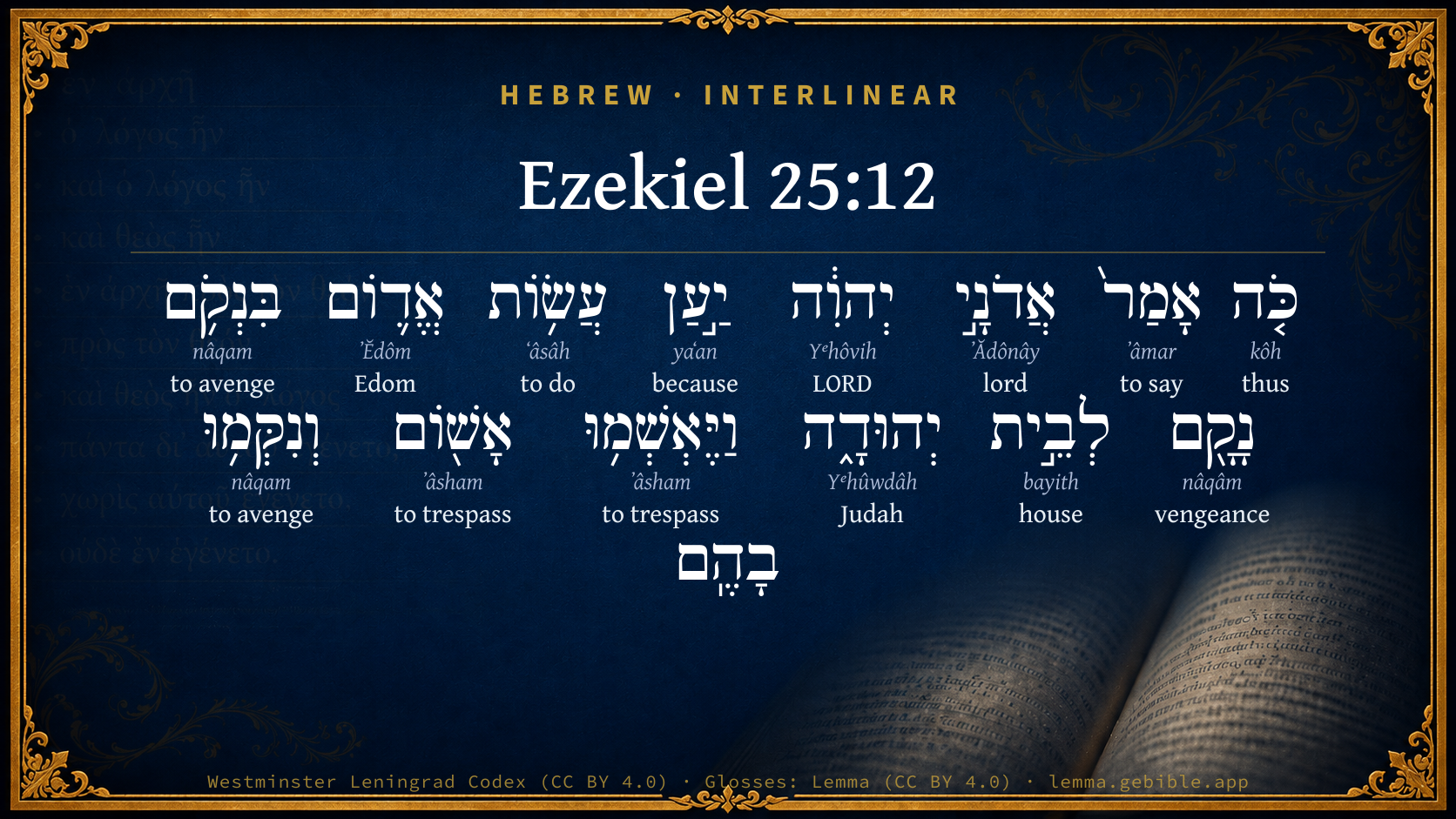
Hebrew (Westminster Leningrad Codex) Ezekiel 25:12 appears in the Hebrew Old Testament. The text above is from the Westminster Leningrad Codex. Each word links to its Strong’s number, a concise gloss, and parsing drawn from the Open Scriptures Hebrew Bible morphology. Click any word for its full Brown-Driver-Briggs (BDB) entry.
Download image
Cite this verse

Ezekiel 25:12 (World English Bible). Public Domain. Lemma interlinear Bible study tool, https://lemma.gebible.app/v/ezekiel/25/12.

Show BibTeX & RIS
BibTeX
RIS
English Translation
Thus says the Lord Yahweh: Because Edom has dealt against the house of Judah by taking vengeance, and has greatly offended, and revenged himself on them;
World English Bible · Public Domain
Download a study sheet

One document with this verse’s original text, its word-by-word gloss line, the meaning frame, cross-references with their text, attributed commentary, and full source and license credits — printable, and it pastes into notes with its structure intact.

This verse Autodidact and up

Study sheet (.html) Plain text (.txt)

A passage Seminary Student

Up to 50 verses in one chapter. A passage sheet keeps up to 6 commentary sources and 12 cross-references per verse, in the order this page ranks them, and says so on the sheet whenever that leaves anything out. Ask for a single verse and you get the Autodidact verse sheet above.

Everything on this page stays free to read, with no account — the sheet is a download of what is already on screen, not access to it.

Want to remove ads? Support Godless Engineer
Compare translations 3

The same verse in 3 English versions, stacked beneath the original-language interlinear above. Click any original word for its lexicon entry.

Each is an independent rendering of the whole verse — the interlinear is not word-aligned to these translations.

Highlighted words mark where these versions differ — a whole-verse word diff, not a word-by-word alignment.

  • World English Bible Public Domain
    Thus says the Lord Yahweh: Because Edom has dealt against the house of Judah by taking vengeance, and has greatly offended, and revenged himself on them;
  • King James Version Public Domain
    Thus saith the Lord GOD; Because that Edom hath dealt against the house of Judah by taking vengeance, and hath greatly offended, and revenged himself upon them;
  • unfoldingWord Literal Text CC BY-SA 4.0
    The Lord Yahweh says this, ‘Edom has taken vengeance against the house of Judah and has committed wrong in doing so.

unfoldingWord Literal Text — © unfoldingWord, licensed CC BY-SA 4.0. Word-aligned USFM3 via Door43 (git.door43.org/unfoldingWord/en_ult).

Versions to compare (up to 4)

3 of 4 selected

Show all 18 translations

Every available English version of this verse, each an independent rendering of the whole verse.

  • World English Bible Public Domain
    Thus says the Lord Yahweh: Because Edom has dealt against the house of Judah by taking vengeance, and has greatly offended, and revenged himself on them;
  • Berean Standard Bible Public Domain
    This is what the Lord GOD says: ‘Because Edom acted vengefully against the house of Judah, and in so doing incurred grievous guilt,
  • Majority Standard Bible Public Domain
    This is what the Lord GOD says: ‘Because Edom acted vengefully against the house of Judah, and in so doing incurred grievous guilt,
  • King James Version Public Domain
    Thus saith the Lord GOD; Because that Edom hath dealt against the house of Judah by taking vengeance, and hath greatly offended, and revenged himself upon them;
  • American Standard Version (1901) Public Domain
    Thus saith the Lord Jehovah: Because that Edom hath dealt against the house of Judah by taking vengeance, and hath greatly offended, and revenged himself upon them;
  • Revised Version (1885) Public Domain
    Thus saith the Lord GOD: Because that Edom hath dealt against the house of Judah by taking vengeance, and hath greatly offended, and revenged himself upon them;
  • Geneva Bible (1599) Public Domain
    Thus sayth the Lord God, Because that Edom hath done euill by taking vengeance vpon the house of Iudah, and hath committed great offence, and reuenged himselfe vpon them,
  • Douay-Rheims (1899) Public Domain
    Thus saith the Lord God: Because Edom hath taken vengeance to revenge herself of the children of Juda, and hath greatly offended, and hath sought revenge of them:
  • Young's Literal Translation Public Domain
    Thus said the Lord Jehovah: Because of the doings of Edom, In taking vengeance on the house of Judah, Yea, they are very guilty, And they have taken vengeance on them.
  • Literal Standard Version CC BY-SA 4.0
    Thus said Lord YHWH: Because of the doings of Edom, || In taking vengeance on the house of Judah, || Indeed, they are very guilty, || And they have taken vengeance on them.
  • Unlocked Literal Bible CC BY-SA 4.0
    The Lord Yahweh says this, 'Edom has taken vengeance against the house of Judah and has committed wrong in doing so.
  • unfoldingWord Literal Text CC BY-SA 4.0
    The Lord Yahweh says this, ‘Edom has taken vengeance against the house of Judah and has committed wrong in doing so.
  • Darby Bible Public Domain
    Thus saith the Lord Jehovah: Because Edom hath dealt against the house of Judah by taking vengeance, and hath made himself very guilty, and revenged himself upon them,
  • World Messianic Bible Public Domain
    “‘The Lord GOD says: “Because Edom has dealt against the house of Judah by taking vengeance, and has greatly offended, and taken revenge on them,”
  • Webster's Bible Public Domain
    Thus saith the Lord GOD; Because Edom hath dealt against the house of Judah by taking vengeance, and hath greatly offended, and revenged himself upon them;
  • Free Bible Version CC BY-SA 4.0
    This is what the Lord God says: Because Edom committed serious sins by taking vicious revenge on the people of Judah,
  • Bible in Basic English Public Domain
    This is what the Lord has said: Because Edom has taken his payment from the people of Judah, and has done great wrong in taking payment from them;
  • JPS Tanakh (1917) Public Domain
    Thus saith the Lord GOD: Because that Edom hath dealt against the house of Judah by taking vengeance, and hath greatly offended, and revenged himself upon them;

Literal Standard Version (2020), Covenant Press — licensed CC BY-SA 4.0. Text via the HelloAO Bible API (eBible.org). Unlocked Literal Bible (unfoldingWord) — licensed CC BY-SA 4.0. Text via the HelloAO Bible API (eBible.org). unfoldingWord Literal Text — © unfoldingWord, licensed CC BY-SA 4.0. Word-aligned USFM3 via Door43 (git.door43.org/unfoldingWord/en_ult). Free Bible Version, Dr. Jonathan Gallagher — licensed CC BY-SA 4.0. Text via the HelloAO Bible API (eBible.org).

Word by word

More ways to search: Search by grammar → Find every occurrence → Compare this word →

Practice this passage: Drill this verse → Learn its vocabulary →

נָקָ֖ם
nâqâm
H5359
“vengeance”
Noun, Common, Masculine, Singular, Absolute
Part of Speech
Noun
Type
Common
Gender
Masculine
Number
Singular
State
Absolute
Full BDB Definition

Origin: from H5358

TWOT: 1413a

vengeance - vengeance (by God, by Samson, by enemies of Judah)
  1. כֹּ֤ה kôh H3541 “thus” Adverb
  2. אָמַר֙ ʼâmar H559 “to say” Verb, Qal, Perfect, 3rd Person, Masculine, Singular
  3. אֲדֹנָ֣י ʼĂdônây H136 “Lord · my” Noun, Common, Masculine, Plural, Construct + Suffix, Personal, 1st Person, Common, Singular
  4. יְהוִ֔ה Yᵉhôvih H3069 “LORD” Noun, Proper
  5. יַ֣עַן yaʻan H3282 “because” Conjunction
  6. עֲשׂ֥וֹת ʻâsâh H6213 “to do” Verb, Qal, Infinitive Construct
  7. אֱד֛וֹם ʼĔdôm H123 “Edom” Noun, Proper
  8. בִּנְקֹ֥ם nâqam H5358 “in/at · to avenge” Preposition + Verb, Qal, Infinitive Construct
  9. לְבֵ֣ית bayith H1004 “to/for · house of” Preposition + Noun, Common, Masculine, Singular, Construct
  10. יְהוּדָ֑ה Yᵉhûwdâh H3063 “Judah” Noun, Proper
  11. וַיֶּאְשְׁמ֥וּ ʼâsham H816 “and · to trespass” Conjunction + Verb, Qal, Sequential Imperfect, 3rd Person, Masculine, Plural
  12. אָשׁ֖וֹם ʼâsham H816 “to trespass” Verb, Qal, Infinitive Absolute
  13. וְנִקְּמ֥וּ nâqam H5358 “and · to avenge” Conjunction + Verb, Niphal, Perfect, 3rd Person, Common, Plural

About this verse

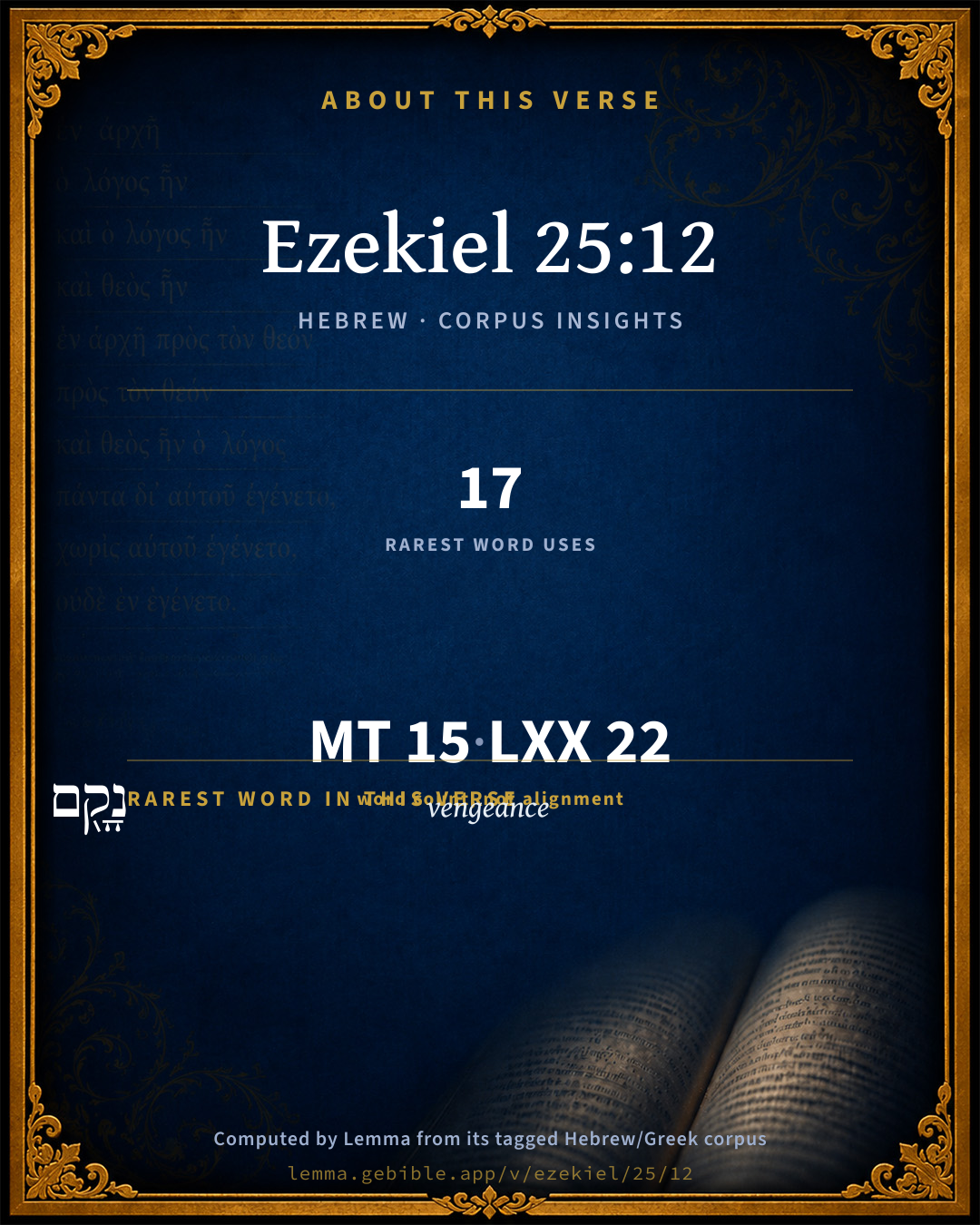
These counts appear in no published source. They are computed here, from the morphology-tagged text and Lemma’s own curated glosses. What Lemma adds →

15
words
12
distinct lemmas
Prophets
section

Notable vocabulary

The rarest word here is נָקָ֖ם vengeance H5359 — appearing just 17 times in the whole Hebrew Bible.

Shared distinctive vocabulary

נָקָ֖ם vengeance H5359 occurs in 17 verses of the Hebrew Bible. Also found in:

Grammatical profile

  • 6 verbs
  • 6 nouns
  • 1 preposition
  • 1 conjunction
  • 1 adverb

Verb forms

  • אָמַר֙ Qal · Perfect
  • עֲשׂ֥וֹת Qal · Infinitive Construct
  • בִּנְקֹ֥ם Qal · Infinitive Construct
  • וַיֶּאְשְׁמ֥וּ Qal · Sequential Imperfect
  • אָשׁ֖וֹם Qal · Infinitive Absolute
  • וְנִקְּמ֥וּ Niphal · Perfect

Repetition

Words recur within this verse — often emphatic in Hebrew:

  • בִּנְקֹ֥ם to avenge H5358 ×2
  • וַיֶּאְשְׁמ֥וּ to trespass H816 ×2

Hebrew & Septuagint length

In English translation the verse runs 26 words from the Hebrew and 30 from the Septuagint (LXX English) — closely comparable.

A rough comparison of the two English renderings, which tokenize alike — not a word-level alignment.

Word counts can differ between the Hebrew and the Greek without any difference in meaning — e.g. the Hebrew direct-object marker אֵת has no separate Greek word, and Greek often adds the article ὁ.

In the original languages it is 15 Hebrew tokens and 22 Greek tokens — but the two are counted differently (Hebrew bundles its prefixes and suffixes into one token; the Greek is in lemma form), so that isn’t a like-for-like length.

Cross-references

8

Topical passages linked to Ezekiel 25:12 in the Treasury of Scripture Knowledge — connected by theme and wording, ordered by reader-vote popularity; previews shown in the World English Bible.

  • Jeremiah 49:7–22 Of Edom. Thus says Yahweh of Hosts: Is wisdom no more in Teman? is counsel perished from the prudent? is their wisdom vanished?
  • Psalms 137:7 Remember, Yahweh, against the children of Edom, The day of Jerusalem; Who said, "Raze it! Raze it even to its foundation!"
  • Ezekiel 25:8 Thus says the Lord Yahweh: Because Moab and Seir say, Behold, the house of Judah is like all the nations;
  • Amos 1:11–12 Thus says Yahweh: "For three transgressions of Edom, yes, for four, I will not turn away its punishment; Because he pursued his brother with the sword, And cast off all pity, And his anger raged continually, And he kept his wrath forever;
  • Obadiah 1:10–16 For the violence done to your brother Jacob, shame will cover you, and you will be cut off forever.
  • Genesis 27:41–42 Esau hated Jacob because of the blessing with which his father blessed him. Esau said in his heart, "The days of mourning for my father are at hand. Then I will kill my brother Jacob."
  • 2 Chronicles 28:17–18 For again the Edomites had come and struck Judah, and carried away captives.
  • Ezekiel 35:1–15 Moreover the word of Yahweh came to me, saying,

Cross-references courtesy of OpenBible.info (CC BY 4.0).

Hebrew and Greek witnesses Masoretic Hebrew ↔ Greek Septuagint

The same verse in the two great witnesses to the Old Testament, shown verse-for-verse.

These are two independent witnesses, not word-aligned to each other, and the Septuagint is shown in lemma (dictionary) form.

Hebrew Ezekiel 25:12 Masoretic · Westminster Leningrad Codex

כֹּ֤ה אָמַר֙ אֲדֹנָ֣י יְהוִ֔ה יַ֣עַן עֲשׂ֥וֹת אֱד֛וֹם בִּנְקֹ֥ם נָקָ֖ם לְבֵ֣ית יְהוּדָ֑ה וַיֶּאְשְׁמ֥וּ אָשׁ֖וֹם וְנִקְּמ֥וּ בָהֶֽם

Thus says the Lord Yahweh: Because Edom has dealt against the house of Judah by taking vengeance, and has greatly offended, and revenged himself on them;

World English Bible · Public Domain

Greek LXX Ezekiel 25:12 Septuagint · lemma form

ὅδε λέγω κύριος ἀντί ὅς ποιέω ὁ ιδουμαία ἐν ὁ ἐκδικέω αὐτός ἐκδίκησις εἰς ὁ οἶκος ιουδα καί μνησικακέω καί ἐκδικέω δίκη

Thus says the Lord; Because of what the Idumeans have done in taking vengeance on the house of Juda, and because they have remembered injuries, and have exacted full recompense;

LXX2012 (modern English Septuagint) · Public Domain

Hebrew: Westminster Leningrad Codex (CC BY 4.0). Greek: Septuagint (public domain); English from LXX2012 (modern English Septuagint) (Public Domain). How the Septuagint differs from the Hebrew →

Targum (Aramaic paraphrase)

1

The Targum is the ancient Jewish Aramaic paraphrase of the Hebrew Scriptures — an interpretive translation, not the Hebrew text itself. Onkelos (literal) and Pseudo-Jonathan (expansive) render the Torah, and Jonathan the Prophets. Coverage is partial: where no permissively-licensed English translation exists for a verse, only the Aramaic is shown. This is verse-level text, not a word-by-word alignment to the Hebrew.

  1. Targum Jonathan Prophets (Joshua–Malachi)
    כִּדְנַן אֲמַר יְיָ אֱלֹהִים חֲלַף דַעֲבַדוּ אֱדוֹמָאֵי בִּתְקוֹף פּוּרְעֲנוּת לְבֵית יְהוּדָה וְחָבוּ חוֹבָא וְאִתְפְּרָעוּ מִנְהוֹן:

    (no public-domain English translation for this verse)

    Targum Jonathan — Aramaic: “Mikraot Gedolot” (public domain). English: “Sefaria Community Translation” (CC0 1.0 (public-domain dedication)); “London "Chaldee Paraphrase," 1871” (public domain). Text via Sefaria.

Commentary

Notes on Ezekiel 25:12 from classic Christian and Jewish commentators (each source and its license shown beneath its notes). The classic Christian expositions comment on the surrounding passage and are grouped to its opening verse, so a note may address several verses; the Jewish commentaries on the Tanakh (Rashi and others) are per-verse, so they appear only where the commentator wrote on this verse.

Lemma curates 59 commentaries, every one of them public domain or Creative Commons licensed, each selected and text-cleaned for this edition rather than reprinted as found. About our sources →

Trapp's Complete Commentary

John Trapp

Eze 25:12 Thus saith the Lord GOD; Because that Edom hath dealt against the house of Judah by taking vengeance, and hath greatly offended, and revenged himself upon them;

Ver. 12. By taking vengeance.] Heb., By revenging revengement; out of a vindictive spirit rejoicing at Judah’s harms, and saying, They were well enough served. See the prophecy of Oba 1:10-16 and Psa 137:7 Their father Esau was of a spiteful spirit, {Gen 27:41} and they took after him, proceeding upon the old score. Hence they are put for God’s and the Church’s enemies by a specialty. {Isa 63:1-6 Joe 3:9-17 Amo 9:1-10} A learned man hath given us this note: Esau signifieth a doer or a worker; Edom, a ruddy, bloody, or earthy man. These Edomites were a type of justiciaries, who will needs be saved by their works and merits. These are the deadliest enemies of God’s people, war upon them continually, seek and suck their blood, and shall at length suffer condign punishment.

And hath greatly offended and revenged himself upon them.] Wishing, as Caligula did by the people of Rome, that they had all but one neck, {a} that he might cut them off at one blow. Plane sunt serpentes, saith Luther concerning hypocrites, quo nullum est animal vindictae cupidius, they are very serpents, than which there is no living creature more revengeful.

{a} ειθ’ ενα αυχενα ειχετε.

John Trapp, A Commentary or Exposition upon All the Books of the Old and New Testament (1647–1656) — public domain. Text from a community e-Sword module.

Joseph Benson's Commentary

Eze 25:12-14. Because that Edom, &c. — “The Idumeans, being the posterity of Esau, bore an ancient grudge against the Jews, upon the account of their ancestor’s losing his right of primogeniture, and the subduing of Edom by David afterward, 2Sa 8:14. Upon both of these accounts they took hold of all opportunities of venting their spite against the Jewish nation: see particularly 2Ch 28:17. For this their behaviour they were in former times reproved by Amo 1:11, and afterward by Obadiah, Eze 25:10, and by Ezekiel, here and Eze 35:5. The ill will that they showed toward them at the time of their captivity was very remarkable, as appears by those pathetical words of Psa 137:7, Remember the children of Edom, O Lord, in the day of Jerusalem, when they said, Down with it, down with it, even to the ground.” I will lay my vengeance upon Edom, by Israel — My people Israel themselves, whom the Edomites have so often insulted, shall be the instruments of my vengeance upon Edom, and shall requite the wrongs they have received by subduing Idumea; this they did under the conduct of Judas Maccabæus. And afterward the high-priest Hyrcanus made an entire conquest of this country: see Prideaux, part 2. p. 307.

Joseph Benson's Commentary on the Old and New Testaments (1811–1818) — public domain. Text from a community e-Sword module.

The Pulpit Commentary

Vers. 12, 13Because that Edom hath dealt against the house of Judah, etc. The statement receives many illustrations, notably in Psa_137:7, and at an earlier date in Amo_1:11; Oba_1:11. What had been malicious exultation (the ejpicairekaki) which Aristotle describes as the extremest type of evil) passed in the case of Edom into overt acts of hostility. The moment of Judah"s weakness was seized on as an opportunity for gratifying what Ezekiel elsewhere (Eze_35:5) calls the "perpetual hatred" of the people against Israel, for taking vengeance for the primal wrong which Esau had suffered at the hand of Jacob. (Gen_27:36) (For other prophecies against Edom, see Num_24:18, Num_24:19; Isa_11:14; Jer_49:7-12; Joe_3:19) Teman. The name, which signifies "South," was probably applied to a district twice, here and in Jer_49:7, Jer_49:8, coupled with Dedan. in Jer_49:20, 21 the cry of the inhabitants of Teman is said to have been "heard in the Red Sea," and this determines its geographical position, as being, in accordance with its name, the southern region of Edom. in Job_2:11 we have Eliphaz the Temanite as one of the patriarch"s friends, and the same name appears as that of a son of Esau. (Gen_36:11) In Jeremiah (loc. cit.) Teman is named as famous for its wisdom. Dedan is named as a grandson of Cash in Gen_10:7, and of Abraham by Keturah in Gen_25:3. It has been inferred from this that there were two branches of the nation, one on the shores of the Persian Gulf, nomadic and trading, as in the "travelling companies" of Dedanim (Isa_21:13; Eze_27:15, Eze_27:20) the other settled in the territory of the Edomites ("Dict. Bible"). The latter is that to which Ezekiel refers. A various punctuation gives, with a better sense, "From Teman even unto Dedan they shall fall by the sword.

Vers. 12-14. The revengeful nation.

The Edomites are characterized as an especially revengeful people, because they watched for their opportunity, and, when the Jews were crushed and prostrate beneath the cruel Chaldean invasion, rushed in to smite their fallen foe.

I THE WICKED REVENGE.

1. Vengeance is presumptuous. There is a right recompense for sin, but this lies with God. "Vengeance is mine; I will repay, saith the Lord". (Rom_12:19) He who seizes the weapons of vengeance usurps the authority of God.

1. Vengeance is cruel. Divine vengeance is a just punishment. There is no vindictive pleasure in it. But human vengeance springs from an evil appetite, that seeks a personal satisfaction in the sufferings of its victim. Such vengeance is distinctly wicked. Indeed, the self-elected minister of vengeance is forced into this dilemma either his vengeance is a delight to him, or it is not. If it is a delight, the joy is wicked, devilish; if it is no delight, why does he practice it, for the plea that he is urged by a sense of public duty is delusive? Directly that becomes the motive, revenge vanishes and punishment takes its place.

2. Vengeance is unchristian. It is to be noted that this vengeful spirit was charged as a great wickedness against the Edomites. They lived in the pre-Christian days, and they were a heathen nation. Much more, then, is revenge sinful in a Christian. We have the clearer New Testament light; we have also the wonderful example of Christ to deter us from revenge. For us to behave as the Edomites is to merit their doom twice over.

3. Vengeance is mean-spirited. Apart from all the above-named considerations, when the question is approached on the lowest ground, vengeance bears a despicable aspect. The Edomites waited till the Chaldean power had overthrown Judah; then they rushed in to complete the destruction. This was behaving like the jackals, who cannot destroy big game, but who are mad to devour the carrion that the lion has left. Revenge knows no honorable laws of war. It has the degraded spirit of the assassin.

II THE NATURAL PUNISHMENT. There is generally a resemblance between sin and its penalty. The punishment is just the fruit of the sin. Thus the vengeful conduct of the Edomites brings vengeance on the head of the vindictive people.

1. Revenge does not end a quarrel. This is the mistake of it. It is foolish and short-sighted, for, in return for its own brief, wild delight, it rouses fresh enmity and provokes retaliation. The too stern treatment of the French by the Germans left a rankling spirit of vengeance in the breasts of the defeated people. The vendetta in Corsica keeps up a feud for generations each member on one side provoking one in return from the other side. Shylock speaks of the mutual vengeance of race-hatred, "if a Jew wrong a Christian, what is his humility? Revenge. If a Christian wrong a Jew, what should his sufferance be by Christian example? Revenge.

2. Revenge provokes the most bitter punishment. This comes from the wronged victim. Judah takes vengeance on Edom. Possibly this happens indirectly through the Chaldean invasion predicted by Jewish prophets, or Jews may have some direct hand in the work. Vengeance makes enemies. This form of self-protection is a fatal failure. The true victory over one"s enemies is by forgiveness, the heaping coals of fire on his head. (Pro_25:21, Pro_25:22)

Vers. 12-14. The hostility add the curse of Edom.

Often in the course of Old Testament history do we meet with references to the inhabitants of Edom, and usually they are exhibited as taking an attitude of hostility towards the chosen people. It is certainly remarkable that Ezekiel, in his Eastern captivity, should concern himself with these border states. But it is evident that he was at the time very deeply impressed with the great principle of national responsibility and national retribution; and that it was revealed to him that this principle had application, not to the Jews alone, but to all the nations of the earth. The Edomites, upon the eastern frontiers of the southern tribes, were often a source of annoyance to the inhabitants of Judah and their neighbors. They were regarded as the foes, not of Israel only, but of Israel"s God. And against them the prophet utters words of reproach and of threatening.

I THE MANIFESTATION OF EDOM"S HOSTILITY AGAINST JUDAH. The attitude of opposition which Edom assumed had an especial character; it was designated "vengeance," "revenge." This implies a standing feud, and the bitterness which is bred of repeated acts of enmity and injustice.

II THE GROUND AND CAUSE OF THIS HOSTILITY. We are not expressly informed upon this point; but we shall not err in assigning this enmity to the repugnance entertained by the Edomites to the religion of Judah, and to the worship and prescribed rites and observances which were so much in conflict with the idolatrous religion professed and practiced by the children of Edom.

III THE GUILT OF THIS HOSTILITY. This is apparent both from the nature of the ease itself, and from the retribution which Divine justice deemed necessary in its chastisement.

IV THE PECULIAR FORM OF PUNISHMENT WITH WHICH EDOM WAS VISITED. This is perhaps the most striking figure in the passage. Retribution was to be wrought upon Edom "by the hand of my people, Israel." The sufferers were the instruments of punishment. The power of Judah may have seemed scarcely adequate to the task. But it was appointed by the King of nations that the Edomites should pay the penalty of sin; and, not only so, but that those whom they had hated and reviled should be the scourge by which the smiters should be smitten. The hand of God"s people Israel was God"s own hand, and, when the Edomites felt it, they knew by bitter experience the righteous vengeance of the Lord. T.

Vers. 12-14. The judgment of Edom; or, the sin and punishment of revenge.

saith the Lord God; Because that Edom hath dealt against the house of Judah by taking vengeance," etc. The Edomites were the descendants of Esau, who settled in Mount Seir immediately after the death of his father Isaac. The country in which they dwelt was called Edom, or Idumaea. It was situated south of the territory of Moab; and "it only embraced the narrow mountainous tract (about a hundred miles long by twenty broad) extending along the eastern side of the Arabah, from the northern end of the gulf of Elath to near the southern end of the Dead Sea." Of their religion little is known; but that they were idolaters appears from 2Ch_25:14, 2Ch_25:15, 2Ch_25:20, and Josephus, "Ant.," 15:7. 9. Consider

I THE HEINOUS SIN OF THE EDOMITES. "Thus saith the Lord God; Because that Edom hath dealt against the house of Judah by taking vengeance, and hath greatly offended, and revenged himself upon them." Notice:

1. The sin itself. Revenge is the sin with which the Edomites are here charged. Distinguish between revenge and vengeance. "Revenge is an act of passion; vengeance, of justice; injuries are revenged, crimes are avenged" (Johnson). Vengeance is righteous, calm, majestic; revenge is wicked, cruel, malignant. The accusation against the Edomites is revenge. Schroder translates, "Because Edom exercises vindictive revenge upon the house of Judah." The hatred of Esau towards his brother Jacob for fraudulently depriving him of his blessing seems to have run down through all his generations. And it was increased by what the Edomites afterwards suffered in conflict with the descendants of Jacob (cf. 1Sa_14:47; 1Ki_11:15, 1Ki_11:16; 2Ch_25:11, 2Ch_25:12) although Hengstenberg says "that Edom brought upon himself, by his own conduct, what he formerly, particularly under David, suffered from Judah. For only on this supposition was the revenge sinful." Revenge was prohibited by the holy Law of God as declared in the Old Testament. (cf. Lev_19:18) And much more so as expressed in the New Testament. (cf. Mat_5:44-48; Rom_12:17, Rom_12:19; Eph_4:31)

2. The manifestation of this sin. Joel, who probably prophesied in the early years of the reign of King Uzziah, predicts that "Edom shall be a desolate wilderness, for the violence done to the children of Judah, because they have shed innocent blood in their land". (Joe_3:19; see also Amo_1:11, Amo_1:12) But probably the reference in our text is chiefly to the action of Edom during the Chaldean invasion of Judaea. "When Nebuchadnezzar besieged Jerusalem, the Edomites joined him, and took an active part in the plunder of the city and slaughter of the poor Jews. Their cruelty at that time seems to be especially referred to in the hundred and thirty-seventh psalm: "Remember, O Lord, the children of Edom in the day of Jerusalem; who said, Raze it, raze it, even to the foundation thereof!" Their conduct at that time is described by the Prophet Obadiah (Vers. 10-14).

3. The aggravations of their sin. They were kinsfolk of Israel and Judah. In joining Nebuchadnezzar against Judah, they were uniting with a foreigner against those who had descended from the same ancestor as themselves. Moreover, in former times the Israelites had made distinctions in their favor. When they marched to the conquest of Canaan, they were commanded not to contend with the Edomites; (Deu_2:4, Deu_2:5) and they observed that command. The Lord also commanded them not to hate the Edomites. (Deu_23:7) Yet the Edomites hated the Jews, and rejoiced in revenging themselves upon them.

II THE RIGHTEOUS RETRIBUTION OF THE SIN OF THE EDOMITES. "Therefore thus saith the Lord God; I will also stretch out mine hand upon Edom, and will cut off man and beast from it," etc. (Vers. 13, 14).

1. The judgment inflicted. Two chief elements of it are mentioned by the prophet slaughter by the sword, and the laying waste of the land. It is also intimated that the judgment should, pass over the whole land. "And I will make it desolate from Teman; even unto Dedan shall they fall by the sword." Or, as some would punctuate, "From Teman even unto Dedan they shall fall by the sword." Teman was a district in the south of Edom, and Dedan was in the north; so that "from Teman unto Dedan" signifies over the entire country. Not in one event alone may we trace the fulfillment of this prediction, but in several. In the time of the Maccabees, Judas the Maccabee slew more than forty thousand Edomites. (RAPC 1Ma 5:3 2Ma 10:15-23) About thirty years afterwards, John Hyrcanus turned his forces against Edom, completely subdued the country, and compelled the people to submit to circumcision and to conform to the Jewish religion, or to suffer expatriation. And they were so desirous of remaining in the country of their forefathers, that they yielded to his conditions, and, as Josephus says, "they were hereafter no other than Jews" (Josephus, "Ant.," 13:9. 1). So complete was their incorporation with the Jews "that the name of Idumaea appears no more in history as a separate kingdom." As Schroder remarks, "The vengeance of God could not in a more marked retribution manifest itself upon Edom than by the extirpation of his nationality, and that precisely in the form of an absorption by Israel." The desolation of the land was at length accomplished by the Mohammedans. "In the seventh century," says Dr. J. L. Porter, "the Mohammedan conquest gave a deathblow to the commerce and prosperity of Edom. Under the withering influence of Mohammedan rule, the great cities fell to ruin, and the country became a desert. The followers of the false prophet were here, as elsewhere, the instruments, in God"s hands, for the execution of his judgments." And so "the Edom of prophecy Edom considered as the enemy of God and the rival of Israel has perished for ever: all, in that respect, is an untrodden wilderness, a hopeless ruin; and therein the veracity of God"s Word finds its verification.

2. The instruments for the infliction of the judgment. "I will lay my vengeance upon Edom by the hand of my people Israel," etc.; "And the house of Jacob shall be a fire, and the house of Joseph a flame, and the house of Esau for stubble," etc.. (Oba_1:18) The prophecy points to Judas the Maccabee and his army, and yet more to John Hyreanus, who completely subjugated the country of Edom, and annihilated the nationality of the Edomites.

3. The retributory character of the judgment. Because that Edom hath dealt against the house of Judah by taking vengeance, and hath greatly offended, and revenged himself upon them; therefore thus saith the Lord God... I will lay my vengeance upon Edom by the hand of my people Israel, and they shall know my vengeance, saith the Lord God." The Edomites inflicted vindictive revenge upon the Jews; and for so doing they must suffer the vengeance of the Lord Jehovah. "Revenge for revenge." "The Lord is a God of recompenses; he shall surely requite". (Jer_51:56)

CONCLUSION. Our subject addresses to us:

1. Warning against estrangement or want of love amongst relatives. When kinsfolk or former friends become hostile to each other, they are much more embittered than strangers in a similar condition. "A brother offended is harder to be won than a strong city: and such contentions are like the bars of a castle"; (Pro_18:19) "Love one another with a pure heart fervently.

2. Warning against encouraging any feeling of revenge. Such feelings turn the heart which entertains them into a hell; and the entertainment of them awakens the stern displeasure of the Most High. Our Lord says," Love your enemies, and pray for them that persecute you," etc.. (Mat_5:44, Mat_5:45) And St. Paul writes, "Bender to no man evil for evil... Avenge not yourselves, beloved, but give place unto wrath," etc.. W.J. (Rom_12:17, Rom_12:19-21)

The Pulpit Commentary (1880–1919), ed. H.D.M. Spence-Jones & Joseph S. Exell — public domain. Text from a community e-Sword module.

Keil & Delitzsch

C. F. Keil & F. Delitzsch

Against the Edomites

Eze 25:12. Thus saith the Lord Jehovah, Because Edom acteth revengefully towards the house of Judah, and hath been very guilty in avenging itself upon them, Eze 25:13. Therefore, thus saith the Lord Jehovah, I will stretch out my hand over Edom, and cut off man and beast from it, and make it a desert from Teman, and unto Dedan they shall fall by the sword. Eze 25:14. And I will inflict my vengeance upon Edom by the hand of my people Israel, that they may do to Edom according to my anger and my wrath; and they shall experience my vengeance, is the saying of the Lord Jehovah. - Whilst the Ammonites and the Moabites are charged with nothing more than malicious pleasure at the fall of Israel, and disregard of its divine calling, the Edomites are reproached with revengeful acts of hostility towards the house of Judah, and threatened with extermination in consequence. The עשׂות, doing or acting of Edom, is more precisely defined as 'בּנקום וגו, i.e., as consisting in the taking of vengeance, and designated as very guilty, ישׁמוּ אשׁום. עשׂה, followed by בּ with an infinitive, as in Eze 17:17. Edom had sought every opportunity of acting thus revengefully towards Israel (vid., Oba 1:11; Amo 1:11), so that in Eze 35:5 Ezekiel speaks of the "eternal enmity" of Edom against Israel. For this reason we must not restrict the reproach in Eze 25:12 to particular outbreaks of this revenge at the time of the devastation and destruction of Judah by the Chaldeans, of which the Psalmist complains in Psa 137:1-9, and for which he invokes the vengeance of God upon Edom. Man and beast are to be cut off from Edom in consequence, and the land to become a desert from Teman to Dedan. These names denote not cities, but districts. Teman is the southern portion of Idumaea (see the comm. on Amo 1:12); and Dedan is therefore the northern district. Dedan is probably not the Cushite tribe mentioned in Gen 10:7, but the tribe of the same name which sprang from the sons of Abraham by Keturah (Gen 25:3), and which is also mentioned in Jer 49:8 in connection with Edom. דּדנה has ה local with Seghol instead of Kametz, probably on account of the preceding a (vid., Ewald, 216c). There is no necessity to connect מתּימן with the following clause, as Hitzig and Kliefoth have done, in opposition to the accents. The two geographical names, which are used as a periphrasis for Idumaea as a whole, are distributed equally through the parallelismus membrorum between the two clauses of the sentence, so that they belong to both clauses, so far as the sense is concerned. Edom is to become a desert from Teman to Dedan, and its inhabitants from Teman to Dedan are to fall by the sword. This judgment of vengeance will be executed by God through His people Israel. The fulfilment of this threat, no doubt, commenced with the subjugation of the Edomites by the Maccabees; but it is not to be limited to that event, as Rosenmller, Kliefoth, and others suppose, although the foundation was thereby laid for the disappearance of the national existence of Edom. For it is impossible with this limitation to do justice to the emphatic expression, "my people Israel." On the ground, therefore, of the prophecies in Amo 9:12 and Oba 1:17, that the people of God are to take possession of Edom, when the fallen tabernacle of David is raised up again, i.e., in the Messianic times, which prophecies point back to that of Balaam in Num 24:18, and have their roots, as this also has, in the promise of God concerning the twin sons of Isaac, "the elder shall serve the younger" (Gen 25:23), we must seek for the complete fulfilment in the victories of the people of God over all their foes, among whom Edom from time immemorial had taken the leading place, at the time when the kingdom of God is perfected. For even here Edom is not introduced merely as a single nation that was peculiarly hostile to Judah, but also as a type of the implacable enmity of the heathen world towards the people and kingdom of God, as in Eze 35:1-15, Isa. 34:63, etc. The vengeance, answering to the anger and wrath of Jehovah, which Israel, as the people of God, is to execute upon Edom, consists not merely in the annihilation of the national existence of Edom, which John Hyrcanus carried into effect by compelling the subjugated Edomites to adopt circumcision (see the comm. on Num 24:18), but chiefly in the wrathful judgment which Israel will execute in the person of Christ upon the arch-enemy of the kingdom of God by its complete extinction.

Keil & Delitzsch — Biblical Commentary on the Old Testament (1861–1891) — public domain (CC PDM 1.0). Text via the HelloAO Bible API. (Old Testament only.)

Fairbairn on Ezekiel, Jonah & the Pastoral Epistles

Patrick Fairbairn

III. The judgment of Edom (Eze 25:12-14).

Eze 25:12. Thus saith the Lord Jehovah, Because of the doing of Edom in wreaking revenge on the house of Judah, and they have made themselves very guilty, and have dealt revengefully against them;

Eze 25:13. Therefore, thus saith the Lord Jehovah, I also stretch out my hand upon Edom, and I cut off from it man and beast; and I will make it desolate from Teman (in the south) to Dedan (in the west); (The accents are manifestly wrong here, as the to Dedan is required after from Teman to complete the sense. Our translators, by following them, have confused the meaning of the passage.) they shall fall by the sword.

Eze 25:14. And I will lay my vengeance upon Edom by the hand of my people Israel; and they shall do in Edom according to my anger, and according to my fury; and they shall know my vengeance, saith the Lord Jehovah.

Here, as in the prophets generally, the specific sin charged against Edom is not that simply of hatred or opposition to the covenant-people, but of deep, brooding, implacable vengeance. It was the hereditary spirit of wickedness which descended from their father Esau, who could not forgive his brother Jacob for getting precedence in regard to the blessing, but nursed for many a year his deadly purpose of revenge. It yielded at last to the unexpected and extraordinary kindness of Jacob, accompanied by the blessing of him with whom Jacob wrestled to the dawning of the day; and the two brothers appear to have spent their latter days in peace and amity. When Israel, however, grew to be a great people under God’s fostering care in Egypt, and marched, with his mighty power on their side, to take possession of the land of Canaan, the old spirit revived in the posterity of Esau. They could not bear to see the younger branch rising to the pre-eminence in rank and glory, which they thought belonged of right to themselves. And thenceforth every opportunity was seized to wreak their vengeance on the children of Israel—for the most part only to draw down a deeper humiliation upon themselves, and never more than with a partial and temporary triumph—till the great period of the Babylonian conquest, when, with the fall of Jerusalem, they supposed that their object was for ever gained. So intense then was their spirit of malignity, that they are represented as not merely taking part with the Babylonians in the last catastrophe, but even as hounding on these ruthless conquerors to consummate the work of destruction, and watching along the byways to cut off the poor fugitives who fled from the presence of the enemy to seek an asylum in other lands, (Comp. especially Psalms 137; Amo 1:11; Oba 1:11)

Neither the vengeful spite of Edom, however, nor the might of the Babylonian conqueror, could defeat the purposes of God; and according to the Divine word, it proved that though Israel was sore broken and depressed by these calamities, he was not destroyed. Edom’s malicious joy was but of short continuance; for he had the mortification of seeing his old enemy return to occupy the former habitation, and from comparatively small beginnings rise again to the position of a formidable power. The children of Edom had meanwhile been moving northwards (having been themselves gradually dispossessed in the south by the Nabathseans), and occupied the territory of Judah as far as Hebron. But this greater proximity to the seed of Israel, and partial encroachment on their possessions, only paved the way for their utter extinction as a nation; for after many hostile encounters between the two races, the Edomites were finally subdued by John Hyrcanus, who compelled them to be circumcised, that they might be incorporated with the Jewish people. The amalgamation of course could only take place gradually; but the circumstance of the Herodian family, who were of Idumean origin, reigning as Jews over the entire region occupied by the two races, is abundant proof that it had been substantially effected about the commencement of the Christian era. From that time they ceased to be known as a distinct people, and shared partly in the fortunes of the Jews and partly in those of the neighbouring Arab population.

In this external subjection of Edom to the power and dominion of Israel, there was a certain measure of fulfilment given to the word: “I lay my vengeance upon Edom by the hand of my people;” a word which clearly pointed to the original promise, “The older shall serve the younger,” and virtually declared that still God’s purpose should stand Israel is the divinely constituted governor of Edom. But it is only in a certain limited and imperfect measure that we see in such external victories and forced compliances the fulfilment of this and similar predictions. These were but the shadow and symbol of what should be accomplished, when in Israel the characteristic of the “my people” came to be fully realized—when they rose, in Christ and the New Testament Church, to be the head of all authority and power and dominion in the world. Viewed in respect to that elevated position, all Edomite rivalry and spite, all carnal opposition and counter-dominion, is doomed to give way, for, in Christ, Israel is governor among the nations; all must serve him, and the nation which does not serve him must perish. So that there is what may be called a twofold revenge. There is first the noble revenge, of which Jacob’s victory over Esau, by means of prayer and personal kindness, was the type—the revenge that melts enmity into love, and overcomes evil with good; or, according to the process described by Obadiah, “deliverance arising first on Mount Zion,” and then “saviours coming up there to judge the mount of Esau,” making Esau’s offspring partakers in Jacob’s blessing, whereby both alike became members of that kingdom which is the Lord’s (Oba 1:17, Oba 1:21). But in so far as this blessed result fails, in so far as Edom still retains the old hatred, and refuses to bow the neck to the yoke of Jesus, then there inevitably comes the vengeance of deserved and final destruction—a vengeance executed no longer in human passion or for selfish aggrandizement, but, as here expressed, in full accordance with the Lord’s mind and purpose, “according to his anger and fury.”

This mode of understanding the prophecy satisfies to the full all its requirements, for on both sides it brings the matter into connection with the perfect adjustments of God’s kingdom in Christ; but we are at a loss to see how it can otherwise meet with any adequate fulfilment. For since it speaks of the Edomites as a people, and these have long since ceased to be a people, the work of complete and perfect retribution it announces must either have taken effect in the manner now described, or it never can be accomplished. The people being gone, no changes upon the land they once occupied can satisfy the conditions of the prophecy.

Patrick Fairbairn — An Exposition of Ezekiel (1851), Jonah (1849), and The Pastoral Epistles (1874) — public domain. Text from a community e-Sword module.

Scofield Reference Notes

C. I. Scofield

Edom

Eze 25:12-14, (See Scofield "Gen 36:1").

The Scofield Reference Bible (1917 edition), notes by C. I. Scofield — public domain. Text from a community e-Sword module.

F. W. Grant's Numerical Bible

Section 2 (Eze 25:12-14).

Edom the unbrotherly enemy; the Lord’s vengeance for his vengeance.

The judgment passes on to Edom, the typical enemy of Israel, who, according to what we have seen of it elsewhere, presents to us the world of the old man, as we may say -the natural fallen man -the most real enemy we have as Christians; none the less so for being akin to us all naturally, even as Edom was the unbrotherly brother of Israel. His enmity is characterized here as revenge. He had, as we know, a quarrel from the beginning -the primal loss of his birthright-blessing, his sale of which, for a mess of pottage, has passed out of his memory. Nothing is stated here as to the cause of his enmity, which is indeed inherent in his nature. The old man has had a quarrel with Cod from the beginning; having turned his back upon Him, and so lost paradise, he counts against God the evils of the place in which he finds himself now, which is indeed very much a wilderness, a "rugged" place, such as Seir was for Edom, according to its name. Yet he has acquired wisdom in it, the wisdom gathered from experience: "Necessity is the mother of invention," as the proverb says; and fallen man has sought out many inventions.

Teman, spoken of here, was noted for the wisdom of its inhabitants. It means "the right hand," which, according to Scripture usage, was the south, and as this, has many significant implications. The right hand is the place of dependence, yet of honor: it was the place of Reuben in the wilderness, and we may remember that he also was a first-born who had lost his birthright place, and yet found blessing in the loss itself. Typically he is the man of faith, essentially dependent, yet finding abundant resources in God who is for him -the refuge always of the destitute. This Reuben thus learns a wisdom of his own, the wisdom of faith; and in this way, as the book of Numbers shows us, falls heir to Sihon, the king of Heshbon, which he possesses and builds up afresh. The story has been told elsewhere. (See Notes, Num 32:1-42.) Heshbon means "device," and it is faith that restores the reason in man to its natural, dependent place, to find how much blessing in it! Teman’s wisdom is dependent also, necessarily; it is Edomite, not Israelite -a fleshly dependence, therefore. He has no faith in God to keep him steady, to give him fixed points to reason from; he is born into a world where he must receive largely from others, inheriting the thoughts of men, fallible, in fact, often deceived, sinful, and capable of deception. Yet men pride themselves upon this godless wisdom, which so often assumes the name of science, though in its wilful ignorance of God it is necessarily ignorant of the sources and origin of all things.

And here we find another name in the prophecy which seems to have a relation and adds significance to all this. Dedan is given as meaning "progress" -the watchword of the day, we might say; but which, after all, has doubt thrown upon it, in its derivation from a word which means not exactly to go forward, but rather to go softly or slowly. Slow enough indeed has been man’s progress through all these centuries of his possession of the earth, although the pace may be quicker now through the multiplication of experiences and experiments which he has been able to make. He has been variously assisted along the road, and by nothing so much as by the divine revelation which has lighted up every place in which it has shone, which he, nevertheless, is seeking to discredit as "unscientific." Discarding this, however, his science must necessarily lose knowledge of the beginning, and is unable to look onward to the end. Put human wisdom right, let it not be esteemed as opposed to faith, let faith not be thought unreasonable, but rather the highest character of reason, and then indeed we might see splendid work, with nature yielding its resources -spite of the fall yielding true blessings, in the bounty of God, which still it witnesses.

Stranger than this unbrotherly strife between Edom and Israel is that which is seen between the men of nature and the men of God. Yet it will continue, if we read Scripture aright, and Ezekiel’s prophecy should throw light upon it and make us aware of what is coming. For power will assuredly put down those whom grace has not subdued; and if neither the witness of Scripture nor of nature have a right effect upon this pride of human wisdom, God Himself must interfere. There is nothing left but for Him to come in in necessary judgment. In the case of Edom, as given here, Israel will be God’s instrument in this; for we know by the voice of prophecy everywhere that to Israel is given the inheritance of the earth, and through the seed of Abraham alone shall all the families of the earth be blessed. The gospel will not effect what men are looking for from it -though it does take out from the earth a people for heaven; but He to whom will be given the heathen for His inheritance, and the uttermost parts of the earth for His possession, will surely rule over the nations with a rod of iron, and as the vessels of a potter shatter them to pieces. This, and Israel’s part in it, we find abundantly in the prophets elsewhere, but it is not the place here to take it up. (See Jer 51:20; Jer 51:23; Isa 11:14, etc.)

F. W. Grant, The Numerical Bible (4th ed., 1903) — public domain. Text from a community e-Sword module.

Tyndale Open Study Notes

Tyndale Open Resources

25:12-14 Ammon and Moab gloated at Judah’s downfall, but Edom actively participated in it (see 35:5; Obad 1). • avenging: The people of Edom cut down fugitives and handed over survivors in aid of the Babylonians (Obad 1:11-14). They were opportunists, settling old scores that dated back to the ancient conflict between Jacob and Esau (Gen 27:41); they gained what they could for themselves out of Judah’s difficulties. In return, the Lord would desolate their land.

Tyndale Open Study Notes — © Tyndale Open Resources, licensed CC BY-SA 4.0. Text via the HelloAO Bible API.

Jamieson, Fausset & Brown

Robert Jamieson, A. R. Fausset & David Brown

taking vengeance--literally, "revenging with revengement," that is, the most unrelenting vengeance. It was not simple hatred, but deep-brooding, implacable revenge. The grudge of Edom or Esau was originally for Jacob's robbing him of Isaac's blessing (Gen 25:23; Gen 27:27-41). This purpose of revenge yielded to the extraordinary kindness of Jacob, through the blessing of Him with whom Jacob wrestled in prayer; but it was revived as an hereditary grudge in the posterity of Esau when they saw the younger branch rising to the pre-eminence which they thought of right belonged to themselves. More recently, for David's subjugation of Edom to Israel (Sa2 8:14). They therefore gave vent to their spite by joining the Chaldeans in destroying Jerusalem (Psa 137:7; Lam 4:22; Oba 1:10-14), and then intercepting and killing the fugitive Jews (Amo 1:11) and occupying part of the Jewish land as far as Hebron.

Jamieson, Fausset & Brown — Commentary Critical and Explanatory on the Whole Bible (1871) — public domain (CC PDM 1.0). Text via the HelloAO Bible API.

Adam Clarke's Commentary

Verse 12. Because that Edom hath dealt] The Edomites were the most inveterate enemies of the Jews from the very earliest times, and ever did all that they could to annoy them.

Adam Clarke's Commentary on the Bible (1810–1826) — public domain. Text from a community e-Sword/MySword module.

Ellicott's Commentary for English Readers

(12) Edom hath dealt against the house of Judah.—The reason of Edom’s hostility to Israel is expressly said to be revenge. Descended from the elder son, they had never looked complacently on the spiritual superiority given to the descendants of the younger. They showed their hostility from the first in refusing, with a show of violence, a passage to the Israelites through their territory (Num_20:18-21); and although they were subdued and made tributary under David and Solomon (2Sa_8:14; 1Ki_9:26), yet in the decline of the Jewish power they availed themselves of every opportunity for hostility (2Ch_28:17, &c). At this time they not only joined the armies of Nebuchadnezzar, but appear to have urged on the conqueror to greater cruelty, and to have themselves waylaid the fugitives to cut them off (Eze_35:5; Psa_137:7; Amo_1:11; Oba_1:11). They also, during the Captivity, took possession of many towns of Judea, including Hebron (Jos., Antt., xii. 8, § 6; B. J., 4:9, § 7), which were re-conquered in the time of the Maccabees. Other prophecies against Edom may be found in Num_24:18-19; Isa_11:14; Jer_49:7-12; Joe_3:19, besides the extended prophecy of Ezekiel in Ezekiel 35.

A Bible Commentary for English Readers, edited by Charles John Ellicott (1878–1897) — public domain. Text from a community e-Sword module.

The Cambridge Bible for Schools and Colleges

gen. ed. J. J. S. Perowne

12. hath greatly offended] Israel as the people of the true God was inviolable (Jer_2:3), except when Jehovah employed the nations to chastise it. Too often the nations exceeded their commission, cherishing purposes of their own (Isa_10:6 seq.), and themselves incurred guilt by their excess (Isa_47:6; Zec_1:15).

12–14. Prophecy against Edom

The relations of Edom to Israel were changeful. Subdued by David it shook off the yoke under Jehoram (2Ki_8:20). Reconquered by Amaziah and Uzziah (2Ki_14:7; 2Ki_14:22), it rebelled under Ahaz (2Ki_16:6; 2Ch_28:17), and from this time was probably independent. Edomites seem to have taken part in the capture of Jerusalem by the Chaldeans, or at least to have been active in cutting off the fugitives (Ob. Eze_25:10-14), and for their part in this they incurred the lasting hatred of Israel (Obad., Lam_4:21; Isa_34:5 seq., Isa_63:1-6; Joe_3:19; Psa_137:7; Mal_1:2. Cf. Jer_49:7 seq.). During the exile the Edomites took possession of part of the land of Israel (Eze_35:10); and in the time of the Maccabean war of independence, like the Ammonites, they shewed their hereditary enmity to Israel (1Ma_5:3; 1Ma_5:35). John Hyrcanus finally subdued them and incorporated them in the state of Israel. Ultimately, like Moab and Ammon, the name of Edom disappears from history, all the three peoples being known by the general name of Arabs,—Children of the East—as Ezek. had prophesied.

The Cambridge Bible for Schools and Colleges (gen. ed. J. J. S. Perowne; Cambridge University Press, 1878–1918) — public domain. Text from a community e-Sword module.

John Gill's Exposition

Thus saith the Lord God,.... Concerning Seir or the Edomites, the prophecy concerning the Moabites being finished:

because that Edom hath dealt against the house of Judah by taking vengeance: or, "revenging a revenge" (w); the Edomites bore an old grudge against the Jews, not only because their father Jacob had got the birthright and blessing from their father Esau; but because they were made tributaries to them in David's time, and afterwards severely chastised by Amaziah; these things they laid up in their minds, and vowed revenge whenever they had an opportunity; and now one offered at the destruction of Jerusalem, which they took:

and hath greatly offended, and revenged himself upon them: not only by rejoicing at the destruction of the Jews, but by encouraging the Babylonians in it; assisting them therein, joining with them in plundering the city, and in cutting off those with the sword who endeavoured to make their escape; see Psa 137:7.

(w) "in ulciscendo ultionem", Montanus, Starckius.

John Gill's Exposition of the Whole Bible (1746–1763) — public domain (CC PDM 1.0). Text via the HelloAO Bible API.

Albert Barnes' Notes on the Bible

Edom, so named from Esau, consisted of various tribes enumerated in Gen. 36. The Edomites became a powerful nation before the Israelites came out of Egypt. David conquered them, but in the reign of Joram they rebelled and were not again subdued 2Ki 8:20. Under the name of Idumea the land was conquered by John Hyrcanus (compare Eze 25:14), when many of the people adopted the religion of the Jews. In later times the Idumean Herod became king of Palestine, reckoning himself as a Jew. Mount Seir, deserted by its original inhabitants, was occupied by a tribe of Arabians (the Nabatheans), under whelm Petra rose and continued a flourishing city under Roman dominion, until the tide of Mahometan conquest brought it to that ruin in which Edom at last found the complete fulfillment of the prophecies uttered against it Eze 35:1-15.

Taking vengeance - Referring to the wrong done by Jacob to Esau Gen 27:36.

Albert Barnes' Notes on the Bible (1834–1885) — public domain. Text from a community e-Sword/MySword module.

Haydock's Catholic Bible Commentary

Revenge; exhorting the Chaldeans to destroy utterly, (Psalm cxxxvi. 7.) and seizing every opportunity of injuring the Jews, 2 Paralipomenon xxviii. 18., and Amos i. 11.

George Leo Haydock (1774–1849), Haydock's Catholic Family Bible and Commentary, 1859 edition — public domain. Excludes Psalms (Douay-Rheims chapter numbering differs from Protestant) and Deuterocanonical books (Catholic canon only).

Matthew Poole's English Annotations

Edom; the Idumeans, children of Esau.

The house of Judah; the kingdom of David after the division of the tribes, when but two remained constant to the house of David.

By taking vengeance for the old quarrel, because Jacob got the blessing from Esau, or rather in revenging a later quarrel, which they had against Judah for the slaughter, spoil, and captivity they suffered by David’s conquering sword.

Hath greatly offended; both in the thing itself, for vengeance belongs to God; and in the manner and measures of executing it, as appears both from Psa 137:7, and the prophecy of Oba 1:10-15, which see, and consider.

Matthew Poole's English Annotations on the Holy Bible (1683–1685) — public domain. Text from a community e-Sword/MySword module.

Whedon's Commentary on the Bible

Daniel D. Whedon

12. Edom — The Edomites (Assyrian, Udumu) were a Semitic race closely related to the Hebrews, whose law required them to be loved as a “brother” and given special temple privileges (Deu_23:7-8). The name, according to Sayce, means “red skins,” which would separate them from the fairer Hebrews and Amorites. They had conquered a strip of country about Mount Seir (Deu_2:22), and were a very powerful nation until conquered by Ramman-Nirari (806-797 B.C.). They, like their brothers, the Israelites, had adopted the “language of Canaan,” and though their libraries have not yet been discovered, some scholars think traces of their literature may be seen in the lists of Edomite princes (Genesis 36), and perhaps also in Job and the Proverbs of Lemuel. Notwithstanding their close relationship, Edom and Israel were frequently at war (2Ki_8:20; 2Ki_14:7; 2Ki_14:22; 2Ki_16:6; 2Ch_28:17). These sons of Esau had “hatred of old” (Eze_35:5) for the sons of Jacob, and exulted with great joy when Jerusalem was destroyed by the Chaldeans, perhaps assisting in the city’s overthrow (Joe_3:19; <19D707>Psa_137:7; Amo_1:11; Oba_1:11). During the Maccabean war they continued hostile to the Jews. “Ultimately, like Moab and Ammon, the name of Edom disappears from history, all the three peoples being known by the general name of Arabs — children of the East — as Ezekiel had prophesied.” — Davidson.

Daniel D. Whedon (gen. ed.), Commentary on the Old and New Testaments (1874–1909) — public domain. Text from a community e-Sword module.

Kretzmann's Popular Commentary

Paul E. Kretzmann

Against Idumea and Philistia

v. 12. Thus saith the Lord God, Because that Edom, whose people were direct descendants of Jacob’s brother Esau, hath dealt against the house of Judah by taking vengeance, or, "by exercising vindictive revenge," and hath greatly offended, heaping guilt upon itself, and revenged himself upon them, still smarting under the feeling of having been cheated of the right of the first-born, Cf Gen 27:41,

v. 13. therefore thus saith the Lord God, I will also stretch out Mine hand upon Edom, in a stern and comprehensive punishment, and will cut off man and beast from it, in a general destruction; and I will make it desolate from Teman, the southernmost part of the country; and they of Dedan, of the northern section of the country, shall fall by the sword, that is, the entire land would become subject to the punishment of the Lord.

v. 14. And I will lay My vengeance upon Edom by the hand of My people Israel, not only in a physical subjection brought about at the time of the Maccabees, but also in the more complete conquest in the Messianic times, when at least some of the inhabitants of this country bowed down before the true God; and they shall do in Edom, in its physical subjection, according to Mine anger and according to My fury; and they shall know My vengeance, saith the Lord God, the manner in which he takes revenge upon such as will not bow down to his rule.

v. 15. Thus saith the Lord God, Because the Philistines, Judah’s neighbors to the southwest, along the shores of the Mediterranean Sea, have dealt by revenge, in vindictive malice, and have taken vengeance with a despiteful heart, in a perpetual war of spite, to destroy it for the old hatred, on account of the enmity which reached back into the earliest history of the relations between the two nations,

v. 16. therefore thus saith the Lord God, Behold, I will stretch out Mine hand upon the Philistines, and I will cut off the Cherethims, another name for the Philistines on account of their Cretan descent, and destroy the remnant of the seacoast. Cf Amo 1:8; Isa 14:30; Jer 47:4.

v. 17. And I will execute great vengeance upon them with furious rebukes, or, "in punishments of fury"; and they shall know that I am the Lord when I shall lay My vengeance upon them, forcing them to concede the unlimited range of His power, so that they would have to confess, even though most unwillingly, that lie alone is the true God.

Paul E. Kretzmann, Popular Commentary of the Bible (1921–1924) — public domain. Text from a community e-Sword module.

unfoldingWord translationNotes

Door43 World Missions Community

Edom has taken

Here "Edom" refers to the people who live there. AT: "The people of Edom have taken" (See: Metonymy)

the house of Judah

The word "house" is a metonym for the family that lives in the house, in this case the descendants of Judah over many years. See how you translated these words in Ezekiel 3:1. AT: "the Judah people group" or "the people of Judah" (See: Metonymy)

I will strike Edom with my hand

Here Yahweh speaks of punishing the people as if he were literally hitting them with his hand. See how you translated a similar phrase in Ezekiel 25:7. AT: "I will punish Edom" (See: Metaphor)

I will make them ... from Teman to Dedan

"I will make all of Edom ... from Teman to Dedan." These are two cities at opposite ends of Edom. This means that Yahweh will destroy all of Edom. (See: How to Translate Names)

They will fall by the sword

The word "fall" represents being killed and the word "sword" refers to their enemies who will kill them in battle. AT: "Their enemies will kill them with their swords" (See: Metonymy)

translationWords

Lord Yahweh

avenge

hand

sword

unfoldingWord translationNotes — © Distant Shores Media and the Door43 World Missions Community, licensed CC BY-SA 4.0. Source: git.door43.org/Door43/en_tn.

Lesson kit

Teaching starters — assembled from the data on this page, not authored interpretation. Every prompt links to the verse data it draws on. Edit before teaching.

Ezekiel, in the Prophets, opens this verse with 15 words (12 distinct Hebrew lemmas). Its most distinctive word is nâqâm (“vengeance”). A historical commentator’s framing appears above. Read the whole chapter for the surrounding context.

Discussion questions

  1. What does “vengeance” (nâqâm) contribute to the verse as a whole?
  2. How does Leviticus 26:25, which shares the word «vengeance», read alongside this verse?
  3. What does the repetition of “to avenge” (2× in this one verse) do in this verse?
  4. These translations render this verse differently; the difference is in the English rendering, not the original. What questions does that raise?
  5. «אָמַר֙» is a Qal Perfect verb. How does that grammatical form shape the action described?
  6. Compare how Trapp's Complete Commentary and Joseph Benson's Commentary read this verse. Where do they agree or differ?

Things to notice

Reading settings

Reading text

Shown beneath each verse's original-language words.

Old Testament
Old Testament edition

Read the OT as the Masoretic Hebrew (MT) or the Greek Septuagint (LXX).

English shown for the Greek Septuagint (in the Hebrew ↔ Greek comparison).

Comparing translations? Open the Compare panel on any verse page to stack up to four side by side.