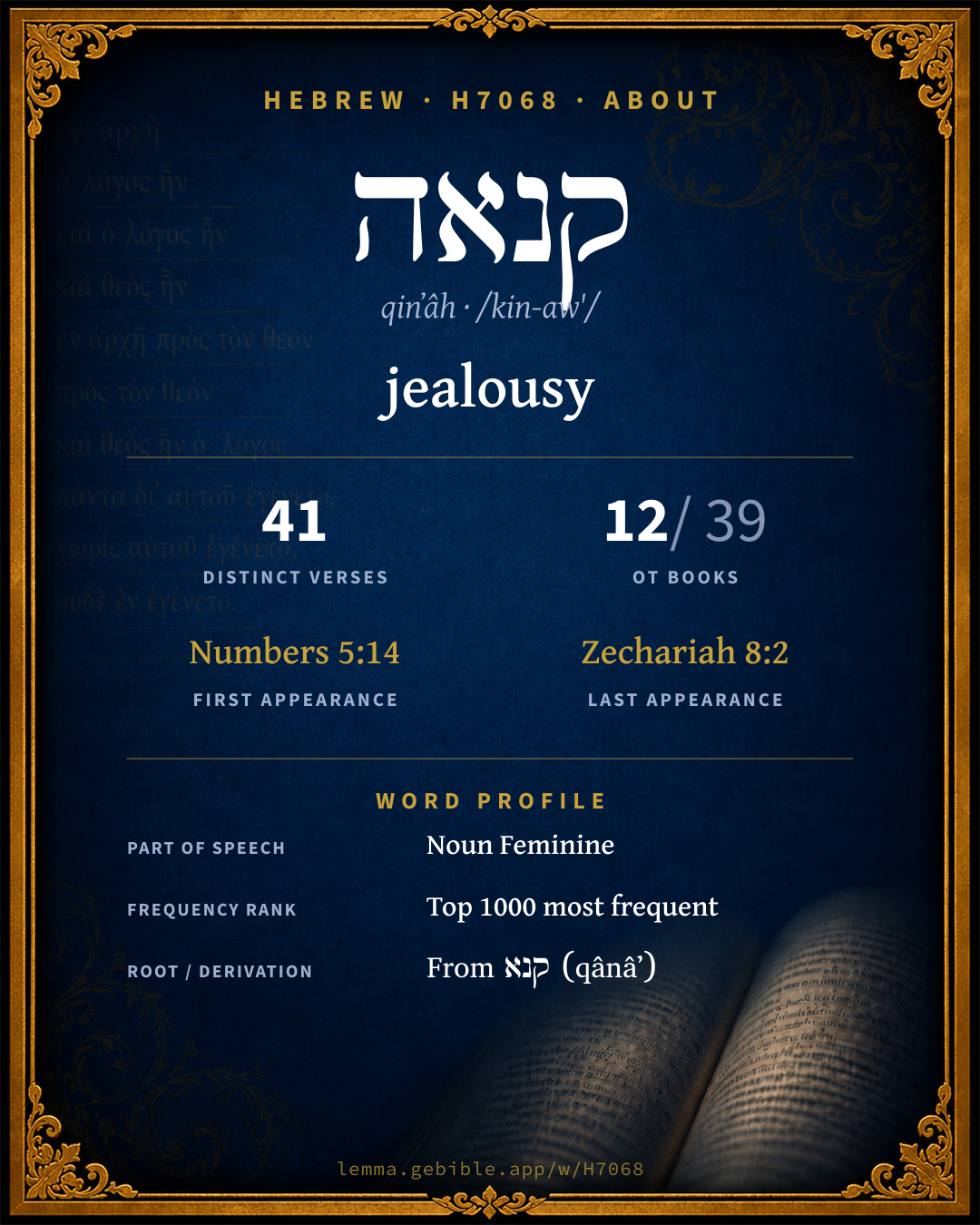
קִנְאָה
jealousy
also: ardour, zeal fuller range ↓
Full lexicon entry — Brown-Driver-Briggs (BDB)
From Brown-Driver-Briggs (BDB)
Where this word appears
See every Construct-state word in the Hebrew Bible →
Grammar key — what these labels mean
Part of speech
- Noun
- A naming word — a person, place, thing, or idea.
Noun type
- Common
- A common noun — a general class of person, place, or thing (“king,” “city,” “water”), not a specific name.
State
- Absolute
- The independent form of a noun, not bound to a following word.
- Construct
- A noun bound to a following noun in a possessive / “of” relationship (the construct chain).
Gender
- Feminine
- Grammatically feminine.
Number
- Singular
- One.
- Plural
- More than one (in Hebrew, generally three or more).
Grammatical forms
- Noun, Common, Feminine, Singular, Construct 24 times (56%)
- Noun, Common, Feminine, Singular, Absolute 15 times (35%)
- Noun, Common, Feminine, Plural, Absolute 4 times (9%)
Parsed forms decoded from the imported morphology (morphhb / Westminster Leningrad Codex — WLC text public domain, morphhb tagging CC BY 4.0), counted across 43 parsed occurrences — not distinct verses.
Every verse where H7068 appears — 41 distinct verses across 12 books. Click any verse to open its interlinear word-by-word view. Verse text shown in the World English Bible for context — . Each verse’s Hebrew form is shown with its reference; the English is not keyword-highlighted, since the data carries no word-level English alignment. Use “Compare translations” on any verse to read it across multiple English versions. This concordance covers the Hebrew Bible; Septuagint (Greek Old Testament) occurrences are not indexed here.
Numbers 7 verses
- Numbers 5:14 קִנְאָ֛ה קִנְאָה֙ n c fs n c fs and the spirit of jealousy comes on him, and he is jealous of his wife, and she is defiled: or if the spirit of jealousy comes on him, and he is jealous of his wife, and she isn't defiled:
- Numbers 5:15 קְנָאֹת֙ n c fp then the man shall bring his wife to the priest, and shall bring her offering for her: the tenth part of an ephah of barley meal. He shall pour no oil on it, nor put frankincense on it, for it is a meal offering of jealousy, a meal offering of memorial, bringing iniquity to memory.
- Numbers 5:18 קְנָאֹ֖ת n c fp The priest shall set the woman before Yahweh, and let the hair of the woman's head go loose, and put the meal offering of memorial in her hands, which is the meal offering of jealousy. The priest shall have in his hand the water of bitterness that brings a curse.
- Numbers 5:25 הַ/קְּנָאֹ֑ת ptcl def.art + n c fp The priest shall take the meal offering of jealousy out of the woman's hand, and shall wave the meal offering before Yahweh, and bring it to the altar.
- Numbers 5:29 הַ/קְּנָאֹ֑ת ptcl def.art + n c fp "This is the law of jealousy, when a wife, being under her husband, goes astray, and is defiled;
- Numbers 5:30 קִנְאָ֖ה n c fs or when the spirit of jealousy comes on a man, and he is jealous of his wife; then he shall set the woman before Yahweh, and the priest shall execute on her all this law.
- Numbers 25:11 קִנְאָתִ֖/י בְּ/קִנְאָתִֽ/י n c fs cs + sfx pers 1cs prep + n c fs cs + sfx pers 1cs Phinehas, the son of Eleazar, the son of Aaron the priest, has turned my wrath away from the children of Israel, in that he was jealous with my jealousy among them, so that I didn't consume the children of Israel in my jealousy.
Deuteronomy 1 verse
2 Kings 2 verses
- 2 Kings 10:16 בְּ/קִנְאָתִ֣/י prep + n c fs cs + sfx pers 1cs He said, Come with me, and see my zeal for Yahweh. So they made him ride in his chariot.
- 2 Kings 19:31 קִנְאַ֛ת n c fs cs For out of Jerusalem shall go forth a remnant, and out of Mount Zion those who shall escape: the zeal of Yahweh shall perform this.
Job 1 verse
Psalms 3 verses
- Psalms 69:9 קִנְאַ֣ת n c fs cs For the zeal of your house consumes me. The reproaches of those who reproach you have fallen on me.
- Psalms 79:5 קִנְאָתֶֽ/ךָ n c fs cs + sfx pers 2ms How long, Yahweh? Will you be angry forever? Will your jealousy burn like fire?
- Psalms 119:139 קִנְאָתִ֑/י n c fs cs + sfx pers 1cs My zeal wears me out, Because my enemies ignore your words.
Proverbs 3 verses
- Proverbs 6:34 קִנְאָ֥ה n c fs For jealousy arouses the fury of the husband. He won't spare in the day of vengeance.
- Proverbs 14:30 קִנְאָֽה n c fs The life of the body is a heart at peace, But envy rots the bones.
- Proverbs 27:4 קִנְאָֽה n c fs Wrath is cruel, And anger is overwhelming; But who is able to stand before jealousy?
Ecclesiastes 2 verses
- Ecclesiastes 4:4 קִנְאַת n c fs cs Then I saw all the labor and achievement that is the envy of a man's neighbor. This also is vanity and a striving after wind.
- Ecclesiastes 9:6 קִנְאָתָ֖/ם n c fs cs + sfx pers 3mp Also their love, their hatred, and their envy has perished long ago; neither have they any more a portion forever in anything that is done under the sun.
Song of Solomon 1 verse
Isaiah 7 verses
- Isaiah 9:7 קִנְאַ֛ת n c fs cs Of the increase of his government and of peace there shall be no end, on the throne of David, and on his kingdom, to establish it, and to uphold it with justice and with righteousness from henceforth even forever. The zeal of Yahweh of Hosts will perform this.
- Isaiah 11:13 קִנְאַ֣ת n c fs cs The envy also of Ephraim shall depart, and those who vex Judah shall be cut off: Ephraim shall not envy Judah, and Judah shall not vex Ephraim.
- Isaiah 26:11 קִנְאַת n c fs cs Yahweh, your hand is lifted up, yet they don't see: but they shall see [your] zeal for the people, and be disappointed; yes, fire shall devour your adversaries.
- Isaiah 37:32 קִנְאַ֛ת n c fs cs For out of Jerusalem shall go forth a remnant, and out of Mount Zion those who shall escape. The zeal of Yahweh of Hosts will perform this.
- Isaiah 42:13 קִנְאָ֑ה n c fs Yahweh will go forth as a mighty man; he will stir up [his] zeal like a man of war: he will cry, yes, he will shout aloud; he will do mightily against his enemies.
- Isaiah 59:17 קִנְאָֽה n c fs He put on righteousness as a breastplate, and a helmet of salvation on his head; and he put on garments of vengeance for clothing, and was clad with zeal as a mantle.
- Isaiah 63:15 קִנְאָֽתְ/ךָ֙ n c fs cs + sfx pers 2ms Look down from heaven, and see from the habitation of your holiness and of your glory: where are your zeal and your mighty acts? the yearning of your heart and your compassion is restrained toward me.
Ezekiel 10 verses
- Ezekiel 5:13 בְּ/קִנְאָתִ֔/י prep + n c fs cs + sfx pers 1cs Thus shall my anger be accomplished, and I will cause my wrath toward them to rest, and I shall be comforted; and they shall know that I, Yahweh, have spoken in my zeal, when I have accomplished my wrath on them.
- Ezekiel 8:3 הַ/קִּנְאָ֥ה ptcl def.art + n c fs He put forth the form of a hand, and took me by a lock of my head; and the Spirit lifted me up between earth and the sky, and brought me in the visions of God to Jerusalem, to the door of the gate of the inner [court] that looks toward the north; where was the seat of the image of jealousy, which provokes to jealousy.
- Ezekiel 8:5 הַ/קִּנְאָ֥ה ptcl def.art + n c fs Then said he to me, Son of man, lift up your eyes now the way toward the north. So I lifted up my eyes the way toward the north, and see, northward of the gate of the altar this image of jealousy in the entry.
- Ezekiel 16:38 וְ/קִנְאָֽה conj + n c fs I will judge you, as women who break wedlock and shed blood are judged; and I will bring on you the blood of wrath and jealousy.
- Ezekiel 16:42 קִנְאָתִ֖/י n c fs cs + sfx pers 1cs So will I cause my wrath toward you to rest, and my jealousy shall depart from you, and I will be quiet, and will be no more angry.
- Ezekiel 23:25 קִנְאָתִ֜/י n c fs cs + sfx pers 1cs I will set my jealousy against you, and they shall deal with you in fury; they shall take away your nose and your ears; and your residue shall fall by the sword: they shall take your sons and your daughters; and your residue shall be devoured by the fire.
- Ezekiel 35:11 וּ/כְ/קִנְאָ֣תְ/ךָ֔ conj + prep + n c fs cs + sfx pers 2ms therefore, as I live, says the Lord Yahweh, I will do according to your anger, and according to your envy which you have shown out of your hatred against them; and I will make myself known among them, when I shall judge you.
- Ezekiel 36:5 קִנְאָתִ֥/י n c fs cs + sfx pers 1cs therefore thus says the Lord Yahweh: Surely in the fire of my jealousy have I spoken against the residue of the nations, and against all Edom, that have appointed my land to themselves for a possession with the joy of all their heart, with despite of soul, to cast it out for a prey.
- Ezekiel 36:6 בְ/קִנְאָתִ֤/י prep + n c fs cs + sfx pers 1cs Therefore prophesy concerning the land of Israel, and tell the mountains and to the hills, to the watercourses and to the valleys, Thus says the Lord Yahweh: Behold, I have spoken in my jealousy and in my wrath, because you have borne the shame of the nations:
- Ezekiel 38:19 וּ/בְ/קִנְאָתִ֥/י conj + prep + n c fs cs + sfx pers 1cs For in my jealousy and in the fire of my wrath have I spoken, Surely in that day there shall be a great shaking in the land of Israel;
Zephaniah 2 verses
- Zephaniah 1:18 קִנְאָת֔/וֹ n c fs cs + sfx pers 3ms Neither their silver nor their gold will be able to deliver them in the day of Yahweh's wrath, but the whole land will be devoured by the fire of his jealousy; for he will make an end, yes, a terrible end, of all those who dwell in the land.
- Zephaniah 3:8 קִנְאָתִ֔/י n c fs cs + sfx pers 1cs "Therefore wait for me," says Yahweh, "until the day that I rise up to the prey, for my determination is to gather the nations, that I may assemble the kingdoms, to pour on them my indignation, even all my fierce anger, for all the earth will be devoured with the fire of my jealousy.
Zechariah 2 verses
- Zechariah 1:14 קִנְאָ֥ה n c fs So the angel who talked with me said to me, "Proclaim, saying, 'Thus says Yahweh of Hosts: "I am jealous for Jerusalem and for Zion with a great jealousy.
- Zechariah 8:2 קִנְאָ֣ה n c fs Thus says Yahweh of Hosts: "I am jealous for Zion with great jealousy, and I am jealous for her with great wrath."
About this entry
At a glance — auto-summarized from this page’s data, not written by a person. Every figure links to its source below. This summary describes the numbers; it doesn’t interpret them.
At its core, קנאה (qinʼâh) means “jealousy.” Beyond its headline sense, its full sense range takes in “ardour” and “zeal”. With 41 verses in 12 books, it is a moderately common word in the Hebrew Bible. Scripture first uses it in Numbers 5:14. Sharing its root, it stands alongside קנא and קנא. Each statement above links to its evidence; the full detail follows below.
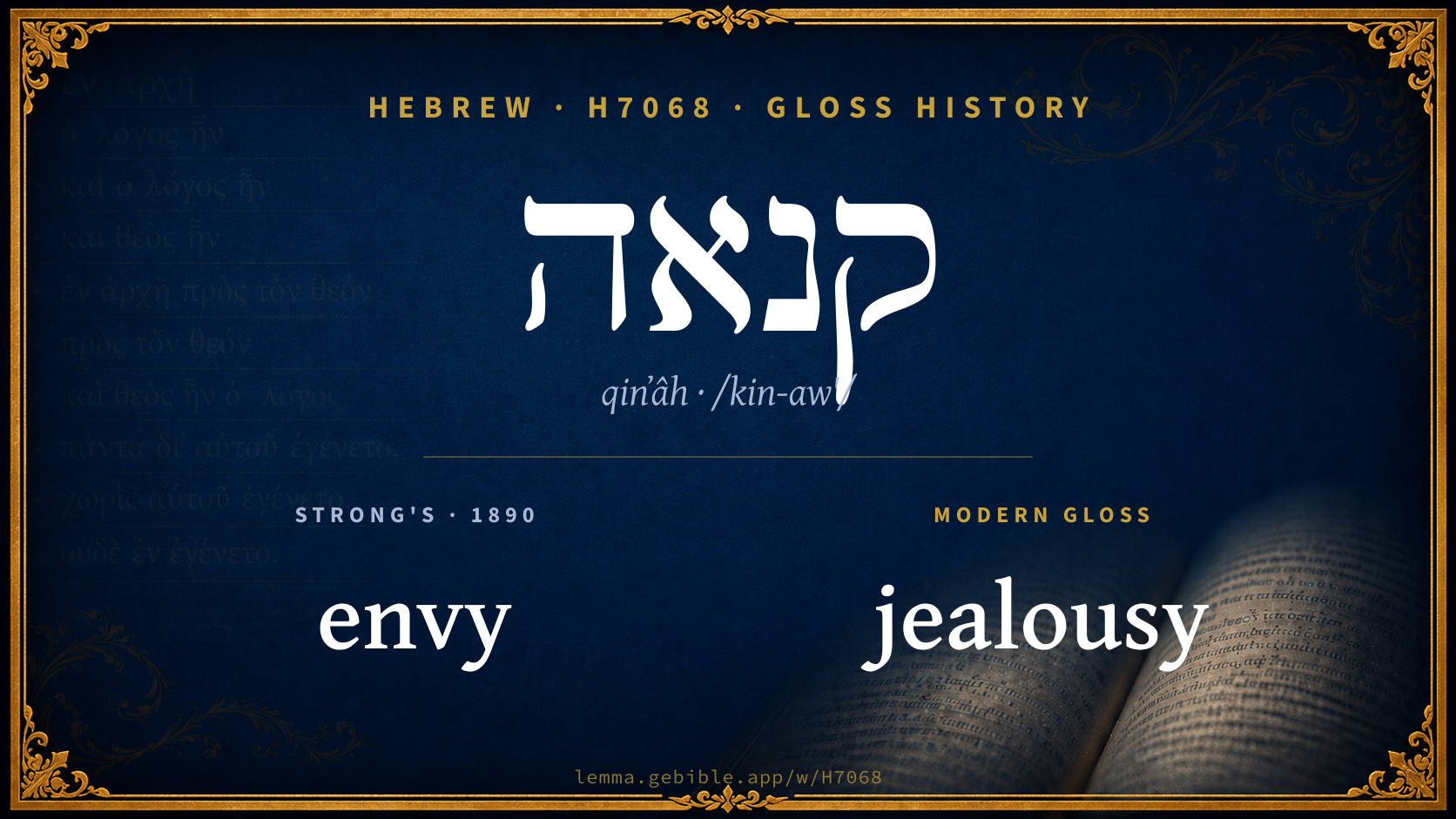
Gloss history
Strong's 1890 vs modern scholarship
About this word
Strong's H7068 catalogs a Hebrew word from the Hebrew Old Testament.
These counts are not copied from any lexicon or concordance. They are computed here, from the morphology-tagged Hebrew Old Testament. What Lemma adds →
- 41
- distinct verses
- The word appears in 41 distinct verses.
- 12 / 39
- OT books
- The word appears in 12 of 39 Old Testament books.
- #837
- by frequency
- Top 1000 most frequent Hebrew words (rank 837 of 8,640 Hebrew words by occurrence).
View all 41 occurrences in the concordance →
By section of the Old Testament
By traditional corpus
Conventional, traditional groupings — biblical authorship is debated, so this is a traditional corpus grouping, not an authorship claim. Each share is this word’s portion of its verses in that division of the Hebrew canon. Each figure is a share of the word’s 41 distinct verses.
- Prophets (Nevi'im) 23 verses · 56%
- Writings (Ketuvim) 10 verses · 24%
- Torah (Pentateuch) 8 verses · 20%
How translations render this word
Counts come from each version’s own published word-to-Strong’s tagging or interlinear alignment — an approximate guide to how each version renders this word, not a word-level alignment the data otherwise carries. Because each total is that version’s own tagged count, the per-version totals vary from one another and need not match the appearance or distinct-verse counts above. These counts may also differ from a printed concordance because Lemma counts each distinctly tagged rendering and does not collapse phrase taggings into a single head-word total. This is a fixed set of word-tagged versions (KJV, ASV, BSB, ULT) and does not change with the reading translation you choose elsewhere. Each version’s license is shown beside its name below (and on Sources).
- King James Version: Jealousy 22×, Zeal 8×, Envy 6×
- American Standard Version: Jealousy 24×, Zeal 8×, Envy 3×
- Berean Standard Bible: Jealousy 19×, Zeal 15×, Envy 4×
- unfoldingWord Literal Text: Jealousy 17×, Zeal 9×, Zeal of 4×
King James Version Public Domain
Renders H7068 across 43 tagged occurrences — most commonly:
Plus 7 renderings that appear only once — usually multi-word phrases or single function words the recovered tagging swept in, not distinct renderings.
American Standard Version Public Domain
Renders H7068 across 43 tagged occurrences — most commonly:
Plus 8 renderings that appear only once — usually multi-word phrases or single function words the recovered tagging swept in, not distinct renderings.
Berean Standard Bible Public Domain
Renders H7068 across 41 tagged occurrences — most commonly:
Plus 3 renderings that appear only once — usually multi-word phrases or single function words the recovered tagging swept in, not distinct renderings. Not rendered by a distinct English word in 2 further occurrences.
unfoldingWord Literal Text CC BY-SA 4.0
Renders H7068 across 44 tagged occurrences — most commonly:
Plus 11 renderings that appear only once — usually multi-word phrases or single function words the recovered tagging swept in, not distinct renderings.
7 senses and sub-senses in the full BDB
What do BDB’s symbols mean?
BDB uses these scholarly abbreviations:
| Symbol | Meaning |
|---|---|
| 𝔊 | the Septuagint (the ancient Greek translation, LXX) |
| 𝔙 | the Vulgate (the Latin translation) |
| 𝔖 | the Syriac version (the Peshitta) |
| 𝔗 | the Targum (the Aramaic translation) |
| ψ | the Psalms |
| √ | root (the underlying root or stem) |
| ‖ | parallel passage (a synonymous or contrasted parallel) |
| † | the dagger: every passage where the word occurs is cited |
The 7 senses and sub-senses the full Brown-Driver-Briggs lexicon distinguishes for this word, in lexicon order (not ranked by frequency), with BDB’s own verbatim wording and sub-sense lettering. Shown in Hebrew script with BDB’s own scholarly abbreviations. The condensed entry is in the Lexicon Entry tab. See also the Forms in the corpus table below.
- 1. ardour of jealousy of husband Pr 6:34; 27:4; רוּחַ ק׳ jealous disposition Nu 5:14(×2), 30 (P); offering for jealousy, מנחת ק׳ v 15, 18, 25 (P); תּוֹרַת הק׳ v 29 (P); of rivalry Ec 4:4; 9:6; Ephr. against Judah Is 11:13; ardent love, ‖ אהבה Ct 8:6. e.g. Proverbs 6:34
- 2. ardour of zeal:
- a. of men for God Nu 25:11(×2) (P) 2 K 10:16; for the house of י׳ ψ 69:10. e.g. Numbers 25:11
- b. of God for his people, especially in battle Is 42:13; 63:15 Zc 1:14; 8:2; מְעִיל ק׳ Is 59:17; ק׳ י׳ תעשׂה זאת 9:6; 37:32 = 2 K 19:31. e.g. Isaiah 42:13
- 3. ardour of anger:
- a. of men against foes Ez 35:11 ψ 119:139; Jb 5:2 (‖ כעשׂ), Pr 14:30 (opp. לֵב מַרְפֵּא). e.g. Ezekiel 35:11
- b. of God against men, ‖ חֵמָה Ez 5:13; 16:38, 42; 23:25; 36:6; ‖ עֶבְרָה 38:19; ‖ אַף Dt 29:19; + אֵשׁ Is 26:11; Ez 36:5; Zp 1:18; 3:8 ψ 79:5; סֵמֶל הַק׳ הַמַּקְנֶה Ez 8:3 the anger-image provoking to anger; ס׳ הק׳ alone v 5. e.g. Ezekiel 5:13
Senses from the full Brown-Driver-Briggs lexicon (Brown, Driver, Briggs; Oxford 1906 — public domain), digitized via Sefaria, supplemented by the OpenScriptures HebrewLexicon (CC BY 4.0). Full attribution on Sources.
Word origin
n.f. ardour, zeal, jealousy (from colour produced in face by deep emotion);—abs. ק׳ Nu 5:14 +; cstr. קִנְאַת Is 9:6; sf. קִנְאָתִי Nu 25:11 +, etc.; pl. קְנָאֹת Nu 5:15, 18, 25, 29;—
— Brown-Driver-Briggs (Oxford 1906, public domain), digitized via Sefaria, supplemented by the OpenScriptures HebrewLexicon (CC BY 4.0). See Sources.
Derived from קנא (qânâʼ) (H7065) — to envy.
Jastrow Dictionary
A second Hebrew/Aramaic lexicon for comparison, covering Aramaic and post-biblical (Talmudic, Targumic, Midrashic) usage that the biblical-Hebrew BDB does not. Matched by lemma rather than by Strong’s number, so a lemma may carry more than one Jastrow headword (shown separately below), and the entries cover usage well beyond the Bible.
קִנְאָה
- jealousy, envy, passion; emulation, zeal. Ab. IV, 21 הק׳ והתאוה וכ׳ jealousy, lust, and ambition carry man out of the world (v. יָצָא). B. Bath. 21ᵃ; 22ᵃ קִנְאַת סופרים וכ׳ emulation among scholars increases wisdom. Meg. 7ᵃ ק׳ את מעוררת עלינו וכ׳ thou wilt arouse the envy of the nations against us. Gitt. 7ᵃ (play on קינה וכ׳, Josh. XV, 22) כל מי שיש לו ק̇' … וד̇ומ̇ס שוכן ע̇ד̇י ע̇ד̇ וכ׳ if a man has cause for anger against a fellowman and keeps silence, he who is enthroned for evermore will do justice to him. Sot. 2ᵇ (expl. קִינּוּי) דבר המטיל ק׳ וכ׳ something which causes ill feeling between her and others (the witnesses that tell); המטיל ק׳ בינו לבינה which causes ill feeling between himself (the husband) and her. Ber. 33ᵇ מטיל ק׳ במעשה וכ׳ he causes jealousy among the works of creation (intimating that God’s love of his creatures is partial). Sabb. 89ᵃ ק׳ יש ביניכם is there envy among you (the angels, that you must be warned not to commit murder &c.)? B. Kam. 82ᵃ מכניס … את הק׳ causes love to enter (into man’s heart) and ill-will to escape; a. fr.—Pl. קְנָאוֹת. Num. R. s. 9; a. e. e.g. Joshua 15:22
קִנְאָה ²
- Targ. Num. V, 14, sq.; ib. 18 (Y. ed. Vien. קִנְאֵיתִי, corr. acc.). Targ. Y. Deut. V, 9. Targ. Prov. XXVII, 4; a. fr.—Sot. 2ᵇ אתו למיעבד ק׳ בהדה they will be the cause of rancor (towards her husband) in her heart; איהו … ק׳ בהדה he will be the cause of her rancor.—Snh. 102ᵇ קִנְאֵיה (fr. קנא), v. קִנָּא.
A Dictionary of the Targumim, the Talmud Babli and Yerushalmi, and the Midrashic Literature (Marcus Jastrow; London, Luzac, 1903) — Public Domain. Digitized via Sefaria. Digitized via Sefaria. Full attribution on Sources.
Forms in the corpus
The 31 distinct written forms H7068 takes in the Hebrew Bible, most frequent first — each parse links to that state’s occurrences in the concordance. Hebrew forms include their vowel points and cantillation, so a single lemma takes many written forms.
Same root — word family
Other BDB entries built from the same root as H7068, grouped by Strong’s listed origin. These share a root / origin per the lexicon — not necessarily a shared meaning. Each links to that word’s own entry.
Derives from
Shares the same root
Compare all same-root words → They share a root, not necessarily a meaning.
Septuagint verse parallels
This word appears in 39 verses that also exist in the Greek Old Testament (Septuagint), out of the 41 Hebrew verses it occurs in. You can read those verses in Greek by switching the Old Testament edition to the Septuagint.
Read these verses in the Septuagint
- Numbers 5:14
- Deuteronomy 29:20
- 2 Kings 10:16
- Job 5:2
- Psalms 79:5
- Proverbs 6:34
- Ecclesiastes 4:4
- Song of Solomon 8:6
- Isaiah 9:7
- Ezekiel 5:13
- Zephaniah 1:18
- Zechariah 1:14
This is a verse-level parallel only — the same verses exist in both the Hebrew and Greek Old Testaments. No word-level Hebrew↔Greek correspondence is claimed: the data carries no such alignment, so no Greek word is shown as this Hebrew word’s translation. Coverage is not total — the Septuagint omits the deuterocanon and renumbers the Psalms, so some Hebrew verses have no direct Greek parallel.