Lamentations 4:10

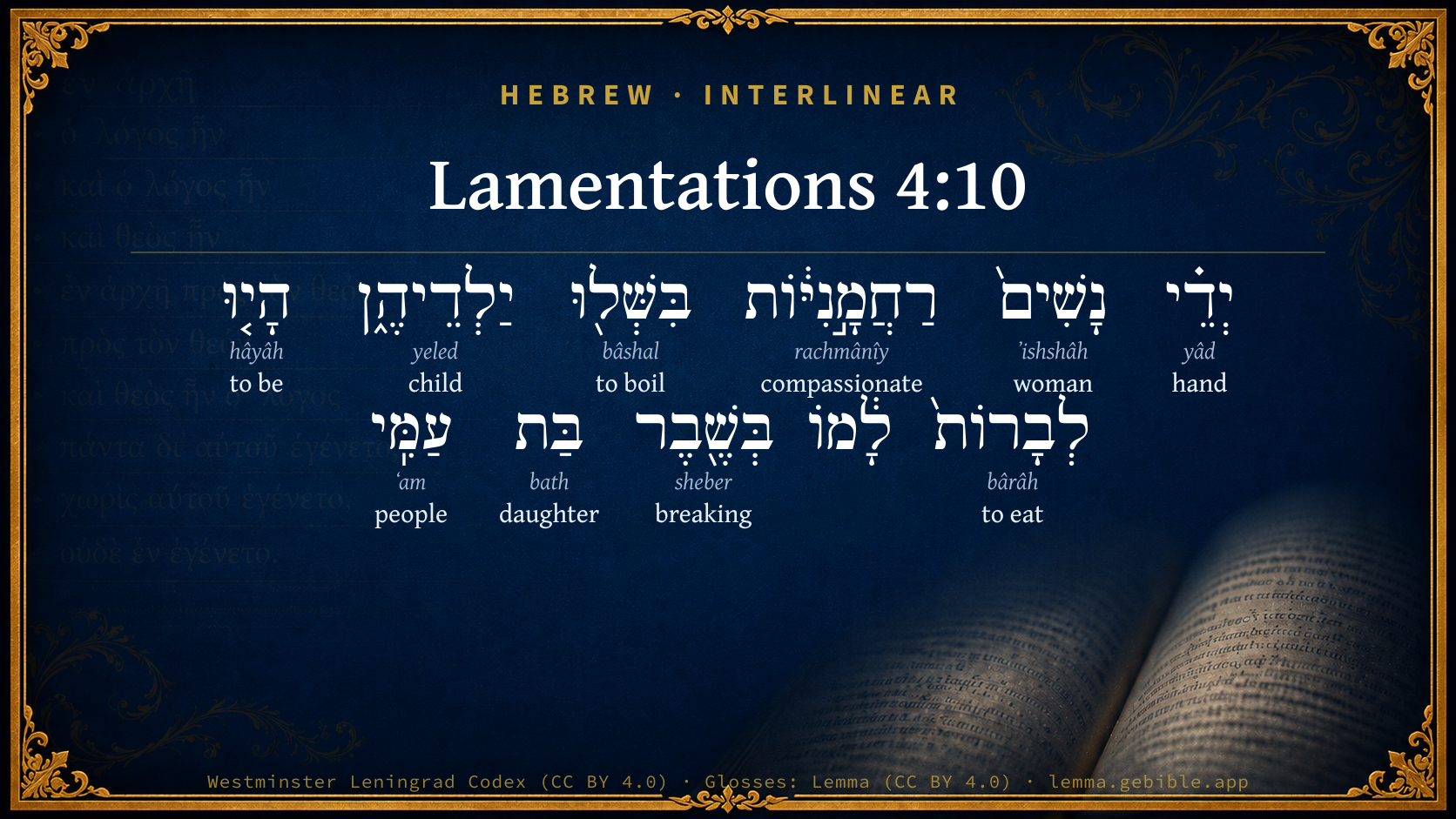
Hebrew (Westminster Leningrad Codex) Lamentations 4:10 appears in the Hebrew Old Testament. The text above is from the Westminster Leningrad Codex. Each word links to its Strong’s number, a concise gloss, and parsing drawn from the Open Scriptures Hebrew Bible morphology. Click any word for its full Brown-Driver-Briggs (BDB) entry.
Download image
Cite this verse

Lamentations 4:10 (World English Bible). Public Domain. Lemma interlinear Bible study tool, https://lemma.gebible.app/v/lamentations/4/10.

Show BibTeX & RIS
BibTeX
RIS
English Translation
The hands of the pitiful women have boiled their own children; They were their food in the destruction of the daughter of my people.
World English Bible · Public Domain
Highlights
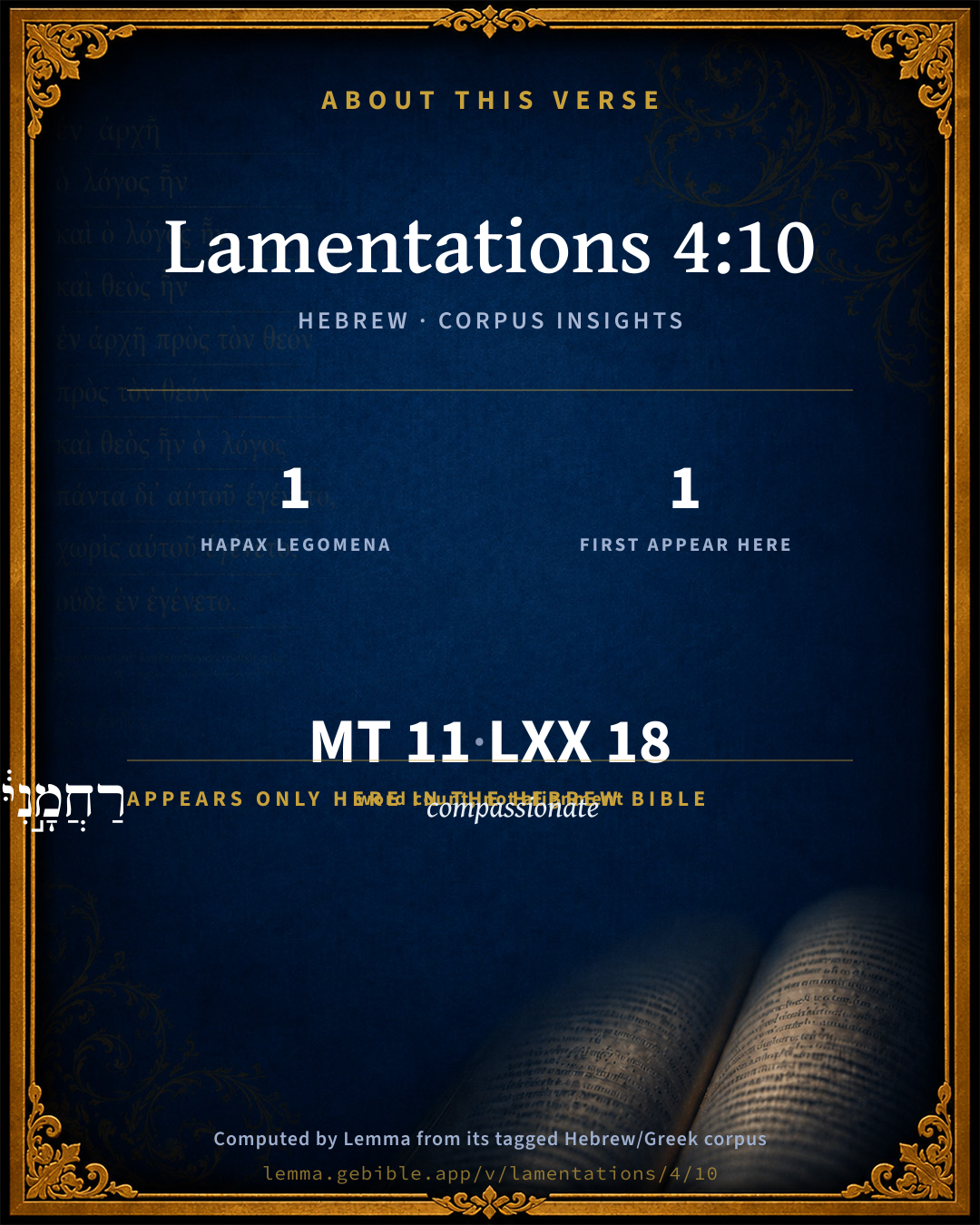
  • 1 hapax legomenon — only here in the Hebrew Bible
  • 1 first appearance in the Hebrew Bible
Full analysis ↓
Download a study sheet

One document with this verse’s original text, its word-by-word gloss line, the meaning frame, cross-references with their text, attributed commentary, and full source and license credits — printable, and it pastes into notes with its structure intact.

This verse Autodidact and up

Study sheet (.html) Plain text (.txt)

A passage Seminary Student

Up to 50 verses in one chapter. A passage sheet keeps up to 6 commentary sources and 12 cross-references per verse, in the order this page ranks them, and says so on the sheet whenever that leaves anything out. Ask for a single verse and you get the Autodidact verse sheet above.

Everything on this page stays free to read, with no account — the sheet is a download of what is already on screen, not access to it.

Want to remove ads? Support Godless Engineer
Compare translations 3

The same verse in 3 English versions, stacked beneath the original-language interlinear above. Click any original word for its lexicon entry.

Each is an independent rendering of the whole verse — the interlinear is not word-aligned to these translations.

Highlighted words mark where these versions differ — a whole-verse word diff, not a word-by-word alignment.

  • World English Bible Public Domain
    The hands of the pitiful women have boiled their own children; They were their food in the destruction of the daughter of my people.
  • King James Version Public Domain
    The hands of the pitiful women have sodden their own children: they were their meat in the destruction of the daughter of my people.
  • unfoldingWord Literal Text CC BY-SA 4.0
    The hands of compassionate women boiled their children; they became food for them in the breaking of the daughter of my people. KAPH

unfoldingWord Literal Text — © unfoldingWord, licensed CC BY-SA 4.0. Word-aligned USFM3 via Door43 (git.door43.org/unfoldingWord/en_ult).

Versions to compare (up to 4)

3 of 4 selected

Show all 18 translations

Every available English version of this verse, each an independent rendering of the whole verse.

  • World English Bible Public Domain
    The hands of the pitiful women have boiled their own children; They were their food in the destruction of the daughter of my people.
  • Berean Standard Bible Public Domain
    The hands of compassionate women have cooked their own children, who became their food in the destruction of the daughter of my people.
  • Majority Standard Bible Public Domain
    The hands of compassionate women have cooked their own children, who became their food in the destruction of the daughter of my people.
  • King James Version Public Domain
    The hands of the pitiful women have sodden their own children: they were their meat in the destruction of the daughter of my people.
  • American Standard Version (1901) Public Domain
    The hands of the pitiful women have boiled their own children; They were their food in the destruction of the daughter of my people.
  • Revised Version (1885) Public Domain
    The hands of the pitiful women have sodden their own children; they were their meat in the destruction of the daughter of my people.
  • Geneva Bible (1599) Public Domain
    The hands of the pitifull women haue sodden their owne children, which were their meate in the destruction of the daughter of my people.
  • Douay-Rheims (1899) Public Domain
    Jod. The hands of the pitiful women have sodden their own children: they were their meat in the destruction of the daughter of my people.
  • Young's Literal Translation Public Domain
    The hands of merciful women have boiled their own children, They have been for food to them, In the destruction of the daughter of my people.
  • Literal Standard Version CC BY-SA 4.0
    The hands of merciful women have boiled their own children, || They have been for food to them, || In the destruction of the daughter of my people.
  • Unlocked Literal Bible CC BY-SA 4.0
    The hands of compassionate women have boiled their own children; they became their food during the time when the daughter of my people was being destroyed.
  • unfoldingWord Literal Text CC BY-SA 4.0
    The hands of compassionate women boiled their children; they became food for them in the breaking of the daughter of my people. KAPH
  • Darby Bible Public Domain
    The hands of pitiful women have boiled their own children: they were their meat in the ruin of the daughter of my people.
  • World Messianic Bible Public Domain
    The hands of the pitiful women have boiled their own children. They were their food in the destruction of the daughter of my people.
  • Webster's Bible Public Domain
    The hands of the pitiful women have boiled their own children: they were their food in the destruction of the daughter of my people.
  • Free Bible Version CC BY-SA 4.0
    The hands of loving women have cooked their own children to eat during the destruction of Jerusalem.
  • Bible in Basic English Public Domain
    The hands of kind-hearted women have been boiling their children; they were their food in the destruction of the daughter of my people.
  • JPS Tanakh (1917) Public Domain
    The hands of women full of compassion have sodden their own children; they were their food in the destruction of the daughter of my people.

Literal Standard Version (2020), Covenant Press — licensed CC BY-SA 4.0. Text via the HelloAO Bible API (eBible.org). Unlocked Literal Bible (unfoldingWord) — licensed CC BY-SA 4.0. Text via the HelloAO Bible API (eBible.org). unfoldingWord Literal Text — © unfoldingWord, licensed CC BY-SA 4.0. Word-aligned USFM3 via Door43 (git.door43.org/unfoldingWord/en_ult). Free Bible Version, Dr. Jonathan Gallagher — licensed CC BY-SA 4.0. Text via the HelloAO Bible API (eBible.org).

Word by word

More ways to search: Search by grammar → Find every occurrence → Compare this word →

Practice this passage: Drill this verse → Learn its vocabulary →

רַחֲמָ֣נִיּ֔וֹת
rachmânîy
H7362
“compassionate”
Adjective, Adjective, Feminine, Plural, Absolute
Part of Speech
Adjective
Type
Adjective
Gender
Feminine
Number
Plural
State
Absolute
Full BDB Definition

Origin: from H7355

TWOT: 2146d

compassionate, compassionate women
  1. יְדֵ֗י yâd H3027 “hands of” Noun, Common, Both, Dual, Construct
  2. נָשִׁים֙ ʼishshâh H802 “women” Noun, Common, Feminine, Plural, Absolute
  3. בִּשְּׁל֖וּ bâshal H1310 “to boil” Verb, Piel, Perfect, 3rd Person, Common, Plural
  4. יַלְדֵיהֶ֑ן yeled H3206 “children · their” Noun, Common, Masculine, Plural, Construct + Suffix, Personal, 3rd Person, Feminine, Plural
  5. הָי֤וּ hâyâh H1961 “to be” Verb, Qal, Perfect, 3rd Person, Common, Plural
  6. לְבָרוֹת֙ bârâh H1262 “to eat” Preposition + Verb, Piel, Infinitive Construct
  7. בְּשֶׁ֖בֶר sheber H7667 “in/at · breaking of” Preposition + Noun, Common, Masculine, Singular, Construct
  8. בַּת bath H1323 “daughter of” Noun, Common, Feminine, Singular, Construct
  9. עַמִּֽי ʻam H5971 “people · my” Noun, Common, Masculine, Singular, Construct + Suffix, Personal, 1st Person, Common, Singular

About this verse

These counts appear in no published source. They are computed here, from the morphology-tagged text and Lemma’s own curated glosses. What Lemma adds →

11
words
10
distinct lemmas
Prophets
section

Notable vocabulary

1 hapax legomenon — a word that appears only here in the entire Hebrew Bible:

  • רַחֲמָ֣נִיּ֔וֹת compassionate H7362

First appearance in Scripture

This word makes its first canonical appearance in the Hebrew Bible here:

  • רַחֲמָ֣נִיּ֔וֹת compassionate H7362

Shared distinctive vocabulary

לְבָרוֹת֙ to eat H1262 occurs in 7 verses of the Hebrew Bible. Also found in:

Grammatical profile

  • 3 verbs
  • 6 nouns
  • 1 adjective
  • 1 preposition

Verb forms

  • בִּשְּׁל֖וּ Piel · Perfect
  • הָי֤וּ Qal · Perfect
  • לְבָרוֹת֙ Piel · Infinitive Construct

Hebrew & Septuagint length

In English translation the verse runs 24 words from the Hebrew and 25 from the Septuagint (LXX English) — closely comparable.

A rough comparison of the two English renderings, which tokenize alike — not a word-level alignment.

Word counts can differ between the Hebrew and the Greek without any difference in meaning — e.g. the Hebrew direct-object marker אֵת has no separate Greek word, and Greek often adds the article ὁ.

In the original languages it is 11 Hebrew tokens and 18 Greek tokens — but the two are counted differently (Hebrew bundles its prefixes and suffixes into one token; the Greek is in lemma form), so that isn’t a like-for-like length.

Cross-references

9

Topical passages linked to Lamentations 4:10 in the Treasury of Scripture Knowledge — connected by theme and wording, ordered by reader-vote popularity; previews shown in the World English Bible.

  • 2 Kings 6:26–29 As the king of Israel was passing by on the wall, there cried a woman to him, saying, Help, my lord, O king.
  • Isaiah 49:15 Can a woman forget her sucking child, that she should not have compassion on the son of her womb? yes, these may forget, yet I will not forget you.
  • Lamentations 2:20 Look, Yahweh, and see to whom you have done thus! Shall the women eat their fruit, the children that are dandled in the hands? Shall the priest and the prophet be killed in the sanctuary of the Lord?
  • Jeremiah 19:9 I will cause them to eat the flesh of their sons and the flesh of their daughters; and they shall eat everyone the flesh of his friend, in the siege and in the distress, with which their enemies, and those who seek their life, shall distress them.
  • Leviticus 26:29 You will eat the flesh of your sons, and you will eat the flesh of your daughters.
  • Lamentations 3:48 My eye runs down with streams of water, for the destruction of the daughter of my people.
  • Lamentations 4:3 Even the jackals draw out the breast, they give suck to their young ones: The daughter of my people is become cruel, like the ostriches in the wilderness.
  • Ezekiel 5:10 Therefore the fathers shall eat the sons in the midst of you, and the sons shall eat their fathers; and I will execute judgments on you; and the whole remnant of you will I scatter to all the winds.
  • Deuteronomy 28:53–57 You shall eat the fruit of your own body, the flesh of your sons and of your daughters, whom Yahweh your God has given you, in the siege and in the distress with which your enemies shall distress you.

Cross-references courtesy of OpenBible.info (CC BY 4.0).

Hebrew and Greek witnesses Masoretic Hebrew ↔ Greek Septuagint

The same verse in the two great witnesses to the Old Testament, shown verse-for-verse.

These are two independent witnesses, not word-aligned to each other, and the Septuagint is shown in lemma (dictionary) form.

Hebrew Lamentations 4:10 Masoretic · Westminster Leningrad Codex

יְדֵ֗י נָשִׁים֙ רַחֲמָ֣נִיּ֔וֹת בִּשְּׁל֖וּ יַלְדֵיהֶ֑ן הָי֤וּ לְבָרוֹת֙ לָ֔מוֹ בְּשֶׁ֖בֶר בַּת עַמִּֽי

The hands of the pitiful women have boiled their own children; They were their food in the destruction of the daughter of my people.

World English Bible · Public Domain

Greek LXX Lamentations 4:10 Septuagint · lemma form

χείρ γυνή οἰκτίρμων ἕψω ὁ παιδίον αὐτός γίγνομαι εἰς βρῶσις αὐτός ἐν ὁ σύντριμμα ὁ θυγάτηρ λαός ἐγώ

JOD. The hands of tender-hearted women have sodden their own children: they became meat for them in the destruction of the daughter of my people.

LXX2012 (modern English Septuagint) · Public Domain

Hebrew: Westminster Leningrad Codex (CC BY 4.0). Greek: Septuagint (public domain); English from LXX2012 (modern English Septuagint) (Public Domain). How the Septuagint differs from the Hebrew →

Commentary

Notes on Lamentations 4:10 from classic Christian and Jewish commentators (each source and its license shown beneath its notes). The classic Christian expositions comment on the surrounding passage and are grouped to its opening verse, so a note may address several verses; the Jewish commentaries on the Tanakh (Rashi and others) are per-verse, so they appear only where the commentator wrote on this verse.

Lemma curates 59 commentaries, every one of them public domain or Creative Commons licensed, each selected and text-cleaned for this edition rather than reprinted as found. About our sources →

Trapp's Complete Commentary

John Trapp

Lam 4:10 The hands of the pitiful women have sodden their own children: they were their meat in the destruction of the daughter of my people.

Ver. 10. The hands of the pitiful women have sodden.] Sodden them rather than roasted them, lest they should be discovered by the smell, and so in danger to be despoiled of them, as it happened at the last siege by the Romans. Lege et luge. Assemble and mourne.

They were their meat.] In eadem viscera, ex quibus exierant, retrusi sunt; they returned into the same bowels whence they came forth.

John Trapp, A Commentary or Exposition upon All the Books of the Old and New Testament (1647–1656) — public domain. Text from a community e-Sword module.

Joseph Benson's Commentary

Lam 4:10-11. The hands of the pitiful women have sodden their own children — The affection of a mother toward her children is the strongest of all natural affections, and yet the famine hath forced that tender sex to divest themselves of it, and to boil and eat their own children. Thus was the prophecy of Moses, Deu 28:53; Deu 28:57, most awfully fulfilled; where see the notes, and on chap. Lam 2:20. The Lord hath accomplished his fury, &c. — God’s anger hath effected an entire destruction, so as not to leave one stone upon another.

Joseph Benson's Commentary on the Old and New Testaments (1811–1818) — public domain. Text from a community e-Sword module.

Jamieson, Fausset & Brown

Robert Jamieson, A. R. Fausset & David Brown

(Lam 2:20; Deu 28:56-57).

pitiful--naturally at other times compassionate (Isa 49:15). JOSEPHUS describes the unnatural act as it took place in the siege under Titus.

sodden--boiled.

Jamieson, Fausset & Brown — Commentary Critical and Explanatory on the Whole Bible (1871) — public domain (CC PDM 1.0). Text via the HelloAO Bible API.

Adam Clarke's Commentary

Verse 10. The hands of the pitiful women have sodden their own children] See Clarke on La 2:20. But here there is a reference to mothers eating their own children; and this was done, not by mothers cruel and brutal, but by נשים רחמניות nashim rachmaniyoth, the compassionate, the tender-hearted mothers. From these horrible scenes it is well to pass with as hasty a step as possible.

Adam Clarke's Commentary on the Bible (1810–1826) — public domain. Text from a community e-Sword/MySword module.

John Calvin's Commentaries

Here Jeremiah refers to that disgraceful and abominable deed mentioned yesterday; for it was not only a barbarity, but a beastly savageness, when mothers boiled their own children. That it was done is evident from other writers; but the Prophet is to us a sufficient witness, who had seen it with his own eyes. He then says that the mothers were merciful, that no one might think that they were divested of every natural feeling; but he meant thus to set forth the blindness which proceeds from God’s dreadful vengeance. He does not, then, praise the mothers for their clemency, as though they felt as they ought to have done for their offspring; but. he intimates that though they would have been otherwise humane, they were yet seized with unusual madness, so that they boiled their own children, even their own bowels. We now, then, perceive the meaning of the word merciful, as applied to the mothers by the Prophet. It is not then to be deemed as a praise to them, as though they had a maternal love for their children; but his object was to set forth that monstrous act, which would not have sufficiently touched their minds, had he not testified that the mothers of whom he speaks were not so brutal as not to have gladly given food to their children; but that they were supernaturally blinded by furious madness. It follows —

John Calvin's Commentaries (1540-1563) — public domain. Text from the Calvin Translation Society English edition (1840s-50s) via the Christian Classics Ethereal Library (ccel.org). Calvin's coverage is partial (roughly two-thirds of the Bible); uncommented books and verses are honest gaps, never fabricated. The 19th-century editor's footnotes and remarks are omitted so the notes are faithfully Calvin's own voice.

Ellicott's Commentary for English Readers

(10) The hands of the pitiful women.—See Note on Lam_2:20.

A Bible Commentary for English Readers, edited by Charles John Ellicott (1878–1897) — public domain. Text from a community e-Sword module.

The Cambridge Bible for Schools and Colleges

gen. ed. J. J. S. Perowne

10. Cp. ch. Lam_2:20, and Jer_19:9.

pitiful] (hitherto) compassionate. For this meaning, as opposed to its modern sense, pitiable, cp. Latimer, Sermons, p. 391. “Because I speak here of orphans, I shall exhort you to be pitiful unto them.”—Bible Word Book.

sodden] boiled (cp. Exo_12:9); the participle of to seethe, for which see 2Ki_4:38.

The Cambridge Bible for Schools and Colleges (gen. ed. J. J. S. Perowne; Cambridge University Press, 1878–1918) — public domain. Text from a community e-Sword module.

John Gill's Exposition

The hands of the pitiful women have sodden their own children,.... Such as were naturally, and agreeably to their sex, pitiful and compassionate; merciful to the poor, as the Targum; and especially tenderhearted to their own offspring; yet, by reason of the soreness of the famine, became so cruel and hardhearted, as to take their own children, and slay them with their own hands, cut them to pieces, put them into a pot of water, and make a fire and boil them, and then eat them, as follows:

they were their meat in the destruction of the daughter of my people: at the time of the destruction of Jerusalem. This strange and unnatural action was foretold by Moses, Deu 28:56; and though we have no particular instance of it on record, as done at the siege of Jerusalem by the Chaldeans, yet no doubt there was, as may be concluded from the words: and at the siege of it by the Romans, when many things here spoken of had a fuller accomplishment, we have a remarkable instance of it, which Josephus (a) relates; an illustrious woman, named Mary, pressed with the famine, slew her own son, a sucking child, boiled him, and ate part of him, and laid up the rest; which was found by the seditious party that broke into her house, which struck them with the utmost horror; See Gill on Lam 2:20.

(a) De Bello Jud. l. 6. c. 3. sect. 4.

John Gill's Exposition of the Whole Bible (1746–1763) — public domain (CC PDM 1.0). Text via the HelloAO Bible API.

Albert Barnes' Notes on the Bible

Pitiful - i. e. tender-hearted, compassionate. meat is used for food Psa 69:21. What is here stated actually occurred during the siege of Jerusalem by Titus.

Albert Barnes' Notes on the Bible (1834–1885) — public domain. Text from a community e-Sword/MySword module.

Haydock's Catholic Bible Commentary

Pitful. So their nature dictates. (Worthington) --- But hunger made them the reverse. Some think they slew their children, to prevent them being exposed to more cruel torments, (Calmet) as the people of Colchis do their sick. (Chardin.) --- Sodden: boiled or roasted; coxerunt, ver. 5., and Deuteronomy xxviii. 55. At the last siege of Jerusalem, this barbarity was manifested. (Calmet) (Josephus, Jewish Wars vii. 8.; Gr. 21.) See chap ii. 20. --- Daughter. So cities are styled. (Worthington)

George Leo Haydock (1774–1849), Haydock's Catholic Family Bible and Commentary, 1859 edition — public domain. Excludes Psalms (Douay-Rheims chapter numbering differs from Protestant) and Deuterocanonical books (Catholic canon only).

Matthew Poole's English Annotations

This was according to what God had threatened in case of disobedience, Deu 28:57, and a thing which hath often happened in sieges, 2Ki 6:29. Such things did happen in the last destruction of Jerusalem, as we read in Josephus; and though we read of no such thing happening in the siege of it by Nebuchadnezzar, yet that there were some such sad instances appears from this text.

Matthew Poole's English Annotations on the Holy Bible (1683–1685) — public domain. Text from a community e-Sword/MySword module.

Whedon's Commentary on the Bible

Daniel D. Whedon

10. A still more terrible feature is added,

Pitiful women have sodden their own children — “Pitiful” — tender hearted, compassionate. “Sodden” — cooked or boiled. Josephus gives a horrible account of a like misery in the siege of Jerusalem under Titus.

Daniel D. Whedon (gen. ed.), Commentary on the Old and New Testaments (1874–1909) — public domain. Text from a community e-Sword module.

The Pulpit Commentary

The pitiful women. Strange contrast between the compassionate nature of woman (comp. Isa_49:15) and the dread horrors of this moral as well as physical catastrophe. (comp. note on Lam_2:20)

The Pulpit Commentary (1880–1919), ed. H.D.M. Spence-Jones & Joseph S. Exell — public domain. Text from a community e-Sword module.

Rashi

Rabbi Shlomo Yitzchaki (Rashi)

food Heb. לְבָרוֹת, for food, like (II Sam. 12:17): “neither did he eat (בָרָה) bread with them”; (ibid. 3: 35): “to serve (לְהַבְרוֹת) David bread.”

Rashi on the Tanakh — English translations: “The Judaica Press complete Tanach with Rashi, translated by A. J. Rosenberg” (CC BY 4.0); “Pentateuch with Rashi's commentary by M. Rosenbaum and A.M. Silbermann, 1929-1934” (public domain); “The Metsudah Tanach series, Lakewood, N.J” (CC BY 4.0); and “The Book of Joshua, Metsudah Publications, 1997” (CC BY 4.0). Text via Sefaria.

Lesson kit

Teaching starters — assembled from the data on this page, not authored interpretation. Every prompt links to the verse data it draws on. Edit before teaching.

Lamentations, in the Prophets, opens this verse with 11 words (10 distinct Hebrew lemmas). Its most distinctive word is rachmânîy (“compassionate”). A historical commentator’s framing appears above. Read the whole chapter for the surrounding context.

Discussion questions

  1. How does “compassionate” (rachmânîy) shape what this verse is saying?
  2. This verse holds 1 word here found nowhere else in the Hebrew Bible. What might the rare word draw attention to?
  3. The word “compassionate” first appears here in Scripture. What is being introduced at this debut?
  4. 1 Samuel 17:8 shares the word «to eat» with this verse. How do the two illuminate each other?
  5. The translations on this page render this verse differently — a whole-verse word diff, not a word-by-word alignment. What might account for the different wordings?
  6. The verb «בִּשְּׁל֖וּ» is Piel Perfect. How does its form color the action?
  7. Reading how Trapp's Complete Commentary and Joseph Benson's Commentary read this verse, where do the two commentators agree and where do they part?

Things to notice

Reading settings

Reading text

Shown beneath each verse's original-language words.

Old Testament
Old Testament edition

Read the OT as the Masoretic Hebrew (MT) or the Greek Septuagint (LXX).

English shown for the Greek Septuagint (in the Hebrew ↔ Greek comparison).

Comparing translations? Open the Compare panel on any verse page to stack up to four side by side.