
Psalms 102:19

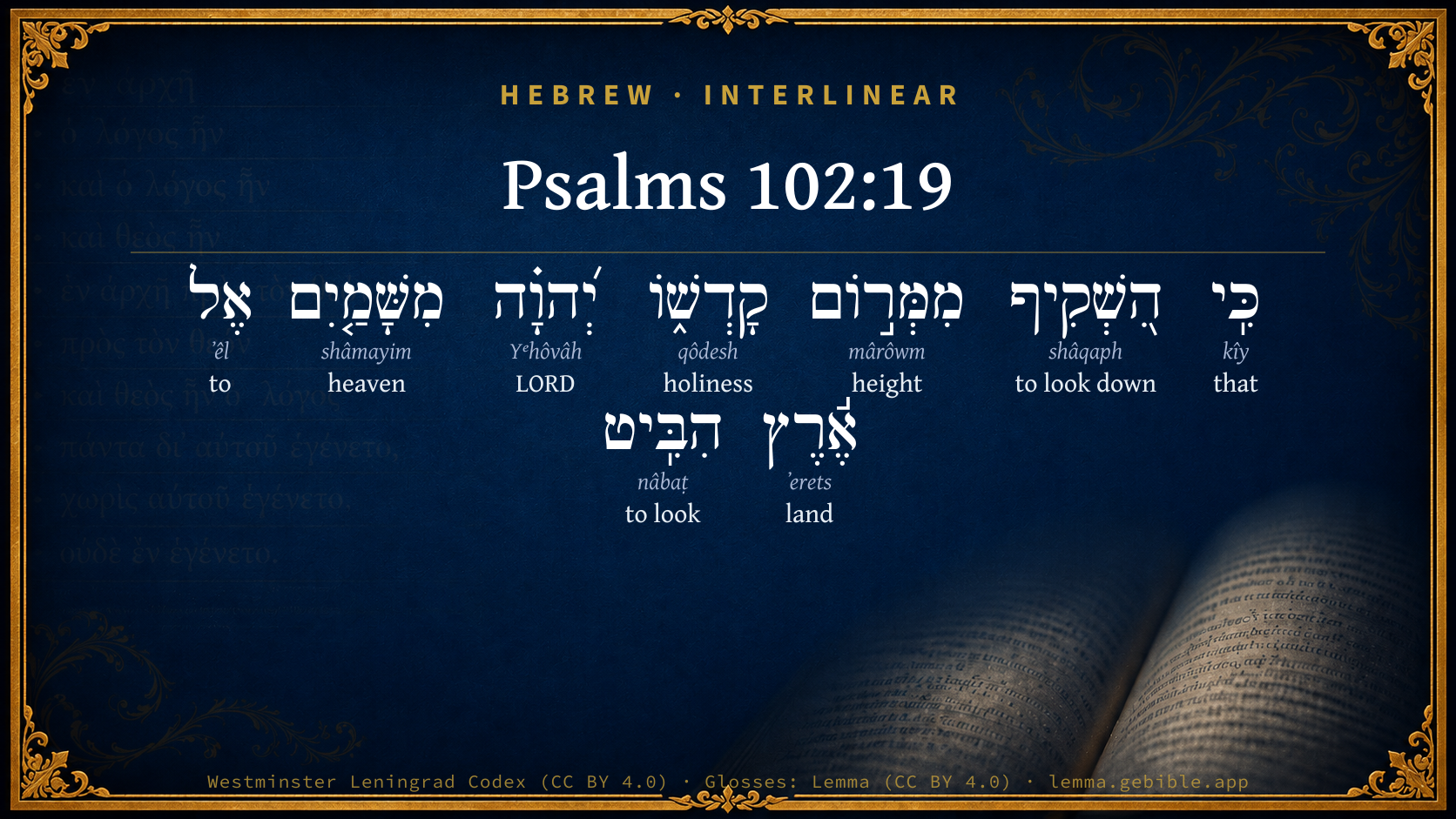
Hebrew (Westminster Leningrad Codex) Psalms 102:19 appears in the Hebrew Old Testament. The text above is from the Westminster Leningrad Codex. Each word links to its Strong’s number, a concise gloss, and parsing drawn from the Open Scriptures Hebrew Bible morphology. Click any word for its full Brown-Driver-Briggs (BDB) entry.
Download image
Cite this verse

Psalms 102:19 (World English Bible). Public Domain. Lemma interlinear Bible study tool, https://lemma.gebible.app/v/psalms/102/19.

Show BibTeX & RIS
BibTeX
RIS
English Translation
For he has looked down from the height of his sanctuary. From heaven, Yahweh saw the earth;
World English Bible · Public Domain
Download a study sheet

One document with this verse’s original text, its word-by-word gloss line, the meaning frame, cross-references with their text, attributed commentary, and full source and license credits — printable, and it pastes into notes with its structure intact.

This verse Autodidact and up

Study sheet (.html) Plain text (.txt)

A passage Seminary Student

Up to 50 verses in one chapter. A passage sheet keeps up to 6 commentary sources and 12 cross-references per verse, in the order this page ranks them, and says so on the sheet whenever that leaves anything out. Ask for a single verse and you get the Autodidact verse sheet above.

Everything on this page stays free to read, with no account — the sheet is a download of what is already on screen, not access to it.

Want to remove ads? Support Godless Engineer
Compare translations 3

The same verse in 3 English versions, stacked beneath the original-language interlinear above. Click any original word for its lexicon entry.

Each is an independent rendering of the whole verse — the interlinear is not word-aligned to these translations.

Highlighted words mark where these versions differ — a whole-verse word diff, not a word-by-word alignment.

  • World English Bible Public Domain
    For he has looked down from the height of his sanctuary. From heaven, Yahweh saw the earth;
  • King James Version Public Domain
    For he hath looked down from the height of his sanctuary; from heaven did the LORD behold the earth;
  • unfoldingWord Literal Text CC BY-SA 4.0
    that he looked down from the height of his holiness; Yahweh from heaven regarded the earth,

unfoldingWord Literal Text — © unfoldingWord, licensed CC BY-SA 4.0. Word-aligned USFM3 via Door43 (git.door43.org/unfoldingWord/en_ult).

Versions to compare (up to 4)

3 of 4 selected

Show all 18 translations

Every available English version of this verse, each an independent rendering of the whole verse.

  • World English Bible Public Domain
    For he has looked down from the height of his sanctuary. From heaven, Yahweh saw the earth;
  • Berean Standard Bible Public Domain
    For He looked down from the heights of His sanctuary; the LORD gazed out from heaven to earth
  • Majority Standard Bible Public Domain
    For He looked down from the heights of His sanctuary; the LORD gazed out from heaven to earth
  • King James Version Public Domain
    For he hath looked down from the height of his sanctuary; from heaven did the LORD behold the earth;
  • American Standard Version (1901) Public Domain
    For he hath looked down from the height of his sanctuary; From heaven did Jehovah behold the earth;
  • Revised Version (1885) Public Domain
    For he hath looked down from the height of his sanctuary; from heaven did the LORD behold the earth;
  • Geneva Bible (1599) Public Domain
    For he hath looked downe from the height of his Sanctuarie: out of the heauen did the Lord beholde the earth,
  • Douay-Rheims (1899) Public Domain
    Let these things be written unto another generation: and the people that shall be created shall praise the Lord:
  • Young's Literal Translation Public Domain
    For He hath looked From the high place of His sanctuary. Jehovah from heaven unto earth looked attentively,
  • Literal Standard Version CC BY-SA 4.0
    For He has looked || From the high place of His sanctuary. YHWH looked attentively from the heavens to earth,
  • Unlocked Literal Bible CC BY-SA 4.0
    For he has looked down from the holy heights; from heaven Yahweh has viewed the earth,
  • unfoldingWord Literal Text CC BY-SA 4.0
    that he looked down from the height of his holiness; Yahweh from heaven regarded the earth,
  • Darby Bible Public Domain
    For he hath looked down from the height of his sanctuary; from the heavens hath Jehovah beheld the earth,
  • World Messianic Bible Public Domain
    for he has looked down from the height of his sanctuary. From heaven, the LORD saw the earth,
  • Webster's Bible Public Domain
    \\102:18\\This shall be written for the generation to come: and the people which shall be created shall praise the LORD.
  • Free Bible Version CC BY-SA 4.0
    The Lord looked down from above, from the heights of his holy place; he looked down from heaven to the earth,
  • Bible in Basic English Public Domain
    For from his holy place the Lord has seen, looking down on the earth from heaven;
  • JPS Tanakh (1917) Public Domain
    (102-20) For He hath looked down from the height of His sanctuary; from heaven did the LORD behold the earth;

Literal Standard Version (2020), Covenant Press — licensed CC BY-SA 4.0. Text via the HelloAO Bible API (eBible.org). Unlocked Literal Bible (unfoldingWord) — licensed CC BY-SA 4.0. Text via the HelloAO Bible API (eBible.org). unfoldingWord Literal Text — © unfoldingWord, licensed CC BY-SA 4.0. Word-aligned USFM3 via Door43 (git.door43.org/unfoldingWord/en_ult). Free Bible Version, Dr. Jonathan Gallagher — licensed CC BY-SA 4.0. Text via the HelloAO Bible API (eBible.org).

Word by word

More ways to search: Search by grammar → Find every occurrence → Compare this word →

Practice this passage: Drill this verse → Learn its vocabulary →

About this verse

These counts appear in no published source. They are computed here, from the morphology-tagged text and Lemma’s own curated glosses. What Lemma adds →

9
words
9
distinct lemmas
Wisdom
section

Notable vocabulary

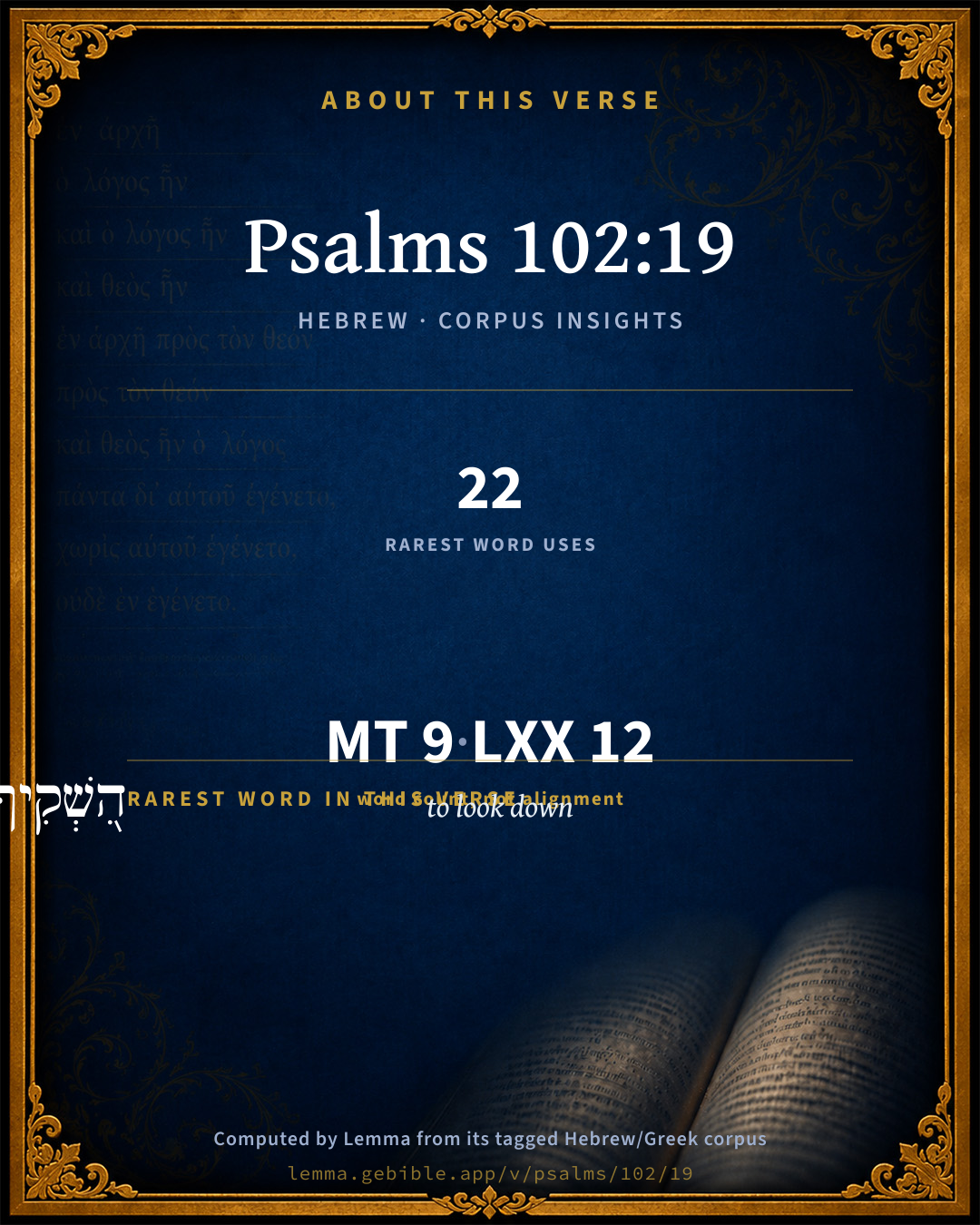
The rarest word here is הִ֭שְׁקִיף to look down H8259 — appearing just 22 times in the whole Hebrew Bible.

Shared distinctive vocabulary

הִ֭שְׁקִיף to look down H8259 occurs in 22 verses of the Hebrew Bible. Also found in:

Grammatical profile

  • 2 verbs
  • 5 nouns
  • 1 preposition
  • 1 conjunction

Verb forms

  • הִ֭שְׁקִיף Hiphil · Perfect
  • הִבִּֽיט Hiphil · Perfect

Hebrew & Septuagint length

In English translation the verse runs 17 words from the Hebrew and 19 from the Septuagint (LXX English) — closely comparable.

A rough comparison of the two English renderings, which tokenize alike — not a word-level alignment.

Word counts can differ between the Hebrew and the Greek without any difference in meaning — e.g. the Hebrew direct-object marker אֵת has no separate Greek word, and Greek often adds the article ὁ.

In the original languages it is 9 Hebrew tokens and 12 Greek tokens — but the two are counted differently (Hebrew bundles its prefixes and suffixes into one token; the Greek is in lemma form), so that isn’t a like-for-like length.

Cross-references

9

Topical passages linked to Psalms 102:19 in the Treasury of Scripture Knowledge — connected by theme and wording, ordered by reader-vote popularity; previews shown in the World English Bible.

  • Deuteronomy 26:15 Look down from your holy habitation, from heaven, and bless your people Israel, and the ground which you have given us, as you swore to our fathers, a land flowing with milk and honey.
  • Psalms 14:2 Yahweh looked down from heaven on the children of men, To see if there were any who did understand, Who did seek after God.
  • 1 Kings 8:39 then hear in heaven, your dwelling-place, and forgive, and do, and render to every man according to all his ways, whose heart you know; (for you, even you only, know the hearts of all the children of men;)
  • 1 Kings 8:43 hear in heaven, your dwelling-place, and do according to all that the foreigner calls to you for; that all the peoples of the earth may know your name, to fear you, as does your people Israel, and that they may know that this house which I have built is called by my name.
  • 2 Chronicles 16:9 For the eyes of Yahweh run back and forth throughout the whole earth, to show himself strong in the behalf of them whose heart is perfect toward him. Herein you have done foolishly; for from henceforth you shall have wars.
  • Job 22:12 "Isn't God in the heights of heaven? See the height of the stars, how high they are!
  • Psalms 33:13–14 Yahweh looks from heaven. He sees all the sons of men.
  • Hebrews 8:1–2 Now in the things which we are saying, the main point is this. We have such a high priest, who sat down on the right hand of the throne of the Majesty in the heavens,
  • Hebrews 9:23–24 It was necessary therefore that the copies of the things in the heavens should be cleansed with these; but the heavenly things themselves with better sacrifices than these.

Cross-references courtesy of OpenBible.info (CC BY 4.0).

Hebrew and Greek witnesses Masoretic Hebrew ↔ Greek Septuagint

The same verse in the two great witnesses to the Old Testament, shown verse-for-verse.

You’re reading Greek Psalm 101 (Hebrew Psalm 102). The Septuagint counts the superscription, so verse numbers can differ from the Hebrew — chapter-level alignment, not verse-by-verse. Numbering follows Rahlfs.

These are two independent witnesses, not word-aligned to each other, and the Septuagint is shown in lemma (dictionary) form.

Hebrew Psalms 102:19 Masoretic · Westminster Leningrad Codex

כִּֽי הִ֭שְׁקִיף מִמְּר֣וֹם קָדְשׁ֑וֹ יְ֝הוָ֗ה מִשָּׁמַ֤יִם אֶל אֶ֬רֶץ הִבִּֽיט

For he has looked down from the height of his sanctuary. From heaven, Yahweh saw the earth;

World English Bible · Public Domain

Greek LXX Greek Psalm 101:19 Septuagint · lemma form

γράφω οὗτος εἰς γενεά ἕτερος καί λαός ὁ κτίζω αἴνεσις ὁ κύριος

For he has looked out from the height of his sanctuary; the Lord looked upon the earth from heaven;

LXX2012 (modern English Septuagint) · Public Domain

Hebrew: Westminster Leningrad Codex (CC BY 4.0). Greek: Septuagint (public domain); English from LXX2012 (modern English Septuagint) (Public Domain). How the Septuagint differs from the Hebrew →

Commentary

Notes on Psalms 102:19 from classic Christian and Jewish commentators (each source and its license shown beneath its notes). The classic Christian expositions comment on the surrounding passage and are grouped to its opening verse, so a note may address several verses; the Jewish commentaries on the Tanakh (Rashi and others) are per-verse, so they appear only where the commentator wrote on this verse.

Lemma curates 59 commentaries, every one of them public domain or Creative Commons licensed, each selected and text-cleaned for this edition rather than reprinted as found. About our sources →

Trapp's Complete Commentary

John Trapp

Psa 102:19 For he hath looked down from the height of his sanctuary; from heaven did the LORD behold the earth;

Ver. 19. For he hath looked down from the height, &c.] This is no small condescension, since he abaseth himself to look upon things in heaven, Psa 113:6.

From heaven did the Lord behold the earth] That is, his poor despised servants, that are in themselves no better than the earth they tread on.

John Trapp, A Commentary or Exposition upon All the Books of the Old and New Testament (1647–1656) — public domain. Text from a community e-Sword module.

The Treasury of David

Charles H. Spurgeon

Ver. 19-20. For he hath looked down from the heights of his sanctuary, or "leaned from the high place of his holiness, "

from heaven did the LORD behold the earth, looking out like a watcher from his tower. What was the object of this leaning lrom the battlements of heaven? Why this intent gaze upon the race of men? The answer is full of astounding mercy; the Lord does not look upon mankind to note their grandees, and observe the doings of their nobles, but

to hear the groaning of the prisoner; to loose those that are appointed to death. Now the groans of those in prison so far from being musical are very horrible to hear, yet God bends to hear them: those who are bound for death are usually ill company, yet Jehovah deigns to stoop from his greatness to relieve their extreme distress and break their chains. This he does by providential rescues, by restoring health to the dying, and by finding food for the famishing: and spiritually this deed of grace is accomplished by sovereign grace, which delivers us by pardon from the sentence of sin, and by the sweetness of the promise from the deadly despair which a sense of sin had created within us. Well may those of us praise the Lord who were once the children of death, but are now brought into the glorious liberty of the children of God. The Jews in captivity were in Haman's time appointed to death, but their God found a way of escape for them, and they joyfully kept the feast of Purim in memorial thereof; let fill souls that have been set free from the crafty malice of the old dragon with even greater gratitude magnify the Lord of infinite compassion.

Ver. 19-22.

1. The notice which God takes of the world, Ps 102:19. (a) The place from which he beholds it: "from heaven, " not from an earthly point of view. (b) The character in which he beholds it; "from the height of his sanctuary, "from the mercy-seat.

2. What attracts his notice most in the world. The groaning of the prisoner and of those appointed to death.

3. The purpose for which he notices them. "To loose, " etc.; "to declare, "etc. (a) For human comfort. (b) For his own glory.

4. When his notice is thus fixed upon the earth. "When, " etc., Ps 102:22. G. R.

Psalms 102:20*

Ver. 2O. To hear the groaning of the prisoner. God takes notice not only of the prayers of his afflicted people, which are the language of grace; but even of their groans, which are the language of nature. Matthew Henry.

Charles H. Spurgeon's The Treasury of David (1869–1885) — public domain. Psalms only. Text from a community e-Sword/MySword module.

Joseph Benson's Commentary

Psa 102:19-22. For he hath looked down — Namely, upon us, and not as an idle spectator, but with an eye of pity and relief; from the height of his sanctuary — From his higher or upper sanctuary, namely, heaven, as the next clause explains it, which is called, God’s high and holy place, Isa 57:15. To loose those that are appointed to death — To release his poor captives out of Babylon, and, which is more, to deliver mankind from the chains and fetters of sin and Satan, and from eternal destruction. To declare the name of the Lord, &c. — That they, being delivered, might publish and celebrate the name and praises of God in his church. When the people are gathered together, &c. — When the Gentiles shall gather themselves to the Jews, and join with them in the praise and worship of the true God, and of the Messiah. This verse seems to be added to intimate, that although the psalmist, in this Psalm, referred to the deliverance of the Jews out of Babylon, yet he had a further design, and a principal respect unto that great and more general deliverance of his church and people by Christ.

Joseph Benson's Commentary on the Old and New Testaments (1811–1818) — public domain. Text from a community e-Sword module.

J. A. Alexander on Psalms

Joseph Addison Alexander

20. (Psa 102:19) For he has leaned from the high, place of his holiness! Jehovah, from heaven to earth has looked. The first word may also be translated that, and the verse be understood as an amplification of the pronoun this at the beginning of Psa 102:18. This is what shall be written for a future generation; this is what they shall praise Jah for; viz. that he has looked, etc. To avoid the repetition of the English verb, as well as to add life to the description, the Hebrew verb is here represented by what seems to be its primary meaning. See above, on Psa 14:2; Psa 85:11, and compare Deu 26:15.

Joseph Addison Alexander, The Psalms Translated and Explained (1850) — public domain. Text from a community e-Sword module.

Tyndale Open Study Notes

Tyndale Open Resources

102:19 The heavenly sanctuary refers to God’s holy place on high (see 92:8-10).

Tyndale Open Study Notes — © Tyndale Open Resources, licensed CC BY-SA 4.0. Text via the HelloAO Bible API.

Adam Clarke's Commentary

Verse 19. For he hath looked down] This, with the three following verses, seems to me to contain a glorious prophecy of the incarnation of Christ, and the gathering in of the Jews and the Gentiles to him. The Lord looks down from heaven, and sees the whole earth groaning and travailing in pain; his eye affects his heart, and he purposes their salvation.

Adam Clarke's Commentary on the Bible (1810–1826) — public domain. Text from a community e-Sword/MySword module.

John Calvin's Commentaries

19. For he hath looked down from the high place of his holiness Now the prophet contemplates the deliverance after which he breathes with anxious desire, as if it had been already accomplished. That the malignity of men might not attempt to obscure such a signal blessing of Heaven, he openly and in express terms claims for God his rightful praise; and the people were constrained in many ways to acknowledge therein the divine hand. Long before they were dragged into captivity, this calamity had been foretold, that when it took place the judgment of God might be clearly manifested; and at the same time deliverance had been promised them, and the time specified to be after the lapse of seventy years. The ingratitude of men therefore could not devise or invent any other cause to which to ascribe their return but the mere goodness of God. Accordingly, it is said, that God looked down from heaven, that the Jews might not attribute to the grace and favor of Cyrus the deliverance which evidently proceeded from Heaven. The high place of his holiness or sanctuary is here equivalent to heaven. As the temple, in some parts of Scripture, (Psalm 26:8 and Psalm 76:2) is called “the habitation of God,” in respect of men, so, that we may not imagine that there is any thing earthly in God, he assigns to himself a dwelling-place in heaven, not because he is shut up there, but that we may seek him above the world.

John Calvin's Commentaries (1540-1563) — public domain. Text from the Calvin Translation Society English edition (1840s-50s) via the Christian Classics Ethereal Library (ccel.org). Calvin's coverage is partial (roughly two-thirds of the Bible); uncommented books and verses are honest gaps, never fabricated. The 19th-century editor's footnotes and remarks are omitted so the notes are faithfully Calvin's own voice.

The Cambridge Bible for Schools and Colleges

gen. ed. J. J. S. Perowne

19. Because he hath looked down … hath beheld] In answer to the prayer of Isa_63:15. Cp. also Deu_26:15; Psa_14:2; Psa_33:13. This verse is related to Psa_102:18 as Psa_102:16-17 are to Psa_102:15. The perfect tense denotes what will lie in the past when the time referred to in Psa_102:18 is reached. Jehovah had not yet ‘looked down’ upon His people when the Psalmist was writing; this is clear from Psa_102:13; but He will assuredly do so, and His renewed regard will be the occasion and theme for their thanksgiving.

The Cambridge Bible for Schools and Colleges (gen. ed. J. J. S. Perowne; Cambridge University Press, 1878–1918) — public domain. Text from a community e-Sword module.

John Gill's Exposition

To hear the groanings of the prisoner,.... Not of a single person only, but of many, who lie in prisons in Popish countries, especially in the Inquisition; where they lie and groan, in darkness and misery, under dreadful tortures; their cries and groans the Lord hears; his heart yearns towards them; he looks with pity on them; and, because of the sighing of these poor and needy ones, he will arise in due time, and set them in safety from him that puffs at them: it is true also of such who are prisoners of sin, Satan, and the law; and, when sensible of it, groan under their bondage, and cry to the Lord for help, who hears them, and directs them, as prisoners of hope, to turn to Christ, their strong hold, Zac 9:11,

to loose those that are appointed to death; delivered to death, as the Targum; delivered over to the secular power, in order to be put to death; who are arraigned and condemned as malefactors, and put into the condemned hole, in order for execution; these the Lord will loose, and save them from the death they are appointed to by men; for this is not to be understood of persons appointed by the Lord to death, either corporeal or eternal, from which none can be loosed, so appointed: in the original text the phrase is "children of death" (d); the same as "children of wrath", Eph 2:3, that is, deserving of death, and under the sentence of it; as all men are in Adam, even the Lord's own people; and who are, in their own apprehension, as dead men, when awakened and convinced of their state by the Spirit of God; these Christ looses from the shackles and fetters of sin, from the bondage of the law, from the tyranny of Satan, and from fears of death, and puts them into the glorious liberty of the children of God.

(d) "filios mortis", Montanus, Vatablus, Musculus, Gejerus, Michaelis.

John Gill's Exposition of the Whole Bible (1746–1763) — public domain (CC PDM 1.0). Text via the HelloAO Bible API.

Albert Barnes' Notes on the Bible

For he hath looked down from the height of his sanctuary - From his high and holy dwelling-place, in heaven. The word here rendered “looked down,” means, in Kal, to lay upon or over; then, in Niphil, to lie out over anything, to project; and then, to bend forward. It then means to bend or incline forward with an intention to look at anything, as from a window, Gen 26:8. Compare Psa 14:2. See also Psa 85:12, note; 1Pe 1:12, note.

From heaven did the Lord behold the earth - Did he look abroad over all the world.

Albert Barnes' Notes on the Bible (1834–1885) — public domain. Text from a community e-Sword/MySword module.

Matthew Poole's English Annotations

He hath looked down, to wit, upon us, not like an idle spectator, but with an eye of pity and relief, as the next verse declares.

From the height of his sanctuary; from his higher or upper sanctuary, to wit, heaven, as the next clause explains it, which is called God’s high and holy place, Isa 57:15.

Matthew Poole's English Annotations on the Holy Bible (1683–1685) — public domain. Text from a community e-Sword/MySword module.

Whedon's Commentary on the Bible

Daniel D. Whedon

19. Looked down—Compare Deu_26:15; Isa_63:15. So manifestly was their salvation above all human power and skill. It came directly from Heaven.

Daniel D. Whedon (gen. ed.), Commentary on the Old and New Testaments (1874–1909) — public domain. Text from a community e-Sword module.

The Pulpit Commentary

For he hath looked down from the height of his sanctuary. God"s true sanctuary is the heaven of heavens wherein he dwells. Earthly sanctuaries are but shadows of this. From heaven did the Lord behold the earth. (comp. Exo_2:23-25) As God in the days of old had looked down on the affliction of his people in Egypt, so did he now "look down" and "behold" their sufferings in Babylon.

The Pulpit Commentary (1880–1919), ed. H.D.M. Spence-Jones & Joseph S. Exell — public domain. Text from a community e-Sword module.

John Wesley's Explanatory Notes

Looked - From heaven.

John Wesley, Explanatory Notes Upon the Whole Bible (1754–1765) — public domain. Text via the GEBible commentary corpus.

unfoldingWord translationNotes

Door43 World Missions Community

For he has looked down from the holy heights; from heaven Yahweh has viewed

These two phrases have similar meaning and are used together for emphasize how God looks down from heaven. (See: Parallelism)

the holy heights

"his holy place high above the earth"

those who were condemned to death

This can be stated in active form. AT: "those whom the authorities had sentenced to die" (See: Active or Passive)

translationWords

holy

heaven

prison

condemn

die

unfoldingWord translationNotes — © Distant Shores Media and the Door43 World Missions Community, licensed CC BY-SA 4.0. Source: git.door43.org/Door43/en_tn.

Rashi

Rabbi Shlomo Yitzchaki (Rashi)

Let this be inscribed So will those who see the salvation say, “let this salvation be inscribed for the latest generation.”

and a created people that became a new creature to emerge from slavery to freedom and from darkness to a great light.

Rashi on the Tanakh — English translations: “The Judaica Press complete Tanach with Rashi, translated by A. J. Rosenberg” (CC BY 4.0); “Pentateuch with Rashi's commentary by M. Rosenbaum and A.M. Silbermann, 1929-1934” (public domain); “The Metsudah Tanach series, Lakewood, N.J” (CC BY 4.0); and “The Book of Joshua, Metsudah Publications, 1997” (CC BY 4.0). Text via Sefaria.

Lesson kit

Teaching starters — assembled from the data on this page, not authored interpretation. Every prompt links to the verse data it draws on. Edit before teaching.

Psalms, in the Wisdom, opens this verse with 9 words (9 distinct Hebrew lemmas). Its most distinctive word is shâqaph (“to look down”). A historical commentator’s framing appears above. Read the whole chapter for the surrounding context.

Discussion questions

  1. What does “to look down” (shâqaph) contribute to the verse as a whole?
  2. How does Genesis 18:16, which shares the word «to look down», read alongside this verse?
  3. These translations render this verse differently; the difference is in the English rendering, not the original. What questions does that raise?
  4. «הִ֭שְׁקִיף» is a Hiphil Perfect verb. How does that grammatical form shape the action described?
  5. Compare how Trapp's Complete Commentary and The Treasury of David read this verse. Where do they agree or differ?

Things to notice

Reading settings

Reading text

Shown beneath each verse's original-language words.

Old Testament
Old Testament edition

Read the OT as the Masoretic Hebrew (MT) or the Greek Septuagint (LXX).

English shown for the Greek Septuagint (in the Hebrew ↔ Greek comparison).

Comparing translations? Open the Compare panel on any verse page to stack up to four side by side.