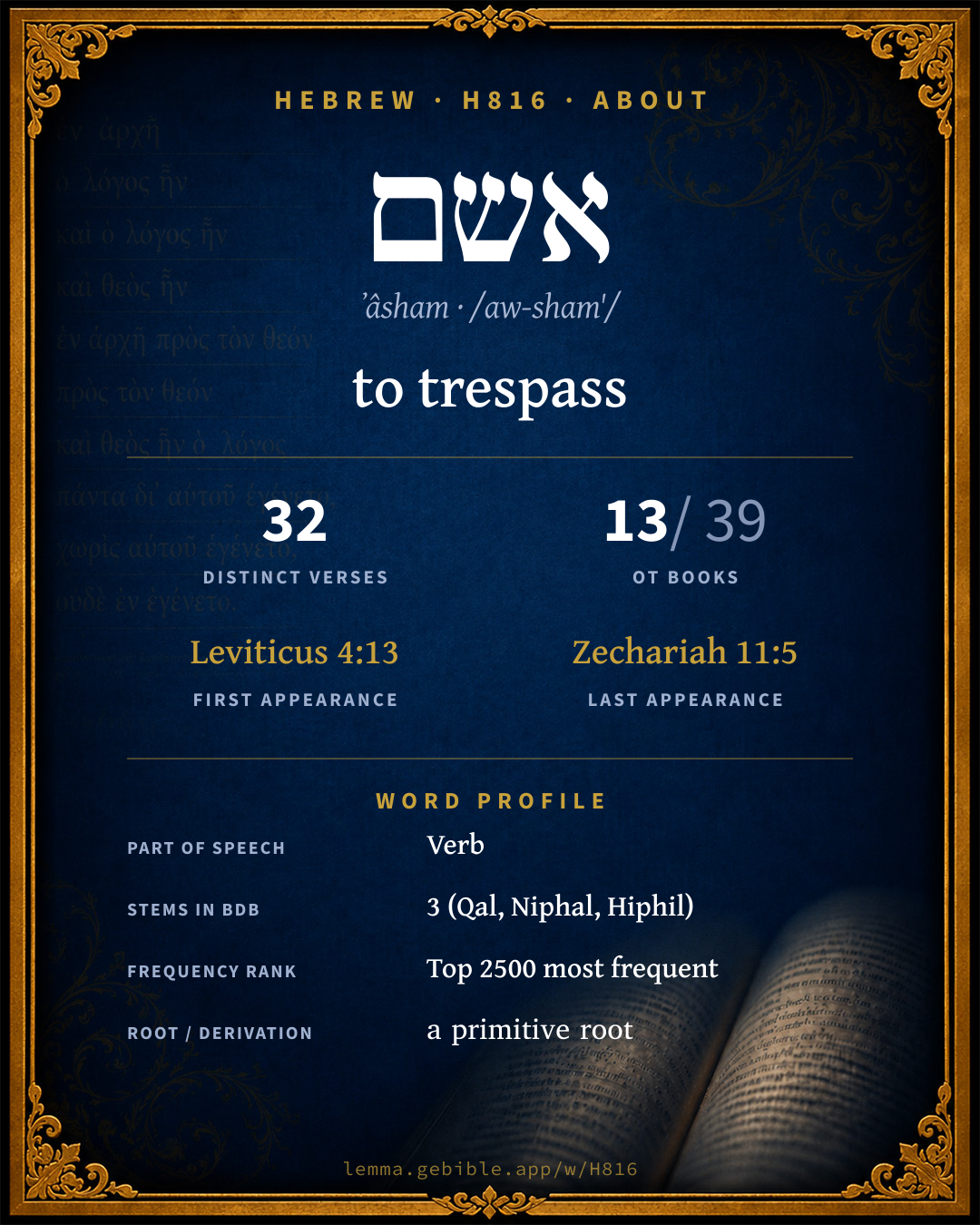
אָשַׁם
to trespass
‘to trespass’ is one of 2 main senses fuller range ↓
Full lexicon entry — Brown-Driver-Briggs (BDB)
From Brown-Driver-Briggs (BDB)
Where this word appears
See every Qal verb in the Hebrew Bible →
Grammar key — what these labels mean
Part of speech
- Verb
- An action or state-of-being word.
Stem
- Qal
- The basic, simple active stem — the plain form of the verb (“he wrote”). Here: ‘commit an offence’
- Niphal
- Usually the simple passive or reflexive of the Qal (“he was written”).
- Hiphil
- The causative active stem (“he caused / brought about”).
Form
- Sequential Perfect
- A perfect with prefixed waw continuing a preceding imperfect or command (waw-consecutive perfect).
- Imperfect
- An incomplete, ongoing, or future action (“he will / would write”).
- Sequential Imperfect
- An imperfect with prefixed waw — the standard past-narrative form (waw-consecutive imperfect).
- Infinitive Absolute
- An unbound verbal noun, often intensifying or standing in for a finite verb.
- Perfect
- A completed action or state — Hebrew marks aspect (completeness) more than strict tense (“he wrote”).
- Imperative
- A direct command (“write!”).
- Jussive
- A third- or second-person volitional form expressing wish or command (“let him write”).
Person
- 3rd Person
- The one spoken about (“he / she / it / they”).
- 2nd Person
- The one addressed (“you”).
- 1st Person
- The speaker (“I / we”).
Gender
- Masculine
- Grammatically masculine.
- Feminine
- Grammatically feminine.
- Common
- Either gender — not distinguished for this form.
Number
- Singular
- One.
- Plural
- More than one (in Hebrew, generally three or more).
Grammatical forms 17 distinct
- Verb, Qal, Imperfect, 3rd Person, Masculine, Plural 8 times (23%)
- Verb, Qal, Sequential Perfect, 3rd Person, Masculine, Singular 7 times (20%)
- Verb, Qal, Perfect, 3rd Person, Masculine, Singular 3 times (9%)
- Verb, Qal, Sequential Imperfect, 3rd Person, Masculine, Plural 2 times (6%)
- Verb, Qal, Infinitive Absolute 2 times (6%)
- Verb, Qal, Imperfect, 2nd Person, Masculine, Plural 2 times (6%)
- Verb, Qal, Perfect, 3rd Person, Feminine, Singular 1 time (3%)
- Verb, Qal, Sequential Perfect, 2nd Person, Masculine, Singular 1 time (3%)
+9 more forms (9 occurrences)
Parsed forms decoded from the imported morphology (morphhb / Westminster Leningrad Codex — WLC text public domain, morphhb tagging CC BY 4.0), counted across 35 parsed occurrences — not distinct verses.
Every verse where H816 appears — 32 distinct verses across 13 books. Click any verse to open its interlinear word-by-word view. Verse text shown in the World English Bible for context — . Each verse’s Hebrew form is shown with its reference; the English is not keyword-highlighted, since the data carries no word-level English alignment. Use “Compare translations” on any verse to read it across multiple English versions. This concordance covers the Hebrew Bible; Septuagint (Greek Old Testament) occurrences are not indexed here.
Leviticus 10 verses
- Leviticus 4:13 וְ/אָשֵֽׁמוּ conj + Qal wpf 3cp "'If the whole congregation of Israel sins, and the thing is hidden from the eyes of the assembly, and they have done any of the things which Yahweh has commanded not to be done, and are guilty;
- Leviticus 4:22 וְ/אָשֵֽׁם conj + Qal wpf 3ms "'When a ruler sins, and unwittingly does any one of all the things which Yahweh his God has commanded not to be done, and is guilty;
- Leviticus 4:27 וְ/אָשֵֽׁם conj + Qal wpf 3ms "'If anyone of the common people sins unwittingly, in doing any of the things which Yahweh has commanded not to be done, and is guilty;
- Leviticus 5:2 וְ/אָשֵֽׁם conj + Qal wpf 3ms "'Or if anyone touches any unclean thing, whether it is the carcass of an unclean animal, or the carcass of unclean cattle, or the carcass of unclean creeping things, and it is hidden from him, and he is unclean, then he shall be guilty.
- Leviticus 5:3 וְ/אָשֵֽׁם conj + Qal wpf 3ms "'Or if he touches the uncleanness of man, whatever his uncleanness is with which he is unclean, and it is hidden from him; when he knows of it, then he shall be guilty.
- Leviticus 5:4 וְ/אָשֵׁ֖ם conj + Qal wpf 3ms "'Or if anyone swears rashly with his lips to do evil, or to do good, whatever it is that a man might utter rashly with an oath, and it is hidden from him; when he knows of it, then he shall be guilty of one of these.
- Leviticus 5:5 יֶאְשַׁ֖ם Qal impf 3ms It shall be, when he is guilty of one of these, he shall confess that in which he has sinned:
- Leviticus 5:17 וְ/אָשֵׁ֖ם conj + Qal wpf 3ms "If anyone sins, and does any of the things which Yahweh has commanded not to be done; though he didn't know it, yet he is guilty, and shall bear his iniquity.
- Leviticus 5:19 אָשֹׁ֥ם אָשַׁ֖ם Qal inf.abs Qal pf 3ms It is a trespass offering. He is certainly guilty before Yahweh."
- Leviticus 6:4 וְ/אָשֵׁם֒ conj + Qal wpf 3ms then it shall be, if he has sinned, and is guilty, he shall restore that which he took by robbery, or the thing which he has gotten by oppression, or the deposit which was committed to him, or the lost thing which he found,
Numbers 2 verses
- Numbers 5:6 וְ/אָֽשְׁמָ֖ה conj + Qal pf 3fs "Speak to the children of Israel: When a man or woman commits any sin that men commit, so as to trespass against Yahweh, and that soul is guilty;
- Numbers 5:7 אָשַׁ֥ם Qal pf 3ms then he shall confess his sin which he has done, and he shall make restitution for his guilt in full, and add to it the fifth part of it, and give it to him in respect of whom he has been guilty.
Judges 1 verse
2 Chronicles 1 verse
Psalms 3 verses
- Psalms 5:10 הַֽאֲשִׁימֵ֨/ם Hiphil impv 2ms + sfx pers 3mp Hold them guilty, God. Let them fall by their own counsels; Thrust them out in the multitude of their transgressions, For they have rebelled against you.
- Psalms 34:21 יֶאְשָֽׁמוּ Qal impf 3mp Evil shall kill the wicked. Those who hate the righteous shall be condemned.
- Psalms 34:22 יֶ֝אְשְׁמ֗וּ Qal impf 3mp Yahweh redeems the soul of his servants. None of those who take refuge in him shall be condemned.
Proverbs 1 verse
Isaiah 1 verse
Jeremiah 2 verses
- Jeremiah 2:3 יֶאְשָׁ֔מוּ Qal impf 3mp Israel [was] holiness to Yahweh, the first fruits of his increase: all who devour him shall be held guilty; evil shall come on them, says Yahweh.
- Jeremiah 50:7 נֶאְשָׁ֑ם Qal impf 1cp All who found them have devoured them; and their adversaries said, We are not guilty, because they have sinned against Yahweh, the habitation of righteousness, even Yahweh, the hope of their fathers.
Ezekiel 3 verses
- Ezekiel 6:6 וְ/יֶאְשְׁמ֜וּ conj + Qal impf 3mp In all your dwelling-places the cities shall be laid waste, and the high places shall be desolate; that your altars may be laid waste and made desolate, and your idols may be broken and cease, and your sun-images may be hewn down, and your works may be abolished.
- Ezekiel 22:4 אָשַׁ֗מְתְּ Qal pf 2fs You have become guilty in your blood that you have shed, and are defiled in your idols which you have made; and you have caused your days to draw near, and are come even to your years: therefore have I made you a reproach to the nations, and a mocking to all the countries.
- Ezekiel 25:12 וַ/יֶּאְשְׁמ֥וּ אָשׁ֖וֹם conj + Qal wimpf 3mp Qal inf.abs Thus says the Lord Yahweh: Because Edom has dealt against the house of Judah by taking vengeance, and has greatly offended, and revenged himself on them;
Hosea 5 verses
- Hosea 4:15 יֶאְשַׁ֖ם Qal juss 3ms "Though you, Israel, play the prostitute, Yet don't let Judah offend; And don't come to Gilgal, Neither go up to Beth Aven, Nor swear, 'As Yahweh lives.'
- Hosea 5:15 יֶאְשְׁמ֖וּ Qal impf 3mp I will go and return to my place, until they acknowledge their offense, And seek my face. In their affliction they will seek me earnestly."
- Hosea 10:2 יֶאְשָׁ֑מוּ Qal impf 3mp Their heart is divided. Now they will be found guilty. He will demolish their altars. He will destroy their sacred stones.
- Hosea 13:1 וַ/יֶּאְשַׁ֥ם conj + Qal wimpf 3ms When Ephraim spoke, there was trembling. He exalted himself in Israel, But when he became guilty in Baal, he died.
- Hosea 13:16 תֶּאְשַׁם֙ Qal impf 3fs Samaria will bear her guilt; For she has rebelled against her God. They will fall by the sword. Their infants will be dashed in pieces, And their pregnant women will be ripped open."
Joel 1 verse
Habakkuk 1 verse
Zechariah 1 verse
About this entry
At a glance — auto-summarized from this page’s data, not written by a person. Every figure links to its source below. This summary describes the numbers; it doesn’t interpret them.
At its core, אשם (ʼâsham) means “to trespass.” Scripture first uses it in Leviticus 4:13. With 32 verses in 13 books, it is a moderately common word in the Hebrew Bible. Its uses concentrate in Leviticus (31% of all occurrences). Across 3 stems, its meaning turns on the binyan (Qal, Niphal). Dig into 32-verse concordance and the renderings breakdown below.
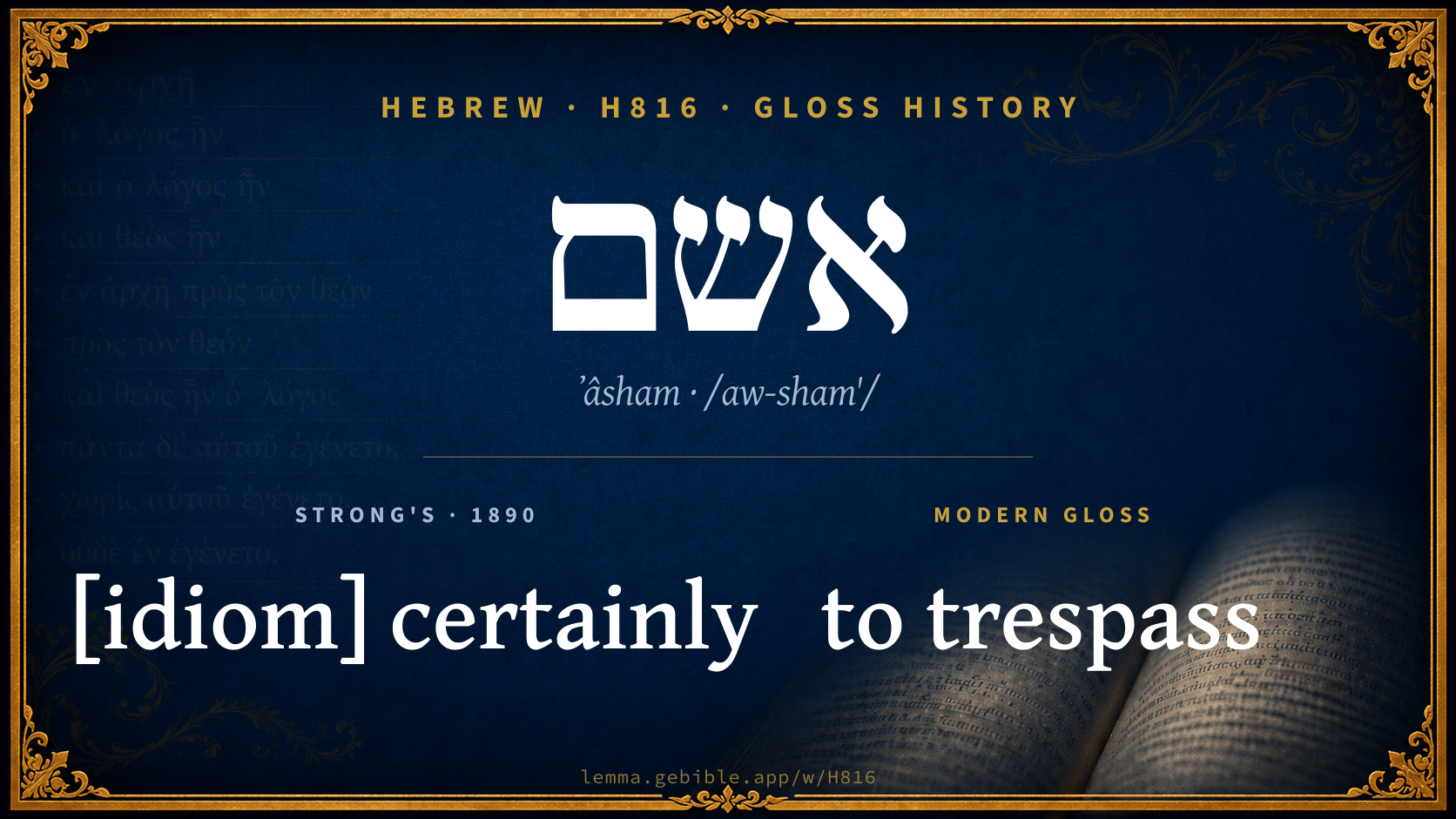
Gloss history
Strong's 1890 vs modern scholarship
About this word
Strong's H816 catalogs a Hebrew word from the Hebrew Old Testament.
These counts are not copied from any lexicon or concordance. They are computed here, from the morphology-tagged Hebrew Old Testament. What Lemma adds →
- 32
- distinct verses
- The word appears in 32 distinct verses.
- 13 / 39
- OT books
- The word appears in 13 of 39 Old Testament books.
- #1,023
- by frequency
- Top 2500 most frequent Hebrew words (rank 1,023 of 8,640 Hebrew words by occurrence).
View all 32 occurrences in the concordance →
By section of the Old Testament
By traditional corpus
Conventional, traditional groupings — biblical authorship is debated, so this is a traditional corpus grouping, not an authorship claim. Each share is this word’s portion of its verses in that division of the Hebrew canon. Each figure is a share of the word’s 32 distinct verses.
- Prophets (Nevi'im) 15 verses · 47%
- Torah (Pentateuch) 12 verses · 38%
- Writings (Ketuvim) 5 verses · 16%
How translations render this word
Counts come from each version’s own published word-to-Strong’s tagging or interlinear alignment — an approximate guide to how each version renders this word, not a word-level alignment the data otherwise carries. Because each total is that version’s own tagged count, the per-version totals vary from one another and need not match the appearance or distinct-verse counts above. These counts may also differ from a printed concordance because Lemma counts each distinctly tagged rendering and does not collapse phrase taggings into a single head-word total. This is a fixed set of word-tagged versions (KJV, ASV, BSB, ULT) and does not change with the reading translation you choose elsewhere. Each version’s license is shown beside its name below (and on Sources).
- King James Version: Be guilty 2×, He shall be guilty 2×, Is guilty 2×
- American Standard Version: Be guilty 2×, He knoweth of it 2×, Shall be condemned 2×
- Berean Standard Bible: He is guilty 3×, Incur guilt 3×, Guilty 2×
- unfoldingWord Literal Text: He becomes guilty 5×, Be guilty 3×, He will be guilty 3×
King James Version Public Domain
Renders H816 across 35 tagged occurrences — most commonly:
Plus 25 renderings that appear only once — usually multi-word phrases or single function words the recovered tagging swept in, not distinct renderings.
American Standard Version Public Domain
Renders H816 across 35 tagged occurrences — most commonly:
Plus 27 renderings that appear only once — usually multi-word phrases or single function words the recovered tagging swept in, not distinct renderings.
Berean Standard Bible Public Domain
Renders H816 across 33 tagged occurrences — most commonly:
Plus 21 renderings that appear only once — usually multi-word phrases or single function words the recovered tagging swept in, not distinct renderings. Not rendered by a distinct English word in 2 further occurrences.
unfoldingWord Literal Text CC BY-SA 4.0
Renders H816 across 41 tagged occurrences — most commonly:
Plus 26 renderings that appear only once — usually multi-word phrases or single function words the recovered tagging swept in, not distinct renderings.
Senses in the full BDB
Hebrew verbs can shift meaning by stem (binyan): Qal is the basic action, Niphal is often passive or reflexive, Piel often intensifies or makes it factitive, and Hiphil is typically causative. The senses below are grouped under the stem BDB assigns to each.
What do BDB’s symbols mean?
BDB uses these scholarly abbreviations:
| Symbol | Meaning |
|---|---|
| 𝔊 | the Septuagint (the ancient Greek translation, LXX) |
| 𝔙 | the Vulgate (the Latin translation) |
| 𝔖 | the Syriac version (the Peshitta) |
| 𝔗 | the Targum (the Aramaic translation) |
| ψ | the Psalms |
| √ | root (the underlying root or stem) |
| ‖ | parallel passage (a synonymous or contrasted parallel) |
| † | the dagger: every passage where the word occurs is cited |
The 6 senses and sub-senses the full Brown-Driver-Briggs lexicon distinguishes for this word, in lexicon order (not ranked by frequency), with BDB’s own verbatim wording and sub-sense lettering. Shown in Hebrew script with BDB’s own scholarly abbreviations. The condensed entry is in the Lexicon Entry tab. See also the Forms in the corpus table below.
Qal
- Pf. אָשַׁם Lv 5:19 Nu 5:7; אָשֵׁם Hb 1:11 + 7 times; אָֽשְׁמָה Nu 5:6; אָשָׁ֑מְתָּ Pr 30:10; אָשַׁמְתְּ Ez 22:4; אָשֵׁ֑מוּ Lv 4:13; Impf. יֶאְשַׁם Ho 4:15 + 13 times; Inf. abs. אָשֹׁם Lv 5:19; אָשׁוֹם Ez 25:12;— e.g. Leviticus 5:19
- 1. commit an offence, a trespass, do a wrong, or an injury, with לְ: אָשֹׁם אָשַׁם ליהוה he hath done a great wrong to Yahweh (in violating the commands) Lv 5:19 (P); וְנָתַן לַאֲשֶׁר אָשַׁם לוֹ and he shall give it (restitution) to him to whom he did wrong Nu 5:7 (P), cf. 2 Ch 19:10, 10; וַיֶּאְשְׁמוּ אָשׁוֹם and they committed lasting wrong (irreparable wrong, the Edomites against Judah) Ez 25:12. e.g. Leviticus 5:19
- 2. be or become guilty Ju 21:22 Je 50:7 Ho 4:15 Hb 1:11; in offences requiring sin-offering Lv 4:13, 22, 27 (P), of trespass-offering Lv 5:2, 3, 17, 23 Nu 5:6 (P); with ל guilty of Lv 5:4, 5 (P), with ב in or through Ez 22:4 Ho 13:1. e.g. Judges 21:22
- 3. be held guilty, bear punishment ψ 34:22, 23 Pr 30:10 Is 24:6 Je 2:3 Ho 5:15; 10:2; 14:1 Zc 11:5 Ez 6:6 (but cf. שָׁמֵם). e.g. Psalms 34:22
Niphal
- נֶאְשָׁמוּ suffer punishment Jo 1:18. (si vera l.; Me We al. נָשַׁמּוּ, √ שׁמם, cf. Drad loc). e.g. Joel 1:18
Hiphil
- Impf. sf. הַאֲשִׁימֵם declare them guilty ψ 5:11. e.g. Psalms 5:11
Senses from the full Brown-Driver-Briggs lexicon (Brown, Driver, Briggs; Oxford 1906 — public domain), digitized via Sefaria, supplemented by the OpenScriptures HebrewLexicon (CC BY 4.0). Full attribution on Sources.
Word origin
vb. offend, be guilty (Arabic أَثِمَ peccavit, إِثْمٌ offence, أَثَامٌ, إِثَامٌ, requital, fault, mulct, cf. Ethiopic ሕሠም:)—
— Brown-Driver-Briggs (Oxford 1906, public domain), digitized via Sefaria, supplemented by the OpenScriptures HebrewLexicon (CC BY 4.0). See Sources.
Origin: a primitive root
Jastrow Dictionary
A second Hebrew/Aramaic lexicon for comparison, covering Aramaic and post-biblical (Talmudic, Targumic, Midrashic) usage that the biblical-Hebrew BDB does not. Matched by lemma rather than by Strong’s number, so a lemma may carry more than one Jastrow headword (shown separately below), and the entries cover usage well beyond the Bible.
אָשַׁם
- 1. to be waste (cmp. Ezek. VI, 6; Hos. XIV,. Snh. 97ᵃ יֶאֱשַׁם (in parall. passages יִשּׁוֹם); v. גַּבְלָן. e.g. Ezekiel 6:6
- 2. to neglect, be guilty.—Denom.:
אָשָׁם
- (b. h.) guilt; guilt-offering, asham, a special kind of offering.—א׳ תלוי (Lev. V, 18) an asham to be offered when you are in doubt as to the commission of a sinful act. Kerith. III, 1; a. fr.; (ib. 17ᵇ differ. opin. as to the nature of the doubt). Ib. VI, 3 אֲשַׁם חסידים the asham offered by the over-scrupulous because they may have transgressed.—א׳ ודאי the asham for the undoubted commission of certain offenses, which are: a) אֲ׳ גזילות for illegal appropriation of private property (after pecuniary reparation; Lev. V, 25); b) אֲ׳ מעילות for misappropriation of sacred property (Lev. V, 16); c) אֲ׳ שפחה חרופה for carnal connection with a slave betrothed to another man (Lev. XIX, 21);—d) אֲ׳ נזיר offering of a nazarite when interrupting the days of vowed nazaritism by levitical impurity (Num. VI, 12).—Deut. R. s. 1, beg. (alluding to וַאֲשִׂמֵם Deut. I, 13) וְאַשְׁמָם כתיב it is so written that you may read v’ashmam (and their guilt); if you listen not to them אשמה תלוי וכ׳ (read אשמם) their guilt shall fall upon your heads (you will be answerable for what offenses they may commit); differ. in Sifré Deut. 13. [Our Bible editions, however, read ואשימם, plene.]—Pl. אֲשָׁמוֹת. Kerith. VI, 4. Sifré l. c.; a. fr. e.g. Leviticus 5:18
A Dictionary of the Targumim, the Talmud Babli and Yerushalmi, and the Midrashic Literature (Marcus Jastrow; London, Luzac, 1903) — Public Domain. Digitized via Sefaria. Digitized via Sefaria. Full attribution on Sources.
Forms in the corpus
The 29 distinct written forms H816 takes in the Hebrew Bible, most frequent first — each parse links to that stem’s occurrences in the concordance. Hebrew forms include their vowel points and cantillation, so a single lemma takes many written forms.
Same root — word family
Other BDB entries built from the same root as H816, grouped by Strong’s listed origin. These share a root / origin per the lexicon — not necessarily a shared meaning. Each links to that word’s own entry.
Derived from this word
Compare all same-root words → They share a root, not necessarily a meaning.
Septuagint verse parallels
This word appears in 31 verses that also exist in the Greek Old Testament (Septuagint), out of the 32 Hebrew verses it occurs in. You can read those verses in Greek by switching the Old Testament edition to the Septuagint.
Read these verses in the Septuagint
- Leviticus 4:13
- Numbers 5:6
- Judges 21:22
- 2 Chronicles 19:10
- Psalms 5:10
- Proverbs 30:10
- Isaiah 24:6
- Jeremiah 2:3
- Ezekiel 6:6
- Hosea 4:15
- Joel 1:18
- Habakkuk 1:11
This is a verse-level parallel only — the same verses exist in both the Hebrew and Greek Old Testaments. No word-level Hebrew↔Greek correspondence is claimed: the data carries no such alignment, so no Greek word is shown as this Hebrew word’s translation. Coverage is not total — the Septuagint omits the deuterocanon and renumbers the Psalms, so some Hebrew verses have no direct Greek parallel.