
Exodus 28:31

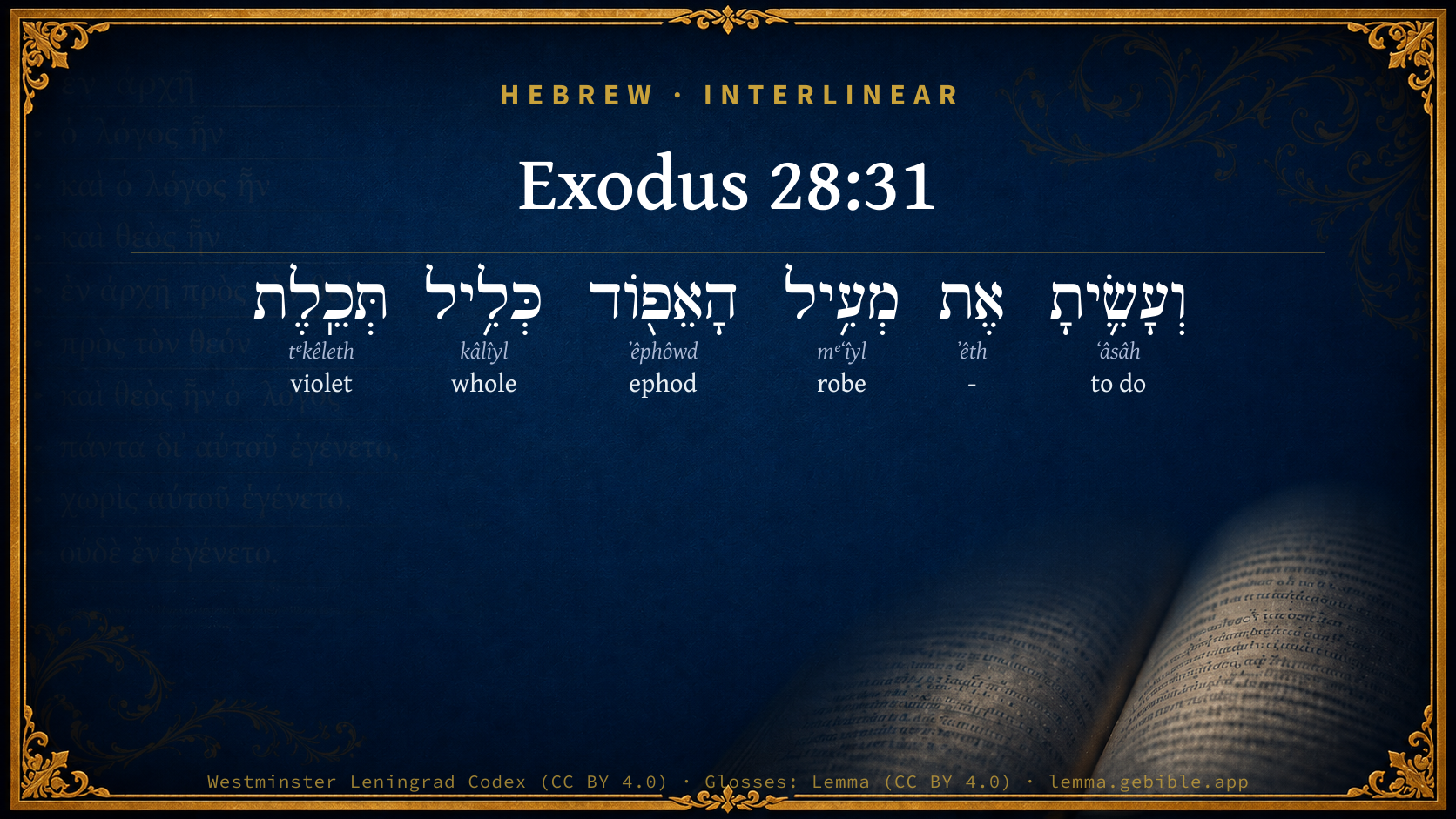
Hebrew (Westminster Leningrad Codex) Exodus 28:31 appears in the Hebrew Old Testament. The text above is from the Westminster Leningrad Codex. Each word links to its Strong’s number, a concise gloss, and parsing drawn from the Open Scriptures Hebrew Bible morphology. Click any word for its full Brown-Driver-Briggs (BDB) entry.
Download image
Cite this verse

Exodus 28:31 (World English Bible). Public Domain. Lemma interlinear Bible study tool, https://lemma.gebible.app/v/exodus/28/31.

Show BibTeX & RIS
BibTeX
RIS
English Translation
"You shall make the robe of the ephod all of blue.
World English Bible · Public Domain
Highlights Full analysis ↓
Download a study sheet

One document with this verse’s original text, its word-by-word gloss line, the meaning frame, cross-references with their text, attributed commentary, and full source and license credits — printable, and it pastes into notes with its structure intact.

This verse Autodidact and up

Study sheet (.html) Plain text (.txt)

A passage Seminary Student

Up to 50 verses in one chapter. A passage sheet keeps up to 6 commentary sources and 12 cross-references per verse, in the order this page ranks them, and says so on the sheet whenever that leaves anything out. Ask for a single verse and you get the Autodidact verse sheet above.

Everything on this page stays free to read, with no account — the sheet is a download of what is already on screen, not access to it.

Want to remove ads? Support Godless Engineer
Compare translations 3

The same verse in 3 English versions, stacked beneath the original-language interlinear above. Click any original word for its lexicon entry.

Each is an independent rendering of the whole verse — the interlinear is not word-aligned to these translations.

Highlighted words mark where these versions differ — a whole-verse word diff, not a word-by-word alignment.

  • World English Bible Public Domain
    "You shall make the robe of the ephod all of blue.
  • King James Version Public Domain
    And thou shalt make the robe of the ephod all of blue.
  • unfoldingWord Literal Text CC BY-SA 4.0
    And you shall make the robe of the ephod entirely of blue.

unfoldingWord Literal Text — © unfoldingWord, licensed CC BY-SA 4.0. Word-aligned USFM3 via Door43 (git.door43.org/unfoldingWord/en_ult).

Versions to compare (up to 4)

3 of 4 selected

Show all 18 translations

Every available English version of this verse, each an independent rendering of the whole verse.

  • World English Bible Public Domain
    "You shall make the robe of the ephod all of blue.
  • Berean Standard Bible Public Domain
    You are to make the robe of the ephod entirely of blue cloth,
  • Majority Standard Bible Public Domain
    You are to make the robe of the ephod entirely of blue cloth,
  • King James Version Public Domain
    And thou shalt make the robe of the ephod all of blue.
  • American Standard Version (1901) Public Domain
    And thou shalt make the robe of the ephod all of blue.
  • Revised Version (1885) Public Domain
    And thou shalt make the robe of the ephod all of blue.
  • Geneva Bible (1599) Public Domain
    And thou shalt make the robe of the Ephod altogether of blewe silke.
  • Douay-Rheims (1899) Public Domain
    And thou shalt make the tunick of the ephod all of violet,
  • Young's Literal Translation Public Domain
    `And thou hast made the upper robe of the ephod completely of blue,
  • Literal Standard Version CC BY-SA 4.0
    And you have made the upper robe of the ephod completely of blue,
  • Unlocked Literal Bible CC BY-SA 4.0
    You will make the robe of the ephod entirely of blue fabric.
  • unfoldingWord Literal Text CC BY-SA 4.0
    And you shall make the robe of the ephod entirely of blue.
  • Darby Bible Public Domain
    And thou shalt make the cloak of the ephod all of blue.
  • World Messianic Bible Public Domain
    “You shall make the robe of the ephod all of blue.
  • Webster's Bible Public Domain
    And thou shalt make the robe of the ephod all of blue.
  • Free Bible Version CC BY-SA 4.0
    Make the robe that goes with the ephod exclusively from blue cloth,
  • Bible in Basic English Public Domain
    The robe which goes with the ephod is to be made all of blue;
  • JPS Tanakh (1917) Public Domain
    And thou shalt make the robe of the ephod all of blue.

Literal Standard Version (2020), Covenant Press — licensed CC BY-SA 4.0. Text via the HelloAO Bible API (eBible.org). Unlocked Literal Bible (unfoldingWord) — licensed CC BY-SA 4.0. Text via the HelloAO Bible API (eBible.org). unfoldingWord Literal Text — © unfoldingWord, licensed CC BY-SA 4.0. Word-aligned USFM3 via Door43 (git.door43.org/unfoldingWord/en_ult). Free Bible Version, Dr. Jonathan Gallagher — licensed CC BY-SA 4.0. Text via the HelloAO Bible API (eBible.org).

Word by word

More ways to search: Search by grammar → Find every occurrence → Compare this word →

Practice this passage: Drill this verse → Learn its vocabulary →

About this verse

These counts appear in no published source. They are computed here, from the morphology-tagged text and Lemma’s own curated glosses. What Lemma adds →

6
words
6
distinct lemmas
Pentateuch
section

Notable vocabulary

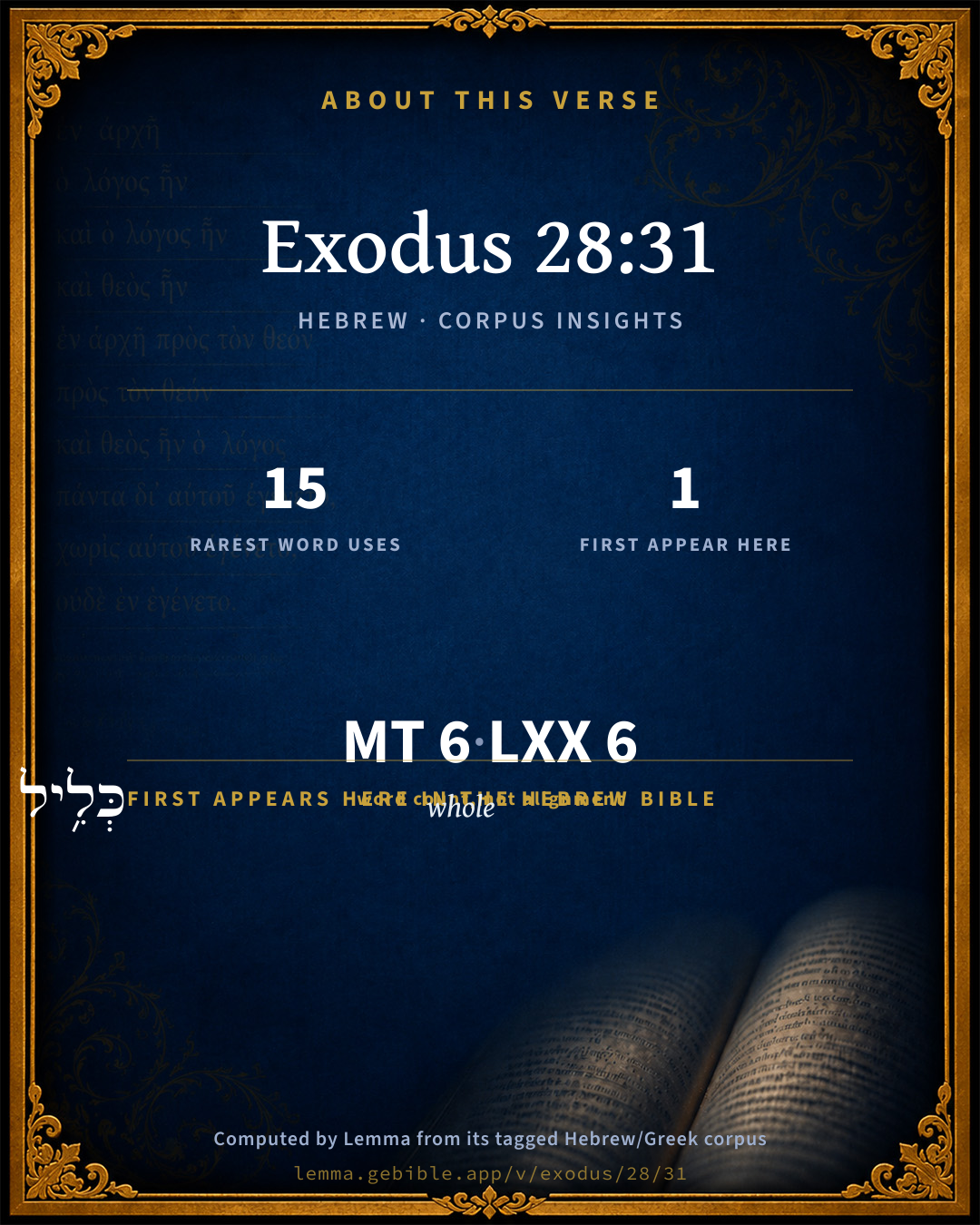
The rarest word here is כְּלִ֥יל whole H3632 — appearing just 15 times in the whole Hebrew Bible.

First appearance in Scripture

This word makes its first canonical appearance in the Hebrew Bible here:

  • כְּלִ֥יל whole H3632

Shared distinctive vocabulary

כְּלִ֥יל whole H3632 occurs in 15 verses of the Hebrew Bible. Also found in:

Grammatical profile

  • 1 verb
  • 3 nouns
  • 1 adjective
  • 1 particle

Verb forms

  • וְעָשִׂ֛יתָ Qal · Sequential Perfect

Hebrew & Septuagint length

In English translation the verse runs 11 words from the Hebrew and 29 from the Septuagint (LXX English) — the Septuagint runs noticeably longer here. See the side-by-side →

A rough comparison of the two English renderings, which tokenize alike — not a word-level alignment.

Word counts can differ between the Hebrew and the Greek without any difference in meaning — e.g. the Hebrew direct-object marker אֵת has no separate Greek word, and Greek often adds the article ὁ.

In the original languages it is 6 Hebrew tokens and 6 Greek tokens — but the two are counted differently (Hebrew bundles its prefixes and suffixes into one token; the Greek is in lemma form), so that isn’t a like-for-like length.

Cross-references

4

Topical passages linked to Exodus 28:31 in the Treasury of Scripture Knowledge — connected by theme and wording, ordered by reader-vote popularity; previews shown in the World English Bible.

  • Exodus 28:4 These are the garments which they shall make: a breastplate, and an ephod, and a robe, and a coat of checker work, a turban, and a sash: and they shall make holy garments for Aaron your brother, and his sons, that he may minister to me in the priest's office.
  • Exodus 28:28 They shall bind the breastplate by the rings of it to the rings of the ephod with a lace of blue, that it may be on the skillfully woven band of the ephod, and that the breastplate may not swing out from the ephod.
  • Exodus 39:22–26 He made the robe of the ephod of woven work, all of blue.
  • Leviticus 8:7 He put the coat on him, tied the sash on him, clothed him with the robe, put the ephod on him, and he tied the skillfully woven band of the ephod on him, and fastened it to him with it.

Cross-references courtesy of OpenBible.info (CC BY 4.0).

Hebrew and Greek witnesses Masoretic Hebrew ↔ Greek Septuagint

The same verse in the two great witnesses to the Old Testament, shown verse-for-verse.

Here the Septuagint runs noticeably longer than the Hebrew — LXX2012 (modern English Septuagint) 29 words vs World English Bible 11. A rough length comparison of the two English translations, not a word-level alignment — read both below.

These are two independent witnesses, not word-aligned to each other, and the Septuagint is shown in lemma (dictionary) form.

Hebrew Exodus 28:31 Masoretic · Westminster Leningrad Codex

וְעָשִׂ֛יתָ אֶת מְעִ֥יל הָאֵפ֖וֹד כְּלִ֥יל תְּכֵֽלֶת

"You shall make the robe of the ephod all of blue.

World English Bible · Public Domain

Greek LXX Exodus 28:31 Septuagint · lemma form

καί ποιέω ὑποδύτης ποδήρης ὅλος ὑακίνθινος

And the sound of Aaron shall be audible when he ministers, as he goes into the sanctuary before the Lord, and as he goes out, that he die not.

LXX2012 (modern English Septuagint) · Public Domain

Hebrew: Westminster Leningrad Codex (CC BY 4.0). Greek: Septuagint (public domain); English from LXX2012 (modern English Septuagint) (Public Domain). How the Septuagint differs from the Hebrew →

Targum (Aramaic paraphrase)

2

The Targum is the ancient Jewish Aramaic paraphrase of the Hebrew Scriptures — an interpretive translation, not the Hebrew text itself. Onkelos (literal) and Pseudo-Jonathan (expansive) render the Torah, and Jonathan the Prophets. Coverage is partial: where no permissively-licensed English translation exists for a verse, only the Aramaic is shown. This is verse-level text, not a word-by-word alignment to the Hebrew.

  1. Targum Onkelos Torah (Genesis–Deuteronomy)
    וְתַעְבֵּד יָת מְעִילָא דְאֵפוֹדָא גְמִיר תִּכְלָא:

    (no public-domain English translation for this verse)

    Targum Onkelos — Aramaic: “Onkelos Genesis” (public domain); “Onkelos Exodus” (public domain); “Onkelos Leviticus” (public domain); “Onkelos Numbers” (public domain); “Onkelos Deuteronomy” (public domain). English: “Sefaria Community Translation” (CC0 1.0 (public-domain dedication)); “J.W. Etheridge. The Targums of Onkelos and Jonathan Ben Uzziel on the Pentateuch. London: Longmans, Green, 1862” (public domain). Text via Sefaria.

  2. Targum Pseudo-Jonathan Torah (Genesis–Deuteronomy)
    וְתַעֲבֵיד יַת מִנְטַר מְעִילָא דְאֵפוֹדָא שְׁזִיר חוּטָא דְתִיכְלָא

    And thou shalt make the mantle-robe (mintar meila) of the ephod, of twined thread of hyacinth;

    Targum Pseudo-Jonathan — Aramaic: “Targum Jonathan on Genesis” (public domain); “Targum Jonathan on Exodus” (public domain); “Targum Jonathan on Leviticus” (public domain); “Targum Jonathan on Numbers” (public domain); “Targum Jonathan on Deuteronomy” (public domain). English: “The Targum of Jonathan ben Uzziel, trans. J. W. Etheridge, London, 1862” (public domain). Text via Sefaria.

Commentary

Notes on Exodus 28:31 from classic Christian and Jewish commentators (each source and its license shown beneath its notes). The classic Christian expositions comment on the surrounding passage and are grouped to its opening verse, so a note may address several verses; the Jewish commentaries on the Tanakh (Rashi and others) are per-verse, so they appear only where the commentator wrote on this verse.

Lemma curates 59 commentaries, every one of them public domain or Creative Commons licensed, each selected and text-cleaned for this edition rather than reprinted as found. About our sources →

Matthew Henry's Commentary

Here is, 1. Direction given concerning the robe of the ephod, Exo 28:31-35. This was next under the ephod, and reached down to the knees, was without sleeves, and was put on over their head, having holes on the sides to put the arms through, or, as Maimonides describes it, was not sewed together on the sides at all. The hole on the top, through which the head was put, was carefully bound about, that it might not tear in the putting on. In religious worship, care must be taken to prevent every thing that may distract the minds of the worshippers, or render the service despicable. Round the skirts of the robe were hung golden bells, and the representations of pomegranates made of yarn of divers colours. The pomegranates added to the beauty of the robe, and the sound of the bells gave notice to the people in the outer court when he went into the holy place to burn incense, that they might then apply themselves to their devotions at the same time (Luk 1:10), in token of their concurrence with him in his offering, and their hopes of the ascent of their prayers to God in virtue of the incense he offered. Aaron must come near to minister in the garments that were appointed him, that he die not. It is at his peril if he attend otherwise than according to the institution. This intimates that we must serve the Lord with fear and holy trembling, as those that know we deserve to die, and are in danger of making some fatal mistake. Some make the bells of the holy robe to typify the sound of the gospel of Christ in the world, giving notice of his entrance within the veil for us. Blessed are those that hear this joyful sound, Psa 89:15. The adding of the pomegranates, which are a fragrant fruit, denotes the sweet savour of the gospel, as well as the joyful sound of it, for it is a savour of life unto life. The church is called an orchard of pomegranates. 2. Concerning the golden plate fixed upon Aaron's forehead, on which must be engraven, Holiness to the Lord (Exo 28:36, Exo 28:37), or The holiness of Jehovah. Aaron must hereby be reminded that God is holy, and that his priests must be holy. Holiness becomes his house and household. The high priest must be sequestered from all pollution, and consecrated to God and to his service and honour, and so must all his ministrations be. All that attend in God's house must have Holiness to the Lord engraven upon their foreheads, that is, they must be holy, devoted to the Lord, and designing his glory in all they do. This must appear in their forehead, in an open profession of their relation to God, as those that are not ashamed to own it, and in a conversation in the world answerable to it. It must likewise be engraven like the engravings of a signet, so deep, so durable, not painted to be washed off, but sincere and lasting; such must our holiness to the Lord be. Aaron must have this upon his forehead, that he may bear the iniquity of the holy things (Exo 28:38), and that they may be accepted before the Lord. Herein he was a type of Christ, the great Mediator between God and man, through whom it is that we have to do with God. (1.) Through him what is amiss in our services is pardoned. The divine law is strict; in many things we come short of our duty, so that we cannot but be conscious to ourselves of much iniquity cleaving even to our holy things; when we would do good evil is present; even this would be our ruin if God should enter into judgment with us. But Christ, our high priest, bears this iniquity, bears it for us so as to bear it from us, and through him it is forgiven to us and not laid to our charge. (2.) Through him what is good is accepted; our persons, our performances, are pleasing to God upon the account of Christ's intercession, and not otherwise, Pe1 2:5. His being holiness to the Lord recommends all those to the divine favour that are interested in his righteousness, and clothed with his Spirit; and therefore he has said it was for our sakes that he sanctified himself, Joh 17:19. Having such a high priest, we come boldly to the throne of grace, Heb 4:14-16. 3. The rest of the garments are but named (Exo 28:39), because there was nothing extraordinary in them. The embroidered coat of fine linen was the innermost of the priestly garments; it reached to the feet, and the sleeves to the wrists, and was bound to the body with a girdle or sash of needle-work. The mitre, or diadem, was of linen, such as kings anciently wore in the east, typifying the kingly office of Christ. He is a priest upon a throne (Zac 6:13), a priest with a crown. These two God has joined, and we must not think to separate them.

Matthew Henry's Commentary on the Whole Bible (1708–1710) — public domain (CC PDM 1.0). Text via the HelloAO Bible API.

Trapp's Complete Commentary

John Trapp

Exo 28:31 And thou shalt make the robe of the ephod all [of] blue.

Ver. 31. The robe of the ephod.] Which signified the royal robe of Christ’s righteousness, reaching down to the feet, large enough to cover all our imperfections.

John Trapp, A Commentary or Exposition upon All the Books of the Old and New Testament (1647–1656) — public domain. Text from a community e-Sword module.

The Biblical Illustrator

Joseph S. Exell

Exo_28:31-35

The robe of the ephod.

The robe of the ephod

The third peculiar garment of the high priest was the robe of the ephod (Exo_28:5; Exo_28:31). On the skirts of which were fastened--

1. The pomegranates of blue silk, and purple, and scarlet round about. This fruit hath a most pleasant smell, sweet in itself, and sweetening other things round about it; and is full of precious juice and liquor.

2. Bells of gold between them round about, a golden bell and a pomegranate; the use of which was, that his sound might be heard round about when he went into the sanctuary and holy of holies. The whole garment signified the righteousness of Christs human nature, which is--

(1) Most sweet itself, having a most pleasant savour as the pomegranate.

(2) Full of most precious juice and virtue, to qualify and abate the raging heat of Gods displeasure, as the juice of pomegranates doth allay the burning heat of an ague that would shake the body to pieces.

(3) Casts upon us a sweet savour being wrapped in it. For we, by nature, stinking in our sins and rottenness, are loathsome to the Lord; but once covered with this mantle, we are a sweet savour to God.

3. This garment hath a sweet sound, as of golden bells, which to hear were most delectable, because the garment of Christs righteousness brings grace to us no otherwise than by the sound of the gospel. For faith, by which we put on Christ, is wrought by hearing the sweet sound and golden bell of the gospel. Whence some have thought, that by this part of the priests attire, is shadowed the prophetical office of Christ. Sweet is the proclamation of the gospel of peace!

4. The use. That by these bells the priests must be heard when he goeth into the sanctuary; signifying the power of Christ, our High Priests, perpetual intercession (being entered into the sanctuary of heaven) for His elect and chosen. (T. Taylor, D. D.)

The blue robe

The robe was of one piece, and was all of blue. This colour sets forth that which was pre-eminently heavenly in the character of Christ, and it reminds us of that perfect, seamless robe of Christs righteousness, which is unto all and upon all them that believe(Rom_3:22). The bottom of this long robe was ornamented with golden bells and pomegranates. Here were sound and fruit, and as much fruit as sound. As he moved about in the court or in the tabernacle, every step sent forth a sweet golden sound from each of the many little bells hanging about his feet, and Aaron would seem to say by this sound, I am ready to serve you, and to bless you. The pomegranates would often remind him that a priest must do more than make a sound; he must work as well as talk; he must produce both sound and fruit, and both must be good. These bells and pomegranates were about the feet--the walk of the high priest; reminding us of the loveliness of Christs walk, and of the sweetness and pleasantness of His conversation. The sound of these bells would not be heard in the camp, and but faintly, if they could be heard at all, outside the court. To hear this sweet sound distinctly, a man must have come as far as to the brazen altar; but he could not come there without an offering. And as the first offering he was required to bring was a sin-offering, if a man stood at the altar of brass and listened to the sweet and joyful sound of the golden bells about the hem of the priests blue robe, we are quite sure that he had come, first of all, as a sinner to be pardoned and saved. So now a man must feel himself a sinner, and in need of a sin-offering: he must come out from the world; must draw near to Him who is both the altar and the sacrifice; must lay his hand by faith on the head of Christ. (G. Rodgers.)

The robe of the ephod

This robe embodied the colour of the heavens; it was all of blue. It seems to have typified the especial glory of the true High Priest, whose name is Prince of Peace, the Lord of Peace; and who wears His princely robes as King of Righteousness, and King of Peace, upon the ground of having made full, perfect, and eternal peace through the blood of His cross. God, known as love, is the God of peace: and He has brought again from the dead our Lord Jesus, that Great Shepherd of the sheep, through the blood of the eternal covenant. That title, the Great Shepherd of the sheep, seems to sum up in one name the whole of the priesthood of Christ, as described in the Epistle to the Hebrews. He is the Great Shepherd; for He is King as well as Priest. He has royal power; a royal heart; royal glory; and His dominions are righteousness and peace; and He is the Shepherd, having proved His love and care for the sheep, in laying down His life for them; and all His priestly service on their behalf is conducted with the heart of a good Shepherd, who loves His own, and whose own the sheep are. This is, therefore, a princely, priestly, shepherd robe. It displays the love of God as seen in the gift of His Son and as manifested by the Son Himself, in laying down His life, and so making peace. It was a robe which covered the high priest from head to foot, and showed the great object of His priesthood, namely, to maintain, on the behalf of His own, that peace with God which He had procured at the cost of His own blood, and which the God of peace had sealed and established, by raising Him from the dead through the blood of the everlasting covenant. This robe was all of one piece, woven from the top throughout, and a provision was made by means of a binding of woven work round about the hole in the top of it, that it should not rend or be rent. Is not this very significant of the unchanging love of Christ? (H. W. Soltau.)

A golden bell and a pomegranate.

Golden bells

I am glad that the first use of bells was a religious use; and hereafter the gospel of God to me shall be a chime of bells; and whether I hear them in the garments of the high priest, or in the cathedral tower, they shall suggest to me the gladness, the warning, and the triumph of the gospel.

1. These gospel bells, like those that adorned the high priests robe, are golden bells. Other bells are made of coarser materials--zinc, and lead, and tin, and copper; but these gospel bells are bells of gold. There is one bell in Europe that cost three hundred thousand dollars. It was at vast expense that metallic voices were given to the towers of York, and Vienna, and Oxford. But all the wealth of heaven was thrown into this gospel bell. No angel can count its value. Eternity cannot demonstrate its cost. When the bell of the Russian Kremlin was being fused, the lords came and threw their gold into the molten mass; but when this Gospel bell was to be constructed, the kings of heaven, the hierarchs of eternity, threw into it their crowns and their sceptres. It is a golden bell. Do you believe it? Hear it ring! God so loved the world that He gave His only begotten Son, that whosoever believeth in Him should not perish, but have everlasting life. Him hath God exalted to be a Prince and a Saviour, to give repentance unto Israel, and forgiveness of sins.

2. I remark, further, that these gospel bells, like those around the high priests garment, are bells of invitation. When the Jews heard the clash of those bells in the hem of the priests robe they knew it was an invitation to worship. That is the meaning of every church tower from San Francisco to New York, and from London to St. Petersburgh. It is, Come--come.

3. I remark, further, that the gospel bells, like those on the high priests robe, are bells of warning. When the Jews heard the clash and ring of these bells, it was a warning for them to worship, lest their God be offended. On Bell Rock, in the German Ocean, there is a lighthouse, and there are two bells, that every half-minute ring out through the fog, through the darkness, through the storm, and over the sea. Beware! Beware! The helmsman on the ship, hearing the warning, turns the wheel and steers off. It is a startling thing, at midnight, to hear the heavy clang of a fire bell, if you live in the third ward, and the tongue of the bell strike one, two, three! If a city is besieged, and the flash of the musketry is seen on the hill-tops, and the cavalry horses are dashing up and down, and the batteries are being unlimbered, all the bells of the city call, to arms! to arms! So this gospel bell is a bell of alarm.

4. I remark, further, that the bells on the high priests robe were bells of joy. When the Jews heard the chiming of those bells on the priests robe, it announced to them the possibility of pardon for their sins, and of deliverance. Behold! I bring you good tidings of great joy, that shall be to all people. There have been bells rung on days of victory. The bell of London rang after Waterloo. The bells in many of our cities rang after the settlement of our national strife. The great bells of York, and Oxford, and Vienna, at some time, have sounded the victory.

5. These gospel bells, of which I speak, are bells of triumph. Aye! they are ringing now: All flesh shall see the salvation of God. And He shall reign for ever and for ever! The Bishop of Malta, in superstition, had all the bells of the city rung, in the hope that the storm that was raging in the city might be quieted. That was superstition: but I think it is faith in God that leads us to believe that the ringing of these gospel bells will yet silence all the storms of this worlds sin, and all the storms of this worlds trouble. Oh! when Jesus, our Great High Priest, in full robes shall enter into His glory, the bells on the hem of His garments will ring with the music of an eternal merriment.

6. But we shall have no share in that joy unless now we listen to the gospel tiding. There is a bell on the other side of the waters, weighing two hundred and eight thousand pounds; and it takes twenty-four men to ring it. But to bring out all the sweetness of this gospel bell would take all the consecrated spirits of earth--seraphim and archangel. Who in this august assembly will listen? Who will listen now? In New England they have what they call a passing bell; that is, when some one dies in a village, word is sent to the sexton, and he sounds the bell just as often as the man lived years: and when the sound is in the tower, the people are solemn, and they say, Some one is dead--who is it? For us the passing bell will soon sound. Gone from the family. Gone from the church. Gone from the last opportunity of salvation. (T. De Witt Talmage.)

Lessons

As the priests must have in their skirts both bells and pomegranates: so must every evangelical minister.

1. The bells allow them not to be dumb dogs (Isa_56:10), but the sound of the law and gospel must clearly sound in their mouths, to be heard afar off.

2. These bells must be of gold, to put ministers in mind that their doctrine be pure; not corrupt, not savouring of popish liberty, or self-respect.

3. They must never come into the congregation without these bells; for ministers must still be furnished with some sound matter of instruction and edification. How is it then that many come into the congregation and never bring bells? Many are afraid lest the sound of their bells should be heard too much, and that it would disgrace them to be counted diligent preachers. And many scorn others that their bells sound so often.

4. To the bells, ministers must join pomegranates: with the wholesome word, join good works and holy life. He carries the bell, a minister whose life is agreeable with the holy doctrine (Mat_5:19). He that keepeth the commandments, and teacheth others so to do, shall be great in the kingdom of God. John Baptist had both bells (being a burning light in himself), and pomegranates; being a shining light unto others. And as the pomegranates smelled sweet; so must ministers labour to leave a sweet smell behind them everywhere. (T. Taylor, D. D.)

The church-going bells

In considering the usefulness of church bells, it may be proper to say: First, that they render a worthy claim for their existence in promoting the temporal welfare of communities where their voice is heard. But, secondly, the worth of a bell is perhaps still more evident when we consider its use for religious purposes. The ways of its usefulness, when calling the people together for worship, are easily seen.

I. It calls attention to the claims of God for love and service. Nothing is more manifest than that men are apt to become careless in respect to these claims.

II. It is useful in promoting a larger attendance upon the services of the sanctuary, than would be secured but for its influence.

III. Added to an increase of attendants, the bell pronotes punctuality.

IV. The bell is useful in the influence it has in preparing the mind of those who obey its call for worship.

V. The bell is useful because of the sacred associations connected with its sound, and the hallowed memories its notes inspire. (G. L. Foster.)

The dumb bell

Mr. Gatty, in his book on Bells, gives the following anecdote, on the credit of Cardinal Baronius: When Charles II., king of France, A.D. 615, was at Sens, in Burgundy, he heard a bell in the church of St. Stephen, the sound of which pleased him so much that he ordered it to be transported to Paris. The Bishop of Sens, however, was greatly displeased at this, and the bell so sympathized with him that it turned dumb on the road and lost all its sound. When the king heard of this he commanded that the bell should be carried back to its old quarters, when, strange to relate, as it approached the town, it recovered its original tone, and began to ring so as to be heard at Sens, whilst yet about four leagues distant from it. The true preacher grows silent if forced to any other service than his Lords. If he attempts to speak on any other topic than that which concerns his Lord and the gospel, he misses his former force; he is not at home, he is glad to end his speech and sit down. Our bell is dumb if it does not ring out for Jesus. The world would soon dismiss us if it had hired us to be its orator, for our heart is elsewhere, and only upon the one dear, familiar theme can be eloquent. (C. H. Spurgeon.)

The Biblical Illustrator, edited by Joseph S. Exell (c. 1880s–1900s) — public domain. Text from a community e-Sword module.

Joseph Benson's Commentary

Exo 28:31. The robe of the ephod — This was next under the ephod, and reached down to the knees, without sleeves, and was put on over the head, having holes on the sides to put the arms through, or, as Maimonides describes it, was not sewed together on the sides at all. The hole on the top, through which the head was put, was carefully bound about that it might not tear in the putting on. The bells gave notice to the people in the outer court when he went into the holy place to burn incense, that they might then apply themselves to their devotions at the same time, (Luk 1:10,) in token of their concurrence with him, and their hopes of the ascent of their prayers to God in the virtue of the incense he offered. Aaron must come near to minister in the garments that were appointed him, that he die not. It is at his peril if he attend otherwise than according to the institution.

Joseph Benson's Commentary on the Old and New Testaments (1811–1818) — public domain. Text from a community e-Sword module.

The Preacher's Complete Homiletical Commentary

Joseph S. Exell (gen. ed.)

THE PRIEST’S ROBE.—Exo_28:31-35

A robe is the badge of office, and the robe here described marks out the high priest as one whose function it was to preserve and declare divine truth. And Christ, the great High Priest, is also the Apostle of our confession. Consider what this robe suggests concerning the truth as it is in Jesus.

I. The colour of the robe suggests, that our great High Priest is the source and guardian of truth. The robe was to be entirely of blue. “That this is significant cannot be doubted, if we consider, that (Num_15:38) the Israelites are commanded to wear on the borders of their garments fringes with a thread of blue, ‘that they might see it and remember all the precepts of the Lord;’ we may, therefore, safely infer that the robe, with its only blue colour, represented the high priest as perfectly and entirely under the command of God, as the instrument and guardian of His laws.”—Kalisch. Christ is the grand source of spiritual and divine truth. He declares the laws of God to mankind. It is the highest truth: blue, the colour of the lofty firmament. It is the purest truth: the deep blue sky is an image of purity—free from all stains and defilements. It is the infinite, eternal, truth: the blue unchanging sky is the image of eternity.

II. The integrity of the robe suggests the integrity of the law and truth of Christ. The robe was of one piece, it was entirely woven without the use of the needle; and the robe was of one colour, all of blue. The Gospel of Jesus is no patchwork, as some would assume, partly true and partly false, partly human and partly divine, partly obligatory and partly obsolete, partly beautiful and partly unseemly. The Gospel of Jesus is not a thing made from scraps and shreds gathered from various sources, Jewish and Pagan,—it is of one spirit, one beauty, one authority throughout. Let us not attempt to tear it asunder. “There was to be a binding of woven work round about the hole for the neck, like the opening of an armour, that it be not rent,” Exo_28:32. Let us make no schism in it. The Gospel of Jesus is the unfolding of God’s heart and God’s mind, and let us be careful and preserve the whole counsel of God.

III. The ornaments of the robe suggest the sweetness and virtue of the truth as it is in Jesus, Exo_28:33-35. “We find allusions to the Word and Testimony of God in the pendant of pomegranates and bells attached to the fringe of the high priest’s robe. The simile in Pro_25:11, where the word is compared to an apple, suggests the idea that the pomegranates, with their pleasant odour, their sweet and refreshing juice, and the richness of their delicious kernel, were symbols of the Word and Testimony of God, as a sweet and Pleasant spiritual food that enlivens the soul and refreshes the heart.”—Delitzsch. The music of the golden bells we may also regard as the delightful harmony of Gospel truth—sweet alike to God and man. The truth as it is in Jesus is full of richness and beauty—it speaks of pardon, reconciliation, and immortality.

“O taste and see that the Lord is good; blessed is the man that trusteth in Him.”

ILLUSTRATIONS

BY

REV. WILLIAM ADAMSON

Scripture-Secrets! Exo_28:1-43. “The Bible can never be exhausted. The most learned commentators and eloquent preachers have but crossed the threshold of the magnificent temple. As in Nature, so in Revelation: the materials of every steam-engine, telegraph, microscope, and other mechanical and scientific contrivances, have been lying for countless ages under the dust of the earth undisturbed until a comparatively recent date.… And what yet may be fashioned out of the materials of nature no sagacity can prognosticate. Our present conquests form the starting-points of more dazzling victories. So, in reference to Revelation: generations yet unborn will group around its pages, and gather from them more sublime and radiant truths than those which have flashed on our intellect and cheered our heart—from the harps of the Hebrew bards they will hear a more elevating melody than ever charmed our spirits, and in the living words of the Divine Man perceive a depth, a grandeur, and a significance of which no conception can be formed. The ancient prophets have yet more to relate. Isaiah will reveal glories surpassing imagination, and Ezekiel unfold splendours which would overpower our visual organs. Intellectual perception will be quickened so as to penetrate the clouds which intercept man’s vision of the truth. No NEW Revelation, however, will be granted; but from the present Bible will stream ‘a light above the brightness of the sun.’ Never need we fear an exhaustion of the truth. It is sempiternal as God, and perennial as the springs of immortality.”

“The Book of God! a well of streams divine!

But who would wish the riches of that mine

To make his own, his thirst to satisfy

From that pure well, must ear, eye, soul apply.”

—Mant.

Pomegranates! Exo_28:33.

(1.) The tree, or rather shrub, which bears this beautiful and delicious fruit, has its habitat in Asia and North Africa. Its leaves are dark green, in shape of those of the myrtle. The flower is a rich, brilliant red, and the fruit like an orange in shape, somewhat darker red in colour. The flavour is almost identical with that of a man darin orange. The pomegranate was exhibited by the Israelite spies at Eshcol. When cut open, it reveals juicy red seeds, arranged symmetrically in rows parallel to the core. Hence in Son_4:3, the Church of Christ, at the time of the Death and Resurrection of Christ, is likened to an open pomegranate.

(2.) Is it more than a mere coincidence that in Son_4:12; Son_6:11; Son_7:12, allusions are made to this fruit! The first of these allegorical prophecies refers to the closing scenes in the life of Christ during the Last Supper; the second is inseparably connected with the Descent of the Holy Spirit at Pentecost; while the third links itself with the subsequent Evangelisation of the Samaritans and other Gentiles. It was then that our Lord passed within the veil after “His Exodus” accomplished at Jerusalem, and when arrayed in the gorgeous high-priestly apparel He presented His fragrant and fruitful intercessions before the Throne of Mercy and Grace above.

“And He gathers the prayers as He stands,

And they change into fruits in His hands,

Pomegranates of purple and red;

And beneath the great arch of the portal,

Through the streets of the City Immortal,

Is wafted the fragrance they shed.”

—Longfellow.

Golden-Bells! Exo_28:34. The sound of these bells was very pleasant to the worshippers in the court of the tabernacle—telling, as they did, of the Advocate within the veil who was acting for them, and prevailing according to the will of God. We have a better High Priest, One who can never die, and who, having entered into heaven itself, now appears in the presence of God for us. May we not well believe, suggests Wood, that the golden bells on His robe are those melodious declarations of love—those alluring promises which give life and gladness to the soul, and which have all their value and significance only as they are connected with Him who is the Substitute and Surety of sinners! Trapp, however, says that they shadow out the prophetical office of Christ here and His perpetual intercession in heaven.

“Hark to the bells among the fruits, low, surging deep,

Falling in tender minors, now once more

Blending in heavenly harmonies, as creep

The rippling wavelets on the shelving shore.”

—Shipton.

Conscience-Chimes! Exo_28:34. Years ago, one lovely Sabbath morning, eight young law students were strolling along the bank of one of the tributaries of the Potomac River. They were going to a secluded spot in a grove to murder the precious hours of that holy day by playing whist and drinking wine. Each of them was the son of a praying mother. As they were sauntering along, and amusing each other with idle jests, the court-house bells—used for calling the people to their house of worship—commenced to ring. Suddenly one of them stopped, told how the bells recalled his mother’s farewell assurance that every Sunday morning, when the church bells rang, she would pray for him, and expressed his determination to go back to church. “Silently,” says the ringleader, “we all followed. Each of us managed to throw our cards and flasks into the stream, and not one of us now lives without a new heart”—each a monument to a mother’s prayers.

“How soft the cadence of those village bells

Falling at intervals upon the ear

In cadence sweet!”

—Cowper.

Pomegranate-Prefigurations! Exo_28:34. If the joyful sounds of grace to sinners were prefigured by the golden bells on the robe of the ephod, it has been suggested that we shall not be far wrong in supposing that these fruits were types of the results which always follow a right hearing of the sweet melody. As every golden bell was followed by its pomegranate, so every Gospel message is, when welcomed, succeeded by its appropriate fruit. The pomegranate is not only

(1) beautiful to the eye, but

(2) richly luscious to the taste. It is also

(3) full of seed, to extend the blessings already possessed by itself. So, says a Glasgow merchant, is it with the fruits of grace. Not one of them but is lovely to the sight of God and man. In themselves refreshing and delightful, they carry spiritual seeds for the propagation of the same rich joy which they enwrap. Blessed in themselves, they give forth blessing to others. These are the fruits of the Spirit detailed by St. Paul. It is hinted by Trapp that these pomegranates shadow out the duty of ministers, which is to live sermons—to be fruitful as well as painful teachers.

“Oh! then sustain me, Holiest! I am vowed

To solemn service high;

And shall the spirit, for Thy tasks endowed

Sink on the threshold of the sanctuary!”

Aaronic-Bells! Exo_28:35.

(1.) This verse shows their use and intent. The sound of the numerous bells that covered Aaron’s robe, gave notice to the assembled people that the most awful ceremony of their religion had commenced. When arrayed in this garb, he bore into the sanctuary the vessel of incense. This was the signal to prostrate themselves before God, and to commence those fervent ejaculations which were to ascend with the column of incense to the Throne of Heaven. The music of the bells was here, then, a signal to wrestle with Jehovah to bless the intercession of Aaron.

(2.) Talmage suggests that the Gospel has many bells:

(1) Golden Bells, signifying the preciousness of the glad tidings of salvation;

(2) Inviting Bells, summoning the servants of God to worship Him in His holy temple;

(3) Warning Bells, saying that delay in serving God is attended with danger;

(4) Cheering Bells, setting forth the possibility of pardon to all anxious sinners; and

(5) Triumphant Bells, singing, “O death, where is thy sting? O grave, where is thy victory?”

(3.) Wood says that the sound of the bells outside attested Aaron’s being alive and active, and accepted in the intercessory work to which he was appointed. When the worshippers learned from the ringing of the bells that their advocate within the veil was prospering in his appeal on their behalf, they were emboldened to blend their supplications with those of Aaron.

“Church-bells beyond the stars heard, the soul’s blood,

The land of spices, something understood.”

—Herbert.

The Preacher's Complete Homiletical Commentary (gen. ed. Joseph S. Exell; Funk & Wagnalls, c. 1892) — public domain (pre-1929). A full-Bible homiletical/sermon-outline anthology covering 65 of 66 books (2 John is absent from the source module). Text from a community e-Sword module.

Tyndale Open Study Notes

Tyndale Open Resources

28:31-35 The robe worn under the ephod is described. The bells signaled that the priest was still moving and had not been struck dead by God’s presence (see Lev 10:1-2). Jewish tradition tells us that the priest had a cord tied to his ankle so that if he died in the Holy Place (Exod 28:35), his body could be dragged out.

Tyndale Open Study Notes — © Tyndale Open Resources, licensed CC BY-SA 4.0. Text via the HelloAO Bible API.

Jamieson, Fausset & Brown

Robert Jamieson, A. R. Fausset & David Brown

the robe of the ephod all of blue--It was the middle garment, under the ephod and above the coat. It had a hole through which the head was thrust, and was formed carefully of one piece, such as was the robe of Christ (Joh 19:23). The high priest's was of a sky-blue color. The binding at the neck was strongly woven, and it terminated below in a fringe, made of blue, purple, and scarlet tassels, in the form of a pomegranate, interspersed with small bells of gold, which tinkled as the wearer was in motion.

Jamieson, Fausset & Brown — Commentary Critical and Explanatory on the Whole Bible (1871) — public domain (CC PDM 1.0). Text via the HelloAO Bible API.

Adam Clarke's Commentary

Verse 31. The robe of the ephod] See Clarke on Ex 28:4. From this description, and from what Josephus says, who must have been well acquainted with its form, we find that this meil, or robe, was one long straight piece of blue cloth, with a hole or opening in the centre for the head to pass through; which hole or opening was bound about, that it might not be rent in putting it on or taking it off, Ex 28:32.

Adam Clarke's Commentary on the Bible (1810–1826) — public domain. Text from a community e-Sword/MySword module.

Ellicott's Commentary for English Readers

3. THE ROBE OF THE EPHOD.

(31-35) The “robe of the ephod” was a frock or tunic, reaching from the neck to below the knees. It was put on over the head, for which a hole was left (Exo_28:32). Josephus says that it had no sleeves; and it would seem that the upper portion, above the waist, was wholly, or almost wholly, concealed by the ephod and breastplate; but the lower portion, from the waist downwards, formed the outer dress of the high priest, and was conspicuous. The plain blue contrasted well with the variegated ephod and the sparkling breastplate. The robe had no ornament excepting round the bottom, where it was fringed with alternate bells and pomegranates. The pomegranates were a decoration, and nothing more; but the bells served a purpose, which is explained in Exo_28:35.

A Bible Commentary for English Readers, edited by Charles John Ellicott (1878–1897) — public domain. Text from a community e-Sword module.

The Cambridge Bible for Schools and Colleges

gen. ed. J. J. S. Perowne

31. robe] Heb. me‘îl, a long garment, worn over the tunic, and usually, it seems, open down the front, and with sleeves (see ill. in DB. i. 625a; and Benz. Arch.2 76 f.), made of better material than the more ordinary simlâh (see on Exo_12:34), and often worn in place of that by men of position (1Sa_18:4; 1Sa_24:4; 1Sa_24:11; by Samuel Exo_15:27, Exo_28:14, cf. Exo_2:19; Ezr_9:3; Ezr_9:5).

blue] or violet (see on Exo_25:4). The robe was to be entirely woven of this material, and without figures: hence it is called simply the ‘work of the weaver’ (Exo_39:22 : see on Exo_26:1).

The Cambridge Bible for Schools and Colleges (gen. ed. J. J. S. Perowne; Cambridge University Press, 1878–1918) — public domain. Text from a community e-Sword module.

John Gill's Exposition

And there shall be a hole in the top of it, in the midst thereof,.... At the neck of it, for the high priest to put his head through when he put it on:

it shall have a binding of woven work round about the hole of it; a large hem or selvage, perhaps of the same kind of woven stuff the robe itself was made of, and this was done to strengthen it:

as it were the hole of an habergeon; a corslet or coat of mail:

that it be not rent; when the high priest put it on; or through the weight of the ephod and the ouches of gold on the shoulder pieces of it, and the breastplate hanging down from thence; this may denote the strength and duration of Christ's righteousness, which is an everlasting one.

John Gill's Exposition of the Whole Bible (1746–1763) — public domain (CC PDM 1.0). Text via the HelloAO Bible API.

Matthew Poole's English Annotations

Not the ephod itself, for that was prescribed before, Exo 28:6, but a long and loose robe called the

robe of the ephod, because it was worn next under it, and was girded about the high priest’s body with the curious girdle of the ephod.

Matthew Poole's English Annotations on the Holy Bible (1683–1685) — public domain. Text from a community e-Sword/MySword module.

Whedon's Commentary on the Bible

Daniel D. Whedon

31-35. The robe of the ephod — A garment distinct and separate from the ephod, and to be worn underneath it. Being all of blue it would appear as a becoming groundwork for the richly ornamented and variously. coloured breastplate with its precious stones. The hole in the top of it, in the midst thereof, was simply an opening, neatly bound by the weaver’s skill, through which the head was put, thus permitting the garment to come down and rest upon the neck, breast, and shoulders. In this same manner the habergeon, or military coat of mail, was made to fit about the neck and shoulders. See the cut at 1Sa_17:5. Linen habergeons of this form are said to have been common in Egypt. This robe was woven so firmly about the hole of it as to be not easily rent, and it seems to have been without sleeves. The skirts of this robe (not merely the hem of it, as the common version) were to be ornamented with pomegranates of blue, and of purple, and of scarlet, running like a rich border around the lower part, and bells of gold were to be placed between the pomegranates, so that a bell and a pomegranate alternated with each other round about. The bells were designed to assure those without that their officiating minister was about his holy work, and when the sound was heard they knew that he was performing his duties in proper attire. The sound indicated both when he entered and when he came out of the holy place. A failure to wear this robe (as also the linen breeches, Exo_28:42-43) would have been on the part of the priest a wanton contempt shown to the holy place and its service, and would have exposed him to the judgment of death.

Daniel D. Whedon (gen. ed.), Commentary on the Old and New Testaments (1874–1909) — public domain. Text from a community e-Sword module.

The Pulpit Commentary

Vers. 31-35. THE ROBE OF THE EPHOD. Underneath the ephod and breast-plate the high priest was to wear a robe, or frock, wholly of blue. This robe was to have a hole for the head at the top, and was to be woven without seam. (Exo_39:22) It was put on over the head, like a habergeon or coat of mail, and probably reached below the knee. Josephus says that it had no sleeves.

All of blue. This plainness and uniformity offered a strong contrast to the variegated hues of the breast-plate and ephod, and threw those portions of the attire into greater prominence. If the blue used was indigo, the effect of the contrast must have been heightened

Ver. 31. The Teachings of the Robe.

I THE NEED OF HEAVENLY CALM AND PURITY, The robe was to be of one hue uniform, peaceful; without glitter; something on which the eye could rest itself with a quiet satisfaction. And it was to be "blue "the colour of heaven, the hue which God has spread over "that spacious firmament on high," which in his word represents to us his dwelling. "The blue sky is an image of purity." Nothing purer, nothing calmer, nothing more restful, than the deep soft azure of the eternal unchanging sky. The high priest"s robe was to mirror it. He was to present himself before God in a robe "all of blue." So let us present ourselves before him arrayed in purity and peacefulness.

II THE NEED OF UNITY. If the ephod was to some extent emblematic of the oneness of the Church, so, and much more, was "the robe of the ephod." It was of woven work, (Exo_39:22) absolutely seamless one, emphatically, in material, in hue, in texture. So Christ prayed that his Church might be one thou, Father, art in me, and I in thee, that they also may be one in us one, even as we are one; I in them, and thou in me, that they may be made perfect in one". (Joh_17:21-23) Visible unity is broken up; but something of invisible unity there may still be, if all true lovers of Christ will cultivate the spirit of unity; judge charitably; think the best they can of all branches of the Church; look to the good points of each; pray for their advance in holiness and in the knowedge of Christ; work with them so far as they cane.g. , for charitable and moral objects, amicably. If we thus act, if we be thus minded, we shall, in a true sense, put on "the robe of the ephod we shall be promoters, and not hinderers, of unity.

III THE NEED OF KEEPING OUR ATTENTION FIXED ON THE ACTIONS OF OUR TRUE HIGH PRIEST, AND JOINING IN THEM. The bells of the robe were to advertise the people of every movement made by the high priest, and enable them to take their part in his actions. To profit by the contrivance, they had to keep their ears attent to the sound, and their minds fixed on the service which was in progress within the sanctuary. We Christians have equal need to mount up in thought continually to that holy place, whither Christ has taken our nature, and set it down at the right hand of God to join with him as he pleads his meritorious sacrifice on our behalf; to "have boldness" with him "to enter into the holiest;" with him to ask the Father to pardon our sins; with him to intercede for the whole Church; with him to pray that strength may be given us to persevere. We do not, indeed, need bells to tell us how he is employed at each successive moment, because he is always doing all these things for us always interceding, always pleading his sacrifice, always beseeching his Father to forgive us and sustain us. We may join him in these acts at any moment. Thus, bells are not necessary for us; but still they may sometimes help us. Many an Israelite, whose thoughts wandered and became fixed on worldly things, when no sound issued from the sanctuary, was recalled to a sense of religion, and the recollection of his soul"s needs, by the tinkling of the priest"s golden bells. So Christians, who ought in heart and mind ever to ascend to where Christ sits at the right hand of God (Col_3:1-3; Eph_2:6, etc.) but whose attention will wander to earth and earthly objects, may sometimes by the chime of bells, or by their solemn toll, be woke up to higher thoughts, recalled, as it were, from earth to heaven, taken back from the vain distractions of the world to that holy place where their High Priest is ever interceding for them.

The Pulpit Commentary (1880–1919), ed. H.D.M. Spence-Jones & Joseph S. Exell — public domain. Text from a community e-Sword module.

John Wesley's Explanatory Notes

The robe of the ephod - This was next under the ephod, and reached down to the knees, without sleeves, and was put on over their head, having holes on the sides to put the arms through, or, as Maimonides describes it, was not sewn together on the sides at all. The hole on the top through which the head was put was carefully bound about, that it might not tear in the putting on. The bells gave notice to the people in the outer court, when he went into the holy place to burn incense, that they might then apply themselves to their devotions at the same time, Luke i, 10, in token of their concurrence with him, and their hopes of the ascent of their prayers to God in the virtue of the incense he offered. Aaron must come near to minister in the garments that were appointed him, that he die not. 'Tis at his peril if he attend otherwise than according to the institution.

John Wesley, Explanatory Notes Upon the Whole Bible (1754–1765) — public domain. Text via the GEBible commentary corpus.

Keil & Delitzsch

C. F. Keil & F. Delitzsch

The third portion of Aaron's official dress was the robe. To the ephod there also belonged a מעיל (from מעל to cover or envelope), an upper garment, called the robe of the ephod, the robe belonging to the ephod, "all of dark-blue purple" (hyacinth), by which we are not to imagine a cloak or mantle, but a long, closely-fitting coat; not reaching to the feet, however, as the Alex. rendering ποδήρης might lead us to suppose, but only to the knees, so as to show the coat (Exo 28:39) which was underneath.

Exo 28:32

"And the opening of the head thereof shall be in the middle of it;" i.e., there was to be an opening in the middle of it to put the head through when it was put on; - "a hem shall be round the opening of it, weavers' work, like the opening of the habergeon shall it (the seam) be to it; it shall not be torn." By the habergeon (θώραξ), or coat-of-mail, we have to understand the linothoo'reex, the linen coat, such as was worn by Ajax for example (Il. 2, 529). Linen habergeons of this kind were made in Egypt in a highly artistic style (see Hengstenberg, Egypt, etc., pp. 141-2). In order that the mel might not be torn when it was put on, the opening for the head was to be made with a strong hem, which was to be of weavers' work; from which it follows as a matter of course that the robe was woven in one piece, and not made in several pieces and then sewed together; and this is expressly stated in Exo 39:22. Josephus and the Rabbins explain the words ארג מעשׂה (ἔργον ὑφαντόν) in this way, and observe at the same time that the mel had no sleeves, but only arm-holes.

Exo 28:33-34

On the lower hem (שׁוּלים the tail or skirt) there were to be pomegranates of dark-blue and dark-red purple and crimson, made of twisted yarn of these colours (Exo 39:24), and little golden bells between them round about, a bell and a pomegranate occurring alternately all round. According to Rashi the pomegranates were "globi quidam rotundi instar malorum punicorum, quasi essent ova gallinarum." פּעמנים (from פּעם to strike of knock, like the old High German cloccon, clochon, i.e., to smite) signifies a little bell, not a spherical ball.

Exo 28:35

Aaron was to put on this coat, to minister, i.e., to perform the duties of his holy office, "that his sound might be heard when he went into the holy place before Jehovah, and when he came out, and he might not die." These directions are referred to in Ecclus. 45:9, and explained as follows: "He compassed him with pomegranates and with many golden bells round about, that as he went there might be a sound, and a noise made, that might be heard in the temple, for a memorial to the children of his people." The probable meaning of these words is either that given by Hiskuni (in Drusius), ut sciant tempus cultus divini atque ita praeparent cor suum ad patrem suum, qui est in coelis, or that given by Oehler, viz., that the ringing of the bells might announce to the people in the court the entrance of the high priest and the rites he was performing, in order that they might accompany him with their thoughts and prayers. But this is hardly correct. For not only is the expression, "for a memorial to the children of Israel," evidently intended by the writer of Ecclesiasticus as a translation of the words ישׂראל לבני זכּרן in Exo 28:12 (cf. Exo 28:29), so that he has transferred to the bells of the mel what really applies to the precious stones on the ephod, which contained the names of the twelve sons of Israel, but he has misunderstood the words themselves; for Aaron was to bear the names of the sons of Israel before Jehovah in these precious stones for a reminder, i.e., to remind Jehovah of His people. Moreover, the words "and he shall not die" are not in harmony with this interpretation. Bhr, Oehler, and others, regard the words as referring to the whole of the high priest's robes, and understand them as meaning, that he would be threatened with death if he appeared before Jehovah without his robes, inasmuch as he was merely a private individual without this holy dress, and could not in that case represent the nation. This is so far justifiable, no doubt, although not favoured by the position of the words in the context, that the bells were inseparably connected with the robe, which was indispensable to the ephod with the choshen, and consequently the bells had no apparent significance except in connection with the whole of the robes. But even if we do adopt this explanation of the words, we cannot suppose that Aaron's not dying depended upon the prayers of the congregation which accompanied his going in and out before Jehovah; for in that case the intercession of the high priest would have lost its objective meaning altogether, and his life would have been actually given up in a certain sense to the caprice of the people. All that remains, therefore, is to take the words as they occur: Aaron was not to appear before the Lord without the sound of the bells upon his robe being heard, in order that he might not die; so that to understand the reason for his not saying, we must inquire what the ringing of the bells signified, or rather, what was the signification of Aaron's robe, with its border of pomegranates and ringing bells. The trivial explanation given by Abraham ben David, viz., that the ringing was to take the place of knocking at the door of Jehovah's palace, as an abrupt entrance into the presence of a great king was punished with death, is not more deserving of a serious refutation than Knobel's idea, for which there is no foundation, that the sounding of the bells was to represent a reverential greeting, and a very musical offering of praise (!).

The special significance of the mel cannot have resided in either its form or its colour; for the only feature connected with its form, that was at all peculiar to it, was its being woven in one piece, which set forth the idea of wholeness or spiritual integrity; and the dark-blue colour indicated nothing more than the heavenly origin and character of the office with which the robe was associated. It must be sought for, therefore, in the peculiar pendants, the meaning of which is to be gathered from the analogous instructions in Num 15:38-39, where every Israelite is directed to make a fringe in the border of his garment, of dark-blue purple thread, and when he looks at the fringe to remember the commandments of God and do them. In accordance with this, we are also to seek for allusions to the word and testimony of God in the pendant of pomegranates and bells attached to the fringe of the high priest's robe. The simile in Pro 25:11, where the word is compared to an apple, suggests the idea that the pomegranates, with their pleasant odour, their sweet and refreshing juice, and the richness of their delicious kernel, were symbols of the word and testimony of God as a sweet and pleasant spiritual food, that enlivens the soul and refreshes the heart (compare Psa 19:8; Psa 119:25, Psa 119:43, Psa 119:50, with Deu 8:3; Pro 9:8, Ecclus. 15:3), and that the bells were symbols of the sounding of this word, or the revelation and proclamation of the word. Through the robe, with this pendant attached, Aaron was represented as the recipient and medium of the word and testimony which came down from heaven; and this was the reason why he was not to appear before the Lord without that sound, lest he should forfeit his life. It was not because he would simply have appeared as a private person if he had gone without it, for he would always have the holy dress of a priest upon him, even when he was not clothed in the official decorations of the high priest; but because no mere priest was allowed to enter the immediate presence of the Lord. This privilege was restricted to the representative of the whole congregation, viz., the high priest; and even he could only do so when wearing the robe of the word of God, as the bearer of the divine testimony, upon which the covenant fellowship with the Lord was founded.

Keil & Delitzsch — Biblical Commentary on the Old Testament (1861–1891) — public domain (CC PDM 1.0). Text via the HelloAO Bible API. (Old Testament only.)

Scofield Reference Notes

C. I. Scofield

robe

(See Scofield "Exo 29:5").

The Scofield Reference Bible (1917 edition), notes by C. I. Scofield — public domain. Text from a community e-Sword module.

Kretzmann's Popular Commentary

Paul E. Kretzmann

The Garments Proper

v. 31. And thou shalt make the robe of the ephod, the robe of office, on which the ephod was fastened, all of blue, of the hyacinth-colored material which reminded them of the heavenly origin and character of the high-priestly office. This outer garment reached to the knees, leaving the skirts of the inner garment in plain sight.

v. 32. And there shall be an hole in the top of it, in the midst thereof; it shall have a binding of woven work, a sort of tape or heavy border, round about the hole of it, as it were the hole of an habergeon, of a linen shirt worn by soldiers, that it be not rent.

v. 33. And beneath, upon the hem of it, thou shalt make pomegranates, ornaments of that shape, of blue, and of purple, and of scarlet, round about the hem thereof; and bells of gold between them round about, which gave forth a musical tinkle as the high priest walked and the skirts of this garment swung back and forth.

v. 34. A golden bell and a pomegranate, a golden bell and a pomegranate, upon the hem of the robe round about, the two ornaments fastened alternately.

v. 35. And it shall be upon Aaron to minister; and his sound shall be heard when he goeth in unto the Holy Place before the Lord, and when he cometh out, that he die not. For as the pomegranates symbolized the sweet odor and the refreshing taste of the Word of God, Pro 25:11, so the golden bells symbolized the beautiful sound of the revelation and proclamation of God. The high priest, therefore, as the representative of the congregation and the bearer of the divine testimony, was not to undertake the work of his office without this official vestment, under penalty of death.

v. 36. And thou shalt make a plate of pure gold, and grave upon it, like the engravings of a signet, holiness to the Lord. This was the high priest’s badge of office, a very important part of his priestly insignia, the crown of holiness, Exo 39:30.

v. 37. And thou shalt put it on a blue lace, that it may be upon the miter; upon the forefront of the miter it shall be, held in place by a hyacinth-colored string.

v. 38. And it shall be upon Aaron’s forehead, that Aaron may bear the iniquity of the holy things, which the children of Israel shall hallow in all their holy gifts. The main function of the high priest’s office was to expiate sins, also such transgressions as were connected with the sacrifices of the people. And it shall be always upon his forehead, that they may be accepted before the Lord. Even so the expiation made by our great High Priest, Jesus Christ, removes from us all transgressions, including even that guilt of weakness which is connected with our Christian profession and worship.

v. 39. And thou shalt embroider the coat of fine linen, the tunic proper, of white byssus, reaching to the ankles; and thou shalt make the miter, the high turban or headdress, of fine linen, of byssus; and thou shalt make the girdle of needlework, woven out of the same precious materials from which the ephod was made.

v. 40. And for Aaron’s sons, as members of the order of priests, thou shalt make coats, and thou shalt make for them girdles, and bonnets shalt thou make for them, caps instead of the more elaborate turban of Aaron, for glory and for beauty, to signify both the great dignity and the peculiar excellence of Jehovah’s worship. The garments of the ordinary priests were pure white with the exception of the girdle; for the color of purity was exceptionally appropriate in the case of the priests, who were continually engaged in making offerings in behalf of the people.

v. 41. And thou shalt put them upon Aaron, thy brother, and his sons with him, each one was to receive the garments intended for his special office; and shalt anoint them, and consecrate them, the application of oil signified the setting apart, the transmitting of the rights and duties, the inducting into office, and sanctify them, that they may minister unto Me in the priest’s office.

v. 42. And thou shalt make them linen breeches to cover their nakedness, Cf Exo 20:26; from the loins even unto the thighs they shall reach, for these parts must be kept covered on account of both natural or hereditary and acquired guilt. Not only every act of shamelessness, but even everything that called attention to sexual matters was to be avoided in the sanctuary.

v. 43. And they shall be upon Aaron and upon his sons when they come in unto the Tabernacle of the Congregation, or when they come near unto the altar to minister in the Holy Place, in their work of offering sacrifices, that they bear not iniquity, and die. It shall be a statute forever unto him and his seed after him. Cf Leviticus 8. All believers of the New Testament have the rank of priests before God, and their garments have been made white by the blood of the Lamb.

Paul E. Kretzmann, Popular Commentary of the Bible (1921–1924) — public domain. Text from a community e-Sword module.

unfoldingWord translationNotes

Door43 World Missions Community

General Information:

Yahweh continues to tell Moses what the people must do.

This must be the work of a weaver

This can be stated as a command. AT: "A weaver must make this robe"

a weaver

"a person who weaves" or "a person who creates cloth using thread"

translationWords

robe

ephod

unfoldingWord translationNotes — © Distant Shores Media and the Door43 World Missions Community, licensed CC BY-SA 4.0. Source: git.door43.org/Door43/en_tn.

Rashi

Rabbi Shlomo Yitzchaki (Rashi)

את מעיל האפוד THE ROBE OF THE EPHOD — i. e. the robe over which the ephod was placed to serve the purpose of a girdle.

כליל תכלת signifies THE WHOLE OF IT BLUE PURPLE, meaning that there should be no other material mixed with it (Yoma 71b).

Rashi on the Tanakh — English translations: “The Judaica Press complete Tanach with Rashi, translated by A. J. Rosenberg” (CC BY 4.0); “Pentateuch with Rashi's commentary by M. Rosenbaum and A.M. Silbermann, 1929-1934” (public domain); “The Metsudah Tanach series, Lakewood, N.J” (CC BY 4.0); and “The Book of Joshua, Metsudah Publications, 1997” (CC BY 4.0). Text via Sefaria.

Ramban (Nachmanides)

Rabbi Moshe ben Nachman (Ramban / Nachmanides)

ME’IL’ (ROBE). Rashi commented: “This was a kind of shirt, and so also was the k’thoneth, except that the k’thoneth was worn next to the body and the me’il is a term for the upper [outer] shirt.” But this is not so, for the me’il is a garment in which one wraps oneself, just as Scripture says, and he [Samuel] is covered with a ‘me’il’, and it is further written, ‘y’atoni’ (He hath covered me) with ‘me’il’ (the robe) of righteousness, and the term atiyah (enwrapping) does not apply to a shirt, but to a garment with which one covers oneself, as it is said, ‘oteh’ (Who coverest Thyself) with light as with a garment, it being associated with the term atoph (enveloping onself). And so we find: and his upper lip ‘ya’teh’ (he shall cover up, [which Onkelos renders] yitatoph. and atoph are identical terms. This is identical with the word kardunin. from the Targum of Jonathan ben Uziel which the Rabbi [Rashi] mentioned [as his translation of the word me’il], for this kardunin is used for enwrapping oneself, something akin to the form of the ephod with which [the High Priest] envelops the half of his body that is towards his feet. But if a me’il was a kind of shirt [as Rashi said], then me’il and kardunin would not be alike at all. Another proof is the verse, and he seized the skirt of ‘me’ilo’ (his robe), and it rent. Thus the me’il has skirts and is not a kind of shirt. Rather, the me’il is a garment which enwraps the whole body from the neck downwards to the feet of the person, and has no sleeves at all. Now in other me’ilim there is a piece of garment for the neck, covering the whole of it, and sewed on [with a needle], this garment being called pi me’il (the hole of the robe), but with reference to this me’il Scripture commanded that it be woven together with the robe. The me’il is entirely slit frontwise till the bottom, and he put his head through the hole on top; thus the neck [of the priest] is enwrapped with the hole of the me’il, and in front of him are the two skirts with which he covers or uncovers himself at will — something like [our] cloak which has no head-tire. Now since the seam divides the front part of the me’il and separates it all the way downwards, therefore the term atiyah (enwrapping) is always used in connection with it [as explained above].Nor do I know either [as explained above], I also do not know why etc.” why the Rabbi [Rashi] made the bells independent objects, stating that there was one bell between every two pomegranates. For if so, the pomegranates served no purpose. And if they were made just for ornament, why were they made like hollow pomegranates? Let him rather make them like golden apples! Moreover, Scripture should have explained with what the bells should be hung, and whether rings should be made on which to hang the bells. Instead, [we must say that] the bells were inside the pomegranates themselves, for the pomegranates were hollow and made in the shape of small pomegranates that have not yet burst open, and the bells were hidden inside but visible through them. Now Scripture has not specified their number. But our Rabbis have said that there were seventy-two bells and within them there were seventy-two clappers; he hung thirty-six on one side and thirty-six on the other side, as is found in Tractate Zebachim, in the chapter The Altar Sanctifies. From here also you may learn that the me’il was not a sort of shirt or kthoneth [as Rashi wrote], but instead it had skirts [front and back, and therefore the Rabbis speak of “one side” and “the other side” of the me’il].Similarly Rashi wrote that “the mitznepheth (mitre) is a kind of domed helmet, for in another place the verse calls it migba’oth, which we translate in the Targum kov’in (helmets).” This also is not correct, for the Rabbis have said that the mitznepheth was sixteen cubits long. Thus it was a sort of turban with which the head is wrapped, as he wound it around and around his head, fold upon fold. Moreover, the mitznepheth of the High Priest is nowhere called migba’oth [as Rashi said]. It is only with reference to the ordinary priests that Scripture calls the head-dress migba’oth,. — Thus Scripture distinguishes between the two garments, since the mitznepheth was made for Aaron and the migba’oth for Aaron’s sons. So how did Rashi write of the mitznepheth that in another place Scripture calls it migba’oth? and these too were a sort of turban, is for the common priest elsewhere called migba’at, that too, continues Ramban, would not be correct; since the head-dress for the common priest is also called mitznepheth, as explained in the text (Gur Aryeh). Thus according to Ramban the head-dress for the common priest is called both mitznepheth and migba’at, while that of the High Priest is called only mitznepheth. except that they were set upon — was wound around his head in several folds like a turban, and the one for the common priest was also wound in folds (hence its name mitznepheth) but set upon his head and came up like a conical helmet [hence its other name — migba’at]. See also Ramban further on Verse 37, and 29:7. the head and the folds came up like a sort of [conical] helmet which is the kovei’a, as Onkelos rendered it. For migba’at is like mikba’at, as I have said in Seder Mikeitz, as the letter gimmel serves here as kuph, excepting that the migba’at was also wound like a mitznepheth. It is for this reason that the Sages always mention in Torath Kohanim, 2:1. — For the term Torath Kohanim see above Note 19. the mitznepheth both in relation to the High Priest and the common priest. And in Tractate Yoma we have been taught [in a Mishnah]: “A High Priest ministers [the Divine Service] in eight garments, and a common priest in four — in tunic, breeches, mitznepheth (mitre), and belt. To these the High Priest adds the breastplate, the ephod, the upper garment, and the frontplate.” applies to the head-dress of both the High Priest and the common priest. As to why the head-dress of the common priest is also called migba’at, see Note 115 above.

Ramban (Nachmanides) on the Tanakh — English translation: “Commentary on the Torah by Ramban (Nachmanides). Translated and annotated by Charles B. Chavel. New York, Shilo Pub. House, 1971-1976” (CC BY 4.0). Text via Sefaria.

Lesson kit

Teaching starters — assembled from the data on this page, not authored interpretation. Every prompt links to the verse data it draws on. Edit before teaching.

Exodus, in the Pentateuch, opens this verse with 6 words (6 distinct Hebrew lemmas). Its most distinctive word is kâlîyl (“whole”). The Greek Septuagint runs longer here. A historical commentator’s framing appears above. Read the whole chapter for the surrounding context.

Discussion questions

  1. How does “whole” (kâlîyl) shape what this verse is saying?
  2. The word “whole” first appears here in Scripture. What is being introduced at this debut?
  3. Exodus 39:22 shares the word «whole» with this verse. How do the two illuminate each other?
  4. Compared with the Hebrew, the Septuagint runs longer here. What questions does that raise?
  5. The translations on this page render this verse differently — a whole-verse word diff, not a word-by-word alignment. What might account for the different wordings?
  6. The verb «וְעָשִׂ֛יתָ» is Qal Sequential Perfect. How does its form color the action?
  7. Reading how Matthew Henry's Commentary and Trapp's Complete Commentary read this verse, where do the two commentators agree and where do they part?

Things to notice

Reading settings

Reading text

Shown beneath each verse's original-language words.

Old Testament
Old Testament edition

Read the OT as the Masoretic Hebrew (MT) or the Greek Septuagint (LXX).

English shown for the Greek Septuagint (in the Hebrew ↔ Greek comparison).

Comparing translations? Open the Compare panel on any verse page to stack up to four side by side.