Ezekiel 16:14

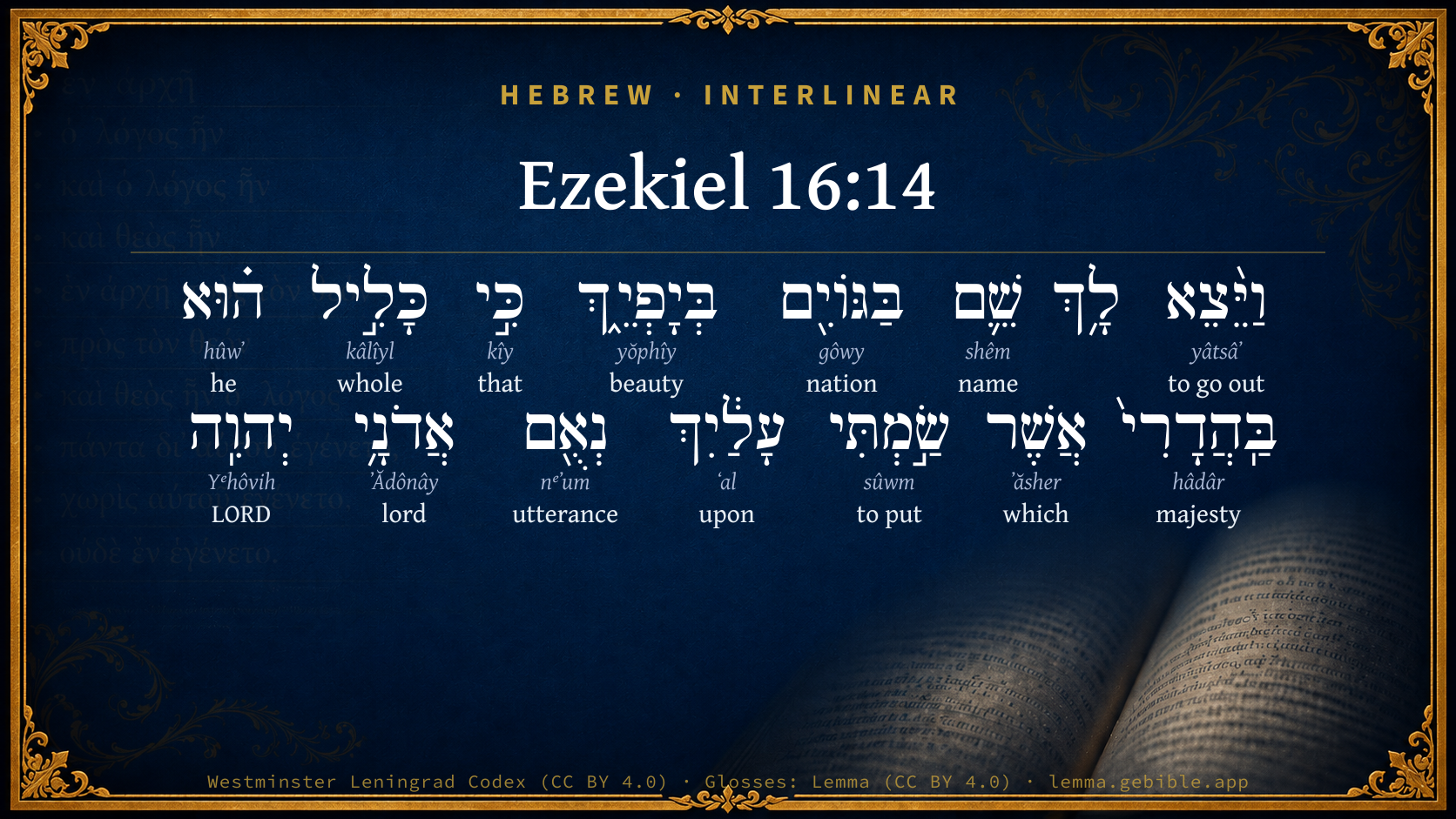
Hebrew (Westminster Leningrad Codex) Ezekiel 16:14 appears in the Hebrew Old Testament. The text above is from the Westminster Leningrad Codex. Each word links to its Strong’s number, a concise gloss, and parsing drawn from the Open Scriptures Hebrew Bible morphology. Click any word for its full Brown-Driver-Briggs (BDB) entry.
Download image
Cite this verse

Ezekiel 16:14 (World English Bible). Public Domain. Lemma interlinear Bible study tool, https://lemma.gebible.app/v/ezekiel/16/14.

Show BibTeX & RIS
BibTeX
RIS
English Translation
Your renown went forth among the nations for your beauty; for it was perfect, through my majesty which I had put on you, says the Lord Yahweh.
World English Bible · Public Domain
Download a study sheet

One document with this verse’s original text, its word-by-word gloss line, the meaning frame, cross-references with their text, attributed commentary, and full source and license credits — printable, and it pastes into notes with its structure intact.

This verse Autodidact and up

Study sheet (.html) Plain text (.txt)

A passage Seminary Student

Up to 50 verses in one chapter. A passage sheet keeps up to 6 commentary sources and 12 cross-references per verse, in the order this page ranks them, and says so on the sheet whenever that leaves anything out. Ask for a single verse and you get the Autodidact verse sheet above.

Everything on this page stays free to read, with no account — the sheet is a download of what is already on screen, not access to it.

Want to remove ads? Support Godless Engineer
Compare translations 3

The same verse in 3 English versions, stacked beneath the original-language interlinear above. Click any original word for its lexicon entry.

Each is an independent rendering of the whole verse — the interlinear is not word-aligned to these translations.

Highlighted words mark where these versions differ — a whole-verse word diff, not a word-by-word alignment.

  • World English Bible Public Domain
    Your renown went forth among the nations for your beauty; for it was perfect, through my majesty which I had put on you, says the Lord Yahweh.
  • King James Version Public Domain
    And thy renown went forth among the heathen for thy beauty: for it was perfect through my comeliness, which I had put upon thee, saith the Lord GOD.
  • unfoldingWord Literal Text CC BY-SA 4.0
    Your fame went out among the nations because of your beauty, for it was perfect in the majesty that I had given to you—this is the Lord Yahweh’s declaration.

unfoldingWord Literal Text — © unfoldingWord, licensed CC BY-SA 4.0. Word-aligned USFM3 via Door43 (git.door43.org/unfoldingWord/en_ult).

Versions to compare (up to 4)

3 of 4 selected

Show all 18 translations

Every available English version of this verse, each an independent rendering of the whole verse.

  • World English Bible Public Domain
    Your renown went forth among the nations for your beauty; for it was perfect, through my majesty which I had put on you, says the Lord Yahweh.
  • Berean Standard Bible Public Domain
    Your fame spread among the nations on account of your beauty, for it was perfect in the splendor I bestowed on you, declares the Lord GOD.
  • Majority Standard Bible Public Domain
    Your fame spread among the nations on account of your beauty, for it was perfect in the splendor I bestowed on you, declares the Lord GOD.
  • King James Version Public Domain
    And thy renown went forth among the heathen for thy beauty: for it was perfect through my comeliness, which I had put upon thee, saith the Lord GOD.
  • American Standard Version (1901) Public Domain
    And thy renown went forth among the nations for thy beauty; for it was perfect, through my majesty which I had put upon thee, saith the Lord Jehovah.
  • Revised Version (1885) Public Domain
    And thy renown went forth among the nations for thy beauty; for it was perfect through my majesty which I had put upon thee, saith the Lord GOD.
  • Geneva Bible (1599) Public Domain
    And thy name was spred among the heathen for thy beautie: for it was perfite through my beautie which I had set vpon thee, saith the Lord God.
  • Douay-Rheims (1899) Public Domain
    And thy renown went forth among the nations for thy beauty: for thou wast perfect through my beauty, which I had put upon thee, saith the Lord God.
  • Young's Literal Translation Public Domain
    And go forth doth thy name among nations, Because of thy beauty -- for it `is' complete, In My honour that I have set upon thee, An affirmation of the Lord Jehovah.
  • Literal Standard Version CC BY-SA 4.0
    And your name goes forth among nations, || Because of your beauty—for it [is] complete, || In My honor that I have set on you, || A declaration of Lord YHWH.
  • Unlocked Literal Bible CC BY-SA 4.0
    Your fame went out among the nations because of your beauty, for it was perfect in the majesty that I had given to you—this is the Lord Yahweh's declaration.
  • unfoldingWord Literal Text CC BY-SA 4.0
    Your fame went out among the nations because of your beauty, for it was perfect in the majesty that I had given to you—this is the Lord Yahweh’s declaration.
  • Darby Bible Public Domain
    And thy fame went forth among the nations for thy beauty; for it was perfect through my magnificence, which I had put upon thee, saith the Lord Jehovah.
  • World Messianic Bible Public Domain
    Your renown went out among the nations for your beauty; for it was perfect, through my majesty which I had put on you,” says the Lord GOD.
  • Webster's Bible Public Domain
    And thy renown went forth among the heathen for thy beauty: for it was perfect through my comeliness, which I had put upon thee, saith the Lord GOD.
  • Free Bible Version CC BY-SA 4.0
    You were famous around the world because of your beauty, for I used my majestic power to make you so wonderful, declares the Lord God.
  • Bible in Basic English Public Domain
    You were so beautiful that the story of you went out into all nations; you were completely beautiful because of my glory which I had put on you, says the Lord.
  • JPS Tanakh (1917) Public Domain
    And thy renown went forth among the nations for thy beauty; for it was perfect, through My splendour which I had put upon thee, saith the Lord GOD.

Literal Standard Version (2020), Covenant Press — licensed CC BY-SA 4.0. Text via the HelloAO Bible API (eBible.org). Unlocked Literal Bible (unfoldingWord) — licensed CC BY-SA 4.0. Text via the HelloAO Bible API (eBible.org). unfoldingWord Literal Text — © unfoldingWord, licensed CC BY-SA 4.0. Word-aligned USFM3 via Door43 (git.door43.org/unfoldingWord/en_ult). Free Bible Version, Dr. Jonathan Gallagher — licensed CC BY-SA 4.0. Text via the HelloAO Bible API (eBible.org).

Word by word

More ways to search: Search by grammar → Find every occurrence → Compare this word →

Practice this passage: Drill this verse → Learn its vocabulary →

כָּלִ֣יל
kâlîyl
H3632
“whole”
Adjective, Adjective, Masculine, Singular, Absolute
Part of Speech
Adjective
Type
Adjective
Gender
Masculine
Number
Singular
State
Absolute
Full BDB Definition

Origin: from H3634

TWOT: 985b

entire, all, perfect (adjective) - entirety (substantive) - whole, whole burnt offering, holocaust, entirety (substantive)
  1. וַיֵּ֨צֵא yâtsâʼ H3318 “and · to go out” Conjunction + Verb, Qal, Sequential Imperfect, 3rd Person, Masculine, Singular
  2. שֵׁ֛ם shêm H8034 “name” Noun, Common, Masculine, Singular, Absolute
  3. בַּגּוֹיִ֖ם gôwy H1471 “in/at the · nations” Preposition, Determined + Noun, Common, Masculine, Plural, Absolute
  4. בְּיָפְיֵ֑ךְ yŏphîy H3308 “in/at · beauty · your” Preposition + Noun, Common, Masculine, Singular, Construct + Suffix, Personal, 2nd Person, Feminine, Singular
  5. כִּ֣י kîy H3588 “that” Conjunction
  6. ה֗וּא hûwʼ H1931 “he” Pronoun, Personal, 3rd Person, Masculine, Singular
  7. בַּֽהֲדָרִי֙ hâdâr H1926 “in/at · majesty · my” Preposition + Noun, Common, Masculine, Singular, Construct + Suffix, Personal, 1st Person, Common, Singular
  8. אֲשֶׁר ʼăsher H834 “which” Particle, Relative
  9. שַׂ֣מְתִּי sûwm H7760 “to put” Verb, Qal, Perfect, 1st Person, Common, Singular
  10. עָלַ֔יִךְ ʻal H5921 “upon · you” Preposition + Suffix, Personal, 2nd Person, Feminine, Singular
  11. נְאֻ֖ם nᵉʼum H5002 “utterance of” Noun, Common, Masculine, Singular, Construct
  12. אֲדֹנָ֥י ʼĂdônây H136 “Lord · my” Noun, Common, Masculine, Plural, Construct + Suffix, Personal, 1st Person, Common, Singular
  13. יְהוִֽה Yᵉhôvih H3069 “LORD” Noun, Proper

About this verse

These counts appear in no published source. They are computed here, from the morphology-tagged text and Lemma’s own curated glosses. What Lemma adds →

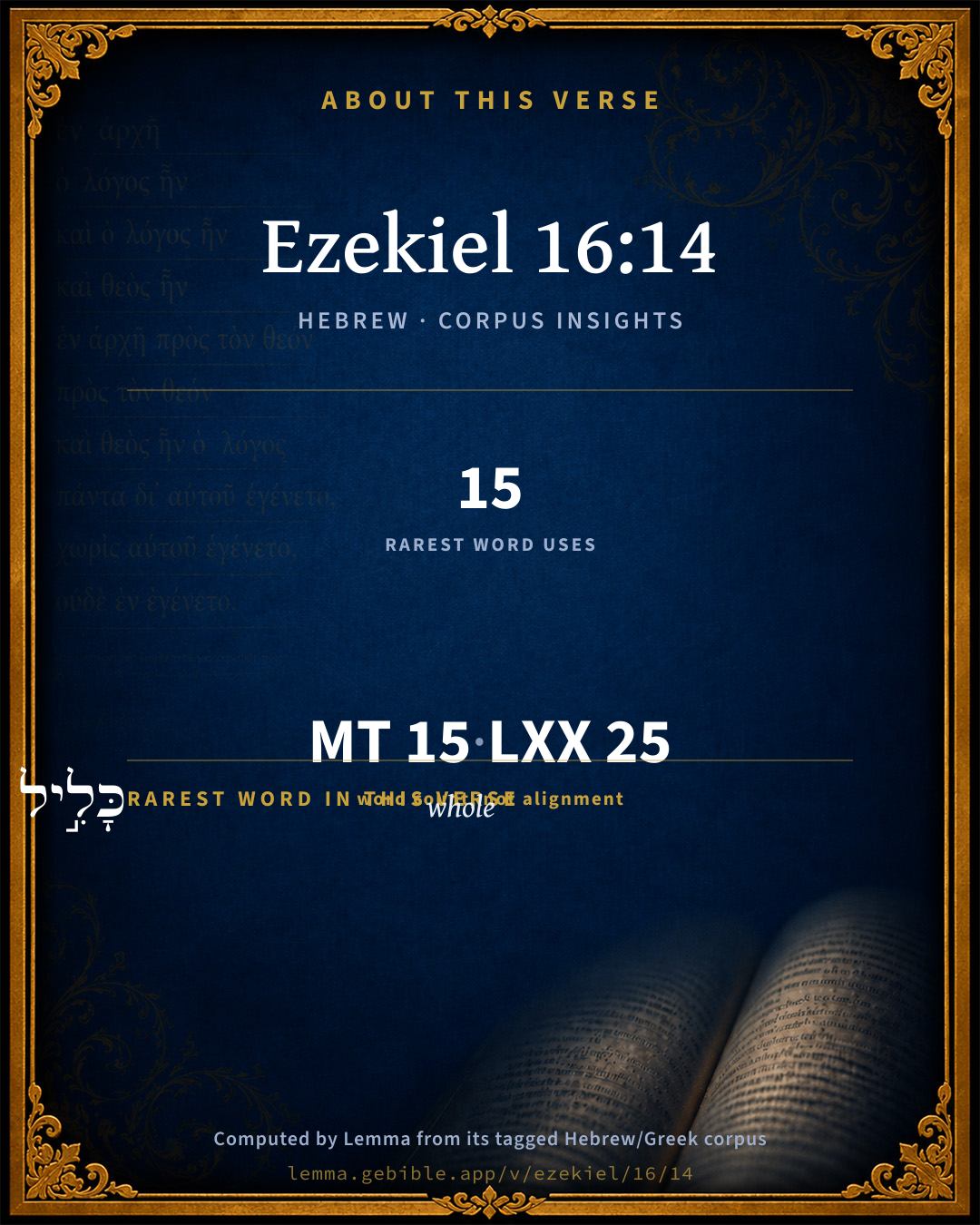
15
words
14
distinct lemmas
Prophets
section

Notable vocabulary

The rarest word here is כָּלִ֣יל whole H3632 — appearing just 15 times in the whole Hebrew Bible.

Shared distinctive vocabulary

כָּלִ֣יל whole H3632 occurs in 15 verses of the Hebrew Bible. Also found in:

Grammatical profile

  • 2 verbs
  • 7 nouns
  • 1 adjective
  • 1 pronoun
  • 2 prepositions
  • 1 conjunction
  • 1 particle

Verb forms

  • וַיֵּ֨צֵא Qal · Sequential Imperfect
  • שַׂ֣מְתִּי Qal · Perfect

Hebrew & Septuagint length

In English translation the verse runs 27 words from the Hebrew and 29 from the Septuagint (LXX English) — closely comparable.

A rough comparison of the two English renderings, which tokenize alike — not a word-level alignment.

Word counts can differ between the Hebrew and the Greek without any difference in meaning — e.g. the Hebrew direct-object marker אֵת has no separate Greek word, and Greek often adds the article ὁ.

In the original languages it is 15 Hebrew tokens and 25 Greek tokens — but the two are counted differently (Hebrew bundles its prefixes and suffixes into one token; the Greek is in lemma form), so that isn’t a like-for-like length.

Cross-references

10

Topical passages linked to Ezekiel 16:14 in the Treasury of Scripture Knowledge — connected by theme and wording, ordered by reader-vote popularity; previews shown in the World English Bible.

  • 1 Kings 10:24 All the earth sought the presence of Solomon, to hear his wisdom, which God had put in his heart.
  • Lamentations 2:15 All that pass by clap their hands at you; They hiss and wag their head at the daughter of Jerusalem, [saying], Is this the city that men called The perfection of beauty, The joy of the whole earth?
  • Deuteronomy 4:6–8 Keep therefore and do them; for this is your wisdom and your understanding in the sight of the peoples, who shall hear all these statutes, and say, Surely this great nation is a wise and understanding people.
  • 1 Corinthians 4:7 For who makes you different? And what do you have that you didn't receive? But if you did receive it, why do you boast as if you had not received it?
  • Deuteronomy 4:32–38 For ask now of the days that are past, which were before you, since the day that God created man on the earth, and from the one end of the sky to the other, whether there has been [any such thing] as this great thing is, or has been heard like it?
  • Joshua 2:9–11 and she said to the men, I know that Yahweh has given you the land, and that the fear of you is fallen on us, and that all the inhabitants of the land melt away before you.
  • Joshua 9:6–9 They went to Joshua to the camp at Gilgal, and said to him, and to the men of Israel, We are come from a far country: now therefore make you a covenant with us.
  • 1 Kings 10:1–13 When the queen of Sheba heard of the fame of Solomon concerning the name of Yahweh, she came to prove him with hard questions.
  • 2 Chronicles 2:11–12 Then Huram the king of Tyre answered in writing, which he sent to Solomon, Because Yahweh loves his people, he has made you king over them.
  • 2 Chronicles 9:23 All the kings of the earth sought the presence of Solomon, to hear his wisdom, which God had put in his heart.

Cross-references courtesy of OpenBible.info (CC BY 4.0).

Hebrew and Greek witnesses Masoretic Hebrew ↔ Greek Septuagint

The same verse in the two great witnesses to the Old Testament, shown verse-for-verse.

These are two independent witnesses, not word-aligned to each other, and the Septuagint is shown in lemma (dictionary) form.

Hebrew Ezekiel 16:14 Masoretic · Westminster Leningrad Codex

וַיֵּ֨צֵא לָ֥ךְ שֵׁ֛ם בַּגּוֹיִ֖ם בְּיָפְיֵ֑ךְ כִּ֣י כָּלִ֣יל ה֗וּא בַּֽהֲדָרִי֙ אֲשֶׁר שַׂ֣מְתִּי עָלַ֔יִךְ נְאֻ֖ם אֲדֹנָ֥י יְהוִֽה

Your renown went forth among the nations for your beauty; for it was perfect, through my majesty which I had put on you, says the Lord Yahweh.

World English Bible · Public Domain

Greek LXX Ezekiel 16:14 Septuagint · lemma form

καί ἐκἔρχομαι σύ ὄνομα ἐν ὁ ἔθνος ἐν ὁ κάλλος σύ διότι συντελέω εἰμί ἐν εὐπρέπεια ἐν ὁ ὡραιότης ὅς τάσσω ἐπί σύ λέγω κύριος

And your name went forth among the nations for your beauty: because it was perfected with elegance, and in the comeliness which I put upon you, says the Lord.

LXX2012 (modern English Septuagint) · Public Domain

Hebrew: Westminster Leningrad Codex (CC BY 4.0). Greek: Septuagint (public domain); English from LXX2012 (modern English Septuagint) (Public Domain). How the Septuagint differs from the Hebrew →

Targum (Aramaic paraphrase)

1

The Targum is the ancient Jewish Aramaic paraphrase of the Hebrew Scriptures — an interpretive translation, not the Hebrew text itself. Onkelos (literal) and Pseudo-Jonathan (expansive) render the Torah, and Jonathan the Prophets. Coverage is partial: where no permissively-licensed English translation exists for a verse, only the Aramaic is shown. This is verse-level text, not a word-by-word alignment to the Hebrew.

  1. Targum Jonathan Prophets (Joshua–Malachi)
    וּנְפַק לָךְ שׁוּם כְּנִשְׁתָּא דְיִשְׂרָאֵל בֵּינֵי עַמְמַיָא בְּשׁוּפְרַיִךְ אֲרֵי גְמִיר הוּא יְקָרִי דְשַׁוֵיתִי עָלַיִךְ אֲמַר יְיָ אֱלֹהִים:

    And your name went out, congregation of Israel, among the nations, in your beauty, for complete was My glory that I set upon you — said the LORD God.

    Targum Jonathan — Aramaic: “Mikraot Gedolot” (public domain). English: “Sefaria Community Translation” (CC0 1.0 (public-domain dedication)); “London "Chaldee Paraphrase," 1871” (public domain). Text via Sefaria.

Commentary

Notes on Ezekiel 16:14 from classic Christian and Jewish commentators (each source and its license shown beneath its notes). The classic Christian expositions comment on the surrounding passage and are grouped to its opening verse, so a note may address several verses; the Jewish commentaries on the Tanakh (Rashi and others) are per-verse, so they appear only where the commentator wrote on this verse.

Lemma curates 59 commentaries, every one of them public domain or Creative Commons licensed, each selected and text-cleaned for this edition rather than reprinted as found. About our sources →

Trapp's Complete Commentary

John Trapp

Eze 16:14 And thy renown went forth among the heathen for thy beauty: for it [was] perfect through my comeliness, which I had put upon thee, saith the Lord GOD.

Ver. 14. And thy renown went forth.] Pliny saith of Jerusalem that it was the most famous of all the cities of the East; of the world he might have said, all things considered.

Through the comeliness which I had put upon thee.] As Abraham’s servant put the jewels upon Rebekah. See on Eze 16:13. That is a famous canon {a} of the second Arausican council, Tales nos amat Deus, quales futuri sumus ipsius dono, non quales sumus nostro merito: God loveth us such as we shall be by his free gift, and not such as we are by our own merit.

{a} Canon 12.

John Trapp, A Commentary or Exposition upon All the Books of the Old and New Testament (1647–1656) — public domain. Text from a community e-Sword module.

Geneva Bible (1599)

Geneva Bible translators

He declareth wherein the dignity of Jerusalem stood: to wit, in that that the Lord gave them of his beauty and excellency.

Geneva Bible (1599) marginal notes — public domain. Text via Bolls.life.

Jamieson, Fausset & Brown

Robert Jamieson, A. R. Fausset & David Brown

thy renown . . . among . . . heathen--The theocracy reached its highest point under Solomon, when distant potentates heard of his "fame" (Kg1 10:1, &c.), for example, the queen of Sheba, Hiram, &c. (Lam 2:15).

my comeliness--It was not thine own, but imparted by Me.

Jamieson, Fausset & Brown — Commentary Critical and Explanatory on the Whole Bible (1871) — public domain (CC PDM 1.0). Text via the HelloAO Bible API.

John Calvin's Commentaries

Here the Prophet still continues to recite those blessings of God by which he had bound the people to himself. As to his saying, that its name had gone forth, it cannot be restricted to a short period; but it embraces a continued series of God’s favors until the people reached the highest point of happiness; and this happened under David. There is no doubt that God here means that he was so continually liberal towards the people that their fame became celebrated, for the name of the Israelites were spread far and wide; and God deservedly recounts their nobility or celebrity of fame among his benefits: hence he adds, on account of the beauty or elegance which I have placed upon thee, says he; because you was perfect through the ornament which I had placed upon thee. Here, therefore, God signifies that the people had not earned their fame by their own virtue, nor were they noble through their own native excellence, so to speak; but rather by ornament bestowed upon them. You, therefore, was of great name among the nations, said he. But wherein was that nobility and excellence? Certainly from my gifts. For nothing was accomplished by thyself so to arrive at a name and dignity more than royal. Through that ornament thy fame was spread abroad among the nations. But this enlargement must be noticed, since the people had not only experienced God’s goodness in that corner of Judea, but, when they ought to be content with their lot, were held in admiration and repute among foreigners. Now follows the reproof —

John Calvin's Commentaries (1540-1563) — public domain. Text from the Calvin Translation Society English edition (1840s-50s) via the Christian Classics Ethereal Library (ccel.org). Calvin's coverage is partial (roughly two-thirds of the Bible); uncommented books and verses are honest gaps, never fabricated. The 19th-century editor's footnotes and remarks are omitted so the notes are faithfully Calvin's own voice.

The Cambridge Bible for Schools and Colleges

gen. ed. J. J. S. Perowne

14. Her renown spread among the nations because of her beauty. In this is included partly the prosperity and success of the state, not without reference perhaps to the beauty of the city (Lam_2:15, the perfection of beauty, the joy of the whole earth, Psa_50:2), and of the land, which is often celebrated (ch. Eze_20:6; Eze_20:15 the glory of all lands, cf. Dan_8:9; Dan_11:16; Dan_11:41; Zec_7:14); and partly also the glory of a higher kind conferred on her by Jehovah and his presence, in the sense of Deu_4:6-8.

my comeliness] Or, my adornment; that given by me (Eze_16:10-13); hardly in the sense of Isa_60:1, that Jerusalem’s beauty was only a reflection of the glory of Jehovah, who was in the midst of her.

These verses allegorically set forth the second period of Israel’s history: her redemption by Jehovah from Egypt, his covenant with her to be her God, his leading her into the promised land, and making her the paramount power there, and loading her with all the riches of that good land. Other prophets with more simplicity have celebrated this early time, “I remember of thee the kindness of thy youth, the love of thine espousals; how thou wentest after me in the wilderness, in a land not sown” (Jer_2:2); “I found Israel like grapes in the wilderness; I saw your fathers as the firstripe on the fig tree at her first season” (Hos_9:10; cf. Deu_32:10).

The Cambridge Bible for Schools and Colleges (gen. ed. J. J. S. Perowne; Cambridge University Press, 1878–1918) — public domain. Text from a community e-Sword module.

John Gill's Exposition

But thou didst trust in thine own beauty,.... As the Jews did in external gifts bestowed upon them; in their outward prosperity and grandeur; in their riches, wealth, and wisdom; and in the extent of their dominions, as in the days of David and Solomon; and in such things men are apt to; put their trust and confidence, and to be elated with, and grow proud and haughty, as a woman because of her beauty: so some professors of religion trust in a form and profession of it; in speculative knowledge, and in outward duties and services; being unconcerned for inward purity and: holiness; and not trusting in the righteousness of Christ, the real beauty of saints:

and playedst the harlot because of thy renown; or "name" (b); which the Jews got among the nations round about them, for their wisdom, riches, and power; which was a snare unto them, as a woman's beauty is to her; and they were admired and courted, and complimented by their neighbours, and so drawn into idolatrous practices, as women into fornication and adultery by the admirers of them: idolatry, which is here meant, is frequently signified by playing the harlot, or by fornication and adultery: or "thou playedst the harlot in thy name" (c); alluding to the custom of harlots, notorious infamous ones, who used to set their names over the apartments, to direct men unto them; and so it may denote how famous and notorious the Jews were for their idolatries, and how impudent in them. Jarchi interprets this of the calf of the wilderness, and other idolatries which the tribe of Dan committed there; but it rather respects the idolatries committed from the times of Solomon to the captivity, which were many, and often repeated; and though sometimes a stop was put to them by pious princes, yet broke out again: so trusting in a man's own righteousness, or in any outward thing, is idolatry; and also false worship and superstitious observances:

and pouredst out thy fornication on everyone that passed by: which expresses the multitude of their idolatries; the measure of them, which ran over; the fondness they had for every idol of their neighbours; like a common strumpet, that prostitutes herself to everyone, not only to the men of her own place and city, but to all strangers and travellers; so the Jews, not content with the idols they had, embraced all that offered or their neighbours could furnish them with:

his it was; or "to him it was"; her desire, her lust, her fornication; everyone that passed by, that would might enjoy her; so the Jews were reader to fall in with every idol and every idolatrous practice. The Targum renders this clause,

"and it is not right for thee to do so;''

to commit and multiply idolatry.

(b) "propter nomen tuum", Pagninus, Montanus, Piscator. (c) "In nomine tuo", V. L. Munster, Tigurine version, Grotius; "super nomen tuum", Starckius; "cum nomine tuo", Junius & Tremellius.

John Gill's Exposition of the Whole Bible (1746–1763) — public domain (CC PDM 1.0). Text via the HelloAO Bible API.

Albert Barnes' Notes on the Bible

Perfect ... my comeliness - The comeliness was not natural, but the gift of God.

Albert Barnes' Notes on the Bible (1834–1885) — public domain. Text from a community e-Sword/MySword module.

Matthew Poole's English Annotations

Thy renown; thy name was great and honoured.

Among the heathen; not only next neighbours, but the uttermost ends of the earth, as it is said of the queen of Sheba, heard thereof.

For thy beauty; the excellent order of thy government, prosperity of thy country, riches of thy merchants, and abundance of thy peace.

Perfect; the best of any upon earth, no nations had such laws as they had, or God so near them; it was perfect in its kind.

My comeliness which I had put upon thee; the form of the civil government and its laws, the wisdom, justice, and courage of the governors, the due compliance of the governed, and the holiness, purity, and truth of their religion; all which concurred to make up this beauty, and it was that God put upon them, or set before them, Deu 4:7,8. The visible, outward, emblematic part of all was beautiful; the invisible, inward, and spiritual part was much more beautiful, and ought to be duly considered. Thus far what God did for her.

Matthew Poole's English Annotations on the Holy Bible (1683–1685) — public domain. Text from a community e-Sword/MySword module.

Whedon's Commentary on the Bible

Daniel D. Whedon

14. It was perfect through my comeliness — All the beauty of Israel which gave her renown among the nations came from Jehovah (Deu_4:6-8; Psa_50:2; Isa_60:1). Her deliverance from Egypt, her conquest of Palestine, her power and wealth under the early kings, and her gorgeous temple with all its splendor of sacrifice, making her “the glory of all lands” (Eze_20:6); all this “comeliness” or “adornment” was from Jehovah. (Compare Deu_32:10; Jer_2:2; Hos_10:10.)

Daniel D. Whedon (gen. ed.), Commentary on the Old and New Testaments (1874–1909) — public domain. Text from a community e-Sword module.

The Pulpit Commentary

It was perfect, etc. (compare the phrase, "perfection of beauty," in Psa_1:2; Lam_2:15, as applied to Jerusalem) The prophet, in the words, my comelinessmajesty (Revised Version) lays stress on the fact that that "perfection" was itself the gift of God.

The renown of Israel.

I THE NATURE OF THIS RENOWN.

1. The renown of great deliverance. The fame of the escape from Egypt and of the overthrow of Pharaoh"s host in the Red Sea spread over the neighbouring lands, so that when the wandering tribes reached the borders of Canaan, they were known as a people marvellously favoured by God. The renown of the redemption by Christ is less appreciated by those who do not share in that redemption. Still it exists. It is a great thing to be among those on whom God"s pity has taken effect, and who have been saved from spiritual destitution.

2. The renown of glorious victory. Israel had made her way safely through the wilderness in spite of the arrows of Amalek and the wiles of Moab. She had crossed the Jordan and conquered Canaan. Since then, though often in adversity, she had ill the main triumphed over her enemies. The history of the Church is a history of victory over opposition and persecution. Often the faithless people of God have had to suffer shame for their sins. Still, on the whole, there has been success and victory.

3. The renown of acquired splendour. It is the beauty of the bride that is renowned. The wealth and wisdom of Solomon brought renown to Israel. For us the renown of Israel is that of her religion the revelation of God that comes to us through her, and the beautiful stories of her saints and heroes. The Church of Christ has won such a renown through her "noble army of martyrs," and the charity and holiness of her less conspicuous children.

II THE SIGNIFICANCE OF THIS RENOWN.

1. It redounds to the glory of God. The bride of Ezekiel"s parable had been a wretched castaway. All her splendors of jewels and raiment came from the kindness of her rescuer. All the beauty of holiness in the saints of God is due to the grace of him who has redeemed them from a state of sin and ruin.

2. It attracts the admiration of men. Israel was envied and admired by the nations in the days of her prosperity. The true beauty and greatness of the Church win men to Christ, as her sin and shame hinder them. The gospel is preached by the renown of Christian lives. A good biography thus declares the truth on which the life it describes has been built.

3. It aggravates the shame of unfaithfulness. That so beautiful and famous a bride should degrade herself, and exchange renown for infamy by proving herself false to her husband, is most shameful. The old renown of beauty adds notoriety to the present disgrace of sin. Israel"s apostasy was the more scandalous because her previous condition had been famous. The fall of the Church would be doubly shameful after the glorious history of past achievements. Men who have borne a high character before the world will be marked with a stigma of the greatest contempt if they fall into notorious wickedness.

4. It preserves an ideal for restorations. The former glory may be recovered. We see in Christian history Types of character to which we should seek to restore the Church. Christ"s redemption will confer a higher beauty than that which was lost by Israel"s apostasy.

The Pulpit Commentary (1880–1919), ed. H.D.M. Spence-Jones & Joseph S. Exell — public domain. Text from a community e-Sword module.

John Wesley's Explanatory Notes

My comeliness - "That is, thro' the beauty of their holiness, as they were a people devoted to God. This was it that put a lustre upon all their other honours, and was indeed the perfection of their beauty. Sanctified souls are truly beautiful in God's sight, and they themselves may take the comfort of it. But God must have all the glory for whatever comeliness they have, it is that which God has put upon them."

John Wesley, Explanatory Notes Upon the Whole Bible (1754–1765) — public domain. Text via the GEBible commentary corpus.

Rashi

Rabbi Shlomo Yitzchaki (Rashi)

for it is all inclusive Heb. כָּלִיל, an expression of all-inclusive beauty (23:12). Another explanation: כִּי כָּלִיל הוּא, for it was perfect. Another explanation: כִּי כָּלִיל couronne in French, like (Lev. 21: 12): “crown (נֵזֶר),” which is translated כְּלִיל by Targum.

Rashi on the Tanakh — English translations: “The Judaica Press complete Tanach with Rashi, translated by A. J. Rosenberg” (CC BY 4.0); “Pentateuch with Rashi's commentary by M. Rosenbaum and A.M. Silbermann, 1929-1934” (public domain); “The Metsudah Tanach series, Lakewood, N.J” (CC BY 4.0); and “The Book of Joshua, Metsudah Publications, 1997” (CC BY 4.0). Text via Sefaria.

Lesson kit

Teaching starters — assembled from the data on this page, not authored interpretation. Every prompt links to the verse data it draws on. Edit before teaching.

Ezekiel, in the Prophets, opens this verse with 15 words (14 distinct Hebrew lemmas). Its most distinctive word is kâlîyl (“whole”). A historical commentator’s framing appears above. Read the whole chapter for the surrounding context.

Discussion questions

  1. The word kâlîyl carries the sense “whole.” How does it shape the verse?
  2. How does Exodus 28:31, which shares the word «whole», read alongside this verse?
  3. These translations render this verse differently; the difference is in the English rendering, not the original. What questions does that raise?
  4. «וַיֵּ֨צֵא» is a Qal Sequential Imperfect verb. How does that grammatical form shape the action described?
  5. Compare how Trapp's Complete Commentary and Geneva Bible (1599) read this verse. Where do they agree or differ?

Things to notice

Reading settings

Reading text

Shown beneath each verse's original-language words.

Old Testament
Old Testament edition

Read the OT as the Masoretic Hebrew (MT) or the Greek Septuagint (LXX).

English shown for the Greek Septuagint (in the Hebrew ↔ Greek comparison).

Comparing translations? Open the Compare panel on any verse page to stack up to four side by side.