
Exodus 34:17

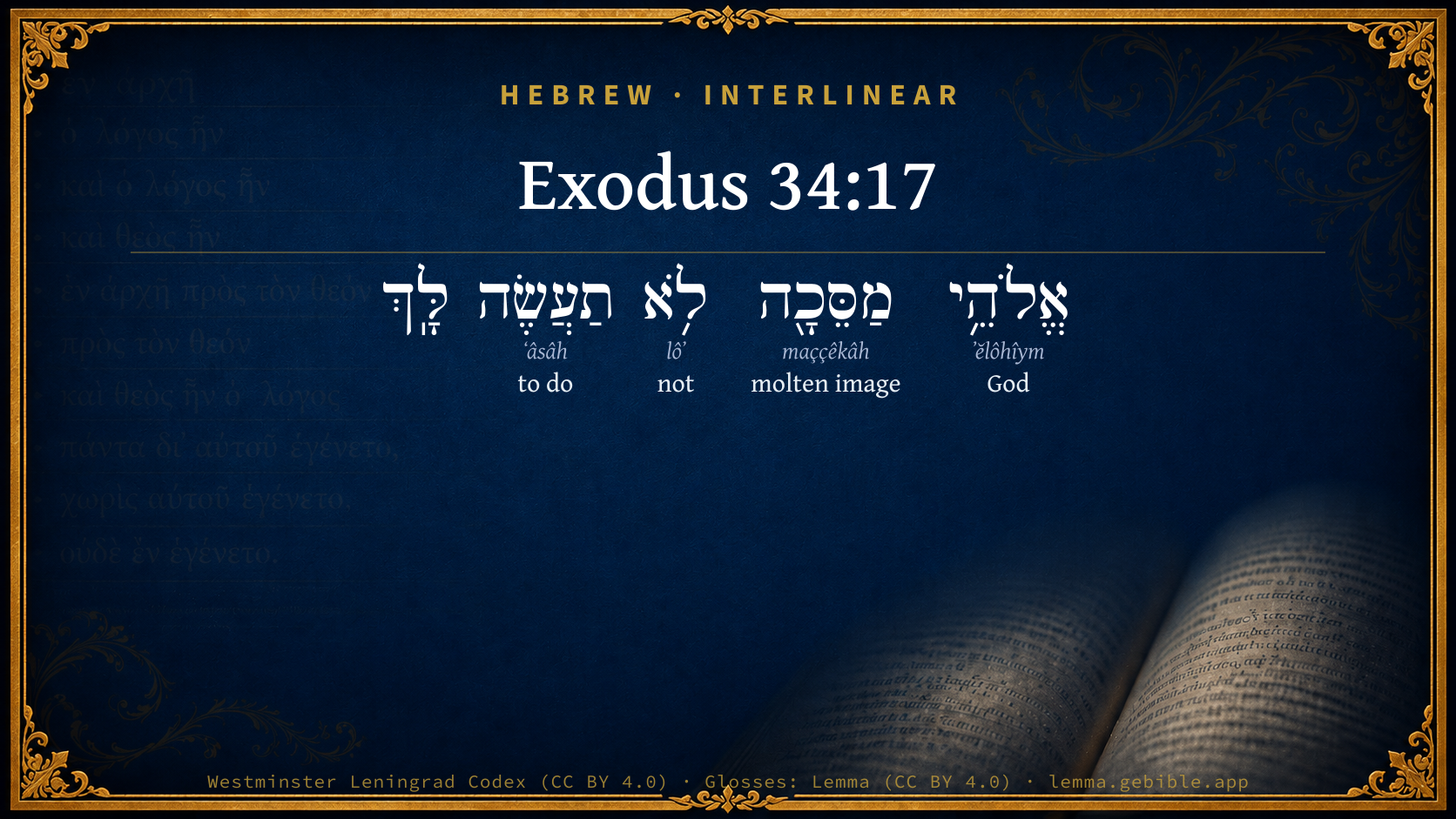
Hebrew (Westminster Leningrad Codex) Exodus 34:17 appears in the Hebrew Old Testament. The text above is from the Westminster Leningrad Codex. Each word links to its Strong’s number, a concise gloss, and parsing drawn from the Open Scriptures Hebrew Bible morphology. Click any word for its full Brown-Driver-Briggs (BDB) entry.
Download image
Cite this verse

Exodus 34:17 (World English Bible). Public Domain. Lemma interlinear Bible study tool, https://lemma.gebible.app/v/exodus/34/17.

Show BibTeX & RIS
BibTeX
RIS
English Translation
You shall make no cast idols for yourselves.
World English Bible · Public Domain
Download a study sheet

One document with this verse’s original text, its word-by-word gloss line, the meaning frame, cross-references with their text, attributed commentary, and full source and license credits — printable, and it pastes into notes with its structure intact.

This verse Autodidact and up

Study sheet (.html) Plain text (.txt)

A passage Seminary Student

Up to 50 verses in one chapter. A passage sheet keeps up to 6 commentary sources and 12 cross-references per verse, in the order this page ranks them, and says so on the sheet whenever that leaves anything out. Ask for a single verse and you get the Autodidact verse sheet above.

Everything on this page stays free to read, with no account — the sheet is a download of what is already on screen, not access to it.

Want to remove ads? Support Godless Engineer
Compare translations 3

The same verse in 3 English versions, stacked beneath the original-language interlinear above. Click any original word for its lexicon entry.

Each is an independent rendering of the whole verse — the interlinear is not word-aligned to these translations.

Highlighted words mark where these versions differ — a whole-verse word diff, not a word-by-word alignment.

  • World English Bible Public Domain
    You shall make no cast idols for yourselves.
  • King James Version Public Domain
    Thou shalt make thee no molten gods.
  • unfoldingWord Literal Text CC BY-SA 4.0
    Do not make for yourselves gods of molten metal.

unfoldingWord Literal Text — © unfoldingWord, licensed CC BY-SA 4.0. Word-aligned USFM3 via Door43 (git.door43.org/unfoldingWord/en_ult).

Versions to compare (up to 4)

3 of 4 selected

Show all 18 translations

Every available English version of this verse, each an independent rendering of the whole verse.

  • World English Bible Public Domain
    You shall make no cast idols for yourselves.
  • Berean Standard Bible Public Domain
    You shall make no molten gods for yourselves.
  • Majority Standard Bible Public Domain
    You shall make no molten gods for yourselves.
  • King James Version Public Domain
    Thou shalt make thee no molten gods.
  • American Standard Version (1901) Public Domain
    Thou shalt make thee no molten gods.
  • Revised Version (1885) Public Domain
    Thou shalt make thee no molten gods.
  • Geneva Bible (1599) Public Domain
    Thou shalt make thee no gods of metall.
  • Douay-Rheims (1899) Public Domain
    Thou shalt not make to thyself any molten gods.
  • Young's Literal Translation Public Domain
    a molten god thou dost not make to thyself.
  • Literal Standard Version CC BY-SA 4.0
    you do not make a molten god for yourself.
  • Unlocked Literal Bible CC BY-SA 4.0
    Do not make for yourselves gods of molten metal.
  • unfoldingWord Literal Text CC BY-SA 4.0
    Do not make for yourselves gods of molten metal.
  • Darby Bible Public Domain
    -- Thou shalt make thyself no molten gods.
  • World Messianic Bible Public Domain
    “You shall make no cast idols for yourselves.
  • Webster's Bible Public Domain
    Thou shalt make thee no molten gods.
  • Free Bible Version CC BY-SA 4.0
    Don't make any idols for yourselves.
  • Bible in Basic English Public Domain
    Make for yourselves no gods of metal.
  • JPS Tanakh (1917) Public Domain
    Thou shalt make thee no molten gods.

Literal Standard Version (2020), Covenant Press — licensed CC BY-SA 4.0. Text via the HelloAO Bible API (eBible.org). Unlocked Literal Bible (unfoldingWord) — licensed CC BY-SA 4.0. Text via the HelloAO Bible API (eBible.org). unfoldingWord Literal Text — © unfoldingWord, licensed CC BY-SA 4.0. Word-aligned USFM3 via Door43 (git.door43.org/unfoldingWord/en_ult). Free Bible Version, Dr. Jonathan Gallagher — licensed CC BY-SA 4.0. Text via the HelloAO Bible API (eBible.org).

Word by word

More ways to search: Search by grammar → Find every occurrence → Compare this word →

Practice this passage: Drill this verse → Learn its vocabulary →

מַסֵּכָ֖ה
maççêkâh
H4541
“molten image”
Noun, Common, Feminine, Singular, Absolute
Part of Speech
Noun
Type
Common
Gender
Feminine
Number
Singular
State
Absolute
Full BDB Definition

Origin: from H5258

TWOT: 1375c , 1376a

a pouring, libation, molten metal, cast image, drink offering - libation (with covenant sacrifice) - molten metal, molten image, molten gods - web, covering, veil, woven stuff
  1. אֱלֹהֵ֥י ʼĕlôhîym H430 “God(s) of” Noun, Common, Masculine, Plural, Construct
  2. לֹ֥א lôʼ H3808 “not” Particle, Negative
  3. תַעֲשֶׂה ʻâsâh H6213 “to do” Verb, Qal, Imperfect, 2nd Person, Masculine, Singular

About this verse

These counts appear in no published source. They are computed here, from the morphology-tagged text and Lemma’s own curated glosses. What Lemma adds →

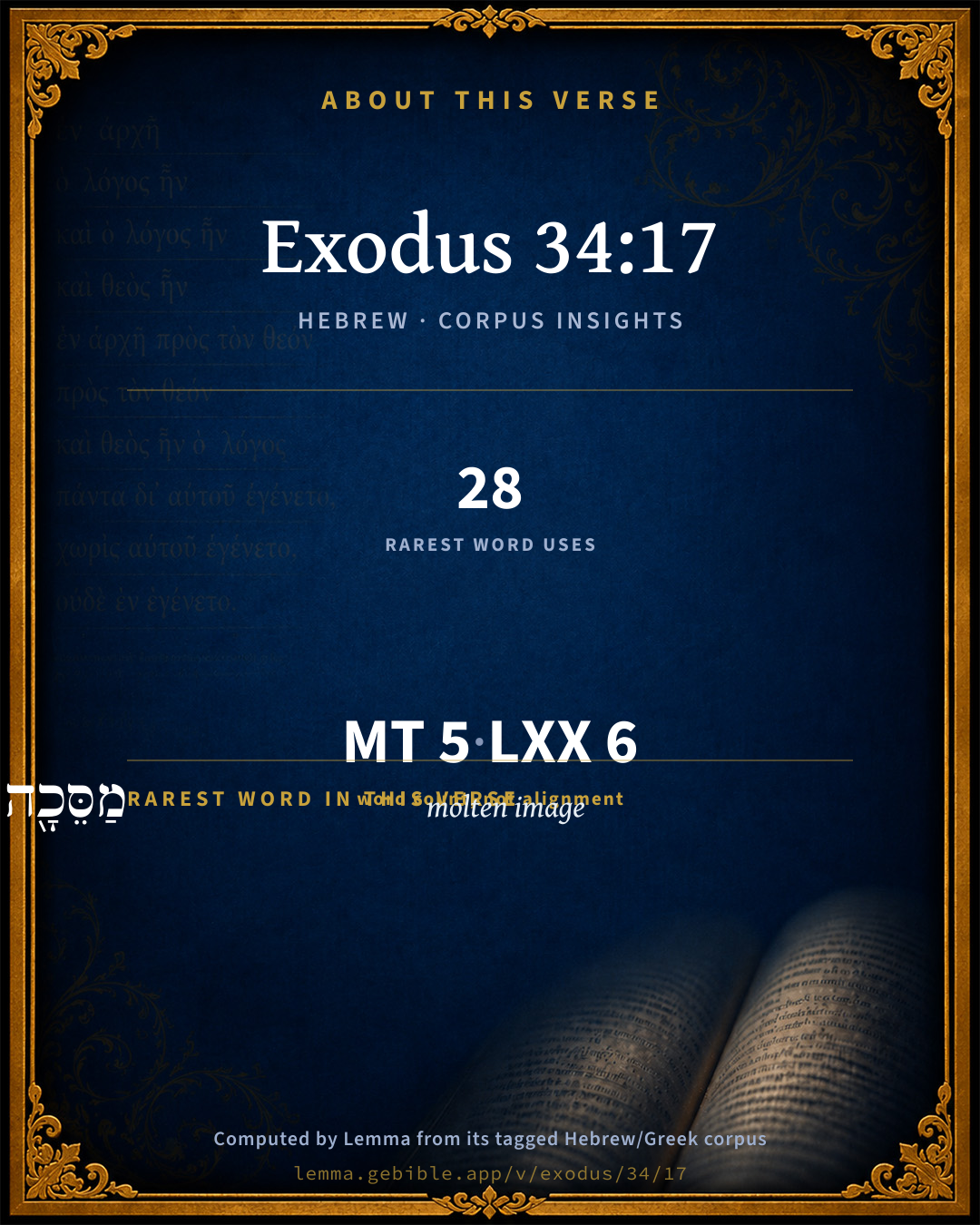
5
words
4
distinct lemmas
Pentateuch
section

Shared distinctive vocabulary

מַסֵּכָ֖ה molten image H4541 occurs in 28 verses of the Hebrew Bible. Also found in:

Grammatical profile

  • 1 verb
  • 2 nouns
  • 1 preposition
  • 1 particle

Verb forms

  • תַעֲשֶׂה Qal · Imperfect

Hebrew & Septuagint length

In English translation the verse runs 8 words from the Hebrew and 9 from the Septuagint (LXX English) — closely comparable.

A rough comparison of the two English renderings, which tokenize alike — not a word-level alignment.

Word counts can differ between the Hebrew and the Greek without any difference in meaning — e.g. the Hebrew direct-object marker אֵת has no separate Greek word, and Greek often adds the article ὁ.

In the original languages it is 5 Hebrew tokens and 6 Greek tokens — but the two are counted differently (Hebrew bundles its prefixes and suffixes into one token; the Greek is in lemma form), so that isn’t a like-for-like length.

Cross-references

6

Topical passages linked to Exodus 34:17 in the Treasury of Scripture Knowledge — connected by theme and wording, ordered by reader-vote popularity; previews shown in the World English Bible.

  • Leviticus 19:4 "'Don't turn to idols, nor make molten gods for yourselves. I am Yahweh your God.
  • Exodus 32:8 They have turned aside quickly out of the way which I commanded them. They have made themselves a molten calf, and have worshiped it, and have sacrificed to it, and said, 'These are your gods, Israel, which brought you up out of the land of Egypt.'"
  • Isaiah 46:6–7 Some pour out gold from the bag, and weigh silver in the balance. They hire a goldsmith, and he makes it a god. They fall down--yes, they worship.
  • Jeremiah 10:14 Every man is become brutish [and is] without knowledge; every goldsmith is disappointed by his engraved image; for his molten image is falsehood, and there is no breath in them.
  • Acts 17:29 Being then the offspring of God, we ought not to think that the Divine Nature is like gold, or silver, or stone, engraved by art and design of man.
  • Acts 19:26 You see and hear, that not at Ephesus alone, but almost throughout all Asia, this Paul has persuaded and turned away many people, saying that they are no gods, that are made with hands.

Cross-references courtesy of OpenBible.info (CC BY 4.0).

Hebrew and Greek witnesses Masoretic Hebrew ↔ Greek Septuagint

The same verse in the two great witnesses to the Old Testament, shown verse-for-verse.

These are two independent witnesses, not word-aligned to each other, and the Septuagint is shown in lemma (dictionary) form.

Hebrew Exodus 34:17 Masoretic · Westminster Leningrad Codex

אֱלֹהֵ֥י מַסֵּכָ֖ה לֹ֥א תַעֲשֶׂה לָּֽךְ

You shall make no cast idols for yourselves.

World English Bible · Public Domain

Greek LXX Exodus 34:17 Septuagint · lemma form

καί θεός χωνευτός οὐ ποιέω σεαυτοῦ

And you shall not make to yourself molten gods.

LXX2012 (modern English Septuagint) · Public Domain

Hebrew: Westminster Leningrad Codex (CC BY 4.0). Greek: Septuagint (public domain); English from LXX2012 (modern English Septuagint) (Public Domain). How the Septuagint differs from the Hebrew →

Targum (Aramaic paraphrase)

2

The Targum is the ancient Jewish Aramaic paraphrase of the Hebrew Scriptures — an interpretive translation, not the Hebrew text itself. Onkelos (literal) and Pseudo-Jonathan (expansive) render the Torah, and Jonathan the Prophets. Coverage is partial: where no permissively-licensed English translation exists for a verse, only the Aramaic is shown. This is verse-level text, not a word-by-word alignment to the Hebrew.

  1. Targum Onkelos Torah (Genesis–Deuteronomy)
    דַחֲלַן דְמַתְּכָא לָא תַעְבֵּד לָךְ:

    (no public-domain English translation for this verse)

    Targum Onkelos — Aramaic: “Onkelos Genesis” (public domain); “Onkelos Exodus” (public domain); “Onkelos Leviticus” (public domain); “Onkelos Numbers” (public domain); “Onkelos Deuteronomy” (public domain). English: “Sefaria Community Translation” (CC0 1.0 (public-domain dedication)); “J.W. Etheridge. The Targums of Onkelos and Jonathan Ben Uzziel on the Pentateuch. London: Longmans, Green, 1862” (public domain). Text via Sefaria.

  2. Targum Pseudo-Jonathan Torah (Genesis–Deuteronomy)
    דַּחֲלַן דְּמַתְּכָא לָא תַעְבְּדוּן לְכוֹן

    Molten gods you shall not make to you.

    Targum Pseudo-Jonathan — Aramaic: “Targum Jonathan on Genesis” (public domain); “Targum Jonathan on Exodus” (public domain); “Targum Jonathan on Leviticus” (public domain); “Targum Jonathan on Numbers” (public domain); “Targum Jonathan on Deuteronomy” (public domain). English: “The Targum of Jonathan ben Uzziel, trans. J. W. Etheridge, London, 1862” (public domain). Text via Sefaria.

Commentary

Notes on Exodus 34:17 from classic Christian and Jewish commentators (each source and its license shown beneath its notes). The classic Christian expositions comment on the surrounding passage and are grouped to its opening verse, so a note may address several verses; the Jewish commentaries on the Tanakh (Rashi and others) are per-verse, so they appear only where the commentator wrote on this verse.

Lemma curates 59 commentaries, every one of them public domain or Creative Commons licensed, each selected and text-cleaned for this edition rather than reprinted as found. About our sources →

Trapp's Complete Commentary

John Trapp

Exo 34:17 Thou shalt make thee no molten gods.

Ver. 17. No molten gods.] As the golden calf was. Goodly gods that are molten! Olim truncus eram. {a}

{a} Horat.

John Trapp, A Commentary or Exposition upon All the Books of the Old and New Testament (1647–1656) — public domain. Text from a community e-Sword module.

Geneva Bible (1599)

Geneva Bible translators

As gold, silver, brass, or anything that is molten: And herein is condemned all manner of idols, whatsoever they be made of.

Geneva Bible (1599) marginal notes — public domain. Text via Bolls.life.

Ellicott's Commentary for English Readers

(17) Thou shalt make thee no molten gods.—It is just possible that the Israelites when they worshipped the golden calf may have conceived that they were not breaking the second commandment, which forbade the adoration of any “graven image.” An express law was therefore made against “molten images.”

A Bible Commentary for English Readers, edited by Charles John Ellicott (1878–1897) — public domain. Text from a community e-Sword module.

The Cambridge Bible for Schools and Colleges

gen. ed. J. J. S. Perowne

17. Molten gods thou shalt not make thee] Cf. Lev_19:4 (H) ‘And molten gods ye shall not make you’; also, for the general thought, Exo_20:23.

Vv. 18–26 agree, for the most part verbally, with Exo_13:13-14; Exo_23:12; Exo_23:15-19. The agreements and differences will be seen most clearly, if the two recensions are printed in parallel columns, with the differences in 34 marked either by italics or, where anything is omitted, by a space in the text.

Exo_23:10-11. (The fallow year.)Exo_23:12. Six days shalt thou do thy work: but on the seventh day thou shalt desist: that thine ox and thine ass may rest, and the son of thy bondmaid, and the sojourner, may be refreshed.Exo_34:21. Six days shalt thou labour; but on the seventh day thou shalt desist: in plowing time and in harvest thou shalt desist.Exo_23:13. And in all things that I have said unto you take ye heed: and make no mention of the name of other gods, neither let it be heard upon thy mouth.Cf. Exo_34:14 a. For thou shalt not worship any other god.Exo_23:14. Three times (regâlim) thou shalt keep a feast unto me in the year.Exo_23:15 a. The feast of unleavened cakes shalt thou keep. Seven days thou shalt eat unleavened cakes, according as I commanded thee, at the appointed time in the month of Abib; for in it thou camest out from Egypt;Exo_34:18. The feast of unleavened cakes shalt thou keep. Seven days thou shalt eat unleavened cakes [Exo_13:6 a], as I commanded thee, at the appointed time in the month of Abib; for in the month of Abib thou camest out from Egypt.Exo_23:12. And thou shalt cause to pass over all that first openeth the womb unto Yahweh: and all that first openeth [the womb], the casting of beasts that thou shalt have, the males (shall be) Yahweh’s:Exo_34:19. All that first openeth the womb is mine: and all thy cattle that is male, that which first openeth [the womb] of ox and sheep:Exo_23:13. and all that which first openeth [the womb] of an ass thou shalt redeem with a lamb [or kid]; and if thou dost not redeem it, thou shalt break its neck: and all the first-born of men among thy sons thou shalt redeem.Exo_34:20. and that which first openeth [the womb] of an ass thou shalt redeem with a lamb [or kid]; and if thou dost not redeem it, thou shalt break its neck: all the first-born of thy sons thou shalt redeem.[Cf. Exo_22:29 b The first-born of thy sons thou shalt give unto me.]Exo_23:15 b … and none shall appear before me empty.And none shall appear before me empty.Exo_23:16 … and the feast of harvest, the firstfruits of thy labours which thou sowest in the field; and the feast of ingathering at the going out of the year, when thou gatherest in thy labours out of the field.Exo_34:22. And the feast of weeks thou shalt hold thee, the firstfruits of wheat harvest; and the feast of ingathering at the close of the year.Exo_23:17. Three times (pe‘âmim) in the year shall all thy males appear before (אל פני) the Lord Yahweh.Exo_34:23. Three times (pe‘âmim) in the year shall all thy males appear before (פני את) the Lord Yahweh, the God of Israel. 24. For I will dispossess nations before thee, and enlarge thy border; and no man shall desire thy land, when thou goest up to appear before (פניאת) Yahweh thy God, three times in the year.Exo_23:18. Thou shalt not sacrifice with leavened bread the blood of my sacrifice; neither shall there remain all night the fat of my feast until morning.Exo_34:25. Thou shalt not slaughter with leavened bread the blood of my sacrifice: neither shall there remain all night unto the morning the sacrifice of the feast of the passover.Exo_23:19. The first of the firstfruits of thy ground thou shalt bring unto the house of Yahweh thy God. Thou shalt not boil a kid in its mother’s milk.Exo_34:26. The first of the firstfruits of thy ground thou shalt bring unto the house of Yahweh thy God. Thou shalt not boil a kid in its mother’s milk.These are evidently two recensions of one and the same collection of laws. Neither can well be throughout in its original order, and later additions have almost certainly been introduced into both, Exo_34:21 is obviously, where it stands, out of place, and is in a much better position in Exo_23:12, Exo_23:12 b and Exo_34:21 b look like explanatory additions made to the same original law by two different compilers (comp. Exo_20:11 with Deu_5:14 last clause, 15). Exo_23:13 (see note ad loc.) reads like the conclusion of some collection of laws, no longer in its original place. Exo_23:14; Exo_23:17 would hardly both stand in a document written by a single hand: probably Exo_23:17 has been introduced from Exo_34:23. In Exo_23:15 the words from Seven days to appear before me empty leave v. 16 without a verb to govern it (in the ||, Exo_34:22, there is a fresh verb); and have probably been introduced here from Exo_34:18, Exo_34:19-20 (to redeem) seems to interrupt the connexion where it stands, and to be interpolated between Exo_23:15 a and 15b: on the other hand, the first clause of Exo_34:19 seems in form more original than the first clause of Exo_13:12, Exo_34:24 is pretty clearly a reflection of the compiler. The two recensions are derived evidently from a common original; but we cannot in all cases say how the differences between them arose. For notes upon the passage as a whole, the reader is referred to chs. 13 and 23: it will be sufficient here to comment on the more important expressions peculiar to ch. 34.

The Cambridge Bible for Schools and Colleges (gen. ed. J. J. S. Perowne; Cambridge University Press, 1878–1918) — public domain. Text from a community e-Sword module.

John Gill's Exposition

Thou shalt make thee no molten gods. Made of a melted liquid, whether gold, or silver, or brass, poured into a mould; and though graven images are not mentioned, they are included, a part being put for the whole, as appears not only from the injunction to break images in general, whether graven or molten, Exo 34:13 but from the second command, which expressly forbids the making and worshipping of them; but "molten" ones are particularly mentioned, because it is probable they were chiefly such the Canaanites worshipped, and especially, because the calf the Israelites had lately made and worshipped was a molten one.

but from the second command, which expressly forbids the making and worshipping of them; but "molten" ones are particularly mentioned, because it is probable they were chiefly such the Canaanites worshipped, and especially, because the calf the Israelites had lately made and worshipped was a molten one.

Exodus 34:18

exo 34:18

exo 34:18

exo 34:18The feast of unleavened bread shalt thou keep,.... Which was instituted at the time of their coming out of Egypt, and on that account, and then observed, Exo 12:15 and afterwards repeated, and the month expressed in which they were to keep it, and the reason of it, as it here follows; see Gill on Exo 13:15.

John Gill's Exposition of the Whole Bible (1746–1763) — public domain (CC PDM 1.0). Text via the HelloAO Bible API.

Matthew Poole's English Annotations

Nor graven, nor any other, as it plainly appears both from the nature of the things, and from many parallel scriptures; but he mentions molten, because their late idol was of that kind.

Matthew Poole's English Annotations on the Holy Bible (1683–1685) — public domain. Text from a community e-Sword/MySword module.

The Pulpit Commentary

Thou shalt make thee no molten gods. An express allusion to the recent sin of the golden calf.

The Pulpit Commentary (1880–1919), ed. H.D.M. Spence-Jones & Joseph S. Exell — public domain. Text from a community e-Sword module.

Keil & Delitzsch

C. F. Keil & F. Delitzsch

The true way to worship Jehovah is then pointed out, first of all negatively, in the prohibition against making molten images, with an allusion to the worship of the golden calf, as evinced by the use of the expression מסּכה אלהי, which only occurs again in Lev 19:4, instead of the phrase "gods of silver and gold" (Exo 20:23); and then positively, by a command to observe the feast of Mazzoth and the consecration of the first-born connected with the Passover (see at Exo 13:2, Exo 13:11, and Exo 13:12), also the Sabbath (Exo 34:21), the feasts of Weeks and Ingathering, the appearance of the male members of the nation three times a year before the Lord (Exo 34:22, see at Exo 23:14-17), together with all the other instructions connected with them (Exo 34:25, Exo 34:26). Before the last, however, the promise is introduced, that after the expulsion of the Canaanites, Jehovah would enlarge the borders of Israel (cf. Exo 23:31), and make their land so secure, that when they went up to the Lord three times in the year, no one should desire their land, sc., because of the universal dread of the might of their God (Exo 23:27).

Keil & Delitzsch — Biblical Commentary on the Old Testament (1861–1891) — public domain (CC PDM 1.0). Text via the HelloAO Bible API. (Old Testament only.)

Lesson kit

Teaching starters — assembled from the data on this page, not authored interpretation. Every prompt links to the verse data it draws on. Edit before teaching.

Exodus, in the Pentateuch, opens this verse with 5 words (4 distinct Hebrew lemmas). Its most distinctive word is maççêkâh (“molten image”). A historical commentator’s framing appears above. Read the whole chapter for the surrounding context.

Discussion questions

  1. How does “molten image” (maççêkâh) shape what this verse is saying?
  2. How does Exodus 32:4, which shares the word «molten image», read alongside this verse?
  3. The translations on this page render this verse differently — a whole-verse word diff, not a word-by-word alignment. What might account for the different wordings?
  4. «תַעֲשֶׂה» is a Qal Imperfect verb. How does that grammatical form shape the action described?
  5. Compare how Trapp's Complete Commentary and Geneva Bible (1599) read this verse. Where do they agree or differ?

Things to notice

Reading settings

Reading text

Shown beneath each verse's original-language words.

Old Testament
Old Testament edition

Read the OT as the Masoretic Hebrew (MT) or the Greek Septuagint (LXX).

English shown for the Greek Septuagint (in the Hebrew ↔ Greek comparison).

Comparing translations? Open the Compare panel on any verse page to stack up to four side by side.