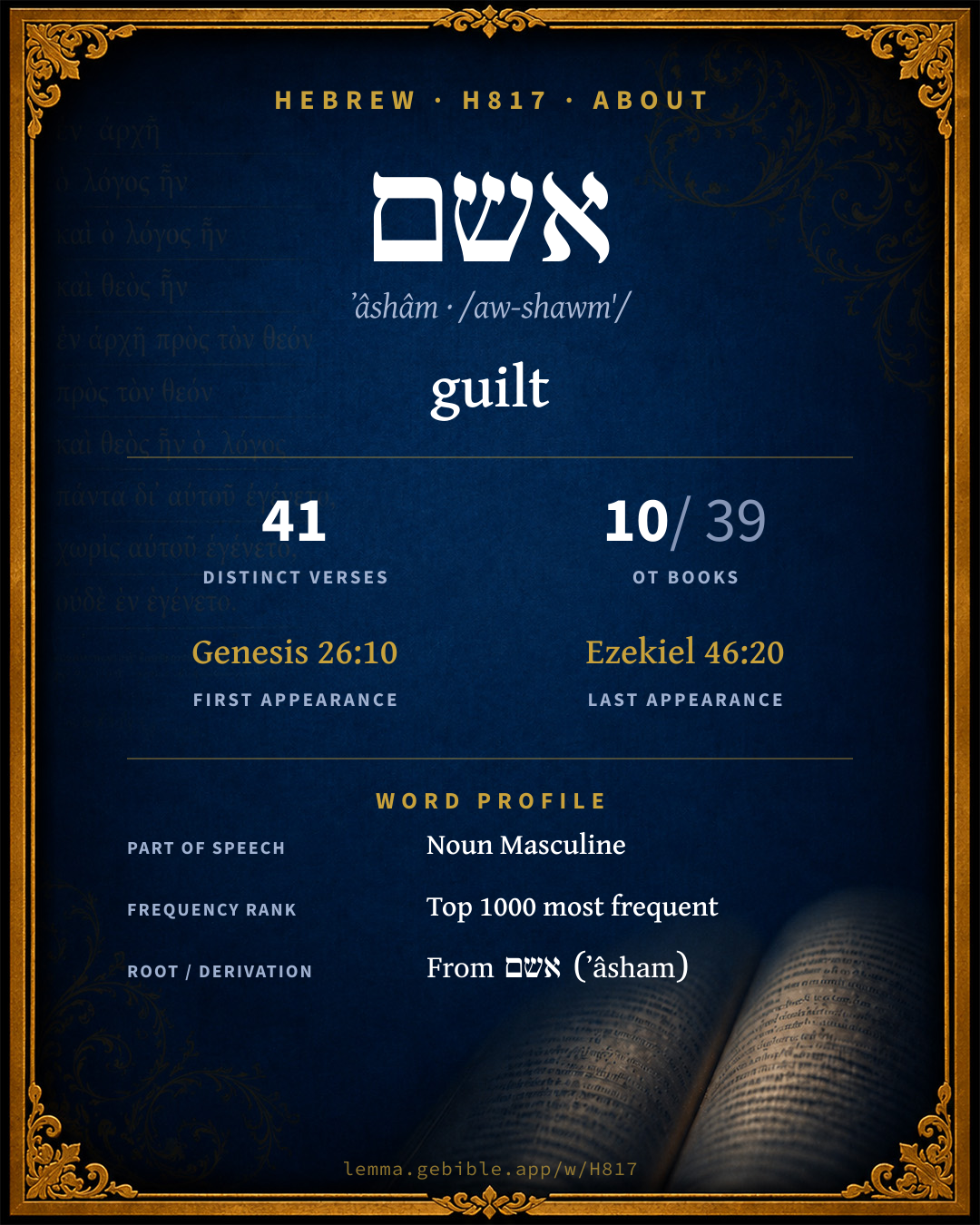
אָשָׁם
guilt
also: offense, guiltiness fuller range ↓
Full lexicon entry — Brown-Driver-Briggs (BDB)
From Brown-Driver-Briggs (BDB)
Where this word appears
See every Absolute-state word in the Hebrew Bible →
Grammar key — what these labels mean
Part of speech
- Noun
- A naming word — a person, place, thing, or idea.
Noun type
- Common
- A common noun — a general class of person, place, or thing (“king,” “city,” “water”), not a specific name.
State
- Absolute
- The independent form of a noun, not bound to a following word.
- Construct
- A noun bound to a following noun in a possessive / “of” relationship (the construct chain).
Gender
- Masculine
- Grammatically masculine.
Number
- Singular
- One.
- Plural
- More than one (in Hebrew, generally three or more).
Grammatical forms
- Noun, Common, Masculine, Singular, Absolute 38 times (83%)
- Noun, Common, Masculine, Singular, Construct 7 times (15%)
- Noun, Common, Masculine, Plural, Construct 1 time (2%)
Parsed forms decoded from the imported morphology (morphhb / Westminster Leningrad Codex — WLC text public domain, morphhb tagging CC BY 4.0), counted across 46 parsed occurrences — not distinct verses.
Every verse where H817 appears — 41 distinct verses across 10 books. Click any verse to open its interlinear word-by-word view. Verse text shown in the World English Bible for context — . Each verse’s Hebrew form is shown with its reference; the English is not keyword-highlighted, since the data carries no word-level English alignment. Use “Compare translations” on any verse to read it across multiple English versions. This concordance covers the Hebrew Bible; Septuagint (Greek Old Testament) occurrences are not indexed here.
Genesis 1 verse
Leviticus 23 verses
- Leviticus 5:6 אֲשָׁמ֣/וֹ n c ms cs + sfx pers 3ms and he shall bring his trespass offering to Yahweh for his sin which he has sinned, a female from the flock, a lamb or a goat, for a sin offering; and the priest shall make atonement for him concerning his sin.
- Leviticus 5:7 אֲשָׁמ֜/וֹ n c ms cs + sfx pers 3ms "'If he can't afford a lamb, then he shall bring his trespass offering for that in which he has sinned, two turtledoves, or two young pigeons, to Yahweh; one for a sin offering, and the other for a burnt offering.
- Leviticus 5:15 אֲשָׁמ֨/וֹ לְ/אָשָֽׁם n c ms cs + sfx pers 3ms prep + n c ms "If anyone commits a trespass, and sins unwittingly, in the holy things of Yahweh; then he shall bring his trespass offering to Yahweh, a ram without blemish from the flock, according to your estimation in silver by shekels, after the shekel of the sanctuary, for a trespass offering.
- Leviticus 5:16 הָ/אָשָׁ֖ם ptcl def.art + n c ms He shall make restitution for that which he has done wrong in the holy thing, and shall add a fifth part to it, and give it to the priest; and the priest shall make atonement for him with the ram of the trespass offering, and he will be forgiven.
- Leviticus 5:18 לְ/אָשָׁ֖ם prep + n c ms He shall bring a ram without blemish from of the flock, according to your estimation, for a trespass offering, to the priest; and the priest shall make atonement for him concerning the thing in which he sinned and didn't know it, and he will be forgiven.
- Leviticus 5:19 אָשָׁ֖ם n c ms It is a trespass offering. He is certainly guilty before Yahweh."
- Leviticus 6:6 אֲשָׁמ֥/וֹ לְ/אָשָׁ֖ם n c ms cs + sfx pers 3ms prep + n c ms He shall bring his trespass offering to Yahweh, a ram without blemish from the flock, according to your estimation, for a trespass offering, to the priest.
- Leviticus 6:17 וְ/כָ/אָשָֽׁם conj + prep det + n c ms It shall not be baked with yeast. I have given it as their portion of my offerings made by fire. It is most holy, as the sin offering, and as the trespass offering.
- Leviticus 7:1 הָ/אָשָׁ֑ם ptcl def.art + n c ms "'This is the law of the trespass offering. It is most holy.
- Leviticus 7:2 הָ/אָשָׁ֑ם ptcl def.art + n c ms In the place where they kill the burnt offering, he shall kill the trespass offering; and its blood he shall sprinkle on the altar round about.
- Leviticus 7:5 אָשָׁ֖ם n c ms and the priest shall burn them on the altar for an offering made by fire to Yahweh: it is a trespass offering.
- Leviticus 7:7 כָּֽ/אָשָׁ֔ם prep det + n c ms "'As is the sin offering, so is the trespass offering; there is one law for them. The priest who makes atonement with them shall have it.
- Leviticus 7:37 וְ/לָ/אָשָׁ֑ם conj + prep det + n c ms This is the law of the burnt offering, of the meal offering, and of the sin offering, and of the trespass offering, and of the consecration, and of the sacrifice of peace offerings;
- Leviticus 14:12 לְ/אָשָׁ֖ם prep + n c ms "The priest shall take one of the male lambs, and offer him for a trespass offering, with the log of oil, and wave them for a wave offering before Yahweh.
- Leviticus 14:13 הָ/אָשָׁ֥ם ptcl def.art + n c ms He shall kill the male lamb in the place where they kill the sin offering and the burnt offering, in the place of the sanctuary; for as the sin offering is the priest's, so is the trespass offering. It is most holy.
- Leviticus 14:14 הָ/אָשָׁם֒ ptcl def.art + n c ms The priest shall take some of the blood of the trespass offering, and the priest shall put it on the tip of the right ear of him who is to be cleansed, and on the thumb of his right hand, and on the big toe of his right foot.
- Leviticus 14:17 הָ/אָשָֽׁם ptcl def.art + n c ms The priest shall put some of the rest of the oil that is in his hand on the tip of the right ear of him who is to be cleansed, and on the thumb of his right hand, and on the big toe of his right foot, upon the blood of the trespass offering.
- Leviticus 14:21 אָשָׁ֛ם n c ms "If he is poor, and can't afford so much, then he shall take one male lamb for a trespass offering to be waved, to make atonement for him, and one tenth of an ephah of fine flour mingled with oil for a meal offering, and a log of oil;
- Leviticus 14:24 הָ/אָשָׁ֖ם ptcl def.art + n c ms The priest shall take the lamb of the trespass offering, and the log of oil, and the priest shall wave them for a wave offering before Yahweh.
- Leviticus 14:25 הָֽ/אָשָׁם֒ הָֽ/אָשָׁ֔ם ptcl def.art + n c ms ptcl def.art + n c ms He shall kill the lamb of the trespass offering. The priest shall take some of the blood of the trespass offering and put it on the tip of the right ear of him who is to be cleansed, and on the thumb of his right hand, and on the big toe of his right foot.
- Leviticus 14:28 הָ/אָשָֽׁם ptcl def.art + n c ms Then the priest shall put some of the oil that is in his hand on the tip of the right ear of him who is to be cleansed, and on the thumb of his right hand, and on the big toe of his right foot, on the place of the blood of the trespass offering.
- Leviticus 19:21 אֲשָׁמ/וֹ֙ אָשָֽׁם n c ms cs + sfx pers 3ms n c ms He shall bring his trespass offering to Yahweh, to the door of the Tent of Meeting, even a ram for a trespass offering.
- Leviticus 19:22 הָֽ/אָשָׁם֙ ptcl def.art + n c ms The priest shall make atonement for him with the ram of the trespass offering before Yahweh for his sin which he has committed: and the sin which he has committed shall be forgiven him.
Numbers 4 verses
- Numbers 5:7 אֲשָׁמ/וֹ֙ n c ms cs + sfx pers 3ms then he shall confess his sin which he has done, and he shall make restitution for his guilt in full, and add to it the fifth part of it, and give it to him in respect of whom he has been guilty.
- Numbers 5:8 הָ/אָשָׁם֙ הָ/אָשָׁ֛ם ptcl def.art + n c ms ptcl def.art + n c ms But if the man has no kinsman to whom restitution may be made for the guilt, the restitution for guilt which is made to Yahweh shall be the priest's; besides the ram of the atonement, by which atonement shall be made for him.
- Numbers 6:12 לְ/אָשָׁ֑ם prep + n c ms He shall separate to Yahweh the days of his separation, and shall bring a male lamb a year old for a trespass offering; but the former days shall be void, because his separation was defiled.
- Numbers 18:9 אֲשָׁמָ/ם֙ n c ms cs + sfx pers 3mp This shall be your of the most holy things, [reserved] from the fire: every offering of theirs, even every meal-offering of theirs, and every sin-offering of theirs, and every trespass-offering of theirs, which they shall render to me, shall be most holy for you and for your sons.
1 Samuel 4 verses
- 1 Samuel 6:3 אָשָׁ֑ם n c ms They said, "If you send away the ark of the God of Israel, don't send it empty; but by all means return him a trespass-offering: then you shall be healed, and it shall be known to you why his hand is not removed from you."
- 1 Samuel 6:4 הָ/אָשָׁם֮ ptcl def.art + n c ms Then they said, "What shall be the trespass-offering which we shall return to him?" They said, "Five golden tumors, and five golden mice, [according to] the number of the lords of the Philistines; for one plague was on you all, and on your lords.
- 1 Samuel 6:8 אָשָׁ֔ם n c ms and take the ark of Yahweh, and lay it on the cart; and put the jewels of gold, which you return him for a trespass-offering, in a coffer by the side of it; and send it away, that it may go.
- 1 Samuel 6:17 אָשָׁ֖ם n c ms These are the golden tumors which the Philistines returned for a trespass-offering to Yahweh: for Ashdod one, for Gaza one, for Ashkelon one, for Gath one, for Ekron one;
2 Kings 1 verse
Psalms 1 verse
Proverbs 1 verse
Isaiah 1 verse
Jeremiah 1 verse
Ezekiel 4 verses
- Ezekiel 40:39 וְ/הָ/אָשָֽׁם conj + ptcl def.art + n c ms In the porch of the gate were two tables on this side, and two tables on that side, to kill thereon the burnt offering and the sin-offering and the trespass-offering.
- Ezekiel 42:13 וְ/הָ/אָשָׁ֔ם conj + ptcl def.art + n c ms Then said he to me, The north chambers and the south chambers, which are before the separate place, they are the holy chambers, where the priests who are near to Yahweh shall eat the most holy things: there shall they lay the most holy things, and the meal-offering, and the sin-offering, and the trespass-offering; for the place is holy.
- Ezekiel 44:29 וְ/הָ/אָשָׁ֔ם conj + ptcl def.art + n c ms They shall eat the meal-offering, and the sin-offering, and the trespass-offering; and every devoted thing in Israel shall be theirs.
- Ezekiel 46:20 הָ/אָשָׁ֖ם ptcl def.art + n c ms He said to me, This is the place where the priests shall boil the trespass-offering and the sin-offering, [and] where they shall bake the meal-offering; that they not bring them forth into the outer court, to sanctify the people.
About this entry
At a glance — auto-summarized from this page’s data, not written by a person. Every figure links to its source below. This summary describes the numbers; it doesn’t interpret them.
At its core, אשם (ʼâshâm) means “guilt.” Its uses cluster heavily in Leviticus (56% of all occurrences). Spanning 41 verses in 10 books, it ranks among the moderately common words of the Hebrew Bible. Alongside “guilt” the lexicon also lists “offense” and “guiltiness” — part of its full sense range. Older and newer Bibles part ways — “trespass offering” in the King James Version, “guilt offering” (Berean Standard Bible) in modern versions. See the renderings breakdown. Each statement above links to its evidence; the full detail follows below.
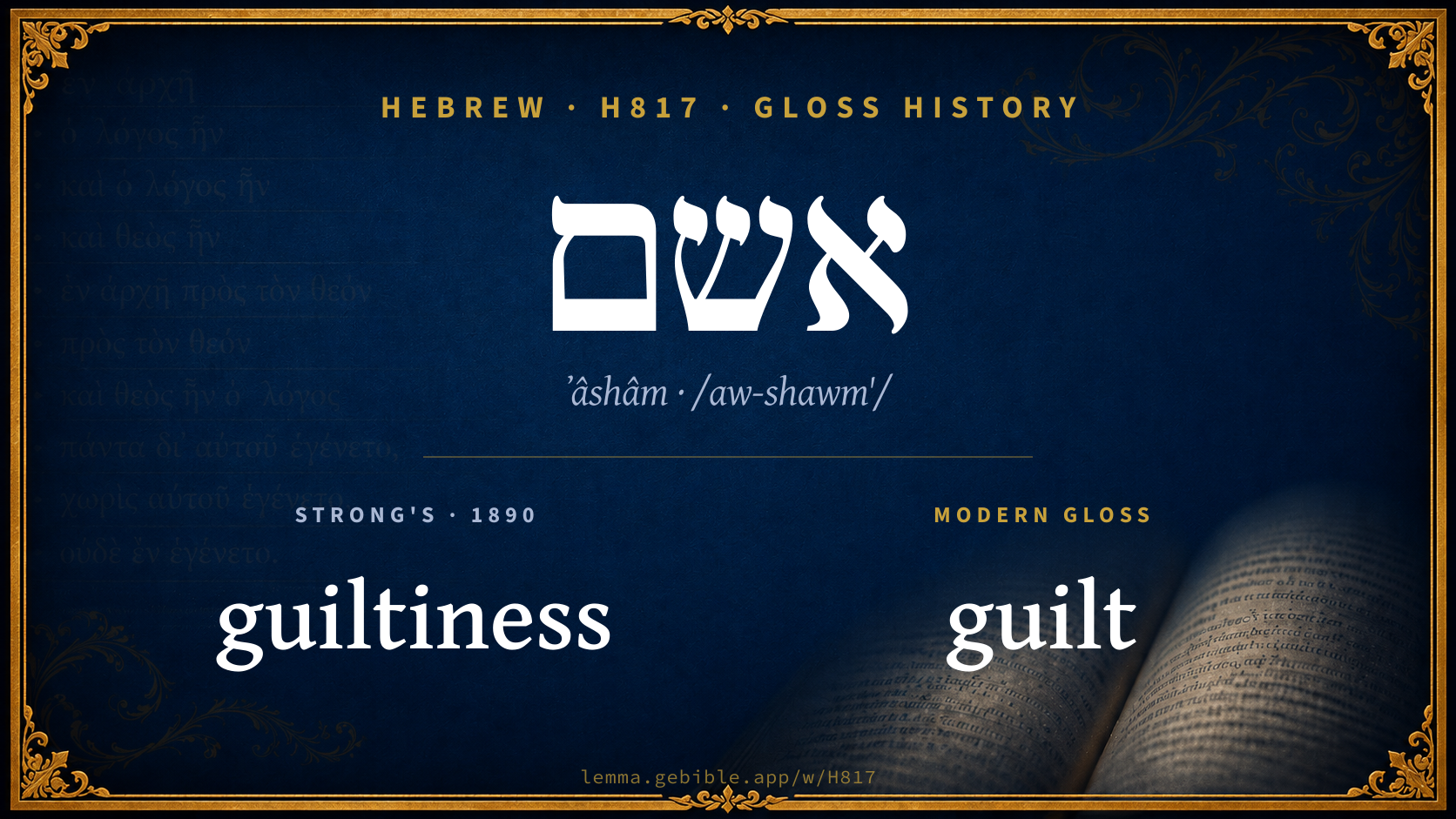
Gloss history
Strong's 1890 vs modern scholarship
About this word
Strong's H817 catalogs a Hebrew word from the Hebrew Old Testament.
These counts are not copied from any lexicon or concordance. They are computed here, from the morphology-tagged Hebrew Old Testament. What Lemma adds →
- 41
- distinct verses
- The word appears in 41 distinct verses.
- 10 / 39
- OT books
- The word appears in 10 of 39 Old Testament books.
- #796
- by frequency
- Top 1000 most frequent Hebrew words (rank 796 of 8,640 Hebrew words by occurrence).
View all 41 occurrences in the concordance →
By section of the Old Testament
By traditional corpus
Conventional, traditional groupings — biblical authorship is debated, so this is a traditional corpus grouping, not an authorship claim. Each share is this word’s portion of its verses in that division of the Hebrew canon. Each figure is a share of the word’s 41 distinct verses.
- Torah (Pentateuch) 28 verses · 68%
- Prophets (Nevi'im) 11 verses · 27%
- Writings (Ketuvim) 2 verses · 5%
How translations render this word
Counts come from each version’s own published word-to-Strong’s tagging or interlinear alignment — an approximate guide to how each version renders this word, not a word-level alignment the data otherwise carries. Because each total is that version’s own tagged count, the per-version totals vary from one another and need not match the appearance or distinct-verse counts above. These counts may also differ from a printed concordance because Lemma counts each distinctly tagged rendering and does not collapse phrase taggings into a single head-word total. This is a fixed set of word-tagged versions (KJV, ASV, BSB, ULT) and does not change with the reading translation you choose elsewhere. Each version’s license is shown beside its name below (and on Sources).
- King James Version: Trespass offering 29×, Trespass 5×, Is a trespass offering 2×
- American Standard Version: Trespass-offering 30×, Guilt 3×, Is a trespass-offering 2×
- Berean Standard Bible: Guilt offering 28×, Guilt offerings 4×, Is a guilt offering 3×
- unfoldingWord Literal Text: Guilt offering 31×, Guilt 8×
King James Version Public Domain
Renders H817 across 46 tagged occurrences — most commonly:
Plus 8 renderings that appear only once — usually multi-word phrases or single function words the recovered tagging swept in, not distinct renderings.
American Standard Version Public Domain
Renders H817 across 47 tagged occurrences — most commonly:
Plus 12 renderings that appear only once — usually multi-word phrases or single function words the recovered tagging swept in, not distinct renderings.
Berean Standard Bible Public Domain
Renders H817 across 42 tagged occurrences — most commonly:
Plus 5 renderings that appear only once — usually multi-word phrases or single function words the recovered tagging swept in, not distinct renderings. Not rendered by a distinct English word in 3 further occurrences.
unfoldingWord Literal Text CC BY-SA 4.0
Renders H817 across 46 tagged occurrences — most commonly:
Plus 7 renderings that appear only once — usually multi-word phrases or single function words the recovered tagging swept in, not distinct renderings.
Senses in the full BDB
What do BDB’s symbols mean?
BDB uses these scholarly abbreviations:
| Symbol | Meaning |
|---|---|
| 𝔊 | the Septuagint (the ancient Greek translation, LXX) |
| 𝔙 | the Vulgate (the Latin translation) |
| 𝔖 | the Syriac version (the Peshitta) |
| 𝔗 | the Targum (the Aramaic translation) |
| ψ | the Psalms |
| √ | root (the underlying root or stem) |
| ‖ | parallel passage (a synonymous or contrasted parallel) |
| † | the dagger: every passage where the word occurs is cited |
The 4 senses and sub-senses the full Brown-Driver-Briggs lexicon distinguishes for this word, in lexicon order (not ranked by frequency), with BDB’s own verbatim wording and sub-sense lettering. Shown in Hebrew script with BDB’s own scholarly abbreviations. The condensed entry is in the Lexicon Entry tab. See also the Forms in the corpus table below.
- 1. offence, trespass, fault ψ 68:22 (guiltiness RV). e.g. Psalms 68:22
- 2. guilt Gn 26:10 (J) Pr 14:9 Je 51:5. e.g. Genesis 26:10
- 3. compensation, לְהָשִׁיב הָאָשָׁם אֵלָיו to whom to return the compensation (or satisfaction for injury) Nu 5:8; cp. v 7 (P; restitution for guilt RV). e.g. Numbers 5:8
- 4. trespass-offering (AV, but guilt-offering RV) used only in Lv 5, 6:10; 7, 14, 19:21, 22 Nu 6:12; 18:9 (P), & Ez 40:39; 42:13; 44:29; 46:20, cf. Ezr 10:19. This offering seems to have been confined to offences against God or man that could be estimated and so covered by compensation. The ordinary trespass-offering was a ram, together with restitution and a penalty of a fifth of its value. The tresspass-offerings of the leper and Nazirite were he-lambs Lv 14 Nu 6:12; if the person who suffered wrong or his kinsmen were not living the fine went to the priests. The victims were offered, the blood and fat pieces going to the altar, the skin and flesh to the priests. There seems to have been no application of the blood to the horns of the altar (the chief ceremony of the sin-offering) because the guilt was not expiated at the altar but by compensation to the wronged person or his representative. A part of the blood of the leper’s trespass-offering was applied to his person to consecrate him (as in the case of the ram of consecration to consecrate the priests Lv 8:23). The trespass-offering is unknown to JED and the older Hebrew literature. However, the Philistines send an אשׁם of golden mice and tumours 1 S 6:3, 4, 8, 17, and an אשׁם of money was given to the priests 2 K 12:17, but these are entirely different from the trespass-offering of P. The Messianic servant offers himself as an אשׁם in compensation for the sins of the people, interposing for them as their substitute Is 53:10 (incorrectly offering for sin AV RV). See further OehlerOT Theol. § 137 Di Lv 5:14. e.g. Leviticus 6:10
Senses from the full Brown-Driver-Briggs lexicon (Brown, Driver, Briggs; Oxford 1906 — public domain), digitized via Sefaria, supplemented by the OpenScriptures HebrewLexicon (CC BY 4.0). Full attribution on Sources.
Word origin
n.m. offence, guilt—א׳ Gn 26:10 + 37 times sf. אֲשָׁמוֹ Nu 5:7 + 7 times—
— Brown-Driver-Briggs (Oxford 1906, public domain), digitized via Sefaria, supplemented by the OpenScriptures HebrewLexicon (CC BY 4.0). See Sources.
Derived from אשם (ʼâsham) (H816) — to trespass.
Jastrow Dictionary
A second Hebrew/Aramaic lexicon for comparison, covering Aramaic and post-biblical (Talmudic, Targumic, Midrashic) usage that the biblical-Hebrew BDB does not. Matched by lemma rather than by Strong’s number, so a lemma may carry more than one Jastrow headword (shown separately below), and the entries cover usage well beyond the Bible.
אָשַׁם
- 1. to be waste (cmp. Ezek. VI, 6; Hos. XIV,. Snh. 97ᵃ יֶאֱשַׁם (in parall. passages יִשּׁוֹם); v. גַּבְלָן. e.g. Ezekiel 6:6
- 2. to neglect, be guilty.—Denom.:
אָשָׁם
- (b. h.) guilt; guilt-offering, asham, a special kind of offering.—א׳ תלוי (Lev. V, 18) an asham to be offered when you are in doubt as to the commission of a sinful act. Kerith. III, 1; a. fr.; (ib. 17ᵇ differ. opin. as to the nature of the doubt). Ib. VI, 3 אֲשַׁם חסידים the asham offered by the over-scrupulous because they may have transgressed.—א׳ ודאי the asham for the undoubted commission of certain offenses, which are: a) אֲ׳ גזילות for illegal appropriation of private property (after pecuniary reparation; Lev. V, 25); b) אֲ׳ מעילות for misappropriation of sacred property (Lev. V, 16); c) אֲ׳ שפחה חרופה for carnal connection with a slave betrothed to another man (Lev. XIX, 21);—d) אֲ׳ נזיר offering of a nazarite when interrupting the days of vowed nazaritism by levitical impurity (Num. VI, 12).—Deut. R. s. 1, beg. (alluding to וַאֲשִׂמֵם Deut. I, 13) וְאַשְׁמָם כתיב it is so written that you may read v’ashmam (and their guilt); if you listen not to them אשמה תלוי וכ׳ (read אשמם) their guilt shall fall upon your heads (you will be answerable for what offenses they may commit); differ. in Sifré Deut. 13. [Our Bible editions, however, read ואשימם, plene.]—Pl. אֲשָׁמוֹת. Kerith. VI, 4. Sifré l. c.; a. fr. e.g. Leviticus 5:18
A Dictionary of the Targumim, the Talmud Babli and Yerushalmi, and the Midrashic Literature (Marcus Jastrow; London, Luzac, 1903) — Public Domain. Digitized via Sefaria. Digitized via Sefaria. Full attribution on Sources.
Forms in the corpus
The 32 distinct written forms H817 takes in the Hebrew Bible, most frequent first — each parse links to that state’s occurrences in the concordance. Hebrew forms include their vowel points and cantillation, so a single lemma takes many written forms.
Same root — word family
Other BDB entries built from the same root as H817, grouped by Strong’s listed origin. These share a root / origin per the lexicon — not necessarily a shared meaning. Each links to that word’s own entry.
Derives from
Shares the same root
Derived from this word
Compare all same-root words → They share a root, not necessarily a meaning.
Septuagint verse parallels
This word appears in 41 verses that also exist in the Greek Old Testament (Septuagint), out of the 41 Hebrew verses it occurs in. You can read those verses in Greek by switching the Old Testament edition to the Septuagint.
Read these verses in the Septuagint
- Genesis 26:10
- Leviticus 5:6
- Numbers 5:7
- 1 Samuel 6:3
- 2 Kings 12:16
- Psalms 68:21
- Proverbs 14:9
- Isaiah 53:10
- Jeremiah 51:5
- Ezekiel 40:39
This is a verse-level parallel only — the same verses exist in both the Hebrew and Greek Old Testaments. No word-level Hebrew↔Greek correspondence is claimed: the data carries no such alignment, so no Greek word is shown as this Hebrew word’s translation. Coverage is not total — the Septuagint omits the deuterocanon and renumbers the Psalms, so some Hebrew verses have no direct Greek parallel.