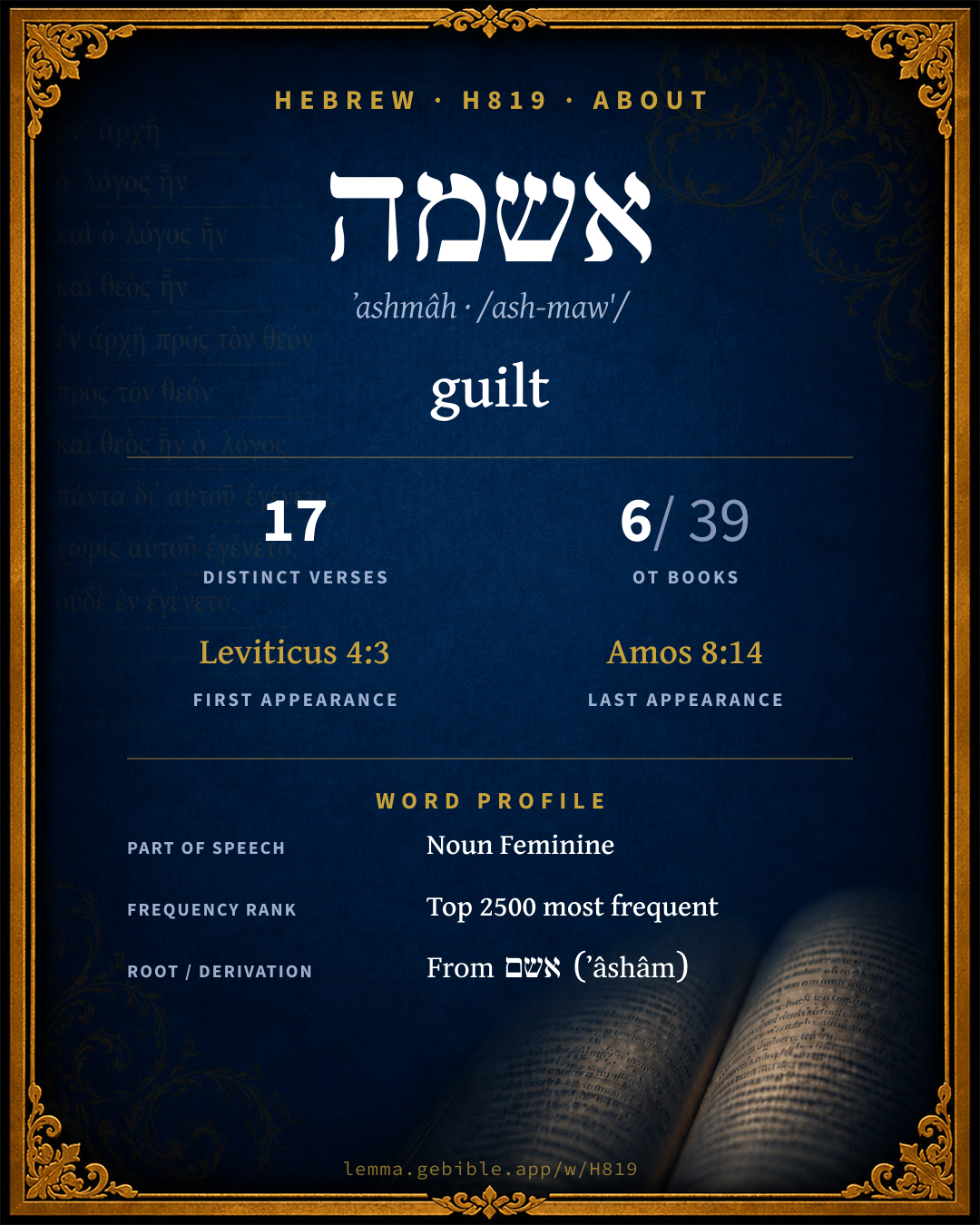
אַשְׁמָה
guilt
also: guiltiness, offense, sin, wrong-doing fuller range ↓
Full lexicon entry — Brown-Driver-Briggs (BDB)
From Brown-Driver-Briggs (BDB)
Where this word appears
See every Construct-state word in the Hebrew Bible →
Grammar key — what these labels mean
Part of speech
- Noun
- A naming word — a person, place, thing, or idea.
Noun type
- Common
- A common noun — a general class of person, place, or thing (“king,” “city,” “water”), not a specific name.
State
- Absolute
- The independent form of a noun, not bound to a following word.
- Construct
- A noun bound to a following noun in a possessive / “of” relationship (the construct chain).
Gender
- Feminine
- Grammatically feminine.
Number
- Singular
- One.
- Plural
- More than one (in Hebrew, generally three or more).
Grammatical forms
- Noun, Common, Feminine, Singular, Construct 11 times (58%)
- Noun, Common, Feminine, Singular, Absolute 6 times (32%)
- Noun, Common, Feminine, Plural, Construct 1 time (5%)
- Noun, Common, Feminine, Plural, Absolute 1 time (5%)
Parsed forms decoded from the imported morphology (morphhb / Westminster Leningrad Codex — WLC text public domain, morphhb tagging CC BY 4.0), counted across 19 parsed occurrences — not distinct verses.
Every verse where H819 appears — 17 distinct verses across 6 books. Click any verse to open its interlinear word-by-word view. Verse text shown in the World English Bible for context — . Each verse’s Hebrew form is shown with its reference; the English is not keyword-highlighted, since the data carries no word-level English alignment. Use “Compare translations” on any verse to read it across multiple English versions. This concordance covers the Hebrew Bible; Septuagint (Greek Old Testament) occurrences are not indexed here.
Leviticus 4 verses
- Leviticus 4:3 לְ/אַשְׁמַ֣ת prep + n c fs cs if the anointed priest sins so as to bring guilt on the people, then let him offer for his sin, which he has sinned, a young bull without blemish to Yahweh for a sin offering.
- Leviticus 6:5 אַשְׁמָתֽ/וֹ n c fs cs + sfx pers 3ms or any thing about which he has sworn falsely; he shall restore it even in full, and shall add a fifth part more to it. To him to whom it belongs he shall give it, in the day of his being found guilty.
- Leviticus 6:7 לְ/אַשְׁמָ֥ה prep + n c fs The priest shall make atonement for him before Yahweh, and he will be forgiven concerning whatever he does to become guilty."
- Leviticus 22:16 אַשְׁמָ֔ה n c fs and so cause them to bear the iniquity that brings guilt, when they eat their holy things: for I am Yahweh who sanctifies them.'"
1 Chronicles 1 verse
2 Chronicles 4 verses
- 2 Chronicles 24:18 בְּ/אַשְׁמָתָ֖/ם prep + n c fs cs + sfx pers 3mp They forsook the house of Yahweh, the God of their fathers, and served the Asherim and the idols: and wrath came on Judah and Jerusalem for this their guiltiness.
- 2 Chronicles 28:10 אֲשָׁמ֔וֹת n c fp Now you purpose to keep under the children of Judah and Jerusalem for bondservants and bondmaids to you: [but] aren't there even with you trespasses of your own against Yahweh your God?
- 2 Chronicles 28:13 לְ/אַשְׁמַ֨ת אַשְׁמָתֵ֑י/נוּ אַשְׁמָה֙ prep + n c fs cs n c fs cs + sfx pers 1cp n c fs and said to them, You shall not bring in the captives here: for you purpose that which will bring on us a trespass against Yahweh, to add to our sins and to our trespass; for our trespass is great, and there is fierce wrath against Israel.
- 2 Chronicles 33:23 אַשְׁמָֽה n c fs He didn't humble himself before Yahweh, as Manasseh his father had humbled himself; but this same Amon trespassed more and more.
Ezra 6 verses
- Ezra 9:6 וְ/אַשְׁמָתֵ֥/נוּ conj + n c fs cs + sfx pers 1cp and I said, my God, I am ashamed and blush to lift up my face to you, my God; for our iniquities are increased over our head, and our guiltiness is grown up to the heavens.
- Ezra 9:7 בְּ/אַשְׁמָ֣ה prep + n c fs Since the days of our fathers we have been exceeding guilty to this day; and for our iniquities have we, our kings, and our priests, been delivered into the hand of the kings of the lands, to the sword, to captivity, and to plunder, and to confusion of face, as it is this day.
- Ezra 9:13 וּ/בְ/אַשְׁמָתֵ֖/נוּ conj + prep + n c fs cs + sfx pers 1cp After all that is come on us for our evil deeds, and for our great guilt, seeing that you our God have punished us less than our iniquities deserve, and have given us such a remnant,
- Ezra 9:15 בְּ/אַשְׁמָתֵ֔י/נוּ prep + n c fs cs + sfx pers 1cp Yahweh, the God of Israel, you are righteous; for we are left a remnant that is escaped, as it is this day: behold, we are before you in our guiltiness; for none can stand before you because of this.
- Ezra 10:10 אַשְׁמַ֥ת n c fs cs Ezra the priest stood up, and said to them, You have trespassed, and have married foreign women, to increase the guilt of Israel.
- Ezra 10:19 אַשְׁמָתָֽ/ם n c fs cs + sfx pers 3mp They gave their hand that they would put away their wives; and being guilty, [they offered] a ram of the flock for their guilt.
Psalms 1 verse
Amos 1 verse
About this entry
At a glance — auto-summarized from this page’s data, not written by a person. Every figure links to its source below. This summary describes the numbers; it doesn’t interpret them.
The Hebrew noun אשמה centers on the idea of “guilt.” Where the King James Version says “trespass,” newer translations reach for “guilt” (Berean Standard Bible); the renderings breakdown has the detail. The Hebrew Bible uses it across 17 verses — uncommon. Ezra dominates its distribution — 6 of 17 verses. Beyond “guilt” it also covers “guiltiness”, “offense”, and “sin” — see its full sense range. For the data behind this summary, explore the sense tree and the renderings breakdown below.
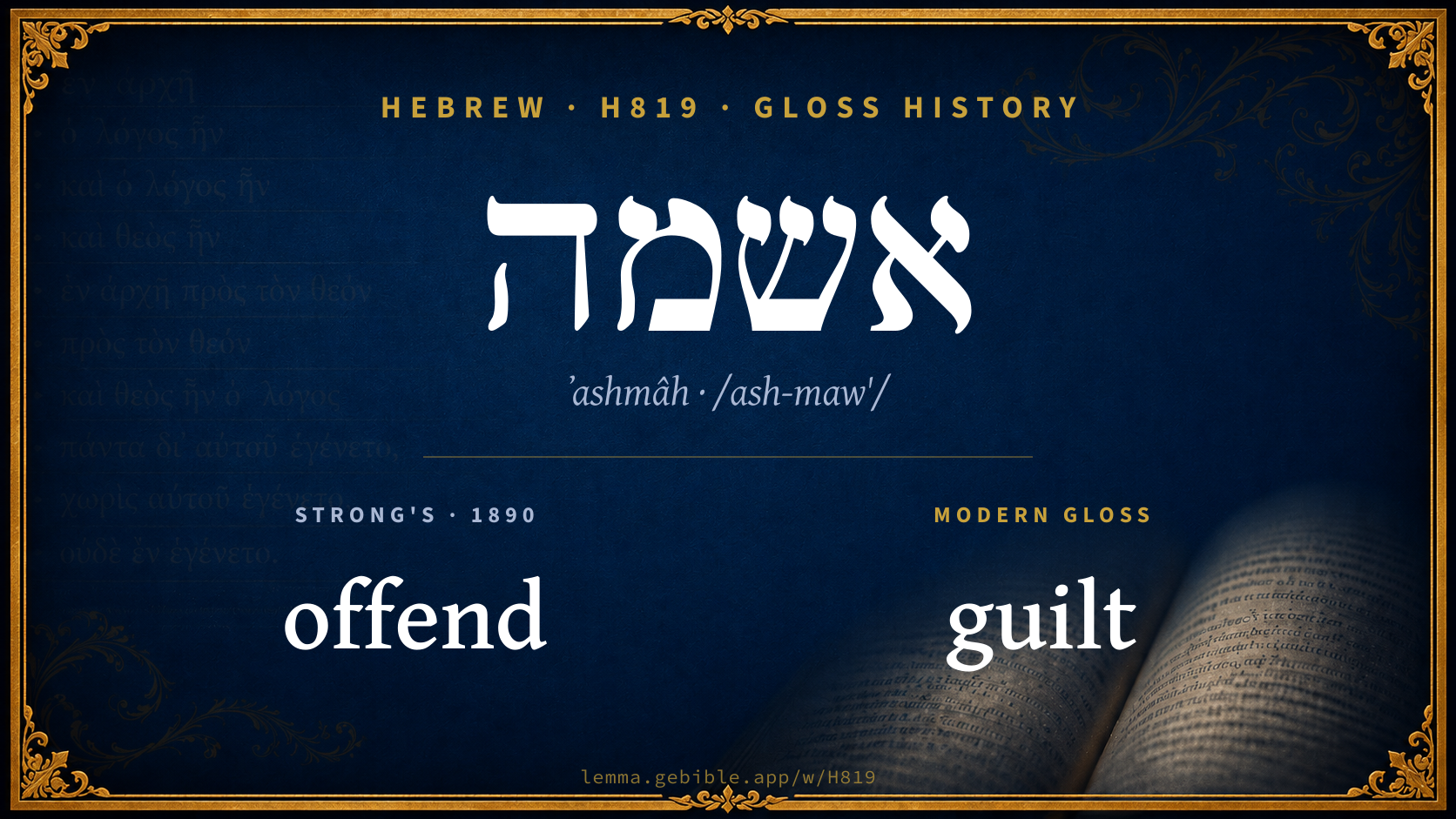
Gloss history
Strong's 1890 vs modern scholarship
About this word
Strong's H819 catalogs a Hebrew word from the Hebrew Old Testament.
These counts are not copied from any lexicon or concordance. They are computed here, from the morphology-tagged Hebrew Old Testament. What Lemma adds →
- 17
- distinct verses
- The word appears in 17 distinct verses.
- 6 / 39
- OT books
- The word appears in 6 of 39 Old Testament books.
- #1,563
- by frequency
- Top 2500 most frequent Hebrew words (rank 1,563 of 8,640 Hebrew words by occurrence).
View all 17 occurrences in the concordance →
Most concentrated in
- Ezra 6 verses 35%
- Leviticus 4 verses 24%
- 2 Chronicles 4 verses 24%
By section of the Old Testament
By traditional corpus
Conventional, traditional groupings — biblical authorship is debated, so this is a traditional corpus grouping, not an authorship claim. Each share is this word’s portion of its verses in that division of the Hebrew canon. Each figure is a share of the word’s 17 distinct verses.
- Writings (Ketuvim) 12 verses · 71%
- Torah (Pentateuch) 4 verses · 24%
- Prophets (Nevi'im) 1 verse · 6%
How translations render this word
Counts come from each version’s own published word-to-Strong’s tagging or interlinear alignment — an approximate guide to how each version renders this word, not a word-level alignment the data otherwise carries. Because each total is that version’s own tagged count, the per-version totals vary from one another and need not match the appearance or distinct-verse counts above. These counts may also differ from a printed concordance because Lemma counts each distinctly tagged rendering and does not collapse phrase taggings into a single head-word total. This is a fixed set of word-tagged versions (KJV, ASV, BSB, ULT) and does not change with the reading translation you choose elsewhere. Each version’s license is shown beside its name below (and on Sources).
- King James Version: Trespass 9×
- American Standard Version: Guilt 3×, Guiltiness 2×, Trespass 2×
- Berean Standard Bible: Guilt 13×
- unfoldingWord Literal Text: Guilt 11×, Guilt of 2×, Wrongdoings 2×
King James Version Public Domain
Renders H819 across 19 tagged occurrences — most commonly:
Plus 10 renderings that appear only once — usually multi-word phrases or single function words the recovered tagging swept in, not distinct renderings.
American Standard Version Public Domain
Renders H819 across 19 tagged occurrences — most commonly:
Plus 12 renderings that appear only once — usually multi-word phrases or single function words the recovered tagging swept in, not distinct renderings.
Berean Standard Bible Public Domain
Renders H819 across 19 tagged occurrences — most commonly:
Plus 6 renderings that appear only once — usually multi-word phrases or single function words the recovered tagging swept in, not distinct renderings.
unfoldingWord Literal Text CC BY-SA 4.0
Renders H819 across 23 tagged occurrences — most commonly:
Plus 8 renderings that appear only once — usually multi-word phrases or single function words the recovered tagging swept in, not distinct renderings.
Senses in the full BDB
What do BDB’s symbols mean?
BDB uses these scholarly abbreviations:
| Symbol | Meaning |
|---|---|
| 𝔊 | the Septuagint (the ancient Greek translation, LXX) |
| 𝔙 | the Vulgate (the Latin translation) |
| 𝔖 | the Syriac version (the Peshitta) |
| 𝔗 | the Targum (the Aramaic translation) |
| ψ | the Psalms |
| √ | root (the underlying root or stem) |
| ‖ | parallel passage (a synonymous or contrasted parallel) |
| † | the dagger: every passage where the word occurs is cited |
The 3 senses and sub-senses the full Brown-Driver-Briggs lexicon distinguishes for this word, in lexicon order (not ranked by frequency), with BDB’s own verbatim wording and sub-sense lettering. Shown in Hebrew script with BDB’s own scholarly abbreviations. The condensed entry is in the Lexicon Entry tab. See also the Forms in the corpus table below.
- 1. doing wrong, committing a trespass or offence 2 Ch 24:18; 28:10, 13(×3) (‖ חטאת v 13) 33:23 Ezr 9:6, 7, 13, 15 (‖ עָוֹן v 13) ψ 69:6 (‖ אִוֶּלֶת); מִכֹּל אֲשֶׁר יַעֲשֶׂת לְאַשְׁמָה בָהּ of all that one may do wrong therein Lv 5:26 (P; ‖ לַחֲטֹא בָהֵנָּה v 22). e.g. 2 Chronicles 24:18
- 2. becoming guilty 1 Ch 21:3 Ezr 10:10, 19; יֶהֱטָא לְאַשְׁמַת הָעָם sin to the becoming guilty of the people (so that the people incur guilt) Lv 4:3; אַשְׁמַת שֹׁמְרוֹן guilt of Samaria (their idols) Am 8:14. e.g. 1 Chronicles 21:3
- 3. bringing a trespass-offering, בְּיוֹם אַשְׁמָתוֹ in the day of his bringing his trespass-offering Lv 5:24; עֲוֹן אַשְׁמָה iniquity requiring a trespass-offering Lv 22:16. e.g. Leviticus 5:24
Senses from the full Brown-Driver-Briggs lexicon (Brown, Driver, Briggs; Oxford 1906 — public domain), digitized via Sefaria, supplemented by the OpenScriptures HebrewLexicon (CC BY 4.0). Full attribution on Sources.
Word origin
n.f. wrong-doing, guiltiness (properly Inf. cf. אַהֲבָה, יִרְאָה)—א׳ Lv 22:16 + 5 times, cstr. אַשְׁמַת Ezr 10:10 + 3 times; sf. אַשְׁמָתוֹ Lv 5:24 + 6 times; pl. אֲשָׁמוֹת 2 Ch 28:10; sf. אַשְׁמוֹתַי ψ 69:6;—
— Brown-Driver-Briggs (Oxford 1906, public domain), digitized via Sefaria, supplemented by the OpenScriptures HebrewLexicon (CC BY 4.0). See Sources.
Derived from אשם (ʼâshâm) (H817) — guilt.
Jastrow Dictionary
A second Hebrew/Aramaic lexicon for comparison, covering Aramaic and post-biblical (Talmudic, Targumic, Midrashic) usage that the biblical-Hebrew BDB does not. Matched by lemma rather than by Strong’s number, so a lemma may carry more than one Jastrow headword (shown separately below), and the entries cover usage well beyond the Bible.
אַשְׁמָה
- negligence, guilt. Shek. VI, 6.—Gen. R. s. 49 זקני א׳ וכ׳ elders in coarseness (cmp. אַשְׁמַאי) which is (in Chaldaic) elders of shame.—Pl. אֲשָׁמוֹת, v. אָשָׁם.
A Dictionary of the Targumim, the Talmud Babli and Yerushalmi, and the Midrashic Literature (Marcus Jastrow; London, Luzac, 1903) — Public Domain. Digitized via Sefaria. Digitized via Sefaria. Full attribution on Sources.
Forms in the corpus
The 19 distinct written forms H819 takes in the Hebrew Bible, most frequent first — each parse links to that state’s occurrences in the concordance. Hebrew forms include their vowel points and cantillation, so a single lemma takes many written forms.
Septuagint verse parallels
This word appears in 17 verses that also exist in the Greek Old Testament (Septuagint), out of the 17 Hebrew verses it occurs in. You can read those verses in Greek by switching the Old Testament edition to the Septuagint.
Read these verses in the Septuagint
This is a verse-level parallel only — the same verses exist in both the Hebrew and Greek Old Testaments. No word-level Hebrew↔Greek correspondence is claimed: the data carries no such alignment, so no Greek word is shown as this Hebrew word’s translation. Coverage is not total — the Septuagint omits the deuterocanon and renumbers the Psalms, so some Hebrew verses have no direct Greek parallel.