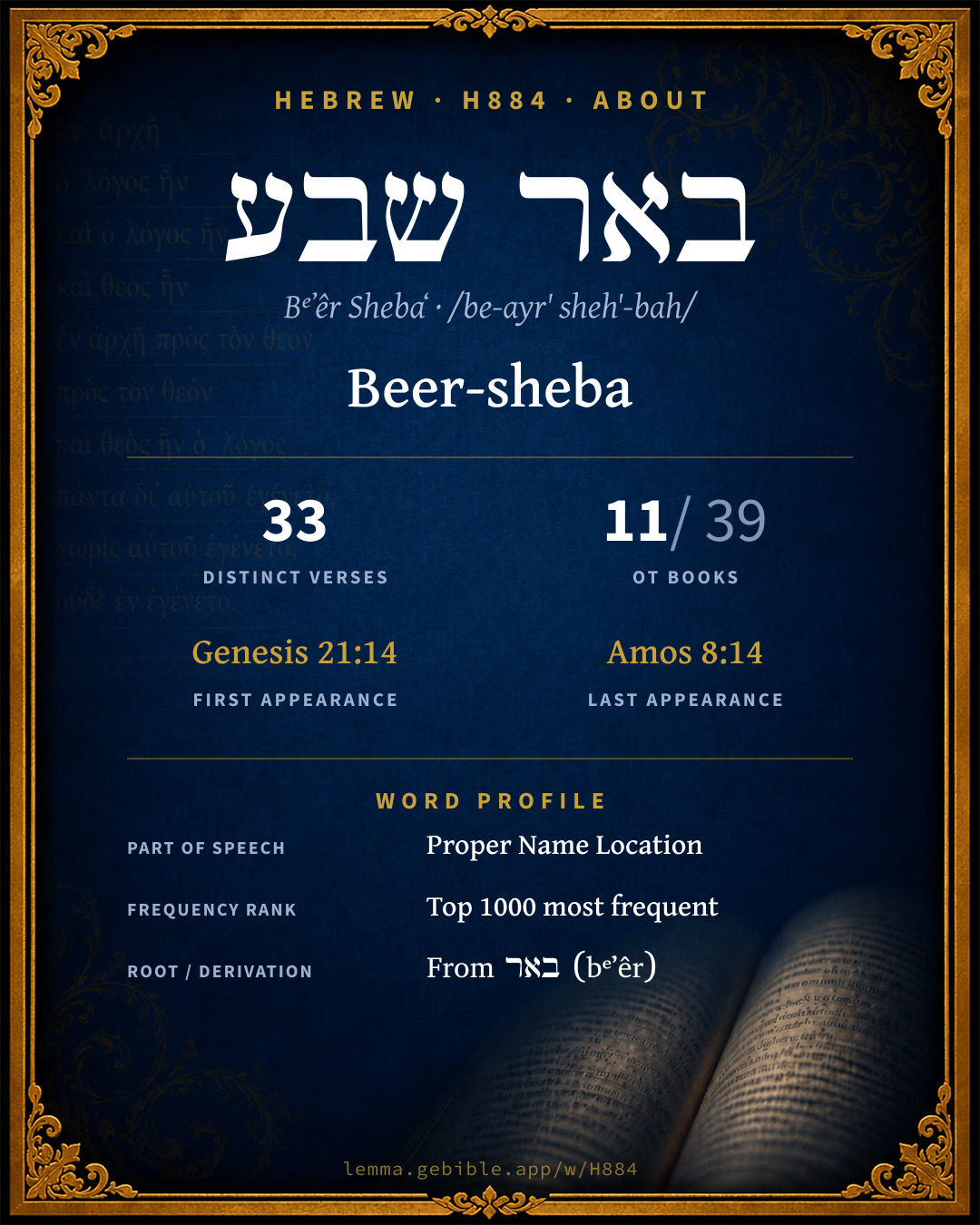
בְּאֵר שֶׁ֫בַע
Beer-sheba
BDB lists 2 entries for ‘Beer-sheba’ fuller range ↓
Full lexicon entry — Brown-Driver-Briggs (BDB)
From Brown-Driver-Briggs (BDB)
Where this word appears
Grammar key — what these labels mean
Part of speech
- Noun
- A naming word — a person, place, thing, or idea.
- Adjective
- A word that describes or qualifies a noun.
Noun type
- Proper
- A name of a specific person, place, or people (e.g. Abraham, Zion, Israel).
State
- Absolute
- The independent form of a noun, not bound to a following word.
Gender
- Feminine
- Grammatically feminine.
Number
- Singular
- One.
Grammatical forms
- Noun, Proper 53 times (78%)
- Adjective, Cardinal number, Feminine, Singular, Absolute 15 times (22%)
Parsed forms decoded from the imported morphology (morphhb / Westminster Leningrad Codex — WLC text public domain, morphhb tagging CC BY 4.0), counted across 68 parsed occurrences — not distinct verses.
Every verse where H884 appears — 33 distinct verses across 11 books. Click any verse to open its interlinear word-by-word view. Verse text shown in the World English Bible for context — . Each verse’s Hebrew form is shown with its reference; the English is not keyword-highlighted, since the data carries no word-level English alignment. Use “Compare translations” on any verse to read it across multiple English versions. This concordance covers the Hebrew Bible; Septuagint (Greek Old Testament) occurrences are not indexed here.
Genesis 10 verses
- Genesis 21:14 בְּאֵ֥ר שָֽׁבַע n Proper n Proper Abraham rose up early in the morning, and took bread and a bottle of water, and gave it to Hagar, putting it on her shoulder, and gave her the child, and sent her away. She departed, and wandered in the wilderness of Beersheba.
- Genesis 21:31 בְּאֵ֣ר שָׁ֑בַע n Proper n Proper Therefore he called that place Beersheba, because they both swore there.
- Genesis 21:32 בִּ/בְאֵ֣ר שָׁ֑בַע prep + n Proper n Proper So they made a covenant at Beersheba. Abimelech rose up with Phicol, the captain of his host, and they returned into the land of the Philistines.
- Genesis 21:33 בִּ/בְאֵ֣ר שָׁ֑בַע prep + n Proper n Proper Abraham planted a tamarisk tree in Beersheba, and called there on the name of Yahweh, the Everlasting God.
- Genesis 22:19 בְּאֵ֣ר שָׁ֑בַע בִּ/בְאֵ֥ר שָֽׁבַע n Proper n Proper prep + n Proper n Proper So Abraham returned to his young men, and they rose up and went together to Beersheba. Abraham lived at Beersheba.
- Genesis 26:23 בְּאֵ֥ר שָֽׁבַע n Proper n Proper He went up from there to Beersheba.
- Genesis 26:33 בְּאֵ֣ר שֶׁ֔בַע n Proper adj Cardinal number fs He called it Shibah. Therefore the name of the city is Beersheba to this day.
- Genesis 28:10 מִ/בְּאֵ֣ר שָׁ֑בַע prep + n Proper n Proper Jacob went out from Beersheba, and went toward Haran.
- Genesis 46:1 בְּאֵ֣רָ/ה שָּׁ֑בַע n Proper + sfx dem n Proper Israel traveled with all that he had, and came to Beersheba, and offered sacrifices to the God of his father, Isaac.
- Genesis 46:5 מִ/בְּאֵ֣ר שָׁ֑בַע prep + n Proper n Proper Jacob rose up from Beersheba, and the sons of Israel carried Jacob, their father, their little ones, and their wives, in the wagons which Pharaoh had sent to carry him.
Joshua 2 verses
Judges 1 verse
1 Samuel 2 verses
- 1 Samuel 3:20 בְּאֵ֣ר שָׁ֑בַע n Proper n Proper All Israel from Dan even to Beersheba knew that Samuel was established to be a prophet of Yahweh.
- 1 Samuel 8:2 בִּ/בְאֵ֥ר שָֽׁבַע prep + n Proper n Proper Now the name of his firstborn was Joel; and the name of his second, Abijah: they were judges in Beersheba.
2 Samuel 5 verses
- 2 Samuel 3:10 בְּאֵ֥ר שָֽׁבַע n Proper n Proper to transfer the kingdom from the house of Saul, and to set up the throne of David over Israel and over Judah, from Dan even to Beersheba.
- 2 Samuel 17:11 בְּאֵ֣ר שֶׁ֔בַע n Proper adj Cardinal number fs But I counsel that all Israel be gathered together to you, from Dan even to Beersheba, as the sand that is by the sea for multitude; and that you go to battle in your own person.
- 2 Samuel 24:2 בְּאֵ֣ר שֶׁ֔בַע n Proper adj Cardinal number fs The king said to Joab the captain of the host, who was with him, Go now back and forth through all the tribes of Israel, from Dan even to Beersheba, and number you the people, that I may know the sum of the people.
- 2 Samuel 24:7 בְּאֵ֥ר שָֽׁבַע n Proper n Proper and came to the stronghold of Tyre, and to all the cities of the Hivites, and of the Canaanites; and they went out to the south of Judah, at Beersheba.
- 2 Samuel 24:15 בְּאֵ֣ר שֶׁ֔בַע n Proper adj Cardinal number fs So Yahweh sent a pestilence on Israel from the morning even to the time appointed; and there died of the people from Dan even to Beersheba seventy thousand men.
1 Kings 2 verses
- 1 Kings 4:25 בְּאֵ֣ר שָׁ֑בַע n Proper n Proper Judah and Israel lived safely, every man under his vine and under his fig tree, from Dan even to Beersheba, all the days of Solomon.
- 1 Kings 19:3 בְּאֵ֥ר שֶׁ֖בַע n Proper adj Cardinal number fs When he saw that, he arose, and went for his life, and came to Beersheba, which belongs to Judah, and left his servant there.
2 Kings 2 verses
- 2 Kings 12:1 מִ/בְּאֵ֥ר שָֽׁבַע prep + n Proper n Proper In the seventh year of Jehu began Jehoash to reign; and he reigned forty years in Jerusalem: and his mother's name was Zibiah of Beersheba.
- 2 Kings 23:8 בְּאֵ֣ר שָׁ֑בַע n Proper n Proper He brought all the priests out of the cities of Judah, and defiled the high places where the priests had burned incense, from Geba to Beersheba; and he broke down the high places of the gates that were at the entrance of the gate of Joshua the governor of the city, which were on a man's left hand at the gate of the city.
1 Chronicles 2 verses
- 1 Chronicles 4:28 בִּ/בְאֵֽר שֶׁ֥בַע prep + n Proper adj Cardinal number fs They lived at Beersheba, and Moladah, and Hazarshual,
- 1 Chronicles 21:2 מִ/בְּאֵ֥ר שֶׁ֖בַע prep + n Proper adj Cardinal number fs David said to Joab and to the princes of the people, Go, number Israel from Beersheba even to Dan; and bring me word, that I may know the sum of them.
2 Chronicles 3 verses
- 2 Chronicles 19:4 מִ/בְּאֵ֥ר שֶׁ֨בַע֙ prep + n Proper adj Cardinal number fs Jehoshaphat lived at Jerusalem: and he went out again among the people from Beersheba to the hill-country of Ephraim, and brought them back to Yahweh, the God of their fathers.
- 2 Chronicles 24:1 מִ/בְּאֵ֥ר שָֽׁבַע prep + n Proper n Proper Joash was seven years old when he began to reign; and he reigned forty years in Jerusalem: and his mother's name was Zibiah, of Beersheba.
- 2 Chronicles 30:5 מִ/בְּאֵֽר שֶׁ֣בַע prep + n Proper adj Cardinal number fs So they established a decree to make proclamation throughout all Israel, from Beersheba even to Dan, that they should come to keep the Passover to Yahweh, the God of Israel, at Jerusalem: for they had not kept it in great numbers in such sort as it is written.
Nehemiah 2 verses
- Nehemiah 11:27 וּ/בִ/בְאֵ֥ר שֶׁ֖בַע conj + prep + n Proper adj Cardinal number fs and in Hazar Shual, and in Beersheba and the towns of it,
- Nehemiah 11:30 מִ/בְּאֵֽר שֶׁ֖בַע prep + n Proper adj Cardinal number fs Zanoah, Adullam, and their villages, Lachish and the fields of it, Azekah and the towns of it. So they encamped from Beersheba to the valley of Hinnom.
Amos 2 verses
- Amos 5:5 וּ/בְאֵ֥ר שֶׁ֖בַע conj + n Proper adj Cardinal number fs But don't seek Bethel, Nor enter into Gilgal, And don't pass to Beersheba: For Gilgal shall surely go into captivity, And Bethel shall come to nothing.
- Amos 8:14 בְּאֵֽר שָׁ֑בַע n Proper n Proper Those who swear by the sin of Samaria, And say, 'As your god, Dan, lives;' And, 'As the way of Beersheba lives;' They will fall, and never rise up again."
About this entry
At a glance — auto-summarized from this page’s data, not written by a person. Every figure links to its source below. This summary describes the numbers; it doesn’t interpret them.
The Hebrew name באר שבע centers on the idea of “Beer-sheba.” Its earliest occurrence is Genesis 21:14. It turns up in 33 verses across 11 books, a moderately common footprint. The word gravitates to Genesis (30%), then 2 Samuel and 2 Chronicles. For the data behind this summary, explore 33-verse concordance and the renderings breakdown below.
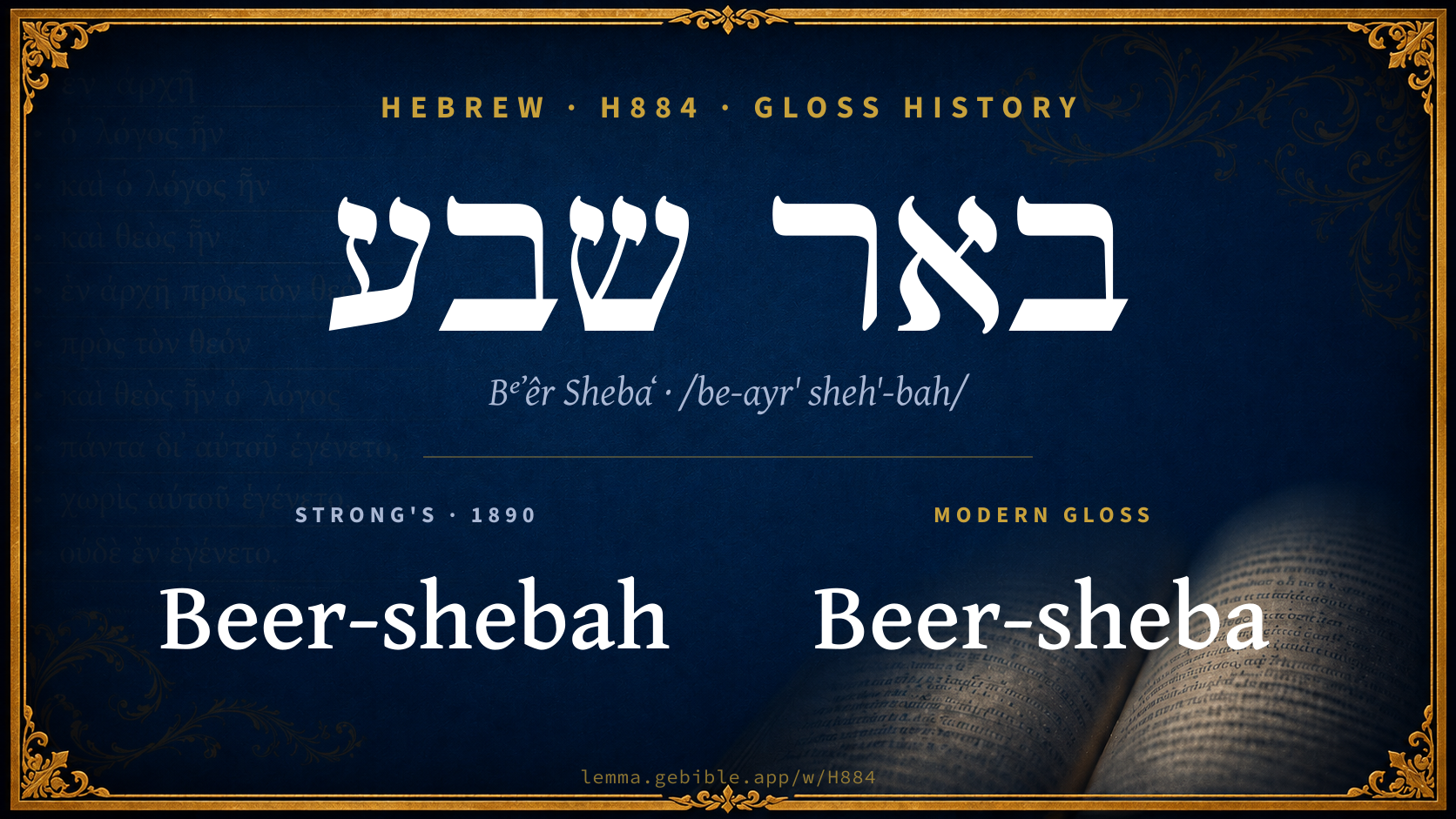
Gloss history
Strong's 1890 vs modern scholarship
About this word
Strong's H884 catalogs a Hebrew word from the Hebrew Old Testament.
These counts are not copied from any lexicon or concordance. They are computed here, from the morphology-tagged Hebrew Old Testament. What Lemma adds →
- 33
- distinct verses
- The word appears in 33 distinct verses.
- 11 / 39
- OT books
- The word appears in 11 of 39 Old Testament books.
- #582
- by frequency
- Top 1000 most frequent Hebrew words (rank 582 of 8,640 Hebrew words by occurrence).
View all 33 occurrences in the concordance →
Most concentrated in
- Genesis 10 verses 30%
- 2 Samuel 5 verses 15%
- 2 Chronicles 3 verses 9%
By section of the Old Testament
By traditional corpus
Conventional, traditional groupings — biblical authorship is debated, so this is a traditional corpus grouping, not an authorship claim. Each share is this word’s portion of its verses in that division of the Hebrew canon. Each figure is a share of the word’s 33 distinct verses.
- Prophets (Nevi'im) 16 verses · 48%
- Torah (Pentateuch) 10 verses · 30%
- Writings (Ketuvim) 7 verses · 21%
How translations render this word
Counts come from each version’s own published word-to-Strong’s tagging or interlinear alignment — an approximate guide to how each version renders this word, not a word-level alignment the data otherwise carries. Because each total is that version’s own tagged count, the per-version totals vary from one another and need not match the appearance or distinct-verse counts above. These counts may also differ from a printed concordance because Lemma counts each distinctly tagged rendering and does not collapse phrase taggings into a single head-word total. This is a fixed set of word-tagged versions (KJV, ASV, BSB, ULT) and does not change with the reading translation you choose elsewhere. Each version’s license is shown beside its name below (and on Sources).
BDB lists this Strong’s number as 2 distinct words (homographs). Each count above pools all of them and is not split by sense — see the Senses section below. A low-frequency rendering may belong to a different one of those words, not the primary meaning.
- King James Version†: Beersheba 32×
- American Standard Version†: Beer-sheba 27×
- Berean Standard Bible†: Beersheba 32×, From 2×
- unfoldingWord Literal Text†: Beersheba 66×, Is beersheba 2×
King James Version Public Domain
Renders H884 across 34† tagged occurrences — most commonly:
Plus 2 renderings that appear only once — usually multi-word phrases or single function words the recovered tagging swept in, not distinct renderings.
American Standard Version Public Domain
Renders H884 across 34† tagged occurrences — most commonly:
Plus 7 renderings that appear only once — usually multi-word phrases or single function words the recovered tagging swept in, not distinct renderings.
Berean Standard Bible Public Domain
Renders H884 across 40† tagged occurrences — most commonly:
Plus 6 renderings that appear only once — usually multi-word phrases or single function words the recovered tagging swept in, not distinct renderings. Not rendered by a distinct English word in 3 further occurrences.
unfoldingWord Literal Text CC BY-SA 4.0
Renders H884 across 68† tagged occurrences — most commonly:
Senses in the full BDB
What do BDB’s symbols mean?
BDB uses these scholarly abbreviations:
| Symbol | Meaning |
|---|---|
| 𝔊 | the Septuagint (the ancient Greek translation, LXX) |
| 𝔙 | the Vulgate (the Latin translation) |
| 𝔖 | the Syriac version (the Peshitta) |
| 𝔗 | the Targum (the Aramaic translation) |
| ψ | the Psalms |
| √ | root (the underlying root or stem) |
| ‖ | parallel passage (a synonymous or contrasted parallel) |
| † | the dagger: every passage where the word occurs is cited |
The 5 senses and sub-senses the full Brown-Driver-Briggs lexicon distinguishes for this word, in lexicon order (not ranked by frequency), with BDB’s own verbatim wording and sub-sense lettering. Shown in Hebrew script with BDB’s own scholarly abbreviations. The condensed entry is in the Lexicon Entry tab. See also the Forms in the corpus table below.
באר שבע I
- 1. a well, often as made by digging (חָפַר) Gn 21:25, 30 (E), 26:15, 18, 19, 21, 22, 32 (all J), also poet. Nu 21:18 (+ כרה) vid. also v 16, 17 (where the well addressed, in song, עֲלִי בְאֵר); also c. כרה in prose Gn 26:25; also with no ref. to its origin Gn 16:14 (J; ‖ עַיִן v 7) 29:2 Ex 2:15 (J) Nu 20:17 21:22 (E) 2 S 17:18, 21; בְּאֵר (ה)מַיִם Gn 21:19 (E) 24:11 (J; ‖ עַיִן vv 13, 16, 43, 45); (cf. also 21:25; 26:18 supr. & especially v 19 בְּאֵר מַיִם חַיִּים); water taken from it by drawing (שָׁאַב) Gn 24:11, 20; flocks watered from it (הִשְׁקָה מִן־) 29:2, 3, 8, 10 (cf. especially Ex 2:16 they drew, דלה, and filled the troughs); also שְׁתֵה מַיִם … מִתּוֹךְ בְּאֵרֶ֑ךָ Pr 5:15 (‖ בּוֹר); the opening called פִּי הַבְּאֵר Gn 29:2, 3(×2) 8, 10; cf. פְּנֵי הַבּ׳ 2 S 17:19 (read prob. פּי so Sam. 𝔗 𝔖 𝔙, cf. Dr); fig. of fresh delights of woman beloved Ct 4:15 מַעְיַן גַּנִּים בְּאֵר מַיִם חַיִּים וְנוֹזְלִים מִן־לְבָנוֹן. e.g. Genesis 21:25
- 2. pit (= בּוֹר); pits of bitumen Gn 14:10 (cf. supr.); בְּאֵר שַׁחַת ψ 55:24 pit of (the) grave; cf. 69:16 וְאַל־תֶּאְטַר עָלַי בְּאֵר פִּיהָ and let not (the) pit shut its mouth over me (‖ מְצוּלָה); fig. of strange woman בְּאֵר צָרָה a narrow pit, out of which rescue is difficult Pr 23:27 (‖ שׁוּחָה עֲמֻקָּה). e.g. Genesis 14:10
- 3. as n.pr.loc.
- a. c. ָה loc. בְּאֵ֫רָה a station of Isr. in desert Nu 21:16, possibly = בְּאֵר אֵילִים Is 15:8. e.g. Numbers 21:16
- b. same form Ju 9:21, according to Euseb. LagOnom.238, 2nd ed. 250 8 miles north of Eleutheropolis; cf. RobBR i. 452 who comp. el-Bîreh, near Beth-shemesh. e.g. Judges 9:21
באר שבע II loc. Beersheba (well of seven, explained Gn 21
Senses from the full Brown-Driver-Briggs lexicon (Brown, Driver, Briggs; Oxford 1906 — public domain), digitized via Sefaria, supplemented by the OpenScriptures HebrewLexicon (CC BY 4.0). Full attribution on Sources.
Word origin
I. n.f. Gn 26:21 well, pit, mostly Hex, Gn 23 times Ex 1 times Nu 5 times, 37 times in all; Arabic بِئْرٌ, Aramaic בְּאֵרָא, בֵּיר, בֵּירָא, ܒܻܪܳܐ, Sab. באר DHMZMG 1875, 608, Assyrian bêru, LyonSargon 61 (connexion with above √ not clear; Lagl.c. spring of water, as coming to light, appearing; possible, although meaning in use rather well, than spring; v. however, Gn 16:14 cf. v 7; 26:19 Nu 21:17)—בּ׳ abs. Gn 21:30 +; cstr. 21:19 +; sf. בְּאֵרֶ֑ךָ Pr 5:15; Pl. abs. בְּאֵרֹת Gn 26:15; cstr. id. 26:18; cf. בֶּאֱרֹת בֶּאֱרֹת חֵמָר Gn 14:10;—
I. n.pr.loc. Beersheba (well of seven, explained Gn 21:30, 31 as place of swearing by seven lambs, or, well of oath, v. שְׁבֻעָה; cf. same meaning otherwise derived 26:33)—בְּאֵר שֶׁבַע Gn 26:33 + 13 times, בְּאֵר־שֶׁבַע Jos 19:2; בְּאֵר שָׁ֑בַע Gn 21:14 + 18 times; בְּאֵ֫רָה שֶׁבַע (ָה loc.) Gn 46:1—south from Hebron, according to Onom. c. 20 miles LagOnom. 103, 234, 2nd ed. 138, 248; mod. Bîr-es-Seba, 12 h. from Hebron RobBR i. 204 f. Surveyiii. 394 Gn 21:14, 31, 32, 33; 22:19(×2) 26:23, 33; 28:10; 46:1, 5 Jos 15:28; 19:2 Ju 20:1 1 S 3:20; 8:2 2 S 17:11; 24:7 1 K 19:3 2 K 12:2; 23:8 Am 5:5 1 Ch 4:28 2 Ch 19:4; 24:1 Ne 11:27, 30; in phrase מִדָּן וְעַד־בּ׳ from Dan to Beersheba (i.e. all the territory of Israel, v. דָּן) Am 8:14 Ju 20:1 1 S 3:20 2 S 3:10; 17:11; 24:2, 15 1 K 5:5, & (only Ch) מִבְּאֵר שֶׁבַע וְעַד־דָּן from Beersheba to Dan 1 Ch 21:2 2 Ch 30:5.
— Brown-Driver-Briggs (Oxford 1906, public domain), digitized via Sefaria, supplemented by the OpenScriptures HebrewLexicon (CC BY 4.0). See Sources.
Derived from באר (bᵉʼêr) (H875) — well.
Forms in the corpus
The 20 distinct written forms H884 takes in the Hebrew Bible, most frequent first — each parse links to that state’s occurrences in the concordance. Hebrew forms include their vowel points and cantillation, so a single lemma takes many written forms.
| Form | Parsing | Example | Uses |
|---|---|---|---|
| בְּאֵ֣ר | Noun, Proper | Genesis 21:31 | 10 |
| שָׁ֑בַע | Noun, Proper | Amos 8:14 | 10 |
| שָֽׁבַע | Noun, Proper | Genesis 21:14 | 8 |
| שֶׁ֖בַע | Adjective, Cardinal number, Feminine, Singular, Absolute | Amos 5:5 | 6 |
| בְּאֵ֥ר | Noun, Proper | Genesis 21:14 | 5 |
| שֶׁ֔בַע | Adjective, Cardinal number, Feminine, Singular, Absolute | Genesis 26:33 | 5 |
| מִ/בְּאֵ֥ר | Noun, Proper | 1 Chronicles 21:2 | 4 |
| בְּאֵֽר | Noun, Proper | Amos 8:14 | 2 |
| בִּ/בְאֵ֣ר | Noun, Proper | Genesis 21:32 | 2 |
| בִּ/בְאֵ֥ר | Noun, Proper | Genesis 22:19 | 2 |
| וּ/בְאֵ֥ר | Noun, Proper | Amos 5:5 | 2 |
| מִ/בְּאֵ֣ר | Noun, Proper | Genesis 28:10 | 2 |
| מִ/בְּאֵֽר | Noun, Proper | 2 Chronicles 30:5 | 2 |
| שֶׁ֥בַע | Adjective, Cardinal number, Feminine, Singular, Absolute | 1 Chronicles 4:28 | 2 |
| בְּאֵ֣רָ/ה | Noun, Proper | Genesis 46:1 | 1 |
| בִּ/בְאֵֽר | Noun, Proper | 1 Chronicles 4:28 | 1 |
| וּ/בִ/בְאֵ֥ר | Noun, Proper | Nehemiah 11:27 | 1 |
| שֶׁ֣בַע | Adjective, Cardinal number, Feminine, Singular, Absolute | 2 Chronicles 30:5 | 1 |
| שֶׁ֨בַע֙ | Adjective, Cardinal number, Feminine, Singular, Absolute | 2 Chronicles 19:4 | 1 |
| שָּׁ֑בַע | Noun, Proper | Genesis 46:1 | 1 |
Same root — word family
Other BDB entries built from the same root as H884, grouped by Strong’s listed origin. These share a root / origin per the lexicon — not necessarily a shared meaning. Each links to that word’s own entry.
Derives from
Proper names from this root
People and places named from this root — a name, not an additional meaning of the word.
- באר Bᵉʼêr H876 Beer
- בארא Bᵉʼêrâʼ H878 Beera
- באר אלים Bᵉʼêr ʼÊlîym H879 Beer-elim
- בארות Bᵉʼêrôwth H881 Beeroth
- בארי Bᵉʼêrîy H882 Beeri
- באר לחי ראי Bᵉʼêr la-Chay Rôʼîy H883 Beer-lahai-roi
- בארת בנייעקן Bᵉʼêrôth Bᵉnêy-Yaʻăqan H885 Beeroth Bene-Jaakan
Compare all same-root words → Showing 4 of 9 — not the complete family. 7 of the same-root words are proper names (people or places). They share a root, not necessarily a meaning.
Bible dictionary
Public-domain dictionary articles matched to this entry by name (Beer-sheba). A biblical name can be shared by more than one person or place, so an article may treat several.
Easton's Bible Dictionary · M. G. Easton, 1897
Well of the oath, or well of seven, a well dug by Abraham, and so named because he and Abimelech here entered into a compact (Gen. 21:31). On re-opening it, Isaac gave it the same name (Gen. 26:31-33). It was a favourite place of abode of both of these patriarchs (21:33-22:1, 19; 26:33; 28:10). It is mentioned among the "cities" given to the tribe of Simeon (Josh. 19:2; 1 Chr. 4:28). From Dan to Beersheba, a distance of about 144 miles (Judg. 20:1; 1 Chr. 21:2; 2 Sam. 24:2), became the usual way of designating the whole Promised Land, and passed into a proverb. After the return from the Captivity the phrase is narrowed into "from Beersheba unto the valley of Hinnom" (Neh. 11:30). The kingdom of the ten tribes extended from Beersheba to Mount Ephraim (2 Chr. 19:4). The name is not found in the New Testament. It is still called by the Arabs Bir es-Seba, i.e., "well of the seven", where there are to the present day two principal wells and five smaller ones. It is nearly midway between the southern end of the Dead Sea and the Mediterranean.
Hitchcock's Bible Names Dictionary · Roswell D. Hitchcock, 1869
the well of an oath; the seventh well
Classic public-domain reference works; full attribution on Sources.
Septuagint verse parallels
This word appears in 30 verses that also exist in the Greek Old Testament (Septuagint), out of the 33 Hebrew verses it occurs in. You can read those verses in Greek by switching the Old Testament edition to the Septuagint.
Read these verses in the Septuagint
- Genesis 21:14
- Joshua 15:28
- Judges 20:1
- 1 Samuel 3:20
- 2 Samuel 3:10
- 1 Kings 19:3
- 2 Kings 12:1
- 1 Chronicles 4:28
- 2 Chronicles 19:4
- Amos 5:5
This is a verse-level parallel only — the same verses exist in both the Hebrew and Greek Old Testaments. No word-level Hebrew↔Greek correspondence is claimed: the data carries no such alignment, so no Greek word is shown as this Hebrew word’s translation. Coverage is not total — the Septuagint omits the deuterocanon and renumbers the Psalms, so some Hebrew verses have no direct Greek parallel.