
Proverbs 20:23

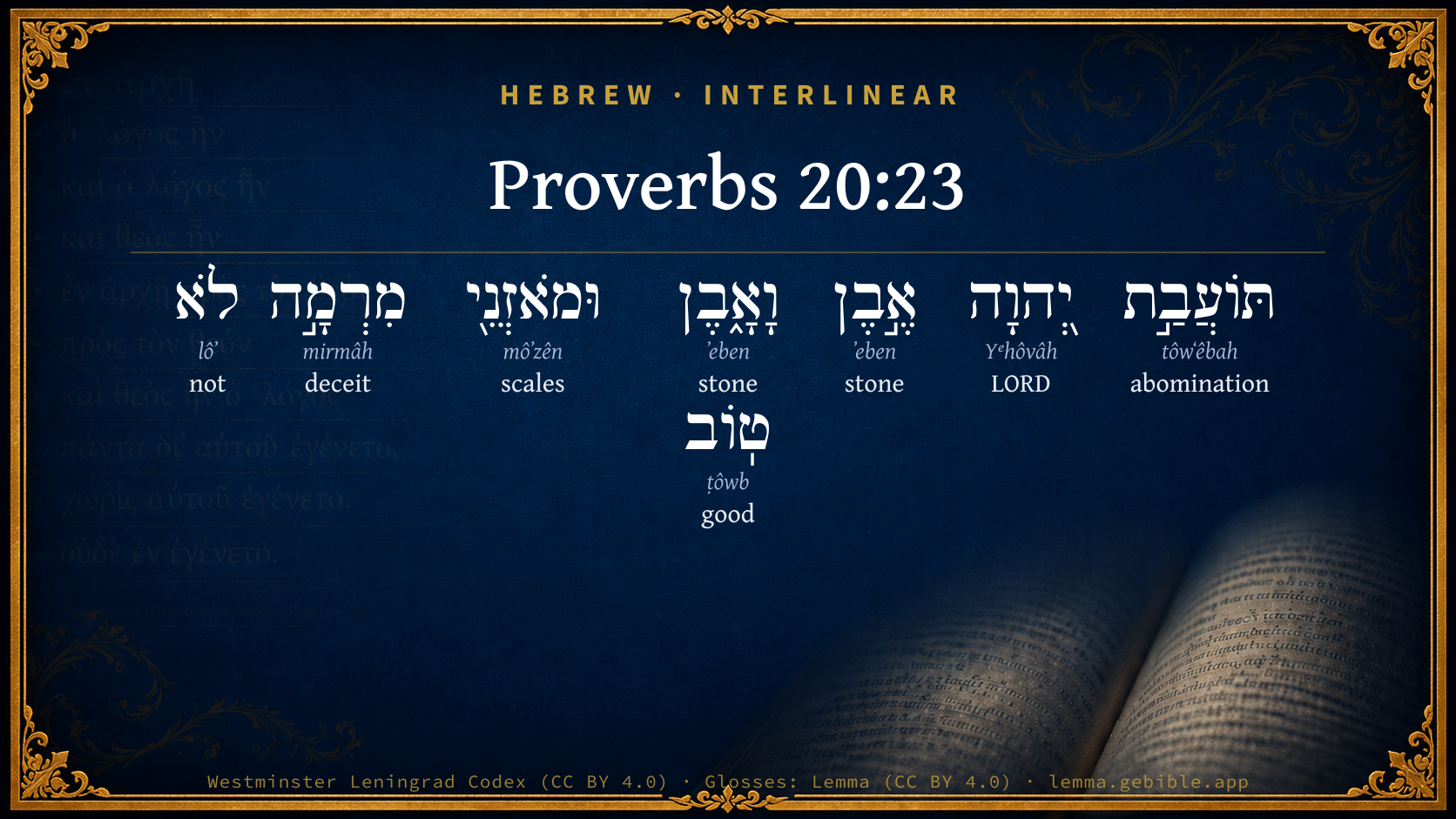
Hebrew (Westminster Leningrad Codex) Proverbs 20:23 appears in the Hebrew Old Testament. The text above is from the Westminster Leningrad Codex. Each word links to its Strong’s number, a concise gloss, and parsing drawn from the Open Scriptures Hebrew Bible morphology. Click any word for its full Brown-Driver-Briggs (BDB) entry.
Download image
Cite this verse

Proverbs 20:23 (World English Bible). Public Domain. Lemma interlinear Bible study tool, https://lemma.gebible.app/v/proverbs/20/23.

Show BibTeX & RIS
BibTeX
RIS
English Translation
Yahweh detests differing weights, And dishonest scales are not pleasing.
World English Bible · Public Domain
Download a study sheet

One document with this verse’s original text, its word-by-word gloss line, the meaning frame, cross-references with their text, attributed commentary, and full source and license credits — printable, and it pastes into notes with its structure intact.

This verse Autodidact and up

Study sheet (.html) Plain text (.txt)

A passage Seminary Student

Up to 50 verses in one chapter. A passage sheet keeps up to 6 commentary sources and 12 cross-references per verse, in the order this page ranks them, and says so on the sheet whenever that leaves anything out. Ask for a single verse and you get the Autodidact verse sheet above.

Everything on this page stays free to read, with no account — the sheet is a download of what is already on screen, not access to it.

Want to remove ads? Support Godless Engineer
Compare translations 3

The same verse in 3 English versions, stacked beneath the original-language interlinear above. Click any original word for its lexicon entry.

Each is an independent rendering of the whole verse — the interlinear is not word-aligned to these translations.

Highlighted words mark where these versions differ — a whole-verse word diff, not a word-by-word alignment.

  • World English Bible Public Domain
    Yahweh detests differing weights, And dishonest scales are not pleasing.
  • King James Version Public Domain
    Divers weights are an abomination unto the LORD; and a false balance is not good.
  • unfoldingWord Literal Text CC BY-SA 4.0
    Stone and stone an abomination to Yahweh, and scales of deceit not good.

unfoldingWord Literal Text — © unfoldingWord, licensed CC BY-SA 4.0. Word-aligned USFM3 via Door43 (git.door43.org/unfoldingWord/en_ult).

Versions to compare (up to 4)

3 of 4 selected

Show all 18 translations

Every available English version of this verse, each an independent rendering of the whole verse.

  • World English Bible Public Domain
    Yahweh detests differing weights, And dishonest scales are not pleasing.
  • Berean Standard Bible Public Domain
    Unequal weights are detestable to the LORD, and dishonest scales are no good.
  • Majority Standard Bible Public Domain
    Unequal weights are detestable to the LORD, and dishonest scales are no good.
  • King James Version Public Domain
    Divers weights are an abomination unto the LORD; and a false balance is not good.
  • American Standard Version (1901) Public Domain
    Diverse weights are an abomination to Jehovah; And a false balance is not good.
  • Revised Version (1885) Public Domain
    Divers weights are an abomination to the LORD; and a false balance is not good.
  • Geneva Bible (1599) Public Domain
    Diuers weightes are an abomination vnto the Lord, and deceitful balances are not good.
  • Douay-Rheims (1899) Public Domain
    Diverse weights are an abomination before the Lord: a deceitful balance is not good.
  • Young's Literal Translation Public Domain
    An abomination to Jehovah `are' a stone and a stone, And balances of deceit `are' not good.
  • Literal Standard Version CC BY-SA 4.0
    A stone and a stone [are] an abomination to YHWH, || And balances of deceit [are] not good.
  • Unlocked Literal Bible CC BY-SA 4.0
    Yahweh hates unequal weights and dishonest scales are not good.
  • unfoldingWord Literal Text CC BY-SA 4.0
    Stone and stone an abomination to Yahweh, and scales of deceit not good.
  • Darby Bible Public Domain
    Divers weights are an abomination unto Jehovah; and a false balance is not good.
  • World Messianic Bible Public Domain
    The LORD detests differing weights, and dishonest scales are not pleasing.
  • Webster's Bible Public Domain
    Divers weights are an abomination to the LORD; and a false balance is not good.
  • Free Bible Version CC BY-SA 4.0
    The Lord hates incorrect weights; using dishonest scales is wrong.
  • Bible in Basic English Public Domain
    Unequal weights are disgusting to the Lord, and false scales are not good.
  • JPS Tanakh (1917) Public Domain
    Divers weights are an abomination to the LORD; and a false balance is not good.

Literal Standard Version (2020), Covenant Press — licensed CC BY-SA 4.0. Text via the HelloAO Bible API (eBible.org). Unlocked Literal Bible (unfoldingWord) — licensed CC BY-SA 4.0. Text via the HelloAO Bible API (eBible.org). unfoldingWord Literal Text — © unfoldingWord, licensed CC BY-SA 4.0. Word-aligned USFM3 via Door43 (git.door43.org/unfoldingWord/en_ult). Free Bible Version, Dr. Jonathan Gallagher — licensed CC BY-SA 4.0. Text via the HelloAO Bible API (eBible.org).

Word by word

More ways to search: Search by grammar → Find every occurrence → Compare this word →

Practice this passage: Drill this verse → Learn its vocabulary →

About this verse

These counts appear in no published source. They are computed here, from the morphology-tagged text and Lemma’s own curated glosses. What Lemma adds →

8
words
7
distinct lemmas
Wisdom
section

Notable vocabulary

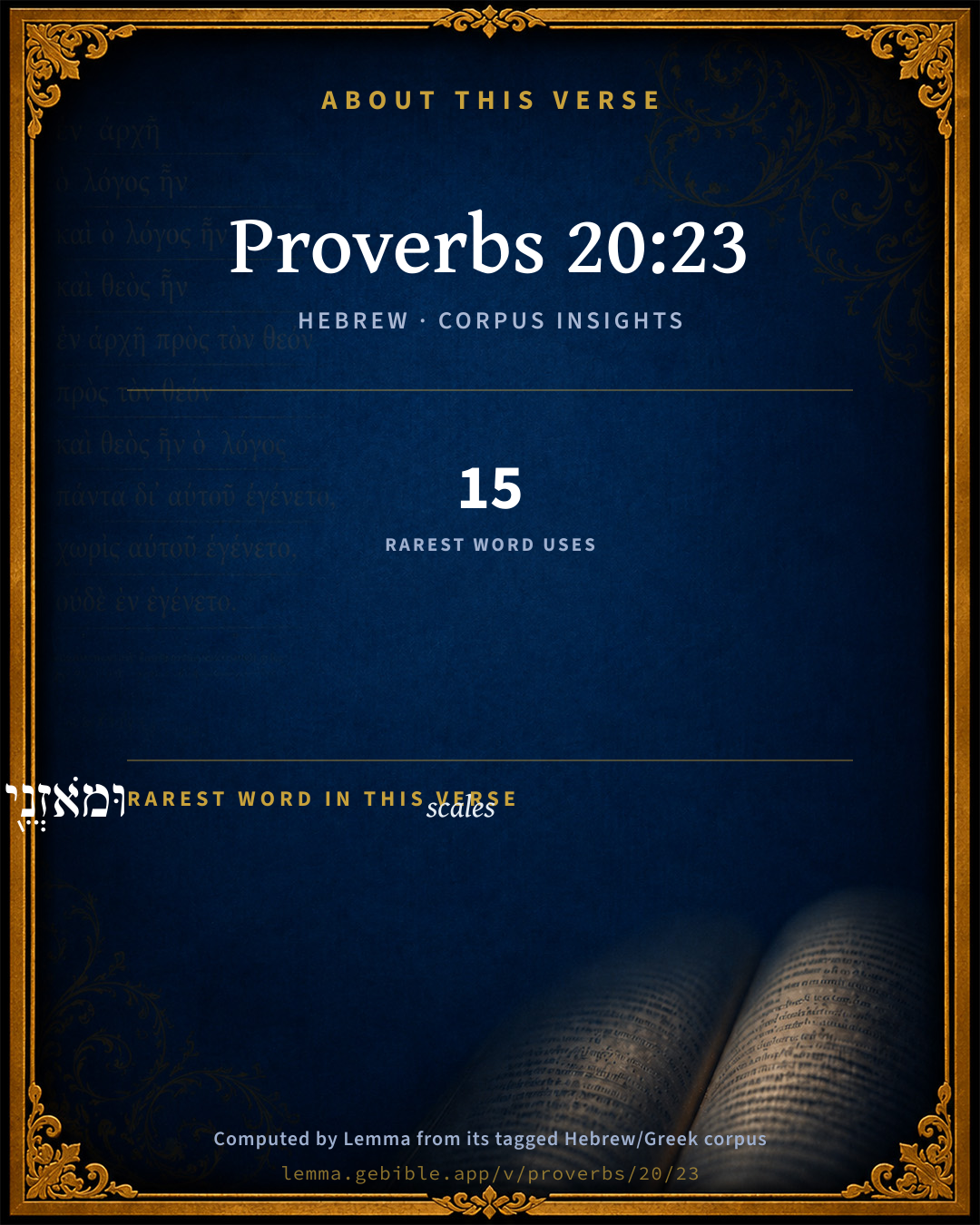
The rarest word here is וּמֹאזְנֵ֖י scales H3976 — appearing just 15 times in the whole Hebrew Bible.

Shared distinctive vocabulary

וּמֹאזְנֵ֖י scales H3976 occurs in 15 verses of the Hebrew Bible. Also found in:

Grammatical profile

  • 6 nouns
  • 1 adjective
  • 1 particle

Repetition

A word recurs within this verse — often emphatic in Hebrew:

  • אֶ֣בֶן stone H68 ×2

Hebrew & Septuagint length

In English translation the verse runs 10 words from the Hebrew and 19 from the Septuagint (LXX English) — the Septuagint runs noticeably longer here. See the side-by-side →

A rough comparison of the two English renderings, which tokenize alike — not a word-level alignment.

Word counts can differ between the Hebrew and the Greek without any difference in meaning — e.g. the Hebrew direct-object marker אֵת has no separate Greek word, and Greek often adds the article ὁ.

Cross-references

5

Topical passages linked to Proverbs 20:23 in the Treasury of Scripture Knowledge — connected by theme and wording, ordered by reader-vote popularity; previews shown in the World English Bible.

  • Proverbs 20:10 Differing weights and differing measures, Both of them alike are an abomination to Yahweh.
  • Hosea 12:7 A merchant has dishonest scales in his hand. He loves to defraud.
  • Proverbs 11:1 A false balance is an abomination to Yahweh, But accurate weights are his delight.
  • Ezekiel 45:10 You shall have just balances, and a just ephah, and a just bath.
  • Amos 8:5 Saying, 'When will the new moon be gone, that we may sell grain? And the Sabbath, that we may market wheat, Making the ephah small, and the shekel large, And dealing falsely with balances of deceit;

Cross-references courtesy of OpenBible.info (CC BY 4.0).

Hebrew and Greek witnesses Masoretic Hebrew ↔ Greek Septuagint

The same verse in the two great witnesses to the Old Testament, shown verse-for-verse.

Here the Septuagint runs noticeably longer than the Hebrew — LXX2012 (modern English Septuagint) 19 words vs World English Bible 10. A rough length comparison of the two English translations, not a word-level alignment — read both below.

These are two independent witnesses, not word-aligned to each other, and the Septuagint is shown in lemma (dictionary) form.

Hebrew Proverbs 20:23 Masoretic · Westminster Leningrad Codex

תּוֹעֲבַ֣ת יְ֭הוָה אֶ֣בֶן וָאָ֑בֶן וּמֹאזְנֵ֖י מִרְמָ֣ה לֹא טֽוֹב

Yahweh detests differing weights, And dishonest scales are not pleasing.

World English Bible · Public Domain

Greek LXX Proverbs 20:23 Septuagint · lemma form
A double weight is an abomination to the Lord; and a deceitful balance is not good in his sight.

LXX2012 (modern English Septuagint) · Public Domain

On this verse, The Pulpit Commentary discusses the Septuagint’s reading. Read the note in Commentary ↓

Hebrew: Westminster Leningrad Codex (CC BY 4.0). Greek: Septuagint (public domain); English from LXX2012 (modern English Septuagint) (Public Domain). How the Septuagint differs from the Hebrew →

Commentary

Notes on Proverbs 20:23 from classic Christian and Jewish commentators (each source and its license shown beneath its notes). The classic Christian expositions comment on the surrounding passage and are grouped to its opening verse, so a note may address several verses; the Jewish commentaries on the Tanakh (Rashi and others) are per-verse, so they appear only where the commentator wrote on this verse.

Lemma curates 59 commentaries, every one of them public domain or Creative Commons licensed, each selected and text-cleaned for this edition rather than reprinted as found. About our sources →

Trapp's Complete Commentary

John Trapp

Pro 20:23 Divers weights [are] an abomination unto the LORD; and a false balance [is] not good.

Ver. 23. Divers weights are an abomination.] In righting and revenging themselves men are apt to weigh things in an uneven balance, to be overpartial in their own cause, and to judge that a heinous offence in another, that is scarce blameworthy in themselves. It is best, therefore, to lay down all injuries at God’s feet, who will be sure to give a "just recompense to every transgression," {Heb 2:2} and will else turn his wrath from our enemies to us, for our diverse weights and false balances. {See Trapp on "Pro 20:10"}

John Trapp, A Commentary or Exposition upon All the Books of the Old and New Testament (1647–1656) — public domain. Text from a community e-Sword module.

The Biblical Illustrator

Joseph S. Exell

Pro_20:23

And a false balance is not good.

False balance applied to providences

We may apply a false balance to the providences which make up our life. What skill some people have in dealing only in dark things, black aspects, wintry phases, deprivations, bereavements, losses! They are eloquent when they tell you what they have parted with. Who can be equally eloquent in numbering mercies? Who ever gets beyond the outside of things, the mere rim, the palpable environment? Who gets into the soul, and who says, I have reason, how can I be poor? I have health, how can I fail? I have home, how can I be desolate? In balancing life take in all these reasons and thoughts and considerations, and so doing you will see that all the while God has been making you rich, or giving you the possibilitity and opportunity of acquiring and enjoying the true wealth. Who is there that keeps a right balance when he has to weigh the present and the future? The unsteady hand can never get an equipoise; the palsied fingers cannot hold the scales. The present is here, the future is yonder; and when did here fail to carry the war against yonder? We have even formed little foolish proverbs about this; we have gone so far as to tell the lie that a bird in the hand is worth two in the bush. Whoever says that is guilty of a palpable sophism. He seems to be speaking truth, he forgets that everything depends on the bird that is in the bush, and all the possibilities and contingencies and promises which relate to the possibility and certainty of its capture if the right way be pursued. We are the victims of the present. It would seem impossible for some men to do justice to spirituality. Spiritual teaching goes for nothing. If you deal in clothing for the head you will get your money; there is a county court to support you--but if you give a man ideas, if you pray him into heaven, if you lift up his soul into a new selfhood, the county court would smile at you if you made application for assistance in any direction that you might think honest and equitable. And the very best of men play at that game. They cannot help it. (J. Parker, D. D.)

The Biblical Illustrator, edited by Joseph S. Exell (c. 1880s–1900s) — public domain. Text from a community e-Sword module.

Bridges on Proverbs

Charles Bridges

Here let us search into the mind of God. Thrice does he bring home one point of practical detail. (Pro 20:10, Pro 20:14, Pro 20:23 .) Yet doubtless this is not a "vain repetition." (Mat 6:7 .) There is a "needs-be" for it. Instead of "precept upon precept, and line upon line" (Isa 28:10 ), the infinite "treasures of wisdom and knowledge" might have poured forth endless variety of instruction. We wonder not to see the apostolic ministry once and again upon the same argument of a sinner’s justification before God.†1 And we gather from this repetition the primary importance, and the peculiarly offensive character of the doctrine. (Rom 10:2-3 .) Does not then this continuous inculcation similarly teach the great weight of the principle involved, and the innate resistance to its full operation? If we feel, that we cannot be too often gladdened with the manifestation of the grace of God; and yet shrink from a frequent and probing application of practical obligation; if we love to be told, what we owe to God on the Sabbath, but revolt from the minute detail of a week, the market and the shop; we do not receive the whole revelation of God, and therefore do not savingly receive any part of it. Ours is not "the wisdom that is from above, without partiality and without hypocrisy." (Jas 3:17 .)

Most palpable is the need for this particular illustration. The evil runs throughout our commercial system. The divers weights, though continually declared to be abominable — yea, an abomination (Pro 11:1 . Mic 6:10-11 ) — to God, yet how often are they palliated, as of daily occurrence, perhaps even of necessity! But ’the scant measure will fill up a full measure of guilt, and the light weights bring upon the soul an heavy weight of judgment.’†2 If Job was fearful, lest his "land and furrows cry against him" (Job 31:38 ), let the trader beware, lest his weights and measures bear witness against him. Cause, indeed, have we for watchfulness! What means this cumbrous and expensive machinery of administration, with all its checks and counter-checks, its fearful multiplication of oaths, but the humiliating declaration, that man cannot trust his fellow-man? Oh! let me not forget, that of all this deceit my heart is the native soil; that nothing but the culture of Divine principle keeps down these poisonous weeds, and nourishes in their room "the fruits of righteousness to the praise and glory of my God." (Php 1:11 .) ’The love of God constrains his servant. God is true to him; and he will not be false to others. God is merciful to him, and he will not be unjust to others.’†3 This is the practical influence of the Gospel.

Footnotes:

†1 See Epistles to the Romans and the Galatians.

†2 Bp. Reynolds’ Sermon on Mic 6:6-8 .

†3 Polhill’s Speculum Theologiæ, p. 438.

Charles Bridges, An Exposition of the Book of Proverbs (1846) — public domain. Text from a community e-Sword module.

Tyndale Open Study Notes

Tyndale Open Resources

20:23 The message of this proverb is presented in three other proverbs (cp. 11:1; 16:11; 20:10).

Tyndale Open Study Notes — © Tyndale Open Resources, licensed CC BY-SA 4.0. Text via the HelloAO Bible API.

Matthew Henry's Commentary

This is to the same purport with what was said Pro 20:20. 1. It is here repeated, because it is a sin that God doubly hates (as lying, which is of the same nature with this sin, is mentioned twice among the seven things that God hates, Pro 6:17, Pro 6:19), and because it was probably a sin very much practised at that time in Israel, and therefore made light of as if there were no harm in it, under pretence that, being commonly used, there was no trading without it. 2. It is here added, A false balance is not good, to intimate that it is not only abominable to God, but unprofitable to the sinner himself; there is really no good to be got by it, no, not a good bargain, for a bargain made by fraud will prove a losing bargain in the end.

Matthew Henry's Commentary on the Whole Bible (1708–1710) — public domain (CC PDM 1.0). Text via the HelloAO Bible API.

Jamieson, Fausset & Brown

Robert Jamieson, A. R. Fausset & David Brown

(Compare Pro 20:10; Pro 11:1).

Jamieson, Fausset & Brown — Commentary Critical and Explanatory on the Whole Bible (1871) — public domain (CC PDM 1.0). Text via the HelloAO Bible API.

The Cambridge Bible for Schools and Colleges

gen. ed. J. J. S. Perowne

23. See Pro_20:10, note.

The Cambridge Bible for Schools and Colleges (gen. ed. J. J. S. Perowne; Cambridge University Press, 1878–1918) — public domain. Text from a community e-Sword module.

John Gill's Exposition

Divers weights are an abomination unto the Lord,.... See Gill on Pro 20:10; which is here repeated for the further confirmation of it, and that it might be taken notice of and avoided; and perhaps this sin of using false weights and measures was common with the Jews;

and a false balance is not good; in the sight of God; but an abomination, as in Pro 11:1; nor is it good for men in the issue; for though they may gain by it at present, it will prove a loss to them in the end, since it will bring a curse on all they get.

John Gill's Exposition of the Whole Bible (1746–1763) — public domain (CC PDM 1.0). Text via the HelloAO Bible API.

Matthew Poole's English Annotations

Divers weights are an abomination unto the Lord; of which See Poole "Pro 20:10".

Is not good; is very wicked and hateful to God and men.

Matthew Poole's English Annotations on the Holy Bible (1683–1685) — public domain. Text from a community e-Sword/MySword module.

Whedon's Commentary on the Bible

Daniel D. Whedon

23. Divers weights… abomination — Compare Pro_20:10, and Pro_11:1. For the expression not good, (a litotes,) comp. Pro_17:26; Pro_18:5.

Daniel D. Whedon (gen. ed.), Commentary on the Old and New Testaments (1874–1909) — public domain. Text from a community e-Sword module.

The Pulpit Commentary

This is a repetition, with a slight variation, of ver. 10 and Pro_11:1 (where see notes). Is not good. A litotes, equivalent to "is very evil," answering to "abomination" in the first member. Septuagint, "is not good before him". (comp. Pro_24:23)

The Pulpit Commentary (1880–1919), ed. H.D.M. Spence-Jones & Joseph S. Exell — public domain. Text from a community e-Sword module.

Keil & Delitzsch

C. F. Keil & F. Delitzsch

23 An abomination to Jahve are two kinds of weights;

And deceitful balances are not good.

A variant to Pro 20:10, Pro 11:1. The pred. לא־טוב (Pro 17:26; Pro 18:5; Pro 19:3) is conceived of as neut.; they are not good, much rather bad and pernicious, for the deceiver succeeds only in appearance; in reality he fails.

Keil & Delitzsch — Biblical Commentary on the Old Testament (1861–1891) — public domain (CC PDM 1.0). Text via the HelloAO Bible API. (Old Testament only.)

Kretzmann's Popular Commentary

Paul E. Kretzmann

v. 23. Divers weights are an abomination unto the Lord, and a false balance is not good. Cf v. 10.

Paul E. Kretzmann, Popular Commentary of the Bible (1921–1924) — public domain. Text from a community e-Sword module.

unfoldingWord translationNotes

Door43 World Missions Community

Yahweh hates unequal weights and dishonest scales are not good

These two phrases basically mean the same thing and are combined to emphasize how bad this is. (See: Parallelism)

A person's steps are directed by Yahweh

This can be stated in active form. AT: "Yahweh directs a person's steps" (See: Active or Passive)

A person's steps

This refers to the various things a person does. AT: "A person's actions" (See: Synecdoche)

how then can he understand his way?

The implicit answer is that he cannot understand it. This rhetorical question may be written as a statement. AT: "therefore, a person cannot understand his way" (See: Rhetorical Question)

understand his way

This is an idiom. The phrase "his way" refers to the person's life. AT: "understand why some things happen in his life" (See: Idiom)

translationWords

Yahweh

good

unfoldingWord translationNotes — © Distant Shores Media and the Door43 World Missions Community, licensed CC BY-SA 4.0. Source: git.door43.org/Door43/en_tn.

Lesson kit

Teaching starters — assembled from the data on this page, not authored interpretation. Every prompt links to the verse data it draws on. Edit before teaching.

Proverbs, in the Wisdom, opens this verse with 8 words (7 distinct Hebrew lemmas). Its most distinctive word is môʼzên (“scales”). The Greek Septuagint runs longer here. A historical commentator’s framing appears above. Read the whole chapter for the surrounding context.

Discussion questions

  1. What does “scales” (môʼzên) contribute to the verse as a whole?
  2. Leviticus 19:36 shares the word «scales» with this verse. How do the two illuminate each other?
  3. “stone” occurs 2× in this one verse. What is the effect of the repetition?
  4. Compared with the Hebrew, the Septuagint runs longer here. What questions does that raise?
  5. The translations on this page render this verse differently — a whole-verse word diff, not a word-by-word alignment. What might account for the different wordings?
  6. Reading how Trapp's Complete Commentary and The Biblical Illustrator read this verse, where do the two commentators agree and where do they part?

Things to notice

Reading settings

Reading text

Shown beneath each verse's original-language words.

Old Testament
Old Testament edition

Read the OT as the Masoretic Hebrew (MT) or the Greek Septuagint (LXX).

English shown for the Greek Septuagint (in the Hebrew ↔ Greek comparison).

Comparing translations? Open the Compare panel on any verse page to stack up to four side by side.