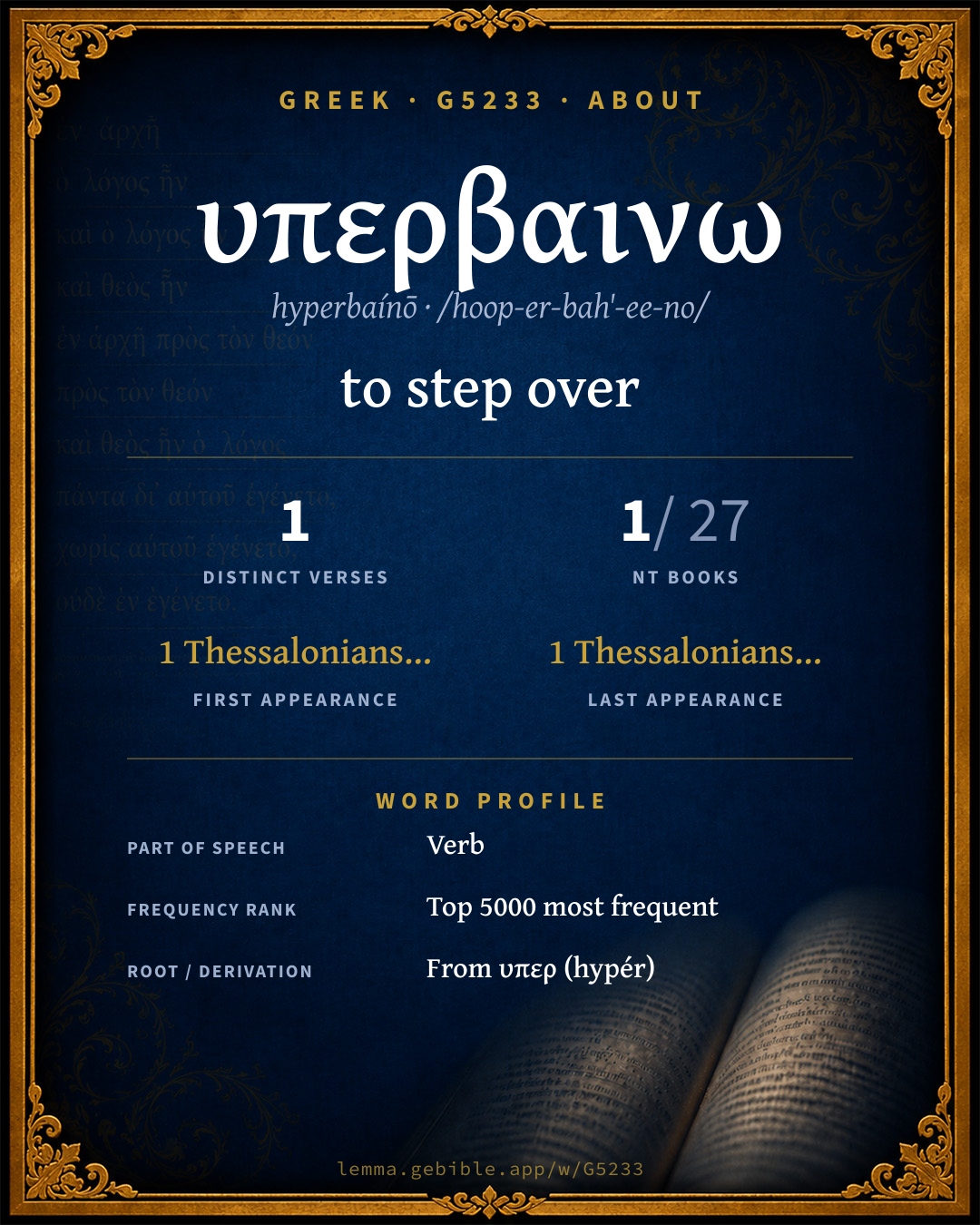
ὑπερβαίνω
to step over
‘to step over’ is one of 2 main senses fuller range ↓
Full lexicon entry — Thayer's Greek Lexicon
From Thayer's Greek Lexicon
Where this word appears
Grammar key — what these labels mean
Part of speech
- Verb
- An action or state-of-being word.
Tense
- Present
- Ongoing or general action in present time (imperfective aspect).
Voice
- Active
- The subject performs the action.
Mood
- Infinitive
- A verbal noun (“to write”), unmarked for person or number.
Every verse where G5233 appears — 1 distinct verse across 1 book. Click any verse to open its interlinear word-by-word view. Verse text shown in the World English Bible for context — . Each verse’s Greek form is shown with its reference; the English is not keyword-highlighted, since the data carries no word-level English alignment. Use “Compare translations” on any verse to read it across multiple English versions. This concordance covers the Greek New Testament; Septuagint (Greek Old Testament) occurrences of this word are not indexed here.
1 Thessalonians 1 verse
About this entry
At a glance — auto-summarized from this page’s data, not written by a person. Every figure links to its source below. This summary describes the numbers; it doesn’t interpret them.
“to step over” is the headline sense of the Greek verb υπερβαινω (hyperbaínō). A scarce word — 1 verse in all of the Greek New Testament. More than three-quarters of its appearances fall in 1 Thessalonians. It occurs only once, in 1 Thessalonians 4:6. Catalogued under 2 senses, its meaning is not single-sense. The sections below give every sense, occurrence, and version rendering.
Gloss history
Strong's 1890 vs modern scholarship

About this word
Strong's G5233 catalogs a Greek word from the Greek New Testament.
These counts are not copied from any lexicon or concordance. They are computed here, from the morphology-tagged Greek New Testament. What Lemma adds →
- 1
- distinct verses
- The word appears in 1 distinct verse.
- 1 / 27
- NT books
- The word appears in 1 of 27 New Testament books.
- #3,503
- by frequency
- Top 5000 most frequent Greek words (rank 3,503 of 5,347 Greek words by occurrence).
View all 1 occurrence in the concordance →
Most concentrated in
- 1 Thessalonians 1 verse 100%
By section of the New Testament
By traditional corpus
Conventional, traditional groupings — biblical authorship is debated, so this is a traditional corpus grouping, not an authorship claim. Some books belong to more than one corpus (Luke is in both the Gospels and the Lukan corpus, and so on), so these shares overlap and need not total 100%. Each figure is a share of the word’s 1 distinct verse.
- Pauline corpus 1 verse · 100%
How translations render this word
Counts come from each version’s own published word-to-Strong’s tagging or interlinear alignment — an approximate guide to how each version renders this word, not a word-level alignment the data otherwise carries. Because each total is that version’s own tagged count, the per-version totals vary from one another and need not match the appearance or distinct-verse counts above. These counts may also differ from a printed concordance because Lemma counts each distinctly tagged rendering and does not collapse phrase taggings into a single head-word total. This is a fixed set of word-tagged versions (KJV, ASV, BSB, ULT) and does not change with the reading translation you choose elsewhere. Each version’s license is shown beside its name below (and on Sources).
- King James Version: Man go beyond 1×
- American Standard Version: Man transgress 1×
- Berean Standard Bible: Should ever violate 1×
- unfoldingWord Literal Text: Transgress 1×
King James Version Public Domain
Renders G5233 across 1 tagged occurrence — most commonly:
American Standard Version Public Domain
Renders G5233 across 1 tagged occurrence — most commonly:
Berean Standard Bible Public Domain
Renders G5233 across 1 tagged occurrence — most commonly:
unfoldingWord Literal Text CC BY-SA 4.0
Renders G5233 across 1 tagged occurrence — most commonly:
Senses in Thayer's
The 2 senses Thayer's distinguishes for this word, in lexicon order (not ranked by frequency or importance). The full entry — with sub-senses — is in the Lexicon Entry tab.
- to step over, beyond
- metaph.
Word origin
Derived from υπερ (hypér) (G5228) — over.
Same root — word family
Other Thayer's entries built from the same root as G5233, grouped by Strong’s listed origin. These share a root / origin per the lexicon — not necessarily a shared meaning. Each links to that word’s own entry.
Derives from
Shares the same root
- υβρις hýbris G5196 insult
- υπεραιρομαι hyperaíromai G5229 to exalt oneself
- υπερακμος hypérakmos G5230 overripe
- υπερανω hyperánō G5231 above
- υπεραυξανω hyperauxánō G5232 to increase greatly
- υπερβαλλω hyperbállō G5235 to surpass
- υπερειδω hypereídō G5237 to overlook
- υπερεκεινα hyperékeina G5238 beyond
- υπερεκτεινω hyperekteínō G5239 to stretch beyond
- υπερεκχυνω hyperekchýnō G5240 to overflow
- υπερεντυγχανω hyperentynchánō G5241 to intercede
- υπερεχω hyperéchō G5242 to stand out
- υπερηφανος hyperḗphanos G5244 haughty
- υπερνικαω hypernikáō G5245 to overcome completely
- υπερογκος hypéronkos G5246 immoderate
- υπερπερισσευω hyperperisseúō G5248 to abound greatly
- υπερπερισσως hyperperissōs G5249 exceedingly
- υπερπλεοναζω hyperpleonázō G5250 to overflow
- υπερυψοω hyperypsóō G5251 to exalt highly
- υπερφρονεω hyperphronéō G5252 to think arrogantly
- υπερωον hyperōion G5253 upper room
- υψος hýpsos G5311 height
Compare all same-root words → Showing 4 of 24 — not the complete family. They share a root, not necessarily a meaning.
Septuagint usage
The same Greek word υπερβαινω appears 13 times in the Greek Old Testament (Septuagint), across 11 verses in 7 books.
- 13
- LXX occurrences
- Tagged occurrences of this Greek word in the Septuagint.
- 11
- verses
- Distinct Septuagint verses containing this word.
- 7 / 39
- OT books
- The word appears in 7 of the 39 Old Testament books.
Sample Septuagint occurrences
- 1 Samuel 5:5 ὑπερβαίνω
- 2 Samuel 18:23 ὑπερβαίνω
- Job 9:11 ὑπερβαίνω
- Psalms 17:30 ὑπερβαίνω
- Proverbs 9:18 ὑπερβαίνω
- Jeremiah 5:22 ὑπερβαίνω
- Micah 7:18 ὑπερβαίνω
Septuagint occurrences (same lexeme)
Every verse where the same Strong’s number (G5233) appears in the Greek Septuagint. Verse text shown in the World English Bible for context; the Greek form is the matched word — the English is not keyword-highlighted.
- 1 Samuel 5:5 ὑπερβαίνω Therefore neither the priests of Dagon, nor any who come into Dagon's house, tread on the threshold of Dagon in Ashdod, to this day.
- 2 Samuel 18:23 ὑπερβαίνω But come what may, [said he], I will run. He said to him, Run. Then Ahimaaz ran by the way of the Plain, and outran the Cushite.
- 2 Samuel 22:30 ὑπερβαίνω For by you I run on a troop; By my God do I leap over a wall.
- Job 9:11 ὑπερβαίνω Behold, he goes by me, and I don't see him. He passes on also, but I don't perceive him.
- Job 14:5 ὑπερβαίνω Seeing his days are determined, The number of his months is with you, And you have appointed his bounds that he can't pass;
- Job 24:2 ὑπερβαίνω There are people who remove the landmarks. They violently take away flocks, and feed them.
- Job 38:11 ὑπερβαίνω And said, 'Here you may come, but no further; Here shall your proud waves be stayed?'
- Psalms 17:30 ὑπερβαίνω
- Proverbs 9:18 ὑπερβαίνω But he doesn't know that the dead are there, That her guests are in the depths of Sheol.
- Jeremiah 5:22 ὑπερβαίνω Don't you fear me? says Yahweh: won't you tremble at my presence, who have placed the sand for the bound of the sea, by a perpetual decree, that it can't pass it? and though the waves of it toss themselves, yet they can't prevail; though they roar, yet they can't pass over it.
- Micah 7:18 ὑπερβαίνω Who is a God like you, who pardons iniquity, And passes over the disobedience of the remnant of his heritage? He doesn't retain his anger forever, Because he delights in loving kindness.
These are occurrences of the same Greek lexeme (G5233) in the Septuagint — not a translation of any one Hebrew word. The store carries no word-level Hebrew↔Greek alignment, so no Hebrew original is asserted here. Counts come from the recovered LXX Strong's tagging — high-frequency vocabulary is well covered, while rare or late forms may be untagged — so they reflect tagged occurrences and may slightly undercount.