
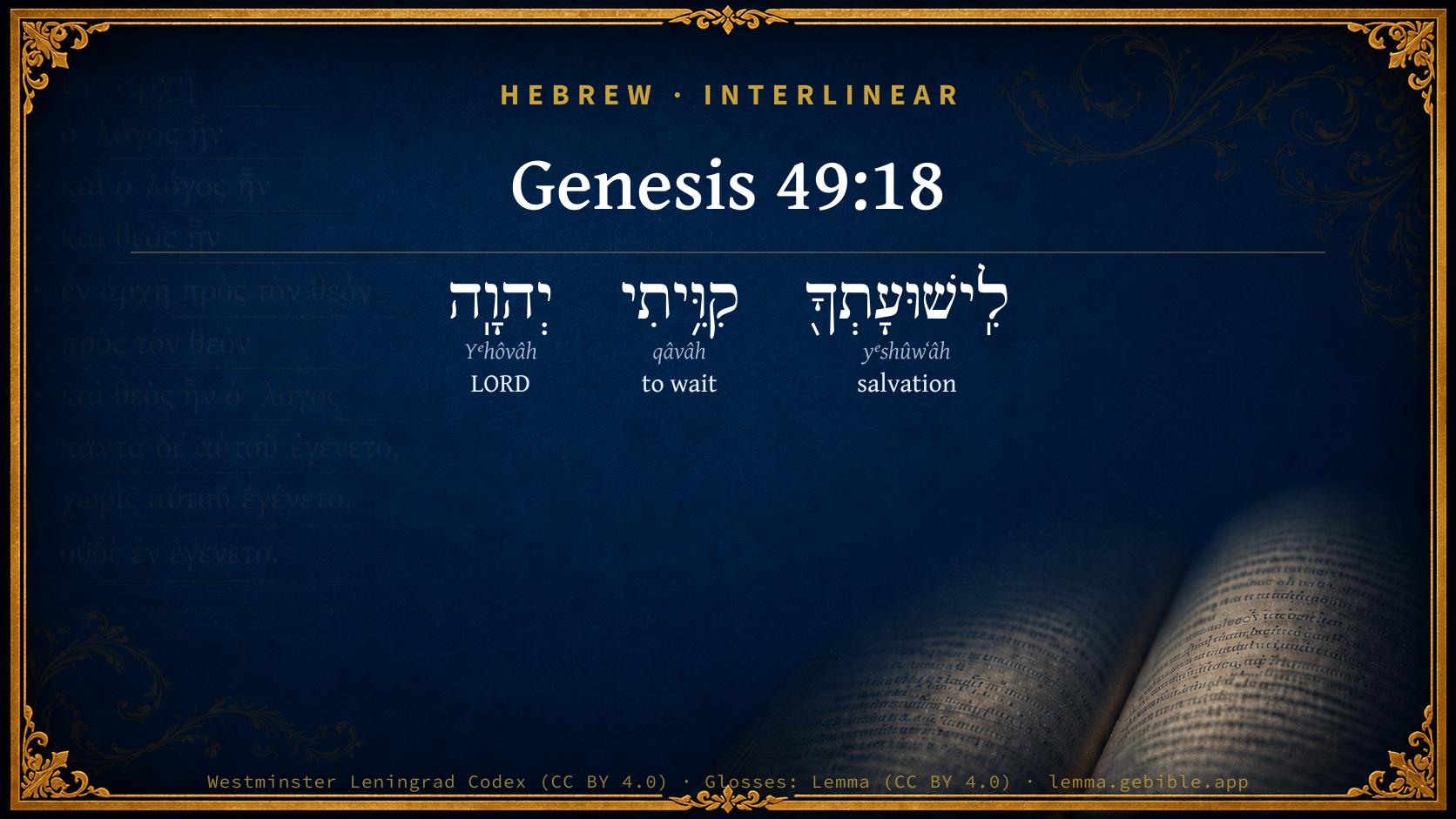
Genesis 49:18

Hebrew (Westminster Leningrad Codex) Genesis 49:18 appears in the Hebrew Old Testament. The text above is from the Westminster Leningrad Codex. Each word links to its Strong’s number, a concise gloss, and parsing drawn from the Open Scriptures Hebrew Bible morphology. Click any word for its full Brown-Driver-Briggs (BDB) entry.
Download image
Cite this verse

Genesis 49:18 (World English Bible). Public Domain. Lemma interlinear Bible study tool, https://lemma.gebible.app/v/genesis/49/18.

Show BibTeX & RIS
BibTeX
RIS
English Translation
I have waited for your salvation, Yahweh.
World English Bible · Public Domain
Highlights
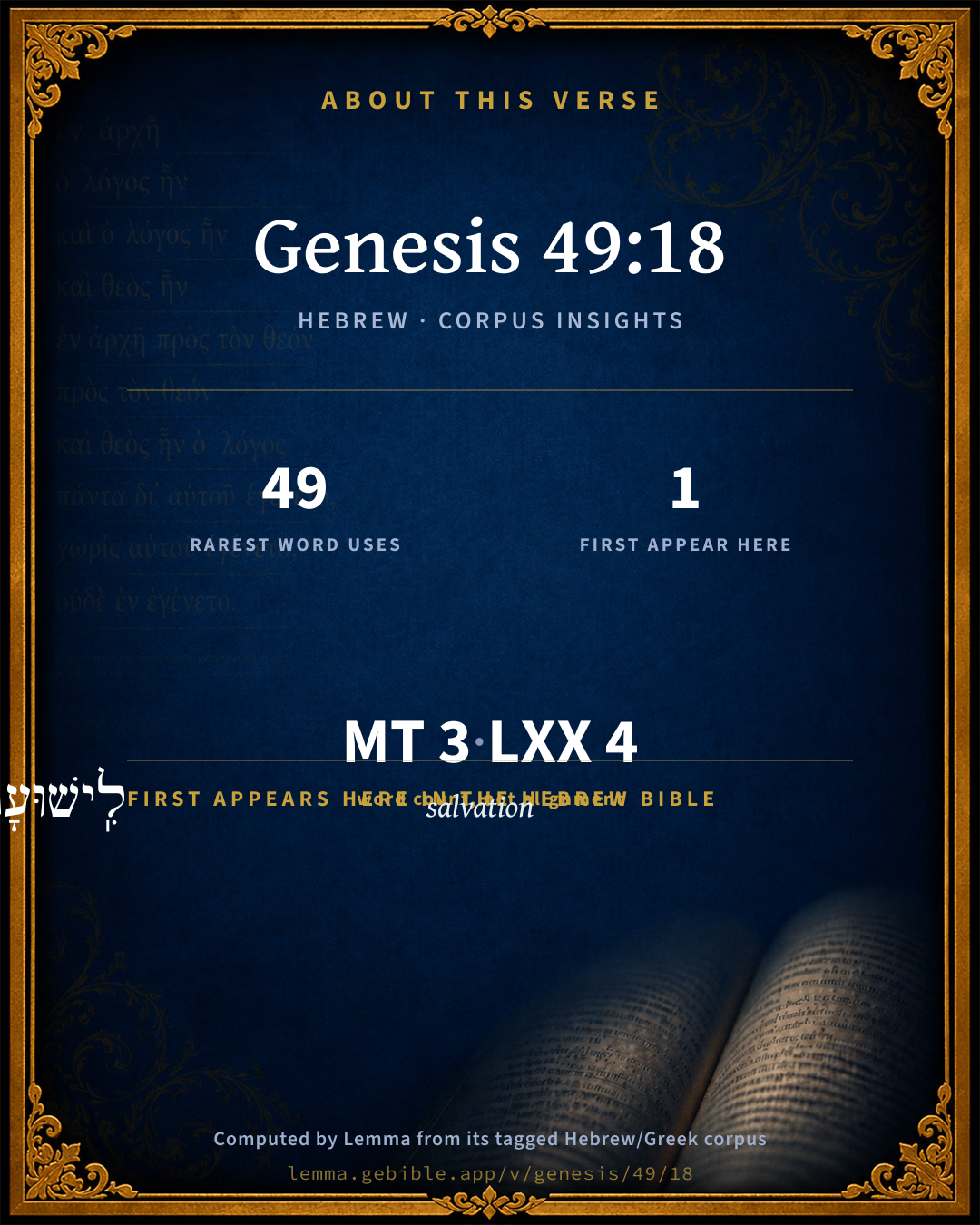
  • 1 first appearance in the Hebrew Bible
Full analysis ↓
Download a study sheet

One document with this verse’s original text, its word-by-word gloss line, the meaning frame, cross-references with their text, attributed commentary, and full source and license credits — printable, and it pastes into notes with its structure intact.

This verse Autodidact and up

Study sheet (.html) Plain text (.txt)

A passage Seminary Student

Up to 50 verses in one chapter. A passage sheet keeps up to 6 commentary sources and 12 cross-references per verse, in the order this page ranks them, and says so on the sheet whenever that leaves anything out. Ask for a single verse and you get the Autodidact verse sheet above.

Everything on this page stays free to read, with no account — the sheet is a download of what is already on screen, not access to it.

Want to remove ads? Support Godless Engineer
Compare translations 3

The same verse in 3 English versions, stacked beneath the original-language interlinear above. Click any original word for its lexicon entry.

Each is an independent rendering of the whole verse — the interlinear is not word-aligned to these translations.

Highlighted words mark where these versions differ — a whole-verse word diff, not a word-by-word alignment.

  • World English Bible Public Domain
    I have waited for your salvation, Yahweh.
  • King James Version Public Domain
    I have waited for thy salvation, O LORD.
  • unfoldingWord Literal Text CC BY-SA 4.0
    I am waiting for your salvation, Yahweh! ts\*

unfoldingWord Literal Text — © unfoldingWord, licensed CC BY-SA 4.0. Word-aligned USFM3 via Door43 (git.door43.org/unfoldingWord/en_ult).

Versions to compare (up to 4)

3 of 4 selected

Show all 17 translations

Every available English version of this verse, each an independent rendering of the whole verse.

  • World English Bible Public Domain
    I have waited for your salvation, Yahweh.
  • Berean Standard Bible Public Domain
    I await Your salvation, O LORD.
  • Majority Standard Bible Public Domain
    I await Your salvation, O LORD.
  • King James Version Public Domain
    I have waited for thy salvation, O LORD.
  • American Standard Version (1901) Public Domain
    I have waited for thy salvation, O Jehovah.
  • Revised Version (1885) Public Domain
    I have waited for thy salvation, O LORD.
  • Geneva Bible (1599) Public Domain
    O Lord, I haue waited for thy saluation.
  • Young's Literal Translation Public Domain
    For Thy salvation I have waited, Jehovah!
  • Literal Standard Version CC BY-SA 4.0
    For Your salvation I have waited, YHWH!
  • Unlocked Literal Bible CC BY-SA 4.0
    I wait for your salvation, Yahweh.
  • unfoldingWord Literal Text CC BY-SA 4.0
    I am waiting for your salvation, Yahweh! ts\*
  • Darby Bible Public Domain
    I wait for thy salvation, O Jehovah.
  • World Messianic Bible Public Domain
    I have waited for your salvation, LORD.
  • Webster's Bible Public Domain
    I have waited for thy salvation O LORD.
  • Free Bible Version CC BY-SA 4.0
    I trust in you to save me, Lord.
  • Bible in Basic English Public Domain
    I have been waiting for your salvation, O Lord.
  • JPS Tanakh (1917) Public Domain
    I wait for Thy salvation, O Lord.

Literal Standard Version (2020), Covenant Press — licensed CC BY-SA 4.0. Text via the HelloAO Bible API (eBible.org). Unlocked Literal Bible (unfoldingWord) — licensed CC BY-SA 4.0. Text via the HelloAO Bible API (eBible.org). unfoldingWord Literal Text — © unfoldingWord, licensed CC BY-SA 4.0. Word-aligned USFM3 via Door43 (git.door43.org/unfoldingWord/en_ult). Free Bible Version, Dr. Jonathan Gallagher — licensed CC BY-SA 4.0. Text via the HelloAO Bible API (eBible.org).

Word by word

More ways to search: Search by grammar → Find every occurrence → Compare this word →

Practice this passage: Drill this verse → Learn its vocabulary →

קִוִּ֥יתִי
qâvâh
H6960
“to wait”
Verb, Piel, Perfect, 1st Person, Common, Singular
Part of Speech
Verb
Stem
Piel
Form
Perfect
Person
1st Person
Gender
Common
Number
Singular
Full BDB Definition

Origin: a primitive root

TWOT: 1994 , 1995

to wait, look for, hope, expect - (Qal) waiting (participle) - (Piel) - to wait or look eagerly for - to lie in wait for - to wait for, linger for - to collect, bind together - (Niphal) to be collected
  1. לִֽישׁוּעָתְךָ֖ yᵉshûwʻâh H3444 “to/for · salvation · your” Preposition + Noun, Common, Feminine, Singular, Construct + Suffix, Personal, 2nd Person, Masculine, Singular
  2. יְהוָֽה Yᵉhôvâh H3068 “LORD” Noun, Proper

About this verse

These counts appear in no published source. They are computed here, from the morphology-tagged text and Lemma’s own curated glosses. What Lemma adds →

3
words
3
distinct lemmas
Pentateuch
section

First appearance in Scripture

This word makes its first canonical appearance in the Hebrew Bible here:

  • לִֽישׁוּעָתְךָ֖ salvation H3444

Shared distinctive vocabulary

קִוִּ֥יתִי to wait H6960 occurs in 45 verses of the Hebrew Bible. Also found in:

Grammatical profile

  • 1 verb
  • 2 nouns

Verb forms

  • קִוִּ֥יתִי Piel · Perfect

Hebrew & Septuagint length

In English translation the verse runs 7 words from the Hebrew and 7 from the Septuagint (LXX English) — the same length.

A rough comparison of the two English renderings, which tokenize alike — not a word-level alignment.

Word counts can differ between the Hebrew and the Greek without any difference in meaning — e.g. the Hebrew direct-object marker אֵת has no separate Greek word, and Greek often adds the article ὁ.

In the original languages it is 3 Hebrew tokens and 4 Greek tokens — but the two are counted differently (Hebrew bundles its prefixes and suffixes into one token; the Greek is in lemma form), so that isn’t a like-for-like length.

Cross-references

28

Topical passages linked to Genesis 49:18 in the Treasury of Scripture Knowledge — connected by theme and wording, ordered by reader-vote popularity; previews shown in the World English Bible.

  • Psalms 119:166 I have hoped for your salvation, Yahweh. I have done your commandments.
  • Psalms 119:174 I have longed for your salvation, Yahweh. Your law is my delight.
  • Isaiah 25:9 It shall be said in that day, Behold, this is our God; we have waited for him, and he will save us: this is Yahweh; we have waited for him, we will be glad and rejoice in his salvation.
  • Micah 7:7 But as for me, I will look to Yahweh. I will wait for the God of my salvation. My God will hear me.
  • Psalms 130:5 I wait for Yahweh. My soul waits. I hope in his word.
  • Psalms 25:5–6 Guide me in your truth, and teach me, For you are the God of my salvation, I wait for you all day long.
  • Psalms 40:1 I waited patiently for Yahweh. He turned to me, and heard my cry.
  • Lamentations 3:25 Yahweh is good to those who wait for him, to the soul that seeks him.
  • Luke 2:25 Behold, there was a man in Jerusalem whose name was Simeon. This man was righteous and devout, looking for the consolation of Israel, and the Holy Spirit was on him.
  • 1 Thessalonians 1:10 and to wait for his Son from heaven, whom he raised from the dead-- Jesus, who delivers us from the wrath to come.
  • Psalms 14:7 Oh that the salvation of Israel would come out of Zion! When Yahweh restores the fortunes of his people, Then Jacob shall rejoice, and Israel shall be glad.
  • Psalms 62:1 My soul rests in God alone. My salvation is from him.
  • Psalms 62:5 My soul, wait in silence for God alone, For my expectation is from him.
  • Psalms 85:7 Show us your loving kindness, Yahweh. Grant us your salvation.
  • Psalms 123:2 Behold, as the eyes of servants look to the hand of their master, As the eyes of a maid to the hand of her mistress; So our eyes look to Yahweh, our God, Until he has mercy on us.
  • Isaiah 8:17 I will wait for Yahweh, who hides his face from the house of Jacob, and I will look for him.
  • Isaiah 33:2 Yahweh, be gracious to us; we have waited for you: be our arm every morning, our salvation also in the time of trouble.
  • Matthew 1:21 She shall bring forth a son. You shall call his name Jesus, for it is he who shall save his people from their sins."
  • Mark 15:43 Joseph of Arimathaea, a prominent council member who also himself was looking for the Kingdom of God, came. He boldly went in to Pilate, and asked for Jesus' body.
  • Luke 1:30 The angel said to her, "Don't be afraid, Mary, for you have found favor with God.
  • Luke 2:30 For my eyes have seen your salvation,
  • Luke 23:51 (he had not consented to their counsel and deed), from Arimathaea, a city of the Jews, who was also waiting for the Kingdom of God:
  • Romans 8:19 For the creation waits with eager expectation for the children of God to be revealed.
  • Romans 8:25 But if we hope for that which we don't see, we wait for it with patience.
  • Galatians 5:5 For we, through the Spirit, by faith wait for the hope of righteousness.
  • Psalms 119:41 Let your loving kindness also come to me, Yahweh, Your salvation, according to your word.
  • Isaiah 30:18 Therefore will Yahweh wait, that he may be gracious to you; and therefore will he be exalted, that he may have mercy on you: for Yahweh is a God of justice; blessed are all those who wait for him.
  • Isaiah 36:8 Now therefore, please give pledges to my master the king of Assyria, and I will give you two thousand horses, if you are able on your part to set riders on them.

Cross-references courtesy of OpenBible.info (CC BY 4.0).

Hebrew and Greek witnesses Masoretic Hebrew ↔ Greek Septuagint

The same verse in the two great witnesses to the Old Testament, shown verse-for-verse.

These are two independent witnesses, not word-aligned to each other, and the Septuagint is shown in lemma (dictionary) form.

Hebrew Genesis 49:18 Masoretic · Westminster Leningrad Codex

לִֽישׁוּעָתְךָ֖ קִוִּ֥יתִי יְהוָֽה

I have waited for your salvation, Yahweh.

World English Bible · Public Domain

Greek LXX Genesis 49:18 Septuagint · lemma form

ὁ σωτηρία περιμένω κύριος

waiting for the salvation of the Lord.

LXX2012 (modern English Septuagint) · Public Domain

Hebrew: Westminster Leningrad Codex (CC BY 4.0). Greek: Septuagint (public domain); English from LXX2012 (modern English Septuagint) (Public Domain). How the Septuagint differs from the Hebrew →

Targum (Aramaic paraphrase)

2

The Targum is the ancient Jewish Aramaic paraphrase of the Hebrew Scriptures — an interpretive translation, not the Hebrew text itself. Onkelos (literal) and Pseudo-Jonathan (expansive) render the Torah, and Jonathan the Prophets. Coverage is partial: where no permissively-licensed English translation exists for a verse, only the Aramaic is shown. This is verse-level text, not a word-by-word alignment to the Hebrew.

  1. Targum Onkelos Torah (Genesis–Deuteronomy)
    לְפוּרְקָנָךְ סַבָּרִית יְיָ

    (no public-domain English translation for this verse)

    Targum Onkelos — Aramaic: “Onkelos Genesis” (public domain); “Onkelos Exodus” (public domain); “Onkelos Leviticus” (public domain); “Onkelos Numbers” (public domain); “Onkelos Deuteronomy” (public domain). English: “Sefaria Community Translation” (CC0 1.0 (public-domain dedication)); “J.W. Etheridge. The Targums of Onkelos and Jonathan Ben Uzziel on the Pentateuch. London: Longmans, Green, 1862” (public domain). Text via Sefaria.

  2. Targum Pseudo-Jonathan Torah (Genesis–Deuteronomy)
    אֲמַר יַעֲקב כַּד חָמָא יַת גִדְעוֹן בַּר יוֹאָשׁ וְיַת שִׁמְשׁוֹן בַּר מָנוֹחַ דְקַיְימִין לִפְרוֹקִין לָא לְפוּרְקָנֵיהּ דְגִדְעוֹן אֲנָא מַסְכֵּי וְלָא לְפוּרְקָנֵיהּ דְשִׁמְשׁוֹן אֲנָא מוֹדִיק דְפוּרְקַנְהוֹן פּוּרְקַן דְשַׁעְתָּא אֱלָהֵין לְפוּרְקָנָךְ סָכִית וְאוֹדִיקִית יְיָ דְפוּרְקָנָךְ פּוּרְקַן עַלְמִין

    When Jakob saw Gideon bar Joash and Shimshon bar Manovach, who were established to be deliverers, he said, I expect not the salvation of Gideon, nor look I for the salvation of Shimshon; for their salvation will be the salvation of an hour; but for Thy salvation have I waited, and will look for, O Lord; for Thy salvation is the salvation of eternity.

    Targum Pseudo-Jonathan — Aramaic: “Targum Jonathan on Genesis” (public domain); “Targum Jonathan on Exodus” (public domain); “Targum Jonathan on Leviticus” (public domain); “Targum Jonathan on Numbers” (public domain); “Targum Jonathan on Deuteronomy” (public domain). English: “The Targum of Jonathan ben Uzziel, trans. J. W. Etheridge, London, 1862” (public domain). Text via Sefaria.

Commentary

Notes on Genesis 49:18 from classic Christian and Jewish commentators (each source and its license shown beneath its notes). The classic Christian expositions comment on the surrounding passage and are grouped to its opening verse, so a note may address several verses; the Jewish commentaries on the Tanakh (Rashi and others) are per-verse, so they appear only where the commentator wrote on this verse.

Lemma curates 59 commentaries, every one of them public domain or Creative Commons licensed, each selected and text-cleaned for this edition rather than reprinted as found. About our sources →

Trapp's Complete Commentary

John Trapp

Gen 49:18 I have waited for thy salvation, O LORD.

Ver. 18. I have waited for thy salvation.] A sudden and sweet ejaculation; either, as, feeling himself faint and spent with speaking, he desires to be dissolved, and so to be freed from all infirmities; or else, foreseeing the defection of this tribe to idolatry, and their many miseries thereupon, he darts up this holy desire to God for them, and himself in them. Good Nehemiah is much in these heavenly ejaculation: and the ancient Christians of Egypt were wont to use very short and frequent prayers, saith Augustine; {a} lest, in longer, their fervour of affection should suffer diminution. "Why criest thou unto me?" saith God to Moses. {Exo 14:15} This was but a sudden desire darted up.

{a} Ne per moras evanesceret et hebetaretur oratio. - Aug.

John Trapp, A Commentary or Exposition upon All the Books of the Old and New Testament (1647–1656) — public domain. Text from a community e-Sword module.

The Biblical Illustrator

Joseph S. Exell

Gen_49:18

I have waited for Thy salvation, of Lord

Times of waiting

A parenthesis in Jacobs long blessing of his sons.

Exhausted with the thoughts and visions which passed over his mind in such quick succession, he paused to take a spiritual inspiration: I have waited for Thy salvation, O Lord.

1. Such chapters of life, such seasons of suspense, such exercises of the quiet confidences of the soul, are to be found in every Christians experience. They may come in different ways to different men, but they are in some form or other a necessity to every man--an essential part of the discipline of the school of salvation.

2. These intervals of waiting must be filled up with four things: prayer, praise, fellowship, and work.

3. It will be a helpful thought to you as you wait, that if you wait, Christ waits. Whatever your longing is that the time be over, His longing is greater. There are many things that you have had that have turned to a curse, which would have been blessings if only there had been more waiting. (J. Vaughan, M. A.)

Waiting for salvation:

1. From these words we may learn what was the nature of that inheritance which the patriarchs regarded as bequeathed to them by the Divine promises. The patriarchs looked for salvation.

2. We learn from the text what had been the great characteristic of Jacobs life from the time that he was first brought under the power of Divine grace. His affections had been set on things above. His chief interest had lain in eternity.

3. The language of Jacob in the text proves most fully the truth elsewhere stated, that the righteous hath hope in his death. Practical questions:

(1) Do you know what is meant by the salvation of the Lord?

(2) Do you know what is meant by waiting for salvation--i.e., ardently but patiently looking forward to it?

(3) Do you know what is meant by preparing while you wait for the salvation of the Lord? (A. D. Davidson.)

Jacobs dying confidence:

I. THE IMPORTANT OBJECT FOR WHICH THE PATRIARCH WAITED.

1. Salvation is present in its commencement.

2. Salvation is future in its consummation.

II. THE GLORIOUS BEING IN WHOM THE PATRIARCH CONFIDED.

1. Salvation is Divinely devised and provided.

2. Salvation is Divinely revealed and promised.

3. Salvation is Divinely imparted and realized.

III. THE SACRED EXERCISE IN WHICH THE PATRIARCH WAS OCCUPIED.

1. We must wait for salvation patiently.

2. We must wait for salvation believingly.

3. We must wait for salvation importunately.

4. We must wait for salvation perseveringly. (Sketches of Sermons.)

Jacobs dying words:

I. The believer can use this language of the text, because he will be PUT, AT DEATH, IN POSSESSION OF A GLORIOUS INHERITANCE--I have waited, said Jacob, for Thy salvation; language implying that there was a future good not yet attained, long as he had been a subject of the Divine government, seeking humbly and holily to walk with God.

II. The words imply Jacobs WILLINGNESS TO LEAVE HIS CHOICEST EARTHLY COMFORTS. He looked for a better heritage, not exposed to vicissitude and change; not amidst a dark and idolatrous land, but in the region of glory where cherubim and seraphim abide; not accorded by the bounty of Pharaoh, but prepared by God for His people. He looked to a house, the builder and maker of which is God. He lived under a darker dispensation than ours; but he had heard the invitation, Come up hither: Enter, thou blessed of the Lord. If then, like Jacob, we have been reconciled and brought near through the blood of the everlasting covenant, are we not warranted in thinking that God will not leave His people comfortless at the last?

III. Jacob had EXPERIENCED MANY TRIALS AND BEEN SUBJECT TO MANY SORROWS. The words, accordingly, seem to have been spoken in assured belief that these would soon be past.

IV. The Christian may feel the force of Jacobs words, inasmuch as he expects to be favoured with the nearer vision of, and to hold CONGENIAL INTERCOURSE WITH, THE SAVIOUR. (A. R. Bonar, D. D.)

Salvation

Salvation! Blessed be God, that our fallen earth has heard the joyful sound! It is unheard in hell. Blessed be the grace which brought it to your ears! To multitudes it is a tuneless cymbal. Salvation! It peoples the many mansions of the heavenly kingdom. Salvation I It is a roll written by Jehovahs pen. It is the decree of Divine councils: the fruit of omniscient mind: the first-born of unmeasured love: the perfection of eternal thought: the strength of omnipotence. Salvation! It is the work for which Jesus was born in Bethlehem, and lived on earth, and died at Calvary, and descended into the grave, and burst the bonds of death, and mounted to heaven, and sits on the right, hand of God. For this He reigns and prays on high. It is the work for which the Spirit seeks our earth, and knocks at the barred entrance of the sinners heart. For this He assails the fortress of self-love, and reveals the perils of sin, and wrestles with ignorance and vain excuses. Salvation! It is the first message which mercy uttered to a ruined world. It is the end of every prophecy--the purport of every precept--the beauty of every promise--the truth of every sacrifice--the substance of every rite--the song of every inspired lip--the longing desire of every renewed heart--the beacon which guides through the voyage of life--the haven to which the tides of grace convey--the end of faith, the full light of hope, the home of love. Salvation! It is the absence of this blessing which builds the prison-house of hell, which kindles the never-quenched fires-which forges the eternal chains which wraps the dreary regions in one mantle of blackness--which gives keenness to the undying worm--which blows up the smoke of torment--which gives the bitterness of despair to the hopeless wail. Does any eager soul exclaim, Tell me, further, wherein Salvations blessedness consists? It is a blessed rescue, to change ceaseless wailings into endless praise: the blackness of darkness into the glories of brightness beyond the sun in his strength. Does any add, Let me clearly understand how this is all accomplished! Come, see the excellent things which Jesus works. He saves by rescuing from hell. He saves by giving title to heaven. He saves by meetening for heaven. He by His Spirit dethrones the love of sin: implants delight in God. It is great, because willed, provided, accepted by a great God, even the Father: because wrought out and finished by a great God, even Jesus: because applied by a great God, even the Spirit. It is great, because it averts great woe: bestows great grace: and blesses a great multitude. O my soul! see to it that you are saved. (Dean Law.)

The death-bed:

I. WHAT IS THIS SALVATION OF WHICH JACOB SPEAKS? As a dying man, he speaks of a salvation towards which he had looked, and for which he had waited until that hour. What that salvation really is, we now know by clear and unequivocal revelation; but the question before us is, what it was in Jacobs estimation, what it was in its actual results upon the dying believer of his day? The full knowledge of the salvation of the gospel gives victory over sin, and death, and the grave.

1. Salvation with him would be deliverance from the burden of the flesh. A mind so spiritual as his, and so habituated to intercourse with the great Father of spirits, could not but discriminate between the immortal spirit and the perishable tenement in which it was confined. He had long experienced the sorrows incident to this imperfect state. The infirmities of age had long been stealing upon him.

2. The salvation for which he looked would be deliverance from sin. Sin was a permanent evil, with which, in some form or other, he had to contend in every period of his life. In youth, maturity, and age, it had still been, in one way or other, the cause of his anxiety. He had, however, attained by faith to the hope of the remission of sin. He leaned upon the Angel that redeemed him from all evil. The system of grace, however fully or scantily revealed, was to him a sufficient ground of hope and practical comfort in the house of his pilgrimage.

3. Jacob would include also in this salvation the high and permanent felicities of an eternal existence. I have waited all the days of my appointed time until my change come. And now, O Lord, fulfil all that I have been led to hope for, and crown this faint and failing spirit with immortal strength, and blessedness, and perfection.

4. Jacob evidently implied, in this strong expression of reliance upon God, the expectation of deliverance from the evils of death itself. The act of dissolution is an event from which human nature shrinks. It is unnatural. It is the consequence of sin. But, Lord, I have waited for Thy salvation. I have looked for complete deliverance. Let my Shepherd and my Guide be with me in the shadowy valley. O God most holy, O Lord most mighty, O merciful Saviour, Thou most worthy Judge Eternal, suffer me not, at my last hour, for any pains of death, to fall from Thee. Here, then, we have a view of the salvation for which Jacob waited.

II. WHAT ARE WE TO UNDERSTAND BY JACOB HAVING WAITED FOR THIS SALVATION? He refers to the habit of his previous life, to the whole tenor of his course. This has been the grand object of my existence. This is the thing for which I have sought.

1. The expression implies that he had believed the truth of this salvation; but of this we need say nothing, for every step of his life exhibits his willing acceptance of the promise of deliverance, and his perfect satisfaction with the covenant of mercy.

2. He had sought for this salvation in the zealous use of the means of grace, in the way of holy and prayerful obedience.

3. He had expected this salvation with increasing affection. It became more and more the object of endeared attachment. To wait, implies the intense occupation of the soul.

4. That Jacob waited implies that he was patient. A waiting spirit is a patient and submissive one. His is not a petulant wish, in a moment of dissatisfaction, to depart; but a calm and even energy of soul bearing towards immortality.

Lessons:

1. Be thankful that, in a rebellious and lost world, the benevolence and the wisdom of God provided, even in the earlier stages of our history, a means of redemption so ample and effective, and left on an infallible record such bright examples for our encouragement and comfort. Let us thank God, and take courage.

2. Again, be humbled when you compare the faith of earlier days with ours in days so rich in evangelical privilege.

3. Lastly, be diligent, then, that you may be found of God in peace, without spot and blameless. (E. Craig.)

The believer waiting for Gods salvation:

I. THE LIVING SAINTS CHARACTER. He is one who is waiting for the salvation of God. By the term salvation here, we are probably to understand the Saviour Himself--the Messiah who had been promised. By the words he uses in the text, Jacob evidently expressed his faith in the testimony of God as to the coming of the Messiah, to whom he looked, as every guilty sinner must do, and in whose name he trusted for salvation and eternal life. Salvation, taken in its fullest sense, expresses all that the soul can require for time and eternity. And well might this good old saint, Jacob, say here, in addressing God, Thy salvation. The glorious design of saving sinners of the human race by a Mediator was conceived in the infinite Mind, and determined upon in the counsels of God, before the foundations of the world were laid, or even time had begun its course. For this salvation Jacob had waited. Numerous had been the incidents of his past life, but amidst them all he had kept his eye fixed on the salvation of God, and had consequently passed through things temporal so as not to lose those things which were eternal.

II. THE DYING SAINTS COMFORT. Brethren, there is no real comfort in dying moments, but that which comes from having waited for God, and being in immediate prospect of entering on a full and uninterrupted enjoyment of the salvation of God; a lively and well-grounded confidence that we are in Christ, and shall be saved in Him, with an everlasting salvation; a hope that maketh not ashamed, that we are heirs of, and are about to be admitted to, glory, honour, and immortality. Sorrow is banished, and desire fully satisfied. A well-grounded hope of thus receiving the end of his faith, even the salvation of his soul, and of being admitted to the felicities, full and perfect and enduring, of the heavenly world, affords strong and abundant consolation to a dying saint. To enjoy this salvation at death and in eternity, it must now be sought by you. (W. Snell.)

Waiting for salvation:

I. How BELIEVERS LIVE. They live waiting for the salvation of the Lord. This comprehends many important particulars both in doctrine and experience.

1. A conviction of the need of salvation. The sick man only needs healing; the man in danger only needs rescuing: to offer to one that is not sick a remedy, and to one that is not lost, salvation, would only be mockery. And this teaches us the reason of a fact which is awful: the whole, in their own estimation, refuse a physician; those who are unconscious that they are lost, ruined, and undone, neglect the great salvation.

2. A knowledge of the method by which salvation is to be obtained. Waiting for a thing implies a sense of its value and importance.

3. Diligence in the use of those means with which the salvation of the soul is connected. Faith and hope do not lie dormant in the heart; they are active principles, always in exercise. The more diligent and devout your attendance on the means which God has appointed in dependence on the influences of the Spirit, the more clear will be your vision, the more fervent your desires, the more full your foretastes of salvation. Waiting on the Lord, you shall renew your strength, and go on in the beauty of holiness, till you appear perfect before God in Zion.

4. That the hope of salvation is the grand support of the believer, and the only source of his consolations under all the sufferings to which he is exposed. He endures, as seeing Him that is invisible, and in hope rejoices against hope.

II. How BELIEVERS DIE. The reigning temper of his heart is still the same. He lived, and now he dies, waiting for the salvation of the Lord. The ruling passion is strong in death. The last emotion, when nature sinks, and all is feebleness and decay, is a desire for the salvation of God. And this implies that the believer considers death--

1. As an entrance on immortality. Surely when he says, I have waited for Thy salvation, O Lord! it does not imply that he wishes his being to become extinct. David knew that he should live in the presence of God. Jacob knew that when the earthly house of his tabernacle was dissolved, he had a building of God, a house not made with hands, eternal in the heavens.

2. As the termination of his sufferings. His temptations and sorrows can follow him no further. At the gate of death he lays down his burden: he is to sigh and suffer no more for ever. His warfare is accomplished. His long, tedious, painful struggles are at an end. Death, which is to some the beginning of sorrows and of sufferings, is to him the end of both.

3. As the harvest, when all the graces of the spirit would be ripened, and matured, and gathered, it is said that the good man shall come to his grave, like as a shock of corn cometh in his season. Observe this figure: The fallow ground is first broke up, the seed is sown, and it remains unseen.

But the process of vegetation is going forward; the germ is expanding; ere long the green blade appears. The frosts pass over it, and it withers; but the sun shines, and it recovers. At length, after it has experienced a few storms, and been impeded in its growth by noxious weeds, in consequence of fruitful showers and genial sunshine, it is fully ripe and fit for the harvest. So the fallow ground of the heart is broken up; the good seed of the kingdom, the incipient principles of grace are implanted. They are hidden for a season, but they proceed; there is the principle of vitality; and we see first the blade, then the ear, and after that the full corn in the ear. All the graces of the Spirit are then ripened and perfected; faith into vision, hope into fruition, and love is made perfect so as to cast out all fear. Then the believer shall see God without an interposing cloud, love Him with a perfect heart, and serve Him without weariness.

4. An assurance of a glorious resurrection. When Jacob was dying, he took an oath of his son that he would bury him in the land of Canaan. And Joseph also gave commandment concerning his bones. What should make these holy men so anxious about the place of their interment? The world is lost to a dead man; and what matters it whether he lies in Egypt or in Canaan? What could it he for, but to express their faith in the promise of God; their belief that death would not cut them off from His favour. The place of their burial, therefore, will remain as a monument of their faith to the latest period of time: and when the angels gather up their fragments, where are they to look for them but in that land where they are laid, and where Christ appeared, and will appear again?

From the whole let us--

1. Learn the vast importance of that salvation which has been an object of desire to the saints of God in all ages. The word signifies deliverance--deliverance from all evil, and introduction to all good.

2. Behold the perfect man, and mark the upright; for the end of that man is peace. If his life is honourable to religion, his death is a confirmation of all that he professed. (W. Thorpe.)

The Biblical Illustrator, edited by Joseph S. Exell (c. 1880s–1900s) — public domain. Text from a community e-Sword module.

Joseph Benson's Commentary

Gen 49:18. I have waited for thy salvation, O Lord — These words may be considered in two lights; 1st, As connected with the preceding prophecy concerning Dan, according to the explanation given in the last note. Under a foresight of their dishonourable, perfidious, and serpent-like conduct, and the general idolatry which should be introduced among his descendants through their means, Jacob says, I have waited for, expected and desired, thy help, O Lord, to save my posterity from the manifold sins and temporal calamities which I foresee are coming upon them, and especially from spiritual and eternal miseries, by that Messiah whom thou hast promised, that seed of the woman which is to bruise the head of him that bruises the heel of thy people. Or, 2d, They may be considered as an unconnected sentence, an ejaculation, in which he interrupts the thread of his discourse, and breathes out his desires after God. And the pious ejaculations of a warm and lively devotion, though sometimes they may be incoherent, yet are not impertinent. It is no absurdity, when we are speaking to men, to lift up our hearts to God. The salvation he waited for was, 1st, Christ, the promised seed, whom he had spoken of, Gen 49:10; now he was going to be gathered to his people, he breathes after him to whom the gathering of the people shall be. 2d, Heaven, the better country, which he declared plainly that he sought, Heb 11:13-14, and continued seeking now he was in Egypt.

Joseph Benson's Commentary on the Old and New Testaments (1811–1818) — public domain. Text from a community e-Sword module.

Keil & Delitzsch

C. F. Keil & F. Delitzsch

But this manifestation of strength, which Jacob expected from Dan and promised prophetically, presupposed that severe conflicts awaited the Israelites. For these conflicts Jacob furnished his sons with both shield and sword in the ejaculatory prayer, "I wait for Thy salvation, O Jehovah!" which was not a prayer for his own soul and its speedy redemption from all evil, but in which, as Calvin has strikingly shown, he expressed his confidence that his descendants would receive the help of his God. Accordingly, the later Targums (Jerusalem and Jonathan) interpret these words as Messianic, but with a special reference to Samson, and paraphrase Gen 49:18 thus: "Not for the deliverance of Gideon, the son of Joash, does my soul wait, for that is temporary; and not for the redemption of Samson, for that is transitory; and not for the redemption of Samson, for that is transitory; but for the redemption of the Messiah, the Son of David, which Thou through Thy word hast promised to bring to Thy people the children of Israel: for this Thy redemption my soul waits."

(Note: This is the reading according to the text of the Jerusalem Targum, in the London Polyglot as corrected from the extracts of Fagius in the Critt. Sacr., to which the Targum Jonathan also adds, "for Thy redemption, O Jehovah, is an everlasting redemption." But whilst the Targumists and several fathers connect the serpent in the way with Samson, by many others the serpent in the way is supposed to be Antichrist. On this interpretation Luther remarks: Puto Diabolum hujus fabulae auctorem fuisse et finxisse hanc glossam, ut nostras cogitationes a vero et praesente Antichristo abduceret.)

Keil & Delitzsch — Biblical Commentary on the Old Testament (1861–1891) — public domain (CC PDM 1.0). Text via the HelloAO Bible API. (Old Testament only.)

Tyndale Open Study Notes

Tyndale Open Resources

49:18 At this point, Jacob interjected an expression of hope. He may have been indirectly reminding his sons of their need for dependence on the Lord or expressing his hope in the Messiah’s reign, when he and his descendants would be rescued from all trouble, grief, and human treachery.

Tyndale Open Study Notes — © Tyndale Open Resources, licensed CC BY-SA 4.0. Text via the HelloAO Bible API.

Geneva Bible (1599)

Geneva Bible translators

Seeing the miseries that his posterity should fall into, he bursteth out in prayer to God to remedy it.

Geneva Bible (1599) marginal notes — public domain. Text via Bolls.life.

John Calvin's Commentaries

18. I have waited for thy salvation, O Lord. It may be asked, in the first place, what occasion induced the holy man to break the connection of his discourse, and suddenly to burst forth in this expression; for whereas he had recently predicted the coming of the Messiah, the mention of salvation would have been more appropriate in that place. I think, indeed, that when he perceived, as from a lofty watchtower, the condition of his offspring continually exposed to various changes, and even to be tossed by storms which would almost overwhelm them, he was moved with solicitude and fear; for he had not so put off all paternal affection, as to be entirely without care for those who were of his own blood. He, therefore, foreseeing many troubles, many dangers, many assaults, and even many slaughters, which threatened his seed with as many destructions, could not but condole with them, and, as a man, be troubled at the sight. But in order that he might rise against every kind of temptation with victorious constancy of mind, he commits himself unto the Lord, who had promised that he would be the guardian of his people. Unless this circumstance be observed, I do not see why Jacob exclaims here, rather than at the beginning or the end of his discourse, that he waited for the salvation of the Lord. But when this sad confusion of things presented itself to him, which was not only sufficiently violent to shake his faith, but was more than sufficiently burdensome entirely to overwhelm his mind, his best remedy was to oppose to it this shield. I doubt not also, that he would advise his sons to rise with him to the exercise of the same confidence. Moreover, because he could not be the author of his own salvation, it was necessary for him to repose upon the promise of God. In the same manner, also, must we, at this day, hope for the salvation of the Church: for although it seems to be tossed on a turbulent sea, and almost sunk in the waves, and though still greater storms are to be feared in future; yet amidst manifold destructions, salvation is to be hoped for, in that deliverance which the Lord has promised. It is even possible that Jacob, foreseeing by the Spirit, how great would be the ingratitude, perfidy, and wickedness of his posterity, by which the grace of God might be smothered, was contending against these temptations. But although he expected salvation not for himself alone, but for all his posterity, this, however, deserves to be specially noted, that he exhibits the life-giving covenant of God to many generations, so as to prove his own confidence that, after his death, God would be faithful to his promise. Whence also it follows, that, with his last breath, and as if in the midst of death, he laid hold on eternal life. But if he, amidst obscure shadows, relying on a redemption seen afar off, boldly went forth to meet death; what ought we to do, on whom the clear day has shined; or what excuse remains for us, if our minds fail amidst similar agitations?

John Calvin's Commentaries (1540-1563) — public domain. Text from the Calvin Translation Society English edition (1840s-50s) via the Christian Classics Ethereal Library (ccel.org). Calvin's coverage is partial (roughly two-thirds of the Bible); uncommented books and verses are honest gaps, never fabricated. The 19th-century editor's footnotes and remarks are omitted so the notes are faithfully Calvin's own voice.

Ellicott's Commentary for English Readers

(18) I have waited for thy salvation, O Lord (Jehovah).—Among the many explanations hazarded of this ejaculation the most probable is that given in the Speaker’s Commentary, that the thought of the serpent wounding his prey in the heel carried the mind of the patriarch back to the fall of man, and the promise made to Eve. And thus it is a profession of faith, naturally called out by this chain of ideas, in the advent in due time of the promised Deliverer, and of which the accomplishment had become united in thought with the name of Jehovah.

A Bible Commentary for English Readers, edited by Charles John Ellicott (1878–1897) — public domain. Text from a community e-Sword module.

The Cambridge Bible for Schools and Colleges

gen. ed. J. J. S. Perowne

18. I have waited] This parenthetical ejaculation of prayer is thought by many scholars to be a gloss. But all authorities contain the verse. There is no obvious reason for inserting such a gloss at this particular point. (a) The ejaculation has by some been thought to shew that, at the time of the composition of this song, Dan was engaged in a long conflict with his foes, and the issue was still doubtful. (b) By others it has been explained as a cry of physical weakness by Jacob. It is very possible that the verse is intended to mark the point at which the song is half finished; but it is not necessarily, therefore, an interpolation.

thy salvation] i.e. deliverance wrought by Thee. For the thought of the prayer, cf. Psa_25:5; Psa_27:14; Psa_119:81; Psa_119:166; Psa_119:174; Isa_25:9.

The Cambridge Bible for Schools and Colleges (gen. ed. J. J. S. Perowne; Cambridge University Press, 1878–1918) — public domain. Text from a community e-Sword module.

John Gill's Exposition

Out of Asher his bread shall be fat,.... Which signifies that this tribe would have a sufficiency of food out of their own land, without being obliged to others, and that it would be of the best sort; it occupied a tract of land, as Andrichomius (l) says, reaching from great Zidon to Carmel of the sea, a space of twenty miles in length; and in breadth, from the great sea to Asor, and even to Naason, a space of nine miles; the land of this tribe is very fat, he says, and exceeding fruitful in wine and oil, especially in the best wheat: and in this tribe, as the same writer (m) observes, among other very fruitful places was the valley of Asher, called the fat valley, which began five miles from Ptolemais, and reached to the sea of Galilee, and contained more than ten miles in length; the soil of which was exceeding fat and fruitful, and produced the most delicate wine and wheat, and might be truly called the fat valley, see Deu 33:24.

and he shall yield royal dainties; food fit for kings, of all sorts, flesh, fish, and fowl: here King Solomon had one of his purveyors to provide food for him and his household, Kg1 4:16. Asher's country answered to his name, which signifies happy or blessed: in those parts Christ was much in the days of his flesh on earth; in Cana of this tribe he turned water into wine and in this country discoursed concerning the bread of life himself, who is the best of bread and royal dainties.

(l) Theatrum Terrae sanctae, p. 1. (m) lb. p. 13.

John Gill's Exposition of the Whole Bible (1746–1763) — public domain (CC PDM 1.0). Text via the HelloAO Bible API.

Matthew Poole's English Annotations

I do earnestly wait, and hope, and pray for thy helping hand to save me and my posterity from the manifold temporal calamities which I foresee will come upon them, and especially from spiritual and eternal mischiefs, by that Messiah which thou hast promised. Jacob in the midst of his great work doth take a little breathing, and finding himself weakened by his speech to his children, and drawing nearer death, he opens his arms to receive it, as the thing for which he had long waited, as the only effectual remedy and mean of salvation or deliverance from all his pains and miseries, and particularly from his present horrors, upon the contemplation of the future state of his children. And this pathetical exclamation may look either,

1. Backward, to the state of the tribe of Dan, which he foresaw would be deplorable, both for its great straits and pressures, of which see Jos 19:47; Jdg 1:34, and especially for that idolatry which that tribe would introduce and promote, Jdg 18:30; 1Ki 12:29, whereby they would ruin themselves, and most of the other tribes with them. Or,

2. Forward, to the doubtful and miserable condition of Gad.

Matthew Poole's English Annotations on the Holy Bible (1683–1685) — public domain. Text from a community e-Sword/MySword module.

Whedon's Commentary on the Bible

Daniel D. Whedon

18. For thy salvation have I longed, Jehovah — What occasioned this abrupt exclamation at this point, or what connexion it has with the context, is not clear. Probably the wars and dangers that awaited the chosen people were vividly presented to the patriarch’s soul as he mentioned the traits of Dan, and these again call up the ancient prophecy of the conflict between the woman’s and the serpent’s seed, (Gen_3:15,) and as he has a glimpse of that momentous struggle, he breaks out with this ejaculation. But if no such relation to the context be allowed, we may suppose that Jacob here breaks out with these words as a refrain, or pause, in the midst of exciting prophecy, and conflicting emotions within.

Daniel D. Whedon (gen. ed.), Commentary on the Old and New Testaments (1874–1909) — public domain. Text from a community e-Sword module.

The Pulpit Commentary

HOMILIES BY W. ROBERTS Ver. 18.

God"s salvation.

I WHAT IT IS. Deliverance from evil, succor against foes, victory over sin and death.

II WHENCE IT COMES. The primal fountain is Jehovah, the covenant God of the believer. The salvation of the gospel is God"s in its original conception and proclamation, in its subsequent procurement and donation, in its ultimate development and consummation.

III HOW IT IS OBTAINED. Not by merit, or by works, but by believing, and waiting, and hoping. "He that believeth shall be saved." "The Lord loveth them that hope in his mercy." "It is good for a man both to hope, and to quietly wait for the salvation of the Lord. W.

Ver. 18.

A dying saint"s exercise.

I ADORATION. "O Lord!" Jehovah the God of redemption, the supreme object of worship.

II MEDITATION. "Thy salvation!" What a theme for the thoughts to dwell on God"s salvation in its origin, in its greatness, in its freeness, &c. ;

III EXPECTATION. "For thy salvation do I hope." Hope is the expectation of fixture good, and presupposes faith as its ground-work and support. W.

The Pulpit Commentary (1880–1919), ed. H.D.M. Spence-Jones & Joseph S. Exell — public domain. Text from a community e-Sword module.

John Wesley's Explanatory Notes

I have waited for thy salvation, Lord - If he must break off here, and his breath will not serve him to finish what he intended, with these words he pours out his soul into the bosom of his God, and even breaths it out. The pious ejaculations of a warm and lively devotion, though sometimes they maybe incoherent, yet they are not impertinent; that may be uttered affectionately, which doth not come in methodically. It is no absurdity, when we are speaking to men, to lift up our hearts to God. The salvation he waited for was, 1st, Christ, the promised seed, whom he had spoken of, ver. 10, now he was going to be gathered to his people, he breathes after him to whom the gathering of the people shall be. 2ndly, Heaven, the better country, which he declared plainly that he sought, Heb. xi, 13, 14, and continued seeking now he was in Egypt.

John Wesley, Explanatory Notes Upon the Whole Bible (1754–1765) — public domain. Text via the GEBible commentary corpus.

Rashi

Rabbi Shlomo Yitzchaki (Rashi)

'לישועתך קויתי ה I HOPE FOR THY AID, O ETERNAL — He prophesied that the Philistines would put out his (Samson’s) eyes, and that he would have to say (Judges 16:28) “Remember me, I pray Thee, and strengthen me, I pray Thee, only this once etc.”

Rashi on the Tanakh — English translations: “The Judaica Press complete Tanach with Rashi, translated by A. J. Rosenberg” (CC BY 4.0); “Pentateuch with Rashi's commentary by M. Rosenbaum and A.M. Silbermann, 1929-1934” (public domain); “The Metsudah Tanach series, Lakewood, N.J” (CC BY 4.0); and “The Book of Joshua, Metsudah Publications, 1997” (CC BY 4.0). Text via Sefaria.

Ramban (Nachmanides)

Rabbi Moshe ben Nachman (Ramban / Nachmanides)

I HOPE FOR THY AID, O ETERNAL. Among all the judges of Israel there was none who fell into the hands of his enemies except Samson, who is this “snake” [referred to in Jacob’s prophecy], just as it is written, Then the Eternal was with the judge, and saved them out of the hand of their enemies all the days of the judge, 2:18. and Samson was the last of the judges since his successor Samuel was a prophet and he did not conduct war on the people’s behalf, and in his days the kings [Saul and David] reigned. Now when the prophet Jacob saw that the deliverance which was to come through Samson ceased [when he died together with the Philistines], he said, “I hope for Thy aid, O Eternal, not for the aid of ‘the snake’ or ‘the serpent,’ for it is by Thee that I will be helped, not by a judge, as Thy salvation is ‘an everlasting salvation.’”

Ramban (Nachmanides) on the Tanakh — English translation: “Commentary on the Torah by Ramban (Nachmanides). Translated and annotated by Charles B. Chavel. New York, Shilo Pub. House, 1971-1976” (CC BY 4.0). Text via Sefaria.

Lesson kit

Teaching starters — assembled from the data on this page, not authored interpretation. Every prompt links to the verse data it draws on. Edit before teaching.

Genesis, in the Pentateuch, opens this verse with 3 words (3 distinct Hebrew lemmas). Its most distinctive word is qâvâh (“to wait”). A historical commentator’s framing appears above. Read the whole chapter for the surrounding context.

Discussion questions

  1. How does “to wait” (qâvâh) shape what this verse is saying?
  2. The word “salvation” first appears here in Scripture. What is being introduced at this debut?
  3. Genesis 1:9 shares the word «to wait» with this verse. How do the two illuminate each other?
  4. These translations render this verse differently. What is at stake in choosing one wording over another?
  5. The verb «קִוִּ֥יתִי» is Piel Perfect. How does its form color the action?
  6. Reading how Trapp's Complete Commentary and The Biblical Illustrator read this verse, where do the two commentators agree and where do they part?

Things to notice

Reading settings

Reading text

Shown beneath each verse's original-language words.

Old Testament
Old Testament edition

Read the OT as the Masoretic Hebrew (MT) or the Greek Septuagint (LXX).

English shown for the Greek Septuagint (in the Hebrew ↔ Greek comparison).

Comparing translations? Open the Compare panel on any verse page to stack up to four side by side.