1 Thessalonians 5:9

Greek (Tischendorf 8th ed.) 1 Thessalonians 5:9 appears in the Greek New Testament. The text above is from the Tischendorf 8th edition. Each word links to its Strong’s number and a concise gloss. Click any word for its full Thayer’s Greek Lexicon entry.
Download image
Cite this verse

1 Thessalonians 5:9 (World English Bible). Public Domain. Lemma interlinear Bible study tool, https://lemma.gebible.app/v/1-thessalonians/5/9.

Show BibTeX & RIS
BibTeX
RIS
English Translation
For God didn't appoint us to wrath, but to the obtaining of salvation through our Lord Jesus Christ,
World English Bible · Public Domain
Download a study sheet

One document with this verse’s original text, its word-by-word gloss line, the meaning frame, cross-references with their text, attributed commentary, and full source and license credits — printable, and it pastes into notes with its structure intact.

This verse Autodidact and up

Study sheet (.html) Plain text (.txt)

A passage Seminary Student

Up to 50 verses in one chapter. A passage sheet keeps up to 6 commentary sources and 12 cross-references per verse, in the order this page ranks them, and says so on the sheet whenever that leaves anything out. Ask for a single verse and you get the Autodidact verse sheet above.

Everything on this page stays free to read, with no account — the sheet is a download of what is already on screen, not access to it.

Want to remove ads? Support Godless Engineer
Compare translations 3

The same verse in 3 English versions, stacked beneath the original-language interlinear above. Click any original word for its lexicon entry.

Each is an independent rendering of the whole verse — the interlinear is not word-aligned to these translations.

Highlighted words mark where these versions differ — a whole-verse word diff, not a word-by-word alignment.

  • World English Bible Public Domain
    For God didn't appoint us to wrath, but to the obtaining of salvation through our Lord Jesus Christ,
  • King James Version Public Domain
    For God hath not appointed us to wrath, but to obtain salvation by our Lord Jesus Christ,
  • unfoldingWord Literal Text CC BY-SA 4.0
    For God did not appoint us for wrath, but for the obtaining of salvation through our Lord Jesus Christ,

unfoldingWord Literal Text — © unfoldingWord, licensed CC BY-SA 4.0. Word-aligned USFM3 via Door43 (git.door43.org/unfoldingWord/en_ult).

Versions to compare (up to 4)

3 of 4 selected

Show all 19 translations

Every available English version of this verse, each an independent rendering of the whole verse.

  • World English Bible Public Domain
    For God didn't appoint us to wrath, but to the obtaining of salvation through our Lord Jesus Christ,
  • Berean Standard Bible Public Domain
    For God has not appointed us to suffer wrath, but to obtain salvation through our Lord Jesus Christ.
  • Majority Standard Bible Public Domain
    For God has not appointed us to suffer wrath, but to obtain salvation through our Lord Jesus Christ.
  • King James Version Public Domain
    For God hath not appointed us to wrath, but to obtain salvation by our Lord Jesus Christ,
  • American Standard Version (1901) Public Domain
    For God appointed us not into wrath, but unto the obtaining of salvation through our Lord Jesus Christ,
  • Revised Version (1885) Public Domain
    For God appointed us not unto wrath, but unto the obtaining of salvation through our Lord Jesus Christ,
  • Geneva Bible (1599) Public Domain
    For God hath not appointed vs vnto wrath, but to obtaine saluation by the meanes of our Lord Iesus Christ,
  • Douay-Rheims (1899) Public Domain
    For God hath not appointed us unto wrath, but unto the purchasing of salvation by our Lord Jesus Christ,
  • Young's Literal Translation Public Domain
    because God did not appoint us to anger, but to the acquiring of salvation through our Lord Jesus Christ,
  • Literal Standard Version CC BY-SA 4.0
    because God did not appoint us to anger, but to the acquiring of salvation through our Lord Jesus Christ,
  • Unlocked Literal Bible CC BY-SA 4.0
    For God did not appoint us for wrath, but to obtain salvation through our Lord Jesus Christ.
  • unfoldingWord Literal Text CC BY-SA 4.0
    For God did not appoint us for wrath, but for the obtaining of salvation through our Lord Jesus Christ,
  • Darby Bible Public Domain
    because God has not set us for wrath, but for obtaining salvation through our Lord Jesus Christ,
  • World Messianic Bible Public Domain
    For God didn’t appoint us to wrath, but to the obtaining of salvation through our Lord Yeshua the Messiah,
  • Webster's Bible Public Domain
    For God hath not appointed us to wrath, but to obtain salvation by our Lord Jesus Christ,
  • Free Bible Version CC BY-SA 4.0
    For God hasn't placed us in a position to be punished, but has reserved us for salvation through our Lord Jesus Christ.
  • Bible in Basic English Public Domain
    For God's purpose for us is not wrath, but salvation through our Lord Jesus Christ,
  • Text-Critical English NT CC BY 4.0
    For God has not appointed us to suffer wrath, but to obtain salvation through our Lord Jesus Christ,
  • Tyndale New Testament (1534) Public Domain
    For god hath not apoynted vs vnto wrath: but to obtayne salvacion by the meanes of oure lorde Iesu Christ

Literal Standard Version (2020), Covenant Press — licensed CC BY-SA 4.0. Text via the HelloAO Bible API (eBible.org). Unlocked Literal Bible (unfoldingWord) — licensed CC BY-SA 4.0. Text via the HelloAO Bible API (eBible.org). unfoldingWord Literal Text — © unfoldingWord, licensed CC BY-SA 4.0. Word-aligned USFM3 via Door43 (git.door43.org/unfoldingWord/en_ult). Free Bible Version, Dr. Jonathan Gallagher — licensed CC BY-SA 4.0. Text via the HelloAO Bible API (eBible.org).

Word by word

More ways to search: Search by grammar → Find every occurrence → Compare this word →

Practice this passage: Drill this verse → Learn its vocabulary →

περιποίησιν
peripoíēsis
G4047
“preservation”
Noun, Accusative, Singular, Feminine
Part of Speech
Noun
Case
Accusative
Number
Singular
Gender
Feminine
Full Thayer's Definition

Origin: from G4046

TDNT: None

1. a preserving, a preservation 2. possession, one's own property 3. an obtaining
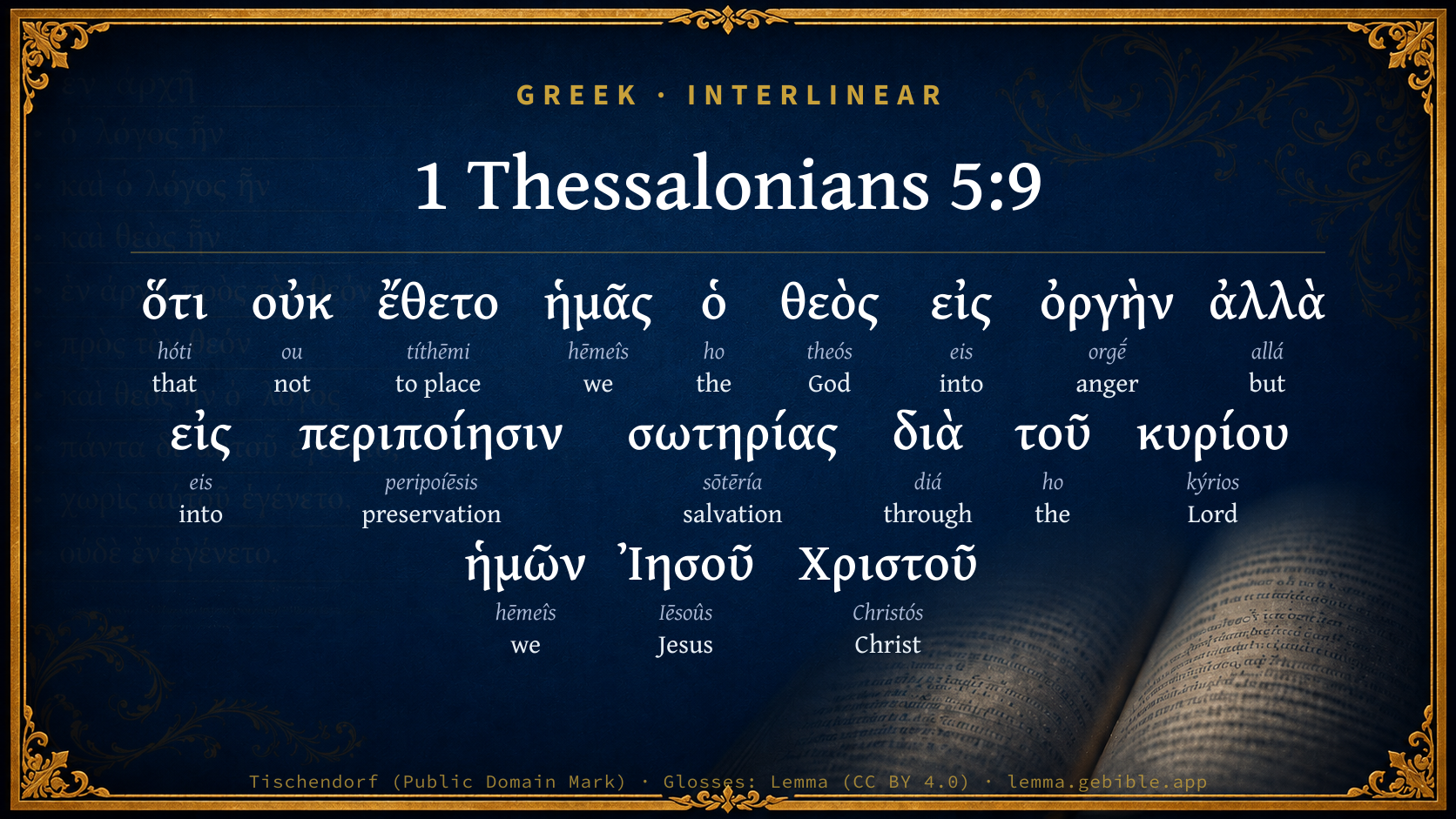
  1. ὅτι hóti G3754 “that” Conjunction
  2. οὐκ ou G3756 “not” Particle, Negative
  3. ἔθετο títhēmi G5087 “to place” Verb, Aorist, Middle, Indicative, 3rd person, Singular
  4. ἡμᾶς hēmeîs G2249 “we” Personal pronoun, 1st person, Accusative, Plural
  5. ὁ ho G3588 “the” Article, Nominative, Singular, Masculine
  6. θεὸς theós G2316 “God” Noun, Nominative, Singular, Masculine
  7. εἰς eis G1519 “into” Preposition
  8. ὀργὴν orgḗ G3709 “anger” Noun, Accusative, Singular, Feminine
  9. ἀλλὰ allá G235 “but” Conjunction
  10. εἰς eis G1519 “into” Preposition
  11. σωτηρίας sōtēría G4991 “salvation” Noun, Genitive, Singular, Feminine
  12. διὰ diá G1223 “through” Preposition
  13. τοῦ ho G3588 “the” Article, Genitive, Singular, Masculine
  14. κυρίου kýrios G2962 “Lord” Noun, Genitive, Singular, Masculine
  15. ἡμῶν hēmeîs G2249 “we” Personal pronoun, 1st person, Genitive, Plural
  16. Ἰησοῦ Iēsoûs G2424 “Jesus” Noun, Genitive, Singular, Masculine
  17. Χριστοῦ Christós G5547 “Christ” Noun, Genitive, Singular, Masculine

About this verse

These counts appear in no published source. They are computed here, from the morphology-tagged text and Lemma’s own curated glosses. What Lemma adds →

18
words
15
distinct lemmas
Pauline Epistles
section

Notable vocabulary

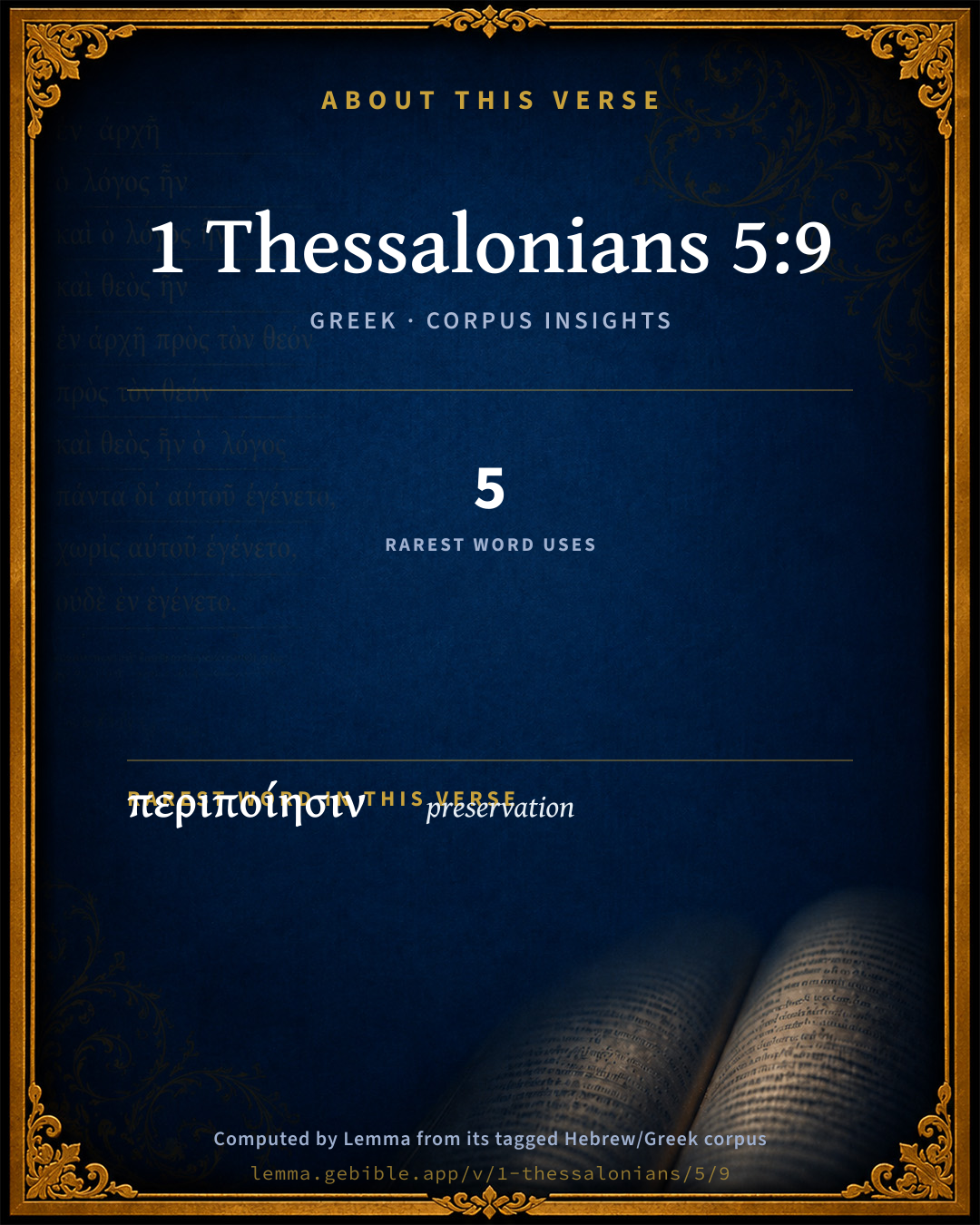
The rarest word here is περιποίησιν preservation G4047 — appearing just 5 times in the whole Greek New Testament.

Shared distinctive vocabulary

περιποίησιν preservation G4047 occurs in 5 verses of the Greek New Testament. Also found in:

Repetition

Words recur within this verse:

Cross-references

22

Topical passages linked to 1 Thessalonians 5:9 in the Treasury of Scripture Knowledge — connected by theme and wording, ordered by reader-vote popularity; previews shown in the World English Bible.

  • 1 Thessalonians 1:10 and to wait for his Son from heaven, whom he raised from the dead-- Jesus, who delivers us from the wrath to come.
  • 1 Peter 2:10 who in time past were no people, but now are God's people, who had not obtained mercy, but now have obtained mercy.
  • 2 Timothy 2:10 Therefore I endure all things for the chosen ones' sake, that they also may obtain the salvation which is in Christ Jesus with eternal glory.
  • Acts 13:48 As the Gentiles heard this, they were glad, and glorified the word of God. As many as were appointed to eternal life believed.
  • Proverbs 16:4 Yahweh has made everything for its own end-- Yes, even the wicked for the day of evil.
  • Romans 9:11–23 For being not yet born, neither having done anything good or bad, that the purpose of God according to election might stand, not of works, but of him who calls,
  • 1 Thessalonians 3:3 that no one be moved by these afflictions. For you know that we are appointed to this task.
  • Exodus 9:16 but indeed for this cause I have made you stand: to show you my power, and that my name may be declared throughout all the earth;
  • 2 Thessalonians 2:13–14 But we are bound to always give thanks to God for you, brothers loved by the Lord, because God chose you from the beginning for salvation through sanctification of the Spirit and belief in the truth;
  • 1 Timothy 1:16 However, for this cause I obtained mercy, that in me first, Jesus Christ might display all his patience, for an example of those who were going to believe in him for eternal life.
  • Ezekiel 38:10–17 Thus says the Lord Yahweh: It shall happen in that day, that things shall come into your mind, and you shall devise an evil device:
  • Romans 11:7 What then? That which Israel seeks for, that he didn't obtain, but the chosen ones obtained it, and the rest were hardened.
  • 1 Timothy 1:13 although I was before a blasphemer, a persecutor, and insolent. However, I obtained mercy, because I did it ignorantly in unbelief.
  • 2 Timothy 2:19–20 However God's firm foundation stands, having this seal, "The Lord knows those who are his," and, "Let every one who names the name of the Lord depart from unrighteousness."
  • 1 Peter 2:8 and, "A stone of stumbling, and a rock of offense." For they stumble at the word, being disobedient, whereunto also they were appointed.
  • Acts 1:20 For it is written in the book of Psalms, 'Let his habitation be made desolate, Let no one dwell therein,' and, 'Let another take his office.'
  • Acts 1:25 to take part in this ministry and apostleship from which Judas fell away, that he might go to his own place."
  • 2 Peter 1:1 Simon Peter, a servant and apostle of Jesus Christ, to those who have obtained a like precious faith with us in the righteousness of our God and Savior, Jesus Christ:
  • 2 Peter 2:3 In covetousness they will exploit you with deceptive words: whose sentence now from of old doesn't linger, and their destruction will not slumber.
  • Jude 1:4 For there are certain men who crept in secretly, even those who were long ago written about for this condemnation: ungodly men, turning the grace of our God into lasciviousness, and denying our only Master, God, and Lord, Jesus Christ.
  • Matthew 26:24 The Son of Man goes, even as it is written of him, but woe to that man through whom the Son of Man is betrayed! It would be better for that man if he had not been born."
  • Romans 11:30 For as you in time past were disobedient to God, but now have obtained mercy by their disobedience,

Cross-references courtesy of OpenBible.info (CC BY 4.0).

Commentary

Notes on 1 Thessalonians 5:9 from classic Christian and Jewish commentators (each source and its license shown beneath its notes). The classic Christian expositions comment on the surrounding passage and are grouped to its opening verse, so a note may address several verses; the Jewish commentaries on the Tanakh (Rashi and others) are per-verse, so they appear only where the commentator wrote on this verse.

Lemma curates 59 commentaries, every one of them public domain or Creative Commons licensed, each selected and text-cleaned for this edition rather than reprinted as found. About our sources →

The Cambridge Bible for Schools and Colleges

gen. ed. J. J. S. Perowne

9. For God hath not appointed us to wrath] In the strict order of the words, appointed us not unto wrath, but (to something very different) unto the obtaining of salvation through our Lord Jesus Christ.

“Obtaining” is securing, making a thing absolutely one’s own,—as in 2Th_2:14 (see note), “the obtaining of the glory of our Lord Jesus Christ.” In Heb_10:39 the same word is rendered “saving of the soul;” in Eph_1:14 it signifies, passively used, a sure possession. In all these instances it points beyond the present attainment of salvation, still subject to trial and hazard, to the full realisation thereof, which is the object of the Christian’s hope (1Th_5:8), as it is the end of God’s designs for him.

“Salvation,” in St Paul and in the N. T. generally, includes the whole of the benefits and blessings of the Gospel, the entire new life and well-being that it brings, both to the individual man and to the world; but it is referred more specifically to two essential elements, or moments, in the great process of renewal—(1) that spoken of in Luk_1:77 as “knowledge of salvation … in remission of sins,” and (2) to man’s deliverance from the grave and entrance on the risen life of the future world,—“salvation that is in Christ Jesus with eternal glory” (2Ti_2:10). In the word redemption this double reference is even more conspicuous: see, e.g., Eph_1:7; Eph_1:14. To this ultimate “salvation” the Apostle directs his readers’ thoughts and hopes.

“Appointed” reminds us of “election” (ch. 1Th_1:4, see note); it implies the authority with which God called the Thessalonians to salvation (comp. ch. 1Th_2:12), as well as the fact of His gracious intention respecting them. Comp. 1Ti_1:12, “appointing me to service,” and ch. 1Th_3:3 above. In 2Th_2:13-14 (see notes) this Divine appointment of grace is more fully set forth.

For the negative side of God’s purpose—not unto anger—see notes on wrath in ch. 1Th_1:10; 1Th_2:16; 2Th_1:8-9. With the thought of Christ’s second coming, so constantly present to St Paul’s mind at this time (see Introd. pp. 18–21), there were present also the issues of the Last Judgement and its solemn contrast—the glorious “salvation” then to be attained by the sons of God, and the final and awful manifestation of His “anger” against the wicked. Similarly “the day of the Lord” is seen in Rom_2:5 as a “day of wrath and revelation of the righteous judgement of God;” and in this light, wrath and future salvation are contrasted in Rom_5:9-10, just as they are here. There also, as in this passage, Christ’s death (see 1Th_5:10) is set forth as our ground of hope in this prospect; through “His blood” we are brought from the sense and fear of God’s anger into His favour, and entitled to expect that eternal redemption will be ours.

It was the conviction that such is God’s purpose and will respecting those who believe in Christ that made St Paul’s “helmet of salvation so strong, and gave it all its splendour. Read Rom_8:31-39 as a commentary on this saying.

On the fall title “our Lord Jesus Christ” see note to ch. 1Th_1:3.

The Cambridge Bible for Schools and Colleges (gen. ed. J. J. S. Perowne; Cambridge University Press, 1878–1918) — public domain. Text from a community e-Sword module.

The Biblical Illustrator

Joseph S. Exell

1Th_5:9-10

For God hath not appointed us unto wrath

Gods everlasting purpose

I.

Gods purpose is--

1. That we should not be lost. We all deserve wrath. All have sinned, and every sin the Divine indignation will avenge. The longer we live in sin, therefore, the greater the amount of wrath our iniquities are treasuring up. And yet, although we are daily provoking the Divine anger, God has not appointed us to wrath. He willeth not the death of a sinner.

2. That we should be saved. The kingdom He has prepared from the foundation of the world.

(1) This should comfort us in trial. Gods purpose none can frustrate. Fear not, little flock, etc.

(2) Dont distress yourselves about election. God has told you that His will is that all men should be saved , and, therefore, if any one perishes, it is not because of Gods secret purpose, but His own want of inclination. Ye will not come.

II. Its accomplishment.

1. There is only one way in which Gods purpose can be effected: By our Lord Jesus Christ. Neither is there salvation in any other. The grand subject of Christianity is Christ; and those who do not make Christ all in all are like those Jewish builders who refused the headstone of the corner, or like the foolish man who built on the sand.

2. In what respect salvation is through Jesus Christ is plainly told us: Who died for us. Christs death rescues us from wrath. That which our sins provoked was borne by Christ.

3. How sad the mistake of those who think little or nothing of Christs atonement, on which hinges our salvation. He that believeth, and he only, shall be saved.

III. Its effects.

1. Life with Christ on earth. Whether we wake. To me to live is Christ. To this end Christ was called Emmanuel. This life is in union with Christ. Wherever you go, Christ goes. He never leaves or forsakes you.

2. Life with Christ in heaven. Our bodies sleep, but not our souls. Absent from the body, etc. This day shalt thou be with Me in paradise. This association will be--

(1) More intimate than that on earth.

(2) More blessed.

(3) More enduring.

Conclusion: We hence perceive--

1. The nature of our present existence. If we are Christians, this life is only the porch to a better; if not, a porch to a worse.

2. The readiness of God to save. He willeth not the death of a sinner. (C. Clayton, M. A.)

Called to salvation

God is pleased to day to put up before your eyes the white flag of mercy, calling you to come to Jesus and live. But recollect, if you do not yield to it, He will put up the red flag of threatening, and then the black flag of execution will not be far off. Perhaps some of you have been suffering under bodily disease--take that as a warning. When our vessels of war would stop a suspicious vessel, they fire a shot athwart her bows as a warning. If she does not haul to, perhaps they give another; and if no notice is taken of this, the gunners go to their business in real earnest, and woe to the offender. Your affliction is the gospels warning gun. Pause awhile, I beseech you; ask the Lord in mercy to look upon you, that you may be saved! As I think upon some of you here who are not saved, I feel some thing like the boy I read of yesterday in the newspapers: Last week there were two lads on the great rocks of Lundy Island, in the Bristol Channel, looking for seagulls eggs; one of them went far down the cliff, and lost his footing, and when his brother, hearing a faint voice, looked down, he saw him clinging to a jutting crag, and striving in vain to find a place for his feet. There stood the anxious brother, alarmed and paralyzed with dread, quite unable to help the younger one in so much peril below, who soon relaxed his hold and was dashed to pieces far beneath. I feel somewhat like that alarmed brother, only there is this happy difference: I can hope for you, and bid you hope for yourselves. You are clinging now, perhaps, to some false hope, and striving to find a rest where rest is not to be found; but the strong-winged Angel of the everlasting gospel is just underneath you this morning, crying, Drop now; simply, drop into My arms; I will take you and bear you aloft in safety. That Angel as the Angel of the Covenant, the Lord Jesus Christ. You must be dashed to pieces forever unless you rest in Him; but cast yourself upon Him, I pray you, and then, as you are carried in safety far off from every fear, you will magnify the grace of God and extol the glorious gospel. (C. H. Spurgeon.)

Who died for us that whether we wake or sleep. More exactly watch. So popular a motto of early Christian life--caught as it was from the lips of Christ (Mar_13:34-37)--that it took the form of a name--Gregory. It has been said that there are three sleeps for man--those of nature, sin, and death; and three corresponding awakenings--those of nature, righteousness, and life eternal. It is of the second that Paul speaks here. Salvation is through our Lord Jesus Christ, who died for us for this purpose, in order that, whether we keep lifes long toilful watch, or fall asleep in what is called death, we should have our true life together with Him. (Bp. Alexander.)

Salvation

I. It is life We shall live. This is the common Scripture designation of all we include in Spiritual and eternal life. All that is opposed to death; the holy, happy, and immortal existence of the whole man, soul and body.

II. Life with Christ. Association or communion. Companionship with Christ.

2. Participation of His life, its power, holiness, blessedness, glory.

III. The life of all. We shall all--all the redeemed, all those dear to us who belong to Christ, all in every age and nation who love Him, are to be made the subjects of this life. (C. Hodge, D. D.)

Assured salvation through Christ

The Thessalonians had groundless fears for their departed friends (1Th_4:13).

I. Gods purpose.

1. We are not appointed to wrath.

2. We are appointed to salvation.

3. We are appointed to salvation obtainable by our Lord Jesus Christ.

II. Nothing can frustrate this purpose.

1. Because Christ has died for us. A continent of truth is spread out in this one fact.

III. Our salvation is assured to us.

1. In this present existence--whether we wake.

2. In death--or sleep. Salvation has two parts--that which is present, or the state of grace; and that which is future, or the state of glory.

IV. We are united to Christ, and our life is joined to His life; and thus, whether we live or die, we are the Lords. It should be noticed, however, that the glory and chief hope of the Church are not to be realized at death (of the individual), but at the Lords coming: one is not to anticipate the other, but all are to be glorified together at Christs coming (1Th_4:14-17; Col_3:4; Heb_11:40). Death affects the mere individual, but the coming of Christ, the whole Church. At death our souls are invisibly and individually with the Lord; at Christs coming, the whole church, with all its members, in body and soul, shall be visibly and collectively with Him.

V. Here is an enduring basis for hope and comfort.

1. Salvation is sure--as sure as Omnipotence can make it in view of Christs death.

2. Salvation will be complete. The body shall be raised in im mortal strength and beauty, and the soul shall be sinless and happy in the service of God.

3. Grief over the dead is natural (Joh_11:31-35; Php_2:27); but, with the hope of resurrection and recognition hereafter, it should be moderated.

4. In all this we perceive the immense benefits revelation and grace have conferred upon us.

(1) In contrast with heathenism. The Greeks believed in the immortality of the soul, but knew nothing about the resurrection of the body. Their dead were called shades. Even the Egyptians did not believe in the resurrection of the body, unless the return of the spirit, as it was believed, to inhabit the mummified body, can be called a resurrection.

(2) As culminating in the Gospel. The Old Testament presented the two doctrines as counterparts to each other--the immortality of the soul and the resurrection of the body. But these two doctrines were not so clearly understood in the Old Testament times as in the New. That they were revealed is evident from such passages as relate to Enoch and Elijah, the raising of the dead, and from Psa_16:9; Psa_16:11; Psa_17:15; Psa_73:24; Pro_14:32; Isa_38:18-19, etc. These doctrines were made illustrious by the death, resurrection, and ascension of the Lord Jesus Christ, and by explicit statements in the New Testament. Hence, in its clearer light, there is more of hope, joy, and comfort than was possible before the coming of Christ. He is the first fruits of them that slept. (L. O. Thompson.)

Christs desire for His peoples company

How all-inclusive the passage is! The whole of that grand purpose for which the Bible was written is contained in these few lines. What have you not in this verse? You have Christ, His death, His substitutionary work, His resurrection, the fact of His present life, the assurance of His return, the saints salvation, the saints eternal glory. This text is also a window through which we look into the heart of Christ, and behold the Saviours great desire that all His people should live together with Him.

I. Loves desire. That we should live together with Him.

1. Viewed from one stand point, this is only natural. Grant love, and you are necessarily compelled to grant something else--desire for the presence of the object beloved. I cannot imagine it possible for the two ever to be separated. Love is always restless until the object of affection is close by. In proportion as the love is pure and intense, so will the delight in the nearness of the object become intensified; and Christ finds His greatest happiness in having His people near Him. Have you joy in communion? He joys more. As you look up to Him, do you feel constrained to sing? He, too, when He looks down on you, feels that He must sing; for the Lord thy God in the midst of thee is mighty: He will joy over thee with singing.

2. And yet it is very marvellous.

(1) Where did the love spring from? Why did He love me at all? Has any friend on earth treated any of us half so ill as we have treated Christ? And yet His choicest desire is that we shall live together with Him. Is it not strange that, though there are some people who would not care to have you in their house, yet Christ wants to have you in His home?

(2) Mysterious? More so still when I call to mind the fact that I do not like to live with myself. Self is my plague. And yet how strange that, though I want to get away from self, Christ wants me to go and live with Him.

3. How all-inclusive the desire is. It is that we should not only live with Him, but together with Him. What is that?

(1) Take it as including all His people, and then it teaches us that Christ is not content for one to be absent. He wants to see all the members of His family brought round the table. Is it not always so when there is love to all? What is the bliss of heaven? All His people together. Fathers united once more to the children who went before, husbands reunited with wives, friends with friends--all together; and then all together with Him. To Christs eye that is the most beautiful picture that heaven itself can present--Christ and all His numerous family, without an absentee.

(2) Or does together apply to Christ? And, if so, there is a beautiful thought in it. You may live in the same house with a person, and yet not live together. Together implies a certain amount of intimacy. When Christ brings His people together He brings them to a home. He does not merely collect a multitude of people. No; in heaven there will be holy familiarity.

II. Loves method to obtain its desire. Christs was most costly. Greater love hath no man than this, etc. If you would measure Christs love, you can only do so by the Cross. Here is the explanation of Calvary. If you say that Christ died in order to satisfy Divine justice, to make an atonement for sin, to deliver from hell--all that is true. But now put it in a more beautiful way: that I might live together with Him who died not on a soft bed, but hanging on hard timber; not with loving friends around, but a hooting crowd; not with death lit up by His Fathers smile, but crying, Eloi, etc., out on a felons hill. And He died in my place. If He had not, I must. Now there is no room for doubt. If, when you were a sinner, Jesus loved you enough to die for you, do you not think that now you are one of His friends, He will love you enough to bring you home?

III. The only conditions that can satisfy Christs desire. Christ is not going to be disappointed. Any way, whether we wake or sleep, He means that we shall be with Him. What is intended by these words?

1. Take them literally. Sleeping or waking, conscious or unconscious, the saint and the Saviour are never far apart.

2. Awake or asleep means living or dying. Christ will have our company living. Christ would not be satisfied merely to have our company in the glory. He wants it down here. His delight is to commune here with His ransomed ones. And suppose we fall asleep in death. Death is but the Lords black chariot that He sends to bring His darlings home. The billow of death never washed a soul from the Saviours arms. It washes the soul from a thousand other hands that try to retain it, but it only sweeps the spirit away to its eternal home.

3. The chief meaning is that, whether by resurrection or translation, we shall be with Him (1Th_4:16). Then there are some who will fall asleep in death, and there are others who will be alive and awake at Christs coming. Will He be satisfied only to have one of the companies with Him.? No; He died for us that, whether we wake or sleep, we should live together with Him. We shall pass either through the portals of death, or over them as did Elijah; but, either way, the goal reached will be the same. (A. G. Brown.)

Oneness with Christ

A well built stone gets to be one with the foundation. In the old Roman walls the mortar seems to be as hard as the stones, and the whole is like one piece; you must blow it to atoms before you can get the wall away. So is it with the true believer; he rests upon his Lord till he grows up into Him, till he is one with Jesus by a living union, so that you scarce know where the foundation ends and where the upbuilding begins; for the believer becometh all in Christ, even as Christ is all in all to him. (C. H. Spurgeon.)

The Biblical Illustrator, edited by Joseph S. Exell (c. 1880s–1900s) — public domain. Text from a community e-Sword module.

The Pulpit Commentary

For. Not a new reason for watchfulness and sobriety, but referring to "the hope of salvation," why we may with confidence put on such a hope as a helmet. God hath not appointed us to wrath, but to obtain or, to the acquisition ofsalvation by or, through our Lord Jesus Christ. Not through the doctrine of Christ, nor even through faith in Christ, but through the Lord Jesus Christ himself, through what he has done for us, and especially through his atoning death. The appointment of God"s grace is here mentioned as the efficient cause of our salvation; and the Lord Jesus Christ, as the Mediator through whom salvation is bestowed.

Vers. 9-11.

The source, channel, and end of the salvation hoped for.

The apostle is now led to illustrate the hope of salvation.

I ITS SOURCE. "For God did not appoint us to wrath, but to the obtaining of salvation.

1. The calling is according to the purpose. "Whom he predestinates, them he also calls." The security of the believer depends, not upon himself, but upon God"s unchangeable and loving purpose.

2. The purpose is not to wrath, but to salvation. Though believers were once of wrath," they are now reconciled to God, and saved from wrath to come.

3. Gods purpose of mercy toward us does not free us from the necessity of being watchful concerning the means of salvation.

II THE CHANNEL OF SALVATION. "By our Lord Jesus Christ.

1. The covenant was ordained in the hand of a mediator. ". (Gal_3:19)

2. His death, not his doctrine or example merely, was necessary to our salvation. "Who died for us.

3. His death was substitutionary. It was "for us.

III THE END OF THIS SALVATION. "Who died for us, that, whether we wake or sleep, we should live with him together." This was "the joy set before him" for which "he endured the cross". (Heb_12:2) that we might live to him in order to our living with him.

1. It is life with Christ. Not merely life in him, but life with him in glory. "I desire to depart and be with Christ, which is far better". (Php_1:23) It is the greatest joy and glory of heaven. (Rom_14:8, Rom_14:9; 1Co_5:9)

2. It is life with all believers. They are to live with him, unsevered from one another; for whether they "are alive and remain," or whether they are of those who "have fallen asleep," they will be together, in Christ"s society. Thus the great salvation is the "common salvation.

IV THE CONSOLATORY ASPECT OF THESE TRUTHS. "Wherefore comfort yourselves together, and edify one another, even as also ye do. " These truths afforded a grand basis for mutual comfort and edification. The Thessalonians ought, therefore, to dismiss their despondency and alarm, and encourage each other with the blessed hopes of the gospel. T.C.

Vers. 9, 10.

The Divine appointment of Christians.

To some it may seem superfluous that a Christian apostle, writing to the members of a Christian Church, should say, "God appointed us not unto wrath." But the import of this declaration is made apparent by what precedes. St. Paul has been contrasting the condition of the sons of light with that of the children of darkness. Among the latter are to be found all degrees of that conduct which bides under the cloak of night from the carelessness that sleeps, down to the debauchery that is awake only to cause its own shame. Such things must bring wrath in "the day of the Lord" (ver. 2). But Christians are called to quite another life. They are not destined to wrath. Let them, therefore, not behave as the sons of the night, but in a way that is worthy of their call to salvation, with sobriety and confidence, strong in faith and love, and rejoicing in hope (ver. 8).

I THE DIVINE APPOINTMENT TO SALVATION.

1. It springs from an august Source. God appoints to salvation. He has a hand in our destinies. We are not left to discover a way of escape from ruin for ourselves. God has interfered for our deliverance.

2. It is determined by a firm ordinance. God "appointed." This word signifies prevision, arrangement, definite order. Redemption is not an irregular makeshift brought about by a hasty after-thought. It enters into the calm, eternal thoughts of God, and takes its place in the orderly disposition of the Divine government.

3. It aims at securing a large result. When God makes bare his arm and settles a solemn appointment, this must be for some adequate result. The object must be large to justify so large an action. Here it is nothing less than perfect deliverance from the ruin of sin. Salvation is not a technical phrase. It is too big a word to be defined by a theological sentence. It is deliverance all round from root and fruit of evil, from wrath of justice, from penalty of law, from tyranny of Satan, from vice of heart, from judgment without, from corruption within.

4. It is to be personally accepted. We are appointed to "the obtaining of salvation;" for

(1) though ordained by God, it is not enjoyed by us until we have personal experience of it;

(2) this personal acceptance depends on our own will and act;

(3) the full consequences of the Divine ordinance of salvation are still future.

II THE METHOD OF ACCOMPLISHING THIS DIVINE APPOINTMENT.

1. It is secured by the mediation of our Lord Jesus Christ. Thus it is to be obtained "through" him, which means

(1) that the salvation itself is brought about by the action of Christ; and

(2) that it becomes ours when we are united to Christ.

Now each of these points has its own distinct position in the great work. Too often they are confused together. It is not necessary for us to comprehend all that Christ does. Our part is to see that we are united to him. He will do his part whether we understand it or not.

2. It involved the death of Christ for us. So much we know as a fact, whatever theory we may have as to the bearings of the crucifixion upon the process of redemption. And it is the great fact which is of supreme importance to us. It is unfortunate that abstract propositions concerning the theological aspects of it should confuse our vision of the simple, touching statement, "He died for us.

III THE END FOR WHICH THIS DIVINE APPOINTMENT IS MADE.

1. This is flint we may live in fellowship with Christ. Strictly speaking, the fellowship with Christ is given as the object of the suffering of death by Christ. But the earlier part of the passage shows us the Divine appointment of salvation as secured through Christ. Putting the two together, we see that salvation is worthless without the life in Christ, as well as that salvation is only possible to those who are in fellowship with Christ. Salvation is in itself a negative term. Bare deliverance is of little use unless some good is to be made of the liberty and immunity. While a fellow-creature is being saved from death by drowning we follow the process with intense interest; but after his deliverance we may not feel much concern with his future career. It may be that he will make but a poor use of his restored life. If we finished the story we might find the issue to be a pitiable anti-climax. God is guarding his great appointment from a similar catastrophe. They who are saved live in fellowship with Christ. Such a life is worth securing at the greatest cost.

2. This fellowship with Christ is independent of the greatest outward changes. It remains whether we wake or sleep, i.e. whether we live or die. W.F.A.

The Pulpit Commentary (1880–1919), ed. H.D.M. Spence-Jones & Joseph S. Exell — public domain. Text from a community e-Sword module.

Tyndale Open Study Notes

Tyndale Open Resources

5:9 God’s anger (1:10; 2:16; Rom 5:9; cp. 2 Thes 1:6-10; 2:8) represents the carrying out of his judgment against evil. However, God destined believers for salvation, not wrath (2 Thes 2:13-14), and they will escape the terrors of the day of the Lord (1 Thes 5:1-3).

Tyndale Open Study Notes — © Tyndale Open Resources, licensed CC BY-SA 4.0. Text via the HelloAO Bible API.

Bengel's Gnomon

Johann Albrecht Bengel

1Th 5:9. Ἔθετο, hath appointed) So the LXX., Psa 66:9, τοῦ θεμένου τὴν ψυχήν μου εἰς ξωήν, who hath placed (holdeth) my soul in life; Jdg 1:28, ἔθετο τὸν Χαναναῖον εἰς φόρον, put the Canaanite to tribute; where indeed the Vatican reading has ἐποίησε, but ἔθετο was a phraseology certainly not unusual with the transcriber.—περιποίησιν σωτηρίας) Salvation of that sort is intended, by which they who are saved are taken out (excepted) from the multitude of those that perish.[30]

[30] See note on Eph 1:14, as to the meaning of περιποίησις. It is said of that which remains, when all else is lost. So here of the elect saved, when all others are lost.—ED.

Bengel's Gnomon of the New Testament — English translation (T&T Clark, Edinburgh, 1860) — public domain. Text from a community e-Sword module.

Meyer's Critical & Exegetical Commentary

Heinrich August Wilhelm Meyer

1Th_5:9. In this verse does not follow a new reason for the duty of watchfulness and sobriety (Musculus), but a confirmation of the concluding words of 1Th_5:8 : ἐλπίδα σωτηρίας. Hofmann strangely perverts the passage: ὅτι is to be translated by that (not by for), and depends on ἐλπίδα,a construction which is plainly impossible by the addition of σωτηρίας to ἐλπίδα, on account of which the passage Rom_8:21, which Hofmann insists on as an alleged analogy, cannot be compared.

The construction τιθέναι or τιθεσθαί τινα εἴς τι, to appoint one for a purpose, to destine one to something, is conformable with the Hebrew שׁוּת שׂוּם, or נָתַן with לְ following; comp. Act_13:47; 1Pe_2:8; 1Ti_1:12.

εἰς ὀργήν] to wrath, i.e. to be subject to it, to become its prey; comp. 1Th_1:10.

ἀλλʼ εἰς περιποιήσιν σωτηρίας] but to the acquisition of salvation. περιποιεῖν means to cause something to remain, to save, to acquire. The middle περιποιεῖσθαι signifies to save for oneself. Therefore περιποίησις denotes the acquisition, and particularly the possession of a people; comp. Eph_1:14; 1Pe_2:9; Act_20:28, corresponding to the Hebrew סְנֻּלָּה, by which the people of Israel were denominated Gods holy property; comp. Exo_19:5; Deu_7:6, etc. Here as in 2Th_2:14 περιποίησις has the meaning of acquisition generally.

διὰ τοῦ κυρίου ἡμῶν Ἰησοῦ Χριστοῦ] belongs to περιποίησιν, not to ἔθετο (Estius). Even by this grammatical relation of the words, Hofmanns opinion, that by διὰ τοῦ κυρίου ἡμῶν Ἰησοῦ Χριστοῦ the pledge of salvation is prominently brought forward, is refuted. But the meaning is not: per doctrinam eam, quam Christus nobis attulit, non rabbini, non philosophi (Grotius), but: by faith on Him.

Meyer — Critical and Exegetical Commentary on the New Testament — English translation by Peter Christie, edited by Frederick Crombie (T&T Clark, 1880) — public domain. Text from a community e-Sword module.

Expositor's Greek Testament

ed. W. Robertson Nicoll

1Th 5:9 . The mention of the future σωτηρία starts Paul off, for a moment, on what it involves (1Th 5:9-10 ).

The Expositor's Greek Testament, edited by W. Robertson Nicoll (1897–1910) — public domain. Text from a community e-Sword module.

Cambridge Greek Testament for Schools and Colleges

9. ο θεος ημας (in this order) B 37, 116; similarly in 1Th 2:16 B distinguishes itself by the order εφθακεν η οργη επʼ αυτους.

B aeth omit χριστου: the general probability of the insertion of χριστος by copyists where it was previously absent, must be weighed against the special probability of its omission in this Epistle where the combination ο κυριος Ιησους prevails.

9. ὅτι οὐκ ἔθετο ἡμᾶς ὁ θεὸς εἰς ὀργὴν ἀλλὰ εἰς περιποίησιν σωτηρίας κ.τ.λ., because God did not appoint us unto wrath, but to (the) securing of salvation through our Lord Jesus Christ. Ὄτι is read by Hofmann as explicative not causative, as stating the content of ἐλπὶς σωτηρίας (1Th 5:8) rather than the reason for it—“a hope that God did not appoint us,” &c.; cf. 2Co 5:11, where ἐλπίζομεν is complemented by a perfect infinitive. But the common interpretation is more natural. Ἔθετο εἰς has “a partially Hebraistic tinge” (Ellicott); the idiom is parallel to שׂוּם לְ, שִׁית לְ, נָתַן לְ; but this is not incorrect Greek: see 1Ti 1:12; 2Ti 1:11; Act 13:47; 1Pe 2:8—the last the only precise parallel; and cf. Jer 2:7; Jer 25:12, &c. (LXX). Cf. with εἰς ὀργὴν θέσθαι Rom 9:22, σκεύη ὀργῆς κατηρτισμένα εἰς ἀπώλειαν: in the (hypothetical) event of “appointing unto wrath” the Divine foreordination supposes foresight, and takes into account all the moral conditions of the case; see Rom 8:29, for the opposite case of predestination to life. That God cherishes no angry purpose toward the Thessalonians, that there is no θησαυρὸς ὀργῆς (Rom 2:5) laid up for them in His plans, but an opposite destiny (1Th 1:4; 2Th 2:13 f.), of this the writers are assured by all that they know of them (see 1Th 1:5 ff., &c.). On this ground (ὅτι κ.τ.λ.) the readers may with a joyful confidence “put on” the “helmet of ἐλπὶς σωτηρίας”: cf. Rom 5:2-11; 2Co 1:7; 2Co 1:21 f., 1Th 4:16 ff., &c. Rom 8:31-39 is a virtual commentary on this passage. Ἔθετο … εἰς περιποίησιν σωτηρίας reminds us of ἐκλογή (1Th 1:4); the verb implies the authority with which God “called” the Thessalonians (1Th 2:12), and His gracious intentions towards them: cf. 1Th 3:3; also 1Ti 1:12, θέμενος εἰς διακονίαν.

Περιποίησις (from περιποιέομαι, to make (to remain) over for oneself) signifies in its primary active sense obtaining permanently, making secure some desired object (in the O. T. frequently, preserving alive)—so here “in acquisitionem salutis” (Vulg.), “ad salutem obtinendam” (Beza); see 2Th 2:14; Heb 10:39; Hebrews 2 Paral. 14:13; for the verb, 1Ti 3:13; Luk 17:33; Act 20:28; Isa 43:21; 1Ma 6:44: this usage is also classical. The noun acquired a further passive meaning, and represents in Mal 3:17 (LXX) סְגֻלָּה, peculium, a treasure, prize—ἔσονταί μοι … εἰς περιποίησιν; hence λαὸς εἰς περιποίησιν, in 1Pe 2:9 (=λαόν μου ὃν περιεποιησάμην, Isa 43:21); the like signification is found in Eph 1:14, εἰς ἀπολύτρωσιν τῆς περιποιήσεως (see J. A. Robinson’s Commentary) Lightfoot regards the περιποίησις as God’s act, and so renders, after the Old Latin, “for the adoption of (consisting in) salvation,” thus making περιποίησις synonymous with ἐκλογή (1Th 1:4); as though the Apostle’s thought were that God has destined the Thessalonians not to be objects of His anger but of His appropriative and saving grace. The parallel passage in Ep. II. does not seem, however, to admit of this interpretation of περιποίησις, and it is far from obvious here; 1Th 5:6-8 incite the readers to a wakeful, soldierlike activity, such as will be crowned by the “winning of salvation,” the glorious end for which “God destined” them when He first “called them to His own kingdom and glory” (1Th 2:12),—the soldier’s prize; cf. 1Ti 6:12, ἀγωνίζου τὸν καλὸν ἀγῶνα … ἐπιλαβοῦ τῆς αἰωνίου ζωῆς. This final attainment of salvation, like its beginning (Rom 5:2; cf. Rom 5:9-11), comes through Christ: see 2Th 1:7 ff.; 2Ti 4:18; 1Co 15:57. For “the Lord Jesus Christ” is the Mediator of salvation, from the first step to the last. The whole basis of redemption, the ground of the believer’s hope of its accomplishment, is laid down in the next verse:—

Cambridge Greek Testament for Schools and Colleges (Cambridge University Press, 1896; 21 vols, various authors incl. Carr, Maclear, Plummer, Farrar, Lumby, Moule, M. R. James, Simcox) — public domain. Text from a community e-Sword module.

Geneva Bible (1599)

Geneva Bible translators

He pricketh us forward by seeing most certain hope of victory before us.

Geneva Bible (1599) marginal notes — public domain. Text via Bolls.life.

Jamieson, Fausset & Brown

Robert Jamieson, A. R. Fausset & David Brown

For--assigning the ground of our "hopes" (Th1 5:8).

appointed us--Translate, "set" (Act 13:47), in His everlasting purpose of love (Th1 3:3; Ti2 1:9). Contrast Rom 9:22; Jde 1:4.

to--that is, unto wrath.

to obtain--Greek, "to the acquisition of salvation"; said, according to BENGEL, Of One saved out of a general wreck, when all things else have been lost: so of the elect saved out of the multitude of the lost (Th2 2:13-14). The fact of God's "appointment" of His grace "through Jesus Christ" (Eph 1:5), takes away the notion of our being able to "acquire" salvation of ourselves. Christ "acquired (so the Greek for 'purchased') the Church (and its salvation) with His own blood" (Act 20:28); each member is said to be appointed by God to the "acquiring of salvation." In the primary sense, God does the work; in the secondary sense, man does it.

Jamieson, Fausset & Brown — Commentary Critical and Explanatory on the Whole Bible (1871) — public domain (CC PDM 1.0). Text via the HelloAO Bible API.

Adam Clarke's Commentary

Verse 9. For God hath not appointed us to wrath] So then it appears that some were appointed to wrath, εις οργην, to punishment; on this subject there can be no dispute. But who are they? When did this appointment take place? And for what cause? These are supposed to be "very difficult questions, and such as cannot receive a satisfactory answer; and the whole must be referred to the sovereignty of God." If we look carefully at the apostle's words, we shall find all these difficulties vanish. It is very obvious that, in the preceding verses, the apostle refers simply to the destruction of the Jewish polity, and to the terrible judgments which were about to fall on the Jews as a nation; therefore, they are the people who were appointed to wrath; and they were thus appointed, not from eternity, nor from any indefinite or remote time, but from that time in which they utterly rejected the offers of salvation made to them by Jesus Christ and his apostles; the privileges of their election were still continued to them, even after they had crucified the Lord of glory; for, when he gave commandment to his disciples to go into all the world, and preach the Gospel to every creature, he bade them begin at Jerusalem. They did so, and continued to offer salvation to them, till at last, being everywhere persecuted, and the whole nation appearing with one consent to reject the Gospel, the kingdom of God was wholly taken away from them, and the apostles turned to the Gentiles. Then God appointed them to wrath; and the cause of that appointment was their final and determined rejection of Christ and his Gospel. But even this appointment to wrath does not signify eternal damnation; nothing of the kind is intended in the word. Though we are sure that those who die in their sins can never see God, yet it is possible that many of those wretched Jews, during their calamities, and especially during the siege of their city, did turn unto the Lord who smote them, and found that salvation which he never denies to the sincere penitent.

When the Jews were rejected, and appointed to wrath, then the Gentiles were elected, and appointed to obtain salvation by our Lord Jesus Christ, whose Gospel they gladly received, and continue to prize; while the remnant of the Jews continue, in all places of their dispersion, the same irreconcilable and blasphemous opponents of the Gospel of Christ. On these accounts the election of the Gentiles and the reprobation of the Jews still continue.

Adam Clarke's Commentary on the Bible (1810–1826) — public domain. Text from a community e-Sword/MySword module.

John Calvin's Commentaries

9 For God hath not appointed us. As he has spoken of the hope of salvation, he follows out that department, and says that God has appointed us to this — that we may obtain salvation through Christ. The passage, however, might be explained in a simple way in this manner — that we must put on the helmet of salvation, because God wills not that we should perish, but rather that we should be saved. And this, indeed, Paul means, but, in my opinion, he has in view something farther. For as the day of Christ is for the most part regarded with alarm, having it in view to close with the mention of it, he says that we are appointed to salvation

The Greek term περιποίησις means enjoyment, (as they speak,) as well as acquisition. Paul, undoubtedly, does not mean that God has called us, that we may procure salvation for ourselves, but that we may obtain it, as it has been acquired for us by Christ. Paul, however, encourages believers to fight strenuously, setting before them the certainty of victory; for the man who fights timidly and hesitatingly is half-conquered. In these words, therefore, he had it in view to take away the dread which arises from distrust. There cannot, however, be a better assurance of salvation gathered, than from the decree of God. The term wrath, in this passage, as in other instances, is taken to mean the judgment or vengeance of God against the reprobate.

John Calvin's Commentaries (1540-1563) — public domain. Text from the Calvin Translation Society English edition (1840s-50s) via the Christian Classics Ethereal Library (ccel.org). Calvin's coverage is partial (roughly two-thirds of the Bible); uncommented books and verses are honest gaps, never fabricated. The 19th-century editor's footnotes and remarks are omitted so the notes are faithfully Calvin's own voice.

Ellicott's Commentary for English Readers

(9) For.—This is not the reason for being watchful, but for being hopeful of salvation. The image of the soldier is abandoned’ as suddenly as it was introduced.

Hath not appointed.—Rather, did not appoint, referring to some mysterious moment of God’s eternal counsels, when He fixed His predestination of us—whether the moment of creative thought, or of sending the gospel to us. The “wrath” is that which is to come upon the “children of wrath” at the Second Advent, as in 1Th_1:10; 1Th_2:16. (Comp. 1Pe_2:8.) We may well be confident then, for we ourselves are the only persons that can defeat God’s predestinations.

To obtain salvation.—More than “obtain;” the Greek means “acquire” by one’s own efforts;” earn and make our own;” being the same word as is used in 1Ti_3:13 and Act_20:28 in the verb; and in the substantive in Eph_1:14 (where it is translated “purchased possession”); 2Th_2:14; Heb_10:39 (translated “saving”); and 1Pe_2:9, where see Note. It will be seen that God does not predestinate men to “salvation” without laborious acquisition on their part, but predestinates them to occupy a position in which they will be able to “work out their own salvation” by placing them “under grace” in the Church. The very same word is used of the Christian’s way of securing salvation, and of Christ’s way of securing it for him (see references); both are “purchasing,” “earning.” But mark that the Christian can only so purchase salvation “through our Lord Jesus Christ:” apart from Him a man can do nothing to redeem himself, but through union with Him the believer can pay the whole price of his salvation (see e.g. Joh_15:5);

A Bible Commentary for English Readers, edited by Charles John Ellicott (1878–1897) — public domain. Text from a community e-Sword module.

John Gill's Exposition

For God hath not appointed us to wrath,.... To destruction and ruin, the effect of wrath; though there are some that are vessels of wrath, fitted for destruction, of old ordained to condemnation, and who are reserved for the day of evil; but there are others who are equally children of wrath, as deserving of the wrath of God in themselves as others, who are not appointed to it; which is an instance of wonderful and distinguishing grace to them:

but to obtain salvation by our Lord Jesus Christ; salvation is alone by Christ, he alone has wrought it out; it is in him, and in no other; he was appointed to this work, was called and sent, and came to do it, and has done it; and God's elect, who were chosen in him, are appointed in the counsel and purpose of God, to obtain, possess, and enjoy this salvation; and which, as this appointment may be known, as it was by these Thessalonians; the Gospel having come to them, not in word only, but in power, and in the Holy Ghost, and in much assurance; as it is an encouragement to faith and hope, so it excites to sobriety and watchfulness, and the discharge of every duty. The doctrine of predestination does not lead to despair, but encourages the hope of salvation; and it is no licentious doctrine, for election to salvation by Christ is through sanctification of the Spirit, and unto holiness; and good works are the fruits of it, and are what God has foreordained his people should walk in.

John Gill's Exposition of the Whole Bible (1746–1763) — public domain (CC PDM 1.0). Text via the HelloAO Bible API.

Trapp's Complete Commentary

John Trapp

9 For God hath not appointed us to wrath, but to obtain salvation by our Lord Jesus Christ,

Ver. 9. God hath not appointed us] As he hath all drunken beasts, 1Co 4:10. Yet, all those dry drunkards, Isa 28:1, that will not awake (though never so much warned) out of the snare of the devil, &c., 2Ti 2:25.

John Trapp, A Commentary or Exposition upon All the Books of the Old and New Testament (1647–1656) — public domain. Text from a community e-Sword module.

Albert Barnes' Notes on the Bible

For God hath not appointed us to wrath - This is designed as an encouragement to effort to secure our salvation. The wish of God is to save us, and therefore we should watch and be sober; we should take to ourselves the whole of the Christian armor, and strive for victory. If he had appointed us to wrath, effort would have been in vain, for we could do nothing but yield to our inevitable destiny. The hope of a final triumph should animate us in our efforts, and cheer us in our struggles with our foes. How much does the hope of victory animate the soldier in battle! When morally certain of success, how his arm is nerved! When everything conspires to favor him, and when he seems to feel that God fights for him, and intends to give him the victory, how his heart exults, and how strong is he in battle! Hence, it was a great point among the ancients, when about entering into battle, to secure evidence that the gods favored them, and meant to give them the victory.

For this purpose they offered sacrifices, and consulted the flight of birds and the entrails of animals; and for this armies were accompanied by soothsayers and priests, that they might interpret any signs which might occur that would be favorable, or to propitiate the favor of the gods by sacrifice. See Homer, passim; Arrian’s Expedition of Alexander, and the classic writers generally. The apostle alludes to something of this kind here. He would excite us to maintain the Christian warfare manfully, by the assurance that God intends that we shall be triumphant. This we are to learn by no conjectures of soothsayers; by no observation of the flight of birds; by no sacrifice which we can make to propitiate his favor, but by the unerring assurance of his holy word. If we are Christians, we know that he intends our salvation, and that victory will be ours; if we are willing to become Christians, we know that the Almighty arm will be stretched out to aid us, and that the “gates of hell” cannot prevent it.

Albert Barnes' Notes on the Bible (1834–1885) — public domain. Text from a community e-Sword/MySword module.

Matthew Poole's English Annotations

For God hath not appointed us to wrath, but to obtain salvation: some expositors make these words an argument to all the duties of holiness mentioned both in this and the foregoing chapters; and it is true, that the knowledge of our being elected, or appointed to salvation, doth not in the elect encourage to sin or sloth, as some affirm, but engage to all holiness: but I had rather restrain the words, and that either to the hope of salvation, mentioned immediately before, and then the sense to be this, we may well hope for salvation seeing God hath appointed us to it; or, to his whole discourse about the coming of Christ, and so they may give the reason why the dead in Christ must rise, and must, with the living saints, meet the Lord in the air, and be for ever with him; yea, and why they need not fear the destruction that will come upon others at that day, and why they should be watchful for its coming, because, saith the apostle: God hath not appointed us to wrath but to obtain salvation, & c. Having spoken of two sorts of persons, the children of the day, and children of the night, and the sudden destruction of the one and salvation of the other at the coming of Christ, he here ascends to the first original of both, which is God’s appointment, which is an act of God’s sovereign will, determining men’s final estates; which seems to be more than mere prescience or foreknowledge, an act of God’s mind, as appears by Rom 8:29; 1Pe 1:2, or more than appointing of the means and way of salvation; but not of persons to be saved, or of persons only materially, as to the number how many, but not formally, or individually, who they are that shall be saved; whereas the apostle writes of some whose names are in the book of life, Phi 4:3, and that from the foundation of the world, Rev 17:8, and chosen before the foundation of the world, Eph 1:4; otherwise, every man’s salvation would depend more upon the uncertainty of man’s will, than the eternal and immutable will of God; whereas whatever God works in man’s salvation, is according to the counsel of his will, Eph 1:11; and God’s counsel is certain, immutable, and eternal, extending not only to actions and means, but persons, Rom 8:29,30. Neither is this appointment of God grounded upon the foresight of man’s faith; for if faith be the gift of God, this gift proceeds from God’s counsel and fore-appointment; else men may say: That I may be saved I must thank God, but that I am saved I must thank myself: and hence there is a possibility for no man to be saved, and all the counsels of God in Christ to be made frustrate. But this is no place for controversy; only where God appoints to salvation, he appoints also to means, and without the means there is no attainment of the end, Eph 1:4; 1Pe 1:2. And the apostle here makes salvation stand opposite to wrath; what before he called destruction, 1Th 5:3, he here calleth wrath, because God’s wrath produceth it, and is manifested in it. And those that are saved are delivered from it; and the supreme reason is, because they were not appointed to it, but to salvation, and none that are appointed to the one are appointed to the other. The vessels of wrath and of mercy are set in an opposite distinction, Rom 9:22,23, and so in the text, to illustrate the mercy of God the more in them that are saved. And whereas the apostle calls it the obtaining of salvation, it implies man’s endeavours for it, though he be appointed of God to it; and speaking positively, not only of himself, but these believing Thessalonians also, he hath appointed us to obtain salvation, doth not this also imply that some good assurance of salvation may be obtained in this world.

By our Lord Jesus Christ; the decrees of salvation are executed in him, and by him; and there is no salvation in any other, Act 4:12. And he saveth not only by his doctrine and example, as some have affirmed, but by his blood as the meritorious, and his Spirit as the efficient, cause of salvation. Whether the infinite wisdom of God could have found out another way I shall not inquire, but this it hath pitched upon, wherein mercy and justice are admirably glorified together, and the highest engagement imaginable laid upon men to love, serve, and honour their Creator. And as the freeness of God’s grace is manifested in his appointing men to salvation, so the exceeding riches of it, in saving them by Jesus Christ. And whereas two things are necessary to it, the reconciling us unto God, and restoring his image in us, the former we have by the merit of his blood, and the latter by the operation of his Spirit; so that we have no ground for that fond opinion, that if men walk honestly and uprightly, they may be saved in any religion.

Matthew Poole's English Annotations on the Holy Bible (1683–1685) — public domain. Text from a community e-Sword/MySword module.

Whedon's Commentary on the Bible

Daniel D. Whedon

9. For—Giving a reason for this hope of salvation.

Not appointed us— Who wait, and watch, and war, in hope of his glorious coming.

To wrath—Which waits the unwatching unbeliever.

Salvation—From destruction at the advent.

Daniel D. Whedon (gen. ed.), Commentary on the Old and New Testaments (1874–1909) — public domain. Text from a community e-Sword module.

John Wesley's Explanatory Notes

God hath not appointed us to wrath - As he hath the obstinately impenitent.

John Wesley, Explanatory Notes Upon the Whole Bible (1754–1765) — public domain. Text via the GEBible commentary corpus.

Scofield Reference Notes

C. I. Scofield

salvation

(See Scofield Rom 1:16).

The Scofield Reference Bible (1917 edition), notes by C. I. Scofield — public domain. Text from a community e-Sword module.

Burkitt's Expository Notes on the New Testament

William Burkitt

Observe here, 1. A reason enforcing the apostle’s exhortation to holiness of life, For, or because God has not appointed us to wrath, but to obtain salvation by Jesus Christ.

Note here, 1. What a Christian is not appointed to; he is not appointed to wrath.

2. What he is appointed to, namely, to obtain salvation.

3. The means by whom a Christian doth obtain salvation, and that is by our Lord Jesus Christ.

Learn, hence, that God’s ordination and appointment of us to happiness and salvation, doth not discharge us from care and endeavour after the practice of universal holiness; it is the greatest piece of folly imaginable, from the appointment of the end, to infer the refusal or neglect of the means.

Learn, 2. That our Lord Jesus is the person appointed by God the Father, by whom alone all believers shall obtain salvation.

Learn, 3. That nothing short of the death of Christ was sufficient to purchase salvation for us, we obtain salvation by Jesus Christ, who died for us.

Learn, 4. That the great end designed by Christ in dying for us, was our living to him, in order to our living with him; a life of grace on earth, is our evidence for a life of glory in heaven; whether we wake or sleep, we should live together with him.

Observe lastly, the great and important duty which he exhorts the Thessalonians to perform mutually to each other, and that is, to comfort themselves together with this hope, and to edify and build up one another in faith and holiness; wherefore comfort yourselves together, and edify one another, as also ye do; implying, that as it is the duty, so it ought to be the endeavour of Christians to edify one another, both in their graces, and in their comforts.

William Burkitt's Expository Notes on the New Testament (1700–1703) — public domain. Text from a community e-Sword module.

McGarvey & Pendleton's Commentaries

J. W. McGarvey

For God appointed us not unto wrath, but unto the obtaining of salvation through our Lord Jesus Christ ,

J. W. McGarvey (with Philip Y. Pendleton), Commentaries on the New Testament (The Fourfold Gospel, 1914; Acts; and the epistles) — public domain. Text from a community e-Sword/MySword module.

The People's New Testament

B. W. Johnson

9. God hath not appointed us to wrath. Hence it is our privilege to hope for salvation through Christ.

B. W. Johnson's The People's New Testament with Notes (1889–1891) — public domain. Electronic text from the Christian Classics Ethereal Library (CCEL) ThML edition.

Alford’s Greek Testament

Henry Alford

9.] Epexegesis of ἐλπίδα σωτηρίας—‘and we may with confidence put on such an hope as our helmet’—for God set us not (‘appointed us not’ (reff.); keep the aorist meaning,—referring to the time when He made the appointment) to (‘with a view to’—so as to issue in, become a prey to) wrath, but to acquisition (περιποιέω, ‘to make to remain over and above,’ hence ‘to keep safe:’ opp. to διαφθείρω, Herod. i. 110; vii. 52, &c. Thuc. iii. 102 (L. and S.). Hence περιποίησις, ‘a keeping safe:’ Plato, Def. 415 c, σωτηρία, περιποίησις ἀβλαβής. If this last remarkable coincidence be taken as a key to our passage, σωτηρίας will be a genitive of apposition, ‘a keeping safe, consisting in salvation.’ But (reff.) it seems more according to the construction to understand περιπ. simply as acquisition, as it undoubtedly is in ref. 2 Thess. Jowett’s note, “περιποιεῖν, to make any thing over: hence περιποίησις, possession,” if I understand it rightly, alleges a meaning of the verb which has no existence. ‘To make to remain over’ is as different as possible from ‘to make over (to another person)’) of salvation through (διὰ … refers to περιπ. σωτ. not to ἔθετο) our Lord Jesus Christ,

Henry Alford, The Greek Testament (1849–1861) — public domain. Text from a community e-Sword module.

International Critical Commentary

9-10. ὅτι οὐκ ἔθετο κτλ With ὅτ “because,” he confirms the propriety of the exhortation to the ἐλπίδα σωτηρία by encouraging the faint-hearted to be assured that that hope is bound to be fulfilled. The ground of assurance is stated, first, negatively, “God did not appoint us Christians for wrath,” that is, for condemnation at the day of judgment (cf. 1:10, 2:16); and then positively, “but to gain salvation.” Since, however, it is impossible to work out one’s own salvation (Php 2:13) unless the divine power operates in the believer, Paul next recalls the means by which salvation is to be acquired, namely, “through” the causal activity of the indwelling “Jesus Christ our Lord.” Furthermore, since death and resurrection are inseparable factors in the redemptive work of Christ (cf. 4:14), he adds: “who died for us,” that is, for our sins, “in order that we might live, have life with him,” the future life in fellowship with Christ, which is the consummation of Christian hope.

The construction τιθέναι τινά εἴς τ, only here in Paul, but frequent in Lxx, is not the equivalent of Act 13:47 = Isa 49:6 (τέθεικά σε εἰς φῶ; contrast Rom 4:17 = Gen 17:5), but nevertheless “appears to have a partially Hebraistic tinge” (Ell.; cf. Psa 65:9, Hos 4:7, Mic 1:7, Jer 25:12, etc.). ἔθετ (= ἔθηκεν Bl 55:1) indicates the purpose of God, but like εἵλατ (II 2:13) is less specific than ἐκλογη (1:4); περιποίησις rare in Gk. Bib., is used absolutely in the passive sense of “possession,” “remnant,” in 2Ch 14:13, Mal 3:17, Hag 2:9, Eph 1:14, 1Pe 2:9; here, however, and II 2:14, Heb 10:39, where a genitive follows, it is active, acquisitio (Vulg, Ell., Mill. and most), “gaining,” “winning,” as indeed γρηγορῶμε and νήφωμε (Find.) and the clause with δια (Dob.) intimate. B and some minuscules invert the order to read ὁ θεὸς ἡμᾶ (cf. 2:16).

διὰ τοῦ κυρίου ἡμῶν Ἰ. Χ This clause is to be construed not with ἔθετ but with the adjacent εἰς περιποίησιν σωτηρίας The δια indicates the causal activity of the risen Lord conceived of as a spiritual power resident in the hearts of believers, enabling them to bring forth the fruits of righteousness essential to salvation and guaranteeing their resurrection from the dead and eternal fellowship with himself.

The phrase is the logical but not grammatical equivalent of ἐν τῷ κυρίῳ: see on 4:2, 14. On the divine name, see 1:3; B Eth. omit Χριστου (cf. 2:19).

International Critical Commentary — older volumes (1896–1929), various authors — public domain. Text from a community e-Sword module.

Vincent's Word Studies in the New Testament

Marvin R. Vincent

For [οτι] . Special emphasis is laid on the hope of salvation. The exhortation to put it on is enforced by the fact that God 's appointment is to salvation and not to wrath.

To obtain [εις περιποιησιν] . More literally, unto the obtaining. See on Eph 1:14. In three out of five instances in N. T. the word clearly means acquiring or obtaining. In Eph 1:14 and 1Pe 2:9, it is sometimes rendered possession (so Rev.). But in Ephesians the meaning is redemption or acquisition, or redemption which will give possession; and in 1st Peter a people for acquisition. The meaning here is that we might obtain. Comp. LXX, Mal 3:17.

Marvin R. Vincent, Word Studies in the New Testament (1887–1900) — public domain. Text from a community e-Sword/MySword module.

Lesson kit

Teaching starters — assembled from the data on this page, not authored interpretation. Every prompt links to the verse data it draws on. Edit before teaching.

1 Thessalonians, in the Pauline Epistles, opens this verse with 18 words (15 distinct Greek lemmas). Its most distinctive word is peripoíēsis (“preservation”). A historical commentator’s framing appears above. Read the whole chapter for the surrounding context.

Discussion questions

  1. The word peripoíēsis carries the sense “preservation.” How does it shape the verse?
  2. How does Ephesians 1:14, which shares the word «preservation», read alongside this verse?
  3. What does the repetition of “into” (2× in this one verse) do in this verse?
  4. These translations render this verse differently. What is at stake in choosing one wording over another?
  5. Compare how The Cambridge Bible for Schools and Colleges and The Biblical Illustrator read this verse. Where do they agree or differ?

Things to notice

  • These translations choose different wording for 7 words in this verse.
  • “into” occurs 2× in this single verse.
  • 15 distinct Greek lemmas span 18 words in this verse.

Reading settings

Reading text

Shown beneath each verse's original-language words.

Old Testament
Old Testament edition

Read the OT as the Masoretic Hebrew (MT) or the Greek Septuagint (LXX).

English shown for the Greek Septuagint (in the Hebrew ↔ Greek comparison).

Comparing translations? Open the Compare panel on any verse page to stack up to four side by side.