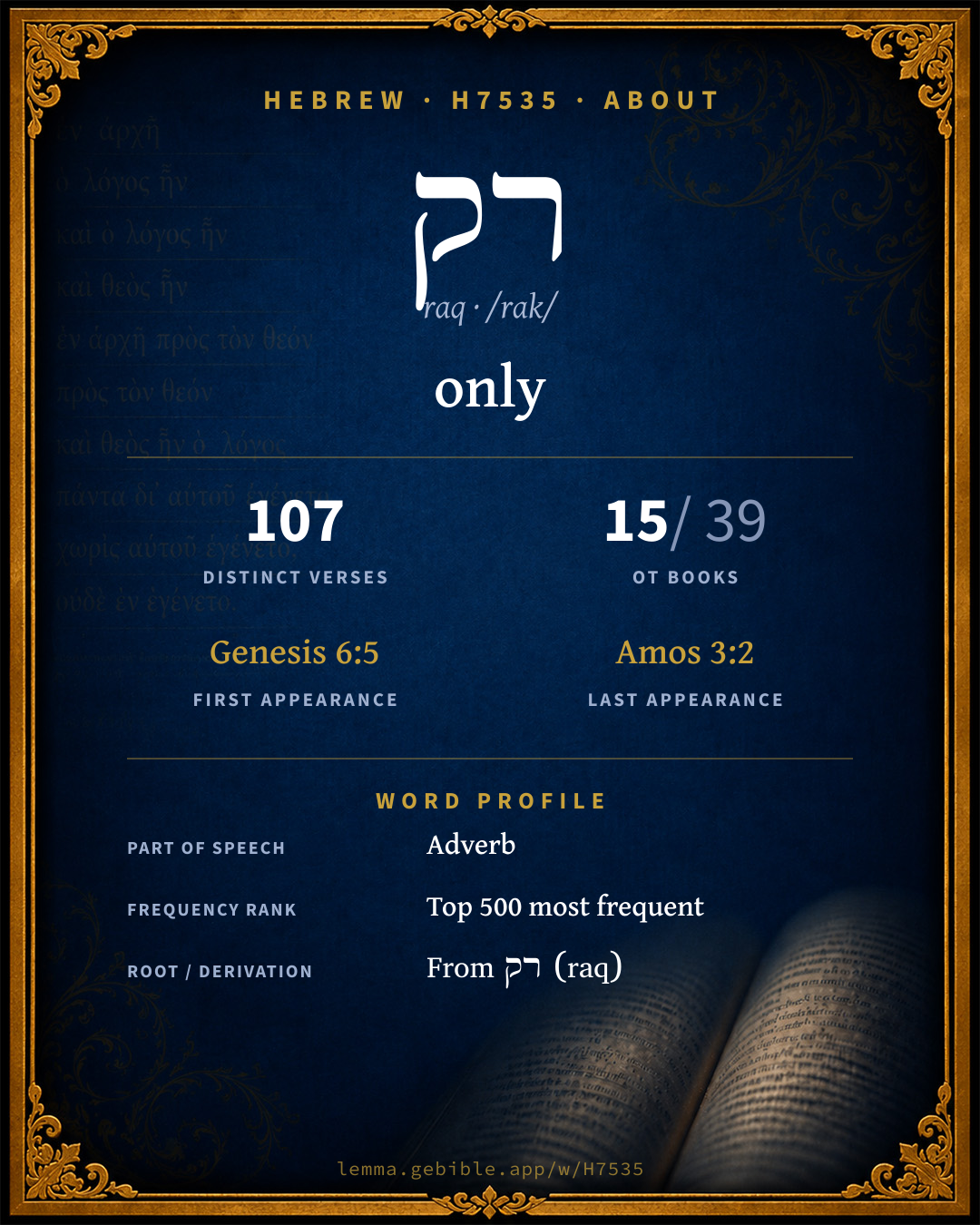
רַק
only
also: altogether, surely fuller range ↓
Full lexicon entry — Brown-Driver-Briggs (BDB)
From Brown-Driver-Briggs (BDB)
Where this word appears
Grammar key — what these labels mean
Part of speech
- Particle
- A short function word — article, negation, interrogative, the sign of the direct object, and the like.
Every verse where H7535 appears in the Book of 1 Kings — 12 distinct verses. Click any verse to open its interlinear word-by-word view. Verse text shown in the World English Bible for context — . Each verse’s Hebrew form is shown with its reference; the English is not keyword-highlighted, since the data carries no word-level English alignment. Use “Compare translations” on any verse to read it across multiple English versions. This concordance covers the Hebrew Bible; Septuagint (Greek Old Testament) occurrences are not indexed here.
1 Kings
- 1 Kings 3:2 רַ֣ק ptcl acc Only the people sacrificed in the high places, because there was no house built for the name of Yahweh until those days.
- 1 Kings 3:3 רַ֚ק ptcl acc Solomon loved Yahweh, walking in the statutes of David his father: only he sacrificed and burnt incense in the high places.
- 1 Kings 8:9 רַ֗ק ptcl acc There was nothing in the ark save the two tables of stone which Moses put there at Horeb, when Yahweh made a covenant with the children of Israel, when they came out of the land of Egypt.
- 1 Kings 8:19 רַ֣ק ptcl acc nevertheless you shall not build the house; but your son who shall come forth out of your loins, he shall build the house for my name.
- 1 Kings 8:25 רַ֠ק ptcl acc Now therefore, Yahweh, the God of Israel, keep with your servant David my father that which you have promised him, saying, There shall not fail you a man in my sight to sit on the throne of Israel, if only your children take heed to their way, to walk before me as you have walked before me.
- 1 Kings 11:13 רַ֤ק ptcl acc However I will not tear away all the kingdom; but I will give one tribe to your son, for David my servant's sake, and for Jerusalem's sake which I have chosen.
- 1 Kings 14:8 רַ֖ק ptcl acc and tore the kingdom away from the house of David, and gave it you; and yet you have not been as my servant David, who kept my commandments, and who followed me with all his heart, to do that only which was right in my eyes,
- 1 Kings 15:5 רַ֕ק ptcl acc because David did that which was right in the eyes of Yahweh, and didn't turn aside from anything that he commanded him all the days of his life, except only in the matter of Uriah the Hittite.
- 1 Kings 15:14 רַ֣ק ptcl acc But the high places were not taken away: nevertheless the heart of Asa was perfect with Yahweh all his days.
- 1 Kings 15:23 רַ֚ק ptcl acc Now the rest of all the acts of Asa, and all his might, and all that he did, and the cities which he built, aren't they written in the book of the chronicles of the kings of Judah? But in the time of his old age he was diseased in his feet.
- 1 Kings 21:25 רַ֚ק ptcl acc (But there was none like Ahab, who did sell himself to do that which was evil in the sight of Yahweh, whom Jezebel his wife stirred up.
- 1 Kings 22:16 רַק ptcl acc The king said to him, How many times shall I adjure you that you speak to me nothing but the truth in the name of Yahweh?
About this entry
At a glance — auto-summarized from this page’s data, not written by a person. Every figure links to its source below. This summary describes the numbers; it doesn’t interpret them.
רק — transliterated raq — is a Hebrew verb carrying the sense “only.” Not a single-sense word: its full sense range also takes in “altogether” and “surely”. Spanning 107 verses in 15 books, it ranks among the common words of the Hebrew Bible. Scripture first uses it in Genesis 6:5. It shares a root with רק, רקה and רקון. See the sense tree, 107-verse concordance, and the renderings breakdown below.
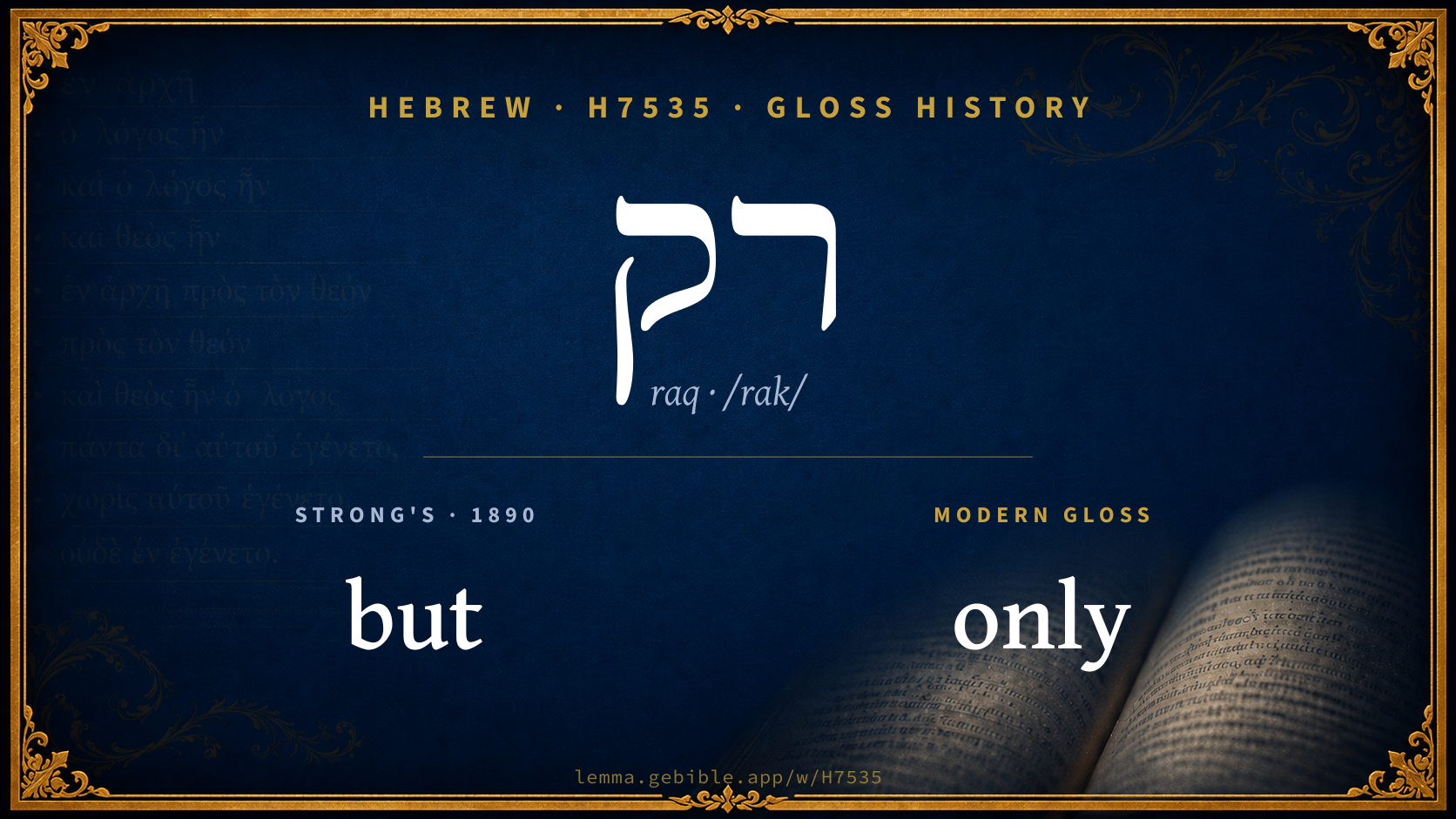
Gloss history
Strong's 1890 vs modern scholarship
About this word
Strong's H7535 catalogs a Hebrew word from the Hebrew Old Testament.
These counts are not copied from any lexicon or concordance. They are computed here, from the morphology-tagged Hebrew Old Testament. What Lemma adds →
- 107
- distinct verses
- The word appears in 107 distinct verses.
- 15 / 39
- OT books
- The word appears in 15 of 39 Old Testament books.
- #398
- by frequency
- Top 500 most frequent Hebrew words (rank 398 of 8,640 Hebrew words by occurrence).
View all 107 occurrences in the concordance →
Most concentrated in
- Deuteronomy 20 verses 19%
- Joshua 15 verses 14%
- 1 Kings 12 verses 11%
By section of the Old Testament
By traditional corpus
Conventional, traditional groupings — biblical authorship is debated, so this is a traditional corpus grouping, not an authorship claim. Each share is this word’s portion of its verses in that division of the Hebrew canon. Each figure is a share of the word’s 107 distinct verses.
- Prophets (Nevi'im) 48 verses · 45%
- Torah (Pentateuch) 40 verses · 37%
- Writings (Ketuvim) 19 verses · 18%
How translations render this word
Counts come from each version’s own published word-to-Strong’s tagging or interlinear alignment — an approximate guide to how each version renders this word, not a word-level alignment the data otherwise carries. Because each total is that version’s own tagged count, the per-version totals vary from one another and need not match the appearance or distinct-verse counts above. These counts may also differ from a printed concordance because Lemma counts each distinctly tagged rendering and does not collapse phrase taggings into a single head-word total. This is a fixed set of word-tagged versions (KJV, ASV, BSB, ULT) and does not change with the reading translation you choose elsewhere. Each version’s license is shown beside its name below (and on Sources).
- King James Version: So 2×
- American Standard Version: Nevertheless 2×, Only 2×, You 2×
- Berean Standard Bible: Only 30×, But 24×, Nevertheless 8×
- unfoldingWord Literal Text: Only 75×, Except 9×, Surely 7×
King James Version Public Domain
Renders H7535 across 16 tagged occurrences — most commonly:
Plus 14 renderings that appear only once — usually multi-word phrases or single function words the recovered tagging swept in, not distinct renderings.
American Standard Version Public Domain
Renders H7535 across 16 tagged occurrences — most commonly:
Plus 10 renderings that appear only once — usually multi-word phrases or single function words the recovered tagging swept in, not distinct renderings.
Berean Standard Bible Public Domain
Renders H7535 across 97 tagged occurrences — most commonly:
Plus 10 renderings that appear only once — usually multi-word phrases or single function words the recovered tagging swept in, not distinct renderings. Not rendered by a distinct English word in 12 further occurrences.
unfoldingWord Literal Text CC BY-SA 4.0
Renders H7535 across 110 tagged occurrences — most commonly:
Plus 4 renderings that appear only once — usually multi-word phrases or single function words the recovered tagging swept in, not distinct renderings.
7 senses and sub-senses in the full BDB
What do BDB’s symbols mean?
BDB uses these scholarly abbreviations:
| Symbol | Meaning |
|---|---|
| 𝔊 | the Septuagint (the ancient Greek translation, LXX) |
| 𝔙 | the Vulgate (the Latin translation) |
| 𝔖 | the Syriac version (the Peshitta) |
| 𝔗 | the Targum (the Aramaic translation) |
| ψ | the Psalms |
| √ | root (the underlying root or stem) |
| ‖ | parallel passage (a synonymous or contrasted parallel) |
| † | the dagger: every passage where the word occurs is cited |
The 7 senses and sub-senses the full Brown-Driver-Briggs lexicon distinguishes for this word, in lexicon order (not ranked by frequency), with BDB’s own verbatim wording and sub-sense lettering. Shown in Hebrew script with BDB’s own scholarly abbreviations. The condensed entry is in the Lexicon Entry tab. See also the Forms in the corpus table below.
- 1. adj. thin;—fpl. רַקּוֹת, of kine, Gn 41:19, 20, 27 (‖ v 3, 4 דַּקּוֹת). e.g. Genesis 41:19
- 2. 109 adv. with restrictive force, only, altogether, surely (syn. אַךְ);—
- a. only, Gn 14:24; 41:40 רַק הַכִּסֵּא אֶגְדַּל מִמֶּךָּ only as regards the throne, etc., 47:22 רַק אַדְמַת הַכֹּהֲנִים לֹא קָנָה, 50:8; Ex 8:5 רַק בַּיְאֹר תִּשָּׁאַרְנָח, 10:17 וְיָסֵר מֵעָלַי רַק הַמָּוֶת הַזֶּה only this death, Dt 2:35 (cf. 20:14; Jos 8:2, 27), 3:11; Ju 6:39 (cf. אַךְ ib. Gn 18:32; Ex 10:17), 11:34 (circ. cl.) רַק הִיא יְחִידָה (there being) only she, an only one, 1 S 1:13; Am 3:2 רק אתכם ידעתי only you have I known, etc., Jb 1:15, 16, 17, 19 וָאִמָּֽלְטָה רַק אֲנִי לְבַדִּי I only, ψ 91:8 + often. Once strengthening אַךְ, †Nu 12:2 הֲרַק אַךְ־בְּמשֶׁה דִּבֶּר י׳. And separated (as sometimes in English) from the word actually emphasized, Pr 13:10 רַק בְּזָדוֹן יִתֵּן מַצָּה by pride there only cometh [נָתַן 1 z] contention. e.g. Genesis 14:24
- b. prefixed to sentences, to add a limitation on sthg. previously expressed (or implied), Gn 19:8 only to these men do nothing, 24:8 רַק אֶת־בְּנִי לֹא־תָשֵׁב הֵ֫נָּה, Ex 8:24 I will let you go …, only go not far, v 25 Nu 20:19 only—it is nothing—let me pass through on my feet (cf. Dt 2:28); especially in Deut. writers, as Dt 10:15; 12:15; 20:16; 1 K 3:2, 3 (cf. 2 K 12:4; 14:4; 15:4, 35), 8:19; 11:13; 15:14, 23; 2 K 3:2 (cf. 14:3; 17:2), etc., Is 4:1; emphasizing a command, Dt 4:9; 12:16, 23 Jos 1:7, 18; 6:18; 13:6; 22:5 (all D2). e.g. Genesis 19:8
- c. emphasizing single words, especially adjj., only = nought but, altogether, Gn 6:5 יֵצֶר מַחְשְׁבוֹת לִבּוֹ רַק רַע is only evil, i.e. exclusively evil, nought but evil, Gn 26:29 עָשִׂינוּ עִמְּךָ רַק טוֹב nothing but good, Dt 28:33 וְהָיִיתָ רַק עָשׁוּק, Is 28:19 רַק זְוָעָה it shall be nought but terror to, etc., 1 K 14:8 (cf. אַךְ 2 b β); sq. an adv. Dt 28:13 וְהָיִיתָ רַק לְמַ֫עְלָה above only; sq. a vb., Ju 14:16 thou dost but hate me. e.g. Genesis 6:5
- d. after a neg., save, except (syn. כִּי אִם 2 a), 1 K 8:9 (= 2 Ch 5:10) אֵין בָּאָרוֹן רַק שְׁנֵי לֻחוֹת הָאֲבָנִים, 15:5; 22:16 (= 2 Ch 18:15), 2 K 17:18. e.g. 1 Kings 8:9
- e. with an affirmative, asseverative force, only, altogether = surely, Gn 20:11 רַק אֵין יִרְאַת אלהים במקום הזה, Dt 4:6 (so EV; but Ges populus mere sapiens, so Di), 1 K 21:25 2 Ch 28:10 ψ 32:6 רַק לְשֶׁטֶף מים רבים אליו לא יַגִּ֑יעוּ. †f. רַק אִם (רַק prefixed for emph.) if only, provided only, Dt 15:5 רַק אִם שׁמוע תשׁמע וג׳, 1 K 8:25 (= 2 Ch 6:16) רַק אִם ישׁמרו בניך דרכם ללכת וג׳, 2 K 21:8 (= 2 Ch 33:8). e.g. Genesis 20:11
Senses from the full Brown-Driver-Briggs lexicon (Brown, Driver, Briggs; Oxford 1906 — public domain), digitized via Sefaria, supplemented by the OpenScriptures HebrewLexicon (CC BY 4.0). Full attribution on Sources.
Word origin
Derived from רק (raq) (H7534) — thin.
Jastrow Dictionary
A second Hebrew/Aramaic lexicon for comparison, covering Aramaic and post-biblical (Talmudic, Targumic, Midrashic) usage that the biblical-Hebrew BDB does not. Matched by lemma rather than by Strong’s number, so a lemma may carry more than one Jastrow headword (shown separately below), and the entries cover usage well beyond the Bible.
רִיקּוּחַ
- perfume.—Pl. רִיקּוּחִים, רִקּ. Tanḥ. Sh’moth 14, v. רִיכּוּךְ.
רַק
- , v. רָקַק, רְקַק.
רֹק
- , v. רוֹק
רַק ²
- only, except.—Pl. רַקִּין use of the word רַק. Gen. R. s. 1; Y. Ber. IX, 14ᵇ bot., v. אַךְ I.
רֵק
- , v. רֵיק, רֵיקָא.
A Dictionary of the Targumim, the Talmud Babli and Yerushalmi, and the Midrashic Literature (Marcus Jastrow; London, Luzac, 1903) — Public Domain. Digitized via Sefaria. Digitized via Sefaria. Full attribution on Sources.
Forms in the corpus
The 19 distinct written forms H7535 takes in the Hebrew Bible, most frequent first — each parse links to that state’s occurrences in the concordance. Hebrew forms include their vowel points and cantillation, so a single lemma takes many written forms.
| Form | Parsing | Example | Uses |
|---|---|---|---|
| רַ֣ק | Particle, Accusative | Deuteronomy 12:23 | 16 |
| רַ֥ק | Particle, Accusative | Deuteronomy 2:35 | 16 |
| רַק | Particle, Accusative | Deuteronomy 3:11 | 14 |
| רַ֚ק | Particle, Accusative | Amos 3:2 | 13 |
| רַ֗ק | Particle, Accusative | Deuteronomy 20:16 | 9 |
| רַ֠ק | Particle, Accusative | Deuteronomy 3:19 | 8 |
| רַ֛ק | Particle, Accusative | Deuteronomy 2:37 | 6 |
| רַ֕ק | Particle, Accusative | 1 Kings 15:5 | 5 |
| רַ֖ק | Particle, Accusative | Deuteronomy 2:28 | 5 |
| רַ֤ק | Particle, Accusative | 1 Kings 11:13 | 3 |
| רַ֧ק | Particle, Accusative | Deuteronomy 10:15 | 3 |
| רַק֩ | Particle, Accusative | Deuteronomy 12:15 | 3 |
| רַ֞ק | Particle, Accusative | Deuteronomy 20:20 | 2 |
| הֲ/רַ֤ק | Adverb | Numbers 12:2 | 1 |
| וְ/רַק | Particle, Accusative | Joshua 6:18 | 1 |
| וְ/רַק֙ | Particle, Accusative | Judges 11:34 | 1 |
| רַ֡ק | Particle, Accusative | Deuteronomy 4:9 | 1 |
| רַ֭ק | Particle, Accusative | Psalms 91:8 | 1 |
| רַק֮ | Particle, Accusative | Deuteronomy 17:16 | 1 |
Same root — word family
Other BDB entries built from the same root as H7535, grouped by Strong’s listed origin. These share a root / origin per the lexicon — not necessarily a shared meaning. Each links to that word’s own entry.
Derives from
Shares the same root
Proper names from this root
People and places named from this root — a name, not an additional meaning of the word.
Compare all same-root words → 1 of the same-root words is a proper name (a person or place). They share a root, not necessarily a meaning.
Septuagint verse parallels
This word appears in 106 verses that also exist in the Greek Old Testament (Septuagint), out of the 107 Hebrew verses it occurs in. You can read those verses in Greek by switching the Old Testament edition to the Septuagint.
Read these verses in the Septuagint
- Genesis 6:5
- Exodus 8:9
- Numbers 12:2
- Deuteronomy 2:28
- Joshua 1:7
- Judges 3:2
- 1 Samuel 1:13
- 1 Kings 3:2
- 2 Kings 3:2
- 2 Chronicles 5:10
- Job 1:12
- Psalms 32:6
This is a verse-level parallel only — the same verses exist in both the Hebrew and Greek Old Testaments. No word-level Hebrew↔Greek correspondence is claimed: the data carries no such alignment, so no Greek word is shown as this Hebrew word’s translation. Coverage is not total — the Septuagint omits the deuterocanon and renumbers the Psalms, so some Hebrew verses have no direct Greek parallel.