
Job 1:12

Hebrew (Westminster Leningrad Codex) Job 1:12 appears in the Hebrew Old Testament. The text above is from the Westminster Leningrad Codex. Each word links to its Strong’s number, a concise gloss, and parsing drawn from the Open Scriptures Hebrew Bible morphology. Click any word for its full Brown-Driver-Briggs (BDB) entry.
Download image
Cite this verse

Job 1:12 (World English Bible). Public Domain. Lemma interlinear Bible study tool, https://lemma.gebible.app/v/job/1/12.

Show BibTeX & RIS
BibTeX
RIS
English Translation
Yahweh said to Satan, "Behold, all that he has is in your power. Only on himself don't put forth your hand." So Satan went forth from the presence of Yahweh.
World English Bible · Public Domain
Download a study sheet

One document with this verse’s original text, its word-by-word gloss line, the meaning frame, cross-references with their text, attributed commentary, and full source and license credits — printable, and it pastes into notes with its structure intact.

This verse Autodidact and up

Study sheet (.html) Plain text (.txt)

A passage Seminary Student

Up to 50 verses in one chapter. A passage sheet keeps up to 6 commentary sources and 12 cross-references per verse, in the order this page ranks them, and says so on the sheet whenever that leaves anything out. Ask for a single verse and you get the Autodidact verse sheet above.

Everything on this page stays free to read, with no account — the sheet is a download of what is already on screen, not access to it.

Want to remove ads? Support Godless Engineer
Compare translations 3

The same verse in 3 English versions, stacked beneath the original-language interlinear above. Click any original word for its lexicon entry.

Each is an independent rendering of the whole verse — the interlinear is not word-aligned to these translations.

Highlighted words mark where these versions differ — a whole-verse word diff, not a word-by-word alignment.

  • World English Bible Public Domain
    Yahweh said to Satan, "Behold, all that he has is in your power. Only on himself don't put forth your hand." So Satan went forth from the presence of Yahweh.
  • King James Version Public Domain
    And the LORD said unto Satan, Behold, all that he hath is in thy power; only upon himself put not forth thine hand. So Satan went forth from the presence of the LORD.
  • unfoldingWord Literal Text CC BY-SA 4.0
    And Yahweh said to the adversary, “Behold, all that his in your hand. Only against him do not stretch out your hand.” And the adversary went away from the face of Yahweh.

unfoldingWord Literal Text — © unfoldingWord, licensed CC BY-SA 4.0. Word-aligned USFM3 via Door43 (git.door43.org/unfoldingWord/en_ult).

Versions to compare (up to 4)

3 of 4 selected

Show all 18 translations

Every available English version of this verse, each an independent rendering of the whole verse.

  • World English Bible Public Domain
    Yahweh said to Satan, "Behold, all that he has is in your power. Only on himself don't put forth your hand." So Satan went forth from the presence of Yahweh.
  • Berean Standard Bible Public Domain
    “Very well,” said the LORD to Satan. “Everything he has is in your hands, but you must not lay a hand on the man himself.” Then Satan went out from the presence of the LORD.
  • Majority Standard Bible Public Domain
    “Very well,” said the LORD to Satan. “Everything he has is in your hands, but you must not lay a hand on the man himself.” Then Satan went out from the presence of the LORD.
  • King James Version Public Domain
    And the LORD said unto Satan, Behold, all that he hath is in thy power; only upon himself put not forth thine hand. So Satan went forth from the presence of the LORD.
  • American Standard Version (1901) Public Domain
    And Jehovah said unto Satan, Behold, all that he hath is in thy power; only upon himself put not forth thy hand. So Satan went forth from the presence of Jehovah.
  • Revised Version (1885) Public Domain
    And the LORD said unto Satan, Behold, all that he hath is in thy power; only upon himself put not forth thine hand. So Satan went forth from the presence of the LORD.
  • Geneva Bible (1599) Public Domain
    Then the Lord sayde vnto Satan, Lo, all that he hath is in thine hand: onely vpon himselfe shalt thou not stretch out thine hand. So Satan departed from the presence of the Lord.
  • Douay-Rheims (1899) Public Domain
    Then the Lord said to Satan: Behold, all that he hath is in thy hand: only put not forth thy hand upon his person. And Satan went forth from the presence of the Lord.
  • Young's Literal Translation Public Domain
    And Jehovah saith unto the Adversary, `Lo, all that he hath `is' in thy hand, only unto him put not forth thy hand.' And the Adversary goeth out from the presence of Jehovah.
  • Literal Standard Version CC BY-SA 4.0
    And YHWH says to Satan, “Behold, all that he has [is] in your hand, only do not put forth your hand to him.” And Satan goes out from the presence of YHWH.
  • Unlocked Literal Bible CC BY-SA 4.0
    Yahweh said to Satan, “Behold, all that he has is in your hand. Only against him himself do not stretch out your hand.” Then Satan went away from the presence of Yahweh.
  • unfoldingWord Literal Text CC BY-SA 4.0
    And Yahweh said to the adversary, “Behold, all that his in your hand. Only against him do not stretch out your hand.” And the adversary went away from the face of Yahweh.
  • Darby Bible Public Domain
    And Jehovah said to Satan, Behold, all that he hath is in thy hand; only upon himself put not forth thy hand. So Satan went forth from the presence of Jehovah.
  • World Messianic Bible Public Domain
    The LORD said to Satan, “Behold, all that he has is in your power. Only on himself don’t stretch out your hand.” So Satan went out from the presence of the LORD.
  • Webster's Bible Public Domain
    And the LORD said to Satan, Behold, all that he hath is in thy power; only upon himself put not forth thy hand. So Satan went forth from the presence of the LORD.
  • Free Bible Version CC BY-SA 4.0
    The Lord told Satan, “Very well, you have the power to do whatever you want to everything he has, but don't hurt him physically.” Then Satan left the Lord's presence.
  • Bible in Basic English Public Domain
    And the Lord said to the Satan, See, I give all he has into your hands, only do not put a finger on the man himself. And the Satan went out from before the Lord.
  • JPS Tanakh (1917) Public Domain
    And the LORD said unto Satan: 'Behold, all that he hath is in thy power; only upon himself put not forth thy hand.' So Satan went forth from the presence of the LORD.

Literal Standard Version (2020), Covenant Press — licensed CC BY-SA 4.0. Text via the HelloAO Bible API (eBible.org). Unlocked Literal Bible (unfoldingWord) — licensed CC BY-SA 4.0. Text via the HelloAO Bible API (eBible.org). unfoldingWord Literal Text — © unfoldingWord, licensed CC BY-SA 4.0. Word-aligned USFM3 via Door43 (git.door43.org/unfoldingWord/en_ult). Free Bible Version, Dr. Jonathan Gallagher — licensed CC BY-SA 4.0. Text via the HelloAO Bible API (eBible.org).

Word by word

More ways to search: Search by grammar → Find every occurrence → Compare this word →

Practice this passage: Drill this verse → Learn its vocabulary →

הַשָּׂטָ֗ן
sâṭân
H7854
“the · adversary”
Particle, Definite Article + Noun, Common, Masculine, Singular, Absolute
Part of Speech
Particle + Noun
Type
Common
Gender
Masculine
Number
Singular
State
Absolute
Full BDB Definition

Origin: from H7853

TWOT: 2252a

adversary, one who withstands - adversary (in general - personal or national) - superhuman adversary - Satan (as noun proper)
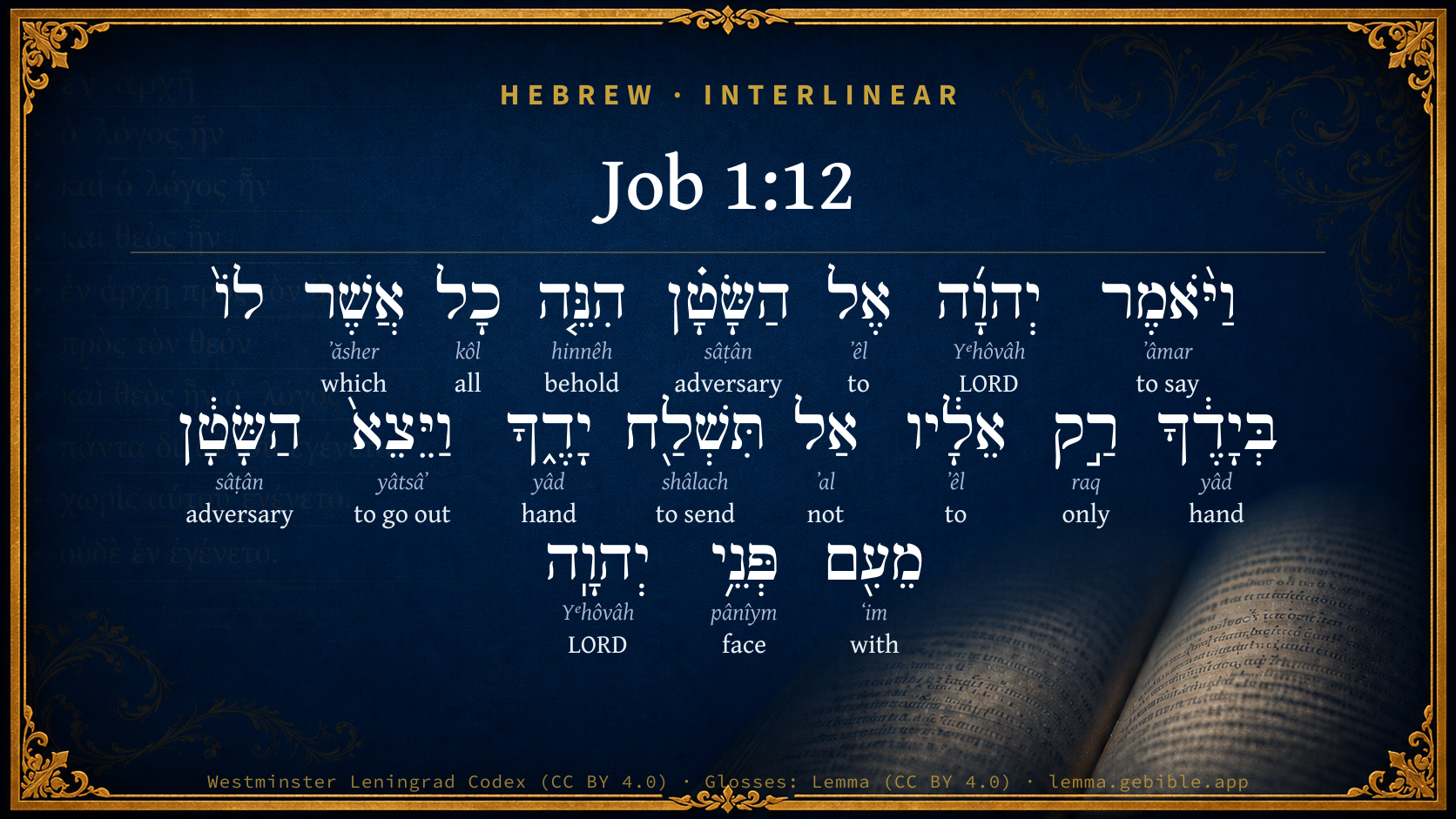
  1. וַיֹּ֨אמֶר ʼâmar H559 “and · to say” Conjunction + Verb, Qal, Sequential Imperfect, 3rd Person, Masculine, Singular
  2. יְהוָ֜ה Yᵉhôvâh H3068 “LORD” Noun, Proper
  3. אֶל ʼêl H413 “to” Preposition
  4. הִנֵּ֤ה hinnêh H2009 “behold” Particle, Demonstrative
  5. כָל kôl H3605 “all of” Noun, Common, Masculine, Singular, Construct
  6. אֲשֶׁר ʼăsher H834 “which” Particle, Relative
  7. בְּיָדֶ֔ךָ yâd H3027 “in/at · hand · your” Preposition + Noun, Common, Both, Singular, Construct + Suffix, Personal, 2nd Person, Masculine, Singular
  8. רַ֣ק raq H7535 “only” Particle, Accusative
  9. אֵלָ֔יו ʼêl H413 “to · him” Preposition + Suffix, Personal, 3rd Person, Masculine, Singular
  10. אַל ʼal H408 “not” Particle, Negative
  11. תִּשְׁלַ֖ח shâlach H7971 “to send” Verb, Qal, Jussive, 2nd Person, Masculine, Singular
  12. יָדֶ֑ךָ yâd H3027 “hand · your” Noun, Common, Both, Singular, Construct + Suffix, Personal, 2nd Person, Masculine, Singular
  13. וַיֵּצֵא֙ yâtsâʼ H3318 “and · to go out” Conjunction + Verb, Qal, Sequential Imperfect, 3rd Person, Masculine, Singular
  14. הַשָּׂטָ֔ן sâṭân H7854 “the · adversary” Particle, Definite Article + Noun, Common, Masculine, Singular, Absolute
  15. מֵעִ֖ם ʻim H5973 “from · with” Preposition + Preposition
  16. פְּנֵ֥י pânîym H6440 “face(s) of” Noun, Common, Both, Plural, Construct
  17. יְהוָֽה Yᵉhôvâh H3068 “LORD” Noun, Proper

About this verse

These counts appear in no published source. They are computed here, from the morphology-tagged text and Lemma’s own curated glosses. What Lemma adds →

19
words
14
distinct lemmas
Wisdom
section

Shared distinctive vocabulary

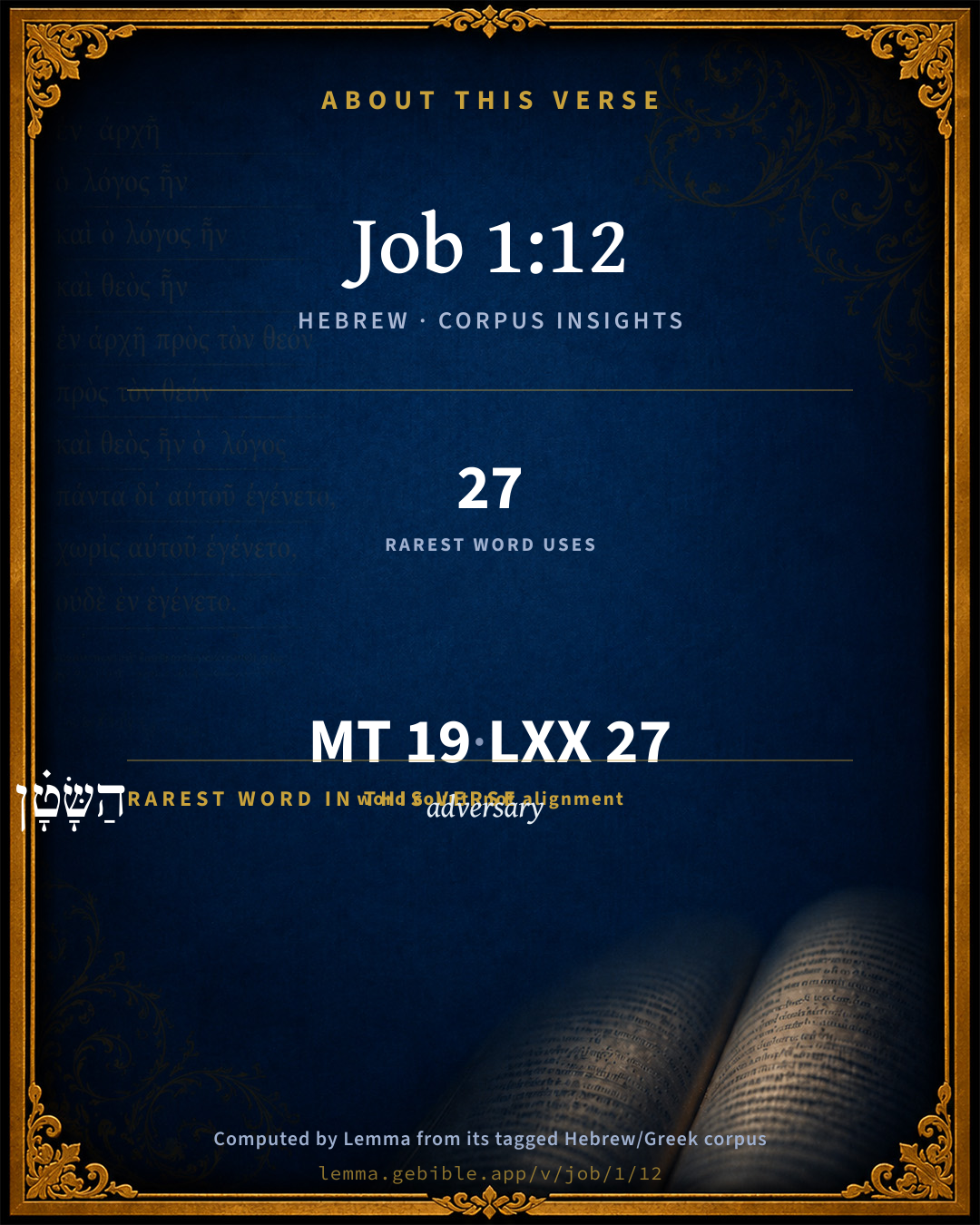
הַשָּׂטָ֗ן adversary H7854 occurs in 23 verses of the Hebrew Bible. Also found in:

Grammatical profile

  • 3 verbs
  • 8 nouns
  • 4 prepositions
  • 4 particles

Verb forms

  • וַיֹּ֨אמֶר Qal · Sequential Imperfect
  • תִּשְׁלַ֖ח Qal · Jussive
  • וַיֵּצֵא֙ Qal · Sequential Imperfect

Repetition

Words recur within this verse — often emphatic in Hebrew:

  • יְהוָ֜ה LORD H3068 ×2
  • הַשָּׂטָ֗ן adversary H7854 ×2
  • בְּיָדֶ֔ךָ hand H3027 ×2
  • אֶל to H413 ×2

Hebrew & Septuagint length

In English translation the verse runs 30 words from the Hebrew and 32 from the Septuagint (LXX English) — closely comparable.

A rough comparison of the two English renderings, which tokenize alike — not a word-level alignment.

Word counts can differ between the Hebrew and the Greek without any difference in meaning — e.g. the Hebrew direct-object marker אֵת has no separate Greek word, and Greek often adds the article ὁ.

In the original languages it is 19 Hebrew tokens and 27 Greek tokens — but the two are counted differently (Hebrew bundles its prefixes and suffixes into one token; the Greek is in lemma form), so that isn’t a like-for-like length.

Cross-references

11

Topical passages linked to Job 1:12 in the Treasury of Scripture Knowledge — connected by theme and wording, ordered by reader-vote popularity; previews shown in the World English Bible.

  • Luke 22:31–32 The Lord said, "Simon, Simon, behold, Satan asked to have you, that he might sift you as wheat,
  • John 3:35–36 The Father loves the Son, and has given all things into his hand.
  • 2 Corinthians 12:7 By reason of the exceeding greatness of the revelations, that I should not be exalted excessively, there was given to me a thorn in the flesh, a messenger of Satan to buffet me, that I should not be exalted excessively.
  • 1 Corinthians 10:13 No temptation has taken you except what is common to man. God is faithful, who will not allow you to be tempted above what you are able, but will with the temptation also make the way of escape, that you may be able to endure it.
  • John 19:11 Jesus answered, "You would have no power at all against me, unless it were given to you from above. Therefore he who delivered me to you has greater sin."
  • Job 2:4–7 Satan answered Yahweh, and said, "Skin for skin. Yes, all that a man has will he give for his life.
  • Isaiah 27:8 In measure, when you send them away, you do contend with them; he has removed [them] with his rough blast in the day of the east wind.
  • Luke 8:32–33 Now there was there a herd of many pigs feeding on the mountain, and they begged him that he would allow them to enter into those. He allowed them.
  • Genesis 16:6 But Abram said to Sarai, "Behold, your maid is in your hand. Do to her whatever is good in your eyes." Sarai dealt harshly with her, and she fled from her face.
  • 1 Kings 22:23 Now therefore, behold, Yahweh has put a lying spirit in the mouth of all these your prophets; and Yahweh has spoken evil concerning you.
  • Jeremiah 38:5 Zedekiah the king said, Behold, he is in your hand; for the king is not he who can do anything against you.

Cross-references courtesy of OpenBible.info (CC BY 4.0).

Hebrew and Greek witnesses Masoretic Hebrew ↔ Greek Septuagint

The same verse in the two great witnesses to the Old Testament, shown verse-for-verse.

These are two independent witnesses, not word-aligned to each other, and the Septuagint is shown in lemma (dictionary) form.

Hebrew Job 1:12 Masoretic · Westminster Leningrad Codex

וַיֹּ֨אמֶר יְהוָ֜ה אֶל הַשָּׂטָ֗ן הִנֵּ֤ה כָל אֲשֶׁר לוֹ֙ בְּיָדֶ֔ךָ רַ֣ק אֵלָ֔יו אַל תִּשְׁלַ֖ח יָדֶ֑ךָ וַיֵּצֵא֙ הַשָּׂטָ֔ן מֵעִ֖ם פְּנֵ֥י יְהוָֽה

Yahweh said to Satan, "Behold, all that he has is in your power. Only on himself don't put forth your hand." So Satan went forth from the presence of Yahweh.

World English Bible · Public Domain

Greek LXX Job 1:12 Septuagint · lemma form

τότε εἶπον ὁ κύριος ὁ διάβολος ἰδού πᾶς ὅσος εἰμί αὐτός δίδωμι ἐν ὁ χείρ σύ ἀλλά αὐτός μή ἅπτομαι καί ἐκἔρχομαι ὁ διάβολος παρά ὁ κύριος

Then the Lord said to the devil, Behold, I give into your hand all that he has, but touch not himself. So the devil went out from the presence of the Lord.

LXX2012 (modern English Septuagint) · Public Domain

Hebrew: Westminster Leningrad Codex (CC BY 4.0). Greek: Septuagint (public domain); English from LXX2012 (modern English Septuagint) (Public Domain). How the Septuagint differs from the Hebrew →

Commentary

Notes on Job 1:12 from classic Christian and Jewish commentators (each source and its license shown beneath its notes). The classic Christian expositions comment on the surrounding passage and are grouped to its opening verse, so a note may address several verses; the Jewish commentaries on the Tanakh (Rashi and others) are per-verse, so they appear only where the commentator wrote on this verse.

Lemma curates 59 commentaries, every one of them public domain or Creative Commons licensed, each selected and text-cleaned for this edition rather than reprinted as found. About our sources →

Trapp's Complete Commentary

John Trapp

Job 1:12 And the LORD said unto Satan, Behold, all that he hath [is] in thy power; only upon himself put not forth thine hand. So Satan went forth from the presence of the LORD.

Ver. 12. And the Lord said unto Satan, Behold, all that he hath is in thy power] Here God in appearance condescendeth to the devil’s desires. But we must know, that God’s end in this large grant was not to gratify the devil, but to glorify himself, by making Satan an instrument of his own shame and infamy, when, by all that he could do, Job would not be drawn to think or speak amiss of God; though Satan left him his wife (who was within his commission) to tempt him to it; and afterwards left him his tongue untouched (when all his body besides was smitten with sore boils), as hoping haply he would have cursed God therewith.

only upon himself put not forth, thy hand] Meddle not with his outward or reward man. He would fain have been doing with both, and had done it now, but for this merciful restriction, which to the devil was (no doubt) a very great vexation. But how could he help it, otherwise than as horses digest their choler by biting on the bridle? The will of the Lord must stand; and Job, though he shall have his back burden of crosses of all kinds, yet they shall not be laid upon him all at once, but piece meal, and at several times. Fidelis est Deus, God is faithful, saith the apostle (and father Latimer died in the flames with those sweet words in his mouth), God is faithful, who will not suffer us to be tempted above that we are able, &c., but will surely proportion the burden to the back, and the stroke to the strength of them that shall bear it. See his gracious dealings with the apostles at their first setting forth into the world; and how by degrees he inured them to bear the cross of Christ, Act 2:1-13; Act 4:5-22; Act 5:17-42; Act 12:1-19.

So Satan went forth from the presence of the Lord] As thinking every hour two till he had sped his commission; the devil descended like lightning upon the earth, to search occasions to ruin Job, aud to triumph over his patience, to touch all that he had, and to touch him to the very quick. This diligence of the devil in evil doing, how happy were it, saith Mr Beza, if we could imitate in doing well? But, behold, while Christ’s enemies watch, and in the night set themselves in readiness to take him, his chief disciples do not only snort and sleep, but cannot so much as be awaked in the garden.

John Trapp, A Commentary or Exposition upon All the Books of the Old and New Testament (1647–1656) — public domain. Text from a community e-Sword module.

The Biblical Illustrator

Joseph S. Exell

Job_1:12-22

So Satan went forth from the presence of the Lord

The foe of foes

I.

The enthusiasm of his malignity. No sooner does he receive permission than he begins in terrible earnestness. He does not seem to have lost a moment. Like a hungry vulture in a carrioned atmosphere, he pounces down upon his victim. Now he strikes at the cattle that were ploughing the field, and the she asses that were beside them. Then he slays the servants, then with a shaft of fire from heaven he burns up the sheep and servants, and then he breathes a hurricane through the wilderness, and levels to the dust the house which his children are revelling in the festive pleasures of family love, and destroys them all. Then he goes to the utmost point of the liberty which his great Master granted him. He could do no more with Jobs circumstances. He deprived him as in a moment of all his property and his children. He had no authority to go beyond this point at present. He had to wait for another Divine communication before he could touch the body of Job. He did his utmost, and did it with an infernal delight.

II. The variety of his agents.

1. Wicked men. He breathed his malign spirit into the men of Sheba, and they rushed to the work of violence and destruction. He inflamed the Chaldeans with the same murderous passions, and then three bands fell upon the camels, carried them away, and slew the servants, etc. Alas! this arch-fiend has access to human souls. He worketh in the children of disobedience. He leadeth them captive at his will.

2. Maternal nature. The great God gave him power over the elements of nature. He kindled the lightning, and made it consume the sheep and the servants. He raised the atmosphere into a tempest, levelled its fury against the house, and brought it down to the destruction of all within. With heavens permission this mighty spirit of evil can cause earthquakes to engulph cities, breathe pestilences to depopulate countries, create storms that will spread devastation over sea and land. He is the prince of the power of the air.

III. The celerity of his movements. How rapidly his fell strokes followed each other. Before the first messenger of evil had told the patriarch his terrible tale, another appeared. Whilst the first was yet speaking, another came; and whilst the second was yet speaking, came the third. The carriers of misery trod on the heels of each other. Why this hurry? Was it because this work of violence was agreeable to the passions of this foul fiend? Or was it because the rapidity would be likely so to shock Jobs moral nature as to produce a religious revulsion, and cause him to do what he desired him to do--curse the Almighty to His face? Perhaps both. Perhaps the celerity was both his pleasure and his policy. Trials seldom come alone.

IV. The folly of his calculations. What was the result of all this on Job? The very reverse of what Sarah had calculated. He worshipped. He did not curse. In his worship we discover three things:--

1. His profound sensibility.

2. His exalted philosophy.

3. His religious magnanimity.

How disappointed this arch-fiend must have been with the result. The result was the very opposite to what he had expected--to what he had wrought for. Thus it has ever been, and thus it will ever be. God may permit Satan to blast our worldly prospects, to wreck our fortunes, and destroy our friendships. But if we trust in Him He will not allow him to touch our souls to their injury. He only uses the fiend to try His servants. An old Welsh minister, in preaching on this text, is reported to have said that God permitted Satan to try Job as the tradesman tries the coin that his customer has tendered in payment for the purchased wares. He strikes it on the counter and hears it ring as rings the true metal, before he accepts it and places it in his drawer. The great Merchantman employed Satan to ring Job on the counter of trial. He did so--did so with all the force of his mighty arm, and in the Divine ear the moral heart of the patriarch vibrated as the music of Divine metal fit for the treasury in the heavens. (Homilist.)

God sets bounds to the afflictions of His people

1. It is not always an argument of Gods goodwill and love to have our motions granted. Many are heard and answered out of anger, not out of love. The children of Israel required meat for their lusts, and God gave it them.

2. That until God gives commission, Satan hath no power over the estates or persons of Gods people, or over anything that belongs unto them.

3. That which Satan and evil men desire sinfully, the Lord grants holily. The will of God and the will of Satan joined both in the same thing; yet they were as different as light and darkness, their ends were as different as their natures.

4. That God Himself sets bounds to the afflictions of His people.

5. That Satan is boundless in his malice toward the people of God. If God did not set him bounds he would set himself no bounds, therefore saith God unto him, only upon himself, etc. (J. Caryl.)

The Biblical Illustrator, edited by Joseph S. Exell (c. 1880s–1900s) — public domain. Text from a community e-Sword module.

Joseph Benson's Commentary

Job 1:12. The Lord said, Behold, all that he hath is in thy power — I give thee full power to do with his property, his servants, his children, and his wife, whatsoever thy craft or malice shall prompt thee to do; only upon himself put not forth thy hand — Meddle not with his own person, with his body or soul. It seems strange that God should give Satan such a permission as this. But he did it for his own glory, for the honour of Job, for the explanation of providence, and the encouragement of his afflicted people in all ages. So Satan went forth from the presence of the Lord — From the place where God is represented as having been especially present, glad of the permission he had obtained to do mischief to a good man; and resolved to lose no time, but immediately to put his project in execution. Schultens observes, that יצא, jatza, to go forth, is used here in a judicial way; comprehending the office of an executer of justice; as Isa 37:36, the angel of the Lord יצא, jatza, went forth, and smote in the camp of the Assyrians. Thus did Satan go forth to execute the judgments wherewith he was permitted to afflict and try Job.

Joseph Benson's Commentary on the Old and New Testaments (1811–1818) — public domain. Text from a community e-Sword module.

Geneva Bible (1599)

Geneva Bible translators

That is, went to execute that which God had permitted him to do: for else he can never go out of God’s presence.

God giveth not Satan power over man to gratify him, but to declare that he hath no power over man, but that which God giveth him.

Geneva Bible (1599) marginal notes — public domain. Text via Bolls.life.

Jamieson, Fausset & Brown

Robert Jamieson, A. R. Fausset & David Brown

in thy power--Satan has no power against man till God gives it. God would not touch Job with His own hand, though Satan asks this (Job 1:11, "thine"), but He allows the enemy to do so.

Jamieson, Fausset & Brown — Commentary Critical and Explanatory on the Whole Bible (1871) — public domain (CC PDM 1.0). Text via the HelloAO Bible API.

Adam Clarke's Commentary

Verse 12. All that he hath is in thy power] Satan cannot deprive a man even of an ass, a sheep, or a pig, but by especial permission of God. His power and malice are ever bounded, and under control.

So Satan went forth] The Targum adds, with authority from the presence of the Lord.

Adam Clarke's Commentary on the Bible (1810–1826) — public domain. Text from a community e-Sword/MySword module.

Ellicott's Commentary for English Readers

(12) All that he hath is in thy power . . .—Mighty as the principle of evil is in the world, it is nevertheless held in check by One who directs it to His own ends. Such is the uniform teaching of Scripture. We are not under the uncontrolled dominion of evil, strong as the temptation may be at times to think so. (See 2Co_12:7; 2Co_12:9; 1Th_2:18, &c.)

A Bible Commentary for English Readers, edited by Charles John Ellicott (1878–1897) — public domain. Text from a community e-Sword module.

The Cambridge Bible for Schools and Colleges

gen. ed. J. J. S. Perowne

12. Satan receives permission to try Job, but the length he can go is rigidly bounded by the will of the Most High. Having received his commission he immediately “goes forth,” glad to appearance in the opportunity of doing mischief and confident in the result.

The Cambridge Bible for Schools and Colleges (gen. ed. J. J. S. Perowne; Cambridge University Press, 1878–1918) — public domain. Text from a community e-Sword module.

John Gill's Exposition

And the Lord said unto Satan, behold, all that he hath is in thy power,.... This he said not as angry and displeased with Job, or as entertaining any ill opinion of him through the suggestions of Satan, nor as gratifying that evil spirit; but in order to convince and confound him, and to try the grace of Job, that he might shine the brighter; and it may be observed, that the Lord alone had the sovereign dispose of all that Job had, and that Satan could have no power over him or his, but what was given him:

only upon himself put not forth thine hand; thus the Lord restrained Satan, who could do nothing without his leave, and limits and bounds the present affliction of his servant to his family and estate; reserving his person and the health of it for another temptation and trial:

so Satan went forth from the presence of the Lord; the Targum adds, "with power", authority, liberty of acting; not from his general presence, which is everywhere, from whence there is no going; nor from his gracious presence, in which he had not been; and much less his glorious presence in heaven, from whence he had been cast long ago; but from the place where the sons and people of God worshipped, and where he granted his presence to them, and from conversing with God there: as soon as Satan had got leave, he at once went forth to execute what he had permission to do, glad at heart he had so far succeeded; and eager upon doing all the mischief he could to a man that was the butt of his malice, and the object of his envy and hatred; the sad effects and consequences of which follow.

John Gill's Exposition of the Whole Bible (1746–1763) — public domain (CC PDM 1.0). Text via the HelloAO Bible API.

Albert Barnes' Notes on the Bible

All that he hath is in thy power - Margin, as in Hebrew “hand.” That is, all this is now committed to thee, for it is manifest that hitherto Satan had no power to injure even his property. He complained that God had made a hedge around all that Job possessed. Now it was all entrusted to him in order that he might make full trim of the faith of Job. The grant extended to his sons and daughters as well as to his property.

Only upon himself put not forth thine hand - Job himself was not to be visited with sickness nor was his life to be taken. The main accusation of Satan was, that Job was virtuous only because God encompassed him with so many blessings, and especially because he had endowed him with so much property. The trial, therefore, only required that it should be seen whether his piety was the mere result of these blessings.

So Satan went forth from the presence of the Lord - That is from the council which had been convened; see the notes at Job 1:6.

Albert Barnes' Notes on the Bible (1834–1885) — public domain. Text from a community e-Sword/MySword module.

Haydock's Catholic Bible Commentary

Hand. God permits evils. (Worthington) --- The devil can do nothing without leave. (Calmet)

George Leo Haydock (1774–1849), Haydock's Catholic Family Bible and Commentary, 1859 edition — public domain. Excludes Psalms (Douay-Rheims chapter numbering differs from Protestant) and Deuterocanonical books (Catholic canon only).

Matthew Poole's English Annotations

All that he hath is in thy power; I give thee full power and liberty to deal with his wife, children, servants, and all his estate, whatsoever thy wit or malice shall prompt thee to do.

Upon himself; his person, body or soul.

From the presence of the Lord, i.e. from that place where God was represented as specially present, being forward and greedy to do the mischief which he had permission to do.

Matthew Poole's English Annotations on the Holy Bible (1683–1685) — public domain. Text from a community e-Sword/MySword module.

Whedon's Commentary on the Bible

Daniel D. Whedon

12. All that he hath is in thy power — As in the margin, hand. Job is now delivered into the hand of Satan. His piety is to be put to the sorest test. All virtue is conditioned upon trial — the higher the virtue the severer the ordeal. The stroke is a bold one, even for the empire of the world. For God had declared Job the best man then living. (Job_1:8.) If Satan should succeed in showing Job to be a hypocrite, he will practically demonstrate that there is no substantial virtue in the world.

So Satan went forth — Not so much to his roaming “to and fro,” as in a straight and definite line to execute his permitted “mission” of evil. By that mission he would seek to destroy virtue; but God shall so overrule him that he will only furnish the conditions by which hardy and tried virtue is made possible and demonstrated. A like remark is made of Cain, (Gen_5:16,) and of Judas, that “he went immediately out” to his deed of treachery. There is no delay: evil nature recoils from the constrained presence of the pure and good to its own congenial work of ruin. He goes with alacrity and with vast resources, and in high expectation of encompassing the fall of one saint, which better pleaseth him than of many unbelievers.

From this we learn that trials are proportioned to the strength of the soul. The intensity of the kindling flames declares the estimate God puts upon the virtue of Job. On the one hand, all temptation at the hand of Satan sets forth the value of the soul, and its high destiny in another life: on the other, the saying is no less true, that “in every temptation to sin the devil cheapens our immortal souls,” and in every way endeavours to depreciate them before the soul itself. “God tries men, that they may rise: Satan tempts them, that they may fall.”

Daniel D. Whedon (gen. ed.), Commentary on the Old and New Testaments (1874–1909) — public domain. Text from a community e-Sword module.

The Pulpit Commentary

And the Lord said unto Satan, Behold, all that he hath is in thy power; literally, in thy hand, as in the margin. God withdraws his protection from Job"s possessions; he does not himself take them away, as Satan had suggested (ver. 11); but he allows Satan, who can do nothing without his allowance, to deal with them as he pleases. As God dispenses blessings through the angelic host, (Psa_91:11, 12 Heb_1:14) so he, sometimes at any rate, allows spirits of evil to be the ministers of his chastisements. Only upon himself put not forth thine hand. The person of Job was not to be touched as yet. He was to be injured only in his belongings. So Satan went forth from the presence of the Lord. Having obtained a permission which he thought would serve his purpose, Satan did not delay, but promptly departed, to take advantage of the permission given him. To be in the presence of God must be an intense pain to the evil one.

In Satan"s power.

I GOD PERMITS TEMPORAL ADVERSITY.

1. It cannot come without his permission. Satan roams over the earth, longing for mischief; yet he cannot do any harm till he obtains leave from the court of heaven. It is some consolation in adversity to know that this has not fallen without God"s observing it, nor even in spite of his will. That which he distinctly sanctions cannot be really bad. Therefore adversity is not the evil it appears to be.

2. God does not always inflict evil immediately. It is not God, but Satan, who smites Job. It would seem that God would never have done it, and that if Satan had not sought permission to hurt Job, Job"s prosperity would have remained unshaken. This is not like the narratives of destroying angels sent forth by God to smite Jerusalem (2Sa_24:16) and to destroy the Assyrian host. (2Ki_19:35) In those cases the calamity was from God. Here it originates in Satan, though it is permitted by God. Possibly we may see a ray of light on the mystery of suffering in this fact, especially as a similar thing is seen in the New Testament, in the ease of the woman "whom Satan has bound", (Luk_13:16) and in the case of a person "delivered over to Satan". (1Ti_1:20) St. Paul"s thorn in the flesh was not a messenger of God, but "a messenger of Satan". (2Co_12:7) There are evils which God would not initiate, yet which it would not be well for him at once to restrain by force.

II GOD LIMITS THE ADVERSITY HE PERMITS. Satan is permitted to lay hold on all that Job possesses, but not to touch the man himself. Thus the adversity is limited, and on various grounds.

1. According to necessity. It shall be no greater than is necessary to accomplish its object. God is lavish of mercies; he is parsimonious with afflictions even in the case of the huge afflictions of a Job! But he is the Judge of how much trouble is necessary, and we cannot estimate it.

2. According to powers of endurance. God will not suffer us to be tempted beyond that we are able to endure. (1Co_10:13) He knew Job when he pertained tremendous troubles to fall upon him. Those Titanic shoulders could carry a giant"s load of calamity. Weaker souls are more gently dealt with.

III THE ADVERSITY IS ONLY PERMITTED FOR THE SAKE OF A GREAT GOOD. To the casual observer it looks as though Job were merely delivered over for Satan to make diabolical sport with him, as the Philistines made sport with blind Samson. But God would not thus cruelly deal with any man. The fact is, Job is to prove a great truth to devils and angels, and ultimately to men also. The testing of his fidelity is a lesson for the universe. It shows that God inspires disinterested devotion. Now, Job was not aware of this purpose. Had he known it, the trial would have been frustrated. To him the series of calamities is an overwhelming mystery, and he is tried the more by its inexplicable character. We cannot see the purpose of our troubles. But there is a purpose. Possibly one explanation is, not that we are merely to suffer for our own soul"s discipline, but, like Job, for the sake of lessons which, without our knowing them, may be taught to others by means of our experience. W.F.A.

The Pulpit Commentary (1880–1919), ed. H.D.M. Spence-Jones & Joseph S. Exell — public domain. Text from a community e-Sword module.

John Wesley's Explanatory Notes

Behold, &c. - It seems strange, that, God should give Satan such a permission as this. But he did it for his own glory, for the honour of Job, for the explanation of providence, and the encouragement of his afflicted people in all ages.

John Wesley, Explanatory Notes Upon the Whole Bible (1754–1765) — public domain. Text via the GEBible commentary corpus.

Keil & Delitzsch

C. F. Keil & F. Delitzsch

12 Then Jehovah said to Satan, Behold, all that he hath is in thy hand; only upon himself put not forth thy hand. And Satan went forth from the presence of Jehovah.

Notice well: The divine permission appears at the same time as a divine command, for in general there is not a permission by which God remains purely passive; wherefore God is even called in Scripture creator mali (the evil act as such only excepted), Isa 45:7. Further, the divine arrangement has not its foundation in the sin which still clings to Job. For in the praise conferred upon Job, it is not said that he is absolutely without sin: universal liability to sin is assumed not only of all the unrighteousness, but even of all the righteousness, of Adam's race. Thirdly, the permission proceeds, on the contrary, from God's purpose to maintain, in opposition to Satan, the righteousness which, in spite of the universal liability to sin, is peculiar to Job; and if we place this single instance in historical connection with the development of the plan of redemption, it is a part of the conflict of the woman's seed with the serpent, and of the gradual degradation of Satan to the lake of fire. After Jehovah's permission, Satan retires forthwith. The license is welcome to him, for he delights in the work of destruction. And he hopes to conquer. For after he has experienced the unlimited power of evil over himself, he has lost all faith in the power of good, and is indeed become himself the self-deceived father of lies.

Keil & Delitzsch — Biblical Commentary on the Old Testament (1861–1891) — public domain (CC PDM 1.0). Text via the HelloAO Bible API. (Old Testament only.)

Rashi

Rabbi Shlomo Yitzchaki (Rashi)

“Behold, all that he has etc. Another explanation: Now the day came about That day when they recommenced the cycle [and were] to eat at the house of their eldest brother.

the angels of God The heavenly hosts, which are near the Divine Presence, to be the members of His household, and were therefore called His children.

to stand beside the Lord Heb. Around Him, as (Gen. 45:1) “all who stood around him (עליו).”

Rashi on the Tanakh — English translations: “The Judaica Press complete Tanach with Rashi, translated by A. J. Rosenberg” (CC BY 4.0); “Pentateuch with Rashi's commentary by M. Rosenbaum and A.M. Silbermann, 1929-1934” (public domain); “The Metsudah Tanach series, Lakewood, N.J” (CC BY 4.0); and “The Book of Joshua, Metsudah Publications, 1997” (CC BY 4.0). Text via Sefaria.

Lesson kit

Teaching starters — assembled from the data on this page, not authored interpretation. Every prompt links to the verse data it draws on. Edit before teaching.

Job, in the Wisdom, opens this verse with 19 words (14 distinct Hebrew lemmas). Its most distinctive word is sâṭân (“adversary”). A historical commentator’s framing appears above. Read the whole chapter for the surrounding context.

Discussion questions

  1. How does “adversary” (sâṭân) shape what this verse is saying?
  2. How does Numbers 22:22, which shares the word «adversary», read alongside this verse?
  3. What does the repetition of “LORD” (2× in this one verse) do in this verse?
  4. The translations on this page render this verse differently — a whole-verse word diff, not a word-by-word alignment. What might account for the different wordings?
  5. «וַיֹּ֨אמֶר» is a Qal Sequential Imperfect verb. How does that grammatical form shape the action described?
  6. Compare how Trapp's Complete Commentary and The Biblical Illustrator read this verse. Where do they agree or differ?

Things to notice

Reading settings

Reading text

Shown beneath each verse's original-language words.

Old Testament
Old Testament edition

Read the OT as the Masoretic Hebrew (MT) or the Greek Septuagint (LXX).

English shown for the Greek Septuagint (in the Hebrew ↔ Greek comparison).

Comparing translations? Open the Compare panel on any verse page to stack up to four side by side.