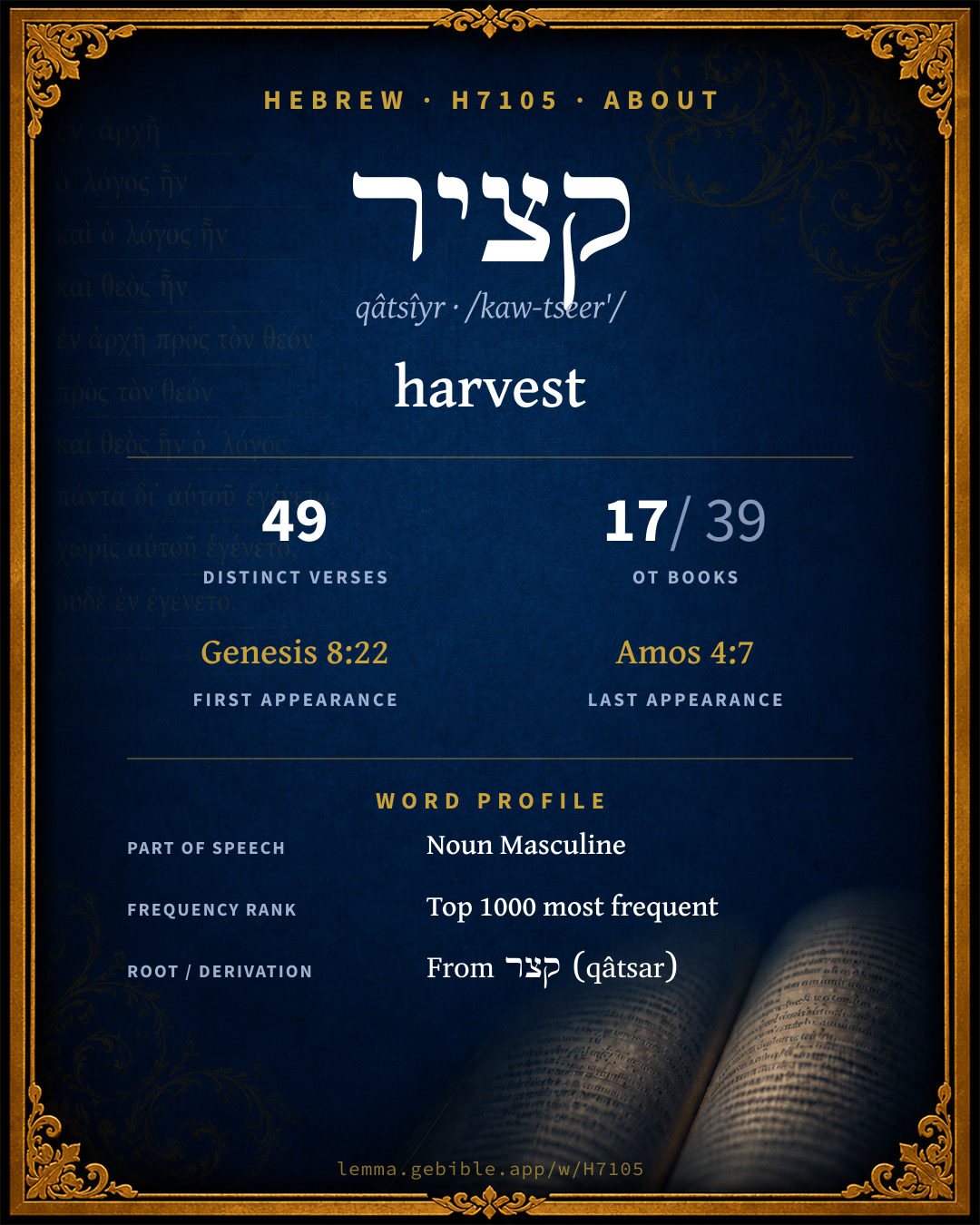
קָצִיר
harvest
‘harvest’ is one of 2 main senses fuller range ↓
Full lexicon entry — Brown-Driver-Briggs (BDB)
From Brown-Driver-Briggs (BDB)
Where this word appears
See every Absolute-state word in the Hebrew Bible →
Grammar key — what these labels mean
Part of speech
- Noun
- A naming word — a person, place, thing, or idea.
Noun type
- Common
- A common noun — a general class of person, place, or thing (“king,” “city,” “water”), not a specific name.
State
- Absolute
- The independent form of a noun, not bound to a following word.
- Construct
- A noun bound to a following noun in a possessive / “of” relationship (the construct chain).
Gender
- Masculine
- Grammatically masculine.
Number
- Singular
- One.
- Plural
- More than one (in Hebrew, generally three or more).
Grammatical forms
- Noun, Common, Masculine, Singular, Absolute 27 times (50%)
- Noun, Common, Masculine, Singular, Construct 26 times (48%)
- Noun, Common, Masculine, Plural, Construct 1 time (2%)
Parsed forms decoded from the imported morphology (morphhb / Westminster Leningrad Codex — WLC text public domain, morphhb tagging CC BY 4.0), counted across 54 parsed occurrences — not distinct verses.
Every verse where H7105 appears — 49 distinct verses across 17 books. Click any verse to open its interlinear word-by-word view. Verse text shown in the World English Bible for context — . Each verse’s Hebrew form is shown with its reference; the English is not keyword-highlighted, since the data carries no word-level English alignment. Use “Compare translations” on any verse to read it across multiple English versions. This concordance covers the Hebrew Bible; Septuagint (Greek Old Testament) occurrences are not indexed here.
Genesis 3 verses
- Genesis 8:22 וְ֠/קָצִיר conj + n c ms While the earth remains, seed time and harvest, and cold and heat, and summer and winter, and day and night shall not cease."
- Genesis 30:14 קְצִיר n c ms cs Reuben went in the days of wheat harvest, and found mandrakes in the field, and brought them to his mother, Leah. Then Rachel said to Leah, "Please give me some of your son's mandrakes."
- Genesis 45:6 וְ/קָצִּֽיר conj + n c ms For these two years the famine has been in the land, and there are yet five years, in which there will be neither plowing nor harvest.
Exodus 3 verses
- Exodus 23:16 הַ/קָּצִיר֙ ptcl def.art + n c ms And the feast of harvest, the first fruits of your labors, which you sow in the field: and the feast of harvest, at the end of the year, when you gather in your labors out of the field.
- Exodus 34:21 וּ/בַ/קָּצִ֖יר conj + prep det + n c ms Six days you shall work, but on the seventh day you shall rest: in plowing time and in harvest you shall rest.
- Exodus 34:22 קְצִ֣יר n c ms cs You shall observe the feast of weeks with the first fruits of wheat harvest, and the feast of harvest at the year's end.
Leviticus 4 verses
- Leviticus 19:9 קְצִ֣יר קְצִֽירְ/ךָ֖ n c ms cs n c ms cs + sfx pers 2ms "'When you reap the harvest of your land, you shall not wholly reap the corners of your field, neither shall you gather the gleanings of your harvest.
- Leviticus 23:10 קְצִירָ֑/הּ קְצִירְ/כֶ֖ם n c ms cs + sfx pers 3fs n c ms cs + sfx pers 2mp "Speak to the children of Israel, and tell them, 'When you have come into the land which I give to you, and shall reap its the harvest, then you shall bring the sheaf of the first fruits of your harvest to the priest:
- Leviticus 23:22 קְצִ֣יר קְצִירְ/ךָ֖ n c ms cs n c ms cs + sfx pers 2ms "'When you reap the harvest of your land, you shall not wholly reap into the corners of your field, neither shall you gather the gleanings of your harvest: you shall leave them for the poor, and for the foreigner. I am Yahweh your God.'"
- Leviticus 25:5 קְצִֽירְ/ךָ֙ n c ms cs + sfx pers 2ms What grows of itself in your harvest you shall not reap, and the grapes of your undressed vine you shall not gather. It shall be a year of solemn rest for the land.
Deuteronomy 1 verse
Joshua 1 verse
Judges 1 verse
Ruth 3 verses
- Ruth 1:22 קְצִ֥יר n c ms cs So Naomi returned, and Ruth the Moabitess, her daughter-in-law, with her, who returned out of the country of Moab: and they came to Bethlehem in the beginning of barley harvest.
- Ruth 2:21 הַ/קָּצִ֖יר ptcl def.art + n c ms Ruth the Moabitess said, Yes, he said to me, You shall keep fast by my young men, until they have ended all my harvest.
- Ruth 2:23 קְצִֽיר וּ/קְצִ֣יר n c ms cs conj + n c ms cs So she kept fast by the maidens of Boaz, to glean to the end of barley harvest and of wheat harvest; and she lived with her mother-in-law.
1 Samuel 3 verses
- 1 Samuel 6:13 קְצִיר n c ms cs They of Beth-shemesh were reaping their wheat harvest in the valley; and they lifted up their eyes, and saw the ark, and rejoiced to see it.
- 1 Samuel 8:12 קְצִיר֔/וֹ n c ms cs + sfx pers 3ms and he will appoint them to him for captains of thousands, and captains of fifties; and [he will set some] to plow his ground, and to reap his harvest, and to make his instruments of war, and the instruments of his chariots.
- 1 Samuel 12:17 קְצִיר n c ms cs Isn't it wheat harvest today? I will call to Yahweh, that he may send thunder and rain; and you shall know and see that your wickedness is great, which you have done in the sight of Yahweh, in asking you a king.
2 Samuel 3 verses
- 2 Samuel 21:9 קָצִיר֙ קְצִ֥יר n c ms n c ms cs He delivered them into the hands of the Gibeonites, and they hanged them in the mountain before Yahweh, and they fell [all] seven together. They were put to death in the days of harvest, in the first days, at the beginning of barley harvest.
- 2 Samuel 21:10 קָצִ֔יר n c ms Rizpah the daughter of Aiah took sackcloth, and spread it for her on the rock, from the beginning of harvest until water was poured on them from the sky; and she allowed neither the birds of the sky to rest on them by day, nor the animals of the field by night.
- 2 Samuel 23:13 קָצִיר֙ n c ms Three of the thirty chief men went down, and came to David in the harvest time to the cave of Adullam; and the troop of the Philistines was encamped in the valley of Rephaim.
Job 4 verses
- Job 5:5 קְצִיר֨/וֹ n c ms cs + sfx pers 3ms Whose harvest the hungry eats up, And take it even out of the thorns; The snare gapes for their substance.
- Job 14:9 קָצִ֣יר n c ms Yet through the scent of water it will bud, And put forth boughs like a plant.
- Job 18:16 קְצִירֽ/וֹ n c ms cs + sfx pers 3ms His roots shall be dried up beneath, Above shall his branch be cut off.
- Job 29:19 בִּ/קְצִירִֽ/י prep + n c ms cs + sfx pers 1cs My root is spread out to the waters, The dew lies all night on my branch;
Psalms 1 verse
Proverbs 5 verses
- Proverbs 6:8 בַ֝/קָּצִ֗יר prep det + n c ms Provides her bread in the summer, And gathers her food in the harvest.
- Proverbs 10:5 בַּ֝/קָּצִ֗יר prep det + n c ms He who gathers in summer is a wise son, But he who sleeps during the harvest is a son who causes shame.
- Proverbs 20:4 בַּ/קָּצִ֣יר prep det + n c ms The sluggard will not plow by reason of the winter; Therefore he shall beg in harvest, and have nothing.
- Proverbs 25:13 קָצִ֗יר n c ms As the cold of snow in the time of harvest, So is a faithful messenger to those who send him; For he refreshes the soul of his masters.
- Proverbs 26:1 בַּ/קָּצִ֑יר prep det + n c ms Like snow in summer, and as rain in harvest, So honor is not fitting for a fool.
Isaiah 8 verses
- Isaiah 9:3 בַּ/קָּצִ֔יר prep det + n c ms You have multiplied the nation, you have increased their joy: they joy before you according to the joy in harvest, as men rejoice when they divide the spoil.
- Isaiah 16:9 קְצִירֵ֖/ךְ n c ms cs + sfx pers 2fs Therefore I will weep with the weeping of Jazer for the vine of Sibmah; I will water you with my tears, Heshbon, and Elealeh: for on your summer fruits and on your harvest the [battle] shout is fallen.
- Isaiah 17:5 קָצִ֣יר n c ms It shall be as when the harvester gathers the standing grain, and his arm reaps the ears; yes, it shall be as when one gleans ears in the valley of Rephaim.
- Isaiah 17:11 קָצִ֛יר n c ms In the day of your planting you hedge it in, and in the morning you make your seed to blossom; but the harvest flees away in the day of grief and of desperate sorrow.
- Isaiah 18:4 קָצִֽיר n c ms For thus has Yahweh said to me, I will be still, and I will see in my dwelling-place, like clear heat in sunshine, like a cloud of dew in the heat of harvest.
- Isaiah 18:5 קָצִיר֙ n c ms For before the harvest, when the blossom is over, and the flower becomes a ripening grape, he will cut off the sprigs with pruning-hooks, and the spreading branches will he take away [and] cut down.
- Isaiah 23:3 קְצִ֥יר n c ms cs On great waters the seed of the Shihor, the harvest of the Nile, was her revenue; and she was the market of nations.
- Isaiah 27:11 קְצִירָ/הּ֙ n c ms cs + sfx pers 3fs When the boughs of it are withered, they shall be broken off; the women shall come, and set them on fire; for it is a people of no understanding: therefore he who made them will not have compassion on them, and he who formed them will show them no favor.
Jeremiah 5 verses
- Jeremiah 5:17 קְצִֽירְ/ךָ֜ n c ms cs + sfx pers 2ms They shall eat up your harvest, and your bread, [which] your sons and your daughters should eat; they shall eat up your flocks and your herds; they shall eat up your vines and your fig trees; they shall beat down your fortified cities, in which you trust, with the sword.
- Jeremiah 5:24 קָצִ֖יר n c ms Neither say they in their heart, Let us now fear Yahweh our God, who gives rain, both the former and the latter, in its season; who preserves to us the appointed weeks of the harvest.
- Jeremiah 8:20 קָצִ֖יר n c ms The harvest is past, the summer is ended, and we are not saved.
- Jeremiah 50:16 קָצִ֑יר n c ms Cut off the sower from Babylon, and him who handles the sickle in the time of harvest: for fear of the oppressing sword they shall turn everyone to his people, and they shall flee everyone to his own land.
- Jeremiah 51:33 הַ/קָּצִ֖יר ptcl def.art + n c ms For thus says Yahweh of hosts, the God of Israel: The daughter of Babylon is like a threshing floor at the time when it is trodden; yet a little while, and the time of harvest shall come for her.
Hosea 1 verse
Joel 2 verses
- Joel 1:11 קְצִ֥יר n c ms cs Be confounded, you farmers! Wail, you vineyard keepers; For the wheat and for the barley; For the harvest of the field has perished.
- Joel 3:13 קָצִ֑יר n c ms Put in the sickle; For the harvest is ripe. Come, tread, for the winepress is full, The vats overflow, for their wickedness is great."
Amos 1 verse
About this entry
At a glance — auto-summarized from this page’s data, not written by a person. Every figure links to its source below. This summary describes the numbers; it doesn’t interpret them.
At its core, קציר (qâtsîyr) means “harvest.” First canonically at Genesis 8:22, it enters the text early. It appears 49 verses across 17 books of the Hebrew Bible, among its moderately common vocabulary. Carrying more than one sense, it rewards its full sense range. It shares a root with קצר, קצר and קצר. Each statement above links to its evidence; the full detail follows below.
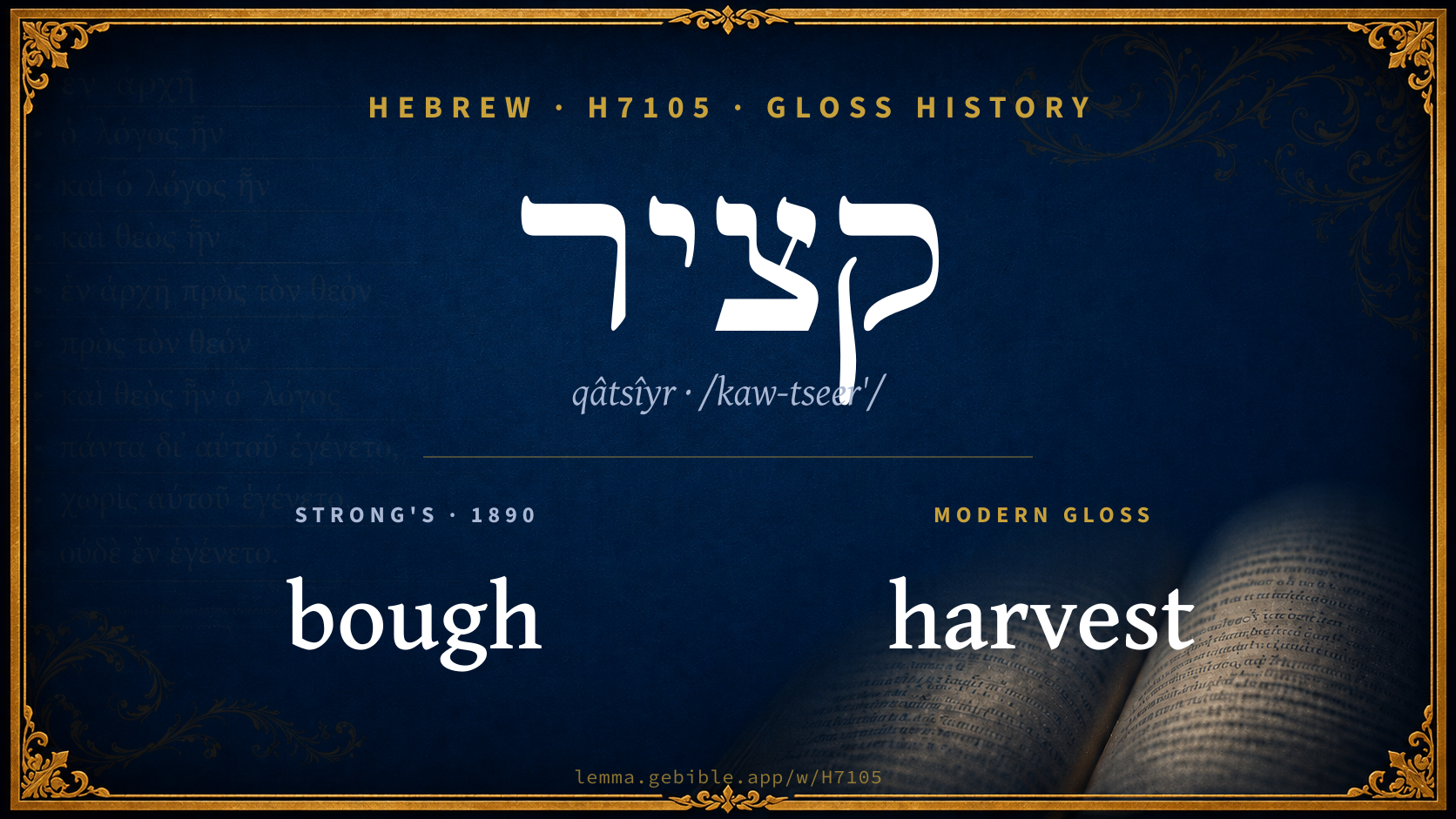
Gloss history
Strong's 1890 vs modern scholarship
About this word
Strong's H7105 catalogs a Hebrew word from the Hebrew Old Testament.
These counts are not copied from any lexicon or concordance. They are computed here, from the morphology-tagged Hebrew Old Testament. What Lemma adds →
- 49
- distinct verses
- The word appears in 49 distinct verses.
- 17 / 39
- OT books
- The word appears in 17 of 39 Old Testament books.
- #696
- by frequency
- Top 1000 most frequent Hebrew words (rank 696 of 8,640 Hebrew words by occurrence).
View all 49 occurrences in the concordance →
By section of the Old Testament
By traditional corpus
Conventional, traditional groupings — biblical authorship is debated, so this is a traditional corpus grouping, not an authorship claim. Each share is this word’s portion of its verses in that division of the Hebrew canon. Each figure is a share of the word’s 49 distinct verses.
- Prophets (Nevi'im) 25 verses · 51%
- Writings (Ketuvim) 13 verses · 27%
- Torah (Pentateuch) 11 verses · 22%
How translations render this word
Counts come from each version’s own published word-to-Strong’s tagging or interlinear alignment — an approximate guide to how each version renders this word, not a word-level alignment the data otherwise carries. Because each total is that version’s own tagged count, the per-version totals vary from one another and need not match the appearance or distinct-verse counts above. These counts may also differ from a printed concordance because Lemma counts each distinctly tagged rendering and does not collapse phrase taggings into a single head-word total. This is a fixed set of word-tagged versions (KJV, ASV, BSB, ULT) and does not change with the reading translation you choose elsewhere. Each version’s license is shown beside its name below (and on Sources).
BDB lists this Strong’s number as 2 distinct words (homographs). Each count above pools all of them and is not split by sense — see the Senses section below. A low-frequency rendering may belong to a different one of those words, not the primary meaning.
- King James Version†: Harvest 46×, Boughs 3×
- American Standard Version†: Harvest 44×, Boughs 2×
- Berean Standard Bible†: Harvest 37×, Branches 3×, Harvest time 3×
- unfoldingWord Literal Text†: Harvest 32×, Harvest of 12×, Branch 3×
King James Version Public Domain
Renders H7105 across 54† tagged occurrences — most commonly:
Plus 5 renderings that appear only once — usually multi-word phrases or single function words the recovered tagging swept in, not distinct renderings.
American Standard Version Public Domain
Renders H7105 across 53† tagged occurrences — most commonly:
Plus 7 renderings that appear only once — usually multi-word phrases or single function words the recovered tagging swept in, not distinct renderings.
Berean Standard Bible Public Domain
Renders H7105 across 51† tagged occurrences — most commonly:
Plus 8 renderings that appear only once — usually multi-word phrases or single function words the recovered tagging swept in, not distinct renderings. Not rendered by a distinct English word in 3 further occurrences.
unfoldingWord Literal Text CC BY-SA 4.0
Renders H7105 across 53† tagged occurrences — most commonly:
Plus 6 renderings that appear only once — usually multi-word phrases or single function words the recovered tagging swept in, not distinct renderings.
Senses in the full BDB
What do BDB’s symbols mean?
BDB uses these scholarly abbreviations:
| Symbol | Meaning |
|---|---|
| 𝔊 | the Septuagint (the ancient Greek translation, LXX) |
| 𝔙 | the Vulgate (the Latin translation) |
| 𝔖 | the Syriac version (the Peshitta) |
| 𝔗 | the Targum (the Aramaic translation) |
| ψ | the Psalms |
| √ | root (the underlying root or stem) |
| ‖ | parallel passage (a synonymous or contrasted parallel) |
| † | the dagger: every passage where the word occurs is cited |
The 3 senses and sub-senses the full Brown-Driver-Briggs lexicon distinguishes for this word, in lexicon order (not ranked by frequency), with BDB’s own verbatim wording and sub-sense lettering. Shown in Hebrew script with BDB’s own scholarly abbreviations. The condensed entry is in the Lexicon Entry tab. See also the Forms in the corpus table below.
- 1. process of harvesting, Gn 45:6 (E; + חָרִישׁ), Ru 2:21. e.g. Genesis 45:6
- 2. what is reaped, harvested, crop, spec. of grain: Gn 8:22 (+ זֶרַע; J), Is 17:11 (fig.; cf. נוד; ‖ זֶרַע), ק׳ יְאֹר 23:3 (‖ id.) i.e. exported grain of Egypt; קְ׳ חִטִּים Ex 34:22 (JE), ins. also 2 S 24:15 (𝔊 Th We Dr al.), לֶקֶט ק׳ Lv 19:9b; 23:22b; ק׳ as eaten Je 5:17; Jb 5:5 (but read here קָֽצְרוּ 𝔊 Me Bu al., cf. BevJPhil. xxvi.304); as acc. cogn. c. קָצַר 1 S 8:12; Dt 24:19 Lv 19:9a; 23:10(×2), 22a סְפִיחַ ק׳ Lv 25:5 (all H), קְ׳ חִטִּים 1 S 6:13; of ripe grain Jo 1:11 (קְ׳ שָׂדֶה), 4:13 (בָּשַׁל ק׳); fig. of punishment Ho 6:11; of vintage Is 16:9 (‖ קַיִץ; read prob. בָּצִיר as ‖ Je 48:32, BuhlLex 13) 17:11; 12:5. e.g. Genesis 8:22
- 3. time of harvest, Ex 34:21 (+ חָרִישׁ; JE), 2 S 21:10 (23:13 read הַצּוּר as ‖ 1 Ch 11:15, so 𝔊L Th We and most), Is 9:2 (sim.), 18:5 (fig.), Je 5:24, ‖ קַיִץ 8:20 Pr 6:8; 10:5; 26:1 (sim.); opp. חֹרֶף 20:4; יְמֵי ק׳ Jos 3:15 (JE), 2 S 21:9a, יוֹם ק׳ Pr 25:13 (sim.), עֵת(־הַ)ק׳ Je 50:16; 51:33 (fig.); of wheat-harvest, יְמֵי קְ׳ חִטִּים Gn 30:14 (J), Ju 15:1, without יְמֵי Ru 2:23b, הֲלוֹא קְ׳־ח׳ הַיּוֹם 1 S 12:17; barley harvest, קְ׳ (הַ)שְׂעֹרִים 2 S 21:9b Ru 1:22; 2:23a; חֹם קָצִיר Is 18:4; חַג הַקּ׳ Ex 23:16 (E). On harvest in Pal. v. VogelstLandwirthsch 57 ff. HaymanSmith DB Agriculture.—Is 17:5 read קֹצֵר, v. קָצַר. e.g. Exodus 34:21
Senses from the full Brown-Driver-Briggs lexicon (Brown, Driver, Briggs; Oxford 1906 — public domain), digitized via Sefaria, supplemented by the OpenScriptures HebrewLexicon (CC BY 4.0). Full attribution on Sources.
Word origin
I. n.m. Je 8:20 harvesting, harvest (cf. LagBN 173);—abs. ק׳ Gn 45:6 +, cstr. קְצִיר Ju 15:1 +; sf. קְצִירְךָ Lv 19:9 +, etc.;—harvest:
II. n.m. Is 27:11 usually coll., boughs, branches (connex. with above √ dub.);—abs. ק׳ Jb 14:9; sf. קְצִירִי Jb 29:19 (in fig.; ‖ שֹׁרֶשׁ), קְצִירוֹ 18:16 (fig.; ‖ id.); קְצִירָהּ Is 27:11; pl. sf. קְצִירֶיהָ ψ 80:12.
— Brown-Driver-Briggs (Oxford 1906, public domain), digitized via Sefaria, supplemented by the OpenScriptures HebrewLexicon (CC BY 4.0). See Sources.
Derived from קצר (qâtsar) (H7114) — to be short.
Jastrow Dictionary
A second Hebrew/Aramaic lexicon for comparison, covering Aramaic and post-biblical (Talmudic, Targumic, Midrashic) usage that the biblical-Hebrew BDB does not. Matched by lemma rather than by Strong’s number, so a lemma may carry more than one Jastrow headword (shown separately below), and the entries cover usage well beyond the Bible.
קְצֵיר־
- , v. קָצֵר
קָצִיר
- cutting, harvest, ripening season. R. Hash. 9ᵃ ק׳ של שביעית וכ׳ a ripening in the Sabbatical year which goes over into the eighth year, i.e. plants which were partly ripe in the Sabbatical year are subject to the laws of the Sabbatical year. Ib. קְצִיר העומר the cutting of the ʿOmer (v. עוֹמֶר); a. fr.—Lev. R. s. 18 (ref. to Is. XVII, 11) קְצִירָן של מלכיות (קְצִירִין) the cutting down (destruction threatened) by the government; ק׳ של יסורין by sufferings; קְצִירוֹ של מלאך וכ׳ the cutting down by the angel of death, v. נִדְנֵד; Yalk. Is. 287.—Pl. קְצִירִין, v. supra. e.g. Isaiah 17:11
A Dictionary of the Targumim, the Talmud Babli and Yerushalmi, and the Midrashic Literature (Marcus Jastrow; London, Luzac, 1903) — Public Domain. Digitized via Sefaria. Digitized via Sefaria. Full attribution on Sources.
Forms in the corpus
The 38 distinct written forms H7105 takes in the Hebrew Bible, most frequent first — each parse links to that state’s occurrences in the concordance. Hebrew forms include their vowel points and cantillation, so a single lemma takes many written forms.
Same root — word family
Other BDB entries built from the same root as H7105, grouped by Strong’s listed origin. These share a root / origin per the lexicon — not necessarily a shared meaning. Each links to that word’s own entry.
Derives from
Shares the same root
Compare all same-root words → They share a root, not necessarily a meaning.
Septuagint verse parallels
This word appears in 47 verses that also exist in the Greek Old Testament (Septuagint), out of the 49 Hebrew verses it occurs in. You can read those verses in Greek by switching the Old Testament edition to the Septuagint.
Read these verses in the Septuagint
- Genesis 8:22
- Exodus 23:16
- Leviticus 19:9
- Deuteronomy 24:19
- Joshua 3:15
- Judges 15:1
- Ruth 1:22
- 1 Samuel 6:13
- 2 Samuel 21:9
- Job 5:5
- Psalms 80:11
- Proverbs 6:8
This is a verse-level parallel only — the same verses exist in both the Hebrew and Greek Old Testaments. No word-level Hebrew↔Greek correspondence is claimed: the data carries no such alignment, so no Greek word is shown as this Hebrew word’s translation. Coverage is not total — the Septuagint omits the deuterocanon and renumbers the Psalms, so some Hebrew verses have no direct Greek parallel.