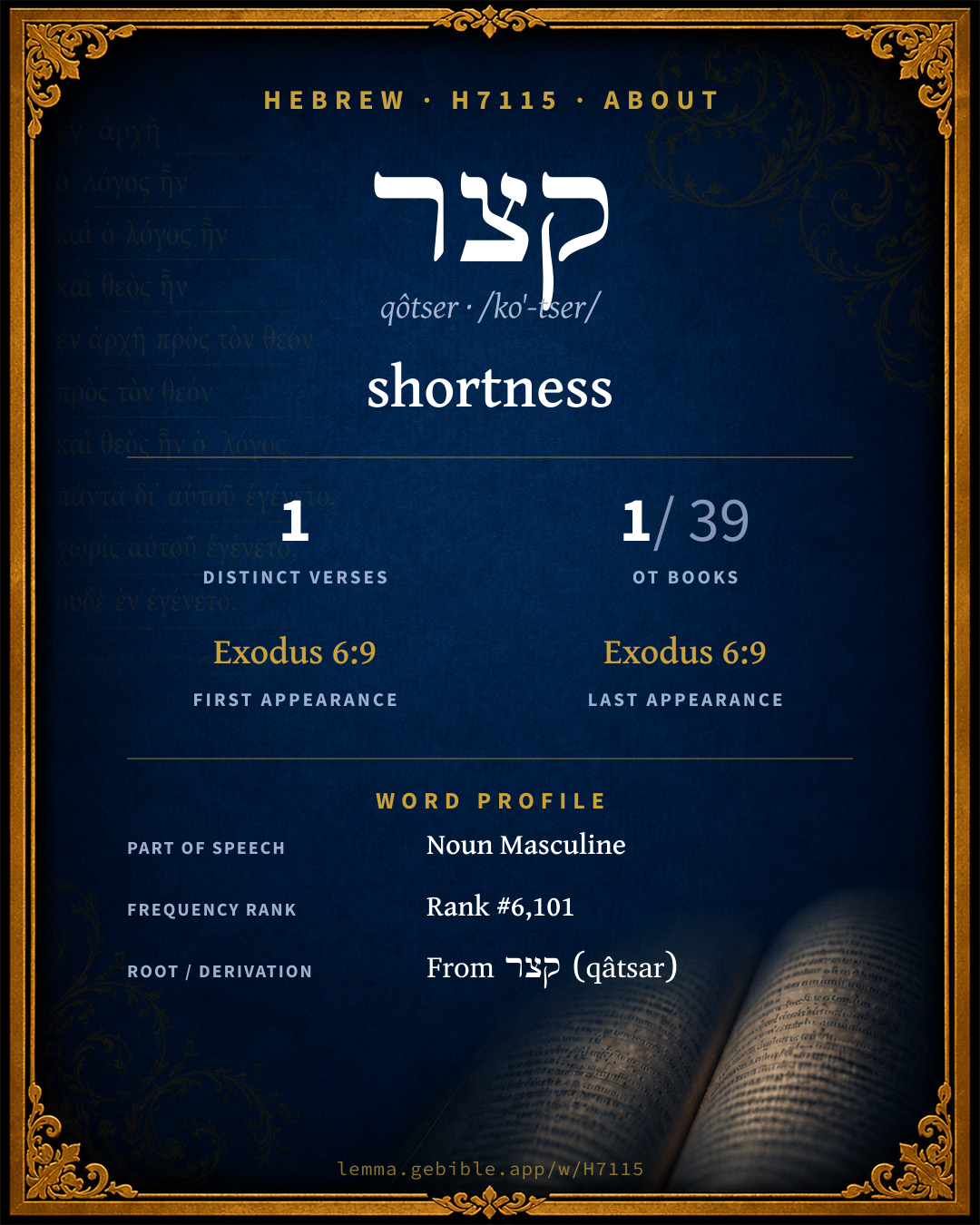
קֹ֫צֶר
shortness
Full lexicon entry — Brown-Driver-Briggs (BDB)
From Brown-Driver-Briggs (BDB)
Where this word appears
Grammar key — what these labels mean
Noun type
- Common
- A common noun — a general class of person, place, or thing (“king,” “city,” “water”), not a specific name.
State
- Construct
- A noun bound to a following noun in a possessive / “of” relationship (the construct chain).
Gender
- Masculine
- Grammatically masculine.
Number
- Singular
- One.
Every verse where H7115 appears — 1 distinct verse across 1 book. Click any verse to open its interlinear word-by-word view. Verse text shown in the World English Bible for context — . Each verse’s Hebrew form is shown with its reference; the English is not keyword-highlighted, since the data carries no word-level English alignment. Use “Compare translations” on any verse to read it across multiple English versions. This concordance covers the Hebrew Bible; Septuagint (Greek Old Testament) occurrences are not indexed here.
Exodus 1 verse
About this entry
At a glance — auto-summarized from this page’s data, not written by a person. Every figure links to its source below. This summary describes the numbers; it doesn’t interpret them.
At its core, קצר (qôtser) means “shortness.” A scarce word — 1 verse in all of the Hebrew Bible. Its uses cluster heavily in Exodus (100% of all occurrences). Found nowhere else but Exodus 6:9. From the same root come קצר, קציר and קצר. Each statement above links to its evidence; the full detail follows below.
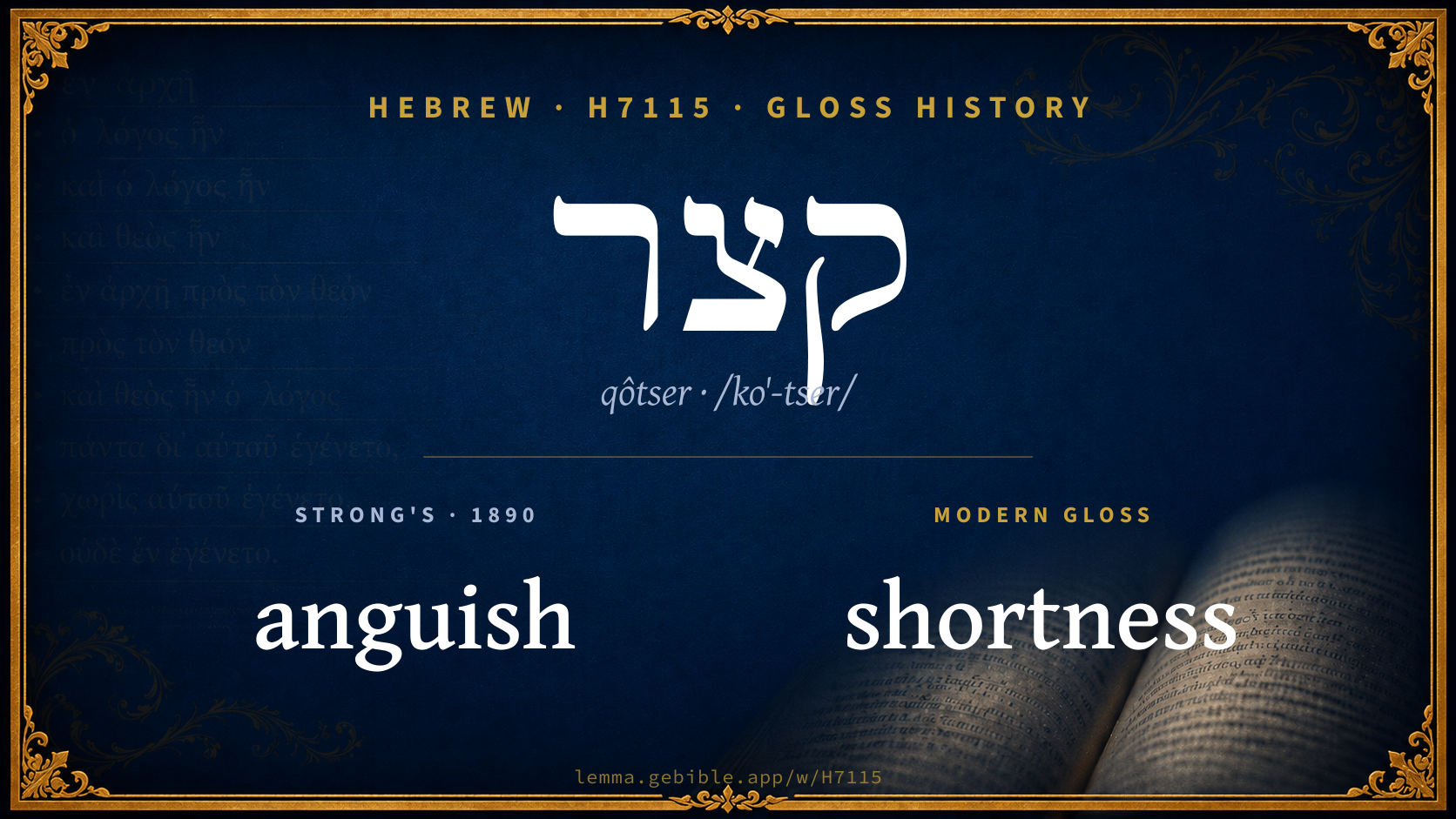
Gloss history
Strong's 1890 vs modern scholarship
About this word
Strong's H7115 catalogs a Hebrew word from the Hebrew Old Testament.
These counts are not copied from any lexicon or concordance. They are computed here, from the morphology-tagged Hebrew Old Testament. What Lemma adds →
- 1
- distinct verses
- The word appears in 1 distinct verse.
- 1 / 39
- OT books
- The word appears in 1 of 39 Old Testament books.
- #6,101
- by frequency
- Rank #6,101 (rank 6,101 of 8,640 Hebrew words by occurrence).
View all 1 occurrence in the concordance →
Most concentrated in
- Exodus 1 verse 100%
By section of the Old Testament
By traditional corpus
Conventional, traditional groupings — biblical authorship is debated, so this is a traditional corpus grouping, not an authorship claim. Each share is this word’s portion of its verses in that division of the Hebrew canon. Each figure is a share of the word’s 1 distinct verse.
- Torah (Pentateuch) 1 verse · 100%
How translations render this word
Counts come from each version’s own published word-to-Strong’s tagging or interlinear alignment — an approximate guide to how each version renders this word, not a word-level alignment the data otherwise carries. Because each total is that version’s own tagged count, the per-version totals vary from one another and need not match the appearance or distinct-verse counts above. These counts may also differ from a printed concordance because Lemma counts each distinctly tagged rendering and does not collapse phrase taggings into a single head-word total. This is a fixed set of word-tagged versions (KJV, ASV, BSB, ULT) and does not change with the reading translation you choose elsewhere. Each version’s license is shown beside its name below (and on Sources).
- King James Version: Anguish 1×
- American Standard Version: Anguish 1×
- Berean Standard Bible: Account of their broken 1×
- unfoldingWord Literal Text: Shortness of 1×
King James Version Public Domain
Renders H7115 across 1 tagged occurrence — most commonly:
American Standard Version Public Domain
Renders H7115 across 1 tagged occurrence — most commonly:
Berean Standard Bible Public Domain
Renders H7115 across 1 tagged occurrence — most commonly:
unfoldingWord Literal Text CC BY-SA 4.0
Renders H7115 across 1 tagged occurrence — most commonly:
Senses in BDB
The 1 sense BDB distinguishes for this word, in lexicon order (not ranked by frequency or importance). The full entry — with sub-senses — is in the Lexicon Entry tab.
- shortness, impatience, anguish
Word origin
קֹ֫צֶר n.[m.] shortness;—cstr. Ex 6:9 (P) = impatience.
— Brown-Driver-Briggs (Oxford 1906, public domain), digitized via Sefaria, supplemented by the OpenScriptures HebrewLexicon (CC BY 4.0). See Sources.
Derived from קצר (qâtsar) (H7114) — to be short.
Jastrow Dictionary
A second Hebrew/Aramaic lexicon for comparison, covering Aramaic and post-biblical (Talmudic, Targumic, Midrashic) usage that the biblical-Hebrew BDB does not. Matched by lemma rather than by Strong’s number, so a lemma may carry more than one Jastrow headword (shown separately below), and the entries cover usage well beyond the Bible.
קָצַר
- (b. h.)
- 1. to cut, reap. Sabb. VII, 2 (among the labors forbidden on the Sabbath) הקוֹצֵר cutting plants. Ib. 73ᵇ משום קוצר as an act coming under the category of reaping. Pes. IV, 8 קוֹצְרִין וגודשין וכ׳ they reaped (the barley) and piled it before the ʿOmer was offered. Peah II, 7 שדה שקְצָרוּהָ וכ׳ a field which gentiles reaped (for themselves) or which robbers reaped. Ib. 8 נותן … שק׳ he must give up the poor man’s share from what he reaped. Ib. III, 6 כדי לִקְצוֹר ולשנות large enough for cutting (swinging the sickle) once and a second time; a. fr.
- 2. to be short, v. קָצֵר.
- 3. (with נפש) to be impatient, vexed; to be sick of. Gen. R. s. 52 אבל היא לא קָצְרָה נפשה וכ׳ but she was not vexed (did not suffer from unsatisfied desire) &c.; Y. Keth. V, 30ᵇ; Yalk. Jud. 70. Tanḥ. Ḥuck. 19 קצרה נפשם בדרך they were sick of marching.
- to shorten, be brief in doing. Ber. I, 4 מקום … לקַצֵּר וכ׳ where they prescribed a lengthy benediction, one is not permitted to shorten, where they prescribed a short formula &c. Y. Yoma VI, beg. 43ᵇ שלא יהא … קַצֵּר (ב)דבריך not that one of the contestants be permitted to speak as long as he needs, and the other be told, make thy speech brief; Y. Snh. III, 21ᶜ top. Ber. 34ᵃ היה מְקַצֵּר וכ׳ gave a very brief prayer. Mekh. B’shall., Vayassʿa, s. 1 ק׳ (ב)ברכותיו gave short benedictions (prayers); לא ק׳ … ממשה he was not briefer than Moses (in his prayer, Num. XII, 13). Ib. יש שעה לְקַצֵּר וכ׳ there is a time to be brief &c.; a. fr. e.g. Numbers 12:13
- 1. to be shortened. Lev. R. s. 21 היו … מִתְקַצְּרוֹת their years (of life) were shortened.
- 2. (with נפש) to be impatient, sick. Tanḥ. l. c. נִתְקַצְּרָה נפש העם בדרך (not נתקצר), v. supra.
קְצַר
- 1. to be short. Targ. Ps. CII, 24 קְצָרוּן Ms. (ed. איתקצרון).
- 2. to shorten, v. infra., v. infra.
- 3. (v. קְצִירָא) to be sick. B. Kam. 91ᵃ למימד גברא כמה מיקצר … לא מִקְצַר וכ׳ Ms. M. (ed. כמה לִיקְצַר) as to estimating how long a person is likely to suffer from such a wound and how long he will not, i.e. as to estimating positively the time needed for recovery, I have no doubt that we can do it.
- to shorten. Targ. Ps. LXXXIX, 46 Ms. (ed. קְ׳, Pe.).
- to be shortened, reduced. Targ. II Kings XIX, 26; Targ. Is. XXXVII, 27. Ib. XXVIII, 20. Targ. Y. Gen. XXVIII, 10; a. e.
קָצֵר
- (b. h.) short. Ab. II, 15 היום ק׳ וכ׳ the day (of life) is short, and the work large. Y. Pes. VII, 35ᵇ bot. ילך לו בק׳ let him take the shortest road to it; a. fr.—Fem. קְצָרָה. Mekh. B’shall., Vayassʿa, s. 1 תפילת הצדיקים ק׳ the prayer of the pious is short. Ber. I, 4 אחת … ואחת ק׳ one lengthy and one short benediction. Ib. IV, 2 היה … תפלה ק׳ used to say a short prayer on entering and on leaving the school-house. Ib. 4. Y. Hor. II, 46ᵈ top בא לו … בק׳ if he came by the shortest road; a. fr.—Midr. Till. to Ps. LIII ע"י שהיתה ידו ק׳ במצות because his hand was short (he was wanting) in good deeds; Yalk. ib. 769; Yalk. Sam. 135 נפשו ק׳; a. fr.—Pl. קְצָרִים; קְצָרוֹת. Cant. R. to VI, 2 ארוכות וק׳, v. אָרוּךְ. Midr. Till. to Ps. LXVIII, ולא היו קִצְרֵי יד בו they were not short-handed with it, i.e. they did not have to economize. Midr. Till. to Ps. CXIX, 81 אתה ארך אפים ואנו קְצֵירֵי רוח thou art long-suffering, but we are hasty of spirit; a. e.—V. קְצָרָה.
קַצָּר
- (preced. wds.) [one who causes shrinking,] fuller, washer. Targ. Josh. XV, 7, a. e. עין ק׳ (h. text עֵין רֹגֵל) the washer’s well.—Y. Ber. IV, 7ᵈ top (Bab. ib. 28ᵃ כובס); a. fr.—B. Kam. 119ᵇ ק׳ שמיה וק׳ שקיל ליה a fuller is named ḳatsra (a shortener), let the ḳatsra take it (the dark border of a white cloth belongs to the fuller).—Pl. קַצְרַיָּא, קַצְרֵי. Targ. I Sam. XIII, 21. Targ. Is. VII, 3 (ed. Wil. קציר׳, corr. acc.).—Snh. 92ᵃ, a. e., v. אוּבְלָא II. Taan. 29ᵇ בטלי ק׳ דבי רב the fullers of the house of Rab are idle (during the week preceding the ninth of Ab); a. e.
A Dictionary of the Targumim, the Talmud Babli and Yerushalmi, and the Midrashic Literature (Marcus Jastrow; London, Luzac, 1903) — Public Domain. Digitized via Sefaria. Digitized via Sefaria. Full attribution on Sources.
Same root — word family
Other BDB entries built from the same root as H7115, grouped by Strong’s listed origin. These share a root / origin per the lexicon — not necessarily a shared meaning. Each links to that word’s own entry.
Derives from
Shares the same root
Compare all same-root words → They share a root, not necessarily a meaning.
Septuagint verse parallels
This word appears in 1 verse that also exists in the Greek Old Testament (Septuagint), out of the 1 Hebrew verse it occurs in. You can read those verses in Greek by switching the Old Testament edition to the Septuagint.
Read these verses in the Septuagint
This is a verse-level parallel only — the same verses exist in both the Hebrew and Greek Old Testaments. No word-level Hebrew↔Greek correspondence is claimed: the data carries no such alignment, so no Greek word is shown as this Hebrew word’s translation. Coverage is not total — the Septuagint omits the deuterocanon and renumbers the Psalms, so some Hebrew verses have no direct Greek parallel.