
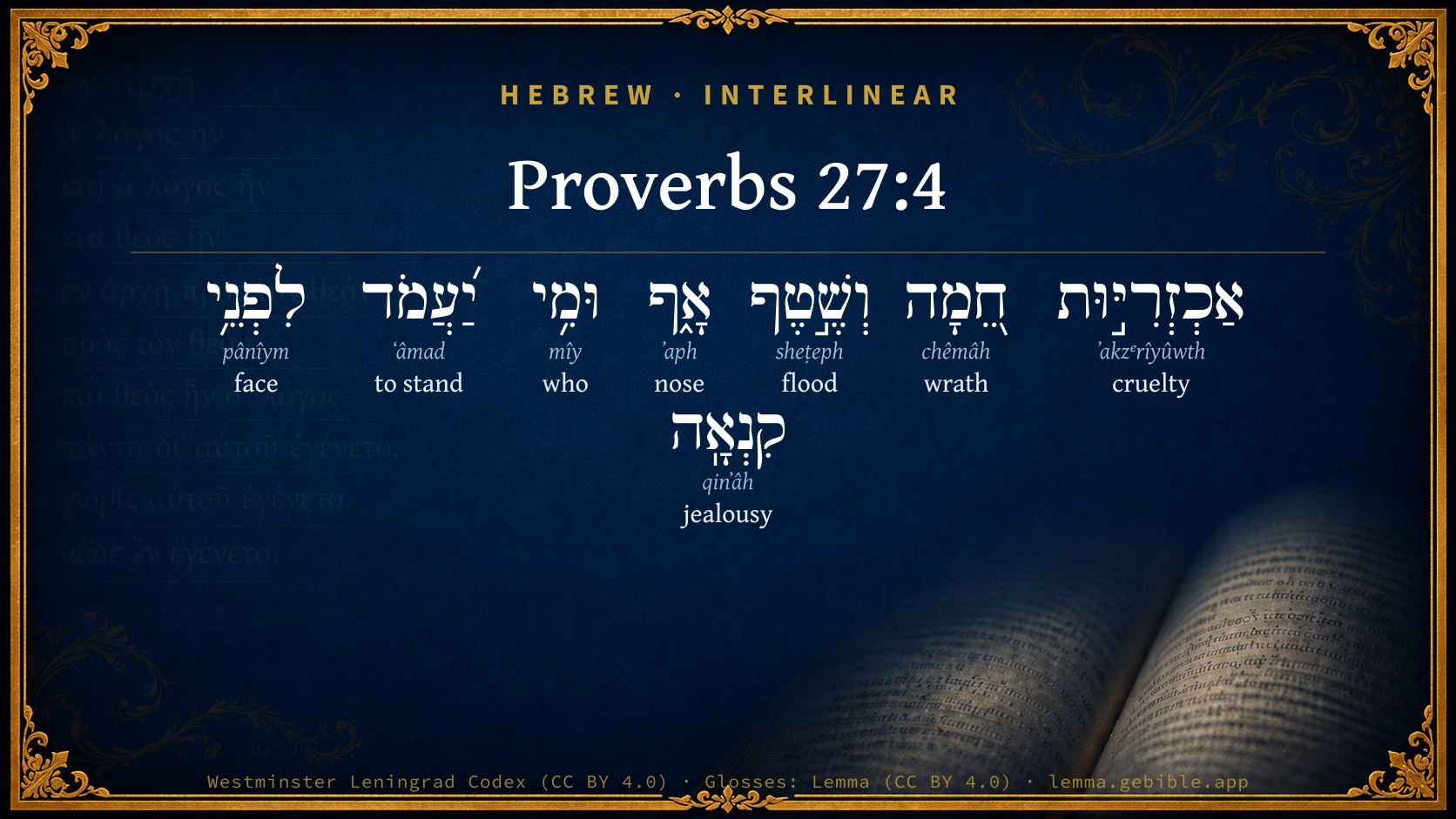
Proverbs 27:4

Hebrew (Westminster Leningrad Codex) Proverbs 27:4 appears in the Hebrew Old Testament. The text above is from the Westminster Leningrad Codex. Each word links to its Strong’s number, a concise gloss, and parsing drawn from the Open Scriptures Hebrew Bible morphology. Click any word for its full Brown-Driver-Briggs (BDB) entry.
Download image
Cite this verse

Proverbs 27:4 (World English Bible). Public Domain. Lemma interlinear Bible study tool, https://lemma.gebible.app/v/proverbs/27/4.

Show BibTeX & RIS
BibTeX
RIS
English Translation
Wrath is cruel, And anger is overwhelming; But who is able to stand before jealousy?
World English Bible · Public Domain
Highlights
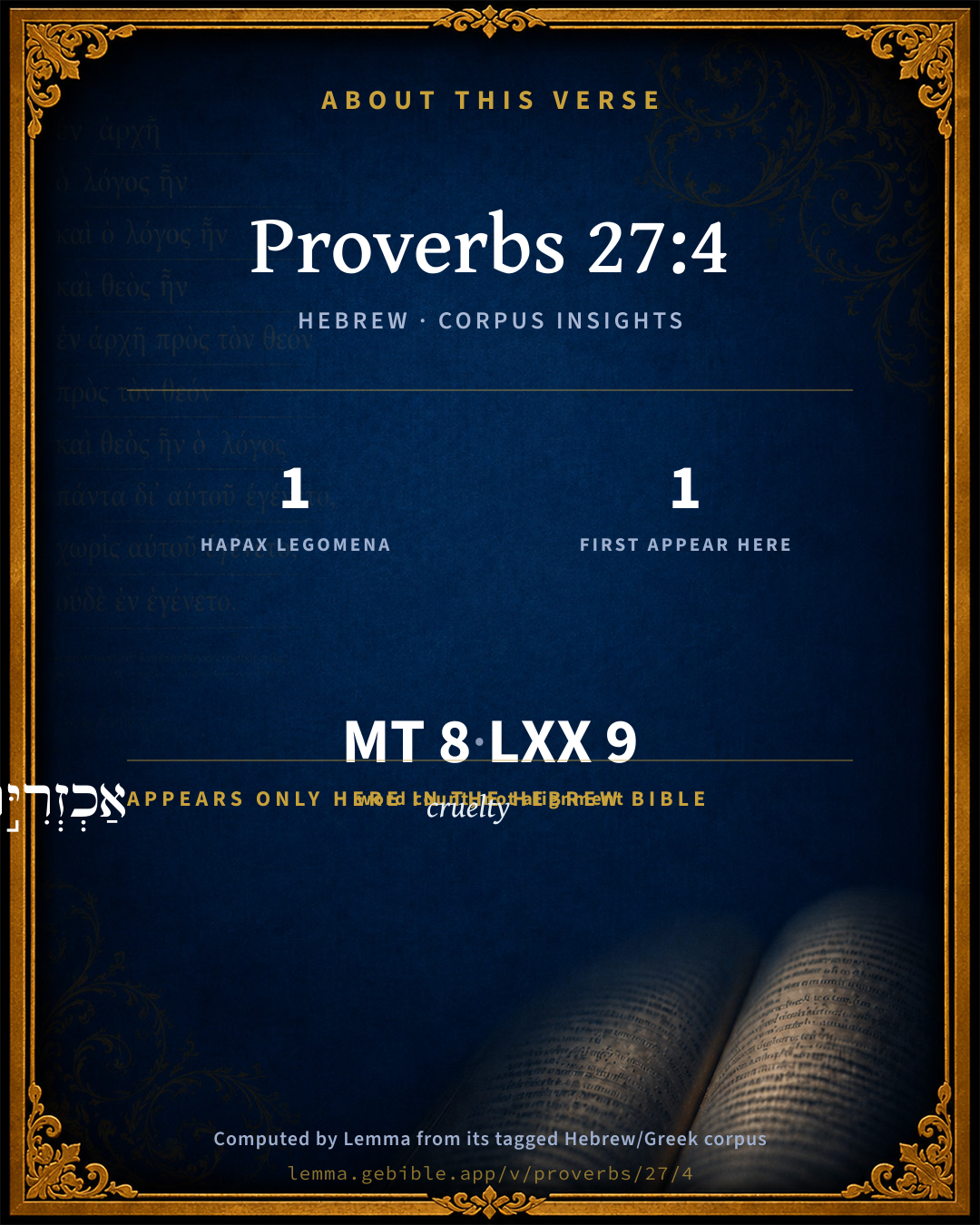
  • 1 hapax legomenon — only here in the Hebrew Bible
  • 1 first appearance in the Hebrew Bible
Full analysis ↓
Download a study sheet

One document with this verse’s original text, its word-by-word gloss line, the meaning frame, cross-references with their text, attributed commentary, and full source and license credits — printable, and it pastes into notes with its structure intact.

This verse Autodidact and up

Study sheet (.html) Plain text (.txt)

A passage Seminary Student

Up to 50 verses in one chapter. A passage sheet keeps up to 6 commentary sources and 12 cross-references per verse, in the order this page ranks them, and says so on the sheet whenever that leaves anything out. Ask for a single verse and you get the Autodidact verse sheet above.

Everything on this page stays free to read, with no account — the sheet is a download of what is already on screen, not access to it.

Want to remove ads? Support Godless Engineer
Compare translations 3

The same verse in 3 English versions, stacked beneath the original-language interlinear above. Click any original word for its lexicon entry.

Each is an independent rendering of the whole verse — the interlinear is not word-aligned to these translations.

Highlighted words mark where these versions differ — a whole-verse word diff, not a word-by-word alignment.

  • World English Bible Public Domain
    Wrath is cruel, And anger is overwhelming; But who is able to stand before jealousy?
  • King James Version Public Domain
    Wrath is cruel, and anger is outrageous; but who is able to stand before envy?
  • unfoldingWord Literal Text CC BY-SA 4.0
    Cruelty of heat and a flood of nose, but who can stand to the face of jealousy?

unfoldingWord Literal Text — © unfoldingWord, licensed CC BY-SA 4.0. Word-aligned USFM3 via Door43 (git.door43.org/unfoldingWord/en_ult).

Versions to compare (up to 4)

3 of 4 selected

Show all 18 translations

Every available English version of this verse, each an independent rendering of the whole verse.

  • World English Bible Public Domain
    Wrath is cruel, And anger is overwhelming; But who is able to stand before jealousy?
  • Berean Standard Bible Public Domain
    Wrath is cruel and anger is like a flood, but who can withstand jealousy?
  • Majority Standard Bible Public Domain
    Wrath is cruel and anger is like a flood, but who can withstand jealousy?
  • King James Version Public Domain
    Wrath is cruel, and anger is outrageous; but who is able to stand before envy?
  • American Standard Version (1901) Public Domain
    Wrath is cruel, and anger is overwhelming; But who is able to stand before jealousy?
  • Revised Version (1885) Public Domain
    Wrath is cruel, and anger is outrageous; but who is able to stand before jealousy?
  • Geneva Bible (1599) Public Domain
    Anger is cruell, and wrath is raging: but who can stand before enuie?
  • Douay-Rheims (1899) Public Domain
    Anger hath no mercy, nor fury when it breaketh forth: and who can bear the violence of one provoked?
  • Young's Literal Translation Public Domain
    Fury `is' fierce, and anger `is' overflowing, And who standeth before jealousy?
  • Literal Standard Version CC BY-SA 4.0
    Fury [is] fierce, and anger [is] overflowing, || And who stands before jealousy?
  • Unlocked Literal Bible CC BY-SA 4.0
    There is the cruelty of rage and the flood of anger, but who is able to stand before jealousy?
  • unfoldingWord Literal Text CC BY-SA 4.0
    Cruelty of heat and a flood of nose, but who can stand to the face of jealousy?
  • Darby Bible Public Domain
    Fury is cruel, and anger is outrageous; but who is able to stand before jealousy?
  • World Messianic Bible Public Domain
    Wrath is cruel, and anger is overwhelming; but who is able to stand before jealousy?
  • Webster's Bible Public Domain
    Wrath is cruel, and anger is outrageous; but who is able to stand before envy?
  • Free Bible Version CC BY-SA 4.0
    Fury may be fierce and cruel, anger may be a destructive flood, but who can withstand jealousy?
  • Bible in Basic English Public Domain
    Wrath is cruel, and angry feeling an overflowing stream; but who does not give way before envy?
  • JPS Tanakh (1917) Public Domain
    Wrath is cruel, and anger is overwhelming; but who is able to stand before jealousy?

Literal Standard Version (2020), Covenant Press — licensed CC BY-SA 4.0. Text via the HelloAO Bible API (eBible.org). Unlocked Literal Bible (unfoldingWord) — licensed CC BY-SA 4.0. Text via the HelloAO Bible API (eBible.org). unfoldingWord Literal Text — © unfoldingWord, licensed CC BY-SA 4.0. Word-aligned USFM3 via Door43 (git.door43.org/unfoldingWord/en_ult). Free Bible Version, Dr. Jonathan Gallagher — licensed CC BY-SA 4.0. Text via the HelloAO Bible API (eBible.org).

Word by word

More ways to search: Search by grammar → Find every occurrence → Compare this word →

Practice this passage: Drill this verse → Learn its vocabulary →

About this verse

These counts appear in no published source. They are computed here, from the morphology-tagged text and Lemma’s own curated glosses. What Lemma adds →

8
words
8
distinct lemmas
Wisdom
section

Notable vocabulary

1 hapax legomenon — a word that appears only here in the entire Hebrew Bible:

  • אַכְזְרִיּ֣וּת cruelty H395

First appearance in Scripture

This word makes its first canonical appearance in the Hebrew Bible here:

  • אַכְזְרִיּ֣וּת cruelty H395

Shared distinctive vocabulary

וְשֶׁ֣טֶף flood H7858 occurs in 6 verses of the Hebrew Bible. Also found in:

Grammatical profile

  • 1 verb
  • 6 nouns
  • 1 particle

Verb forms

  • יַ֝עֲמֹד Qal · Imperfect

Hebrew & Septuagint length

In English translation the verse runs 15 words from the Hebrew and 11 from the Septuagint (LXX English) — closely comparable.

A rough comparison of the two English renderings, which tokenize alike — not a word-level alignment.

Word counts can differ between the Hebrew and the Greek without any difference in meaning — e.g. the Hebrew direct-object marker אֵת has no separate Greek word, and Greek often adds the article ὁ.

In the original languages it is 8 Hebrew tokens and 9 Greek tokens — but the two are counted differently (Hebrew bundles its prefixes and suffixes into one token; the Greek is in lemma form), so that isn’t a like-for-like length.

Cross-references

15

Topical passages linked to Proverbs 27:4 in the Treasury of Scripture Knowledge — connected by theme and wording, ordered by reader-vote popularity; previews shown in the World English Bible.

  • Proverbs 6:34 For jealousy arouses the fury of the husband. He won't spare in the day of vengeance.
  • Proverbs 14:30 The life of the body is a heart at peace, But envy rots the bones.
  • James 3:14–16 But if you have bitter jealousy and selfish ambition in your heart, don't boast and don't lie against the truth.
  • Job 5:2 For resentment kills the foolish man, And jealousy kills the simple.
  • Matthew 27:18 For he knew that because of envy they had delivered him up.
  • Acts 7:9 "The patriarchs, moved with jealousy against Joseph, sold him into Egypt. God was with him,
  • 1 John 3:12 unlike Cain, who was of the evil one, and killed his brother. Why did he kill him? Because his works were evil, and his brother's righteous.
  • Genesis 26:14 He had possessions of flocks, possessions of herds, and a great household. The Philistines envied him.
  • Genesis 37:11 His brothers envied him; but his father kept this saying in mind.
  • Song of Solomon 8:6 Set me as a seal on your heart, As a seal on your arm; For love is strong as death. Jealousy is as cruel as Sheol; Its flashes are flashes of fire, A very flame of Yahweh.
  • Acts 17:5 But the unpersuaded Jews took along some wicked men from the marketplace, and gathering a crowd, set the city in an uproar. Assaulting the house of Jason, they sought to bring them out to the people.
  • James 4:5–6 Or do you think that the Scripture says in vain, "The Spirit who lives in us yearns jealously"?
  • Acts 5:17 But the high priest rose up, and all those who were with him (which is the sect of the Sadducees), and they were filled with jealousy,
  • Romans 1:29 being filled with all unrighteousness, sexual immorality, wickedness, covetousness, maliciousness; full of envy, murder, strife, deceit, evil habits, secret slanderers,
  • James 1:19–21 So, then, my beloved brothers, let every man be swift to hear, slow to speak, and slow to anger;

Cross-references courtesy of OpenBible.info (CC BY 4.0).

Hebrew and Greek witnesses Masoretic Hebrew ↔ Greek Septuagint

The same verse in the two great witnesses to the Old Testament, shown verse-for-verse.

These are two independent witnesses, not word-aligned to each other, and the Septuagint is shown in lemma (dictionary) form.

Hebrew Proverbs 27:4 Masoretic · Westminster Leningrad Codex

אַכְזְרִיּ֣וּת חֵ֭מָה וְשֶׁ֣טֶף אָ֑ף וּמִ֥י יַ֝עֲמֹד לִפְנֵ֥י קִנְאָֽה

Wrath is cruel, And anger is overwhelming; But who is able to stand before jealousy?

World English Bible · Public Domain

Greek LXX Proverbs 27:4 Septuagint · lemma form

ἀνελεήμων θυμός καί ὀξύς ὀργή ἀλλά οὐδείς ὑποἵστημι ζῆλος

Wrath is merciless, and anger sharp: but envy can bear nothing.

LXX2012 (modern English Septuagint) · Public Domain

On this verse, Haydock's Catholic Bible Commentary discusses the Septuagint’s reading. Read the note in Commentary ↓

Hebrew: Westminster Leningrad Codex (CC BY 4.0). Greek: Septuagint (public domain); English from LXX2012 (modern English Septuagint) (Public Domain). How the Septuagint differs from the Hebrew →

Commentary

Notes on Proverbs 27:4 from classic Christian and Jewish commentators (each source and its license shown beneath its notes). The classic Christian expositions comment on the surrounding passage and are grouped to its opening verse, so a note may address several verses; the Jewish commentaries on the Tanakh (Rashi and others) are per-verse, so they appear only where the commentator wrote on this verse.

Lemma curates 59 commentaries, every one of them public domain or Creative Commons licensed, each selected and text-cleaned for this edition rather than reprinted as found. About our sources →

Trapp's Complete Commentary

John Trapp

Pro 27:4 Wrath [is] cruel, and anger [is] outrageous; but who [is] able to stand before envy?

Ver. 4. Wrath is cruel, and anger is outrageous.] Or, Overflowing all the banks, or carrying all before it as an impetuous land flood, and therefore most intolerable, as Pro 27:3; but behold a worse matter: Envy is an evil that none can stand before for it knows neither end nor measure, as appears in the devil and his patriarch Cain; in Saul, the Pharisees, those spiteful Jews, Act 13:45. And to this day they do antiquum obtinere, bear the old grudge to us Christians, cursing us in their daily prayers, calling us bastard Gentiles, professing that if their Messiah were come, rather than we should have any part in him, or benefit by him, they would crucify him a hundred times over. They have a saying among them, Optimus qui inter gentes est dignus cui caput conteratur tanquam serpenti; The best of us Gentiles is worthy of the serpent’s punishment, viz., to have his head bruised, &c., so great is their envy still against Christians, who pity them and pray for them; and truly it is no more than need, since by the question here propounded we may easily guess how potent this quick sighted and sharp fanged malignity, envy, is; indeed the venom of all vices is found in it; neither will it be drawn to embrace that good which it envies to another, as too good for him. {Act 13:44-45}

John Trapp, A Commentary or Exposition upon All the Books of the Old and New Testament (1647–1656) — public domain. Text from a community e-Sword module.

The Biblical Illustrator

Joseph S. Exell

Pro_27:4

Wrath is cruel, and anger is outrageous; but who is able to stand before envy?

Anger and envy

I. The evil principles indicated in the text are extensively and dangerously prevalent. To be irritated and out of temper is one of the common tendencies of our nature, manifested even in childhood. The root is wrath, anger. This pernicious root grows differently in different natures, and with more or less vigour. This vicious principle is generally regarded too complacently, as though it were a necessary part of our nature. Wrath is dangerous. Its tendency is to increase. The spark will rise into a flame. The intensity of anger depends upon external circumstances, and also upon the condition of our health. The external exciting causes are continually changing. The foolish vice of irritating the temper of others is too common. Some like to torment the susceptible. Others are perpetually fault-finding and sneering. Envy is the condition of one who looks upon the happiness of another and longs to possess it. Envy generally seeks to conceal itself, and to work in secret and in darkness. Passion would strike down its victim in the public market-place, whilst envy would carefully weigh out and mix the poison for its victim to consume unconsciously in his food. This dangerous and deadly principle has extensive existence. Envy is the development of germs which are universally diffused. Then search into the very depths of your nature after the most minute germs of this evil.

II. Wherein Lies our safety against the growth and development of these principles? There may be lurking in our nature forces which need to be held in check by a stronger power than mere intellectual culture. Our higher civilisation too often only gilds crime, and throws its mantle over it. A formal profession of religion may cover the vilest lusts of humanity. There is a higher power. Christianity offers a Divine power by which the evil nature may be purified and every evil passion brought into subjection. Our safety, our only safety, lies in the renewal and sanctification of our nature by the Holy Ghost. Separated from the conscious presence of Christ, and destitute of His renewing grace and protecting providence, who can tell into what mischief we may fall! (Robert Ann.)

The sin of envy

The envious man is far blacker than the passionate man; for the outrageous behaviour of an angry person sounds an alarm to his neighbour to be on his guard, but the envious man conceals his malignity till he has a fit opportunity to strike a mortal blow without danger of missing his aim. The one is a dog, that barks before he bites, the other is an adder in the grass, that stings the traveller when he is dreading no hurt; for the malice of the envious man is generally unsuspected, because no occasion was given for it. It is the good and happiness of the envied object that excited his malignity, and he does not so much as pretend that he has received any provocation. (George Lawson, D.D.)

The nature and mischief of envy

The wise man compares envy with two very exorbitant commotions of mans mind, wrath and anger. Worse than these, more unkind and uncharitable, more unjust, violent and mischievous, is envy. There is neither any goodness, nor yet any strength, that is a sufficient guard against it.

1. There is no mans innocency, no mans virtue, that can secure him from the direful strokes of envy. Sometimes a mans goodness actually inflames the hearts of the envious. See case of Cain and Abel; of Esau; of the brethren of Joseph; of Saul, etc. The greatest instance of all is the envy of Scribes and Pharisees against our Saviour.

2. There is no man so great and powerful, or of so secure an estate or fortune, but the violence of envy hath been capable of overthrowing him. Illustrate case of Abner.

I. A just description of envy. It is a displeasure or trouble arising in a mans mind from the sight or knowledge of another mans prosperity, and causing a man to hate such person, and try to ruin him. It commonly arises on the sight of the prosperity of inferiors or equals. Men envy that to others which they think themselves as well or better to deserve. They seldom envy things or persons that are much above them. Distinguish envy from emulation. Illustrate by these two qualities in Saul and Jonathan, on the occasion of Davids killing Goliath. Emulation is a great and noble virtue, envy a poor and sneaking vice. It is always hiding itself. No man will own himself to be envious. He disguises it under a mighty pretended zeal for the truth; or a great love for the public welfare; or a charitable concern for the credit of his neighbour. How few men are wholly free from this vice.

II. The mischievous effects produced by envy. See these, that we may be more set against it; that we may avoid it ourselves; that we may beware of it in others; that we may use our utmost endeavours to quench this flame. Disturbances in the state, schism in the Church, and trouble in a neighbourhood, or in a private family, are generally traceable to envy. To what end is all this evil done by envious men? What do they get by it? Envy is its own punishment. No man can find a greater torment for an envious man than he inflicts upon himself. Even if it succeeds in pulling down a man, it very rarely gets into his place. How is it that God endures, and seems to leave alone, these mischief-making, envious men? They are agents in doing His disciplinary work in His people. It makes men self-watchful. The envious quickly light upon and show up faults that we might have passed over. The envious calumniate failings, not virtues. Remedies are--

1. A right apprehension of the things of this world.

2. A due submission to the will of God.

3. A true humility.

4. A Christian charity.

This last plucks it up by the very roots; and plants in our hearts what is most contrary thereto. (Jonathan Blagrave, D.D.)

The Biblical Illustrator, edited by Joseph S. Exell (c. 1880s–1900s) — public domain. Text from a community e-Sword module.

Joseph Benson's Commentary

Pro 27:4. Wrath is cruel — And doth many barbarous things; and anger is outrageous — Often depriving a man of the proper use of his reason, and hurrying him into many mischiefs and miseries; but who is able to stand before envy? — Envy is worse than both of them, 1st, Because it is more unjust and unreasonable, as not being caused by any provocation, as wrath and anger are; but proceeding from mere malignity of mind, whereby a man is grieved for another man’s happiness, in which he ought to rejoice; 2d, Because it is more deeply rooted and implacable, whereas the other passions are commonly allayed; and, 3d, Because it is more secret and undiscernible, and therefore the mischievous effects of it are hardly avoidable, whereas wrath and anger discover themselves, and so forewarn and forearm a man against danger.

Joseph Benson's Commentary on the Old and New Testaments (1811–1818) — public domain. Text from a community e-Sword module.

Tyndale Open Study Notes

Tyndale Open Resources

27:4 Anger can be dangerous but can be countered with a gentle answer (15:1). Jealousy is harder to resolve (6:34-35).

Tyndale Open Study Notes — © Tyndale Open Resources, licensed CC BY-SA 4.0. Text via the HelloAO Bible API.

Geneva Bible (1599)

Geneva Bible translators

For the envious are obstinate, and cannot be reconciled.

Geneva Bible (1599) marginal notes — public domain. Text via Bolls.life.

Jamieson, Fausset & Brown

Robert Jamieson, A. R. Fausset & David Brown

envy--or, "jealousy" (compare Margin; Pro 6:34), is more unappeasable than the simpler bad passions.

Jamieson, Fausset & Brown — Commentary Critical and Explanatory on the Whole Bible (1871) — public domain (CC PDM 1.0). Text via the HelloAO Bible API.

Adam Clarke's Commentary

Verse 4. Who is able to stand before envy?] The rabbins have a curious story on this subject, and it has been formed by the moderns into a fable. There were two persons, one covetous and the other envious, to whom a certain person promised to grant whatever they should ask; but double to him who should ask last. The covetous man would not ask first, because he wished to get the double portion, and the envious man would not make the first request because he could not bear the thoughts of thus benefiting his neighbour. However, at last he requested that one of his eyes should be taken out, in order that his neighbour might lose both.

Adam Clarke's Commentary on the Bible (1810–1826) — public domain. Text from a community e-Sword/MySword module.

Ellicott's Commentary for English Readers

(4) But who is able to stand before envy?—Rather, jealousy. (Comp. Pro_6:34.) “Wrath” and “anger” rage for awhile like a storm, and then subside; but jealousy can never be completely set at rest.

A Bible Commentary for English Readers, edited by Charles John Ellicott (1878–1897) — public domain. Text from a community e-Sword module.

The Cambridge Bible for Schools and Colleges

gen. ed. J. J. S. Perowne

4. envy] Rather, jealousy. Comp. Pro_6:34.

The Cambridge Bible for Schools and Colleges (gen. ed. J. J. S. Perowne; Cambridge University Press, 1878–1918) — public domain. Text from a community e-Sword module.

John Gill's Exposition

Wrath is cruel, and anger is outrageous,.... Or "an inundation" (x); it is like the breaking in of the sea, or a flood of mighty waters, which know no bounds, and there is no stopping them: so cruel and outrageous were the wrath and anger of Simeon and Levi, in destroying the Shechemites; of Pharaoh, in making the Israelites to serve with hard bondage, and ordering their male children to be killed and drowned; and of Herod, in murdering the infants in and about Bethlehem;

but who is able to stand before envy? which is secret in a man's heart, and privately contrives and works the ruin of another, and against which there no guarding. All mankind in Adam fell before the envy of Satan; for it was through the envy of the devil that sin and death came into the world, in the Apocrypha:

"Nevertheless through envy of the devil came death into the world: and they that do hold of his side do find it.'' (Wisdom 2:24)

Abel could not stand before the envy of Cain; nor Joseph before the envy of his brethren; nor Christ before the envy of the Jews, his bitter enemies; and, where it is, there is confusion and every evil work, Jam 3:14. An envious man is worse than an angry and wrathful man; his wrath and anger may be soon over, or there may be ways and means of appeasing him; but envy continues and abides, and works insensibly.

(x) "inundatio", Michaelis, so Montanus, Vatablus, Tigurine version, "exundatio", Junius & Tremellius, Piscator; "inundatio salcans", Schultens.

John Gill's Exposition of the Whole Bible (1746–1763) — public domain (CC PDM 1.0). Text via the HelloAO Bible API.

Albert Barnes' Notes on the Bible

Envy - Better, as in the margin, the violence of passion in the husband who thinks himself wronged (compare Pro 6:34).

Albert Barnes' Notes on the Bible (1834–1885) — public domain. Text from a community e-Sword/MySword module.

Haydock's Catholic Bible Commentary

And who. Septuagint, "but envy (zeal) beareth nothing." The more we yield to the envious, the more he is offended at our good behaviour.

George Leo Haydock (1774–1849), Haydock's Catholic Family Bible and Commentary, 1859 edition — public domain. Excludes Psalms (Douay-Rheims chapter numbering differs from Protestant) and Deuterocanonical books (Catholic canon only).

Matthew Poole's English Annotations

Envy is worse than both of them, partly, because it is more unjust and unreasonable, as not caused by any provocation, as wrath and anger are, but only proceeding from a malignity of mind, whereby a man is grieved for another man’s happiness, in which he should rejoice; partly, because it is more deeply rooted and implacable, whereas the other passions are commonly allayed; and partly, because it is more secret and undiscernible, and therefore the mischievous effects of it are hardly avoidable; whereas wrath and anger discover themselves, and so forewarn and forearm a man against the danger.

Matthew Poole's English Annotations on the Holy Bible (1683–1685) — public domain. Text from a community e-Sword/MySword module.

Whedon's Commentary on the Bible

Daniel D. Whedon

4. Anger is outrageous — Impetuous; an outpouring like a rushing torrent.

Envy — קנאה, (kinah,) mostly rendered jealousy in our Version, but sometimes “envy.” The critics generally give the preference to jealousy here. By some, envy and jealousy are considered the same passion with different objects. Compare Pro_6:34-35.

Daniel D. Whedon (gen. ed.), Commentary on the Old and New Testaments (1874–1909) — public domain. Text from a community e-Sword module.

The Pulpit Commentary

Wrath is cruel, and anger is outrageous. Again substantives are used, as in ver. 3, "Cruelty of wrath, and overflowing of anger." Figure to yourself the fierceness and cruelty of a sudden excitement of anger, or the bursting forth of passion which, like a flood, carries all before it; these may be violent for a time, yet they will subside when they have spent themselves. But who is able to stand before envy? or rather, jealousy. The reference is not so much to the general feeling of envy as to the outraged love in the relation of husband and wife. (see Pro_6:34, and note there) Son_8:6, "Love is strong as death; jealousy is cruel as the grave: the flashes thereof are flashes of fire, a very vehement flame." Such jealousy does not blaze forth in some sudden outbreak, and then die away; it lives and broods and feeds itself hourly with fresh aliment, and is ready to act at any moment, hesitating at no means to gratify itself, and sacrificing without mercy its victim. Septuagint, "Pitiless is wrath, and sharp is anger; but jealousy (zhlov ) submits to nothing."

The Pulpit Commentary (1880–1919), ed. H.D.M. Spence-Jones & Joseph S. Exell — public domain. Text from a community e-Sword module.

Keil & Delitzsch

C. F. Keil & F. Delitzsch

4 The madness of anger, and the overflowing of wrath -

And before jealousy who keeps his place!

Here also the two pairs of words 4a stand in connection; אכזריּוּת (for which the Cod. Jaman has incorrectly אכזריות) is the connecting form; vid., regarding אכזרי, Pro 5:9. Let one imagine the blind, relentless rage of extreme excitement and irritation, a boiling over of anger like a water-flood, which bears everything down along with it - these paroxysms of wrath do not usually continue long, and it is possible to appease them; but jealousy is a passion that not only rages, but reckons calmly; it incessantly ferments through the mind, and when it breaks forth, he perishes irretrievably who is its object. Fleischer generalizes this idea: "enmity proceeding from hatred, envy, or jealousy, it is difficult or altogether impossible to withstand, since it puts into operation all means, both secretly and openly, to injure the enemy." But after Pro 6:34., cf. Sol 8:8, there is particularly meant the passion of scorned, mortified, deceived love, viz., in the relation of husband and wife.

Keil & Delitzsch — Biblical Commentary on the Old Testament (1861–1891) — public domain (CC PDM 1.0). Text via the HelloAO Bible API. (Old Testament only.)

Rashi

Rabbi Shlomo Yitzchaki (Rashi)

but who can stand up before jealousy Who can stand up before the jealousy of He Who is jealous and vengeful?

Rashi on the Tanakh — English translations: “The Judaica Press complete Tanach with Rashi, translated by A. J. Rosenberg” (CC BY 4.0); “Pentateuch with Rashi's commentary by M. Rosenbaum and A.M. Silbermann, 1929-1934” (public domain); “The Metsudah Tanach series, Lakewood, N.J” (CC BY 4.0); and “The Book of Joshua, Metsudah Publications, 1997” (CC BY 4.0). Text via Sefaria.

Lesson kit

Teaching starters — assembled from the data on this page, not authored interpretation. Every prompt links to the verse data it draws on. Edit before teaching.

Proverbs, in the Wisdom, opens this verse with 8 words (8 distinct Hebrew lemmas). Its most distinctive word is ʼakzᵉrîyûwth (“cruelty”). A historical commentator’s framing appears above. Read the whole chapter for the surrounding context.

Discussion questions

  1. The word ʼakzᵉrîyûwth carries the sense “cruelty.” How does it shape the verse?
  2. This verse holds 1 word here found nowhere else in the Hebrew Bible. What might the rare word draw attention to?
  3. The word “cruelty” first appears here in Scripture. What is being introduced at this debut?
  4. Job 38:25 shares the word «flood» with this verse. How do the two illuminate each other?
  5. These translations render this verse differently. What is at stake in choosing one wording over another?
  6. The verb «יַ֝עֲמֹד» is Qal Imperfect. How does its form color the action?
  7. Reading how Trapp's Complete Commentary and The Biblical Illustrator read this verse, where do the two commentators agree and where do they part?

Things to notice

Reading settings

Reading text

Shown beneath each verse's original-language words.

Old Testament
Old Testament edition

Read the OT as the Masoretic Hebrew (MT) or the Greek Septuagint (LXX).

English shown for the Greek Septuagint (in the Hebrew ↔ Greek comparison).

Comparing translations? Open the Compare panel on any verse page to stack up to four side by side.