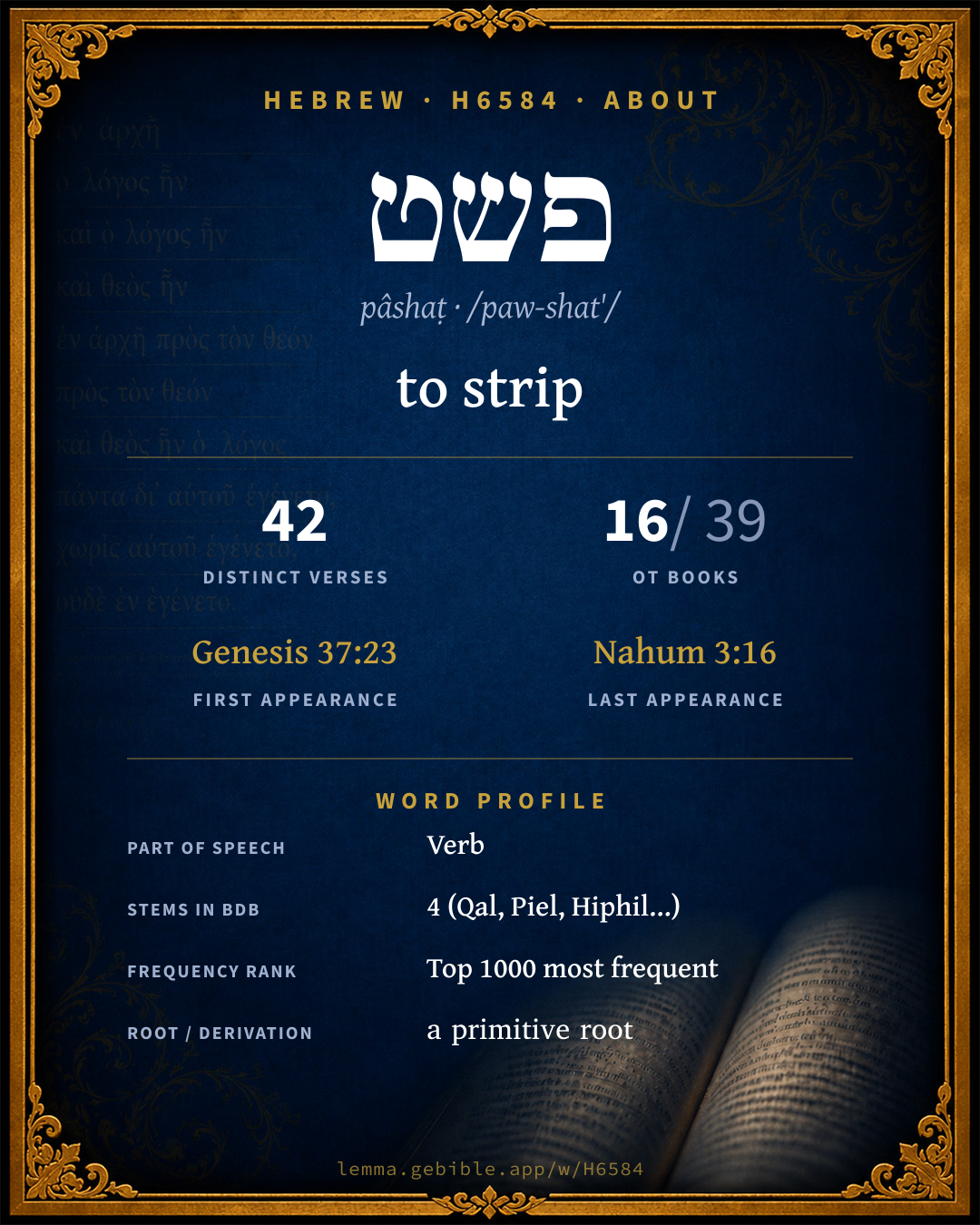
פָּשַׁט
to strip
also: invade, strip off, make a dash, raid fuller range ↓
Full lexicon entry — Brown-Driver-Briggs (BDB)
From Brown-Driver-Briggs (BDB)
Where this word appears
See every Qal verb in the Hebrew Bible →
Grammar key — what these labels mean
Part of speech
- Verb
- An action or state-of-being word.
Stem
- Qal
- The basic, simple active stem — the plain form of the verb (“he wrote”). Here: ‘strip off’
- Piel
- An intensive or resultative active stem.
- Hiphil
- The causative active stem (“he caused / brought about”). Here: ‘strip one of garment’
- Hithpael
- The reflexive or reciprocal stem (the subject acts on itself).
Form
- Sequential Imperfect
- An imperfect with prefixed waw — the standard past-narrative form (waw-consecutive imperfect).
- Perfect
- A completed action or state — Hebrew marks aspect (completeness) more than strict tense (“he wrote”).
- Infinitive Construct
- A bound verbal noun, frequently with prepositions (“to write / in writing”).
- Sequential Perfect
- A perfect with prefixed waw continuing a preceding imperfect or command (waw-consecutive perfect).
- Imperfect
- An incomplete, ongoing, or future action (“he will / would write”).
- Imperative
- A direct command (“write!”).
- Participle Active
- A verbal adjective expressing ongoing or characteristic action (“writing / one who writes”).
State
- Absolute
- The independent form of a noun, not bound to a following word.
Person
- 3rd Person
- The one spoken about (“he / she / it / they”).
- 2nd Person
- The one addressed (“you”).
- 1st Person
- The speaker (“I / we”).
Gender
- Masculine
- Grammatically masculine.
- Common
- Either gender — not distinguished for this form.
- Feminine
- Grammatically feminine.
Number
- Plural
- More than one (in Hebrew, generally three or more).
- Singular
- One.
Grammatical forms 26 distinct
- Verb, Qal, Sequential Imperfect, 3rd Person, Masculine, Plural 6 times (14%)
- Verb, Qal, Perfect, 3rd Person, Common, Plural 5 times (12%)
- Verb, Piel, Infinitive Construct 3 times (7%)
- Verb, Hiphil, Sequential Imperfect, 3rd Person, Masculine, Plural 3 times (7%)
- Verb, Qal, Sequential Perfect, 3rd Person, Masculine, Singular 2 times (5%)
- Verb, Qal, Imperfect, 3rd Person, Masculine, Plural 2 times (5%)
- Verb, Qal, Perfect, 3rd Person, Masculine, Singular 2 times (5%)
- Verb, Hiphil, Sequential Perfect, 3rd Person, Common, Plural 2 times (5%)
+18 more forms (18 occurrences)
Parsed forms decoded from the imported morphology (morphhb / Westminster Leningrad Codex — WLC text public domain, morphhb tagging CC BY 4.0), counted across 43 parsed occurrences — not distinct verses.
Every verse where H6584 appears — 42 distinct verses across 16 books. Click any verse to open its interlinear word-by-word view. Verse text shown in the World English Bible for context — . Each verse’s Hebrew form is shown with its reference; the English is not keyword-highlighted, since the data carries no word-level English alignment. Use “Compare translations” on any verse to read it across multiple English versions. This concordance covers the Hebrew Bible; Septuagint (Greek Old Testament) occurrences are not indexed here.
Genesis 1 verse
Leviticus 3 verses
- Leviticus 1:6 וְ/הִפְשִׁ֖יט conj + Hiphil wpf 3ms He shall flay the burnt offering, and cut it into pieces.
- Leviticus 6:11 וּ/פָשַׁט֙ conj + Qal wpf 3ms He shall take off his garments, and put on other garments, and carry the ashes outside the camp to a clean place.
- Leviticus 16:23 וּ/פָשַׁט֙ conj + Qal wpf 3ms "Aaron shall come into the Tent of Meeting, and shall take off the linen garments, which he put on when he went into the Holy Place, and shall leave them there.
Numbers 2 verses
- Numbers 20:26 וְ/הַפְשֵׁ֤ט conj + Hiphil impv 2ms and strip Aaron of his garments, and put them on Eleazar his son: and Aaron shall be gathered [to his people], and shall die there.
- Numbers 20:28 וַ/יַּפְשֵׁט֩ conj + Hiphil wimpf 3ms Moses stripped Aaron of his garments, and put them on Eleazar his son; and Aaron died there on the top of the mountain: and Moses and Eleazar came down from the mountain.
Judges 3 verses
- Judges 9:33 וּ/פָשַׁטְתָּ֣ conj + Qal pf 2ms and it shall be, that in the morning, as soon as the sun is up, you shall rise early, and rush on the city; and, behold, when he and the people who are with him come out against you, then may you do to them as you shall find occasion.
- Judges 9:44 פָּשְׁט֕וּ פָּֽשְׁט֛וּ Qal pf 3cp Qal pf 3cp Abimelech, and the companies that were with him, rushed forward, and stood in the entrance of the gate of the city: and the two companies rushed on all who were in the field, and struck them.
- Judges 20:37 וַֽ/יִּפְשְׁט֖וּ conj + Qal wimpf 3mp The liers-in-wait hurried, and rushed on Gibeah; and the liers-in-wait drew themselves along, and struck all the city with the edge of the sword.
1 Samuel 9 verses
- 1 Samuel 18:4 וַ/יִּתְפַּשֵּׁ֣ט conj + Hithpael wimpf 3ms Jonathan stripped himself of the robe that was on him, and gave it to David, and his clothing, even to his sword, and to his bow, and to his sash.
- 1 Samuel 19:24 וַ/יִּפְשַׁ֨ט conj + Qal wimpf 3ms He also stripped off his clothes, and he also prophesied before Samuel, and lay down naked all that day and all that night. Therefore they say, "Is Saul also among the prophets?"
- 1 Samuel 23:27 פָשְׁט֥וּ Qal pf 3cp But there came a messenger to Saul, saying, Haste you, and come; for the Philistines have made a raid on the land.
- 1 Samuel 27:8 וַֽ/יִּפְשְׁט֛וּ conj + Qal wimpf 3mp David and his men went up, and made a raid on the Geshurites, and the Girzites, and the Amalekites; for those [nations] were the inhabitants of the land, who were of old, as you go to Shur, even to the land of Egypt.
- 1 Samuel 27:10 פְּשַׁטְתֶּ֖ם Qal pf 2mp Achish said, Against whom have you made a raid today? David said, Against the South of Judah, and against the South of the Jerahmeelites, and against the South of the Kenites.
- 1 Samuel 30:1 פָֽשְׁט֗וּ Qal pf 3cp It happened, when David and his men were come to Ziklag on the third day, that the Amalekites had made a raid on the South, and on Ziklag, and had struck Ziklag, and burned it with fire,
- 1 Samuel 30:14 פָּשַׁ֜טְנוּ Qal pf 1cp We made a raid on the South of the Cherethites, and on that which belongs to Judah, and on the South of Caleb; and we burned Ziklag with fire.
- 1 Samuel 31:8 לְ/פַשֵּׁ֖ט prep + Piel inf.cs It happened on the next day, when the Philistines came to strip the slain, that they found Saul and his three sons fallen on Mount Gilboa.
- 1 Samuel 31:9 וַ/יַּפְשִׁ֖יטוּ conj + Hiphil wimpf 3mp They cut off his head, and stripped off his armor, and sent into the land of the Philistines round about, to carry the news to the house of their idols, and to the people.
2 Samuel 1 verse
1 Chronicles 4 verses
- 1 Chronicles 10:8 לְ/פַשֵּׁ֖ט prep + Piel inf.cs It happened on the next day, when the Philistines came to strip the slain, that they found Saul and his sons fallen on Mount Gilboa.
- 1 Chronicles 10:9 וַ/יַּ֨פְשִׁיטֻ֔/הוּ conj + Hiphil wimpf 3mp + sfx pers 3ms They stripped him, and took his head, and his armor, and sent into the land of the Philistines round about, to carry the news to their idols, and to the people.
- 1 Chronicles 14:9 וַֽ/יִּפְשְׁט֖וּ conj + Qal wimpf 3mp Now the Philistines had come and made a raid in the valley of Rephaim.
- 1 Chronicles 14:13 וַֽ/יִּפְשְׁט֖וּ conj + Qal wimpf 3mp The Philistines yet again made a raid in the valley.
2 Chronicles 4 verses
- 2 Chronicles 25:13 וַֽ/יִּפְשְׁטוּ֙ conj + Qal wimpf 3mp But the men of the army whom Amaziah sent back, that they should not go with him to battle, fell on the cities of Judah, from Samaria even to Beth Horon, and struck of them three thousand, and took much spoil.
- 2 Chronicles 28:18 פָּשְׁט֗וּ Qal pf 3cp The Philistines also had invaded the cities of the lowland, and of the South of Judah, and had taken Beth-shemesh, and Aijalon, and Gederoth, and Soco with the towns of it, and Timnah with the towns of it, Gimzo also and the towns of it: and they lived there.
- 2 Chronicles 29:34 לְ/הַפְשִׁ֖יט prep + Hiphil inf.cs But the priests were too few, so that they could not flay all the burnt offerings: therefore their brothers the Levites helped them, until the work was ended, and until the priests had sanctified themselves; for the Levites were more upright in heart to sanctify themselves than the priests.
- 2 Chronicles 35:11 מַפְשִׁיטִֽים Hiphil ptcp.act mp They killed the Passover, and the priests sprinkled [the blood which they received] of their hand, and the Levites flayed them.
Nehemiah 1 verse
Job 3 verses
- Job 1:17 וַֽ/יִּפְשְׁט֤וּ conj + Qal wimpf 3mp While he was still speaking, there came also another, and said, "The Chaldeans made three bands, and swept down on the camels, and have taken them away, yes, and killed the servants with the edge of the sword; and I alone have escaped to tell you."
- Job 19:9 הִפְשִׁ֑יט Hiphil pf 3ms He has stripped me of my glory, And taken the crown from my head.
- Job 22:6 תַּפְשִֽׁיט Hiphil impf 2ms For you have taken pledges from your brother for nothing, And stripped the naked of their clothing.
Song of Solomon 1 verse
Isaiah 1 verse
Ezekiel 4 verses
- Ezekiel 16:39 וְ/הִפְשִׁ֤יטוּ conj + Hiphil wpf 3cp I will also give you into their hand, and they shall throw down your vaulted place, and break down your lofty places; and they shall strip you of your clothes, and take your beautiful jewels; and they shall leave you naked and bare.
- Ezekiel 23:26 וְ/הִפְשִׁיט֖וּ/ךְ conj + Hiphil wpf 3cp + sfx pers 2fs They shall also strip you of your clothes, and take away your beautiful jewels.
- Ezekiel 26:16 יִפְשֹׁ֑טוּ Qal impf 3mp Then all the princes of the sea shall come down from their thrones, and lay aside their robes, and strip off their embroidered garments: they shall clothe themselves with trembling; they shall sit on the ground, and shall tremble every moment, and be astonished at you.
- Ezekiel 44:19 יִפְשְׁט֣וּ Qal impf 3mp When they go forth into the outer court, even into the outer court to the people, they shall put off their garments in which they minister, and lay them in the holy chambers; and they shall put on other garments, that they not sanctify the people with their garments.
Hosea 2 verses
- Hosea 2:3 אַפְשִׁיטֶ֣/נָּה Hiphil impf 1cs + sfx pers 3fs Lest I strip her naked, And make her bare as in the day that she was born, And make her like a wilderness, And set her like a dry land, And kill her with thirst.
- Hosea 7:1 פָּשַׁ֥ט Qal pf 3ms When I would heal Israel, Then the iniquity of Ephraim is uncovered, Also the wickedness of Samaria; For they commit falsehood, And the thief enters in, And the gang of robbers ravages outside.
Micah 2 verses
- Micah 2:8 תַּפְשִׁט֑וּ/ן Hiphil impf 2mp + sfx n But lately my people have risen up as an enemy. You strip the robe and clothing from those who pass by without a care, returning from battle.
- Micah 3:3 הִפְשִׁ֔יטוּ Hiphil pf 3cp Who also eat the flesh of my people, And flay their skin from off them, And break their bones, And chop them in pieces, as for the pot, And as flesh within the caldron.
Nahum 1 verse
About this entry
At a glance — auto-summarized from this page’s data, not written by a person. Every figure links to its source below. This summary describes the numbers; it doesn’t interpret them.
פשט — transliterated pâshaṭ — is a Hebrew verb carrying the sense “to strip.” Different stems carry different senses — BDB groups them under 4 stems, among them Qal and Piel. The Hebrew Bible uses it across 42 verses — moderately common. Debuting at Genesis 37:23, it then recurs through the corpus. See the sense tree, 42-verse concordance, and the renderings breakdown below.
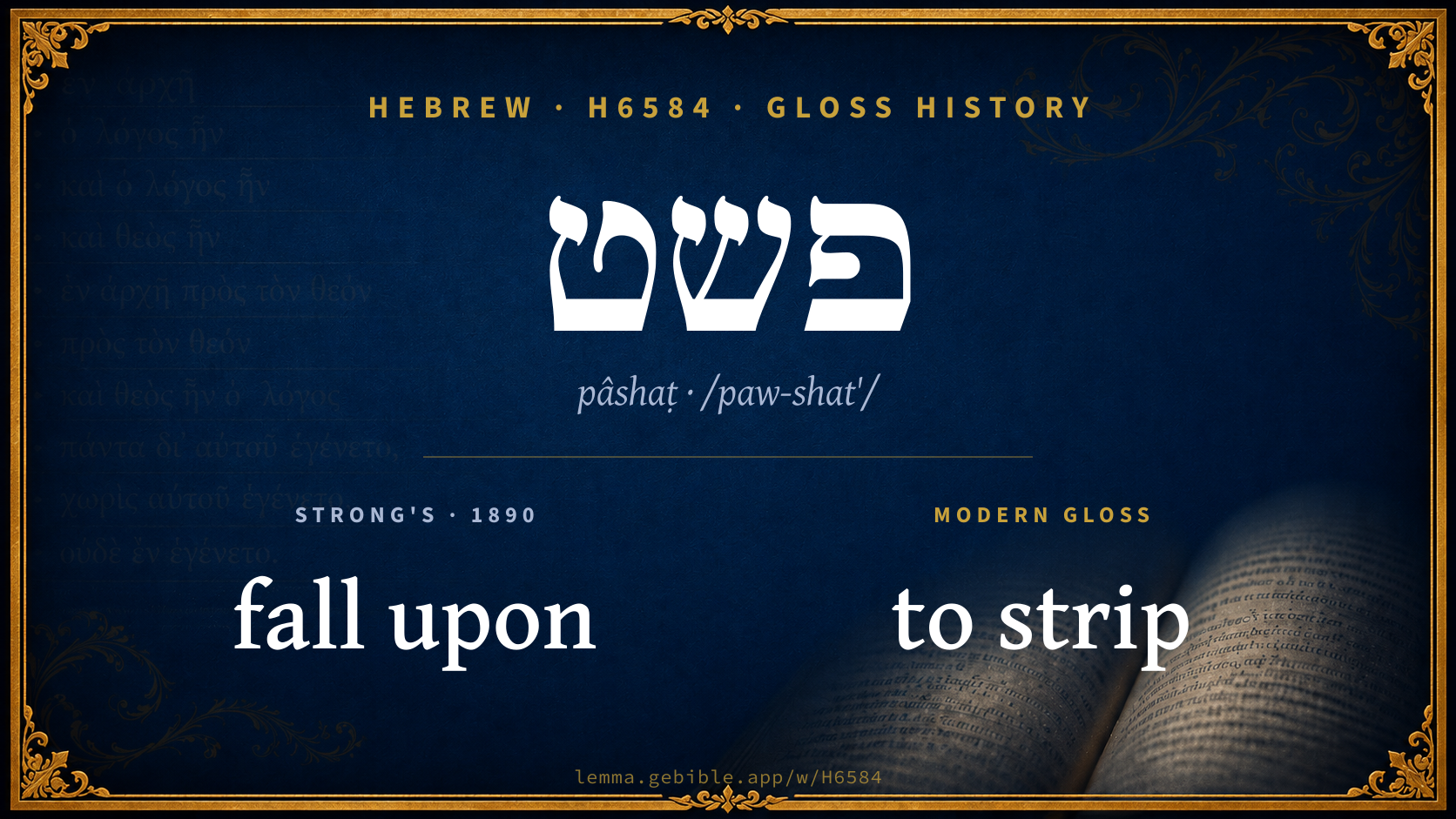
Gloss history
Strong's 1890 vs modern scholarship
About this word
Strong's H6584 catalogs a Hebrew word from the Hebrew Old Testament.
These counts are not copied from any lexicon or concordance. They are computed here, from the morphology-tagged Hebrew Old Testament. What Lemma adds →
- 42
- distinct verses
- The word appears in 42 distinct verses.
- 16 / 39
- OT books
- The word appears in 16 of 39 Old Testament books.
- #837
- by frequency
- Top 1000 most frequent Hebrew words (rank 837 of 8,640 Hebrew words by occurrence).
View all 42 occurrences in the concordance →
Most concentrated in
- 1 Samuel 9 verses 21%
- 1 Chronicles 4 verses 10%
- 2 Chronicles 4 verses 10%
By section of the Old Testament
By traditional corpus
Conventional, traditional groupings — biblical authorship is debated, so this is a traditional corpus grouping, not an authorship claim. Each share is this word’s portion of its verses in that division of the Hebrew canon. Each figure is a share of the word’s 42 distinct verses.
- Prophets (Nevi'im) 23 verses · 55%
- Writings (Ketuvim) 13 verses · 31%
- Torah (Pentateuch) 6 verses · 14%
How translations render this word
Counts come from each version’s own published word-to-Strong’s tagging or interlinear alignment — an approximate guide to how each version renders this word, not a word-level alignment the data otherwise carries. Because each total is that version’s own tagged count, the per-version totals vary from one another and need not match the appearance or distinct-verse counts above. These counts may also differ from a printed concordance because Lemma counts each distinctly tagged rendering and does not collapse phrase taggings into a single head-word total. This is a fixed set of word-tagged versions (KJV, ASV, BSB, ULT) and does not change with the reading translation you choose elsewhere. Each version’s license is shown beside its name below (and on Sources).
- King James Version: Strip 4×, Stripped 3×, Fell 2×
- American Standard Version: Strip 4×, Made a raid 3×, Stripped 3×
- Berean Standard Bible: Raided 6×, Strip 3×, Rushed 2×
- unfoldingWord Literal Text: Strip 4×, And 3×, Raided 3×
King James Version Public Domain
Renders H6584 across 43 tagged occurrences — most commonly:
Plus 28 renderings that appear only once — usually multi-word phrases or single function words the recovered tagging swept in, not distinct renderings.
American Standard Version Public Domain
Renders H6584 across 41 tagged occurrences — most commonly:
Plus 25 renderings that appear only once — usually multi-word phrases or single function words the recovered tagging swept in, not distinct renderings.
Berean Standard Bible Public Domain
Renders H6584 across 43 tagged occurrences — most commonly:
Plus 28 renderings that appear only once — usually multi-word phrases or single function words the recovered tagging swept in, not distinct renderings.
unfoldingWord Literal Text CC BY-SA 4.0
Renders H6584 across 48 tagged occurrences — most commonly:
Plus 27 renderings that appear only once — usually multi-word phrases or single function words the recovered tagging swept in, not distinct renderings.
9 senses and sub-senses in the full BDB
Hebrew verbs can shift meaning by stem (binyan): Qal is the basic action, Niphal is often passive or reflexive, Piel often intensifies or makes it factitive, and Hiphil is typically causative. The senses below are grouped under the stem BDB assigns to each. This entry also uses Hithpael (reflexive or reciprocal).
What do BDB’s symbols mean?
BDB uses these scholarly abbreviations:
| Symbol | Meaning |
|---|---|
| 𝔊 | the Septuagint (the ancient Greek translation, LXX) |
| 𝔙 | the Vulgate (the Latin translation) |
| 𝔖 | the Syriac version (the Peshitta) |
| 𝔗 | the Targum (the Aramaic translation) |
| ψ | the Psalms |
| √ | root (the underlying root or stem) |
| ‖ | parallel passage (a synonymous or contrasted parallel) |
| † | the dagger: every passage where the word occurs is cited |
The 9 senses and sub-senses the full Brown-Driver-Briggs lexicon distinguishes for this word, in lexicon order (not ranked by frequency), with BDB’s own verbatim wording and sub-sense lettering. Shown in Hebrew script with BDB’s own scholarly abbreviations. The condensed entry is in the Lexicon Entry tab. See also the Forms in the corpus table below.
Qal
- Pf. 3 ms. פ׳ Ho 7:1 +, 2 ms. וּפָשַׁטְתָּ֫ Ju 9:33, etc.; Impf. 3 ms. וַיִפְשַׁט 1 S 19:24; 3 mpl. יִפְשֹׁ֑טוּ Ez 26:1, etc.; Imv. ms. פְּשֹׁ֫טָה Is 32:11; Pt. pl. פֹּשְׁטִים Ne 4:17;— e.g. Hosea 7:1
- 1. strip off, put off, one’s garment (acc.) 1 S 19:24; Ez 26:16; 44:19; Lv 6:4 (opp. לָבַשׁ, 16:23 (id.; both P), Ne 4:17; Ct 5:3; acc. om. Is 32:11; of locusts Na 3:16 stripping off (sheaths of wings, cf. Da DrAm 85). e.g. 1 Samuel 19:24
- 2. put off (one’s shelter), i.e. make a dash (from a sheltered place), c. אֶל Ju 20:37, abs. 9:44; especially of marauding foray, Ho 7:1, c. עַל against Ju 9:33, 44; 1 S 23:27; 30:14 (ins. עַל cf. 𝔊 We Dr al.), Jb 1:17, c. אֶל 1 S 27:8; 30:1, c. בְּ 1 Ch 14:9, 13; 2 Ch 25:13; 28:18; in 1 S 27:10 read אָן (for אַל־), We Dr al. e.g. Judges 20:37
Piel
- Inf. cstr. לְפַשֵּׁט, c. acc. pers. 1 S 31:8 to strip the slain = 1 Ch 10:8; abs. only to strip (sc. the slain) 2 S 23:10 (ins. also ‖ 1 Ch 11:13 Dr). e.g. 1 Samuel 31:8
Hiphil
- Pf. 3 ms. הִפְשִׁיט Jb 19:9; 3 mpl. sf. וְהִפְשִׁיטוּךְ Ez 23:26, etc.; Impf. 3 ms. וַיַּפְשֵׁט Nu 20:28; 1 s. sf. אַפְשִׁיטֶנָּה Ho 2:5; 2 mpl. תַּפְשִׁט֑וּן Mi 2:8, etc.; Imv. הַפְשֵׁט Nu 20:26; Inf. cstr. הַפְשִׁיט 2 Ch 29:34; Pt. pl. מַפְשִׁיטִים 35:11;— e.g. Job 19:9
- 1. strip one of garment (2 acc.) Gn 37:23 (E), Nu 20:26, 28 (opp. הִלְבִּישׁ), Ez 16:39; 23:26; c. acc. pers. alone 1 Ch 10:9; Ho 2:5 strip her (sf.) naked (עֲרֻמָּה). e.g. Genesis 37:23
- 2. strip off, acc. כֵּלָיו 1 S 31:9, clothing Jb 22:6; c. acc. אֶדֶר + מִמּוּל Mi 2:8; c. acc. עוֹר + מֵעַל 3:3, cf. (acc. כְּבוֹדִי) Jb 19:9. e.g. 1 Samuel 31:9
- 3. flay, c. acc. הָעֹלָה Lv 1:6; 2 Ch 29:34; acc. om. 35:11. e.g. Leviticus 1:6
Hithpael
- Impf. 3 ms. וַיִּתְפַּשֵּׁט 1 S 18:4 he stripped himself of his garment (acc.). e.g. 1 Samuel 18:4
Senses from the full Brown-Driver-Briggs lexicon (Brown, Driver, Briggs; Oxford 1906 — public domain), digitized via Sefaria, supplemented by the OpenScriptures HebrewLexicon (CC BY 4.0). Full attribution on Sources.
Word origin
vb. strip off, make a dash, raid (cf. Assyrian pašâṭu, expunge, obliterate; NH פָּשַׁט, Aramaic פְּשַׁט, ܦܫܰܛ, are stretch out, extend, make plain, so Arabic بَسَطَ );—
— Brown-Driver-Briggs (Oxford 1906, public domain), digitized via Sefaria, supplemented by the OpenScriptures HebrewLexicon (CC BY 4.0). See Sources.
Origin: a primitive root
Jastrow Dictionary
A second Hebrew/Aramaic lexicon for comparison, covering Aramaic and post-biblical (Talmudic, Targumic, Midrashic) usage that the biblical-Hebrew BDB does not. Matched by lemma rather than by Strong’s number, so a lemma may carry more than one Jastrow headword (shown separately below), and the entries cover usage well beyond the Bible.
פָּשַׁט
- (b. h.)
- 1. to stretch, straighten. Sabb. I, 1, sq. פ׳ העני את ידו וכ׳ if the recipient puts his hand forth to within (the house). Pes. 118ᵇ, a. e. שפּוֹשְׁטִין, v. פַּס II. Gen. R. s. 28 לא פָשְׁטוּ ידיהם במצות they (the Sodomites) never stretched their hands forth for good deeds (charity); Lam. R. to IV, 6; Yalk. Ez. 351. Ber. 3ᵇ; Snh. 16ᵃ לכו פִשְׁטוּ וכ׳, v. גְּדוּד. Men. I, 2 פושט את אצבעותיו וכ׳ he stretches his fingers so as to reach his wrist. Lev. R. s. 2 פושטין לו יד we must reach forth our hands to him, v. כָּנָף. Keth. XIII, 5 הפוסק … ופ׳ לו את הרגל if a man promises a certain amount to his intended son-in-law, and shows him the foot, i.e. refuses to give it to him; a. v. fr.—Y. R. Hash. III, 58ᵈ top (ref. to פשוט, ib. III, 3) כדי שיִפְשְׁטוּ וכ׳ (or שיְפַשְּׁטוּ, Pi.) (the horn is straight,) intimating that they must straighten their hearts through repentance.—Part. pass. פָּשׁוּט, q. v.
- 2. to strip; (sub. בגדיו) to undress. Yoma III, 4; 6. Ib. 31ᵇ פּוֹשֵׁט … מקדש he (the high priest) undresses first and then sanctifies (washes his hands and feet). Ib. 32ᵃ כלום אדם פושט אלא וכ׳ can a man put off anything except what he has put on? Tam. I, 1; a. fr.—Part. pass. פָּשׁוּט. Y. Yoma III, 40ᶜ bot. אחת פ׳ ואחת לבוש וכ׳ whether he undresses or dresses, in either case the sanctification follows the act.
- 3. to make plain, to explain. Num. R. s. 18; Tanḥ. Ḥuck. 1 היה יושב ופושט וכ׳ was sitting at the gate of his town and explaining (teaching); (Gen. R. s. 10 ודורש). Ex. R. s. 47 היה למד … ופושט אותה וכ׳ he learned (the Torah) in day-time and explained it to himself at night; a. fr.—Part. pass. as ab. Lev. R. s. 16 (ref. to Ps. XXXIV, 13) כל ימי … היכן הוא פ׳ all my days I have read this verse (question), but I never knew where it is answered. e.g. Psalms 34:13
- 4. (neut. verb) to spread, be published. Hor. 3ᵇ עד שתִּפְשׁוֹט הוראה בכל וכ׳ until the decision is spread (adopted) in the whole congregation of Israel. Ab. Zar. 36ᵃ; a. fr.
- 1. to stretch, straighten out. Y. Snh. III, 21ᵃ bot. התחיל מְפַשֵּׁט וכ׳ (interch. with פישט) he began to put forth his hands and deal in fruits of the Sabbatical year. Tosef. Neg. I, 8 מְפַשְּׁטִין את קומטיו וכ׳ the creases are straightened out, and then the leprous spot is examined; a. e.—Tosef. Nidd. VI, 4, v. infra.—Part. pass. מְפוּשָּׁט. Y. Naz. IX, 57ᵈ רגליו מְפוּשָּׁטוֹת וידו וכ׳ if the corpse is found with its feet stretched and its hands on the heart, opp. קמצוץ.
- 2. to strip, take off. Tosef. Kel. B. Kam. IV, 17 משיְפַשֵּׁט את חלוקו (not חלוקן) from the time that the coat (the plaster of the stove) is taken off.
- 1. to be straightened out, be unfolded, become flat. Kel. XXVI, 2 נ׳ טהור when it (the bag) is straightened out (so as to be a plain piece of leather, v. פָּשׁוּט), it is not susceptible to uncleanness. Tosef. Neg. l. c. כקמוט שנ׳ like a creased garment that has been straightened out; a. e.
- 2. to be stripped. Pirké d’R. El. ch. XIV נ׳ עור צפורן וכ׳ the horny skin was taken from Adam, and he saw himself naked. Midr. Till. to Ps. XCII, v. infra.
- 1. to strip, flay. Pes. V, 9 כיצד תולין ומַפְשִׁיטִין how did they suspend and flay (the Passover lamb)? Ib. מי … ולהַפְשִׁיט he that could find no place where to suspend and flay. Tam. IV, 2. Pesik. R. s. 28 הִפְשִׁיטוּ את עבדיהם וכ׳ they undressed their men servants and maid servants and presented them &c.; a. fr.
- 2. to shed the skin. Pirké d’R. El. l. c. שיהא מַפְשִׁיט את עורו וכ׳ that it (the serpent) should shed its skin once in seven years. Midr. Till. to Ps. XCII מן העור שה׳ הנחש וכ׳ ed. Bub. (oth. ed. שנפשט) of the skin which the serpent shed the Lord made garments of honor &c.; Pirké d’R. El. ch. XX; Yalk. Gen. 34.
- to be stripped. Zeb. XI, 3 עד שלא ה׳ before the hide was taken off. Ib. 93ᵇ; a. e.
- to be straightened, become even; to flatten. Ḥag. 9ᵃ חיגר … ונ׳ וכ׳ if he was lame on the first day and became straight &c. Y. Yeb. I, 2ᵈ bot. עד שתִּתְפַּשֵּׁט הכף, v. כַּף; Tosef. Nidd. VI, 4 עד שתְּפַשֵּׁט את וכ׳. B. Bath. 120ᵃ נִתְפַּשְּׁטוּ הקמטין וכ׳ the wrinkles became even, and her beauty returned &c.; a. e.
פְּשַׁט
- 1. to stretch, stretch forth; to straighten. Targ. Y. Gen. XXII, 10. Ib. XXXVIII, 28. Targ. Prov. XXXI, 19; a. fr.—Ib. XXVI, 18, v. בְּשַׁט.—R. Hash. 26ᵇ כמה דפָשֵׁיט איניש וכ׳ the more man straightens his mind (removes all duplicity, v. preced.), the better it is, opp. כייף bends, humbles.—Part. pass. פָּשִׁיט; f. פְּשִׁיטָא. Targ. Y. Ex. XXVI, 28 (ed. Amst. פַּשִּׁיט). Targ. II Esth. V, 1.
- 2. to strip, tear, flay. Targ. Y. II, Num. XXIII, 24.—Pes. 113ᵃ פְּשׁוֹט; B. Bath. 110ᵃ, v. נְטַשׁ I.
- 3. (neut. verb) to be stretched forth, reach out. Y. Peah VIII, end, 21ᵇ ידיה דלא פַשְׁטַן מיתן וכ׳ may these hands which did not reach out to give thee, be cut off.
- 4. to explain, teach; to deduce. Gen. R. s. 17 הוון יתבין פַּשְטִין וכ׳ he and R. … sat teaching; Lev. R. s. 34. B. Mets. 18ᵇ וקא פשיט רבא דיחזיר and Raba decided that restitution must be made. Kidd. 9ᵇ בתר דבעיא הדר פַּשְׁטָהּ after having raised the question, he met it again himself. Ber. 2ᵇ והדר פשטו לה מברייתא and then they solved the question by deduction from a Boraitha. Hor. 13ᵇ פ׳ גרס ותנא וכ׳ he explained (the subject to himself), and committed it to memory again and again. B. Mets. 90ᵇ פְּשׁוֹט מהא חדא derive from this (Boraitha) one answer to the questions before us. Kidd. 25ᵃ מי בעיתו … ולא פְשִׁיטְנָא לכו did you ever ask me anything that I did not explain to you?; a. fr.—V. פְּשִׁיטָא.
A Dictionary of the Targumim, the Talmud Babli and Yerushalmi, and the Midrashic Literature (Marcus Jastrow; London, Luzac, 1903) — Public Domain. Digitized via Sefaria. Digitized via Sefaria. Full attribution on Sources.
Forms in the corpus
The 39 distinct written forms H6584 takes in the Hebrew Bible, most frequent first — each parse links to that stem’s occurrences in the concordance. Hebrew forms include their vowel points and cantillation, so a single lemma takes many written forms.
Septuagint verse parallels
This word appears in 41 verses that also exist in the Greek Old Testament (Septuagint), out of the 42 Hebrew verses it occurs in. You can read those verses in Greek by switching the Old Testament edition to the Septuagint.
Read these verses in the Septuagint
- Genesis 37:23
- Leviticus 1:6
- Numbers 20:26
- Judges 9:33
- 1 Samuel 18:4
- 2 Samuel 23:10
- 1 Chronicles 10:8
- 2 Chronicles 25:13
- Job 1:17
- Song of Solomon 5:3
- Isaiah 32:11
- Ezekiel 16:39
This is a verse-level parallel only — the same verses exist in both the Hebrew and Greek Old Testaments. No word-level Hebrew↔Greek correspondence is claimed: the data carries no such alignment, so no Greek word is shown as this Hebrew word’s translation. Coverage is not total — the Septuagint omits the deuterocanon and renumbers the Psalms, so some Hebrew verses have no direct Greek parallel.