
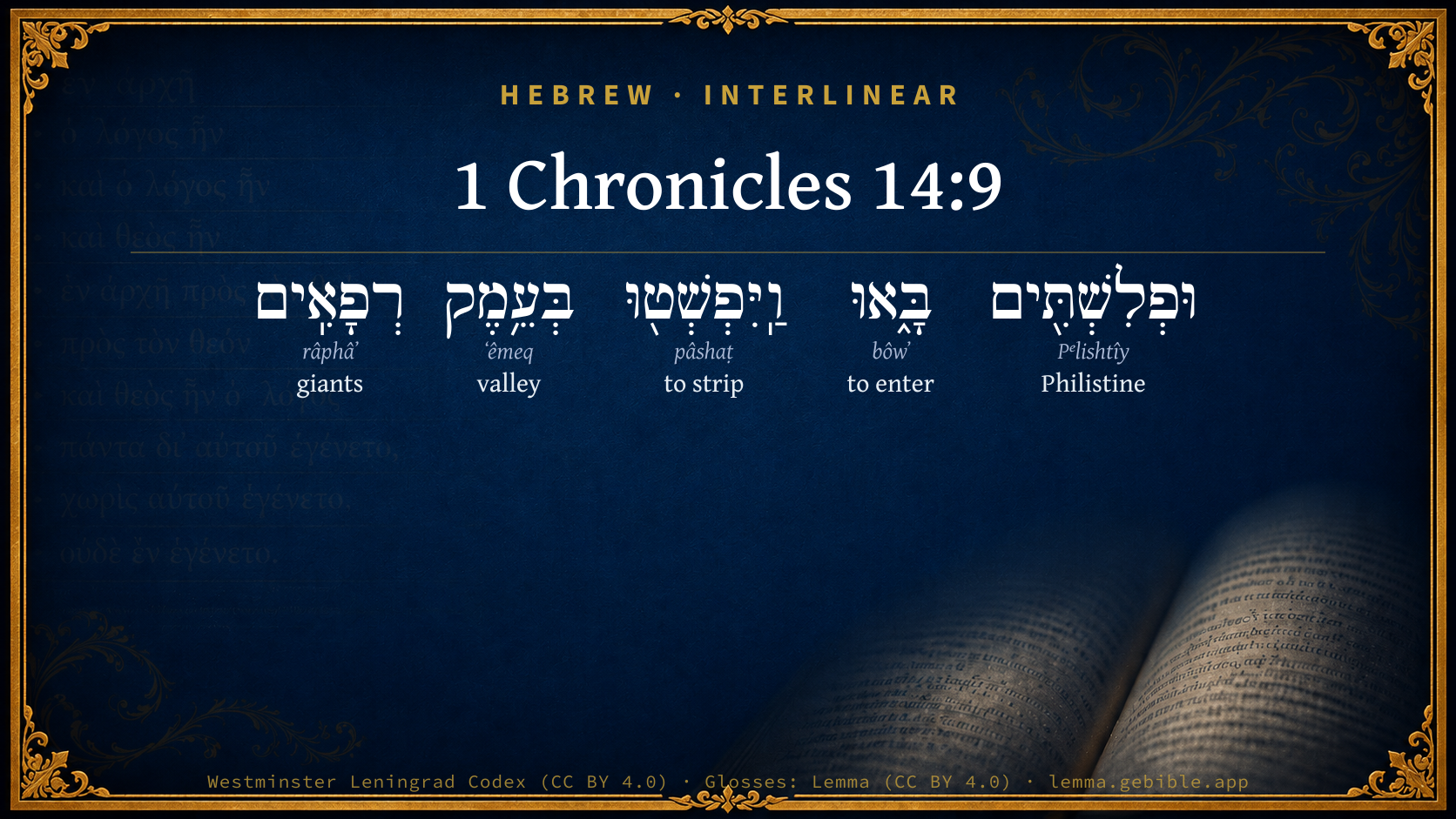
1 Chronicles 14:9

Hebrew (Westminster Leningrad Codex) 1 Chronicles 14:9 appears in the Hebrew Old Testament. The text above is from the Westminster Leningrad Codex. Each word links to its Strong’s number, a concise gloss, and parsing drawn from the Open Scriptures Hebrew Bible morphology. Click any word for its full Brown-Driver-Briggs (BDB) entry.
Download image
Cite this verse

1 Chronicles 14:9 (World English Bible). Public Domain. Lemma interlinear Bible study tool, https://lemma.gebible.app/v/1-chronicles/14/9.

Show BibTeX & RIS
BibTeX
RIS
English Translation
Now the Philistines had come and made a raid in the valley of Rephaim.
World English Bible · Public Domain
Download a study sheet

One document with this verse’s original text, its word-by-word gloss line, the meaning frame, cross-references with their text, attributed commentary, and full source and license credits — printable, and it pastes into notes with its structure intact.

This verse Autodidact and up

Study sheet (.html) Plain text (.txt)

A passage Seminary Student

Up to 50 verses in one chapter. A passage sheet keeps up to 6 commentary sources and 12 cross-references per verse, in the order this page ranks them, and says so on the sheet whenever that leaves anything out. Ask for a single verse and you get the Autodidact verse sheet above.

Everything on this page stays free to read, with no account — the sheet is a download of what is already on screen, not access to it.

Want to remove ads? Support Godless Engineer
Compare translations 3

The same verse in 3 English versions, stacked beneath the original-language interlinear above. Click any original word for its lexicon entry.

Each is an independent rendering of the whole verse — the interlinear is not word-aligned to these translations.

Highlighted words mark where these versions differ — a whole-verse word diff, not a word-by-word alignment.

  • World English Bible Public Domain
    Now the Philistines had come and made a raid in the valley of Rephaim.
  • King James Version Public Domain
    And the Philistines came and spread themselves in the valley of Rephaim.
  • unfoldingWord Literal Text CC BY-SA 4.0
    And the Philistines came, and they spread out in the Valley of the Raphaites.

unfoldingWord Literal Text — © unfoldingWord, licensed CC BY-SA 4.0. Word-aligned USFM3 via Door43 (git.door43.org/unfoldingWord/en_ult).

Versions to compare (up to 4)

3 of 4 selected

Show all 18 translations

Every available English version of this verse, each an independent rendering of the whole verse.

  • World English Bible Public Domain
    Now the Philistines had come and made a raid in the valley of Rephaim.
  • Berean Standard Bible Public Domain
    Now the Philistines had come and raided the Valley of Rephaim.
  • Majority Standard Bible Public Domain
    Now the Philistines had come and raided the Valley of Rephaim.
  • King James Version Public Domain
    And the Philistines came and spread themselves in the valley of Rephaim.
  • American Standard Version (1901) Public Domain
    Now the Philistines had come and made a raid in the valley of Rephaim.
  • Revised Version (1885) Public Domain
    Now the Philistines had come and made a raid in the valley of Rephaim.
  • Geneva Bible (1599) Public Domain
    And the Philistims came, and spred them selues in the valley of Rephaim.
  • Douay-Rheims (1899) Public Domain
    And the Philistines came and spread themselves in the vale of Raphaim.
  • Young's Literal Translation Public Domain
    And the Philistines have come, and rush into the valley of Rephaim,
  • Literal Standard Version CC BY-SA 4.0
    And the Philistines have come, and rush into the Valley of Rephaim,
  • Unlocked Literal Bible CC BY-SA 4.0
    Now the Philistines had come and made a raid in the Valley of Rephaim.
  • unfoldingWord Literal Text CC BY-SA 4.0
    And the Philistines came, and they spread out in the Valley of the Raphaites.
  • Darby Bible Public Domain
    And the Philistines came and spread themselves in the valley of Rephaim.
  • World Messianic Bible Public Domain
    Now the Philistines had come and made a raid in the valley of Rephaim.
  • Webster's Bible Public Domain
    And the Philistines came and spread themselves in the valley of Rephaim.
  • Free Bible Version CC BY-SA 4.0
    The Philistines arrived and raided the valley of Rephaim.
  • Bible in Basic English Public Domain
    Now the Philistines had come, and had gone out in every direction in the valley of Rephaim.
  • JPS Tanakh (1917) Public Domain
    Now the Philistines had come and made a raid in the valley of Rephaim.

Literal Standard Version (2020), Covenant Press — licensed CC BY-SA 4.0. Text via the HelloAO Bible API (eBible.org). Unlocked Literal Bible (unfoldingWord) — licensed CC BY-SA 4.0. Text via the HelloAO Bible API (eBible.org). unfoldingWord Literal Text — © unfoldingWord, licensed CC BY-SA 4.0. Word-aligned USFM3 via Door43 (git.door43.org/unfoldingWord/en_ult). Free Bible Version, Dr. Jonathan Gallagher — licensed CC BY-SA 4.0. Text via the HelloAO Bible API (eBible.org).

Word by word

More ways to search: Search by grammar → Find every occurrence → Compare this word →

Practice this passage: Drill this verse → Learn its vocabulary →

About this verse

These counts appear in no published source. They are computed here, from the morphology-tagged text and Lemma’s own curated glosses. What Lemma adds →

5
words
5
distinct lemmas
Historical
section

Notable vocabulary

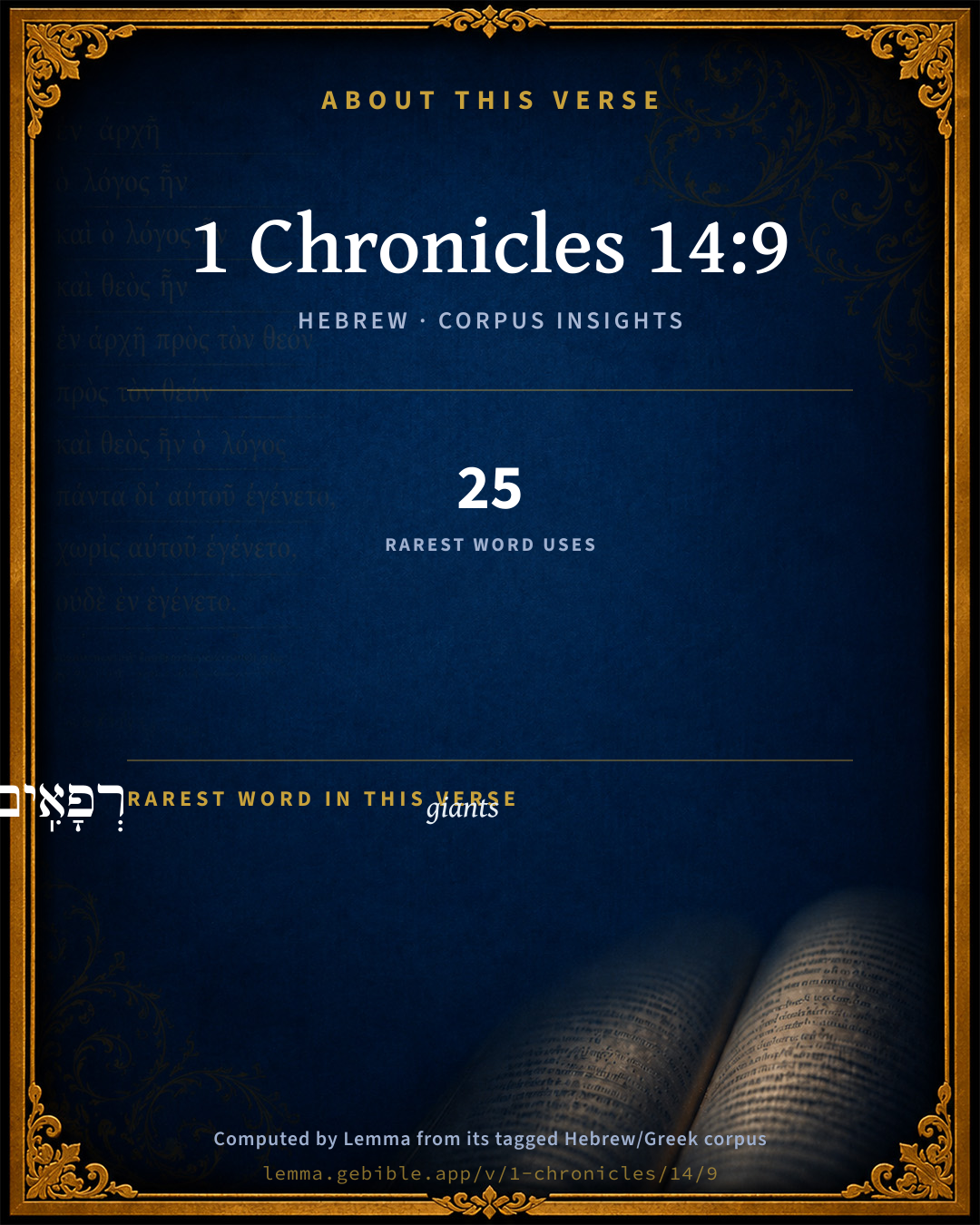
The rarest word here is רְפָאִֽים giants H7497 — appearing just 25 times in the whole Hebrew Bible.

Shared distinctive vocabulary

רְפָאִֽים giants H7497 occurs in 24 verses of the Hebrew Bible. Also found in:

Grammatical profile

  • 2 verbs
  • 3 nouns

Verb forms

  • בָּ֑אוּ Qal · Perfect
  • וַֽיִּפְשְׁט֖וּ Qal · Sequential Imperfect

Hebrew & Septuagint length

In English translation the verse runs 14 words from the Hebrew and 11 from the Septuagint (LXX English) — closely comparable.

A rough comparison of the two English renderings, which tokenize alike — not a word-level alignment.

Word counts can differ between the Hebrew and the Greek without any difference in meaning — e.g. the Hebrew direct-object marker אֵת has no separate Greek word, and Greek often adds the article ὁ.

Cross-references

5

Topical passages linked to 1 Chronicles 14:9 in the Treasury of Scripture Knowledge — connected by theme and wording, ordered by reader-vote popularity; previews shown in the World English Bible.

  • 1 Chronicles 11:15 Three of the thirty chief men went down to the rock to David, into the cave of Adullam; and the host of the Philistines were encamped in the valley of Rephaim.
  • 2 Samuel 5:18 Now the Philistines had come and spread themselves in the valley of Rephaim.
  • 1 Chronicles 14:13 The Philistines yet again made a raid in the valley.
  • 2 Samuel 23:13 Three of the thirty chief men went down, and came to David in the harvest time to the cave of Adullam; and the troop of the Philistines was encamped in the valley of Rephaim.
  • Isaiah 17:5 It shall be as when the harvester gathers the standing grain, and his arm reaps the ears; yes, it shall be as when one gleans ears in the valley of Rephaim.

Cross-references courtesy of OpenBible.info (CC BY 4.0).

Hebrew and Greek witnesses Masoretic Hebrew ↔ Greek Septuagint

The same verse in the two great witnesses to the Old Testament, shown verse-for-verse.

These are two independent witnesses, not word-aligned to each other, and the Septuagint is shown in lemma (dictionary) form.

Hebrew 1 Chronicles 14:9 Masoretic · Westminster Leningrad Codex

וּפְלִשְׁתִּ֖ים בָּ֑אוּ וַֽיִּפְשְׁט֖וּ בְּעֵ֥מֶק רְפָאִֽים

Now the Philistines had come and made a raid in the valley of Rephaim.

World English Bible · Public Domain

Greek LXX 1 Chronicles 14:9 Septuagint · lemma form

καί ἀλλόφυλος ἔρχομαι καί συνπίπτω ἐν ὁ κοιλάς ὁ γίγας

And the Philistines came and assembled together in the giants' valley.

LXX2012 (modern English Septuagint) · Public Domain

Hebrew: Westminster Leningrad Codex (CC BY 4.0). Greek: Septuagint (public domain); English from LXX2012 (modern English Septuagint) (Public Domain). How the Septuagint differs from the Hebrew →

Commentary

Notes on 1 Chronicles 14:9 from classic Christian and Jewish commentators (each source and its license shown beneath its notes). The classic Christian expositions comment on the surrounding passage and are grouped to its opening verse, so a note may address several verses; the Jewish commentaries on the Tanakh (Rashi and others) are per-verse, so they appear only where the commentator wrote on this verse.

Lemma curates 59 commentaries, every one of them public domain or Creative Commons licensed, each selected and text-cleaned for this edition rather than reprinted as found. About our sources →

Ellicott's Commentary for English Readers

(9) And the Philistines came.—Now the Philistines had come. The narrative goes back to 1Ch_14:8 a. The invaders had approached by another road than usual, and encamped in the valley of Rephaim (1Ch_11:15).

Spread themselves.—The chronicler has given an easier term than that used in Samuel.

A Bible Commentary for English Readers, edited by Charles John Ellicott (1878–1897) — public domain. Text from a community e-Sword module.

The Cambridge Bible for Schools and Colleges

gen. ed. J. J. S. Perowne

9. spread themselves] R.V. made a raid. In fact both renderings are right; the Philistines scattered themselves in search of spoil.

the valley of Rephaim] to be identified probably with the shallow valley, now called Beḳâ‘a, across which runs the road from Jerusalem to Beth-lehem (Bädeker, p. 120).

The Cambridge Bible for Schools and Colleges (gen. ed. J. J. S. Perowne; Cambridge University Press, 1878–1918) — public domain. Text from a community e-Sword module.

The Pulpit Commentary

Spread themselves. The root, fvp appears here for the of the parallel place. So also again in ver. 13 of this chapter. In the valley of Rephaim; i.e. of giants, though some translate "healers," and yet others "chiefs." Though not Canaanites, they once held portions of Canaan. Their origin is very uncertain. Kalisch ("Commentary on Old Testament," p. 351) thinks they were descendants of Japheth (Gen_14:5 Gen_15:20; Deu_2:9-11 Deu_3:11) The "valley" was south of Jerusalem, but whether more south-east or south-west is not certain; probably the former (Jos_15:8 Jos_18:16; Isa_17:5)

Vers. 9-11.

The God of battles.

This is one of the many passages in the Old Testament where God is represented as presiding over and prospering the military expeditions of the Israelites. Rationalists see in such passages nothing more than evidence that the Hebrews were a warlike people, and that they, like other nations, attributed their successes in war to the intervention and favour of their Deity. But those who believe in the inspiration and authority of Scripture cannot be satisfied with such an explanation. The text suggests some reflections which may cast light upon this difficulty.

I THERE IS A GENERAL SENSE IN WHICH JEHOVAH WAS AND IS THE LORD OF HOSTS, THE GOD OF BATTLES. It would be barbarous and absurd to suppose that the benevolent Ruler of all prefers war in itself to peace, that he takes pleasure in the carnage and agony, the bereavement and desolation, which are distinctive of war. But as all strength and valour, all foresight, skill, and patience are his gifts, to him must ultimately be traced the force, the generalship, by which victories are won.

II THERE IS A DIVINE PROVIDENCE WHICH OVERRULES THE CONFLICTS OF THE NATIONS. There can be no question that the course of human history has been, to a large extent, governed by the wars which have occupied so much of the energy and have consumed so much of the blood and the treasure of mankind. We have read of "the fifteen decisive battles of the world." They who believe in the providential government of the world at all can scarcely refuse to believe that the warfares of the nations have been permitted and overruled for good by God. Great principles, even principles of a moral kind, have sometimes been fought upon the field of battle. Civilization and barbarism, slavery and freedom, brute force and enlightenment, have thus contended together for the mastery and the victory.

III THERE WERE SPECIAL REASONS WHY GOD SHOULD HAVE INTERESTED HIMSELF IN THE WARS OF THE JEWS.

1. The contests between Israel and Israel"s enemies were contests betweena morally superior and certain morally inferior races. When wars took place

2. between the Israelites and the Canaanites or Philistines, it is plain to every student of history that the victory of Israel was the victory of monotheism and morality over idolatry and the most flagrant and disgusting vice. The cause of Philistia was the cause of heathenism, cruelty, and pollution; the cause of David was that of comparative justice, purity, and spirituality.

3. The victories of Israel furthered the best interests of mankind. Had Israelbeen subjugated or annihilated, the best prospects of the human race would have been clouded with awful darkness. The independence and nationality of the Hebrews formed a distinct step forward in the march of humanity.

4. The triumphs of David were a link in that chain which led to theredemption of mankind. We cannot separate the Old Testament, historically or religiously, from the New. The kingdom and the conquests of David have relation to the kingdom and the conquests of him who was Son of David and Son of God. T.

The Pulpit Commentary (1880–1919), ed. H.D.M. Spence-Jones & Joseph S. Exell — public domain. Text from a community e-Sword module.

Lesson kit

Teaching starters — assembled from the data on this page, not authored interpretation. Every prompt links to the verse data it draws on. Edit before teaching.

1 Chronicles, in the Historical, opens this verse with 5 words (5 distinct Hebrew lemmas). Its most distinctive word is râphâʼ (“giants”). A historical commentator’s framing appears above. Read the whole chapter for the surrounding context.

Discussion questions

  1. How does “giants” (râphâʼ) shape what this verse is saying?
  2. How does Genesis 14:5, which shares the word «giants», read alongside this verse?
  3. These translations render this verse differently; the difference is in the English rendering, not the original. What questions does that raise?
  4. «בָּ֑אוּ» is a Qal Perfect verb. How does that grammatical form shape the action described?
  5. Compare how Ellicott's Commentary for English Readers and The Cambridge Bible for Schools and Colleges read this verse. Where do they agree or differ?

Things to notice

Reading settings

Reading text

Shown beneath each verse's original-language words.

Old Testament
Old Testament edition

Read the OT as the Masoretic Hebrew (MT) or the Greek Septuagint (LXX).

English shown for the Greek Septuagint (in the Hebrew ↔ Greek comparison).

Comparing translations? Open the Compare panel on any verse page to stack up to four side by side.