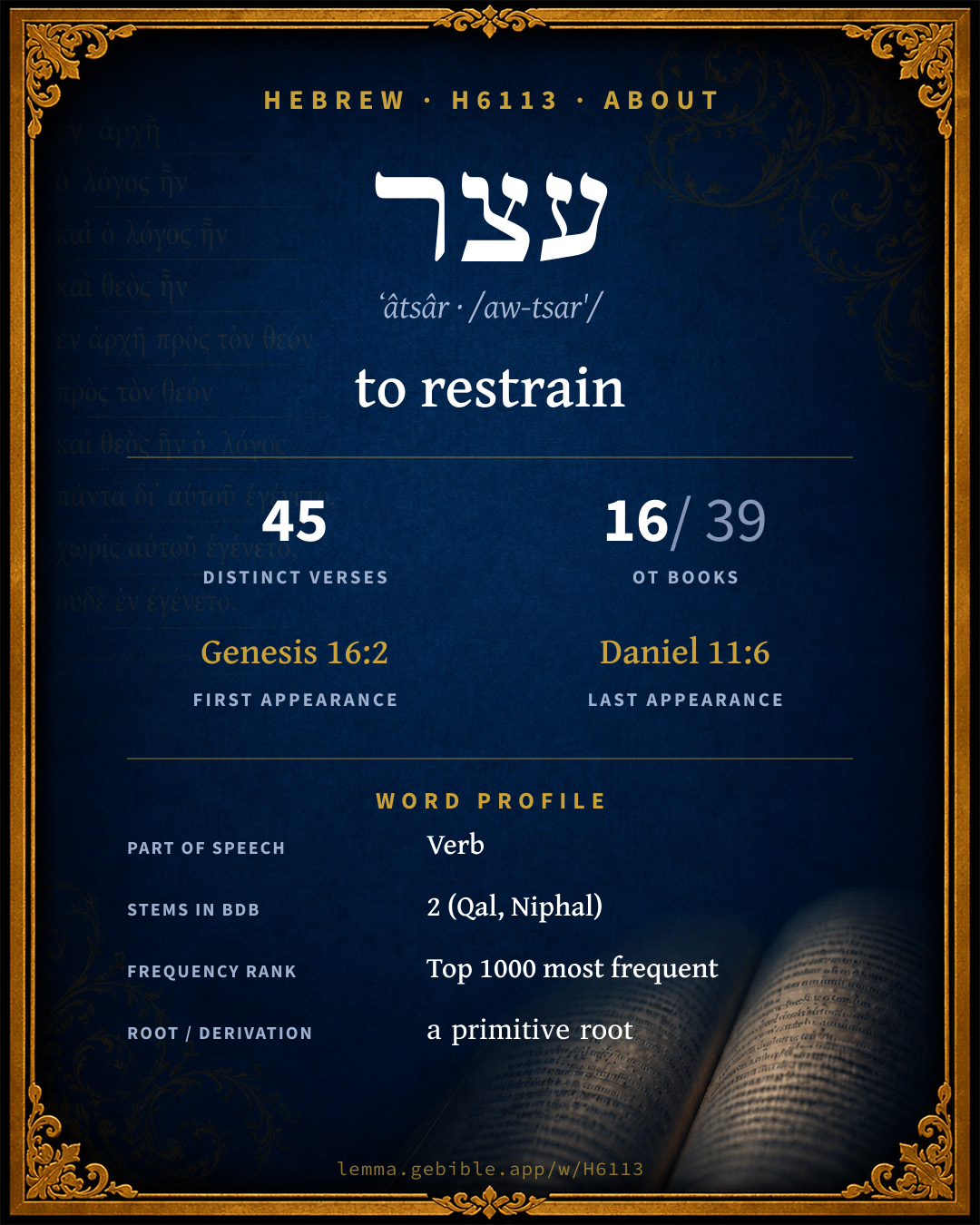
עָצַר
to restrain
also: retain, close up, shut, withhold fuller range ↓
Full lexicon entry — Brown-Driver-Briggs (BDB)
From Brown-Driver-Briggs (BDB)
Where this word appears
See every Qal verb in the Hebrew Bible →
Grammar key — what these labels mean
Part of speech
- Verb
- An action or state-of-being word.
Stem
- Qal
- The basic, simple active stem — the plain form of the verb (“he wrote”). Here: ‘restrain’
- Niphal
- Usually the simple passive or reflexive of the Qal (“he was written”). Here: ‘be restrained’
Form
- Participle Passive
- A verbal adjective expressing action received (“written”).
- Sequential Imperfect
- An imperfect with prefixed waw — the standard past-narrative form (waw-consecutive imperfect).
- Imperfect
- An incomplete, ongoing, or future action (“he will / would write”).
- Infinitive Construct
- A bound verbal noun, frequently with prepositions (“to write / in writing”).
- Perfect
- A completed action or state — Hebrew marks aspect (completeness) more than strict tense (“he wrote”).
- Jussive
- A third- or second-person volitional form expressing wish or command (“let him write”).
- Sequential Perfect
- A perfect with prefixed waw continuing a preceding imperfect or command (waw-consecutive perfect).
- Participle Active
- A verbal adjective expressing ongoing or characteristic action (“writing / one who writes”).
- Infinitive Absolute
- An unbound verbal noun, often intensifying or standing in for a finite verb.
- Cohortative
- A first-person volitional form expressing wish or resolve (“let me / let us write”).
State
- Absolute
- The independent form of a noun, not bound to a following word.
Person
- 3rd Person
- The one spoken about (“he / she / it / they”).
- 1st Person
- The speaker (“I / we”).
- 2nd Person
- The one addressed (“you”).
Gender
- Masculine
- Grammatically masculine.
- Feminine
- Grammatically feminine.
- Common
- Either gender — not distinguished for this form.
Number
- Singular
- One.
- Plural
- More than one (in Hebrew, generally three or more).
Grammatical forms 24 distinct
- Verb, Qal, Participle Passive, Masculine, Singular, Absolute 11 times (24%)
- Verb, Niphal, Sequential Imperfect, 3rd Person, Feminine, Singular 4 times (9%)
- Verb, Qal, Imperfect, 3rd Person, Masculine, Singular 4 times (9%)
- Verb, Qal, Perfect, 3rd Person, Masculine, Singular 3 times (7%)
- Verb, Niphal, Infinitive Construct 2 times (4%)
- Verb, Qal, Perfect, 1st Person, Common, Singular 2 times (4%)
- Verb, Qal, Perfect, 3rd Person, Common, Plural 2 times (4%)
- Verb, Qal, Infinitive Construct 2 times (4%)
+16 more forms (16 occurrences)
Parsed forms decoded from the imported morphology (morphhb / Westminster Leningrad Codex — WLC text public domain, morphhb tagging CC BY 4.0), counted across 46 parsed occurrences — not distinct verses.
Every verse where H6113 appears — 45 distinct verses across 16 books. Click any verse to open its interlinear word-by-word view. Verse text shown in the World English Bible for context — . Each verse’s Hebrew form is shown with its reference; the English is not keyword-highlighted, since the data carries no word-level English alignment. Use “Compare translations” on any verse to read it across multiple English versions. This concordance covers the Hebrew Bible; Septuagint (Greek Old Testament) occurrences are not indexed here.
Genesis 2 verses
- Genesis 16:2 עֲצָרַ֤/נִי Qal pf 3ms + sfx pers 1cs Sarai said to Abram," See now, Yahweh has restrained me from bearing. Please go in to my handmaid. It may be that I will obtain children by her." Abram listened to the voice of Sarai.
- Genesis 20:18 עָצֹ֤ר עָצַר֙ Qal inf.abs Qal pf 3ms For Yahweh had closed up tight all the wombs of the house of Abimelech, because of Sarah, Abraham's wife.
Numbers 3 verses
- Numbers 16:48 וַ/תֵּעָצַ֖ר conj + Niphal wimpf 3fs He stood between the dead and the living; and the plague was stayed.
- Numbers 16:50 נֶעֱצָֽרָה Niphal pf 3fs Aaron returned to Moses to the door of the tent of meeting: and the plague was stayed.
- Numbers 25:8 וַ/תֵּֽעָצַר֙ conj + Niphal wimpf 3fs and he went after the man of Israel into the pavilion, and thrust both of them through, the man of Israel, and the woman through her body. So the plague was stayed from the children of Israel.
Deuteronomy 2 verses
- Deuteronomy 11:17 וְ/עָצַ֤ר conj + Qal wpf 3ms and the anger of Yahweh be kindled against you, and he shut up the sky, so that there shall be no rain, and the land shall not yield its fruit; and you perish quickly from off the good land which Yahweh gives you.
- Deuteronomy 32:36 עָצ֥וּר Qal ptcp.pass ms For Yahweh will judge his people, Repent himself for his servants; When he sees that [their] power is gone, There is none [remaining], shut up or left at large.
Judges 2 verses
- Judges 13:15 נַעְצְרָה Qal coh 1cp Manoah said to the angel of Yahweh, I pray you, let us detain you, that we may make ready a kid for you.
- Judges 13:16 תַּעְצְרֵ֨/נִי֙ Qal impf 2ms + sfx pers 1cs The angel of Yahweh said to Manoah, Though you detain me, I won't eat of your bread; and if you will make ready a burnt offering, you must offer it to Yahweh. For Manoah didn't know that he was the angel of Yahweh.
1 Samuel 3 verses
- 1 Samuel 9:17 יַעְצֹ֥ר Qal impf 3ms When Samuel saw Saul, Yahweh said to him, Behold, the man of whom I spoke to you! this same shall have authority over my people.
- 1 Samuel 21:5 עֲצֻֽרָה Qal ptcp.pass fs David answered the priest, and said to him, Of a truth women have been kept from us about these three days; when I came out, the vessels of the young men were holy, though it was but a common journey; how much more then today shall their vessels be holy?
- 1 Samuel 21:7 נֶעְצָר֙ Niphal ptcp.act ms Now a certain man of the servants of Saul was there that day, detained before Yahweh; and his name was Doeg the Edomite, the best of the herdsmen who belonged to Saul.
2 Samuel 2 verses
- 2 Samuel 24:21 וְ/תֵעָצַ֥ר conj + Niphal impf 3fs Araunah said, Why is my lord the king come to his servant? David said, To buy the threshing floor of you, to build an altar to Yahweh, that the plague may be stayed from the people.
- 2 Samuel 24:25 וַ/תֵּעָצַ֥ר conj + Niphal wimpf 3fs David built there an altar to Yahweh, and offered burnt offerings and peace-offerings. So Yahweh was entreated for the land, and the plague was stayed from Israel.
1 Kings 4 verses
- 1 Kings 8:35 בְּ/הֵעָצֵ֥ר prep + Niphal inf.cs When the sky is shut up, and there is no rain, because they have sinned against you; if they pray toward this place, and confess your name, and turn from their sin, when you do afflict them:
- 1 Kings 14:10 עָצ֥וּר Qal ptcp.pass ms therefore, behold, I will bring evil on the house of Jeroboam, and will cut off from Jeroboam every man-child, him who is shut up and him who is left at large in Israel, and will utterly sweep away the house of Jeroboam, as a man sweeps away dung, until it be all gone.
- 1 Kings 18:44 יַעַצָרְ/כָ֖ה Qal impf 3ms + sfx pers 2ms It happened at the seventh time, that he said, "Behold, a small cloud, like a man's hand, is rising out of the sea." He said, Go up, tell Ahab, Make ready [your chariot], and get you down, that the rain not stop you.
- 1 Kings 21:21 וְ/עָצ֥וּר conj + Qal ptcp.pass ms Behold, I will bring evil on you, and will utterly sweep you away and will cut off from Ahab every man-child, and him who is shut up and him who is left at large in Israel:
2 Kings 4 verses
- 2 Kings 4:24 תַּעֲצָר Qal juss 2ms Then she saddled a donkey, and said to her servant, Drive, and go forward; don't slacken me the riding, except I bid you.
- 2 Kings 9:8 וְ/עָצ֥וּר conj + Qal ptcp.pass ms For the whole house of Ahab shall perish; and I will cut off from Ahab every man-child, and him who is shut up and him who is left at large in Israel.
- 2 Kings 14:26 עָצוּר֙ Qal ptcp.pass ms For Yahweh saw the affliction of Israel, that it was very bitter; for there was none shut up nor left at large, neither was there any helper for Israel.
- 2 Kings 17:4 וַֽ/יַּעַצְרֵ֨/הוּ֙ conj + Qal wimpf 3ms + sfx pers 3ms The king of Assyria found conspiracy in Hoshea; for he had sent messengers to So king of Egypt, and offered no tribute to the king of Assyria, as he had done year by year: therefore the king of Assyria shut him up, and bound him in prison.
1 Chronicles 3 verses
- 1 Chronicles 12:1 עָצ֔וּר Qal ptcp.pass ms Now these are those who came to David to Ziklag, while he yet kept himself close because of Saul the son of Kish; and they were among the mighty men, his helpers in war.
- 1 Chronicles 21:22 וְ/תֵעָצַ֥ר conj + Niphal juss 3fs Then David said to Ornan, Give me the place of this threshing floor, that I may build thereon an altar to Yahweh: for the full price shall you give it me, that the plague may be stayed from the people.
- 1 Chronicles 29:14 נַעְצֹ֣ר Qal impf 1cp But who am I, and what is my people, that we should be able to offer so willingly as this? For all things come of you, and of your own have we given you.
2 Chronicles 7 verses
- 2 Chronicles 2:6 יַעֲצָר Qal impf 3ms But who is able to build him a house, seeing heaven and the heaven of heavens can't contain him? who am I then, that I should build him a house, save only to burn incense before him?
- 2 Chronicles 6:26 בְּ/הֵעָצֵ֧ר prep + Niphal inf.cs When the sky is shut up, and there is no rain, because they have sinned against you; if they pray toward this place, and confess your name, and turn from their sin, when you do afflict them:
- 2 Chronicles 7:13 אֶֽעֱצֹ֤ר Qal impf 1cs If I shut up the sky so that there is no rain, or if I command the locust to devour the land, or if I send pestilence among my people;
- 2 Chronicles 13:20 עָצַ֧ר Qal pf 3ms Neither did Jeroboam recover strength again in the days of Abijah: and Yahweh struck him, and he died.
- 2 Chronicles 14:11 יַעְצֹ֥ר Qal juss 3ms Asa cried to Yahweh his God, and said, Yahweh, there is none besides you to help, between the mighty and him who has no strength: help us, Yahweh our God; for we rely on you, and in your name are we come against this multitude. Yahweh, you are our God; don't let man prevail against you.
- 2 Chronicles 20:37 עָצְר֖וּ Qal pf 3cp Then Eliezer the son of Dodavahu of Mareshah prophesied against Jehoshaphat, saying, Because you have joined yourself with Ahaziah, Yahweh has destroyed your works. The ships were broken, so that they were not able to go to Tarshish.
- 2 Chronicles 22:9 לַ/עְצֹ֥ר prep + Qal inf.cs He sought Ahaziah, and they caught him (now he was hiding in Samaria), and they brought him to Jehu, and killed him; and they buried him, for they said, He is the son of Jehoshaphat, who sought Yahweh with all his heart. The house of Ahaziah had no power to hold the kingdom.
Nehemiah 1 verse
Job 3 verses
- Job 4:2 וַ/עְצֹ֥ר conj + Qal inf.cs "If someone ventures to talk with you, will you be grieved? But who can withhold himself from speaking?
- Job 12:15 יַעְצֹ֣ר Qal impf 3ms Behold, he withholds the waters, and they dry up; Again, he sends them out, and they overturn the earth.
- Job 29:9 עָצְר֣וּ Qal pf 3cp The princes refrained from talking, And laid their hand on their mouth;
Psalms 1 verse
Isaiah 1 verse
Jeremiah 4 verses
- Jeremiah 20:9 עָצֻ֖ר Qal ptcp.pass ms If I say, I will not make mention of him, nor speak any more in his name, then there is in my heart as it were a burning fire shut up in my bones, and I am weary with forbearing, and I can't [contain].
- Jeremiah 33:1 עָצ֔וּר Qal ptcp.pass ms Moreover the word of Yahweh came to Jeremiah the second time, while he was yet shut up in the court of the guard, saying,
- Jeremiah 36:5 עָצ֔וּר Qal ptcp.pass ms Jeremiah commanded Baruch, saying, I am shut up; I can't go into the house of Yahweh:
- Jeremiah 39:15 עָצ֔וּר Qal ptcp.pass ms Now the word of Yahweh came to Jeremiah, while he was shut up in the court of the guard, saying,
Daniel 3 verses
- Daniel 10:8 עָצַ֖רְתִּי Qal pf 1cs So I was left alone, and saw this great vision, and there remained no strength in me; for my comeliness was turned in me into corruption, and I retained no strength.
- Daniel 10:16 עָצַ֖רְתִּי Qal pf 1cs Behold, one in the likeness of the sons of men touched my lips: then I opened my mouth, and spoke and said to him who stood before me, my lord, by reason of the vision my sorrows are turned on me, and I retain no strength.
- Daniel 11:6 תַעְצֹ֞ר Qal impf 3fs At the end of years they shall join themselves together; and the daughter of the king of the south shall come to the king of the north to make an agreement: but she shall not retain the strength of her arm; neither shall he stand, nor his arm; but she shall be given up, and those who brought her, and he who became the father of her, and he who strengthened her in those times.
About this entry
At a glance — auto-summarized from this page’s data, not written by a person. Every figure links to its source below. This summary describes the numbers; it doesn’t interpret them.
The Hebrew verb עצר centers on the idea of “to restrain.” Where the King James Version says “is shut up,” newer translations reach for “and” (unfoldingWord Literal Text); the renderings breakdown has the detail. It appears 45 verses across 16 books of the Hebrew Bible, among its moderately common vocabulary. Debuting at Genesis 16:2, it then recurs through the corpus. As a verb its force shifts by stem, across 2 stems (Qal, Niphal, and more). Dig into 45-verse concordance and the renderings breakdown below.
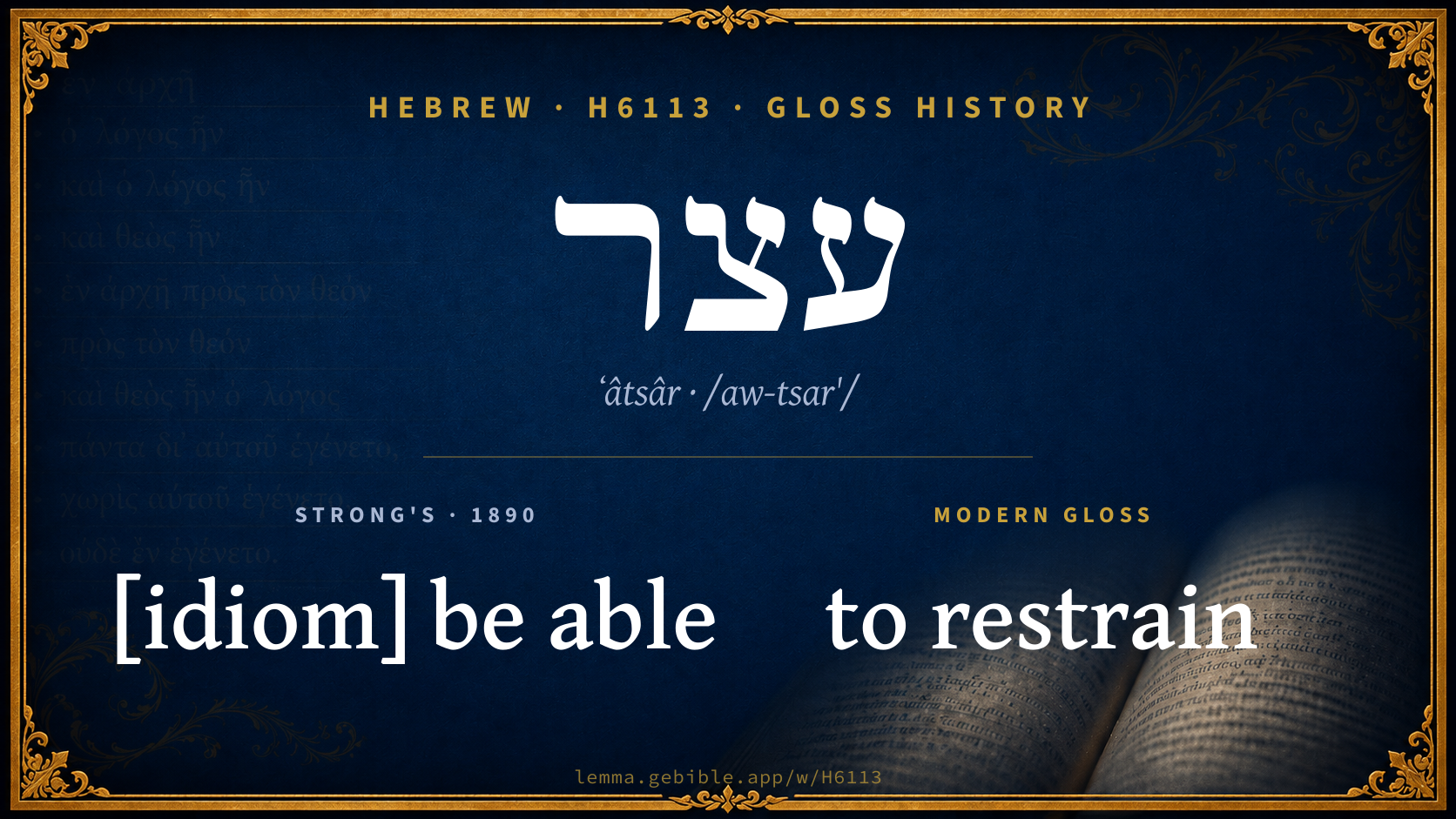
Gloss history
Strong's 1890 vs modern scholarship
About this word
Strong's H6113 catalogs a Hebrew word from the Hebrew Old Testament.
These counts are not copied from any lexicon or concordance. They are computed here, from the morphology-tagged Hebrew Old Testament. What Lemma adds →
- 45
- distinct verses
- The word appears in 45 distinct verses.
- 16 / 39
- OT books
- The word appears in 16 of 39 Old Testament books.
- #796
- by frequency
- Top 1000 most frequent Hebrew words (rank 796 of 8,640 Hebrew words by occurrence).
View all 45 occurrences in the concordance →
Most concentrated in
- 2 Chronicles 7 verses 16%
- 1 Kings 4 verses 9%
- 2 Kings 4 verses 9%
By section of the Old Testament
By traditional corpus
Conventional, traditional groupings — biblical authorship is debated, so this is a traditional corpus grouping, not an authorship claim. Each share is this word’s portion of its verses in that division of the Hebrew canon. Each figure is a share of the word’s 45 distinct verses.
- Prophets (Nevi'im) 20 verses · 44%
- Writings (Ketuvim) 18 verses · 40%
- Torah (Pentateuch) 7 verses · 16%
How translations render this word
Counts come from each version’s own published word-to-Strong’s tagging or interlinear alignment — an approximate guide to how each version renders this word, not a word-level alignment the data otherwise carries. Because each total is that version’s own tagged count, the per-version totals vary from one another and need not match the appearance or distinct-verse counts above. These counts may also differ from a printed concordance because Lemma counts each distinctly tagged rendering and does not collapse phrase taggings into a single head-word total. This is a fixed set of word-tagged versions (KJV, ASV, BSB, ULT) and does not change with the reading translation you choose elsewhere. Each version’s license is shown beside its name below (and on Sources).
- King James Version: Is shut up 5×, Was stayed 5×, May be stayed 2×
- American Standard Version: Was stayed 5×, Is shut up 4×, Shut up 2×
- Berean Standard Bible: Both slave 4×, Was halted 3×, Are shut 2×
- unfoldingWord Literal Text: And 5×, Was restrained 3×, Are restrained 2×
King James Version Public Domain
Renders H6113 across 46 tagged occurrences — most commonly:
Plus 32 renderings that appear only once — usually multi-word phrases or single function words the recovered tagging swept in, not distinct renderings.
American Standard Version Public Domain
Renders H6113 across 46 tagged occurrences — most commonly:
Plus 35 renderings that appear only once — usually multi-word phrases or single function words the recovered tagging swept in, not distinct renderings.
Berean Standard Bible Public Domain
Renders H6113 across 44 tagged occurrences — most commonly:
Plus 31 renderings that appear only once — usually multi-word phrases or single function words the recovered tagging swept in, not distinct renderings. Not rendered by a distinct English word in 2 further occurrences.
unfoldingWord Literal Text CC BY-SA 4.0
Renders H6113 across 61 tagged occurrences — most commonly:
Plus 39 renderings that appear only once — usually multi-word phrases or single function words the recovered tagging swept in, not distinct renderings.
Senses in the full BDB
Hebrew verbs can shift meaning by stem (binyan): Qal is the basic action, Niphal is often passive or reflexive, Piel often intensifies or makes it factitive, and Hiphil is typically causative. The senses below are grouped under the stem BDB assigns to each.
What do BDB’s symbols mean?
BDB uses these scholarly abbreviations:
| Symbol | Meaning |
|---|---|
| 𝔊 | the Septuagint (the ancient Greek translation, LXX) |
| 𝔙 | the Vulgate (the Latin translation) |
| 𝔖 | the Syriac version (the Peshitta) |
| 𝔗 | the Targum (the Aramaic translation) |
| ψ | the Psalms |
| √ | root (the underlying root or stem) |
| ‖ | parallel passage (a synonymous or contrasted parallel) |
| † | the dagger: every passage where the word occurs is cited |
The 4 senses and sub-senses the full Brown-Driver-Briggs lexicon distinguishes for this word, in lexicon order (not ranked by frequency), with BDB’s own verbatim wording and sub-sense lettering. Shown in Hebrew script with BDB’s own scholarly abbreviations. The condensed entry is in the Lexicon Entry tab. See also the Forms in the corpus table below.
Qal
- Pf. 3 ms. ע׳ Gn 20:18 +, sf. עֲצָרַנִי 16:2; 1 s. עָצַרְתִּי Dn 10:8, 16, etc.; Impf. 3 ms. יַעְצֹר 1 S 9:17 +, יַעְצָר־ 2 Ch 2:5; sf. יַעֲצָרְכָה 1 K 18:44, etc.; Inf. abs. עָצֹר Gn 20:18, cstr. לַעְצֹר 2 Ch 22:9, וַעְצֹר Jb 4:2 (Ges§ 28 b); Pt. pass. עָצוּר Je 33:1 +, etc.;— e.g. Genesis 20:18
- 1. restrain, c. acc. pers. Gn 16:2 (J; + מִן, i.e. prevent), עָצֹר עָצַר בְּעַד כָּל־רֶחֶם 20:18 (E), cf. abs. Is 66:9 (opp. מוֹלִיד); sq. inf. 2 K 4:24; c. acc. pers. alone 1 K 18:44 hinder, stop; c. acc. of sky (hindering rain) Dt 11:17; 2 Ch 7:13; pt. pass. abs. shut up, or hindered (for reasons not given) Je 36:5; Ne 6:10 (? by a vow, or by ceremonial uncleanness, cf. RSSem i. 436 f., 2nd ed. 455 f.); = shut up (c. ב, in prison) 2 K 17:4, pt. pass. Je 33:1; 39:15, fig. 20:9; on עָצוּר וְעָזוּב (5 times), v. I. עזב; עֲצֻרָה לָנוּ 1 S 21:6 women have been kept away with ref. to us (cf. RSl.c.); עָצוּר מִפְּנֵי 1 Ch 12:1 kept away from before Saul; = detain, c. acc. Ju 13:15, 16; in Jb c. בְּ, ע׳ בְּמִלִּין 4:2, cf. 29:9, so בַּמַּיִם 12:15; ע׳ בְּעַמִּי 1 S 9:17 is rule over, etc. (si vera l.); ins. also (with other words) 10:1 𝔊 We Dr al. e.g. Genesis 16:2
- 2. (late) retain, c. acc. כֹּחַ 2 Ch 13:20; 22:9 Dn 10:8, 16; 11:6; + inf. = be able to 1 Ch 29:14 2 Ch 2:5; om. כֹּחַ 14:10 (+ עִמְּךָ), 20:37 (+ inf.). e.g. 2 Chronicles 13:20
Niphal
- be restrained, stayed, of plague: Pf. 3 fs. נֶעֱצָ֑רָה Nu 17:15; Impf. 3 fs. תֵּעָצַר 2 S 24:21 = 1 Ch 21:22, וַתֵּעָצַר Nu 17:13; 25:8 (P) 2 S 24:25 ψ 106:30; be shut up (of sky), Inf. cstr. בְּהֵעָצֵר 1 K 8:35 = 2 Ch 6:26; be under restraint or detention Pt. נֶעְצָר 1 S 21:8 + לִפְנֵי י׳ (? i.e. kept by a vow, cf. HPS and Ne 6:10 supr.). e.g. Numbers 17:15
Senses from the full Brown-Driver-Briggs lexicon (Brown, Driver, Briggs; Oxford 1906 — public domain), digitized via Sefaria, supplemented by the OpenScriptures HebrewLexicon (CC BY 4.0). Full attribution on Sources.
Word origin
vb. restrain, retain (NH id.; cf. prob. Assyrian eṣêru, retain, restrain, DlHWB 122 JägerBAS i.483 Zehnpfundib.500* cf. Assyrian uṣurtu, taboo SACJA, 1904, 754.; Ethiopic ዐጸረ: press, Arabic عَصَرَ; 𝔗 עֲצַר, Syriac ܥܨܰܪ id.);—
— Brown-Driver-Briggs (Oxford 1906, public domain), digitized via Sefaria, supplemented by the OpenScriptures HebrewLexicon (CC BY 4.0). See Sources.
Origin: a primitive root
Jastrow Dictionary
A second Hebrew/Aramaic lexicon for comparison, covering Aramaic and post-biblical (Talmudic, Targumic, Midrashic) usage that the biblical-Hebrew BDB does not. Matched by lemma rather than by Strong’s number, so a lemma may carry more than one Jastrow headword (shown separately below), and the entries cover usage well beyond the Bible.
עָצַר
- [to press,] to close up; to detain; to ward off; to gather, store away. Succ. 38ᵃ עוֹצֶרֶת רוחות וכ׳ wards off evil winds and dews (v. infra). Num. R. s. 19 היאך יכול … וַעֲצָרוֹ how could the angel of death strike a man that had stood up against the angel of death and warded him off? (ref. to Num. XVII, 13). Sifré Num. 151; Yalk. ib. 782 (ref. to עצרת, Num. XXIX, 35) עֲצָרוֹ הכתוב מלצאת the Scripture keeps him (the pilgrim) from leaving (Jerusalem, on the eighth day). Pesik. R. (ed. Fr.) addit. s. 4; Pesik. Bayom, p. 193ᵇ הק"בה עוֹצֵר וכ׳ the Lord locks his Presence up with them, v. infra. Ab. Zar. 71ᵃ עול תחתי לעוֹצֵר, v. עָלַל; a. fr.—Part. pass. עָצוּר; f. עֲצוּרָה; pl. עֲצוּרִים, עְצוּרִין; עְצוּרוֹת. Sifré l. c. מה זה ע׳ מלצאת אף זה ע׳ וכ׳ as on this (the eighth day) one is prohibited to leave, so is one on this (the first day). Sifré Deut. 135 (ref. to עצרת, Deut. XVI, 8) יכול יהא אדם ע׳ כל וכ׳ from this you might infer that one must be confined the whole day in the schoolhouse (for religious exercises). Ib. מה שביעי ע׳ אף ששי ע׳ as the seventh day is under restrictions (as to week-day labor), so is the sixth day (i.e. the days intervening between the first and the seventh day); אי מה שביעי ע׳ מכל מלאכה וכ׳ you might infer from this that as the seventh day is under restriction as regards all sorts of labor (even work of necessity), so is the sixth; Ḥag. 18ᵃ השביעי ע׳ בכל מלאכה … ימים ע׳ וכ׳ the seventh day is under a general restriction, but the six days are not; Yalk. Deut. 904; ib. 907. Ḥull. 67ᵃ בורות … שהן ע׳ ככלים wells, pits and caves, the waters of which are restrained as in vessels; Yalk. Lev. 537 עצירים … בכלים (corr. acc.); a. fr. e.g. Numbers 17:13
- to be detained; to be gathered together. Pesik. R. l. c. כל זמן שישראל נֶעֱצָרִין וכ׳ as long as Israel holds festive gatherings in synagogues and schoolhouses, the Lord locks up &c. (v. supra); Pesik. l. c.ᵃ מְעַצְּרִין (Pi.). Yalk. Num. 782 (ref. to עצרת, v. supra) למה נֶעֶצְרוּ עיד יום אחד why are they detained one more day? Taan. 7ᵇ הגשמים נעצרין the rains are withheld. Ib. 8ᵃ השמים נעצרין מלהוריד וכ׳ the heavens are locked up so as not to let down rain &c.; a. fr.
- 1. to hold festive gatherings. Pesik. l. c., v. supra.
- 2. to detain, keep off. Succ. 37ᵇ כדי לעַצֵּר רוחות וכ׳ in order to keep off evil winds &c. (v. supra).
עֲצַר
- 1. to press, squeeze. Targ. Jud. VI, 38. Targ. Gen. XL, 11 (O. ed. Vien. עַצָּרִית, Pa.); a. fr.—Y. Sabb. XVII, 16ᵇ top; Y. Bets. I, 60ᵇ bot., v. זַיָּירָא.
- 2. to keep back, save. Y. Taan. III, 66ᵈ top עֲצוֹר וכ׳, v. גּוֹלְתָא.
עַצָּר
- m. = עָצוֹר. Targ. Am. IX, 13 ע׳ ענבין (not עֵצֶר, עֵצָר).
A Dictionary of the Targumim, the Talmud Babli and Yerushalmi, and the Midrashic Literature (Marcus Jastrow; London, Luzac, 1903) — Public Domain. Digitized via Sefaria. Digitized via Sefaria. Full attribution on Sources.
Forms in the corpus
The 38 distinct written forms H6113 takes in the Hebrew Bible, most frequent first — each parse links to that stem’s occurrences in the concordance. Hebrew forms include their vowel points and cantillation, so a single lemma takes many written forms.
Same root — word family
Other BDB entries built from the same root as H6113, grouped by Strong’s listed origin. These share a root / origin per the lexicon — not necessarily a shared meaning. Each links to that word’s own entry.
Derived from this word
- מעצור maʻtsôwr H4622 restraint
- מעצר maʻtsâr H4623 control
- עצר ʻetser H6114 restraint
- עצר ʻôtser H6115 restraint
- עצרה ʻătsârâh H6116 assembly
Compare all same-root words → Showing 4 of 6 — not the complete family. They share a root, not necessarily a meaning.
Septuagint verse parallels
This word appears in 42 verses that also exist in the Greek Old Testament (Septuagint), out of the 45 Hebrew verses it occurs in. You can read those verses in Greek by switching the Old Testament edition to the Septuagint.
Read these verses in the Septuagint
- Genesis 16:2
- Numbers 25:8
- Deuteronomy 11:17
- Judges 13:15
- 1 Samuel 9:17
- 2 Samuel 24:21
- 1 Kings 8:35
- 2 Kings 4:24
- 1 Chronicles 12:1
- 2 Chronicles 2:6
- Job 4:2
- Psalms 106:30
This is a verse-level parallel only — the same verses exist in both the Hebrew and Greek Old Testaments. No word-level Hebrew↔Greek correspondence is claimed: the data carries no such alignment, so no Greek word is shown as this Hebrew word’s translation. Coverage is not total — the Septuagint omits the deuterocanon and renumbers the Psalms, so some Hebrew verses have no direct Greek parallel.