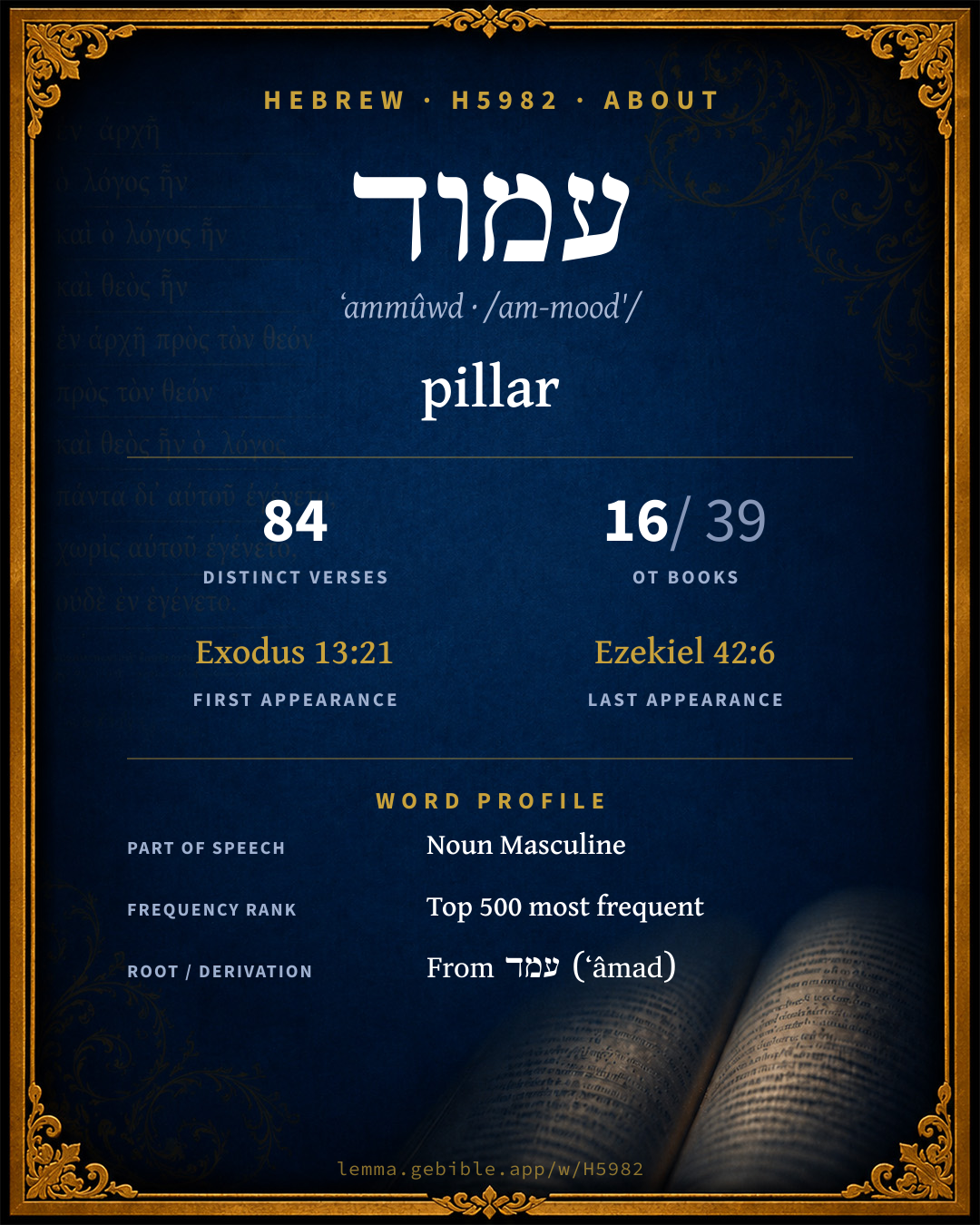
עַמּוּד
pillar
‘pillar’ is one of 4 main senses fuller range ↓
Full lexicon entry — Brown-Driver-Briggs (BDB)
From Brown-Driver-Briggs (BDB)
Where this word appears
Grammar key — what these labels mean
Part of speech
- Noun
- A naming word — a person, place, thing, or idea.
Noun type
- Common
- A common noun — a general class of person, place, or thing (“king,” “city,” “water”), not a specific name.
State
- Absolute
- The independent form of a noun, not bound to a following word.
- Construct
- A noun bound to a following noun in a possessive / “of” relationship (the construct chain).
Gender
- Masculine
- Grammatically masculine.
Number
- Plural
- More than one (in Hebrew, generally three or more).
- Singular
- One.
Every verse where H5982 appears in the Book of Esther — 1 distinct verse. Click any verse to open its interlinear word-by-word view. Verse text shown in the World English Bible for context — . Each verse’s Hebrew form is shown with its reference; the English is not keyword-highlighted, since the data carries no word-level English alignment. Use “Compare translations” on any verse to read it across multiple English versions. This concordance covers the Hebrew Bible; Septuagint (Greek Old Testament) occurrences are not indexed here.
Esther
About this entry
At a glance — auto-summarized from this page’s data, not written by a person. Every figure links to its source below. This summary describes the numbers; it doesn’t interpret them.
The Hebrew noun עמוד centers on the idea of “pillar.” Its meaning spans more than one sense — see its full sense range. The Hebrew Bible uses it across 84 verses — moderately common. Exodus dominates its distribution — 30 of 84 verses. First canonically at Exodus 13:21, it enters the text early. For the data behind this summary, explore the sense tree and the renderings breakdown below.
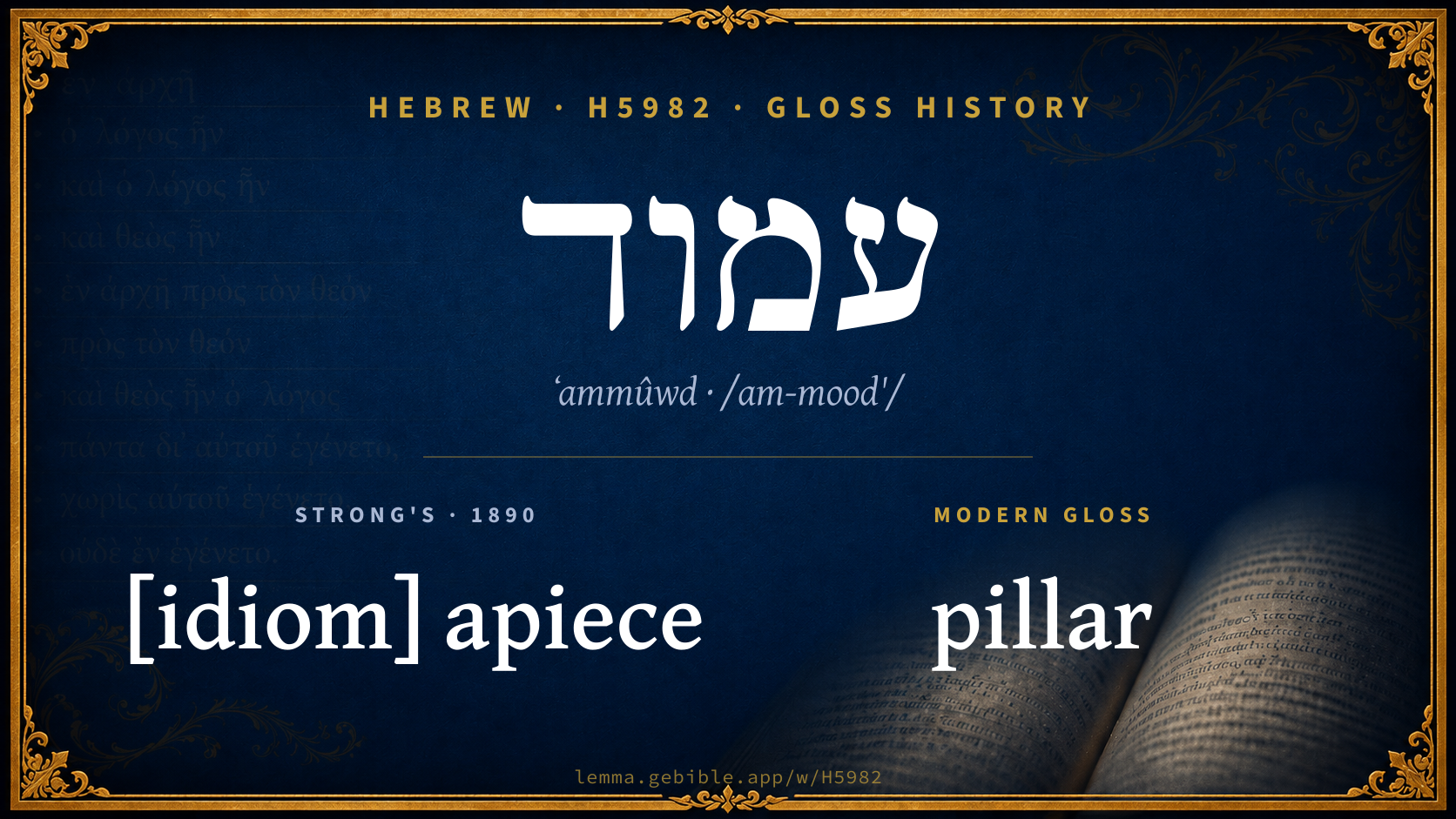
Gloss history
Strong's 1890 vs modern scholarship
About this word
Strong's H5982 catalogs a Hebrew word from the Hebrew Old Testament.
These counts are not copied from any lexicon or concordance. They are computed here, from the morphology-tagged Hebrew Old Testament. What Lemma adds →
- 84
- distinct verses
- The word appears in 84 distinct verses.
- 16 / 39
- OT books
- The word appears in 16 of 39 Old Testament books.
- #387
- by frequency
- Top 500 most frequent Hebrew words (rank 387 of 8,640 Hebrew words by occurrence).
View all 84 occurrences in the concordance →
By section of the Old Testament
By traditional corpus
Conventional, traditional groupings — biblical authorship is debated, so this is a traditional corpus grouping, not an authorship claim. Each share is this word’s portion of its verses in that division of the Hebrew canon. Each figure is a share of the word’s 84 distinct verses.
- Torah (Pentateuch) 37 verses · 44%
- Prophets (Nevi'im) 30 verses · 36%
- Writings (Ketuvim) 17 verses · 20%
How translations render this word
Counts come from each version’s own published word-to-Strong’s tagging or interlinear alignment — an approximate guide to how each version renders this word, not a word-level alignment the data otherwise carries. Because each total is that version’s own tagged count, the per-version totals vary from one another and need not match the appearance or distinct-verse counts above. These counts may also differ from a printed concordance because Lemma counts each distinctly tagged rendering and does not collapse phrase taggings into a single head-word total. This is a fixed set of word-tagged versions (KJV, ASV, BSB, ULT) and does not change with the reading translation you choose elsewhere. Each version’s license is shown beside its name below (and on Sources).
- King James Version: Pillars 67×, Pillar 28×, All the pillars 2×
- American Standard Version: Pillars 66×, Pillar 25×, Them 3×
- Berean Standard Bible: Pillars 37×, Posts 34×, Pillar 27×
- unfoldingWord Literal Text: Pillars 59×, Pillar 14×, Pillar of 13×
King James Version Public Domain
Renders H5982 across 110 tagged occurrences — most commonly:
Plus 9 renderings that appear only once — usually multi-word phrases or single function words the recovered tagging swept in, not distinct renderings.
American Standard Version Public Domain
Renders H5982 across 110 tagged occurrences — most commonly:
Plus 12 renderings that appear only once — usually multi-word phrases or single function words the recovered tagging swept in, not distinct renderings.
Berean Standard Bible Public Domain
Renders H5982 across 104 tagged occurrences — most commonly:
Plus 4 renderings that appear only once — usually multi-word phrases or single function words the recovered tagging swept in, not distinct renderings. Not rendered by a distinct English word in 7 further occurrences.
unfoldingWord Literal Text CC BY-SA 4.0
Renders H5982 across 137 tagged occurrences — most commonly:
Plus 13 renderings that appear only once — usually multi-word phrases or single function words the recovered tagging swept in, not distinct renderings.
7 senses and sub-senses in the full BDB
What do BDB’s symbols mean?
BDB uses these scholarly abbreviations:
| Symbol | Meaning |
|---|---|
| 𝔊 | the Septuagint (the ancient Greek translation, LXX) |
| 𝔙 | the Vulgate (the Latin translation) |
| 𝔖 | the Syriac version (the Peshitta) |
| 𝔗 | the Targum (the Aramaic translation) |
| ψ | the Psalms |
| √ | root (the underlying root or stem) |
| ‖ | parallel passage (a synonymous or contrasted parallel) |
| † | the dagger: every passage where the word occurs is cited |
The 7 senses and sub-senses the full Brown-Driver-Briggs lexicon distinguishes for this word, in lexicon order (not ranked by frequency), with BDB’s own verbatim wording and sub-sense lettering. Shown in Hebrew script with BDB’s own scholarly abbreviations. The condensed entry is in the Lexicon Entry tab. See also the Forms in the corpus table below.
- 1. pillar, supporting house Ju 16:25, 26, 29; pillars in tabern. Ex 27:10, 11, 17; 36:38; Nu 3:37 + 27 times Ex Nu (P), + עַמּוּדֵי שִׁטִּים pillars of acacia wood Ex 26:32, 37; 36:36; pillars in Sol.’s palace 1 K 7:2, 3, 6, אוּלָם הָע׳ v 6, עַמּוּדֵי אֲרָזִים v 2 pillars of cedar (P); in Ezek.’s temple Ez 42:6(×2); ע׳ שֵׁשׁ Est 1:6 (in palace), Ct 5:15 (sim.). e.g. Judges 16:25
- 2. two bronze pillars—1 K 7:15; 2 K 25:13 = Je 52:17—before temple 1 K 7:15(×2) + 14 times 1 K 7, + 2 K 25:16, 17(×2) = Je 52:20, 21(×2), Je 27:19; 1 Ch 18:8; 2 Ch 3:15, 16, 17 + 4 times 2 Ch 4; perhaps one was הָע׳ by which king stood in temple 2 K 11:14 = 2 Ch 23:13; 2 K 23:3; > ע׳ here = standing-place, platform Thes al.; two pillars bef. Ezek.’s temple Ez 40:49. e.g. 1 Kings 7:15
- 3. columns, uprights, of silver Ct 3:10 (litter). e.g. Song of Solomon 3:10
- 4. ע׳ עָשָׁן Ju 20:40 column of smoke: ע׳ (הֶ)עָנָן Ex 13:21, 22 (J) + 6 times JE, hence Ne 9:12, 19 ψ 99:7; ‖ ע׳ (הָ)אֵשׁ Ex 13:21, 22 (J), Nu 14:14 (JE), Ne 9:12, 19; ע׳ אֵשׁ וְעָנָן Ex 14:24 (J), all of the theoph at time of Exodus. e.g. Judges 20:40
- 5.
- a. ע׳ בַּרְזֶל Je 1:18 (fig. of proph.). e.g. Jeremiah 1:18
- b. poet. of pillars of earth Jb 9:5 ψ 75:4, of heaven Jb 26:11. e.g. Job 9:5
- c. of wisdom’s house Pr 9:1. e.g. Proverbs 9:1
Senses from the full Brown-Driver-Briggs lexicon (Brown, Driver, Briggs; Oxford 1906 — public domain), digitized via Sefaria, supplemented by the OpenScriptures HebrewLexicon (CC BY 4.0). Full attribution on Sources.
Word origin
n.m. 1 K 7:15 pillar, column;—עַמּוּד abs. 1 K 7:15 +, cstr. Ex 13:21 +; עַמֻּד abs. Je 52:21, cstr. Nu 14:14; sf. עַמּוּדוֹ 2 Ch 23:13; pl. עַמּוּדִים 1 K 7:16 +, less often עַמֻּ׳ v 21 +; cstr. עַמּוּדֵי Ex 26:32 + less often עַמֻּ׳ 38:17 +; sf. עַמּוּדָיו Ex 36:38 +, עַמֻּדָיו 27:10 +, etc.;—
— Brown-Driver-Briggs (Oxford 1906, public domain), digitized via Sefaria, supplemented by the OpenScriptures HebrewLexicon (CC BY 4.0). See Sources.
Derived from עמד (ʻâmad) (H5975) — to stand.
Jastrow Dictionary
A second Hebrew/Aramaic lexicon for comparison, covering Aramaic and post-biblical (Talmudic, Targumic, Midrashic) usage that the biblical-Hebrew BDB does not. Matched by lemma rather than by Strong’s number, so a lemma may carry more than one Jastrow headword (shown separately below), and the entries cover usage well beyond the Bible.
עַמּוּד
- 1. column, stand. Ex. R. s. 1, ע׳ השן an ivory column. Y. Ber. IX, 13ᵃ אדם … ועומד אחורי הע׳ וכ׳ a man enters a synagogue and stands behind a stand praying silently, and the Lord listens. Bab. Ber. 28ᵇ (of R. Joḥănan) ע׳ הימיני thou right-hand pillar (cmp. I Kings VII, 21). Ex. R. s. 2, end (ref. to הנני, Ex. III, 5) במקום עַמּוּדוֹ של עולם וכ׳ thou standest in the place of the pillar of the world; Abraham said, here am I, and so dost thou; Tanḥ. Sh’moth 19; a. fr.—Trnsf. (v. מַעֲמַד) the group of people belonging to the maʿămad. Y. Taan. IV, 67ᵈ bot.; Y. Pes. IV, beg. 30ᶜ e.g. 1 Kings 7:21
- 2. cylinder around which a scroll is rolled, handle. Yad. III, 4 אינו … עד שיעשה לו ע׳ does not make the hands unclean, until he fastens a handle to it. B. Bath. 13ᵇ כדי לגול ע׳ blank margin wide enough to roll around the cylinder. Ib. 14ᵃ ספר תורה … ועושה לו ע׳ אילך ואילך a scroll of the Law is rolled (on both sides) towards the middle of it, therefore it must have a handle on each side; Y. Meg. I, 71ᵈ; a. fr.—Pl. עַמּוּדִים, עַמּוּדִין. Ib.ᶜ top; Snh. 22ᵃ, v. וא"ו; a. e.
- 3. ע׳ השחר the morning dawn. Ber. I, 1; a. fr.
- 4. the fecal mass in the rectum; also the jet of urine when being discharged. Ber. 62ᵇ; 25ᵃ ע׳ החוזד וכ׳ a suppressed discharge produces dropsy. Ib. כנגד ע׳ בלבד only in the sight of urine at its discharge; a. e.
- 5. (bot.) the central stalk of onions &c., the scape. Ukts. I, 2 הע׳ שהוא מכוון וכ׳ the scape as far as it is surrounded by the edible part, the scape within the bulb; ib. 3 הע׳ שאינו מכוון וכ׳ that part of the scape which protrudes above the bulb.—[B. Bath. IV, 5 עמודין, v. עֲכִירִים.]
עַמּוּד ²
- 1. column, stand. Targ. Y. Gen. XIX, 26. Targ. Ex. XIII, 22; a. fr.—עמוד קריצתא = h. עמוד השחר, v. preced. Targ. Y. Gen. XXXII, 25.—Keth. 17ᵃ איפסיק ע׳ דנורא וכ׳ a column of fire was interposed between him and the rest of the world; ib. 77ᵇ; a. fr.—Pl. עַמּוּדִין, עַמּוּדַיָּא, עַמּוּדֵי. Targ. Ez. XLII, 6. Targ. Y. Gen. XLVI, 28; a. fr.—Ber. 8ᵃ לא מצלו אלא ביני ע׳ וכ׳ they prayed only between the columns (or stands, of the building) where they used to study; ib. 30ᵇ. Gen. R. s. 34, end; Yalk. ib. 61, v. מַזְגָּא II; a. fr.
- 2. continuous flow, jet. Ab. Zar. 73ᵃ צירצור קטן דלא נפיש עַמּוּדֵיה a small bottle the jet from which is not large; חבית דנפיש עַמּוּדָהּ (not עמודיה, v. Rabb. D. S. a. l. note 400) a jug whose jet is large.
A Dictionary of the Targumim, the Talmud Babli and Yerushalmi, and the Midrashic Literature (Marcus Jastrow; London, Luzac, 1903) — Public Domain. Digitized via Sefaria. Digitized via Sefaria. Full attribution on Sources.
Forms in the corpus
The 68 distinct written forms H5982 takes in the Hebrew Bible, most frequent first — each parse links to that state’s occurrences in the concordance. Hebrew forms include their vowel points and cantillation, so a single lemma takes many written forms.
The 60 most common forms are shown; 8 rarer forms follow in the full concordance.
Same root — word family
Other BDB entries built from the same root as H5982, grouped by Strong’s listed origin. These share a root / origin per the lexicon — not necessarily a shared meaning. Each links to that word’s own entry.
Derives from
Shares the same root
- מעמד maʻămâd H4612 service
- מעמד moʻŏmâd H4613 foothold
- עמד ʻômed H5977 standing place
- עמדה ʻemdâh H5979 standing ground
Compare all same-root words → Showing 4 of 6 — not the complete family. They share a root, not necessarily a meaning.
Septuagint verse parallels
This word appears in 77 verses that also exist in the Greek Old Testament (Septuagint), out of the 84 Hebrew verses it occurs in. You can read those verses in Greek by switching the Old Testament edition to the Septuagint.
Read these verses in the Septuagint
- Exodus 13:21
- Numbers 3:36
- Deuteronomy 31:15
- Judges 16:25
- 1 Kings 7:2
- 2 Kings 11:14
- 1 Chronicles 18:8
- 2 Chronicles 3:15
- Esther 1:6
- Job 9:6
- Psalms 75:3
- Proverbs 9:1
This is a verse-level parallel only — the same verses exist in both the Hebrew and Greek Old Testaments. No word-level Hebrew↔Greek correspondence is claimed: the data carries no such alignment, so no Greek word is shown as this Hebrew word’s translation. Coverage is not total — the Septuagint omits the deuterocanon and renumbers the Psalms, so some Hebrew verses have no direct Greek parallel.