
Psalms 75:3

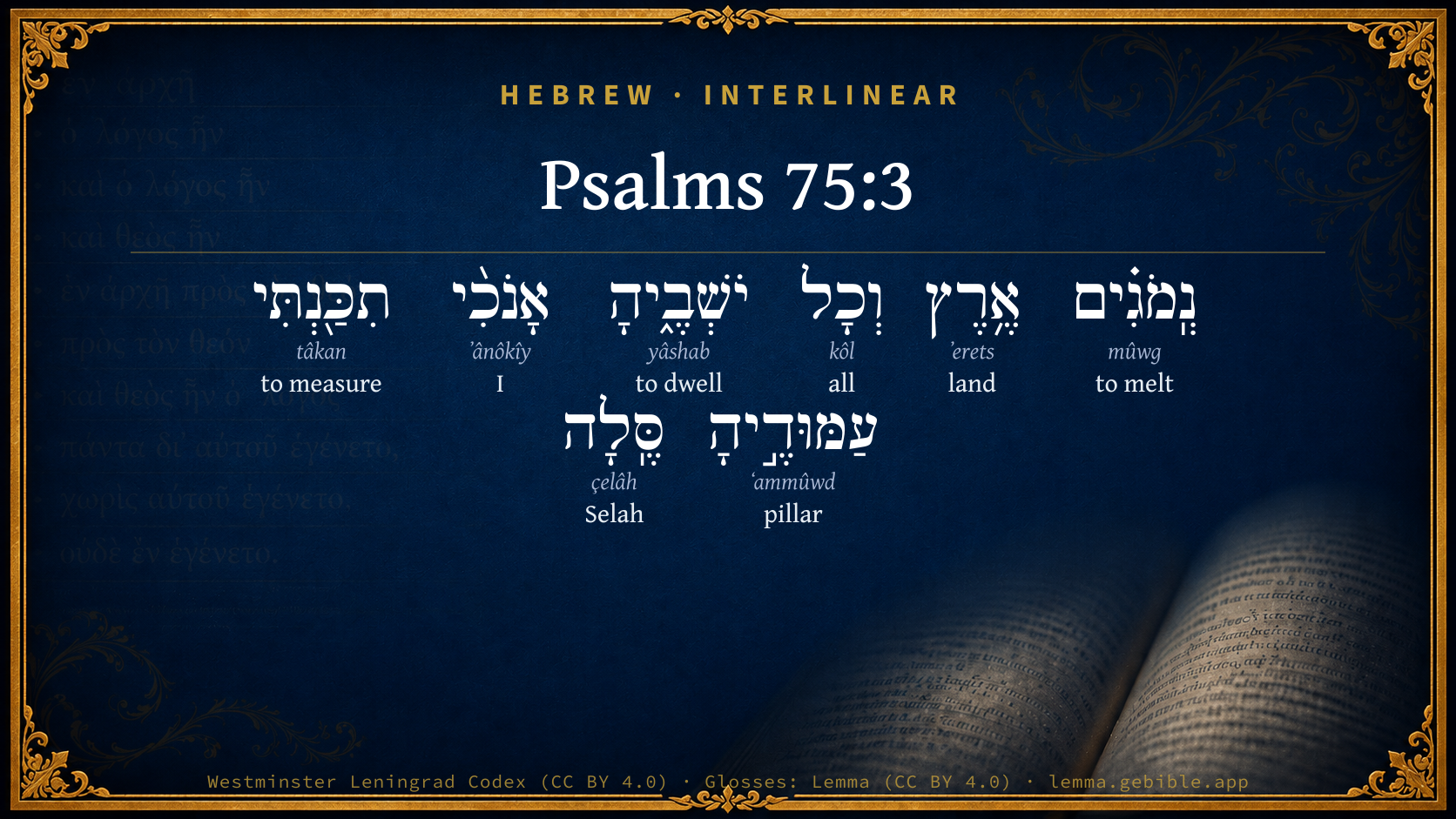
Hebrew (Westminster Leningrad Codex) Psalms 75:3 appears in the Hebrew Old Testament. The text above is from the Westminster Leningrad Codex. Each word links to its Strong’s number, a concise gloss, and parsing drawn from the Open Scriptures Hebrew Bible morphology. Click any word for its full Brown-Driver-Briggs (BDB) entry.
Download image
Cite this verse

Psalms 75:3 (World English Bible). Public Domain. Lemma interlinear Bible study tool, https://lemma.gebible.app/v/psalms/75/3.

Show BibTeX & RIS
BibTeX
RIS
English Translation
The earth and all its inhabitants quake. I firmly hold its pillars. Selah.
World English Bible · Public Domain
Download a study sheet

One document with this verse’s original text, its word-by-word gloss line, the meaning frame, cross-references with their text, attributed commentary, and full source and license credits — printable, and it pastes into notes with its structure intact.

This verse Autodidact and up

Study sheet (.html) Plain text (.txt)

A passage Seminary Student

Up to 50 verses in one chapter. A passage sheet keeps up to 6 commentary sources and 12 cross-references per verse, in the order this page ranks them, and says so on the sheet whenever that leaves anything out. Ask for a single verse and you get the Autodidact verse sheet above.

Everything on this page stays free to read, with no account — the sheet is a download of what is already on screen, not access to it.

Want to remove ads? Support Godless Engineer
Compare translations 3

The same verse in 3 English versions, stacked beneath the original-language interlinear above. Click any original word for its lexicon entry.

Each is an independent rendering of the whole verse — the interlinear is not word-aligned to these translations.

Highlighted words mark where these versions differ — a whole-verse word diff, not a word-by-word alignment.

  • World English Bible Public Domain
    The earth and all its inhabitants quake. I firmly hold its pillars. Selah.
  • King James Version Public Domain
    The earth and all the inhabitants thereof are dissolved: I bear up the pillars of it. Selah.
  • unfoldingWord Literal Text CC BY-SA 4.0
    The earth and all its inhabitants are melting; I, I established its pillars. Selah ts\*

unfoldingWord Literal Text — © unfoldingWord, licensed CC BY-SA 4.0. Word-aligned USFM3 via Door43 (git.door43.org/unfoldingWord/en_ult).

Versions to compare (up to 4)

3 of 4 selected

Show all 18 translations

Every available English version of this verse, each an independent rendering of the whole verse.

  • World English Bible Public Domain
    The earth and all its inhabitants quake. I firmly hold its pillars. Selah.
  • Berean Standard Bible Public Domain
    When the earth and all its dwellers quake, it is I who bear up its pillars. Selah
  • Majority Standard Bible Public Domain
    When the earth and all its dwellers quake, it is I who bear up its pillars. Selah
  • King James Version Public Domain
    The earth and all the inhabitants thereof are dissolved: I bear up the pillars of it. Selah.
  • American Standard Version (1901) Public Domain
    The earth and all the inhabitants thereof are dissolved: I have set up the pillars of it. Selah
  • Revised Version (1885) Public Domain
    The earth and all the inhabitants thereof are dissolved: I have set up the pillars of it. Selah
  • Geneva Bible (1599) Public Domain
    The earth and all the inhabitantes thereof are dissolued: but I will establish the pillars of it. Selah.
  • Douay-Rheims (1899) Public Domain
    when I shall take a time, I will judge justices.
  • Young's Literal Translation Public Domain
    Melted is the earth and all its inhabitants, I -- I have pondered its pillars. Selah.
  • Literal Standard Version CC BY-SA 4.0
    The earth and all its inhabitants are melted, || I have pondered its pillars. Selah.
  • Unlocked Literal Bible CC BY-SA 4.0
    Though the earth and all the inhabitants shake in fear, I make steady the earth's pillars. Selah
  • unfoldingWord Literal Text CC BY-SA 4.0
    The earth and all its inhabitants are melting; I, I established its pillars. Selah ts\*
  • Darby Bible Public Domain
    The earth and all the inhabitants thereof are dissolved: I have established its pillars. Selah.
  • World Messianic Bible Public Domain
    The earth and all its inhabitants quake. I firmly hold its pillars. Selah.
  • Webster's Bible Public Domain
    \\75:2\\When I shall receive the congregation I will judge uprightly.
  • Free Bible Version CC BY-SA 4.0
    When the earth quakes, and all its inhabitants tremble, I am the one who holds it steady. Selah.
  • Bible in Basic English Public Domain
    When the earth and all its people become feeble, I am the support of its pillars. (Selah.)
  • JPS Tanakh (1917) Public Domain
    (75-4) When the earth and all the inhabitants thereof are dissolved, I Myself establish the pillars of it.' Selah

Literal Standard Version (2020), Covenant Press — licensed CC BY-SA 4.0. Text via the HelloAO Bible API (eBible.org). Unlocked Literal Bible (unfoldingWord) — licensed CC BY-SA 4.0. Text via the HelloAO Bible API (eBible.org). unfoldingWord Literal Text — © unfoldingWord, licensed CC BY-SA 4.0. Word-aligned USFM3 via Door43 (git.door43.org/unfoldingWord/en_ult). Free Bible Version, Dr. Jonathan Gallagher — licensed CC BY-SA 4.0. Text via the HelloAO Bible API (eBible.org).

Word by word

More ways to search: Search by grammar → Find every occurrence → Compare this word →

Practice this passage: Drill this verse → Learn its vocabulary →

נְֽמֹגִ֗ים
mûwg
H4127
“melting”
Verb, Niphal, Participle Active, Masculine, Plural, Absolute
Part of Speech
Verb
Stem
Niphal
Form
Participle Active
Gender
Masculine
Number
Plural
State
Absolute
Full BDB Definition

Origin: a primitive root

TWOT: 1156

to melt, cause to melt - (Qal) - to melt, faint - to cause to melt - (Niphal) to melt away - (Polel) to soften, dissolve, dissipate - (Hithpolel) to melt, flow
  1. אֶ֥רֶץ ʼerets H776 “land” Noun, Common, Both, Singular, Absolute
  2. וְכָל kôl H3605 “and · all of” Conjunction + Noun, Common, Masculine, Singular, Construct
  3. יֹשְׁבֶ֑יהָ yâshab H3427 “dwelling · her” Verb, Qal, Participle Active, Masculine, Plural, Construct + Suffix, Personal, 3rd Person, Feminine, Singular
  4. אָנֹכִ֨י ʼânôkîy H595 “I” Pronoun, Personal, 1st Person, Common, Singular
  5. תִכַּ֖נְתִּי tâkan H8505 “to measure” Verb, Piel, Perfect, 1st Person, Common, Singular
  6. עַמּוּדֶ֣יהָ ʻammûwd H5982 “pillars · her” Noun, Common, Masculine, Plural, Construct + Suffix, Personal, 3rd Person, Feminine, Singular
  7. סֶּֽלָה çelâh H5542 “Selah” Particle, Interjection

About this verse

These counts appear in no published source. They are computed here, from the morphology-tagged text and Lemma’s own curated glosses. What Lemma adds →

8
words
8
distinct lemmas
Wisdom
section

Notable vocabulary

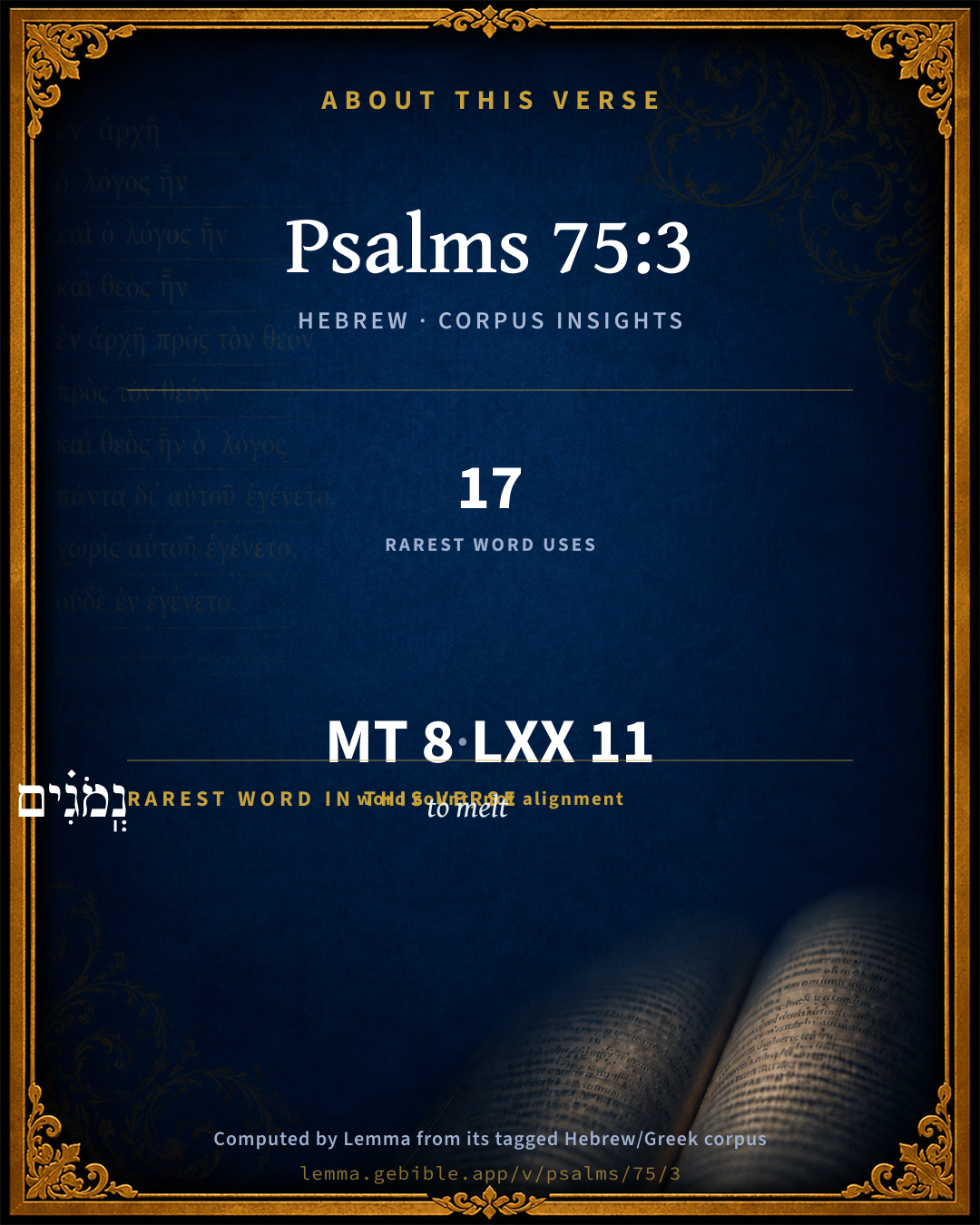
The rarest word here is נְֽמֹגִ֗ים to melt H4127 — appearing just 17 times in the whole Hebrew Bible.

Shared distinctive vocabulary

נְֽמֹגִ֗ים to melt H4127 occurs in 17 verses of the Hebrew Bible. Also found in:

Grammatical profile

  • 3 verbs
  • 3 nouns
  • 1 pronoun
  • 1 particle

Verb forms

  • נְֽמֹגִ֗ים Niphal · Participle Active
  • יֹשְׁבֶ֑יהָ Qal · Participle Active
  • תִכַּ֖נְתִּי Piel · Perfect

Hebrew & Septuagint length

In English translation the verse runs 13 words from the Hebrew and 16 from the Septuagint (LXX English) — closely comparable.

A rough comparison of the two English renderings, which tokenize alike — not a word-level alignment.

Word counts can differ between the Hebrew and the Greek without any difference in meaning — e.g. the Hebrew direct-object marker אֵת has no separate Greek word, and Greek often adds the article ὁ.

In the original languages it is 8 Hebrew tokens and 11 Greek tokens — but the two are counted differently (Hebrew bundles its prefixes and suffixes into one token; the Greek is in lemma form), so that isn’t a like-for-like length.

Cross-references

11

Topical passages linked to Psalms 75:3 in the Treasury of Scripture Knowledge — connected by theme and wording, ordered by reader-vote popularity; previews shown in the World English Bible.

  • 1 Samuel 2:8 He raises up the poor out of the dust, He lifts up the needy from the dunghill, To make them sit with princes, Inherit the throne of glory: For the pillars of the earth are Yahweh's, He has set the world on them.
  • Isaiah 24:19 The earth is utterly broken, the earth is torn apart, the earth is shaken violently.
  • Hebrews 1:3 His Son is the radiance of his glory, the very image of his substance, and upholding all things by the word of his power, when he had by himself made purification for our sins, sat down on the right hand of the Majesty on high;
  • Isaiah 49:8 Thus says Yahweh, In an acceptable time have I answered you, and in a day of salvation have I helped you; and I will preserve you, and give you for a covenant of the people, to raise up the land, to make them inherit the desolate heritage:
  • 1 Samuel 18:7 The women sang one to another as they played, and said, Saul has slain his thousands, David his ten thousands.
  • 1 Samuel 25:28 Please forgive the trespass of your handmaid: for Yahweh will certainly make my lord a sure house, because my lord fights the battles of Yahweh; and evil shall not be found in you all your days.
  • 1 Samuel 31:1–7 Now the Philistines fought against Israel: and the men of Israel fled from before the Philistines, and fell down slain on Mount Gilboa.
  • 2 Samuel 5:2 In times past, when Saul was king over us, it was you who led out and brought in Israel: and Yahweh said to you, You shall be shepherd of my people Israel, and you shall be prince over Israel.
  • Psalms 60:1–3 God, you have rejected us. You have broken us down. You have been angry. Restore us, again.
  • Psalms 78:60–72 So that he forsook the tent of Shiloh, The tent which he placed among men;
  • Isaiah 24:1–12 Behold, Yahweh makes the earth empty, and makes it waste, and turns it upside down, and scatters abroad the inhabitants of it.

Cross-references courtesy of OpenBible.info (CC BY 4.0).

Hebrew and Greek witnesses Masoretic Hebrew ↔ Greek Septuagint

The same verse in the two great witnesses to the Old Testament, shown verse-for-verse.

You’re reading Greek Psalm 74 (Hebrew Psalm 75). The Septuagint counts the superscription, so verse numbers can differ from the Hebrew — chapter-level alignment, not verse-by-verse. Numbering follows Rahlfs.

These are two independent witnesses, not word-aligned to each other, and the Septuagint is shown in lemma (dictionary) form.

Hebrew Psalms 75:3 Masoretic · Westminster Leningrad Codex

נְֽמֹגִ֗ים אֶ֥רֶץ וְכָל יֹשְׁבֶ֑יהָ אָנֹכִ֨י תִכַּ֖נְתִּי עַמּוּדֶ֣יהָ סֶּֽלָה

The earth and all its inhabitants quake. I firmly hold its pillars. Selah.

World English Bible · Public Domain

Greek LXX Greek Psalm 74:3 Septuagint · lemma form

διαἡγέομαι πᾶς ὁ θαυμάσιος σύ ὅταν λαμβάνω καιρός ἐγώ εὐθύτης κρίνω

The earth is dissolved, and all that dwell in it: I have strengthened its pillars. Pause.

LXX2012 (modern English Septuagint) · Public Domain

Hebrew: Westminster Leningrad Codex (CC BY 4.0). Greek: Septuagint (public domain); English from LXX2012 (modern English Septuagint) (Public Domain). How the Septuagint differs from the Hebrew →

Commentary

Notes on Psalms 75:3 from classic Christian and Jewish commentators (each source and its license shown beneath its notes). The classic Christian expositions comment on the surrounding passage and are grouped to its opening verse, so a note may address several verses; the Jewish commentaries on the Tanakh (Rashi and others) are per-verse, so they appear only where the commentator wrote on this verse.

Lemma curates 59 commentaries, every one of them public domain or Creative Commons licensed, each selected and text-cleaned for this edition rather than reprinted as found. About our sources →

Trapp's Complete Commentary

John Trapp

Psa 75:3 The earth and all the inhabitants thereof are dissolved: I bear up the pillars of it. Selah.

Ver. 3. The earth and all the inhabitants thereof are dissolved] Both Church and commonwealth here are utterly out of order; I shall endeavour mine utmost to set all to rights, and so to preserve the world from ruin, which subsisteth by and for the sake of God’s Israel, Absque stationibus non staret mundus.

I bear up the pillars of it] Semen sanctum statumen terrae, Isa 6:13, The holy seed upholdeth the state. David did (as Lucan saith of Cato), toti genitum se credere mundo; Jesus Christ much more; he is the true Atlas, upholding all things by the word of his power, Heb 1:3.

John Trapp, A Commentary or Exposition upon All the Books of the Old and New Testament (1647–1656) — public domain. Text from a community e-Sword module.

The Biblical Illustrator

Joseph S. Exell

Psa_75:3

I bear up the pillars of it.

God behind nature

It is literally true in the realm of nature. I bear up the pillars of it. God is being gradually eliminated from His own world. In olden time God was brought in at every nook and corner and turn. If it rained, the Lord had opened the bottles of heaven. If there was a drought, the Lord had locked up the heavens. If a hurricane occurred, the Lord had raised up a mighty wind. In ancient times men saw God in all the phenomena of nature. We are more educated now--indeed, so educated that we have nearly excluded God from the realm of His own universe. There is a scientific explanation for everything. No matter what may happen, we are told, There are the pillars that support, and there is nothing supernatural. But the Lord comes in and asks this question, Who supports the pillars? If a semi-infidel world says, Everything can be explained by science, and that which at present seems almost insoluble has only to be waited for a little while, and the pillars will appear, God says, True, but then 1 bear up the pillars. (A. G. Brown.)

The Biblical Illustrator, edited by Joseph S. Exell (c. 1880s–1900s) — public domain. Text from a community e-Sword module.

Joseph Benson's Commentary

Psa 75:3. The earth — Or land; and all the inhabitants thereof are dissolved — Or melted, as נמגים, nemogim, may be rendered. It seems to mean, either that the Israelitish affairs were thrown into confusion, and the frame of the government dissolved by their civil distractions, or that the people were consumed and destroyed by the continual irruptions of foreign enemies. I bear up the pillars of it — How much soever I am traduced by mine enemies, as the great disturber of the land, I must do myself this right to affirm that, under God, I do support and establish it, by maintaining religion and justice, by appointing, countenancing, and supporting good magistrates, and by encouraging the Lord’s prophets and servants, and all good men, who are indeed the pillars of a nation.

Joseph Benson's Commentary on the Old and New Testaments (1811–1818) — public domain. Text from a community e-Sword module.

J. A. Alexander on Psalms

Joseph Addison Alexander

4. (Psa 75:3). Melted (are) the earth and all dwelling on it; I have weighed the pillars of it. Selah. Dissolved with fear, enfeebled, or reduced to nothing. See above, on Psa 46:6. The figure in the last clause is obscure. The act of weighing may be intended to suggest that of raising, bearing up. Compare Isa 40:12-13; Isa 40:15. Some suppose, however, that it means to measure, estimate, or value, and implies not only perfect knowledge but creative power. As a part of the promise or encouraging assurance begun in the preceding verse, the one before us must mean that God himself will prevent or rectify the evils caused or threatened by his enemies.

Joseph Addison Alexander, The Psalms Translated and Explained (1850) — public domain. Text from a community e-Sword module.

Geneva Bible (1599)

Geneva Bible translators

Though all things be brought to ruin, yet I can restore and preserve them.

Geneva Bible (1599) marginal notes — public domain. Text via Bolls.life.

Adam Clarke's Commentary

Verse 3. The earth and all the inhabitants thereof are dissolved] They all depend on me; and whenever I withdraw the power by which they exist and live, they are immediately dissolved.

I bear up the pillars of it.] By the word of my power all things are upheld, and without me nothing can subsist. Those who consider this Psalm to have been written by David before he was anointed king over ALL Israel, understand the words thus: "All is at present in a state of confusion; violence and injustice reign: but when 'I shall receive the whole congregation,' when all the tribes shall acknowledge me as king, I will reorganize the whole constitution. It is true that the land and all its inhabitants are dissolved-unsettled and unconnected by the bands of civil interest. The whole system is disorganized: 'I bear up the pillars of it;' the expectation of the chief people is placed upon me; and it is the hope they have of my coming speedily to the throne of all Israel that prevents them from breaking out into actual rebellion."

Adam Clarke's Commentary on the Bible (1810–1826) — public domain. Text from a community e-Sword/MySword module.

John Calvin's Commentaries

3. The earth is dissolved, and all its inhabitants. Many commentators are of opinion that these words are properly applicable to Christ, at whose coming it behoved the earth and its inhabitants to be shaken. He reigns, as we know, that he may destroy the old man, and he commences his spiritual kingdom with the destruction of the flesh; but he conducts his administration in such a manner as that afterwards there follows the restoration of the new man. Of the second part of the verse, I will establish the pillars of it, they make the same application, explaining it as if Christ had said, As soon as I come into the world, the earth with its inhabitants shall melt and be dissolved; but immediately after I will establish it upon firm and solid foundations; for my elect ones, renewed by my Spirit, shall no longer be like grass or withered flowers, but shall have conferred upon them new and unwonted stability. I do not, however, think that such a refined interpretation ever entered into the mind of the prophet, whose words I consider as simply meaning, that although the earth may be dissolved, God has the props or supports of it in his own hand. This verse is connected with the preceding; for it confirms the truth that God in due time will manifest himself to be an impartial and righteous judge; it being an easy matter for him, although the whole fabric of the world were fallen into ruins, to rebuild it from its decayed materials. At the same time, I have no doubt that there is a reference to the actual state of things in the natural world. The earth occupies the lowest place in the celestial sphere, and yet instead of having foundations on which it is supported, is it not rather suspended in the midst of the air? Besides, since so many waters penetrate and pass through its veins, would it not be dissolved were it not established by the secret power of God? While, however, the prophet alludes to the natural state of the earth, he, nevertheless, rises higher, teaching us, that were the world even in ruins, it is in the power of God to re-establish it.

John Calvin's Commentaries (1540-1563) — public domain. Text from the Calvin Translation Society English edition (1840s-50s) via the Christian Classics Ethereal Library (ccel.org). Calvin's coverage is partial (roughly two-thirds of the Bible); uncommented books and verses are honest gaps, never fabricated. The 19th-century editor's footnotes and remarks are omitted so the notes are faithfully Calvin's own voice.

Ellicott's Commentary for English Readers

(3) The earth . . .—Better—

“Are earth and all its inhabitants dissolved?

It was I adjusted its pillars.”

(See Hannah’s song, 1Sa_2:8.) Though the crisis be such that all is confusion and anarchy (comp. Isa_24:19-20 for the figure), there is no cause for fear; there is still a Ruler in heaven, He who built up the edifice which now seems to totter to its fall. The verb rendered in the Authorised Version “bear up,” is used in Job_28:15, Isa_40:12 in the sense of “weighing” or “measuring;” but with the same allusion to the creative work of God. Here it plainly means, so to adjust the pillars as to make them equal to the weight they have to bear.

The “pillars” are the “mountains,” as in Job_26:11. (See Note, Psa_24:2.) Comp. Shelley—

“Sunbeam proof, I hang like a roof,

The mountains its columns are.”

A Bible Commentary for English Readers, edited by Charles John Ellicott (1878–1897) — public domain. Text from a community e-Sword module.

The Cambridge Bible for Schools and Colleges

gen. ed. J. J. S. Perowne

3. The first line virtually forms the protasis of the sentence: Though the earth &c.; I have set up the pillars of it. Though all the world is in terror and confusion, I (emphatic) have established a moral order in it. The material world is often compared to a building with its foundations and pillars (1Sa_2:8; Job_9:6; Job_38:4 ff.); and the moral world is described by the same figure. Cp. Psa_11:3; Psa_82:5.

I bear up] Lit. I have proportioned, or, adjusted by line and measure. The rendering of R.V. marg., When the earth … I set up, will mean that when confusion reigns, God re-establishes order: but it is better to understand the perfect tense (I have set up) of the fundamental laws which God has from the first ordained.

The Cambridge Bible for Schools and Colleges (gen. ed. J. J. S. Perowne; Cambridge University Press, 1878–1918) — public domain. Text from a community e-Sword module.

John Gill's Exposition

The earth and all the inhabitants thereof are dissolved,.... Or "melted" (p); the inhabitants, through fear and dread of the righteous Judge, appearing in the clouds of heaven, and of the wrath that is coming on they are deserving of; and the earth, through fire, when the heavens being on fire shall be dissolved, the elements melt with fervent heat, and the earth and the works therein shall be burnt up, Pe2 3:10.

I bear up the pillars of it.: so that it shall not utterly perish; for though by the fire, at the general conflagration, the heavens and the earth will be so melted and dissolved as to lose their present form, and shall be purged and purified from all noxious qualities, the effects of sin; yet the substance will remain, out of which will be formed new heavens and a new earth, and this through the power of Christ sustaining it, and preserving it from entire destruction or annihilation. R. Obadiah by "pillars" understands in a figurative sense the righteous, for whose sake the world is continued in its being; these at the general conflagration will be bore up and preserved by Christ, whom they shall meet in the air, even the church, who is the pillar and ground of truth; and not only the ministers of the Gospel, who are pillars in Christ's house, but also every believer, which is a pillar there, that shall never go out, Ti1 3:15. Aben Ezra and Kimchi interpret the pillars of the mountains.

Selah. See Gill on Psa 3:2.

(p) "liquefacti", Montanus; "liquefiet", Musculus.

John Gill's Exposition of the Whole Bible (1746–1763) — public domain (CC PDM 1.0). Text via the HelloAO Bible API.

Albert Barnes' Notes on the Bible

The earth and all the inhabitants thereof are dissolved - The word rendered “dissolved” means properly to melt, to flow down; then, to melt away, to pine away, to perish. Isa 64:7; Job 30:22; Nah 1:5; Psa 107:26. Here it means that there was, as it were, a general breaking up of things; or that none of the institutions of the land seemed to have any stability. There seemed to be no government, but universal anarchy and confusion.

I bear up the pillars of it - Of the earth; of society. The earth here is compared with an edifice supported by pillars. Compare Jdg 16:26; 1Sa 2:8; 1Ti 3:15. As applied to a prince or ruler, this means that the permanent structure of the state, the welfare of society, depended on his administration. If, according to the view of others, it is applied to God, the meaning is, that as he upholds the world, there cannot be permanent misrule; that amidst all the commotions of earth, and all that seemed to threaten ruin, his hand sustained all, and he would not allow things to proceed to permanent disorder. In the former case, the assertion would be true if a prince felt that he had power to support the government, and to restore order; in the latter case, it must be true, for God sustains the earth, and as he can check disorder when he shall judge it best to interpose, so he will not permit it ultimately to prevail.

Selah - A musical pause. See the notes at Psa 3:2.

Albert Barnes' Notes on the Bible (1834–1885) — public domain. Text from a community e-Sword/MySword module.

Matthew Poole's English Annotations

Dissolved; or, melted, consumed or destroyed; partly by the ill government of Saul and Ish-bosheth, and the great officers of state and war under them; and partly by intestine divisions and wars.

I bear up the pillars of it: howsoever I am traduced by mine enemies as the great disturber of the land, I must do myself this right, to affirm that, under God, I do support and establish it, by maintaining religion and justice, and by setting us good magistrates, and encouraging good ministers, and good men, which are indeed the pillars of a nation.

Matthew Poole's English Annotations on the Holy Bible (1683–1685) — public domain. Text from a community e-Sword/MySword module.

The Treasury of David

Charles H. Spurgeon

Ver. 3. The earth and all the inhabitants thereof are dissolved. When anarchy is abroad, and tyrants are in power, everything is unloosed, dissolution threatens all things, the solid mountains of government melt as wax; but even then the Lord upholds and sustains the right.

I bear up the pillars of it. Hence, there is no real cause for fear. While the pillars stand, and stand they must for God upholds them, the house will brave out the storm. In the day of the Lord's appearing a general melting will take place, but in that day our covenant God will be the sure support of our confidence.

"How can I sink with such a prop

As my eternal God,

Who bears the earth's huge pillars up,

And spreads the heavens abroad."

Selah. Here may the music pause while the sublime vision passes before our view; a world dissolved and an immutable God uplifting all his people above the terrible commotion.

Ver. 3. I bear up the pillars of it. I prevent it from falling to pieces, as a house, supported by columns too weak to bear its weight, would do. Daniel Cresswell.

Ver. 3. I bear up the pillars of it. Learn to whom the glory of bearing up the world is due. God's providence is the true Atlas which supports the world, and doth shoulder up the world, whilst it treads on sin and sinners. Upon a serious view taken of providence on this wise displayed, we may say as they said of old, "The Lord, he is the God; the Lord he is the God, "1Ki 18:39. Thomas Crane.

Ver. 3. We can imagine a monarch, and especially an eastern monarch, in the plenitude of his power, and the arrogance of his pride, as he casts his haughty glance over the ensign of his might, saying to himself, "I bear up the pillars of the earth." But one could never imagine such a thought arising in the heart, or proceeding from the lips of David or Hezekiah. I know not who of the sons of Adam, frail and feeble at their best estate, could have ever said, The earth and all the inhabitants thereof are dissolved: I bear up the pillars of it. I know of none but him who said, "All power is given unto me in heaven and in earth, "and who, as he said these words, ascended up into heaven to exercise that sovereignty, and repair that mighty ruin which had been wrought on earth when Satan triumphed in Paradise. Barton Bouchier.

Ver. 3. The Lord the stay of his people under the worst circumstances.

Ver. 3. Teacheth us that no disorder or confusion should hinder us from doing that which God requireth of us; nay, rather, the more things are out of order the more readily should we labour to redress them. Thomas Wilcocks.

Psalms 75:4*

Charles H. Spurgeon's The Treasury of David (1869–1885) — public domain. Psalms only. Text from a community e-Sword/MySword module.

Whedon's Commentary on the Bible

Daniel D. Whedon

3. The earth and all the inhabitants… are dissolved—A figurative description of a wasted country and a dispirited people.

Dissolved— Melted, become faint with fear and discouragement. Psa_107:26; Eze_21:15. Isa_14:31, “Thou, whole Palestina, art dissolved:” this latter is spoken of this same or a subsequent Assyrian invasion.

Earth—The land—the “earth” so far as relates to Hebrew territory. To the eye the desolation seemed world wide.

I bear up the pillars of it—I adjust its pillars. The king still speaks in the name of God. Every thing in the kingdom is shaken and thrown out of order except the throne. From this solid centre and basis the reconstruction of government and the restoration of order and prosperity must proceed. “The pillars and foundations of the earth signify those fundamental laws which are essential to the existence and well being of society.”—French and Skinner. The lofty image here employed is often used to denote the shaking or overthrow of governments. Psa_46:2; Psa_82:5; Jer_4:23-27. It is quite common for interpreters to apply this to God, or to Christ as king, as speaking of himself and of mankind; but it is a safer method of interpretation to follow the historic and literal sense where it adequately meets the import of the language. To spiritualize historic facts does not interpret them; but the underlying moral of history is of universal application, and both fact and moral are given in holy Scripture to illustrate the divine government.

Daniel D. Whedon (gen. ed.), Commentary on the Old and New Testaments (1874–1909) — public domain. Text from a community e-Sword module.

The Pulpit Commentary

The earth and all the inhabitants thereof are dissolved. They "melt" with fear, (Psa_44:6) either at God"s coming in judgment, or at the dissolution which a hostile invasion is bringing on their land. I bear up the pillars of it. Meanwhile God upholds, and will uphold, both the moral and physical order of things. He will neither suffer the earth to be moved, nor the supports on which society depends to fail and crumble away.

Help laid on One that is mighty.

Our text and this whole psalm show clearly enough that

I SUCH HELP WAS NEEDED.

1. Society, order, law, seemed all on the point of dissolution. A condition of affairs is contemplated in which everything seemed rushing ruinwards, and would rapidly have reached such sad ending, had they not been held back by One mightier than they. We cannot say for certain, though we may conjecture, what special age, persons, or events are alluded to. The psalm suits several such, and is capable of many applications. For our own use of its teachings it is well that we are left in ignorance of its actual allusions, and cannot point to the special events which were before the psalmist"s mind.

2. And such conditions are all too common. We see them in nations, Churches, families, individual souls. Everything seems slipping away, all order and strength and well being dissolving. It is as if "the earth and all the inhabitants thereof were dissolved." It is so in things temporal, and so, too, in things spiritual.

3. The causes that produce such conditions are manifold. Sometimes, in nations, it is war, or political strife, or, and this more commonly, moral corruption. So it seems to have been in the condition contemplated by this psalm (see vers. 2, 4). And none can read the records of history, whether in the Bible or in other books, but may trace this cause, sin, ever at its deadly work. If a nation, a Church, a city has fallen, we have not far to seek for what has brought it about, The philosophy of history is the tracing out the contrasted effects of righteousness and wrong. And in the dissolution told of here, the solvent that brought it about was certainly sin. And so is it also in the like conditions that are found elsewhere.

4. But wherever found, they are very sad. The groaning and travail of the whole creation, which were so audible and distressing to St. Paul, are the result of such conditions, and the sorrow would have been greater than he could have borne had he not been "saved by hope the hope suggested by the latter half of our text, of help being laid on One that is mighty. For

II SUCH HELP IS FORTHCOMING. "I bear up the pillars of it." The earth is pictured as some vast temple supported on pillars, but which are on the point of giving way, and would were they not upheld by a mighty support. The meaning is plain that there is One who holds back the ruin which is everywhere threatening, who will interpose and prevent it. Who is this Mighty One? It may be some monarch, statesman, prophet. God has raised up such like Moses, David, our own Alfred the Great; like Nehemiah, like William the Silent, and many more. The saying, "I bear up," etc., is not arrogance, but the simple statement of the duty God has assigned him. The faith in God, and the courage which characterize such men, are evident in this psalm. But in the last resort it is God who is the real Up-bearer. It is he who inspires and qualifies his servants.

III SUCH HELP, UNDER SUCH CIRCUMSTANCES, IS WAITING FOR US. Seek it. S.C.

The Pulpit Commentary (1880–1919), ed. H.D.M. Spence-Jones & Joseph S. Exell — public domain. Text from a community e-Sword module.

John Wesley's Explanatory Notes

Dissolved - Or, destroyed; by intestine divisions and wars. I hear - I support it, by maintaining religion and justice, by setting up good magistrates, and encouraging good ministers, and good men, who are indeed the pillars of a nation.

John Wesley, Explanatory Notes Upon the Whole Bible (1754–1765) — public domain. Text via the GEBible commentary corpus.

Rashi

Rabbi Shlomo Yitzchaki (Rashi)

When I take a festive day When we have a festival, we do not engage in obscenity and levity, as [do] all the nations.

I shall judge with fairness We take it to our heart to praise You and laud You according to the incident of that day.

Rashi on the Tanakh — English translations: “The Judaica Press complete Tanach with Rashi, translated by A. J. Rosenberg” (CC BY 4.0); “Pentateuch with Rashi's commentary by M. Rosenbaum and A.M. Silbermann, 1929-1934” (public domain); “The Metsudah Tanach series, Lakewood, N.J” (CC BY 4.0); and “The Book of Joshua, Metsudah Publications, 1997” (CC BY 4.0). Text via Sefaria.

Lesson kit

Teaching starters — assembled from the data on this page, not authored interpretation. Every prompt links to the verse data it draws on. Edit before teaching.

Psalms, in the Wisdom, opens this verse with 8 words (8 distinct Hebrew lemmas). Its most distinctive word is mûwg (“to melt”). A historical commentator’s framing appears above. Read the whole chapter for the surrounding context.

Discussion questions

  1. How does “to melt” (mûwg) shape what this verse is saying?
  2. How does Exodus 15:15, which shares the word «to melt», read alongside this verse?
  3. The translations on this page render this verse differently — a whole-verse word diff, not a word-by-word alignment. What might account for the different wordings?
  4. «נְֽמֹגִ֗ים» is a Niphal Participle Active verb. How does that grammatical form shape the action described?
  5. Compare how Trapp's Complete Commentary and The Biblical Illustrator read this verse. Where do they agree or differ?

Things to notice

Reading settings

Reading text

Shown beneath each verse's original-language words.

Old Testament
Old Testament edition

Read the OT as the Masoretic Hebrew (MT) or the Greek Septuagint (LXX).

English shown for the Greek Septuagint (in the Hebrew ↔ Greek comparison).

Comparing translations? Open the Compare panel on any verse page to stack up to four side by side.