
Ezekiel 42:6

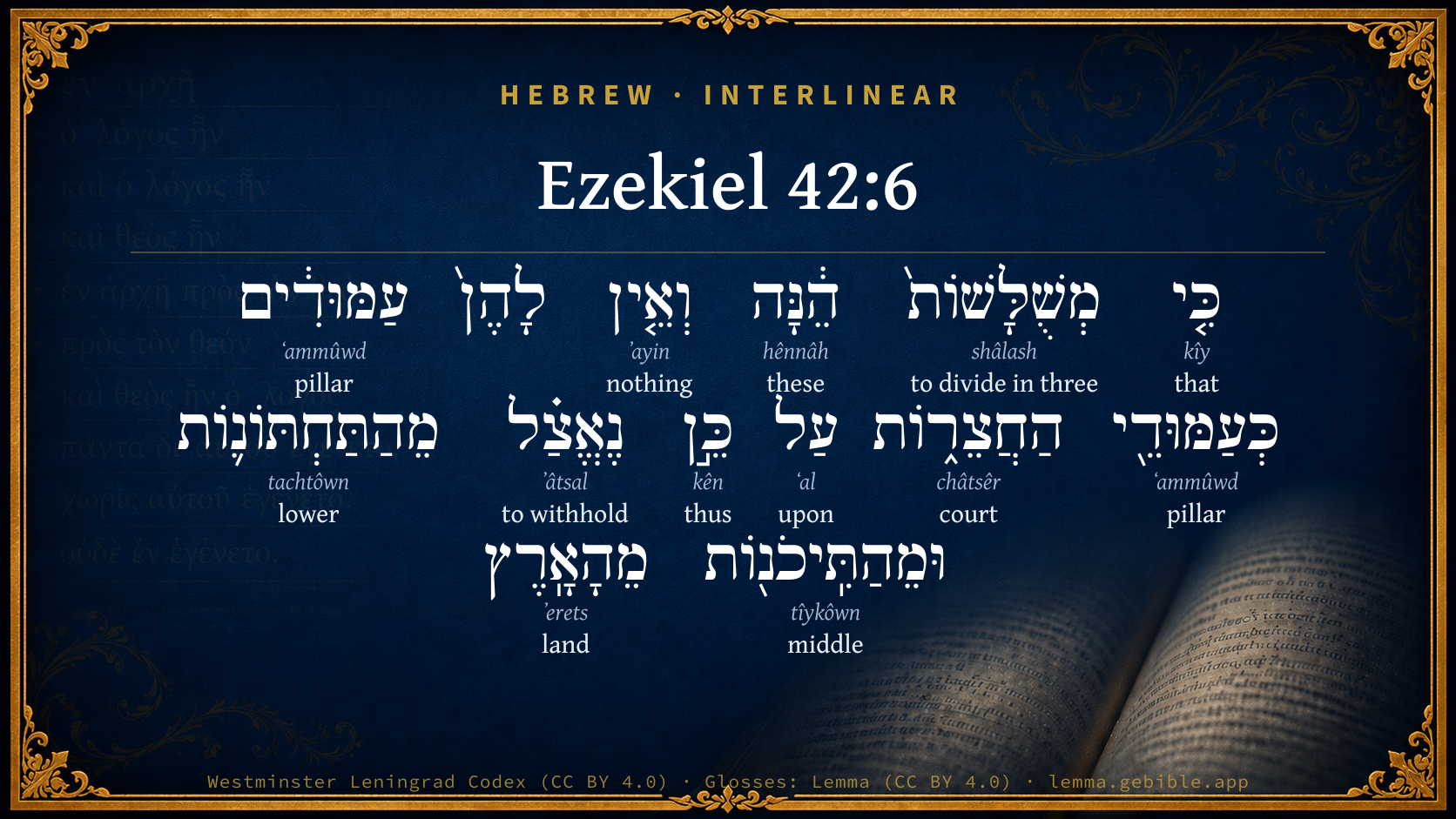
Hebrew (Westminster Leningrad Codex) Ezekiel 42:6 appears in the Hebrew Old Testament. The text above is from the Westminster Leningrad Codex. Each word links to its Strong’s number, a concise gloss, and parsing drawn from the Open Scriptures Hebrew Bible morphology. Click any word for its full Brown-Driver-Briggs (BDB) entry.
Download image
Cite this verse

Ezekiel 42:6 (World English Bible). Public Domain. Lemma interlinear Bible study tool, https://lemma.gebible.app/v/ezekiel/42/6.

Show BibTeX & RIS
BibTeX
RIS
English Translation
For they were in three stories, and they didn't have pillars as the pillars of the courts: therefore [the uppermost] was straitened more than the lowest and the middle from the ground.
World English Bible · Public Domain
Download a study sheet

One document with this verse’s original text, its word-by-word gloss line, the meaning frame, cross-references with their text, attributed commentary, and full source and license credits — printable, and it pastes into notes with its structure intact.

This verse Autodidact and up

Study sheet (.html) Plain text (.txt)

A passage Seminary Student

Up to 50 verses in one chapter. A passage sheet keeps up to 6 commentary sources and 12 cross-references per verse, in the order this page ranks them, and says so on the sheet whenever that leaves anything out. Ask for a single verse and you get the Autodidact verse sheet above.

Everything on this page stays free to read, with no account — the sheet is a download of what is already on screen, not access to it.

Want to remove ads? Support Godless Engineer
Compare translations 3

The same verse in 3 English versions, stacked beneath the original-language interlinear above. Click any original word for its lexicon entry.

Each is an independent rendering of the whole verse — the interlinear is not word-aligned to these translations.

Highlighted words mark where these versions differ — a whole-verse word diff, not a word-by-word alignment.

  • World English Bible Public Domain
    For they were in three stories, and they didn't have pillars as the pillars of the courts: therefore [the uppermost] was straitened more than the lowest and the middle from the ground.
  • King James Version Public Domain
    For they were in three stories, but had not pillars as the pillars of the courts: therefore the building was straitened more than the lowest and the middlemost from the ground.
  • unfoldingWord Literal Text CC BY-SA 4.0
    For the halls on the third story had no columns, unlike the courtyards, which did have columns. So the highest level’s rooms were smaller in size compared to the rooms in the lowest and middle levels.

unfoldingWord Literal Text — © unfoldingWord, licensed CC BY-SA 4.0. Word-aligned USFM3 via Door43 (git.door43.org/unfoldingWord/en_ult).

Versions to compare (up to 4)

3 of 4 selected

Show all 18 translations

Every available English version of this verse, each an independent rendering of the whole verse.

  • World English Bible Public Domain
    For they were in three stories, and they didn't have pillars as the pillars of the courts: therefore [the uppermost] was straitened more than the lowest and the middle from the ground.
  • Berean Standard Bible Public Domain
    For they were arranged in three stories, and unlike the courts, they had no pillars. So the upper chambers were set back further than the lower and middle floors.
  • Majority Standard Bible Public Domain
    For they were arranged in three stories, and unlike the courts, they had no pillars. So the upper chambers were set back further than the lower and middle floors.
  • King James Version Public Domain
    For they were in three stories, but had not pillars as the pillars of the courts: therefore the building was straitened more than the lowest and the middlemost from the ground.
  • American Standard Version (1901) Public Domain
    For they were in three stories, and they had not pillars as the pillars of the courts: therefore `the uppermost' was straitened more than the lowest and the middlemost from the ground.
  • Revised Version (1885) Public Domain
    For they were in three stories, and they had not pillars as the pillars of the courts: therefore the uppermost was straitened more than the lowest and the middlemost from the ground.
  • Geneva Bible (1599) Public Domain
    For they were in three rowes, but had not pillars as the pillars of the court: therefore there was a difference from them beneath and from the middlemost, euen from the ground.
  • Douay-Rheims (1899) Public Domain
    For they were of three stories, and had not pillars, as the pillars of the courts: therefore did they appear above out of the lower places, and out of the middle places, fifty cubits from the ground.
  • Young's Literal Translation Public Domain
    for they `are' threefold, and they have no pillars as the pillars of the court, therefore it hath been kept back -- more than the lower and than the middle one -- from the ground.
  • Literal Standard Version CC BY-SA 4.0
    for they [are] threefold, and they have no pillars as the pillars of the court, therefore it has been kept back—more than the lower and than the middle one—from the ground.
  • Unlocked Literal Bible CC BY-SA 4.0
    For the halls on the third story had no columns, unlike the courtyards, which did have columns. So the highest level's rooms were smaller in size compared to the rooms in the lowest and middle levels.
  • unfoldingWord Literal Text CC BY-SA 4.0
    For the halls on the third story had no columns, unlike the courtyards, which did have columns. So the highest level’s rooms were smaller in size compared to the rooms in the lowest and middle levels.
  • Darby Bible Public Domain
    For they were in three [stories], but had not pillars as the pillars of the courts; therefore [the third story] was straitened more than the lowest and the middle-most from the ground.
  • World Messianic Bible Public Domain
    For they were in three stories, and they didn’t have pillars as the pillars of the courts. Therefore the uppermost was set back more than the lowest and the middle from the ground.
  • Webster's Bible Public Domain
    For they were in three stories, but had not pillars as the pillars of the courts: therefore the building was straitened more than the lowest and the middlemost from the ground.
  • Free Bible Version CC BY-SA 4.0
    Since they didn't have pillars like the courtyards, the upper rooms were set farther back than the lower and middle levels.
  • Bible in Basic English Public Domain
    For they were on three floors, and they had no pillars like the pillars of the outer square; so the highest was narrower than the lowest and middle floors from the earth level.
  • JPS Tanakh (1917) Public Domain
    For they were in three stories, and they had not pillars as the pillars of the courts; therefore room was taken away from the lowest and the middlemost, in comparison with the ground.

Literal Standard Version (2020), Covenant Press — licensed CC BY-SA 4.0. Text via the HelloAO Bible API (eBible.org). Unlocked Literal Bible (unfoldingWord) — licensed CC BY-SA 4.0. Text via the HelloAO Bible API (eBible.org). unfoldingWord Literal Text — © unfoldingWord, licensed CC BY-SA 4.0. Word-aligned USFM3 via Door43 (git.door43.org/unfoldingWord/en_ult). Free Bible Version, Dr. Jonathan Gallagher — licensed CC BY-SA 4.0. Text via the HelloAO Bible API (eBible.org).

Word by word

More ways to search: Search by grammar → Find every occurrence → Compare this word →

Practice this passage: Drill this verse → Learn its vocabulary →

נֶאֱצַ֗ל
ʼâtsal
H680
“to withhold”
Verb, Niphal, Perfect, 3rd Person, Masculine, Singular
Part of Speech
Verb
Stem
Niphal
Form
Perfect
Person
3rd Person
Gender
Masculine
Number
Singular
Full BDB Definition

Origin: a primitive root

TWOT: 153

to lay aside, reserve, withdraw, withhold - (Qal) to reserve, set apart, withhold - (Niphal) to be withdrawn - (Hiphil) to withdraw
  1. כִּ֤י kîy H3588 “that” Conjunction
  2. מְשֻׁלָּשׁוֹת֙ shâlash H8027 “divided in three” Verb, Pual, Participle Passive, Feminine, Plural, Absolute
  3. הֵ֔נָּה hênnâh H2007 “these” Pronoun, Personal, 3rd Person, Feminine, Plural
  4. וְאֵ֤ין ʼayin H369 “and · nothing” Conjunction + Particle, Negative
  5. עַמּוּדִ֔ים ʻammûwd H5982 “pillars” Noun, Common, Masculine, Plural, Absolute
  6. כְּעַמּוּדֵ֖י ʻammûwd H5982 “like/as · pillars of” Preposition + Noun, Common, Masculine, Plural, Construct
  7. הַחֲצֵר֑וֹת châtsêr H2691 “the · courts” Particle, Definite Article + Noun, Common, Both, Plural, Absolute
  8. עַל ʻal H5921 “upon” Preposition
  9. כֵּ֣ן kên H3651 “thus” Particle, Demonstrative
  10. מֵהַתַּחְתּוֹנ֛וֹת tachtôwn H8481 “from · the · lower” Preposition + Particle, Definite Article + Adjective, Adjective, Feminine, Plural, Absolute
  11. וּמֵהַתִּֽיכֹנ֖וֹת tîykôwn H8484 “and · from · the · middle” Conjunction + Preposition + Particle, Definite Article + Adjective, Adjective, Feminine, Plural, Absolute
  12. מֵהָאָֽרֶץ ʼerets H776 “from · the · land” Preposition + Particle, Definite Article + Noun, Common, Both, Singular, Absolute

About this verse

These counts appear in no published source. They are computed here, from the morphology-tagged text and Lemma’s own curated glosses. What Lemma adds →

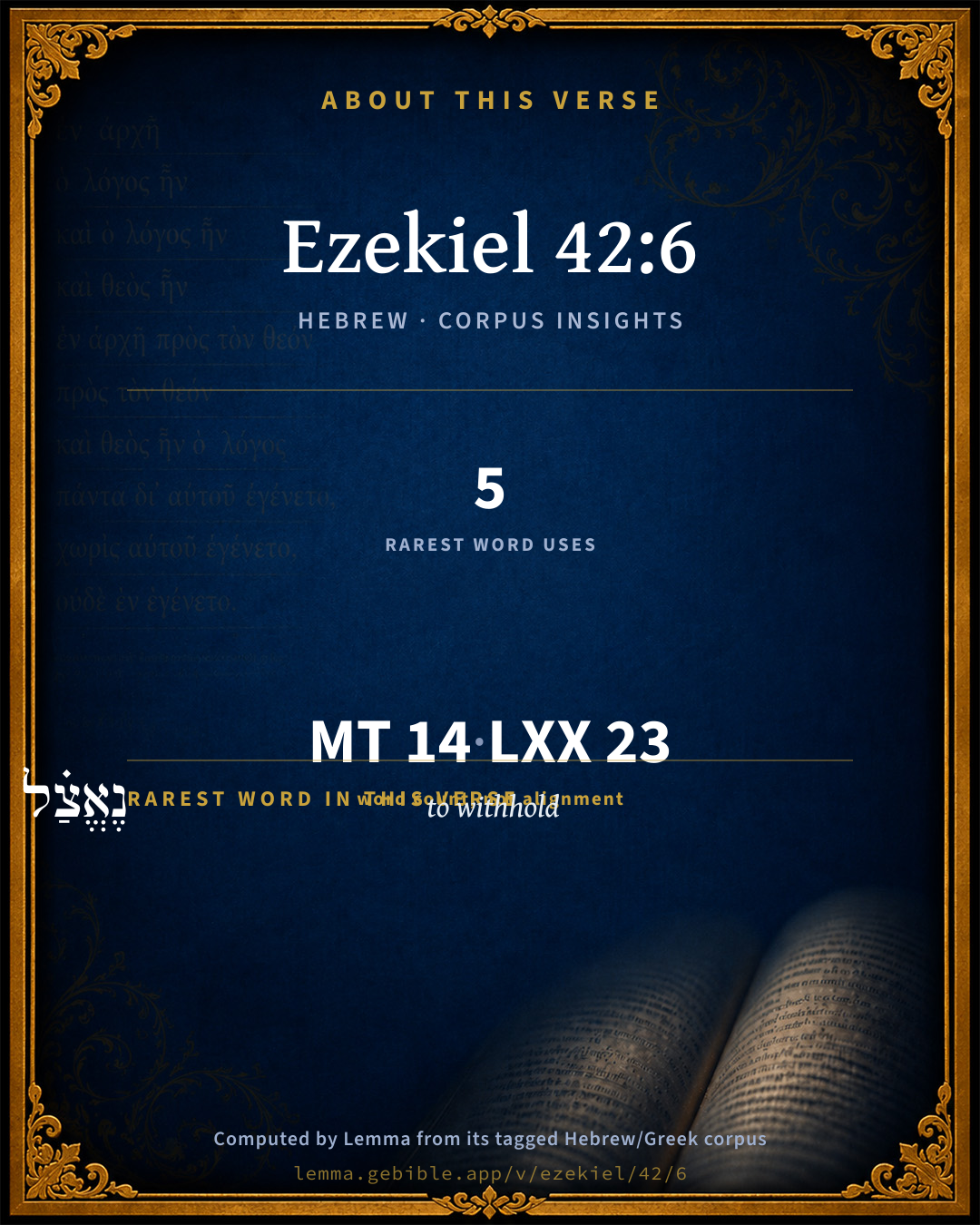
14
words
12
distinct lemmas
Prophets
section

Notable vocabulary

The rarest word here is נֶאֱצַ֗ל to withhold H680 — appearing just 5 times in the whole Hebrew Bible.

Shared distinctive vocabulary

נֶאֱצַ֗ל to withhold H680 occurs in 5 verses of the Hebrew Bible. Also found in:

Grammatical profile

  • 2 verbs
  • 4 nouns
  • 2 adjectives
  • 1 pronoun
  • 2 prepositions
  • 1 conjunction
  • 2 particles

Verb forms

  • מְשֻׁלָּשׁוֹת֙ Pual · Participle Passive
  • נֶאֱצַ֗ל Niphal · Perfect

Repetition

A word recurs within this verse — often emphatic in Hebrew:

  • עַמּוּדִ֔ים pillar H5982 ×2

Hebrew & Septuagint length

In English translation the verse runs 32 words from the Hebrew and 30 from the Septuagint (LXX English) — closely comparable.

A rough comparison of the two English renderings, which tokenize alike — not a word-level alignment.

Word counts can differ between the Hebrew and the Greek without any difference in meaning — e.g. the Hebrew direct-object marker אֵת has no separate Greek word, and Greek often adds the article ὁ.

In the original languages it is 14 Hebrew tokens and 23 Greek tokens — but the two are counted differently (Hebrew bundles its prefixes and suffixes into one token; the Greek is in lemma form), so that isn’t a like-for-like length.

Cross-references

2

Topical passages linked to Ezekiel 42:6 in the Treasury of Scripture Knowledge — connected by theme and wording, ordered by reader-vote popularity; previews shown in the World English Bible.

  • Ezekiel 41:6 The side-chambers were in three stories, one over another, and thirty in order; and they entered into the wall which belonged to the house for the side-chambers round about, that they might have hold [therein], and not have hold in the wall of the house.
  • 1 Kings 6:8 The door for the middle side-chambers was in the right side of the house: and they went up by winding stairs into the middle [story], and out of the middle into the third.

Cross-references courtesy of OpenBible.info (CC BY 4.0).

Hebrew and Greek witnesses Masoretic Hebrew ↔ Greek Septuagint

The same verse in the two great witnesses to the Old Testament, shown verse-for-verse.

These are two independent witnesses, not word-aligned to each other, and the Septuagint is shown in lemma (dictionary) form.

Hebrew Ezekiel 42:6 Masoretic · Westminster Leningrad Codex

כִּ֤י מְשֻׁלָּשׁוֹת֙ הֵ֔נָּה וְאֵ֤ין לָהֶן֙ עַמּוּדִ֔ים כְּעַמּוּדֵ֖י הַחֲצֵר֑וֹת עַל כֵּ֣ן נֶאֱצַ֗ל מֵהַתַּחְתּוֹנ֛וֹת וּמֵהַתִּֽיכֹנ֖וֹת מֵהָאָֽרֶץ

For they were in three stories, and they didn't have pillars as the pillars of the courts: therefore [the uppermost] was straitened more than the lowest and the middle from the ground.

World English Bible · Public Domain

Greek LXX Ezekiel 42:6 Septuagint · lemma form

διότι τριπλόος εἰμί καί στῦλος οὐ ἔχω καθώς ὁ στῦλος ὁ ἐξώτερος διά οὗτος ἐκἔχω ὁ ὑποκάτωθεν καί ὁ μέσος ἀπό ὁ γῆ

For they were triple, and they had not pillars like the pillars of the outer ones: therefore they projected from the lower ones and the middle ones from the ground.

LXX2012 (modern English Septuagint) · Public Domain

On this verse, The Cambridge Bible for Schools and Colleges discusses the Septuagint’s reading. Read the note in Commentary ↓

Hebrew: Westminster Leningrad Codex (CC BY 4.0). Greek: Septuagint (public domain); English from LXX2012 (modern English Septuagint) (Public Domain). How the Septuagint differs from the Hebrew →

Targum (Aramaic paraphrase)

1

The Targum is the ancient Jewish Aramaic paraphrase of the Hebrew Scriptures — an interpretive translation, not the Hebrew text itself. Onkelos (literal) and Pseudo-Jonathan (expansive) render the Torah, and Jonathan the Prophets. Coverage is partial: where no permissively-licensed English translation exists for a verse, only the Aramaic is shown. This is verse-level text, not a word-by-word alignment to the Hebrew.

  1. Targum Jonathan Prophets (Joshua–Malachi)
    אֲרֵי מִתַּלְתָּן אִינוּן וְלֵית לְהוֹן עַמוּדִין כְּעַמוּדֵי דָרָתָא עַל כֵּן דְחִיקָן מֵאַרְעֲיָתָא וּמִמְצִיעָתָא מֵאַרְעָא:

    (no public-domain English translation for this verse)

    Targum Jonathan — Aramaic: “Mikraot Gedolot” (public domain). English: “Sefaria Community Translation” (CC0 1.0 (public-domain dedication)); “London "Chaldee Paraphrase," 1871” (public domain). Text via Sefaria.

Commentary

Notes on Ezekiel 42:6 from classic Christian and Jewish commentators (each source and its license shown beneath its notes). The classic Christian expositions comment on the surrounding passage and are grouped to its opening verse, so a note may address several verses; the Jewish commentaries on the Tanakh (Rashi and others) are per-verse, so they appear only where the commentator wrote on this verse.

Lemma curates 59 commentaries, every one of them public domain or Creative Commons licensed, each selected and text-cleaned for this edition rather than reprinted as found. About our sources →

Trapp's Complete Commentary

John Trapp

Eze 42:6 For they [were] in three [stories], but had not pillars as the pillars of the courts: therefore [the building] was straitened more than the lowest and the middlemost from the ground.

Ver. 6. Therefore the building was straitened.] As the rules of architecture direct, and as right reason required, lest the building should shrink under its own burden. Ne structura pondere dissiliret.

John Trapp, A Commentary or Exposition upon All the Books of the Old and New Testament (1647–1656) — public domain. Text from a community e-Sword module.

Ellicott's Commentary for English Readers

(6) As the pillars of the courts.—This statement is introduced to show that as there was no external support for the galleries, they must have been taken from the width of the chambers; but it gives incidentally the interesting information that there were pillars in the courts. These could not have been the ornamental pillars at the entrance of the various porches, for the connection implies that they supported something. It is quite likely, therefore, that there were cloisters around the inside of the wall of the courts (on the pavement), as in the later Temple.

A Bible Commentary for English Readers, edited by Charles John Ellicott (1878–1897) — public domain. Text from a community e-Sword module.

The Cambridge Bible for Schools and Colleges

gen. ed. J. J. S. Perowne

6. the pillars of the courts] LXX. reads: pillars of the outer ones, i.e. the chambers in the outer court. Probably there is a transcriptional error here, cf. Eze_41:15.

was straitened] lit. there was (room) taken away from the lowest … from the ground. The last words seem in apposition with “lowest,” and refer to the ground area. The verse indicates that the chambers in the outer court had pillars, and that the three stories were all of the same dimensions.

The Cambridge Bible for Schools and Colleges (gen. ed. J. J. S. Perowne; Cambridge University Press, 1878–1918) — public domain. Text from a community e-Sword module.

John Gill's Exposition

For they were in three stories,.... Not only the galleries or posts, but the chambers; they were one over another; there were the lowermost, middlemost, and uppermost; which, as before, may denote the difference in churches, and the different states, conditions, and characters of those that are in them; some being fathers, others young men, and others little children: or their different offices and relations; some being pastors, others deacons, and others private members: or their knowledge of and profession of faith in the doctrine of the Trinity, the mystery of God, and of the Father, and of Christ; and their being baptized in the name of the three divine Persons; and their being built on Christ the foundation, a habitation for God through the Spirit:

but had not pillars as the pillars of the courts; those which supported the porticos and galleries in the courts of the temple, not pillars so thick and strong as they: so the churches represented by these chambers, though they have Gospel ministers, which are as pillars, and valuable members, which are as such, that shall not go out; yet they have not those external supports from great and rich men, but consist generally of the poor of this world, as churches on a civil establishment have, who are supported by the state:

therefore the building was straitened more than the lowest and the middlemost from the ground; the upper part of it, or the uppermost chambers, were more straitened, and had less room in them, than the middlemost, and the middlemost than the lowest; suggesting, that the more heavenly and spiritual men are, the farther they depart from the men of the world and their conversation, from the sentiments and practices of natural men, the more they are exposed to their scorn and contempt, and are the more afflicted and straitened by them.

John Gill's Exposition of the Whole Bible (1746–1763) — public domain (CC PDM 1.0). Text via the HelloAO Bible API.

Albert Barnes' Notes on the Bible

The front of the higher stories was not supported on pillars, but there was a narrowing from “the lowest” (chambers) “and” from “the middlemost” (chambers) “from the ground.”

Albert Barnes' Notes on the Bible (1834–1885) — public domain. Text from a community e-Sword/MySword module.

Haydock's Catholic Bible Commentary

Fifty cubits. We only allow thirty, as this is not in Hebrew, &c. The text, ver. 10., and 12., seems incorrect. (Calmet)

George Leo Haydock (1774–1849), Haydock's Catholic Family Bible and Commentary, 1859 edition — public domain. Excludes Psalms (Douay-Rheims chapter numbering differs from Protestant) and Deuterocanonical books (Catholic canon only).

Matthew Poole's English Annotations

In three stories; built high one over another.

As the pillars of the courts; as thick and strong as those were, but of the slenderer and weaker make.

The building, the highest room of the building, was straitened; was laid at nearer distance than the middlemost from the lowest, or than the roof of the lowest from the ground.

Matthew Poole's English Annotations on the Holy Bible (1683–1685) — public domain. Text from a community e-Sword/MySword module.

The Pulpit Commentary

Verse 6 supplies the reason for this shortening of the upper stories. The chambers had not pillars (see on Eze_40:49) as the courts had. Though it is not otherwise stated, these appear to have had colonnades like these in the Herodian (Josephus, "Aut.," 15. 11. 5) and probably also the Solomonic temple; (Act_3:11) and hence the second and third stories required to recede in order to find supports for their respective galleries.

The Pulpit Commentary (1880–1919), ed. H.D.M. Spence-Jones & Joseph S. Exell — public domain. Text from a community e-Sword module.

John Wesley's Explanatory Notes

As the pillars - So thick and strong as those were.

John Wesley, Explanatory Notes Upon the Whole Bible (1754–1765) — public domain. Text via the GEBible commentary corpus.

Lesson kit

Teaching starters — assembled from the data on this page, not authored interpretation. Every prompt links to the verse data it draws on. Edit before teaching.

Ezekiel, in the Prophets, opens this verse with 14 words (12 distinct Hebrew lemmas). Its most distinctive word is ʼâtsal (“to withhold”). A historical commentator’s framing appears above. Read the whole chapter for the surrounding context.

Discussion questions

  1. The word ʼâtsal carries the sense “to withhold.” How does it shape the verse?
  2. How does Genesis 27:36, which shares the word «to withhold», read alongside this verse?
  3. What does the repetition of “pillar” (2× in this one verse) do in this verse?
  4. These translations render this verse differently; the difference is in the English rendering, not the original. What questions does that raise?
  5. «מְשֻׁלָּשׁוֹת֙» is a Pual Participle Passive verb. How does that grammatical form shape the action described?
  6. Compare how Trapp's Complete Commentary and Ellicott's Commentary for English Readers read this verse. Where do they agree or differ?

Things to notice

Reading settings

Reading text

Shown beneath each verse's original-language words.

Old Testament
Old Testament edition

Read the OT as the Masoretic Hebrew (MT) or the Greek Septuagint (LXX).

English shown for the Greek Septuagint (in the Hebrew ↔ Greek comparison).

Comparing translations? Open the Compare panel on any verse page to stack up to four side by side.