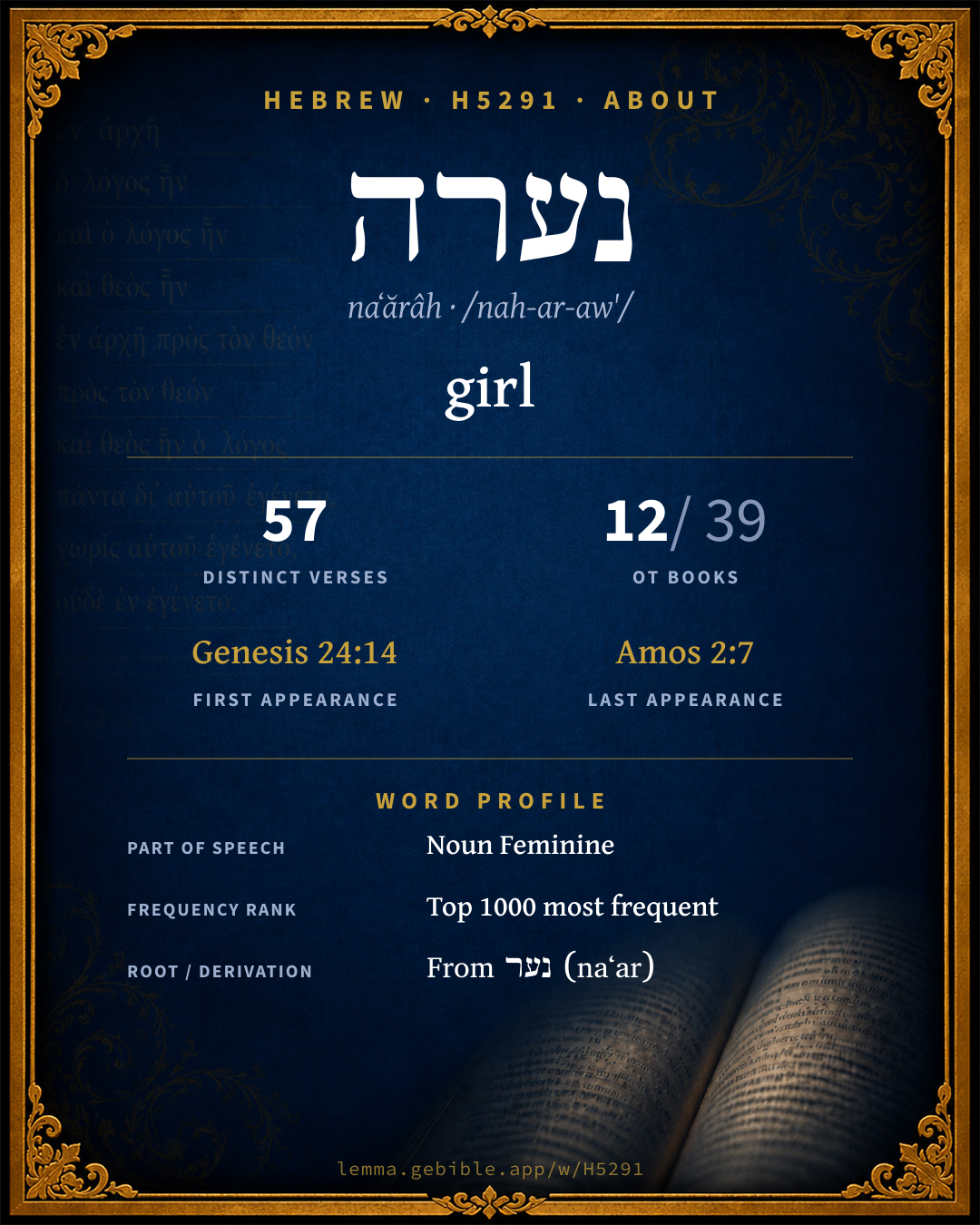
נַעֲרָה
girl
also: damsel, female servant fuller range ↓
Full lexicon entry — Brown-Driver-Briggs (BDB)
From Brown-Driver-Briggs (BDB)
Where this word appears
Grammar key — what these labels mean
Part of speech
- Noun
- A naming word — a person, place, thing, or idea.
Noun type
- Common
- A common noun — a general class of person, place, or thing (“king,” “city,” “water”), not a specific name.
State
- Absolute
- The independent form of a noun, not bound to a following word.
- Construct
- A noun bound to a following noun in a possessive / “of” relationship (the construct chain).
Gender
- Feminine
- Grammatically feminine.
Number
- Singular
- One.
- Plural
- More than one (in Hebrew, generally three or more).
Every verse where H5291 appears in the Book of Deuteronomy — 12 distinct verses. Click any verse to open its interlinear word-by-word view. Verse text shown in the World English Bible for context — . Each verse’s Hebrew form is shown with its reference; the English is not keyword-highlighted, since the data carries no word-level English alignment. Use “Compare translations” on any verse to read it across multiple English versions. This concordance covers the Hebrew Bible; Septuagint (Greek Old Testament) occurrences are not indexed here.
Deuteronomy
- Deuteronomy 22:15 ה/נער הַֽ/נַּעֲרָ֖ה ה/נער הַֽ/נַּעֲרָ֛ה ptcl def.art + n c fs ptcl def.art + n c fs ptcl def.art + n c fs ptcl def.art + n c fs then shall the father of the young lady, and her mother, take and bring forth the tokens of the young lady's virginity to the elders of the city in the gate;
- Deuteronomy 22:16 ה/נער הַֽ/נַּעַרָ֖ה ptcl def.art + n c fs ptcl def.art + n c fs and the young lady's father shall tell the elders, I gave my daughter to this man to wife, and he hates her;
- Deuteronomy 22:19 הַֽ/נַּעֲרָ֔ה ptcl def.art + n c fs and they shall fine him one hundred [shekels] of silver, and give them to the father of the young lady, because he has brought up an evil name on a virgin of Israel: and she shall be his wife; he may not put her away all his days.
- Deuteronomy 22:20 ל/נער לַֽ/נַּעֲרָֽה prep det + n c fs prep det + n c fs But if this thing be true, that the tokens of virginity were not found in the young lady;
- Deuteronomy 22:21 ה/נער הַֽ/נַּעֲרָ֜ה ptcl def.art + n c fs ptcl def.art + n c fs then they shall bring out the young lady to the door of her father's house, and the men of her city shall stone her to death with stones, because she has done folly in Israel, to play the prostitute in her father's house: so shall you put away the evil from the midst of you.
- Deuteronomy 22:23 נער נַעֲרָ֣ה n c fs n c fs If there be a young lady who is a virgin pledged to be married to a husband, and a man find her in the city, and lie with her;
- Deuteronomy 22:24 ה/נער הַֽ/נַּעֲרָ֗ה ptcl def.art + n c fs ptcl def.art + n c fs then you shall bring them both out to the gate of that city, and you shall stone them to death with stones; the lady, because she didn't cry, being in the city; and the man, because he has humbled his neighbor's wife: so you shall put away the evil from the midst of you.
- Deuteronomy 22:25 ה/נער הַֽ/נַּעֲרָה֙ ptcl def.art + n c fs ptcl def.art + n c fs But if the man find the lady who is pledged to be married in the field, and the man force her, and lie with her; then the man only who lay with her shall die:
- Deuteronomy 22:26 ו/ל/נער וְ/לַֽ/נַּעֲרָה֙ ל/נער לַֽ/נַּעֲרָ֖ה conj + prep det + n c fs conj + prep det + n c fs prep det + n c fs prep det + n c fs but to the lady you shall do nothing; there is in the lady no sin worthy of death: for as when a man rises against his neighbor, and kills him, even so is this matter;
- Deuteronomy 22:27 ה/נער הַֽ/נַּעֲרָה֙ ptcl def.art + n c fs ptcl def.art + n c fs for he found her in the field, the pledged to be married lady cried, and there was none to save her.
- Deuteronomy 22:28 נער נַעֲרָ֤ה n c fs n c fs If a man find a lady who is a virgin, who is not pledged to be married, and lay hold on her, and lie with her, and they be found;
- Deuteronomy 22:29 ה/נער הַֽ/נַּעֲרָ֖ה ptcl def.art + n c fs ptcl def.art + n c fs then the man who lay with her shall give to the lady's father fifty [shekels] of silver, and she shall be his wife, because he has humbled her; he may not put her away all his days.
About this entry
At a glance — auto-summarized from this page’s data, not written by a person. Every figure links to its source below. This summary describes the numbers; it doesn’t interpret them.
The Hebrew noun נערה centers on the idea of “girl.” Where the King James Version says “damsel,” newer translations reach for “girl” (Berean Standard Bible) and “young woman” (unfoldingWord Literal Text); the renderings breakdown has the detail. It appears 57 verses across 12 books of the Hebrew Bible, among its moderately common vocabulary. Debuting at Genesis 24:14, it then recurs through the corpus. Alongside “girl” the lexicon also lists “damsel” and “female servant” — part of its full sense range. For the data behind this summary, explore the sense tree and the renderings breakdown below.
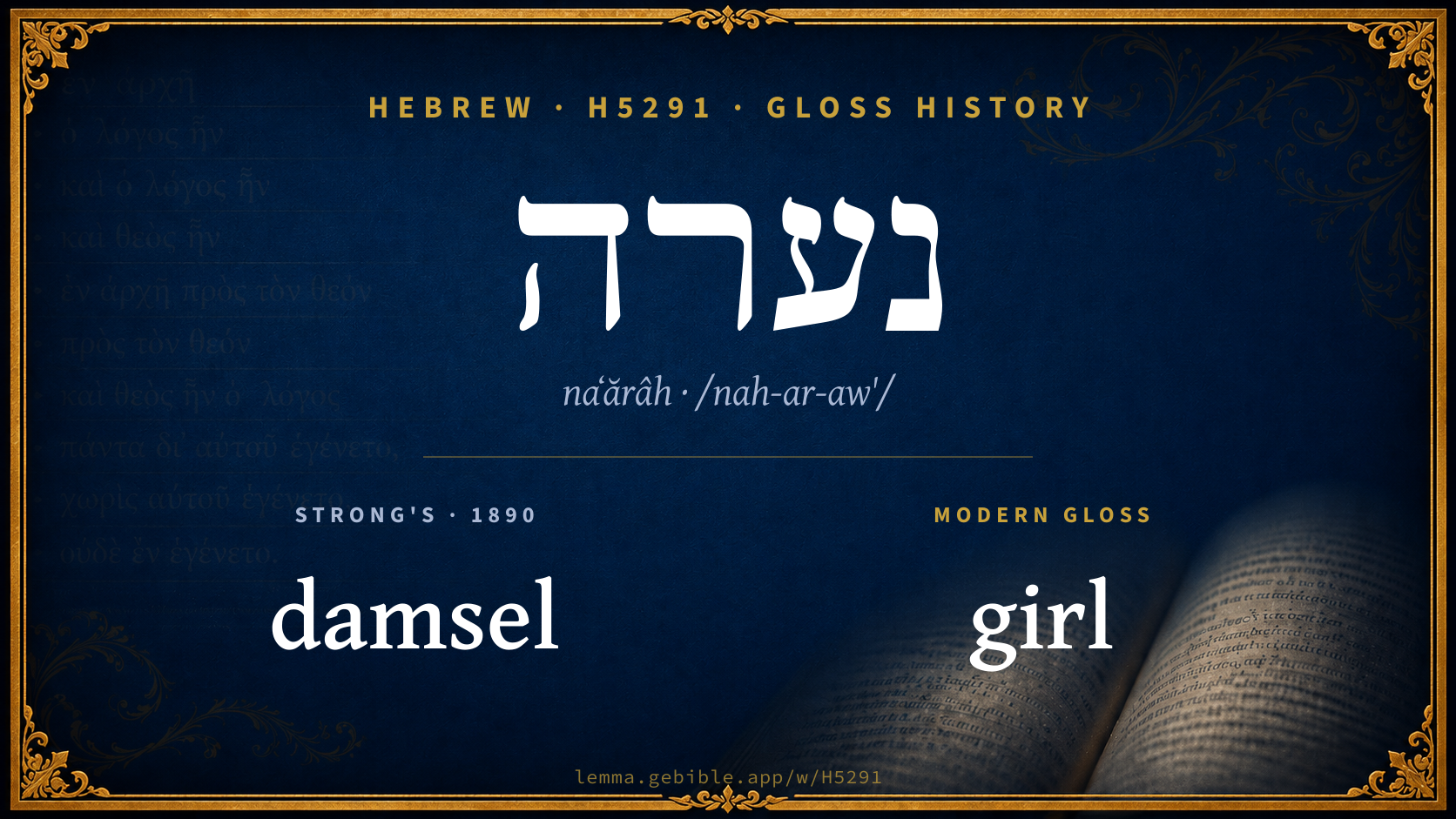
Gloss history
Strong's 1890 vs modern scholarship
About this word
Strong's H5291 catalogs a Hebrew word from the Hebrew Old Testament.
These counts are not copied from any lexicon or concordance. They are computed here, from the morphology-tagged Hebrew Old Testament. What Lemma adds →
- 57
- distinct verses
- The word appears in 57 distinct verses.
- 12 / 39
- OT books
- The word appears in 12 of 39 Old Testament books.
- #523
- by frequency
- Top 1000 most frequent Hebrew words (rank 523 of 8,640 Hebrew words by occurrence).
View all 57 occurrences in the concordance →
Most concentrated in
- Deuteronomy 12 verses 21%
- Esther 10 verses 18%
- Genesis 8 verses 14%
By section of the Old Testament
By traditional corpus
Conventional, traditional groupings — biblical authorship is debated, so this is a traditional corpus grouping, not an authorship claim. Each share is this word’s portion of its verses in that division of the Hebrew canon. Each figure is a share of the word’s 57 distinct verses.
- Torah (Pentateuch) 21 verses · 37%
- Writings (Ketuvim) 21 verses · 37%
- Prophets (Nevi'im) 15 verses · 26%
How translations render this word
Counts come from each version’s own published word-to-Strong’s tagging or interlinear alignment — an approximate guide to how each version renders this word, not a word-level alignment the data otherwise carries. Because each total is that version’s own tagged count, the per-version totals vary from one another and need not match the appearance or distinct-verse counts above. These counts may also differ from a printed concordance because Lemma counts each distinctly tagged rendering and does not collapse phrase taggings into a single head-word total. This is a fixed set of word-tagged versions (KJV, ASV, BSB, ULT) and does not change with the reading translation you choose elsewhere. Each version’s license is shown beside its name below (and on Sources).
BDB lists this Strong’s number as 2 distinct words (homographs). Each count above pools all of them and is not split by sense — see the Senses section below. A low-frequency rendering may belong to a different one of those words, not the primary meaning.
- King James Version†: Damsel 21×, Maidens 10×, Damsel's 7×
- American Standard Version†: Damsel 23×, Maidens 11×, Maiden 5×
- Berean Standard Bible†: Girl 8×, Young woman 7×, Girl’s 5×
- unfoldingWord Literal Text†: Young woman 24×, Girl 16×, Young women 11×
King James Version Public Domain
Renders H5291 across 62† tagged occurrences — most commonly:
Plus 13 renderings that appear only once — usually multi-word phrases or single function words the recovered tagging swept in, not distinct renderings.
American Standard Version Public Domain
Renders H5291 across 62† tagged occurrences — most commonly:
Plus 16 renderings that appear only once — usually multi-word phrases or single function words the recovered tagging swept in, not distinct renderings.
Berean Standard Bible Public Domain
Renders H5291 across 56† tagged occurrences — most commonly:
Plus 13 renderings that appear only once — usually multi-word phrases or single function words the recovered tagging swept in, not distinct renderings. Not rendered by a distinct English word in 5 further occurrences.
unfoldingWord Literal Text CC BY-SA 4.0
Renders H5291 across 73† tagged occurrences — most commonly:
Plus 11 renderings that appear only once — usually multi-word phrases or single function words the recovered tagging swept in, not distinct renderings.
Senses in the full BDB
What do BDB’s symbols mean?
BDB uses these scholarly abbreviations:
| Symbol | Meaning |
|---|---|
| 𝔊 | the Septuagint (the ancient Greek translation, LXX) |
| 𝔙 | the Vulgate (the Latin translation) |
| 𝔖 | the Syriac version (the Peshitta) |
| 𝔗 | the Targum (the Aramaic translation) |
| ψ | the Psalms |
| √ | root (the underlying root or stem) |
| ‖ | parallel passage (a synonymous or contrasted parallel) |
| † | the dagger: every passage where the word occurs is cited |
The 3 senses and sub-senses the full Brown-Driver-Briggs lexicon distinguishes for this word, in lexicon order (not ranked by frequency), with BDB’s own verbatim wording and sub-sense lettering. Shown in Hebrew script with BDB’s own scholarly abbreviations. The condensed entry is in the Lexicon Entry tab. See also the Forms in the corpus table below.
נערה I girl, damsel
- 1. girl, damsel; נ׳ קְטַנָּה little girl only 2 K 5:2, cf. v 4, perhaps = young daughters Jb 40:29; elsewhere = young woman 1 S 9:11; especially as marriageable, Gn 24:14, 16, 28, 55, 57; 34:3, 12 (all J), Dt 22:15(×2), 16, 19, 20, 21, 24, 26(×2), 29; 1 K 1:3, 4; Est 2:4, 7, 8, 9, 12(×2), 13; specif. virgin נ׳ בְּתוּלָה Ju 21:12; Dt 22:23, 28; 1 K 1:2; Est 2:2, 3 (cf. Dt 22:15b, 20); נ׳ מְאֹרָשָׂה betrothed girl Dt 22:25, 27; young widow Ru 2:6; 4:12; of a concubine Ju 19:3, 4, 5, 6, 8, 9, a prostitute Am 2:7. e.g. 2 Kings 5:2
- 2. of female attendants, maids (always pl.), Gn 24:61 (J), Ex 2:5 (E), 1 S 25:42; Pr 9:3; 27:27; 31:15; Est 2:9(×2); 4:4, 16; gleaner(s) Ru 2:5, 8, 22, 23; 3:2.— e.g. Genesis 24:61
- נער Kt in Pent. as fem. (Qr נַעֲ֯רָ is prob. not original; it is not found in Sam. Pent., and fpl. נַעֲרֹתֶיהָ occurs Gn Ex; cf. Ges§§ 2 n., 17 c.
נערה II loc. on border of Ephr.
Senses from the full Brown-Driver-Briggs lexicon (Brown, Driver, Briggs; Oxford 1906 — public domain), digitized via Sefaria, supplemented by the OpenScriptures HebrewLexicon (CC BY 4.0). Full attribution on Sources.
Word origin
I. n.f. girl, damsel;—abs. נ׳ Ju 19:3 + 22 times, also Qr Gn 24:14 + 20 times Gn Dt (נַעֲרָה Kt in Pent. only Dt 22:19, v. infr.); pl. abs. נְעָרוֹת 1 S 9:11 +, cstr. נַעֲרוֹת Est 4:4; sf. נַעֲרוֹתָיו Ru 2:22; 3:2, נַעֲרֹתֶיהָ Gn 24:61; Ex 2:5, etc.;—
II. n.pr.loc. on border of Ephr.:—only c. ה loc., נַעֲרָ֫תָה Jos 16:7 (𝔊 αἱ κῶμαι αὐτῶν; 𝔊L id. + Αναραθα); appar. = נַעֲרָן, q.v. infr.; Νοοραθ lay 5 Rom. miles from Jericho LagOnom. 283, 11 cf. BuhlGeogr. 181.
— Brown-Driver-Briggs (Oxford 1906, public domain), digitized via Sefaria, supplemented by the OpenScriptures HebrewLexicon (CC BY 4.0). See Sources.
Derived from נער (naʻar) (H5288) — boy.
Forms in the corpus
The 48 distinct written forms H5291 takes in the Hebrew Bible, most frequent first — each parse links to that state’s occurrences in the concordance. Hebrew forms include their vowel points and cantillation, so a single lemma takes many written forms.
Same root — word family
Other BDB entries built from the same root as H5291, grouped by Strong’s listed origin. These share a root / origin per the lexicon — not necessarily a shared meaning. Each links to that word’s own entry.
Derives from
Shares the same root
Proper names from this root
People and places named from this root — a name, not an additional meaning of the word.
- נערי Naʻăray H5293 Naarai
- נעריה Nᵉʻaryâh H5294 Neariah
- נערן Naʻărân H5295 Naaran
- ענר ʻÂnêr H6063 Aner
- נערה Naʻărâh H5292 Naarah
Compare all same-root words → Showing 4 of 8 — not the complete family. 5 of the same-root words are proper names (people or places). They share a root, not necessarily a meaning.
Septuagint verse parallels
This word appears in 57 verses that also exist in the Greek Old Testament (Septuagint), out of the 57 Hebrew verses it occurs in. You can read those verses in Greek by switching the Old Testament edition to the Septuagint.
Read these verses in the Septuagint
- Genesis 24:14
- Exodus 2:5
- Deuteronomy 22:15
- Judges 19:3
- Ruth 2:5
- 1 Samuel 9:11
- 1 Kings 1:2
- 2 Kings 5:2
- Esther 2:2
- Job 41:5
- Proverbs 9:3
- Amos 2:7
This is a verse-level parallel only — the same verses exist in both the Hebrew and Greek Old Testaments. No word-level Hebrew↔Greek correspondence is claimed: the data carries no such alignment, so no Greek word is shown as this Hebrew word’s translation. Coverage is not total — the Septuagint omits the deuterocanon and renumbers the Psalms, so some Hebrew verses have no direct Greek parallel.