
Proverbs 9:3

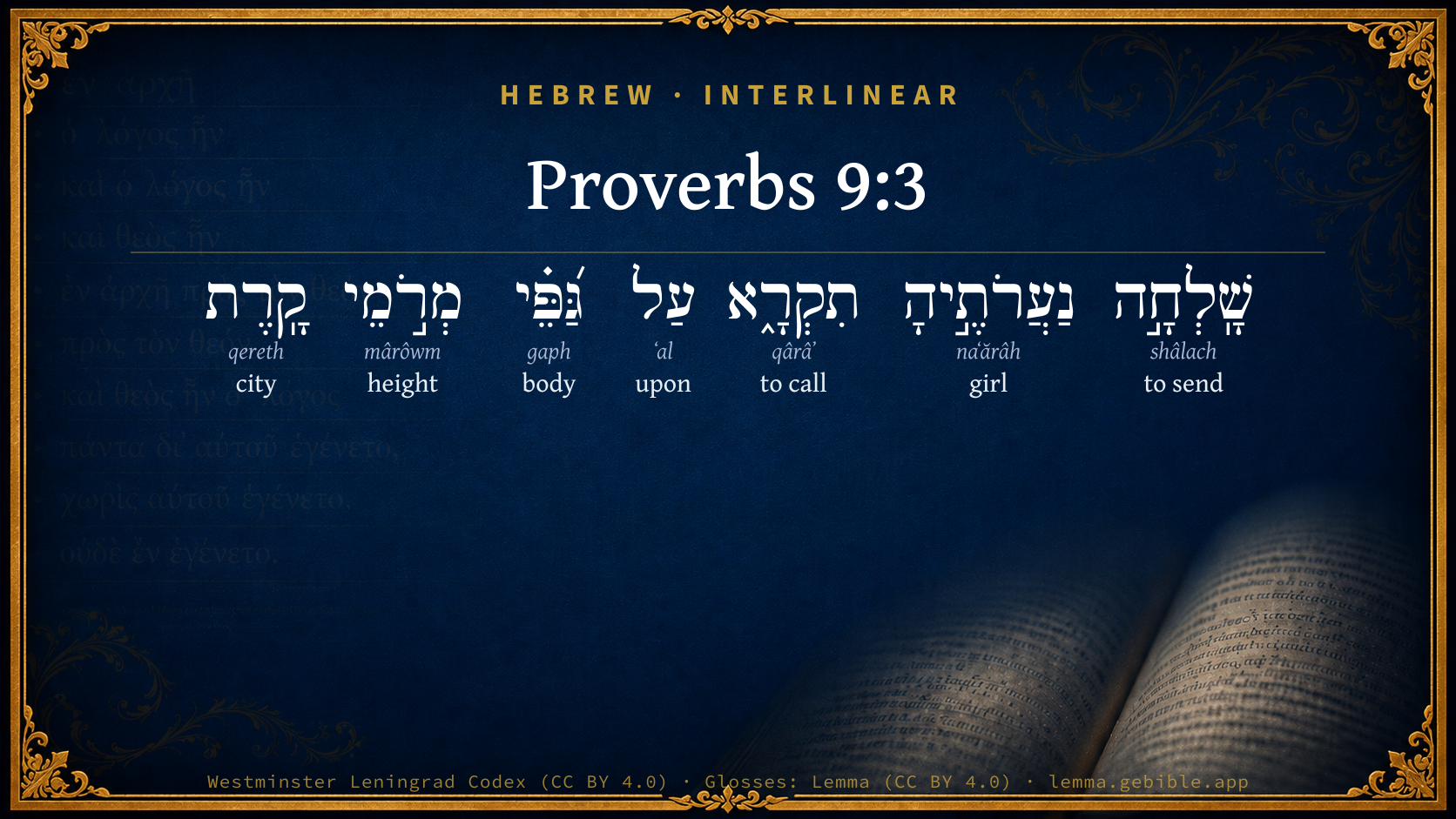
Hebrew (Westminster Leningrad Codex) Proverbs 9:3 appears in the Hebrew Old Testament. The text above is from the Westminster Leningrad Codex. Each word links to its Strong’s number, a concise gloss, and parsing drawn from the Open Scriptures Hebrew Bible morphology. Click any word for its full Brown-Driver-Briggs (BDB) entry.
Download image
Cite this verse

Proverbs 9:3 (World English Bible). Public Domain. Lemma interlinear Bible study tool, https://lemma.gebible.app/v/proverbs/9/3.

Show BibTeX & RIS
BibTeX
RIS
English Translation
She has sent out her maidens. She cries from the highest places of the city:
World English Bible · Public Domain
Download a study sheet

One document with this verse’s original text, its word-by-word gloss line, the meaning frame, cross-references with their text, attributed commentary, and full source and license credits — printable, and it pastes into notes with its structure intact.

This verse Autodidact and up

Study sheet (.html) Plain text (.txt)

A passage Seminary Student

Up to 50 verses in one chapter. A passage sheet keeps up to 6 commentary sources and 12 cross-references per verse, in the order this page ranks them, and says so on the sheet whenever that leaves anything out. Ask for a single verse and you get the Autodidact verse sheet above.

Everything on this page stays free to read, with no account — the sheet is a download of what is already on screen, not access to it.

Want to remove ads? Support Godless Engineer
Compare translations 3

The same verse in 3 English versions, stacked beneath the original-language interlinear above. Click any original word for its lexicon entry.

Each is an independent rendering of the whole verse — the interlinear is not word-aligned to these translations.

Highlighted words mark where these versions differ — a whole-verse word diff, not a word-by-word alignment.

  • World English Bible Public Domain
    She has sent out her maidens. She cries from the highest places of the city:
  • King James Version Public Domain
    She hath sent forth her maidens: she crieth upon the highest places of the city,
  • unfoldingWord Literal Text CC BY-SA 4.0
    She has sent out her young women; she calls out on the tops of the heights of the city.

unfoldingWord Literal Text — © unfoldingWord, licensed CC BY-SA 4.0. Word-aligned USFM3 via Door43 (git.door43.org/unfoldingWord/en_ult).

Versions to compare (up to 4)

3 of 4 selected

Show all 18 translations

Every available English version of this verse, each an independent rendering of the whole verse.

  • World English Bible Public Domain
    She has sent out her maidens. She cries from the highest places of the city:
  • Berean Standard Bible Public Domain
    She has sent out her maidservants; she calls out from the heights of the city.
  • Majority Standard Bible Public Domain
    She has sent out her maidservants; she calls out from the heights of the city.
  • King James Version Public Domain
    She hath sent forth her maidens: she crieth upon the highest places of the city,
  • American Standard Version (1901) Public Domain
    She hath sent forth her maidens; She crieth upon the highest places of the city:
  • Revised Version (1885) Public Domain
    She hath sent forth her maidens, she crieth upon the highest places of the city,
  • Geneva Bible (1599) Public Domain
    She hath sent forth her maydens and cryeth vpon the highest places of the citie, saying,
  • Douay-Rheims (1899) Public Domain
    She hath sent her maids to invite to the tower, and to the walls of the city:
  • Young's Literal Translation Public Domain
    She hath sent forth her damsels, She crieth on the tops of the high places of the city:
  • Literal Standard Version CC BY-SA 4.0
    She has sent forth her girls, || She cries on the tops of the high places of the city:
  • Unlocked Literal Bible CC BY-SA 4.0
    She has sent out her maids; she calls out from the highest points of the city,
  • unfoldingWord Literal Text CC BY-SA 4.0
    She has sent out her young women; she calls out on the tops of the heights of the city.
  • Darby Bible Public Domain
    she hath sent forth her maidens: she crieth upon the summits of the high places of the city,
  • World Messianic Bible Public Domain
    She has sent out her maidens. She cries from the highest places of the city:
  • Webster's Bible Public Domain
    She hath sent forth her maidens: she crieth upon the highest places of the city,
  • Free Bible Version CC BY-SA 4.0
    She has sent out her servant girls with invitations. She calls out from the highest places of the town,
  • Bible in Basic English Public Domain
    She has sent out her women-servants; her voice goes out to the highest places of the town, saying,
  • JPS Tanakh (1917) Public Domain
    She hath sent forth her maidens, she calleth, upon the highest places of the city:

Literal Standard Version (2020), Covenant Press — licensed CC BY-SA 4.0. Text via the HelloAO Bible API (eBible.org). Unlocked Literal Bible (unfoldingWord) — licensed CC BY-SA 4.0. Text via the HelloAO Bible API (eBible.org). unfoldingWord Literal Text — © unfoldingWord, licensed CC BY-SA 4.0. Word-aligned USFM3 via Door43 (git.door43.org/unfoldingWord/en_ult). Free Bible Version, Dr. Jonathan Gallagher — licensed CC BY-SA 4.0. Text via the HelloAO Bible API (eBible.org).

Word by word

More ways to search: Search by grammar → Find every occurrence → Compare this word →

Practice this passage: Drill this verse → Learn its vocabulary →

About this verse

These counts appear in no published source. They are computed here, from the morphology-tagged text and Lemma’s own curated glosses. What Lemma adds →

7
words
7
distinct lemmas
Wisdom
section

Notable vocabulary

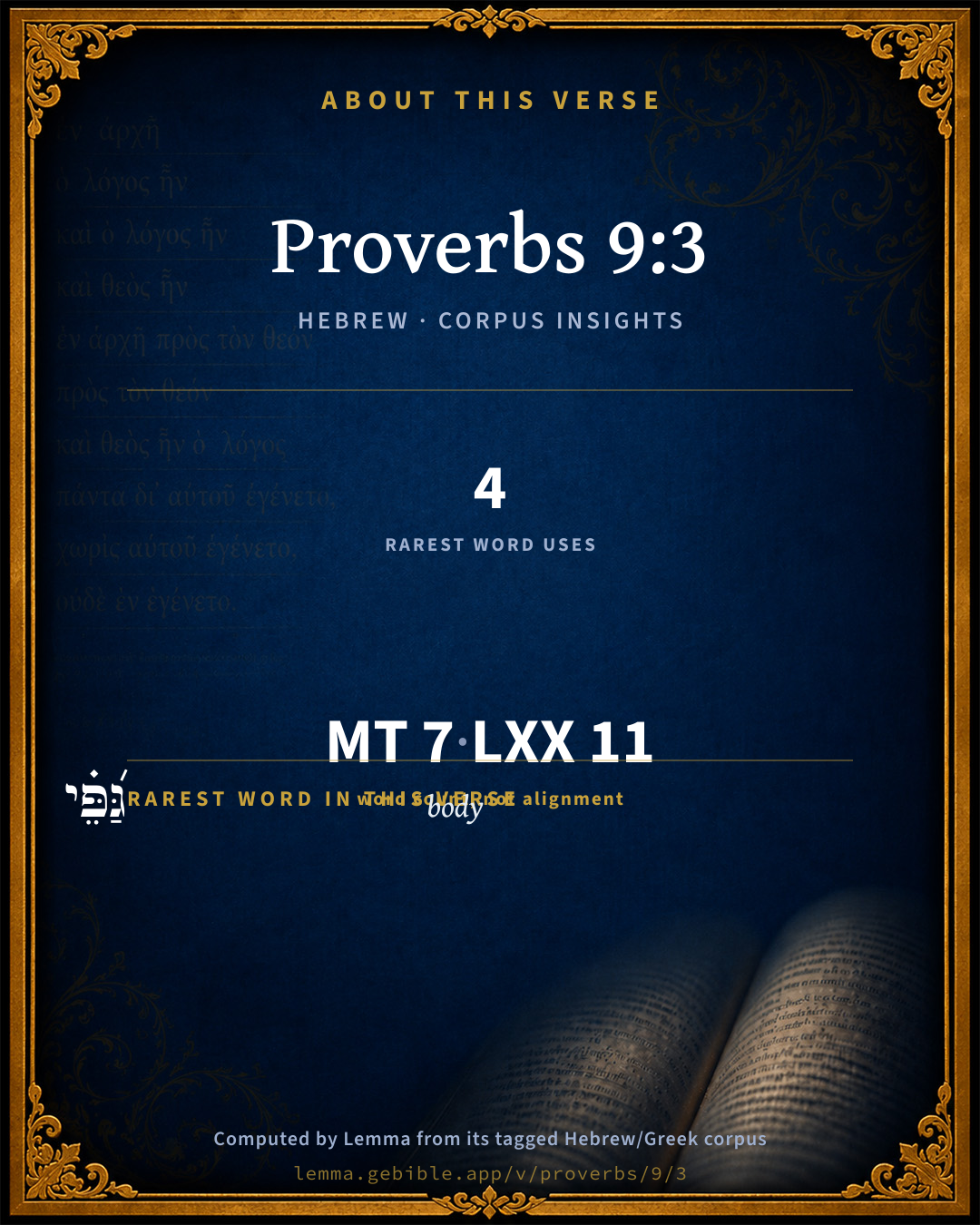
The rarest word here is גַּ֝פֵּ֗י body H1610 — appearing just 4 times in the whole Hebrew Bible.

Shared distinctive vocabulary

גַּ֝פֵּ֗י body H1610 occurs in 3 verses of the Hebrew Bible. Also found in:

Grammatical profile

  • 2 verbs
  • 4 nouns
  • 1 preposition

Verb forms

  • שָֽׁלְחָ֣ה Qal · Perfect
  • תִקְרָ֑א Qal · Imperfect

Hebrew & Septuagint length

In English translation the verse runs 15 words from the Hebrew and 15 from the Septuagint (LXX English) — the same length.

A rough comparison of the two English renderings, which tokenize alike — not a word-level alignment.

Word counts can differ between the Hebrew and the Greek without any difference in meaning — e.g. the Hebrew direct-object marker אֵת has no separate Greek word, and Greek often adds the article ὁ.

In the original languages it is 7 Hebrew tokens and 11 Greek tokens — but the two are counted differently (Hebrew bundles its prefixes and suffixes into one token; the Greek is in lemma form), so that isn’t a like-for-like length.

Cross-references

13

Topical passages linked to Proverbs 9:3 in the Treasury of Scripture Knowledge — connected by theme and wording, ordered by reader-vote popularity; previews shown in the World English Bible.

  • Proverbs 9:14 She sits at the door of her house, On a seat in the high places of the city,
  • Proverbs 8:1–3 Doesn't wisdom cry out? Doesn't understanding raise her voice?
  • Matthew 22:3–4 and sent out his servants to call those who were invited to the marriage feast, but they would not come.
  • Psalms 68:11 The Lord announced the word. The ones who proclaim it are a great company.
  • Proverbs 1:20–23 Wisdom calls aloud in the street. She utters her voice in the public squares.
  • Matthew 22:9 Go therefore to the intersections of the highways, and as many as you may find, invite to the marriage feast.'
  • Luke 11:49 Therefore also the wisdom of God said, 'I will send to them prophets and apostles; and some of them they will kill and persecute,
  • Luke 14:17 He sent out his servant at supper time to tell those who were invited, 'Come, for everything is ready now.'
  • Luke 14:21–23 "That servant came, and told his lord these things. Then the master of the house, being angry, said to his servant, 'Go out quickly into the streets and lanes of the city, and bring in the poor, maimed, blind, and lame.'
  • John 7:37 Now on the last and greatest day of the feast, Jesus stood and cried out, "If anyone is thirsty, let him come to me and drink!
  • John 18:20 Jesus answered him, "I spoke openly to the world. I always taught in synagogues, and in the temple, where the Jews always meet. I said nothing in secret.
  • Romans 10:15 And how will they preach unless they are sent? As it is written: "How beautiful are the feet of those who preach the Gospel of peace, Who bring glad tidings of good things!"
  • 2 Corinthians 5:20–21 We are therefore ambassadors on behalf of Christ, as though God were entreating by us. We beg you on behalf of Christ, be reconciled to God.

Cross-references courtesy of OpenBible.info (CC BY 4.0).

Hebrew and Greek witnesses Masoretic Hebrew ↔ Greek Septuagint

The same verse in the two great witnesses to the Old Testament, shown verse-for-verse.

These are two independent witnesses, not word-aligned to each other, and the Septuagint is shown in lemma (dictionary) form.

Hebrew Proverbs 9:3 Masoretic · Westminster Leningrad Codex

שָֽׁלְחָ֣ה נַעֲרֹתֶ֣יהָ תִקְרָ֑א עַל גַּ֝פֵּ֗י מְרֹ֣מֵי קָֽרֶת

She has sent out her maidens. She cries from the highest places of the city:

World English Bible · Public Domain

Greek LXX Proverbs 9:3 Septuagint · lemma form

ἀποστέλλω ὁ ἑαυτοῦ δοῦλος συνκαλέω μετά ὑψηλός κήρυγμα ἐπί κρατήρ λέγω

She has sent forth her servants, calling with a loud proclamation to the feast, saying,

LXX2012 (modern English Septuagint) · Public Domain

On this verse, Haydock's Catholic Bible Commentary discusses the Septuagint’s reading. Read the note in Commentary ↓

Hebrew: Westminster Leningrad Codex (CC BY 4.0). Greek: Septuagint (public domain); English from LXX2012 (modern English Septuagint) (Public Domain). How the Septuagint differs from the Hebrew →

Commentary

Notes on Proverbs 9:3 from classic Christian and Jewish commentators (each source and its license shown beneath its notes). The classic Christian expositions comment on the surrounding passage and are grouped to its opening verse, so a note may address several verses; the Jewish commentaries on the Tanakh (Rashi and others) are per-verse, so they appear only where the commentator wrote on this verse.

Lemma curates 59 commentaries, every one of them public domain or Creative Commons licensed, each selected and text-cleaned for this edition rather than reprinted as found. About our sources →

Trapp's Complete Commentary

John Trapp

Pro 9:3 She hath sent forth her maidens: she crieth upon the highest places of the city,

Ver. 3. She hath sent forth her maidens.] So ministers are called - in prosecution of the allegory, for it is fit that this great lady should have suitable attendants - to teach them innocence, purity, and sedulity as maidens, keeping the word in sincerity, and not adulterating and corrupting it, as vintners oft do their wines, or hucksters their wares. Hence Isaiah also putteth the prophets and evangelists in the feminine gender, Mebashereth {Isa 52:7}

She crieth upon, &c.] She, together with her maids, crieth; she puts not off all the business to them, but hath a hand in it herself. We are workers together with God, saith Paul.

John Trapp, A Commentary or Exposition upon All the Books of the Old and New Testament (1647–1656) — public domain. Text from a community e-Sword module.

The Biblical Illustrator

Joseph S. Exell

Pro_9:3-4

Whoso is simple, let him turn in hither.

The choice of wisdom

Life is reduced to an alternative; there is clearly marked out for us all, at the beginning of our life, that all is one thing or the other, wisdom or folly. To these two voices, all the noise and tumult of life, and all the diverse voices in your own souls, may be reduced. They are all either the call of the wisdom of God, or they are the call of folly, sense, and sin. Let me counsel you, then--

I. To choose. The curse of men--and of young people especially--is that they drift into passions and habits before they know where they are. But it is a low and discreditable thing for men, old or young, that they should be the creatures and sport of the mere circumstances around them. All your life should have in it the deliberation and the resolve of a calm, settled choice. Here is the manliness of manhood, that a man has a reason for what he does, and has a will in doing it. Be the masters and lords of the circumstances in which you stand. There are two courses in life. There are but two. The two are utterly irreconcilable and discordant. You cannot have them both. Then be men, and choose.

II. Choose wisdom.

1. Look at these two personified claimants--Wisdom and Folly. Wisdom is closely connected with uprightness of heart. It is both an intellectual and a moral excellence. Wisdom has rectitude for an essential part of it, the fibre of its very being is righteousness and holiness. This wisdom is not only an attribute of the human soul. We rise to righteousness. If a man would be wise, it must be with a wisdom that was in God before it is in him. Our prayer should be, In Thy wisdom make us wise. A further step has to be taken. Christ is the power of God and the wisdom of God. There, in that living person, is the highest embodiment of all wisdom. All which is not of God is the foolish woman. All which does not inhere in Christ, and appeal to us through and from Him, is that clamorous and persistent voice which leads us all astray, if we listen to it. The world and sense--these are her grossest forms. But there are less offensive forms besetting us all.

III. Choose now. Wisdom appeals to conscience. Folly appeals only to the sense of pleasure and the desire for its gratification. Both ask for your decision now. There is a strange tendency to put off decision. But it is an awful risk for a man to run. Every day that you live makes it less likely that you will choose. Every day that you live makes it harder for you to choose aright. Every day that you live takes away some of the power of resolving, and takes away some motive to resolve. (A. Maclaren, D. D.)

The Biblical Illustrator, edited by Joseph S. Exell (c. 1880s–1900s) — public domain. Text from a community e-Sword module.

Joseph Benson's Commentary

Pro 9:3. She hath sent forth her maidens — Her servants, to invite the guests, namely, the ministers of the word of God, whom he calls maidens, for the decency of the parable; for Wisdom being compared to a great princess, it was fit she should be attended on by maidens. She crieth upon the highest places — Upon the tops of the houses, (which were flat,) conformably to what our Lord says, Mat 10:7, What ye hear in the ear, that preach ye upon the housetops. Or, from such high seats and places as those from which judges delivered their sentences, and officers made proclamations for the convenience of the people’s better hearing.

Joseph Benson's Commentary on the Old and New Testaments (1811–1818) — public domain. Text from a community e-Sword module.

Tyndale Open Study Notes

Tyndale Open Resources

9:3 Throughout the ancient Near East, temples were built on the heights overlooking the city. A commitment to wisdom involves a commitment to the Lord (contrast 9:14).

Tyndale Open Study Notes — © Tyndale Open Resources, licensed CC BY-SA 4.0. Text via the HelloAO Bible API.

Geneva Bible (1599)

Geneva Bible translators

Meaning, true preachers, which are not infected with man’s wisdom.

Geneva Bible (1599) marginal notes — public domain. Text via Bolls.life.

Jamieson, Fausset & Brown

Robert Jamieson, A. R. Fausset & David Brown

maidens--servants to invite (compare Psa 68:11; Isa 40:9).

highest places--ridges of heights, conspicuous places.

Jamieson, Fausset & Brown — Commentary Critical and Explanatory on the Whole Bible (1871) — public domain (CC PDM 1.0). Text via the HelloAO Bible API.

Adam Clarke's Commentary

Verse 3. She hath sent forth her maidens] The wisdom of God has made use of the most proper means to communicate Divine knowledge to the inhabitants of the earth; as a good and gracious Creator wills to teach them whence they came, how they are supported, whither they are going, and for what end they were formed. It is a custom to the present day, in Asiatic countries, to send their invitations to guests by a company of females, preceded by eunuchs: they go to the doors of the invited, and deliver their message.

Adam Clarke's Commentary on the Bible (1810–1826) — public domain. Text from a community e-Sword/MySword module.

Ellicott's Commentary for English Readers

(3) She hath sent forth her maidens.—Wisdom being here described under the figure of a woman, is properly represented as attended by her maidens, whom she sends forth to summon the guests. But the King (Matthew 22) despatches His servants for the same work, viz., His prophets and wise men and scribes (Mat_23:34), whom from age to age He sends forth as His messengers.

She crieth upon the highest places of the city—so that all may hear. (Comp. our Lord’s command to proclaim His message “upon the housetops,” Mat_10:27).

A Bible Commentary for English Readers, edited by Charles John Ellicott (1878–1897) — public domain. Text from a community e-Sword module.

John Gill's Exposition

She hath sent forth her maidens,.... Not moral virtues, or good works, which subserve the interest of Christ and religion, adorn the Gospel and its professors; nor the liberal arts and sciences, said to be handmaids to divinity; nor angels, ministering spirits to Christ; but the ministers of the Gospel, who being so called does not suppose or encourage women's preaching; but have the name to keep up the decency of the parable, and the propriety of the allegory: for since Wisdom is represented as a lady, a princess or queen, it is proper that her attendants should be maidens, or that she should employ such in inviting her guests; as Rebekah, Pharaoh's daughter, Esther, and others, are said to have their maidens to wait upon them: and besides, it very fitly expresses the character of Gospel ministers; as that they are the servants of Christ, followers of him, obsequious to him, humble and modest, incorrupt in doctrine, pure in conversation, and whose voice is soft, pleasant, and delightful: being not the rough voice of the law, but the still, small, musical voice of the Gospel; a voice of love, grace, and mercy; of peace, pardon, and righteousness, liberty, life, and salvation; very charming, alluring, and drawing. These Christ has a property in; he chooses and calls them, and fits them for his service; and they give up themselves to him, and willingly engage in it. And these he "sends forth": from him they have their mission and commission to preach the Gospel; to invite persons to the Gospel feast, to partake of the provisions he has made: he sends them forth publicly into the world, into all places where his people are, into the streets and lanes; yea, to the hedges and highways, to invite, and even to compel them to come in. And this supposes superiority in him, and authority given to them;

she crieth upon the high places of the city; this is to be understood of the preaching of the Gospel, both by Christ himself in person, in the city of Jerusalem, in the temple, and other public places; and by his ministers, and by him speaking in them there or elsewhere; and which is not a mere whisper, but a cry, a proclamation made aloud, and to be delivered with fervency and earnestness: the "city" may mean the church of God, and the "highest places" the ordinances thereof; and may in general denote the publicness of them; which are in the church, as the wings or pinnacles of the higher parts or buildings of a city are in that, as the word (l) signifies.

(l) "super alas"; Montanus, so Ben Melech; "super pinnis", Piscator, Amama; "in pinnnaculis": Cocceius; "super convexitatibas", Schultens.

John Gill's Exposition of the Whole Bible (1746–1763) — public domain (CC PDM 1.0). Text via the HelloAO Bible API.

Albert Barnes' Notes on the Bible

Wisdom and the “foolish woman” Pro 9:13 speak from the same places and to the same class - the simple, undecided, wavering, standing at the diverging point of the two paths that lead to life or death.

Albert Barnes' Notes on the Bible (1834–1885) — public domain. Text from a community e-Sword/MySword module.

Haydock's Catholic Bible Commentary

Maids. Septuagint, "servant men," the pastors of the church, inviting all to piety in so public a manner, that none can plead ignorance. (St. Gregory) (Calmet) --- To invite. Protestants, "she crieth upon the highest places of the city." (Haydock) --- Christ enjoins his apostles to preach on the roofs, Matthew x. 37.

George Leo Haydock (1774–1849), Haydock's Catholic Family Bible and Commentary, 1859 edition — public domain. Excludes Psalms (Douay-Rheims chapter numbering differs from Protestant) and Deuterocanonical books (Catholic canon only).

Matthew Poole's English Annotations

Her maidens; her servants, to invite the guests; ministers of the word, whom he calls maidens, partly for the decency of the parable; for wisdom being compared to a great princess, was fit to be attended upon by maidens; and partly to show that God by his word did work sweetly, though strongly, and did allure and draw rather than drive sinners to repentance.

Upon the highest places: either upon the tops of the houses, which were flat; or rather, from such high seats as those from which judges delivered their sentences, and officers made proclamations, for the conveniency of the people’s better hearing.

Matthew Poole's English Annotations on the Holy Bible (1683–1685) — public domain. Text from a community e-Sword/MySword module.

Whedon's Commentary on the Bible

Daniel D. Whedon

3. Sent forth her maidens — נערתיה, her young women. Wisdom being personified as a woman, a queen, it is fitting that her attendants should also be women.

She crieth — That is, by her maidens. Hasselquist says, that at Alexandria (Egypt) he saw, on one occasion, ten or twelve women going about the city inviting people to a banquet by a peculiar cry or noise. The office of announcing and celebrating glad tidings among the Hebrews, says Bishop Lowth, belonged peculiarly to the women. On occasion of any great victory or other joyful event, the women went forth with music song, and dance, to celebrate the occurrence. So did Miriam and “all the women,” after the passage of the Red Sea. Exo_15:20-21. So Jephthah’s daughter. Jdg_11:34. So, after David’s victory over Goliath, it is said “that the women came out of all the cities of Israel, singing and dancing, to meet king Saul, with tabrets, with joy, and with instruments of music; and the women answered one another as they played, [in alternate chorus:] —

“Saul has slain his thousands,

And David his ten thousands.”

In Psa_68:11, the word rendered “those publishing it,” המבשׂרות, (hambhasseroth,) is a feminine plural participle, and might be translated, female heralds of good news. The same word in the singular is also used.

Isa_40:9, is rendered by Lowth, “O daughter, that bringest glad tidings.” All these passages recognise the fact that to women belonged, by custom, the proclamation of joyful news. To women, also, was it first given to proclaim the gospel of the resurrection. Luk_24:1, seq.; Joh_20:17-18.

Daniel D. Whedon (gen. ed.), Commentary on the Old and New Testaments (1874–1909) — public domain. Text from a community e-Sword module.

The Pulpit Commentary

She hath sent forth her maidens, as in Mat_22:3, to call them that were bidden to the feast. The Septuagint has toulouv , "her servants," but the Authorized Version is correct, and feminine attendants are in strict harmony with the rest of the apologue. By them are represented the apostles and preachers and ministers, who go forth to win souls for Christ. St. Gregory sees in their being called "maidens" an intimation that they are in themselves weak and abject, and are only useful and honoured as being the mouthpiece of their Lord ("Moral.," 33:33). She crieth upon the highest places of the city, where her voice could best be heard, as in Pro_8:2 Mat_10:27. She is not satisfied with delegating her message to others; she delivers it herself. Septuagint, "calling with a loud proclamation to the cup (epi krathra) ;" Vulgate, Misit ancillas suas ut vocarent ad arcem et ad moenia civitatis, "She has sent her handmaids to invite to the citadel, and to the wails of the town." On which rendering St. Gregory comments, "In that while they tell of the interior life, they lift us up to the high walls of the city above, which same walls, surely, except any be humble, they do not ascend" ("Moral.," 17:43).

The Pulpit Commentary (1880–1919), ed. H.D.M. Spence-Jones & Joseph S. Exell — public domain. Text from a community e-Sword module.

John Wesley's Explanatory Notes

Maidens - Her servants to invite the guests, ministers of the word whom he calls maidens for the decency of the parable; for wisdom being compared to a great princess, was fit to be attended upon by maidens. Highest places - From such high seats as those from which Judges delivered their sentences, and officers made proclamations.

John Wesley, Explanatory Notes Upon the Whole Bible (1754–1765) — public domain. Text via the GEBible commentary corpus.

unfoldingWord translationNotes

Door43 World Missions Community

General Information:

These verses begin to give the message of Wisdom, who is personified as a woman. (See: Personification)

She has sent out her maids

These maids went out and invited people to come to the feast that Wisdom had prepared.

her maids

Young women or girls who are in the service of a respectable, adult woman, such as Wisdom.

she calls out

"she proclaims" or "she summons" AT: "she loudly recites her invitation"

the highest points of the city

The invitation is shouted from the highest points so that it will be best heard by all the people.

Who is naive? Let ... the one lacking good sense

These two phrases describe the same group of people, those who need more wisdom in their lives. Here the question is addressed to all such people. AT: "Anyone who is naive, let ... anyone lacking good sense"

is naive

"is inexperienced or immature"

turn aside here

"leave his path and come into my house"

unfoldingWord translationNotes — © Distant Shores Media and the Door43 World Missions Community, licensed CC BY-SA 4.0. Source: git.door43.org/Door43/en_tn.

Rashi

Rabbi Shlomo Yitzchaki (Rashi)

She has sent her maidens Adam and Eve.

Rashi on the Tanakh — English translations: “The Judaica Press complete Tanach with Rashi, translated by A. J. Rosenberg” (CC BY 4.0); “Pentateuch with Rashi's commentary by M. Rosenbaum and A.M. Silbermann, 1929-1934” (public domain); “The Metsudah Tanach series, Lakewood, N.J” (CC BY 4.0); and “The Book of Joshua, Metsudah Publications, 1997” (CC BY 4.0). Text via Sefaria.

Lesson kit

Teaching starters — assembled from the data on this page, not authored interpretation. Every prompt links to the verse data it draws on. Edit before teaching.

Proverbs, in the Wisdom, opens this verse with 7 words (7 distinct Hebrew lemmas). Its most distinctive word is gaph (“body”). A historical commentator’s framing appears above. Read the whole chapter for the surrounding context.

Discussion questions

  1. What does “body” (gaph) contribute to the verse as a whole?
  2. How does Exodus 21:3, which shares the word «body», read alongside this verse?
  3. The translations on this page render this verse differently — a whole-verse word diff, not a word-by-word alignment. What might account for the different wordings?
  4. «שָֽׁלְחָ֣ה» is a Qal Perfect verb. How does that grammatical form shape the action described?
  5. Compare how Trapp's Complete Commentary and The Biblical Illustrator read this verse. Where do they agree or differ?

Things to notice

Reading settings

Reading text

Shown beneath each verse's original-language words.

Old Testament
Old Testament edition

Read the OT as the Masoretic Hebrew (MT) or the Greek Septuagint (LXX).

English shown for the Greek Septuagint (in the Hebrew ↔ Greek comparison).

Comparing translations? Open the Compare panel on any verse page to stack up to four side by side.