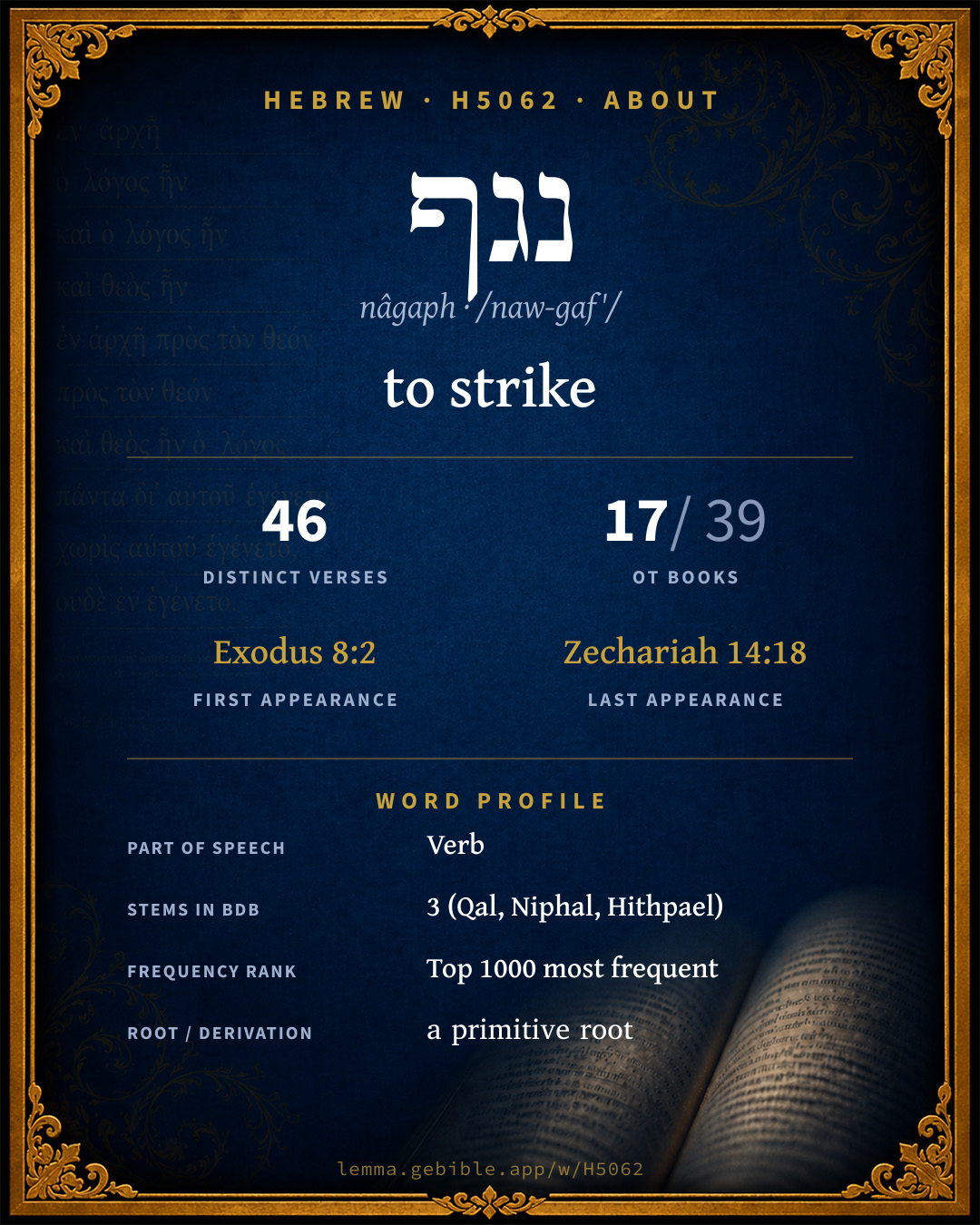
נָגַף
to strike
‘to strike’ is one of 4 main senses fuller range ↓
Full lexicon entry — Brown-Driver-Briggs (BDB)
From Brown-Driver-Briggs (BDB)
Where this word appears
See every Qal verb in the Hebrew Bible →
Grammar key — what these labels mean
Part of speech
- Verb
- An action or state-of-being word.
Stem
- Niphal
- Usually the simple passive or reflexive of the Qal (“he was written”).
- Qal
- The basic, simple active stem — the plain form of the verb (“he wrote”).
- Hithpael
- The reflexive or reciprocal stem (the subject acts on itself).
Form
- Sequential Imperfect
- An imperfect with prefixed waw — the standard past-narrative form (waw-consecutive imperfect).
- Perfect
- A completed action or state — Hebrew marks aspect (completeness) more than strict tense (“he wrote”).
- Imperfect
- An incomplete, ongoing, or future action (“he will / would write”).
- Infinitive Construct
- A bound verbal noun, frequently with prepositions (“to write / in writing”).
- Participle Active
- A verbal adjective expressing ongoing or characteristic action (“writing / one who writes”).
- Sequential Perfect
- A perfect with prefixed waw continuing a preceding imperfect or command (waw-consecutive perfect).
- Infinitive Absolute
- An unbound verbal noun, often intensifying or standing in for a finite verb.
State
- Absolute
- The independent form of a noun, not bound to a following word.
Person
- 3rd Person
- The one spoken about (“he / she / it / they”).
- 2nd Person
- The one addressed (“you”).
- 1st Person
- The speaker (“I / we”).
Gender
- Masculine
- Grammatically masculine.
- Common
- Either gender — not distinguished for this form.
- Feminine
- Grammatically feminine.
Number
- Singular
- One.
- Plural
- More than one (in Hebrew, generally three or more).
Grammatical forms 24 distinct
- Verb, Qal, Sequential Imperfect, 3rd Person, Masculine, Singular 6 times (12%)
- Verb, Niphal, Sequential Imperfect, 3rd Person, Masculine, Singular 5 times (10%)
- Verb, Niphal, Perfect, 3rd Person, Common, Plural 4 times (8%)
- Verb, Qal, Imperfect, 3rd Person, Masculine, Singular 4 times (8%)
- Verb, Niphal, Sequential Imperfect, 3rd Person, Masculine, Plural 3 times (6%)
- Verb, Qal, Infinitive Construct 3 times (6%)
- Verb, Qal, Perfect, 3rd Person, Masculine, Singular 3 times (6%)
- Verb, Niphal, Imperfect, 2nd Person, Masculine, Plural 2 times (4%)
+16 more forms (19 occurrences)
Parsed forms decoded from the imported morphology (morphhb / Westminster Leningrad Codex — WLC text public domain, morphhb tagging CC BY 4.0), counted across 49 parsed occurrences — not distinct verses.
Every verse where H5062 appears — 46 distinct verses across 17 books. Click any verse to open its interlinear word-by-word view. Verse text shown in the World English Bible for context — . Each verse’s Hebrew form is shown with its reference; the English is not keyword-highlighted, since the data carries no word-level English alignment. Use “Compare translations” on any verse to read it across multiple English versions. This concordance covers the Hebrew Bible; Septuagint (Greek Old Testament) occurrences are not indexed here.
Exodus 6 verses
- Exodus 8:2 נֹגֵ֛ף Qal ptcp.act ms If you refuse to let them go, behold, I will plague all your borders with frogs:
- Exodus 12:23 לִ/נְגֹּ֣ף לִ/נְגֹּֽף prep + Qal inf.cs prep + Qal inf.cs For Yahweh will pass through to strike the Egyptians; and when he sees the blood on the lintel, and on the two side-posts, Yahweh will pass over the door, and will not allow the destroyer to come in to your houses to strike you.
- Exodus 12:27 בְּ/נָגְפּ֥/וֹ prep + Qal inf.cs + sfx pers 3ms that you shall say, 'It is the sacrifice of Yahweh's Passover, who passed over the houses of the children of Israel in Egypt, when he struck the Egyptians, and spared our houses.'" The people bowed their heads and worshiped.
- Exodus 21:22 וְ/נָ֨גְפ֜וּ conj + Qal wpf 3cp "If men fight and hurt a pregnant woman so that she gives birth prematurely, and yet no harm follows, he shall be surely fined as much as the woman's husband demands and the judges allow.
- Exodus 21:35 יִגֹּ֧ף Qal impf 3ms "If one man's bull injures another's, so that it dies, then they shall sell the live bull, and divide its price; and they shall also divide the dead animal.
- Exodus 32:35 וַ/יִּגֹּ֥ף conj + Qal wimpf 3ms Yahweh struck the people, because they made the calf, which Aaron made.
Leviticus 1 verse
Numbers 1 verse
Deuteronomy 3 verses
- Deuteronomy 1:42 תִּנָּֽגְפ֔וּ Niphal impf 2mp Yahweh said to me, Tell them, Don't go up, neither fight; for I am not among you; lest you be struck before your enemies.
- Deuteronomy 28:7 נִגָּפִ֖ים Niphal ptcp.act mp Yahweh will cause your enemies who rise up against you to be struck before you: they shall come out against you one way, and shall flee before you seven ways.
- Deuteronomy 28:25 נִגָּף֮ Niphal ptcp.act ms Yahweh will cause you to be struck before your enemies; you shall go out one way against them, and shall flee seven ways before them: and you shall be tossed back and forth among all the kingdoms of the earth.
Joshua 1 verse
Judges 4 verses
- Judges 20:32 נִגָּפִ֥ים Niphal ptcp.act mp The children of Benjamin said, They are struck down before us, as at the first. But the children of Israel said, Let us flee, and draw them away from the city to the highways.
- Judges 20:35 וַ/יִּגֹּ֨ף conj + Qal wimpf 3ms Yahweh struck Benjamin before Israel; and the children of Israel destroyed of Benjamin that day twenty-five thousand one hundred men: all these drew the sword.
- Judges 20:36 נִגָּ֑פוּ Niphal pf 3cp So the children of Benjamin saw that they were struck; for the men of Israel gave place to Benjamin, because they trusted to the liers-in-wait whom they had set against Gibeah.
- Judges 20:39 נִגּ֨וֹף נִגָּ֥ף Niphal inf.abs Niphal ptcp.act ms The men of Israel turned in the battle, and Benjamin began to strike and kill of the men of Israel about thirty persons; for they said, Surely they are struck down before us, as in the first battle.
1 Samuel 6 verses
- 1 Samuel 4:2 וַ/יִּנָּ֥גֶף conj + Niphal wimpf 3ms The Philistines put themselves in array against Israel: and when they joined battle, Israel was struck before the Philistines; and they killed of the army in the field about four thousand men.
- 1 Samuel 4:3 נְגָפָ֧/נוּ Qal pf 3ms + sfx pers 1cp When the people were come into the camp, the elders of Israel said, Why has Yahweh struck us today before the Philistines? Let us get the ark of the covenant of Yahweh out of Shiloh to us, that it may come among us, and save us out of the hand of our enemies.
- 1 Samuel 4:10 וַ/יִּנָּ֤גֶף conj + Niphal wimpf 3ms The Philistines fought, and Israel was struck, and they fled every man to his tent: and there was a very great slaughter; for there fell of Israel thirty thousand footmen.
- 1 Samuel 7:10 וַ/יִּנָּגְפ֖וּ conj + Niphal wimpf 3mp As Samuel was offering up the burnt offering, the Philistines drew near to battle against Israel; but Yahweh thundered with a great thunder on that day on the Philistines, and confused them; and they were struck down before Israel.
- 1 Samuel 25:38 וַ/יִּגֹּ֧ף conj + Qal wimpf 3ms It happened about ten days after, that Yahweh struck Nabal, so that he died.
- 1 Samuel 26:10 יִגָּפֶ֑/נּוּ Qal impf 3ms + sfx pers 1cp David said, As Yahweh lives, Yahweh will strike him; or his day shall come to die; or he shall go down into battle and perish.
2 Samuel 5 verses
- 2 Samuel 2:17 וַ/יִּנָּ֤גֶף conj + Niphal wimpf 3ms The battle was very severe that day: and Abner was beaten, and the men of Israel, before the servants of David.
- 2 Samuel 10:15 נִגַּ֖ף Niphal pf 3ms When the Syrians saw that they were put to the worse before Israel, they gathered themselves together.
- 2 Samuel 10:19 נִגְּפוּ֙ Niphal pf 3cp When all the kings who were servants to Hadarezer saw that they were put to the worse before Israel, they made peace with Israel, and served them. So the Syrians feared to help the children of Ammon any more.
- 2 Samuel 12:15 וַ/יִּגֹּ֣ף conj + Qal wimpf 3ms Nathan departed to his house. Yahweh struck the child that Uriah's wife bore to David, and it was very sick.
- 2 Samuel 18:7 וַ/יִּנָּ֤גְפוּ conj + Niphal wimpf 3mp The people of Israel were struck there before the servants of David, and there was a great slaughter there that day of twenty thousand men.
1 Kings 1 verse
2 Kings 1 verse
1 Chronicles 2 verses
- 1 Chronicles 19:16 נִגְּפוּ֮ Niphal pf 3cp When the Syrians saw that they were put to the worse before Israel, they sent messengers, and drew forth the Syrians who were beyond the River, with Shophach the captain of the host of Hadarezer at their head.
- 1 Chronicles 19:19 נִגְּפוּ֙ Niphal pf 3cp When the servants of Hadarezer saw that they were put to the worse before Israel, they made peace with David, and served him: neither would the Syrians help the children of Ammon any more.
2 Chronicles 8 verses
- 2 Chronicles 6:24 יִנָּגֵ֞ף Niphal impf 3ms If your people Israel be struck down before the enemy, because they have sinned against you, and shall turn again and confess your name, and pray and make supplication before you in this house;
- 2 Chronicles 13:15 נָגַ֤ף Qal pf 3ms Then the men of Judah gave a shout: and as the men of Judah shouted, it happened, that God struck Jeroboam and all Israel before Abijah and Judah.
- 2 Chronicles 13:20 וַ/יִּגְּפֵ֥/הוּ conj + Qal wimpf 3ms + sfx pers 3ms Neither did Jeroboam recover strength again in the days of Abijah: and Yahweh struck him, and he died.
- 2 Chronicles 14:12 וַ/יִּגֹּ֤ף conj + Qal wimpf 3ms So Yahweh struck the Ethiopians before Asa, and before Judah; and the Ethiopians fled.
- 2 Chronicles 20:22 וַ/יִּנָּגֵֽפוּ conj + Niphal wimpf 3mp When they began to sing and to praise, Yahweh set liers-in-wait against the children of Ammon, Moab, and Mount Seir, who had come against Judah; and they were struck.
- 2 Chronicles 21:14 נֹגֵ֛ף Qal ptcp.act ms behold, Yahweh will strike with a great plague your people, and your children, and your wives, and all your substance;
- 2 Chronicles 21:18 נְגָפ֨/וֹ Qal pf 3ms + sfx pers 3ms After all this Yahweh struck him in his bowels with an incurable disease.
- 2 Chronicles 25:22 וַ/יִּנָּ֥גֶף conj + Niphal wimpf 3ms Judah was put to the worse before Israel; and they fled every man to his tent.
Psalms 2 verses
Proverbs 1 verse
Isaiah 1 verse
Jeremiah 1 verse
Zechariah 2 verses
- Zechariah 14:12 יִגֹּ֤ף Qal impf 3ms This will be the plague with which Yahweh will strike all the peoples who have warred against Jerusalem: their flesh will consume away while they stand on their feet, and their eyes will consume away in their sockets, and their tongue will consume away in their mouth.
- Zechariah 14:18 יִגֹּ֤ף Qal impf 3ms If the family of Egypt doesn't go up, and doesn't come, neither will it rain on them. This will be the plague with which Yahweh will strike the nations that don't go up to keep the feast of tents.
About this entry
At a glance — auto-summarized from this page’s data, not written by a person. Every figure links to its source below. This summary describes the numbers; it doesn’t interpret them.
נגף (nâgaph) is a Hebrew verb most often rendered “to strike.” The King James Version usually renders it “smote,” while modern versions prefer “they had been defeated” (Berean Standard Bible) and “and” (unfoldingWord Literal Text) — see the renderings breakdown. Spanning 46 verses in 17 books, it ranks among the moderately common words of the Hebrew Bible. Scripture first uses it in Exodus 8:2. Read the stem: it spans 3 stems, including Qal and Niphal. The sections below give every sense, occurrence, and version rendering.
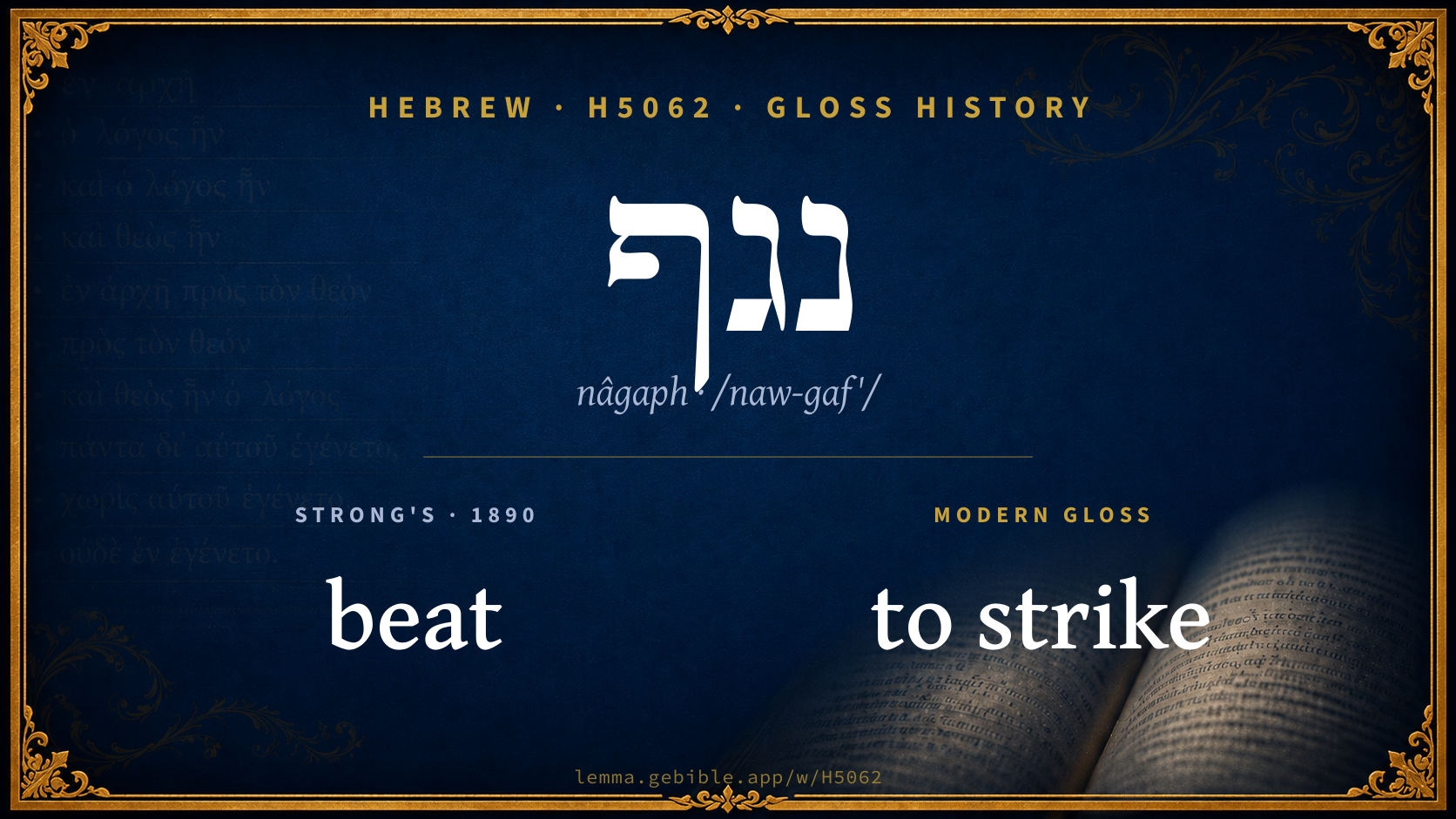
Gloss history
Strong's 1890 vs modern scholarship
About this word
Strong's H5062 catalogs a Hebrew word from the Hebrew Old Testament.
These counts are not copied from any lexicon or concordance. They are computed here, from the morphology-tagged Hebrew Old Testament. What Lemma adds →
- 46
- distinct verses
- The word appears in 46 distinct verses.
- 17 / 39
- OT books
- The word appears in 17 of 39 Old Testament books.
- #752
- by frequency
- Top 1000 most frequent Hebrew words (rank 752 of 8,640 Hebrew words by occurrence).
View all 46 occurrences in the concordance →
Most concentrated in
- 2 Chronicles 8 verses 17%
- Exodus 6 verses 13%
- 1 Samuel 6 verses 13%
By section of the Old Testament
By traditional corpus
Conventional, traditional groupings — biblical authorship is debated, so this is a traditional corpus grouping, not an authorship claim. Each share is this word’s portion of its verses in that division of the Hebrew canon. Each figure is a share of the word’s 46 distinct verses.
- Prophets (Nevi'im) 22 verses · 48%
- Writings (Ketuvim) 13 verses · 28%
- Torah (Pentateuch) 11 verses · 24%
How translations render this word
Counts come from each version’s own published word-to-Strong’s tagging or interlinear alignment — an approximate guide to how each version renders this word, not a word-level alignment the data otherwise carries. Because each total is that version’s own tagged count, the per-version totals vary from one another and need not match the appearance or distinct-verse counts above. These counts may also differ from a printed concordance because Lemma counts each distinctly tagged rendering and does not collapse phrase taggings into a single head-word total. This is a fixed set of word-tagged versions (KJV, ASV, BSB, ULT) and does not change with the reading translation you choose elsewhere. Each version’s license is shown beside its name below (and on Sources).
- King James Version: Smote 5×, They were smitten 5×, Smite 3×
- American Standard Version: Smote 5×, They were put to the worse 4×, Will smite 4×
- Berean Standard Bible: They had been defeated 5×, Are defeated 2×, Defeated 2×
- unfoldingWord Literal Text: And 11×, Strike 3×, Struck 3×
King James Version Public Domain
Renders H5062 across 49 tagged occurrences — most commonly:
Plus 20 renderings that appear only once — usually multi-word phrases or single function words the recovered tagging swept in, not distinct renderings.
American Standard Version Public Domain
Renders H5062 across 48 tagged occurrences — most commonly:
Plus 23 renderings that appear only once — usually multi-word phrases or single function words the recovered tagging swept in, not distinct renderings.
Berean Standard Bible Public Domain
Renders H5062 across 48 tagged occurrences — most commonly:
Plus 23 renderings that appear only once — usually multi-word phrases or single function words the recovered tagging swept in, not distinct renderings. Not rendered by a distinct English word in 1 further occurrence.
unfoldingWord Literal Text CC BY-SA 4.0
Renders H5062 across 68 tagged occurrences — most commonly:
Plus 34 renderings that appear only once — usually multi-word phrases or single function words the recovered tagging swept in, not distinct renderings.
Senses in the full BDB
Hebrew verbs can shift meaning by stem (binyan): Qal is the basic action, Niphal is often passive or reflexive, Piel often intensifies or makes it factitive, and Hiphil is typically causative. The senses below are grouped under the stem BDB assigns to each. This entry also uses Hithpael (reflexive or reciprocal).
What do BDB’s symbols mean?
BDB uses these scholarly abbreviations:
| Symbol | Meaning |
|---|---|
| 𝔊 | the Septuagint (the ancient Greek translation, LXX) |
| 𝔙 | the Vulgate (the Latin translation) |
| 𝔖 | the Syriac version (the Peshitta) |
| 𝔗 | the Targum (the Aramaic translation) |
| ψ | the Psalms |
| √ | root (the underlying root or stem) |
| ‖ | parallel passage (a synonymous or contrasted parallel) |
| † | the dagger: every passage where the word occurs is cited |
The 3 senses and sub-senses the full Brown-Driver-Briggs lexicon distinguishes for this word, in lexicon order (not ranked by frequency), with BDB’s own verbatim wording and sub-sense lettering. Shown in Hebrew script with BDB’s own scholarly abbreviations. The condensed entry is in the Lexicon Entry tab. See also the Forms in the corpus table below.
Qal
- Pf. נ׳ 2 Ch 13:15; Is 19:22 (וְ consec.); sf. נְגָפוֹ 2 Ch 21:18, etc.; Impf. יִגֹּף Ex 21:35 + 2 times; וַיִּגֹּף Ex 32:35 + 4 times; אֶגּוֹף ψ 89:24 +, etc.; Inf. abs. נָגֹף Is 19:22; cstr. לִנְגֹּף Ex 12:23(×2); נָגְפוֹ v 27;—strike, smite, of serious (even fatal) injury, sq. acc. pers. Ex 21:22, 35 (E); one’s foot against (בְּ) stone ψ 91:12; abs. (stumble) Pr 3:23; especially of judgment, subj. י׳, obj. individ. (fatal stroke) 1 S 25:38; 26:10; 2 S 12:15; 2 Ch 13:20; 21:18 (לָחֳלִי); obj. people (abs.) Ex 12:23(×2), 27 (JE), 32:35 Jos 24:5 (E), Is 19:22, cf. v 22; v. also ψ 89:24; cf. c. acc. cogn. מַגֵּפָה Zc 14:12, 18; 2 Ch 21:14 (sq. also בְּעַמֶּ֑ךָ); c. בְּ instr. Ex 7:27; of causing defeat in battle, sq. acc. + לִפְנֵי Ju 20:35 1 S 4:3 2 Ch 13:15; 14:11. e.g. 2 Chronicles 13:15
Niphal
- Pf. נִגַּף 2 S 10:15; נִגְּפוּ v 19 + 2 times, etc.; Impf. יִנָּגֵף 2 Ch 6:24; וַיִּנָּגֵף 1 S 4:2 + 4 times; Inf. abs. נִגּוֹף Ju 20:39; cstr. הִנָּגֵף 1 K 8:33; Pt. נִגָּף Dt 28:25; Ju 20:39, etc.;—be smitten, bef. enemy, in battle, sq. לִפְנֵי Ju 20:32, 39(×2) 1 S 4:2; 7:10; 2 S 10:15, 19; 18:7; 1 K 8:33; 2 K 14:12; 1 Ch 19:16, 19; 2 Ch 6:24; 25:22; Lv 26:17; Nu 14:42; Dt 1:42; abs. Ju 20:36; 1 S 4:10; 2 S 2:17; 2 Ch 20:22; Pt. after נָתַן, sq. לִפְנֵי Dt 28:7, 25 Vid. נָגַע Niph. e.g. 2 Samuel 10:15
Hithpael
- Impf. יִתְנַגְּפוּ Je 13:16 = stumble, subj. רַגְלֵיכֶם, sq. על (loc.); cf. Qal (ψ 91:12) and נֶגֶף 2. e.g. Jeremiah 13:16
Senses from the full Brown-Driver-Briggs lexicon (Brown, Driver, Briggs; Oxford 1906 — public domain), digitized via Sefaria, supplemented by the OpenScriptures HebrewLexicon (CC BY 4.0). Full attribution on Sources.
Word origin
vb. strike, smite (Aramaic נְגַף);—
— Brown-Driver-Briggs (Oxford 1906, public domain), digitized via Sefaria, supplemented by the OpenScriptures HebrewLexicon (CC BY 4.0). See Sources.
Origin: a primitive root
Jastrow Dictionary
A second Hebrew/Aramaic lexicon for comparison, covering Aramaic and post-biblical (Talmudic, Targumic, Midrashic) usage that the biblical-Hebrew BDB does not. Matched by lemma rather than by Strong’s number, so a lemma may carry more than one Jastrow headword (shown separately below), and the entries cover usage well beyond the Bible.
נָגַף
- (b. h.) to strike, push; to injure. Tosef. B. Kam. I, 9 נגח נ׳ וכ׳ if he gored, pushed, bit &c. Num. R. s. 5 ונ׳ הקב"ה עושי וכ׳ and the Lord struck those who made the golden calf; a. fr.—Part. pass. נָגוּף; pl. נְגוּפִים. Midr. Till. to Ps. CXVIII, 23 כשיראו … אינן אלו הנ׳ וכ׳ when the nations shall see Israel in prosperity, they shall say, these are not the stricken, these are not the rejected &c.
- to be stricken. Yoma 19ᵇ
- to strike against. Lam. R. introd. (R. Joḥ. 2) לכשיִתְנַגְּפוּ רגליכם וכ׳ when your feet shall strike against the mountains &c. (fr. Jer. XIII, 16). e.g. Jeremiah 13:16
נְגַף
- Targ. Ps. LXXXIX, 24. Targ. Ex. XXI, 35; a. e.
- same. Part. pass. מְנַגַּף bruised, wounded. Yoma 53ᵃ עד דמְנַגְּפַן כרעיה וכ׳ (some ed. דמִינַּגְּפַן Ithpa.; Ms. M. a. Ar. דהוה מנקפן, v. Rabb. D. S. a. l. note) until his feet were bruised (bleeding) &c.
- to strike against, be bruised. Targ. Jer. XIII, 16.—Yoma l. c., v. supra.
נֶגֶף
- preced.) plague. Ex. R. s. 15 מצרים … לברוח מן הנ׳ וכ׳ the Egyptians went around seeking a way how to flee from the plague; a. e.
A Dictionary of the Targumim, the Talmud Babli and Yerushalmi, and the Midrashic Literature (Marcus Jastrow; London, Luzac, 1903) — Public Domain. Digitized via Sefaria. Digitized via Sefaria. Full attribution on Sources.
Forms in the corpus
The 43 distinct written forms H5062 takes in the Hebrew Bible, most frequent first — each parse links to that stem’s occurrences in the concordance. Hebrew forms include their vowel points and cantillation, so a single lemma takes many written forms.
Same root — word family
Other BDB entries built from the same root as H5062, grouped by Strong’s listed origin. These share a root / origin per the lexicon — not necessarily a shared meaning. Each links to that word’s own entry.
Derived from this word
Compare all same-root words → They share a root, not necessarily a meaning.
Septuagint verse parallels
This word appears in 45 verses that also exist in the Greek Old Testament (Septuagint), out of the 46 Hebrew verses it occurs in. You can read those verses in Greek by switching the Old Testament edition to the Septuagint.
Read these verses in the Septuagint
- Exodus 8:2
- Leviticus 26:17
- Numbers 14:42
- Deuteronomy 1:42
- Joshua 24:5
- Judges 20:32
- 1 Samuel 4:2
- 2 Samuel 2:17
- 1 Kings 8:33
- 2 Kings 14:12
- 1 Chronicles 19:16
- 2 Chronicles 6:24
This is a verse-level parallel only — the same verses exist in both the Hebrew and Greek Old Testaments. No word-level Hebrew↔Greek correspondence is claimed: the data carries no such alignment, so no Greek word is shown as this Hebrew word’s translation. Coverage is not total — the Septuagint omits the deuterocanon and renumbers the Psalms, so some Hebrew verses have no direct Greek parallel.