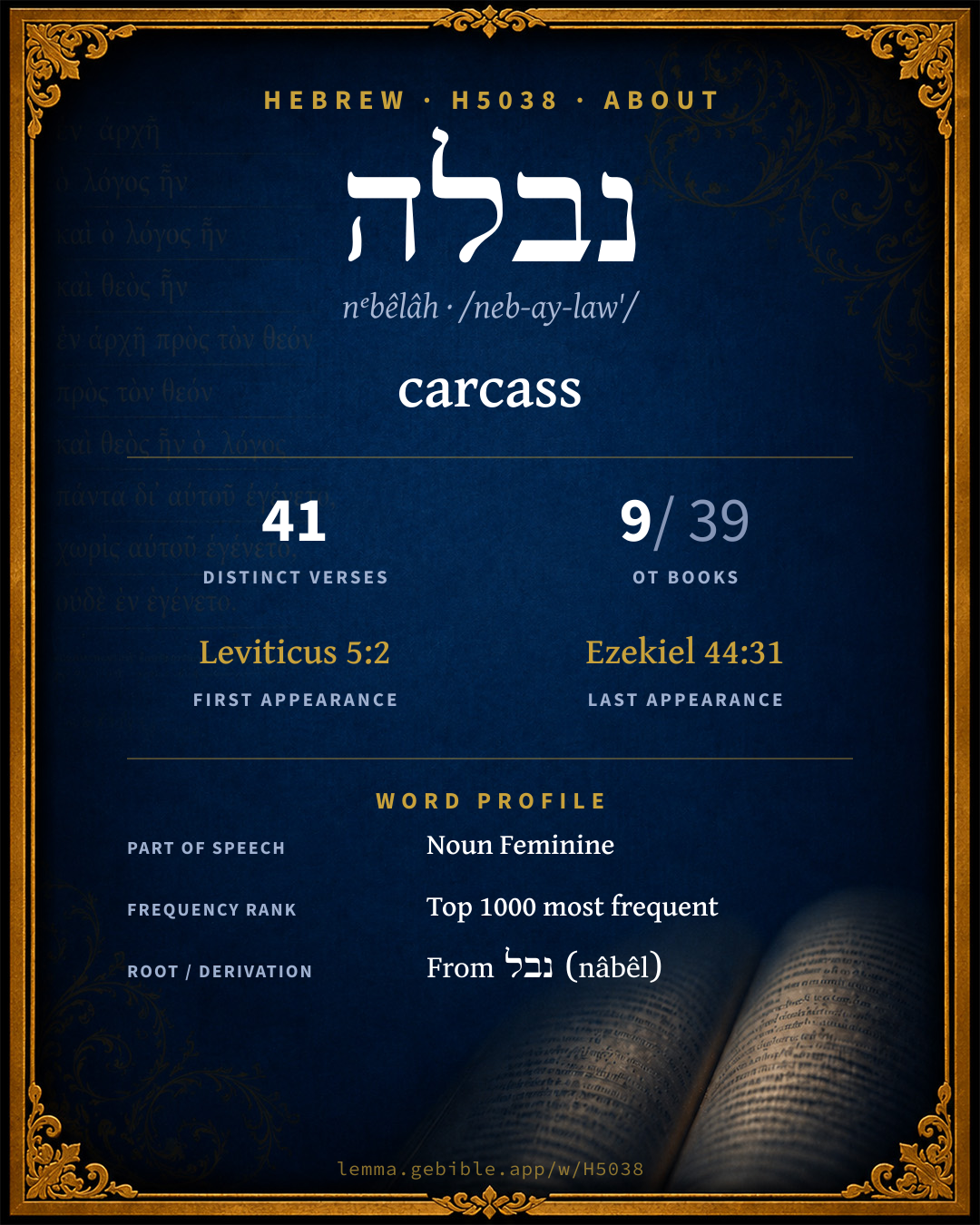
נְבֵלָה
carcass
‘carcass’ is one of 2 main senses fuller range ↓
Full lexicon entry — Brown-Driver-Briggs (BDB)
From Brown-Driver-Briggs (BDB)
Where this word appears
See every Construct-state word in the Hebrew Bible →
Grammar key — what these labels mean
Part of speech
- Noun
- A naming word — a person, place, thing, or idea.
Noun type
- Common
- A common noun — a general class of person, place, or thing (“king,” “city,” “water”), not a specific name.
State
- Construct
- A noun bound to a following noun in a possessive / “of” relationship (the construct chain).
- Absolute
- The independent form of a noun, not bound to a following word.
Gender
- Feminine
- Grammatically feminine.
Number
- Singular
- One.
Grammatical forms
- Noun, Common, Feminine, Singular, Construct 37 times (77%)
- Noun, Common, Feminine, Singular, Absolute 11 times (23%)
Parsed forms decoded from the imported morphology (morphhb / Westminster Leningrad Codex — WLC text public domain, morphhb tagging CC BY 4.0), counted across 48 parsed occurrences — not distinct verses.
Every verse where H5038 appears — 41 distinct verses across 9 books. Click any verse to open its interlinear word-by-word view. Verse text shown in the World English Bible for context — . Each verse’s Hebrew form is shown with its reference; the English is not keyword-highlighted, since the data carries no word-level English alignment. Use “Compare translations” on any verse to read it across multiple English versions. This concordance covers the Hebrew Bible; Septuagint (Greek Old Testament) occurrences are not indexed here.
Leviticus 16 verses
- Leviticus 5:2 בְ/נִבְלַ֨ת בְּ/נִבְלַת֙ בְּ/נִבְלַ֖ת prep + n c fs cs prep + n c fs cs prep + n c fs cs "'Or if anyone touches any unclean thing, whether it is the carcass of an unclean animal, or the carcass of unclean cattle, or the carcass of unclean creeping things, and it is hidden from him, and he is unclean, then he shall be guilty.
- Leviticus 7:24 נְבֵלָה֙ n c fs The fat of that which dies of itself, and the fat of that which is torn of animals, may be used for any other service, but you shall in no way eat of it.
- Leviticus 11:8 וּ/בְ/נִבְלָתָ֖/ם conj + prep + n c fs cs + sfx pers 3mp Of their flesh you shall not eat, and their carcasses you shall not touch; they are unclean to you.
- Leviticus 11:11 נִבְלָתָ֖/ם n c fs cs + sfx pers 3mp and you detest them. You shall not eat of their flesh, and you shall detest their carcasses.
- Leviticus 11:24 בְּ/נִבְלָתָ֖/ם prep + n c fs cs + sfx pers 3mp "'By these you will become unclean: whoever touches the carcass of them shall be unclean until the evening.
- Leviticus 11:25 מִ/נִּבְלָתָ֑/ם prep + n c fs cs + sfx pers 3mp Whoever carries any part of their carcass shall wash his clothes, and be unclean until the evening.
- Leviticus 11:27 בְּ/נִבְלָתָ֖/ם prep + n c fs cs + sfx pers 3mp Whatever goes on its paws, among all animals that go on all fours, they are unclean to you. Whoever touches their carcass shall be unclean until the evening.
- Leviticus 11:28 נִבְלָתָ֔/ם n c fs cs + sfx pers 3mp He who carries their carcass shall wash his clothes, and be unclean until the evening. They are unclean to you.
- Leviticus 11:35 מִ/נִּבְלָתָ֥/ם prep + n c fs cs + sfx pers 3mp Everything whereupon part of their carcass falls shall be unclean; whether oven, or range for pots, it shall be broken in pieces: they are unclean, and shall be unclean to you.
- Leviticus 11:36 בְּ/נִבְלָתָ֖/ם prep + n c fs cs + sfx pers 3mp Nevertheless a spring or a cistern in which water is a gathered shall be clean: but that which touches their carcass shall be unclean.
- Leviticus 11:37 מִ/נִּבְלָתָ֔/ם prep + n c fs cs + sfx pers 3mp If part of their carcass falls on any sowing seed which is to be sown, it is clean.
- Leviticus 11:38 מִ/נִּבְלָתָ֖/ם prep + n c fs cs + sfx pers 3mp But if water is put on the seed, and part of their carcass falls on it, it is unclean to you.
- Leviticus 11:39 בְּ/נִבְלָתָ֖/הּ prep + n c fs cs + sfx pers 3fs "'If any animal, of which you may eat, dies; he who touches its carcass shall be unclean until the evening.
- Leviticus 11:40 מִ/נִּבְלָתָ֔/הּ נִבְלָתָ֔/הּ prep + n c fs cs + sfx pers 3fs n c fs cs + sfx pers 3fs He who eats of its carcass shall wash his clothes, and be unclean until the evening. He also who carries its carcass shall wash his clothes, and be unclean until the evening.
- Leviticus 17:15 נְבֵלָה֙ n c fs "'Every person that eats what dies of itself, or that which is torn by animals, whether he is native-born or a foreigner, he shall wash his clothes, and bathe himself in water, and be unclean until the evening: then he shall be clean.
- Leviticus 22:8 נְבֵלָ֧ה n c fs That which dies of itself, or is torn by animals, he shall not eat, defiling himself by it. I am Yahweh.
Deuteronomy 4 verses
- Deuteronomy 14:8 וּ/בְ/נִבְלָתָ֖/ם conj + prep + n c fs cs + sfx pers 3mp The pig, because it has a split hoof but doesn't chew the cud, is unclean to you: of their flesh you shall not eat, and their carcasses you shall not touch.
- Deuteronomy 14:21 נְ֠בֵלָה n c fs You shall not eat of anything that dies of itself: you may give it to the foreigner living among you who is within your gates, that he may eat it; or you may sell it to a foreigner: for you are a holy people to Yahweh your God. You shall not boil a kid in its mother's milk.
- Deuteronomy 21:23 נִבְלָת֜/וֹ n c fs cs + sfx pers 3ms his body shall not remain all night on the tree, but you shall surely bury him the same day; for he who is hanged is accursed of God; that you don't defile your land which Yahweh your God gives you for an inheritance.
- Deuteronomy 28:26 נִבְלָֽתְ/ךָ֙ n c fs cs + sfx pers 2ms Your dead body shall be food to all birds of the sky, and to the animals of the earth; and there shall be none to frighten them away.
Joshua 1 verse
1 Kings 6 verses
- 1 Kings 13:22 נִבְלָתְ/ךָ֖ n c fs cs + sfx pers 2ms but came back, and have eaten bread and drunk water in the place of which he said to you, Eat no bread, and drink no water; your body shall not come to the tomb of your fathers.
- 1 Kings 13:24 נִבְלָת/וֹ֙ הַ/נְּבֵלָֽה n c fs cs + sfx pers 3ms ptcl def.art + n c fs When he was gone, a lion met him by the way, and killed him: and his body was cast in the way, and the donkey stood by it; the lion also stood by the body.
- 1 Kings 13:25 הַ/נְּבֵלָה֙ הַ/נְּבֵלָ֑ה ptcl def.art + n c fs ptcl def.art + n c fs Behold, men passed by, and saw the body cast in the way, and the lion standing by the body; and they came and told it in the city where the old prophet lived.
- 1 Kings 13:28 נִבְלָת/וֹ֙ הַ/נְּבֵלָ֑ה הַ/נְּבֵלָ֔ה n c fs cs + sfx pers 3ms ptcl def.art + n c fs ptcl def.art + n c fs He went and found his body cast in the way, and the donkey and the lion standing by the body: the lion had not eaten the body, nor torn the donkey.
- 1 Kings 13:29 נִבְלַ֧ת n c fs cs The prophet took up the body of the man of God, and laid it on the donkey, and brought it back; and he came to the city of the old prophet, to mourn, and to bury him.
- 1 Kings 13:30 נִבְלָת֖/וֹ n c fs cs + sfx pers 3ms He laid his body in his own grave; and they mourned over him, [saying], Alas, my brother!
2 Kings 1 verse
Psalms 1 verse
Isaiah 2 verses
- Isaiah 5:25 נִבְלָתָ֛/ם n c fs cs + sfx pers 3mp Therefore Yahweh's anger burns against his people, And he has stretched out his hand against them, and has struck them. The mountains tremble, And their dead bodies are as refuse in the midst of the streets. For all this, his anger is not turned away, But his hand is still stretched out.
- Isaiah 26:19 נְבֵלָתִ֖/י n c fs cs + sfx pers 1cs Your dead shall live; my dead bodies shall arise. Awake and sing, you who dwell in the dust; for your dew is [as] the dew of herbs, and the earth shall cast forth the dead.
Jeremiah 8 verses
- Jeremiah 7:33 נִבְלַ֨ת n c fs cs The dead bodies of this people shall be food for the birds of the sky, and for the animals of the earth; and none shall frighten them away.
- Jeremiah 9:22 נִבְלַ֣ת n c fs cs Speak, Thus says Yahweh, The dead bodies of men shall fall as dung on the open field, and as the handful after the harvester; and none shall gather [them].
- Jeremiah 16:4 נִבְלָתָ/ם֙ n c fs cs + sfx pers 3mp They shall die grievous deaths: they shall not be lamented, neither shall they be buried; they shall be as dung on the surface of the ground; and they shall be consumed by the sword, and by famine; and their dead bodies shall be food for the birds of the sky, and for the animals of the earth.
- Jeremiah 16:18 בְּ/נִבְלַ֤ת prep + n c fs cs First I will recompense their iniquity and their sin double, because they have polluted my land with the carcasses of their detestable things, and have filled my inheritance with their abominations.
- Jeremiah 19:7 נִבְלָתָ/ם֙ n c fs cs + sfx pers 3mp I will make void the counsel of Judah and Jerusalem in this place; and I will cause them to fall by the sword before their enemies, and by the hand of those who seek their life: and their dead bodies will I give to be food for the birds of the sky, and for the animals of the earth.
- Jeremiah 26:23 נִבְלָת֔/וֹ n c fs cs + sfx pers 3ms and they fetched forth Uriah out of Egypt, and brought him to Jehoiakim the king, who killed him with the sword, and cast his dead body into the graves of the common people.
- Jeremiah 34:20 נִבְלָתָ/ם֙ n c fs cs + sfx pers 3mp I will even give them into the hand of their enemies, and into the hand of those who seek their life; and their dead bodies shall be for food to the birds of the sky, and to the animals of the earth.
- Jeremiah 36:30 וְ/נִבְלָת/וֹ֙ conj + n c fs cs + sfx pers 3ms Therefore thus says Yahweh concerning Jehoiakim king of Judah: He shall have none to sit on the throne of David; and his dead body shall be cast out in the day to the heat, and in the night to the frost.
Ezekiel 2 verses
- Ezekiel 4:14 וּ/נְבֵלָ֨ה conj + n c fs Then said I, Ah Lord Yahweh! behold, my soul has not been polluted; for from my youth up even until now have I not eaten of that which dies of itself, or is torn of animals; neither came there abominable flesh into my mouth.
- Ezekiel 44:31 נְבֵלָה֙ n c fs The priests shall not eat of anything that dies of itself, or is torn, whether it be bird or animal.
About this entry
At a glance — auto-summarized from this page’s data, not written by a person. Every figure links to its source below. This summary describes the numbers; it doesn’t interpret them.
נבלה (nᵉbêlâh) is a Hebrew noun most often rendered “carcass.” Its English rendering has broadened — “carcase” classically, “body” (Berean Standard Bible) and “corpse” (unfoldingWord Literal Text) in modern versions; see the renderings breakdown. The Hebrew Bible uses it across 41 verses — moderately common. Leviticus dominates its distribution — 16 of 41 verses. Not a single-sense word: explore its full sense range. The sections below give every sense, occurrence, and version rendering.
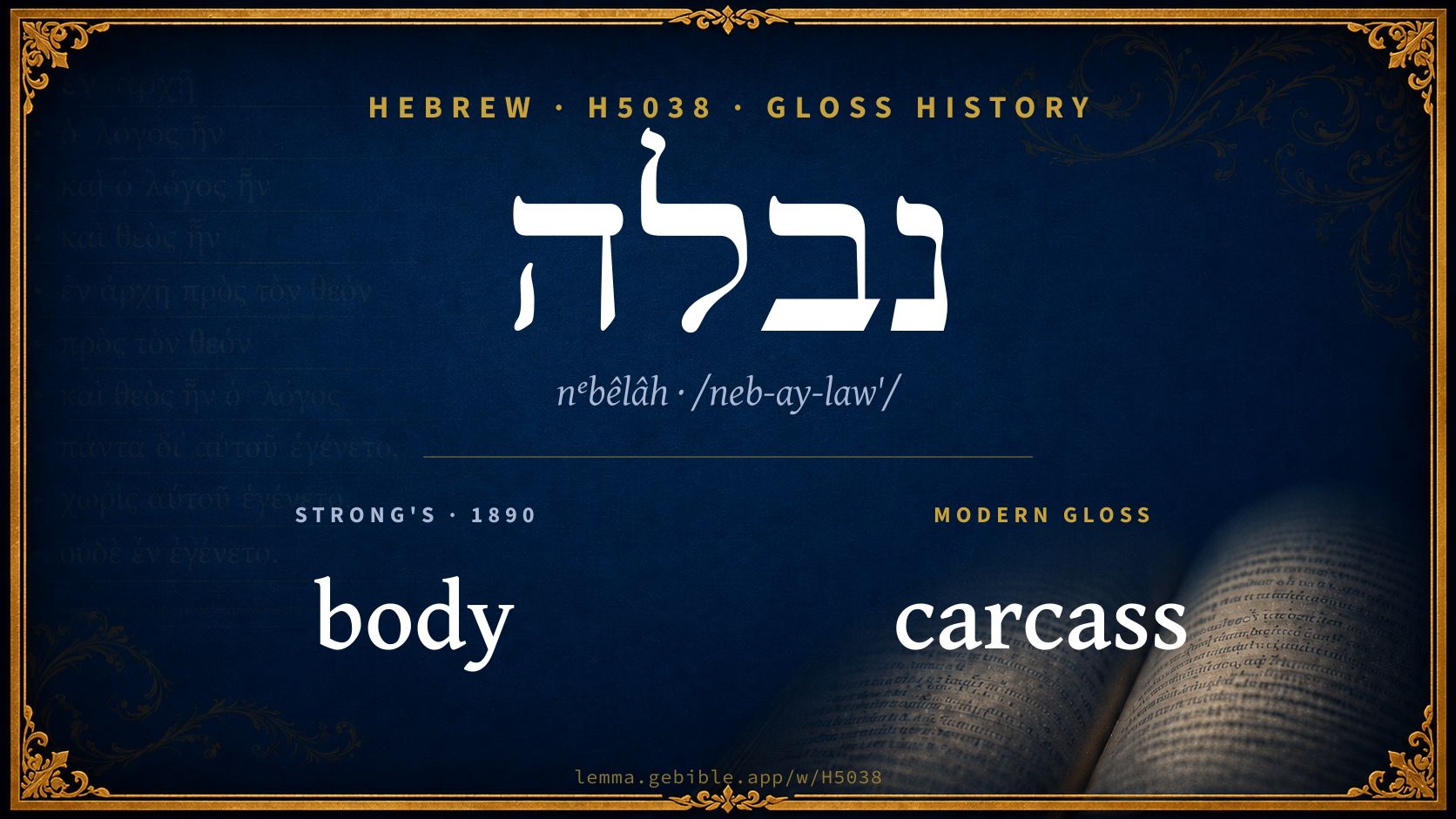
Gloss history
Strong's 1890 vs modern scholarship
About this word
Strong's H5038 catalogs a Hebrew word from the Hebrew Old Testament.
These counts are not copied from any lexicon or concordance. They are computed here, from the morphology-tagged Hebrew Old Testament. What Lemma adds →
- 41
- distinct verses
- The word appears in 41 distinct verses.
- 9 / 39
- OT books
- The word appears in 9 of 39 Old Testament books.
- #767
- by frequency
- Top 1000 most frequent Hebrew words (rank 767 of 8,640 Hebrew words by occurrence).
View all 41 occurrences in the concordance →
By section of the Old Testament
By traditional corpus
Conventional, traditional groupings — biblical authorship is debated, so this is a traditional corpus grouping, not an authorship claim. Each share is this word’s portion of its verses in that division of the Hebrew canon. Each figure is a share of the word’s 41 distinct verses.
- Torah (Pentateuch) 20 verses · 49%
- Prophets (Nevi'im) 20 verses · 49%
- Writings (Ketuvim) 1 verse · 2%
How translations render this word
Counts come from each version’s own published word-to-Strong’s tagging or interlinear alignment — an approximate guide to how each version renders this word, not a word-level alignment the data otherwise carries. Because each total is that version’s own tagged count, the per-version totals vary from one another and need not match the appearance or distinct-verse counts above. These counts may also differ from a printed concordance because Lemma counts each distinctly tagged rendering and does not collapse phrase taggings into a single head-word total. This is a fixed set of word-tagged versions (KJV, ASV, BSB, ULT) and does not change with the reading translation you choose elsewhere. Each version’s license is shown beside its name below (and on Sources).
- King James Version: Carcase 21×, Carcases 6×, Any part of their carcase 2×
- American Standard Version: Body 12×, Dead bodies 8×, Carcass 6×
- Berean Standard Bible: Body 11×, Carcass 8×, Corpses 7×
- unfoldingWord Literal Text: Corpse 14×, Carcass 6×, Carcasses 6×
King James Version Public Domain
Renders H5038 across 48 tagged occurrences — most commonly:
Plus 13 renderings that appear only once — usually multi-word phrases or single function words the recovered tagging swept in, not distinct renderings.
American Standard Version Public Domain
Renders H5038 across 48 tagged occurrences — most commonly:
Plus 6 renderings that appear only once — usually multi-word phrases or single function words the recovered tagging swept in, not distinct renderings.
Berean Standard Bible Public Domain
Renders H5038 across 44 tagged occurrences — most commonly:
Plus 7 renderings that appear only once — usually multi-word phrases or single function words the recovered tagging swept in, not distinct renderings. Not rendered by a distinct English word in 4 further occurrences.
unfoldingWord Literal Text CC BY-SA 4.0
Renders H5038 across 55 tagged occurrences — most commonly:
Plus 6 renderings that appear only once — usually multi-word phrases or single function words the recovered tagging swept in, not distinct renderings.
Senses in the full BDB
What do BDB’s symbols mean?
BDB uses these scholarly abbreviations:
| Symbol | Meaning |
|---|---|
| 𝔊 | the Septuagint (the ancient Greek translation, LXX) |
| 𝔙 | the Vulgate (the Latin translation) |
| 𝔖 | the Syriac version (the Peshitta) |
| 𝔗 | the Targum (the Aramaic translation) |
| ψ | the Psalms |
| √ | root (the underlying root or stem) |
| ‖ | parallel passage (a synonymous or contrasted parallel) |
| † | the dagger: every passage where the word occurs is cited |
The 3 senses and sub-senses the full Brown-Driver-Briggs lexicon distinguishes for this word, in lexicon order (not ranked by frequency), with BDB’s own verbatim wording and sub-sense lettering. Shown in Hebrew script with BDB’s own scholarly abbreviations. The condensed entry is in the Lexicon Entry tab. See also the Forms in the corpus table below.
- 1.
- a. human (not in Ez P, (H), which use פֶּגֶר); Jos 8:29 (JE), 1 K 13:22, 24(×2), 25(×2), 28(×3), 29, 30 2 K 9:37 Je 26:23; 36:30 Dt 21:23; 28:26; coll. corpses Is 5:25; 26:19 (wish for restoration to life), Je 7:33; 9:21; 16:4; 19:7; 34:20 ψ 79:2. e.g. Joshua 8:29
- b. of lifeless idols, coll. נִבְלַת שִׁקּוּצֵיהֶם וגו׳ Je 16:18. e.g. Jeremiah 16:18
- 2. of animals (clean and unclean, wild animals, cattle, birds and reptiles, chiefly Lv Ez), Dt 14:8; Lv 5:2(×3) 11:8, 11, 24, 25, 27, 28, 35, 36, 37, 38; 17:15 (all P); נ׳ specif. = body of animal dying of itself Dt 14:21; Lv 7:24; 11:39, 40(×2) (P), 22:8 (H), Ez 4:14; 44:31. e.g. Deuteronomy 14:8
Senses from the full Brown-Driver-Briggs lexicon (Brown, Driver, Briggs; Oxford 1906 — public domain), digitized via Sefaria, supplemented by the OpenScriptures HebrewLexicon (CC BY 4.0). Full attribution on Sources.
Word origin
n.f. carcass, corpse (as inert, flabby);—נ׳ abs. 1 K 13:24 +; cstr. נִבְלַת v 29 +; sf. נְבֵלָתִי Is 26:19; נִבְלָֽתְךָ Dt 28:26 1 K 13:22; נִבְלָתוֹ Jos 8:29 + 6 times; נִבְלָתָהּ Lv 11:39, 40(×2); נִבְלָתָם Is 5:25 + 14 times;—carcass, corpse:
— Brown-Driver-Briggs (Oxford 1906, public domain), digitized via Sefaria, supplemented by the OpenScriptures HebrewLexicon (CC BY 4.0). See Sources.
Derived from נבל (nâbêl) (H5034) — to be foolish.
Jastrow Dictionary
A second Hebrew/Aramaic lexicon for comparison, covering Aramaic and post-biblical (Talmudic, Targumic, Midrashic) usage that the biblical-Hebrew BDB does not. Matched by lemma rather than by Strong’s number, so a lemma may carry more than one Jastrow headword (shown separately below), and the entries cover usage well beyond the Bible.
בלי ²
- , v. בלל; cmp. נבל) to be crumbled; to be worn out, to fail, decay, perish. Koh. R. to I, 4 הוא בוֹלֶה it (the generation of man) decays (dies out), אינה בוֹלָה it (the earth) does not grow old. Taan. 9ᵃ (play on עד בלי די Mal. III, 10) עד שיִבְלוּ שפתותיכם מלומר די until your lips grow tired from saying, It is enough; (Y. ib. III, 66ᵈ bot. שיבללו, v. בָּלַל); a. fr.—Part. pass. בָּלוּי outworn. Pl. בְּלוּיִים. Midr. Till. to Ps. XXV, 1. e.g. Malachi 3:10
- to wear out, outlive, survive. Lev. R. s. 4 הנפש מְבַלָּה וכ׳ the soul survives the body. Lev. R. s. 19 (play on אין בלתך, I Sam. II, 2) אין לְבַלֹּותֶךָ there is none to outlive thee. Koh. R. l. c.; Cant. R. to V, 15 one erects a building ואחר מְבַלֶּה אותו (not מכלה) and another man ruins it. Snh. 105ᵃ, v. בִּלְעָם. e.g. 1 Samuel 2:2
- , Nithpa. נִתְבַּלָּה to become outworn, fade away. Esth. R. introd. עתידין לְהִבָּלוֹת (Gen. R. s. 42 לִבְלוֹת) are destined to decay. Deut. R. s. 7, end נִתְבַּלּוּ (the garments) were worn out. B. Mets. 87ᵃ נ׳ הבשר her body was withered. B. Bath. 146ᵃ עשויין לִיבָּלוֹת made to be used up.
נְבֵלָה
- carrion, an animal that has died a natural death. Gen. R. s. 81, end להוט אחר הנ׳ greedy for carrion. Ukts. III, 3 נִבְלַת בהמה טמאה the carcass of an unclean animal; a. fr.—Esp. (ritual) an animal not slaughtered according to the ritual rules (v. דְּרָסָה, הַגְרָמָה &c.). Ḥull. II, 4 כל שנפסלה בשחיטתה נ׳ whatever has become unfit through faulty slaughtering, is called n’belah, contrad. to טְרֵפָה. Ab. Zar. 67ᵇ sq. כל הראויה לגר קרויה נ׳ וכ׳ that which is fit for the stranger (Deut. XIV, 21) is called n’belah (the eating of which is a punishable offence), whatever is unfit for the stranger (putrefied &c.) is no longer called n’belah. Ker. 21ᵃ נְבֵילָתוֹ מנלן whence do we derive the prohibition to eat it when unlawfully slaughtered? Y. Shebi. IV, 35ᵃ bot. (in Chald. dict.) בשר דנ׳ forbidden meat; Ḥull. 95ᵃ בְּשַׂר נ׳, opp. בשר שחוטה. Ib. מותרות משום נ׳ they are permitted as far as n’belah is concerned, i.e. they do not make unclean (Lev. XI, 39); a. v. fr.—Pl. נְבֵלוֹת, נְבֵילוֹת. Ib.; Shek. VII, 3 איברים נ׳ if found cut in limbs, they are forbidden, opp. מותרות. Eduy. VIII, 1. Ib. V, 1; a. fr. e.g. Deuteronomy 14:21
נְבָלָה
- 1. meanness, obscenity. Treat. Der. Er. ch. II מְדַבְּרֵי נ׳ those talking obscenely. Ib. הדר בנ׳ עם אשתו who lives with his wife in an obscene manner; a. e.—Pl. נְבָלוֹת. Ex. R. s. 24 (ref. to Deut. XXXII, 6) עם נבל שעשו נ׳ וכ׳ ‘a disgraced people’, for they did disgraceful things, as it is said (Ps. LXXIX, 2), they made ‘the disgraced’ of thy people food &c. (taking נִבְלַת as if from נְבָלָה).—2) destruction. Gen. R. s. 38; Yalk. ib. 62 (play on וְנָבְלָה, Gen. XI, 7) משפתם אעשה (עמהם) נ׳ through their own lips I shall bring destruction upon them. e.g. Deuteronomy 32:6
A Dictionary of the Targumim, the Talmud Babli and Yerushalmi, and the Midrashic Literature (Marcus Jastrow; London, Luzac, 1903) — Public Domain. Digitized via Sefaria. Digitized via Sefaria. Full attribution on Sources.
Forms in the corpus
The 38 distinct written forms H5038 takes in the Hebrew Bible, most frequent first — each parse links to that state’s occurrences in the concordance. Hebrew forms include their vowel points and cantillation, so a single lemma takes many written forms.
Same root — word family
Other BDB entries built from the same root as H5038, grouped by Strong’s listed origin. These share a root / origin per the lexicon — not necessarily a shared meaning. Each links to that word’s own entry.
Derives from
Shares the same root
Compare all same-root words → They share a root, not necessarily a meaning.
Septuagint verse parallels
This word appears in 40 verses that also exist in the Greek Old Testament (Septuagint), out of the 41 Hebrew verses it occurs in. You can read those verses in Greek by switching the Old Testament edition to the Septuagint.
Read these verses in the Septuagint
- Leviticus 5:2
- Deuteronomy 14:8
- Joshua 8:29
- 1 Kings 13:22
- 2 Kings 9:37
- Psalms 79:2
- Isaiah 5:25
- Jeremiah 7:33
- Ezekiel 4:14
This is a verse-level parallel only — the same verses exist in both the Hebrew and Greek Old Testaments. No word-level Hebrew↔Greek correspondence is claimed: the data carries no such alignment, so no Greek word is shown as this Hebrew word’s translation. Coverage is not total — the Septuagint omits the deuterocanon and renumbers the Psalms, so some Hebrew verses have no direct Greek parallel.