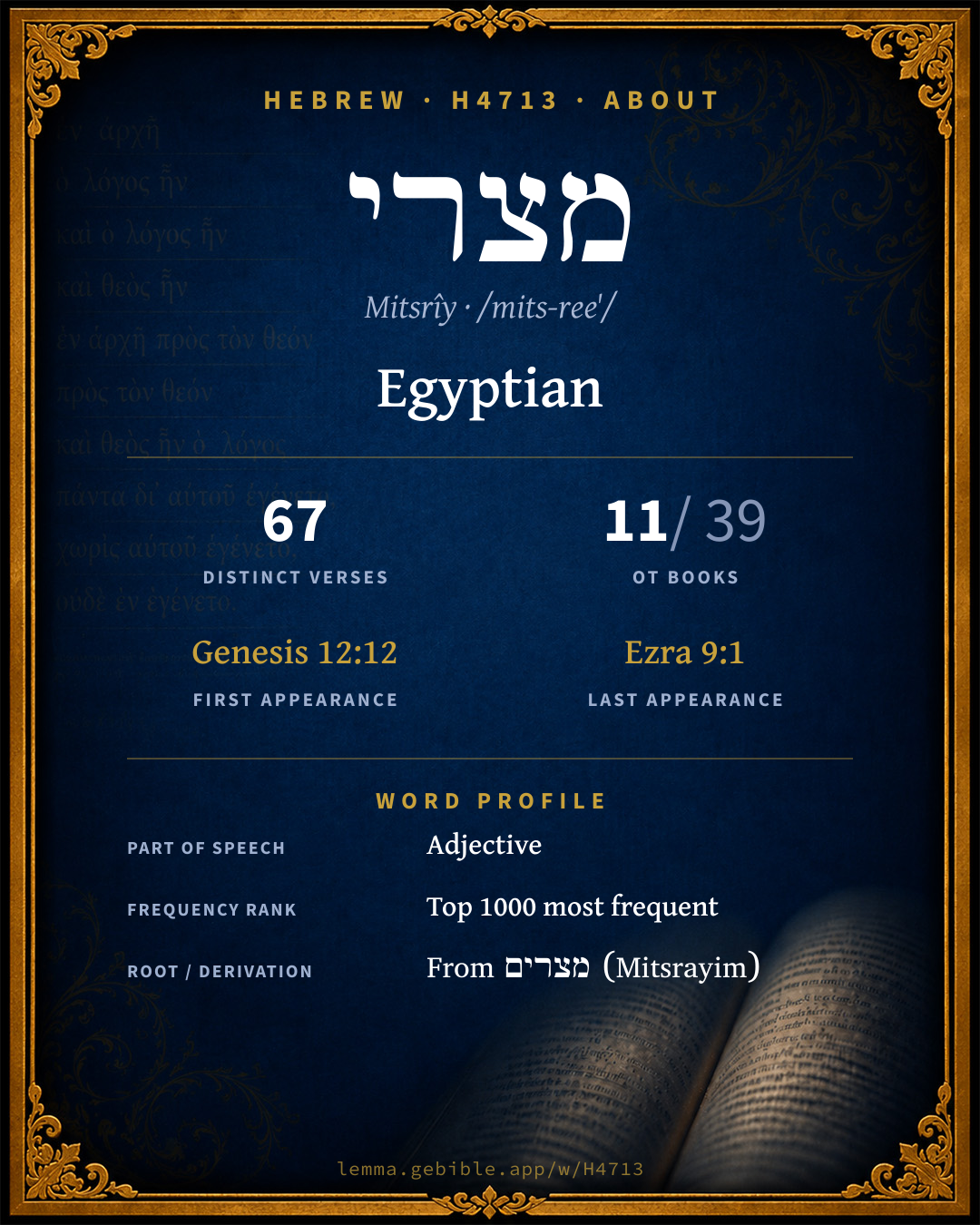
מִצְרִי
Egyptian
BDB lists 2 entries for ‘Egyptian’ fuller range ↓
Full lexicon entry — Brown-Driver-Briggs (BDB)
From Brown-Driver-Briggs (BDB)
Where this word appears
Grammar key — what these labels mean
Part of speech
- Noun
- A naming word — a person, place, thing, or idea.
Noun type
- Proper
- A name of a specific person, place, or people (e.g. Abraham, Zion, Israel).
- Gentilic
- A noun naming a member of a people, tribe, or region of origin (e.g. an Israelite, a Moabite).
State
- Absolute
- The independent form of a noun, not bound to a following word.
Gender
- Masculine
- Grammatically masculine.
- Feminine
- Grammatically feminine.
Number
- Singular
- One.
- Plural
- More than one (in Hebrew, generally three or more).
Every verse where H4713 appears in the Book of Genesis — 18 distinct verses. Click any verse to open its interlinear word-by-word view. Verse text shown in the World English Bible for context — . Each verse’s Hebrew form is shown with its reference; the English is not keyword-highlighted, since the data carries no word-level English alignment. Use “Compare translations” on any verse to read it across multiple English versions. This concordance covers the Hebrew Bible; Septuagint (Greek Old Testament) occurrences are not indexed here.
Genesis
- Genesis 12:12 הַ/מִּצְרִ֔ים ptcl def.art + n Gentilic mp It will happen, when the Egyptians will see you, that they will say, 'This is his wife.' They will kill me, but they will save you alive.
- Genesis 12:14 הַ/מִּצְרִים֙ ptcl def.art + n Gentilic mp It happened that when Abram had come into Egypt, the Egyptians saw that the woman was very beautiful.
- Genesis 16:1 מִצְרִ֖ית n Gentilic fs Now Sarai, Abram's wife, bore him no children. She had a handmaid, an Egyptian, whose name was Hagar.
- Genesis 16:3 הַ/מִּצְרִית֙ ptcl def.art + n Gentilic fs Sarai, Abram's wife, took Hagar the Egyptian, her handmaid, after Abram had lived ten years in the land of Canaan, and gave her to Abram her husband to be his wife.
- Genesis 21:9 הַ/מִּצְרִ֛ית ptcl def.art + n Gentilic fs Sarah saw the son of Hagar the Egyptian, whom she had borne to Abraham, mocking.
- Genesis 25:12 הַ/מִּצְרִ֛ית ptcl def.art + n Gentilic fs Now this is the history of the generations of Ishmael, Abraham's son, whom Hagar the Egyptian, Sarah's handmaid, bore to Abraham.
- Genesis 39:1 מִצְרִ֔י n Gentilic ms Joseph was brought down to Egypt. Potiphar, an officer of Pharaoh's, the captain of the guard, an Egyptian, bought him from the hand of the Ishmaelites that had brought him down there.
- Genesis 39:2 הַ/מִּצְרִֽי ptcl def.art + n Gentilic ms Yahweh was with Joseph, and he was a prosperous man. He was in the house of his master the Egyptian.
- Genesis 39:5 הַ/מִּצְרִ֖י ptcl def.art + n Gentilic ms It happened from the time that he made him overseer in his house, and over all that he had, that Yahweh blessed the Egyptian's house for Joseph's sake; and the blessing of Yahweh was on all that he had, in the house and in the field.
- Genesis 41:55 מִצְרַ֨יִם֙ n Proper When all the land of Egypt was famished, the people cried to Pharaoh for bread, and Pharaoh said to all the Egyptians, "Go to Joseph. What he says to you, do."
- Genesis 41:56 לְ/מִצְרַ֔יִם prep + n Proper The famine was over all the surface of the earth. Joseph opened all the store-houses, and sold to the Egyptians. The famine was severe in the land of Egypt.
- Genesis 43:32 וְ/לַ/מִּצְרִ֞ים הַ/מִּצְרִ֗ים לְ/מִצְרָֽיִם conj + prep det + n Gentilic mp ptcl def.art + n Gentilic mp prep + n Proper They served him by himself, and them by themselves, and the Egyptians, that ate with him, by themselves, because the Egyptians don't eat bread with the Hebrews, for that is an abomination to the Egyptians.
- Genesis 45:2 מִצְרַ֔יִם n Proper He wept aloud. The Egyptians heard, and the house of Pharaoh heard.
- Genesis 46:34 מִצְרַ֖יִם n Proper that you shall say, 'Your servants have been keepers of cattle from our youth even until now, both we, and our fathers:' that you may dwell in the land of Goshen; for every shepherd is an abomination to the Egyptians."
- Genesis 47:15 מִצְרַ֨יִם n Proper When the money was all spent in the land of Egypt, and in the land of Canaan, all the Egyptians came to Joseph, and said, "Give us bread, for why should we die in your presence? For our money fails."
- Genesis 47:20 מִצְרַ֨יִם֙ n Proper So Joseph bought all the land of Egypt for Pharaoh, for the Egyptians sold every man his field, because the famine was severe on them, and the land became Pharaoh's.
- Genesis 50:3 מִצְרַ֖יִם n Proper Forty days were fulfilled for him, for that is how many the days it takes to embalm. The Egyptians wept for him for seventy days.
- Genesis 50:11 לְ/מִצְרָ֑יִם prep + n Proper When the inhabitants of the land, the Canaanites, saw the mourning in the floor of Atad, they said, "This is a grievous mourning by the Egyptians." Therefore, the name of it was called Abel Mizraim, which is beyond the Jordan.
About this entry
At a glance — auto-summarized from this page’s data, not written by a person. Every figure links to its source below. This summary describes the numbers; it doesn’t interpret them.
מצרי (Mitsrîy) is a Hebrew name most often rendered “Egyptian.” It first appears in Genesis 12:12. Spanning 67 verses in 11 books, it ranks among the moderately common words of the Hebrew Bible. Exodus dominates its distribution — 32 of 67 verses. The sections below give every occurrence and version rendering.
Gloss history
Strong's 1890 vs modern scholarship
About this word
Strong's H4713 catalogs a Hebrew word from the Hebrew Old Testament.
These counts are not copied from any lexicon or concordance. They are computed here, from the morphology-tagged Hebrew Old Testament. What Lemma adds →
- 67
- distinct verses
- The word appears in 67 distinct verses.
- 11 / 39
- OT books
- The word appears in 11 of 39 Old Testament books.
- #523
- by frequency
- Top 1000 most frequent Hebrew words (rank 523 of 8,640 Hebrew words by occurrence).
View all 67 occurrences in the concordance →
By section of the Old Testament
By traditional corpus
Conventional, traditional groupings — biblical authorship is debated, so this is a traditional corpus grouping, not an authorship claim. Each share is this word’s portion of its verses in that division of the Hebrew canon. Each figure is a share of the word’s 67 distinct verses.
- Torah (Pentateuch) 57 verses · 85%
- Prophets (Nevi'im) 7 verses · 10%
- Writings (Ketuvim) 3 verses · 4%
How translations render this word
Counts come from each version’s own published word-to-Strong’s tagging or interlinear alignment — an approximate guide to how each version renders this word, not a word-level alignment the data otherwise carries. Because each total is that version’s own tagged count, the per-version totals vary from one another and need not match the appearance or distinct-verse counts above. These counts may also differ from a printed concordance because Lemma counts each distinctly tagged rendering and does not collapse phrase taggings into a single head-word total. This is a fixed set of word-tagged versions (KJV, ASV, BSB, ULT) and does not change with the reading translation you choose elsewhere. Each version’s license is shown beside its name below (and on Sources).
- King James Version: Egyptian 14×, Egyptian's 3×, Egyptians 3×
- American Standard Version: Egyptian 16×, Egyptians 3×
- Berean Standard Bible: Egyptians 38×, Egyptian 17×, Although the egyptian 2×
- unfoldingWord Literal Text: Egyptians 43×, Egyptian 23×, Egypt 10×
King James Version Public Domain
Renders H4713 across 27 tagged occurrences — most commonly:
Plus 7 renderings that appear only once — usually multi-word phrases or single function words the recovered tagging swept in, not distinct renderings. Not rendered by a distinct English word in 3 further occurrences.
American Standard Version Public Domain
Renders H4713 across 27 tagged occurrences — most commonly:
Plus 8 renderings that appear only once — usually multi-word phrases or single function words the recovered tagging swept in, not distinct renderings.
Berean Standard Bible Public Domain
Renders H4713 across 65 tagged occurrences — most commonly:
Plus 6 renderings that appear only once — usually multi-word phrases or single function words the recovered tagging swept in, not distinct renderings. Not rendered by a distinct English word in 5 further occurrences.
unfoldingWord Literal Text CC BY-SA 4.0
Renders H4713 across 76 tagged occurrences — most commonly:
Senses in the full BDB
What do BDB’s symbols mean?
BDB uses these scholarly abbreviations:
| Symbol | Meaning |
|---|---|
| 𝔊 | the Septuagint (the ancient Greek translation, LXX) |
| 𝔙 | the Vulgate (the Latin translation) |
| 𝔖 | the Syriac version (the Peshitta) |
| 𝔗 | the Targum (the Aramaic translation) |
| ψ | the Psalms |
| √ | root (the underlying root or stem) |
| ‖ | parallel passage (a synonymous or contrasted parallel) |
| † | the dagger: every passage where the word occurs is cited |
The 2 senses and sub-senses the full Brown-Driver-Briggs lexicon distinguishes for this word, in lexicon order (not ranked by frequency), with BDB’s own verbatim wording and sub-sense lettering. Shown in Hebrew script with BDB’s own scholarly abbreviations. The condensed entry is in the Lexicon Entry tab. See also the Forms in the corpus table below.
- 1. adj. אִישׁ מ׳=an Egyptian Gn 39:1 Ex 2:11, 19 Lv 24:10 1 S 30:11 2 S 23:30; הָאִישׁ הַמּ׳ 1 Ch 11:23; נַעַר מ׳ 1 S 30:13, עֶבֶד מ׳ 1 Ch 2:34; שִׁפְחָה מִצְרִית Gn 16:1, כַּנָּשִׁים הַמִּצְרִיֹּת Ex 1:19. e.g. Genesis 39:1
- 2. c. art.=subst. the Egyptian Gn 39:2, 5 Ex 2:12, 14 2 S 23:30(×2) 1 Ch 11:23(×2); so once without art. מִצְרִי Dt 23:8; הַמִּצְרִי once (late) coll.=the Egyptians Ezr 9:1 (where with Canaanitish peoples); pl.=the Egyptians, הָמִּצְרִים Gn 12:12, 14; 43:32 Dt 26:6 Jos 24:7; fs. הָגָר הַמִּצְרִית Hagar the Egyptian woman Gn 16:3; 21:9; 25:12. e.g. Genesis 39:2
Senses from the full Brown-Driver-Briggs lexicon (Brown, Driver, Briggs; Oxford 1906 — public domain), digitized via Sefaria, supplemented by the OpenScriptures HebrewLexicon (CC BY 4.0). Full attribution on Sources.
Word origin
adj.gent. Egyptian;—ms. מ׳ Gn 39:1 + 16 times; fs. מִצְרִית 16:1 + 3 times; mpl. מִצְרִים 12:12 + 5 times; fpl. מִצְרִיֹּת Ex 1:19;—
— Brown-Driver-Briggs (Oxford 1906, public domain), digitized via Sefaria, supplemented by the OpenScriptures HebrewLexicon (CC BY 4.0). See Sources.
Derived from מצרים (Mitsrayim) (H4714) — Egypt.
Jastrow Dictionary
A second Hebrew/Aramaic lexicon for comparison, covering Aramaic and post-biblical (Talmudic, Targumic, Midrashic) usage that the biblical-Hebrew BDB does not. Matched by lemma rather than by Strong’s number, so a lemma may carry more than one Jastrow headword (shown separately below), and the entries cover usage well beyond the Bible.
*מִצְרִי I
- (v. מָצַר I) anything twisted of rushes, palm-twigs &c. חבל מ׳ a common rope (badge of disgrace worn by the Sotah, v. סוֹטָה). Sot. I, 6; a. fr.—[Y. ib. I, 17ᵃ top; Num. R. s. 9 take our w. to mean Egyptian, v. next w.].—Fem. מִצְרִית. Sot. II, 1, a. fr. כפיפה מ׳, v. כְּפִיפָה.
מִצְרִי II
- (b. h.) Egyptian. Yeb. VIII, 3 מ׳ ואדומי an Egyptian and an Edomite convert. Ib. 76ᵇ, a. e. גר מ׳ היה לי וכ׳ an Egyptian proselyte was my fellow student &c. Ib. מ׳ ראשון an original Egyptian proselyte, opp. to מ׳ שני the son of an Egyptian proselyte. B. Bath. III, 6 סולם המ׳ an Egyptian (small) ladder; a. fr.—Pl. מִצְרִיִּים, מִצְרִים. Pes. X, 5. Ex. R. s. 1; a. fr.—Fem. מִצְרִית. Yeb. l. c. מ׳ ראשונה, מ׳ שנייה, v. supra. B. Bath. l. c. חלון המ׳, v. חַלּוֹן; a. fr.—Pl. מִצְרִיּוֹת. Ex. R. l. c.; a. fr.
מִצְרַי
- , v. מִצְרָאָה
A Dictionary of the Targumim, the Talmud Babli and Yerushalmi, and the Midrashic Literature (Marcus Jastrow; London, Luzac, 1903) — Public Domain. Digitized via Sefaria. Digitized via Sefaria. Full attribution on Sources.
Forms in the corpus
The 37 distinct written forms H4713 takes in the Hebrew Bible, most frequent first — each parse links to that state’s occurrences in the concordance. Hebrew forms include their vowel points and cantillation, so a single lemma takes many written forms.
| Form | Parsing | Example | Uses |
|---|---|---|---|
| מִצְרַ֔יִם | Noun, Proper | Exodus 3:20 | 10 |
| מִצְרַ֨יִם֙ | Noun, Proper | Exodus 7:5 | 7 |
| מִצְרַ֖יִם | Noun, Proper | Exodus 3:9 | 6 |
| מִצְרִ֔י | Noun, Gentilic, Masculine, Singular, Absolute | Deuteronomy 23:7 | 5 |
| מִצְרָ֑יִם | Noun, Proper | Exodus 3:21 | 4 |
| מִצְרָֽיִם | Noun, Proper | Exodus 3:22 | 4 |
| הַ/מִּצְרִ֔י | Noun, Gentilic, Masculine, Singular, Absolute | Exodus 2:12 | 3 |
| מִצְרַ֛יִם | Noun, Proper | Exodus 1:13 | 3 |
| מִצְרַ֜יִם | Noun, Proper | Exodus 14:9 | 3 |
| הַ/מִּצְרִ֖י | Noun, Gentilic, Masculine, Singular, Absolute | Ezra 9:1 | 2 |
| הַ/מִּצְרִ֗ים | Noun, Gentilic, Masculine, Plural, Absolute | Genesis 43:32 | 2 |
| הַ/מִּצְרִ֛ית | Noun, Gentilic, Feminine, Singular, Absolute | Genesis 21:9 | 2 |
| הַ/מִּצְרִ֑י | Noun, Gentilic, Masculine, Singular, Absolute | Exodus 2:14 | 1 |
| הַ/מִּצְרִ֔ים | Noun, Gentilic, Masculine, Plural, Absolute | Genesis 12:12 | 1 |
| הַ/מִּצְרִ֖ים | Noun, Gentilic, Masculine, Plural, Absolute | Deuteronomy 26:6 | 1 |
| הַ/מִּצְרִ֜י | Noun, Gentilic, Masculine, Singular, Absolute | 1 Chronicles 11:23 | 1 |
| הַ/מִּצְרִ֤י | Noun, Gentilic, Masculine, Singular, Absolute | 1 Chronicles 11:23 | 1 |
| הַ/מִּצְרִֽי | Noun, Gentilic, Masculine, Singular, Absolute | Genesis 39:2 | 1 |
| הַ/מִּצְרִי֙ | Noun, Gentilic, Masculine, Singular, Absolute | 2 Samuel 23:21 | 1 |
| הַ/מִּצְרִיֹּ֖ת | Noun, Gentilic, Feminine, Plural, Absolute | Exodus 1:19 | 1 |
| הַ/מִּצְרִים֙ | Noun, Gentilic, Masculine, Plural, Absolute | Genesis 12:14 | 1 |
| הַ/מִּצְרִית֙ | Noun, Gentilic, Feminine, Singular, Absolute | Genesis 16:3 | 1 |
| וְ/לַ/מִּצְרִ֞ים | Noun, Gentilic, Masculine, Plural, Absolute | Genesis 43:32 | 1 |
| וּ/מִצְרַ֣יִם | Noun, Proper | Numbers 33:4 | 1 |
| לְ/מִצְרַ֔יִם | Noun, Proper | Genesis 41:56 | 1 |
| לְ/מִצְרָ֑יִם | Noun, Proper | Genesis 50:11 | 1 |
| לְ/מִצְרָֽיִם | Noun, Proper | Genesis 43:32 | 1 |
| מִצְרִ֖י | Noun, Gentilic, Masculine, Singular, Absolute | 1 Chronicles 2:34 | 1 |
| מִצְרִ֖ית | Noun, Gentilic, Feminine, Singular, Absolute | Genesis 16:1 | 1 |
| מִצְרִ֜י | Noun, Gentilic, Masculine, Singular, Absolute | 2 Samuel 23:21 | 1 |
| מִצְרִ֣י | Noun, Gentilic, Masculine, Singular, Absolute | 1 Samuel 30:13 | 1 |
| מִצְרִי֙ | Noun, Gentilic, Masculine, Singular, Absolute | 1 Samuel 30:11 | 1 |
| מִצְרַ֗יִם | Noun, Proper | Exodus 3:8 | 1 |
| מִצְרַ֣יִם | Noun, Proper | Exodus 14:10 | 1 |
| מִצְרַ֥יִם | Noun, Proper | 1 Samuel 6:6 | 1 |
| מִצְרַ֨יִם | Noun, Proper | Genesis 47:15 | 1 |
| מִצְרַיִם֒ | Noun, Proper | Exodus 10:6 | 1 |
Septuagint verse parallels
This word appears in 67 verses that also exist in the Greek Old Testament (Septuagint), out of the 67 Hebrew verses it occurs in. You can read those verses in Greek by switching the Old Testament edition to the Septuagint.
Read these verses in the Septuagint
- Genesis 12:12
- Exodus 1:13
- Leviticus 24:10
- Numbers 14:13
- Deuteronomy 23:7
- Joshua 24:6
- Judges 6:9
- 1 Samuel 6:6
- 2 Samuel 23:21
- 1 Chronicles 2:34
- Ezra 9:1
This is a verse-level parallel only — the same verses exist in both the Hebrew and Greek Old Testaments. No word-level Hebrew↔Greek correspondence is claimed: the data carries no such alignment, so no Greek word is shown as this Hebrew word’s translation. Coverage is not total — the Septuagint omits the deuterocanon and renumbers the Psalms, so some Hebrew verses have no direct Greek parallel.