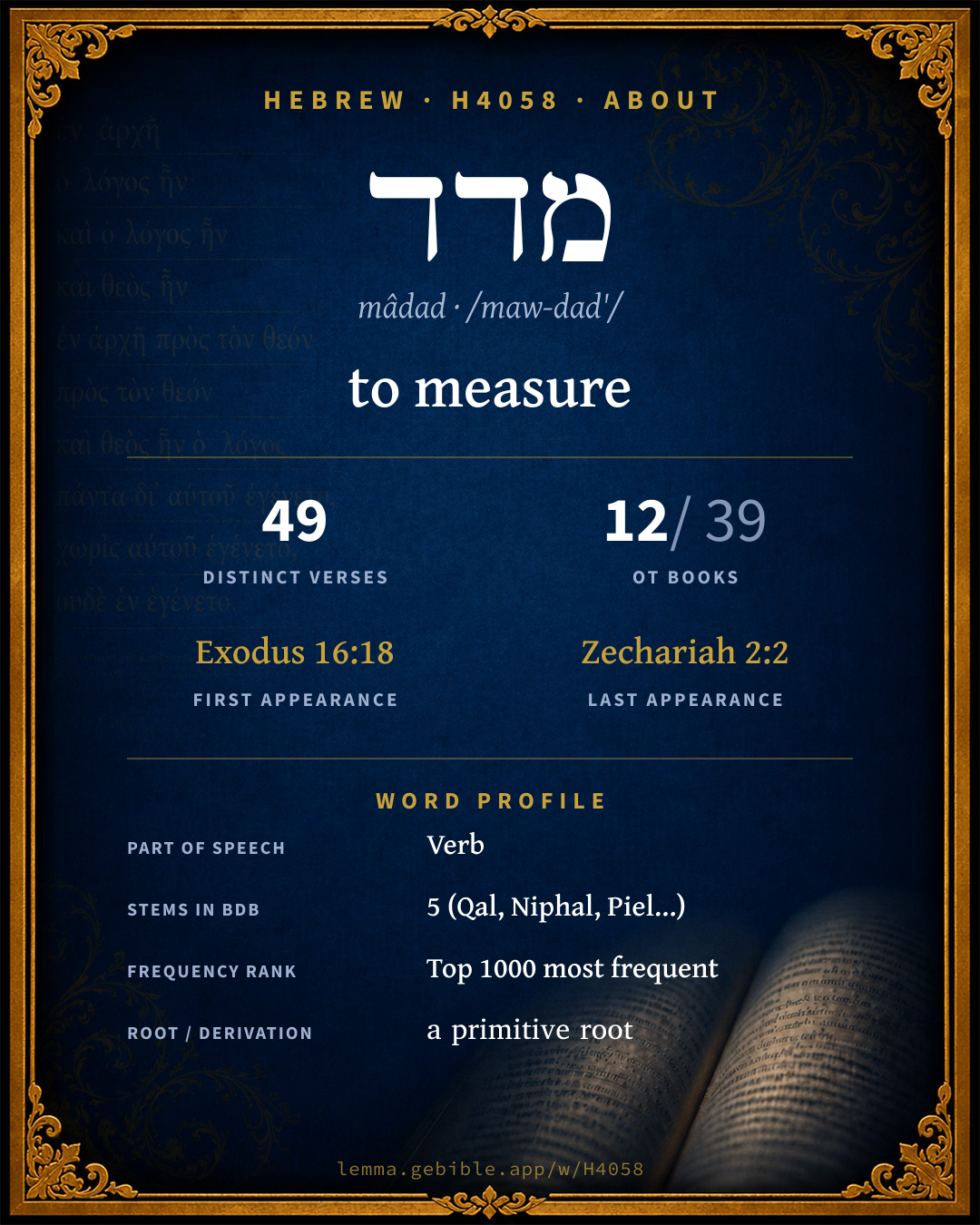
מָדַד
to measure
‘to measure’ is one of 5 main senses fuller range ↓
Full lexicon entry — Brown-Driver-Briggs (BDB)
From Brown-Driver-Briggs (BDB)
Where this word appears
See every Qal verb in the Hebrew Bible →
Grammar key — what these labels mean
Part of speech
- Verb
- An action or state-of-being word.
Stem
- Qal
- The basic, simple active stem — the plain form of the verb (“he wrote”). Here: ‘measure of length’
- Niphal
- Usually the simple passive or reflexive of the Qal (“he was written”).
- Piel
- An intensive or resultative active stem. Here: ‘extend’
- Hithpolel
- The reflexive counterpart of the Polel.
Form
- Sequential Imperfect
- An imperfect with prefixed waw — the standard past-narrative form (waw-consecutive imperfect).
- Perfect
- A completed action or state — Hebrew marks aspect (completeness) more than strict tense (“he wrote”).
- Sequential Perfect
- A perfect with prefixed waw continuing a preceding imperfect or command (waw-consecutive perfect).
- Imperfect
- An incomplete, ongoing, or future action (“he will / would write”).
- Infinitive Construct
- A bound verbal noun, frequently with prepositions (“to write / in writing”).
- Cohortative
- A first-person volitional form expressing wish or resolve (“let me / let us write”).
Person
- 3rd Person
- The one spoken about (“he / she / it / they”).
- 1st Person
- The speaker (“I / we”).
- 2nd Person
- The one addressed (“you”).
Gender
- Masculine
- Grammatically masculine.
- Common
- Either gender — not distinguished for this form.
Number
- Singular
- One.
- Plural
- More than one (in Hebrew, generally three or more).
Grammatical forms 16 distinct
- Verb, Qal, Sequential Imperfect, 3rd Person, Masculine, Singular 23 times (45%)
- Verb, Qal, Perfect, 3rd Person, Masculine, Singular 9 times (18%)
- Verb, Qal, Sequential Perfect, 3rd Person, Masculine, Singular 3 times (6%)
- Verb, Qal, Sequential Perfect, 3rd Person, Common, Plural 2 times (4%)
- Verb, Niphal, Imperfect, 3rd Person, Masculine, Singular 2 times (4%)
- Verb, Piel, Sequential Imperfect, 3rd Person, Masculine, Singular 2 times (4%)
- Verb, Qal, Sequential Perfect, 1st Person, Common, Singular 1 time (2%)
- Verb, Qal, Sequential Perfect, 2nd Person, Masculine, Plural 1 time (2%)
+8 more forms (8 occurrences)
Parsed forms decoded from the imported morphology (morphhb / Westminster Leningrad Codex — WLC text public domain, morphhb tagging CC BY 4.0), counted across 51 parsed occurrences — not distinct verses.
Every verse where H4058 appears — 49 distinct verses across 12 books. Click any verse to open its interlinear word-by-word view. Verse text shown in the World English Bible for context — . Each verse’s Hebrew form is shown with its reference; the English is not keyword-highlighted, since the data carries no word-level English alignment. Use “Compare translations” on any verse to read it across multiple English versions. This concordance covers the Hebrew Bible; Septuagint (Greek Old Testament) occurrences are not indexed here.
Exodus 1 verse
Numbers 1 verse
Deuteronomy 1 verse
Ruth 1 verse
2 Samuel 1 verse
1 Kings 1 verse
Psalms 2 verses
Isaiah 2 verses
- Isaiah 40:12 מָדַ֨ד Qal pf 3ms Who has measured the waters in the hollow of his hand, and meted out the sky with the span, and comprehended the dust of the earth in a measure, and weighed the mountains in scales, and the hills in a balance?
- Isaiah 65:7 וּ/מַדֹּתִ֧י conj + Qal wpf 1cs your own iniquities, and the iniquities of your fathers together, says Yahweh, who have burned incense on the mountains, and blasphemed me on the hills; therefore will I first measure their work into their bosom.
Jeremiah 2 verses
- Jeremiah 31:37 יִמַּ֤דּוּ Niphal impf 3mp Thus says Yahweh: If heaven above can be measured, and the foundations of the earth searched out beneath, then will I also cast off all the seed of Israel for all that they have done, says Yahweh.
- Jeremiah 33:22 יִמַּ֖ד Niphal impf 3ms As the host of the sky can't be numbered, neither the sand of the sea measured; so will I multiply the seed of David my servant, and the Levites who minister to me.
Ezekiel 35 verses
- Ezekiel 40:5 וַ/יָּ֜מָד conj + Qal wimpf 3ms Behold, a wall on the outside of the house round about, and in the man's hand a measuring reed six cubits long, of a cubit and a handbreadth each: so he measured the thickness of the building, one reed; and the height, one reed.
- Ezekiel 40:6 וַ/יָּ֣מָד conj + Qal wimpf 3ms Then came he to the gate which looks toward the east, and went up the steps of it: and he measured the threshold of the gate, one reed broad; and the other threshold, one reed broad.
- Ezekiel 40:8 וַ/יָּ֜מָד conj + Qal wimpf 3ms He measured also the porch of the gate toward the house, one reed.
- Ezekiel 40:9 וַ/יָּ֜מָד conj + Qal wimpf 3ms Then measured he the porch of the gate, eight cubits; and the posts of it, two cubits; and the porch of the gate was toward the house.
- Ezekiel 40:11 וַ/יָּ֛מָד conj + Qal wimpf 3ms He measured the breadth of the opening of the gate, ten cubits; and the length of the gate, thirteen cubits;
- Ezekiel 40:13 וַ/יָּ֣מָד conj + Qal wimpf 3ms He measured the gate from the roof of the one lodge to the roof of the other, a breadth of twenty-five cubits; door against door.
- Ezekiel 40:19 וַ/יָּ֣מָד conj + Qal wimpf 3ms Then he measured the breadth from the forefront of the lower gate to the forefront of the inner court outside, one hundred cubits, [both] on the east and on the north.
- Ezekiel 40:20 מָדַ֥ד Qal pf 3ms The gate of the outer court whose prospect is toward the north, he measured the length of it and the breadth of it.
- Ezekiel 40:23 וַ/יָּ֧מָד conj + Qal wimpf 3ms There was a gate to the inner court over against the [other] gate, [both] on the north and on the east; and he measured from gate to gate one hundred cubits.
- Ezekiel 40:24 וּ/מָדַ֤ד conj + Qal wpf 3ms He led me toward the south; and, behold, a gate toward the south: and he measured the posts of it and the arches of it according to these measures.
- Ezekiel 40:27 וַ/יָּ֨מָד conj + Qal wimpf 3ms There was a gate to the inner court toward the south: and he measured from gate to gate toward the south a hundred cubits.
- Ezekiel 40:28 וַ/יָּ֨מָד֙ conj + Qal wimpf 3ms Then he brought me to the inner court by the south gate: and he measured the south gate according to these measures;
- Ezekiel 40:32 וַ/יָּ֣מָד conj + Qal wimpf 3ms He brought me into the inner court toward the east: and he measured the gate according to these measures;
- Ezekiel 40:35 וּ/מָדַ֖ד conj + Qal pf 3ms He brought me to the north gate: and he measured [it] according to these measures;
- Ezekiel 40:47 וַ/יָּ֨מָד conj + Qal wimpf 3ms He measured the court, one hundred cubits long, and a hundred cubits broad, foursquare; and the altar was before the house.
- Ezekiel 40:48 וַ/יָּ֨מָד֙ conj + Qal wimpf 3ms Then he brought me to the porch of the house, and measured each post of the porch, five cubits on this side, and five cubits on that side: and the breadth of the gate was three cubits on this side, and three cubits on that side.
- Ezekiel 41:1 וַ/יָּ֣מָד conj + Qal wimpf 3ms He brought me to the temple, and measured the posts, six cubits broad on the one side, and six cubits broad on the other side, which was the breadth of the tent.
- Ezekiel 41:2 וַ/יָּ֤מָד conj + Qal wimpf 3ms The breadth of the entrance was ten cubits; and the sides of the entrance were five cubits on the one side, and five cubits on the other side: and he measured the length of it, forty cubits, and the breadth, twenty cubits.
- Ezekiel 41:3 וַ/יָּ֥מָד conj + Qal wimpf 3ms Then went he inward, and measured each post of the entrance, two cubits; and the entrance, six cubits; and the breadth of the entrance, seven cubits.
- Ezekiel 41:4 וַ/יָּ֨מָד conj + Qal wimpf 3ms He measured the length of it, twenty cubits, and the breadth, twenty cubits, before the temple: and he said to me, This is the most holy place.
- Ezekiel 41:5 וַ/יָּ֥מָד conj + Qal wimpf 3ms Then he measured the wall of the house, six cubits; and the breadth of every side-chamber, four cubits, round about the house on every side.
- Ezekiel 41:13 וּ/מָדַ֣ד conj + Qal wpf 3ms So he measured the house, one hundred cubits long; and the separate place, and the building, with the walls of it, one hundred cubits long;
- Ezekiel 41:15 וּ/מָדַ֣ד conj + Qal wpf 3ms He measured the length of the building before the separate place which was at the back of it, and the galleries of it on the one side and on the other side, one hundred cubits; and the inner temple, and the porches of the court;
- Ezekiel 42:15 וּ/מְדָד֖/וֹ conj + Qal pf 3ms + sfx pers 3ms Now when he had made an end of measuring the inner house, he brought me forth by the way of the gate whose prospect is toward the east, and measured it round about.
- Ezekiel 42:16 מָדַ֛ד Qal pf 3ms He measured on the east side with the measuring reed five hundred reeds, with the measuring reed round about.
- Ezekiel 42:17 מָדַ֖ד Qal pf 3ms He measured on the north side five hundred reeds with the measuring reed round about.
- Ezekiel 42:18 מָדָ֑ד Qal pf 3ms He measured on the south side five hundred reeds with the measuring reed.
- Ezekiel 42:19 מָדַ֛ד Qal pf 3ms He turned about to the west side, and measured five hundred reeds with the measuring reed.
- Ezekiel 42:20 מְדָד֗/וֹ Qal pf 3ms + sfx pers 3ms He measured it on the four sides: it had a wall round about, the length five hundred, and the breadth five hundred, to make a separation between that which was holy and that which was common.
- Ezekiel 43:10 וּ/מָדְד֖וּ conj + Qal wpf 3cp You, son of man, show the house to the house of Israel, that they may be ashamed of their iniquities; and let them measure the pattern.
- Ezekiel 45:3 תָּמ֔וֹד Qal impf 2ms Of this measure shall you measure a length of twenty-five thousand, and a breadth of ten thousand: and in it shall be the sanctuary, which is most holy.
- Ezekiel 47:3 וַ/יָּ֤מָד conj + Qal wimpf 3ms When the man went forth eastward with the line in his hand, he measured one thousand cubits, and he caused me to pass through the waters, waters that were to the ankles.
- Ezekiel 47:4 וַ/יָּ֣מָד וַ/יָּ֣מָד conj + Qal wimpf 3ms conj + Qal wimpf 3ms Again he measured one thousand, and caused me to pass through the waters, waters that were to the knees. Again he measured one thousand, and caused me to pass through [the waters], waters that were to the loins.
- Ezekiel 47:5 וַ/יָּ֣מָד conj + Qal wimpf 3ms Afterward he measured one thousand; [and it was] a river that I could not pass through; for the waters were risen, waters to swim in, a river that could not be passed through.
- Ezekiel 47:18 תָּמֹ֑דּוּ Qal impf 2mp The east side, between Hauran and Damascus and Gilead, and the land of Israel, shall be the Jordan; from the [north] border to the east sea shall you measure. This is the east side.
Hosea 1 verse
Zechariah 1 verse
About this entry
At a glance — auto-summarized from this page’s data, not written by a person. Every figure links to its source below. This summary describes the numbers; it doesn’t interpret them.
The Hebrew verb מדד centers on the idea of “to measure.” The word gravitates to Ezekiel (71%), then Psalms and Isaiah. It appears 49 verses across 12 books of the Hebrew Bible, among its moderately common vocabulary. Its earliest occurrence is Exodus 16:18. The verb spans 5 stems, from Qal to Niphal. For the data behind this summary, explore the sense tree and the renderings breakdown below.
Gloss history
Strong's 1890 vs modern scholarship
About this word
Strong's H4058 catalogs a Hebrew word from the Hebrew Old Testament.
These counts are not copied from any lexicon or concordance. They are computed here, from the morphology-tagged Hebrew Old Testament. What Lemma adds →
- 49
- distinct verses
- The word appears in 49 distinct verses.
- 12 / 39
- OT books
- The word appears in 12 of 39 Old Testament books.
- #723
- by frequency
- Top 1000 most frequent Hebrew words (rank 723 of 8,640 Hebrew words by occurrence).
View all 49 occurrences in the concordance →
By section of the Old Testament
By traditional corpus
Conventional, traditional groupings — biblical authorship is debated, so this is a traditional corpus grouping, not an authorship claim. Each share is this word’s portion of its verses in that division of the Hebrew canon. Each figure is a share of the word’s 49 distinct verses.
- Prophets (Nevi'im) 43 verses · 88%
- Torah (Pentateuch) 3 verses · 6%
- Writings (Ketuvim) 3 verses · 6%
How translations render this word
Counts come from each version’s own published word-to-Strong’s tagging or interlinear alignment — an approximate guide to how each version renders this word, not a word-level alignment the data otherwise carries. Because each total is that version’s own tagged count, the per-version totals vary from one another and need not match the appearance or distinct-verse counts above. These counts may also differ from a printed concordance because Lemma counts each distinctly tagged rendering and does not collapse phrase taggings into a single head-word total. This is a fixed set of word-tagged versions (KJV, ASV, BSB, ULT) and does not change with the reading translation you choose elsewhere. Each version’s license is shown beside its name below (and on Sources).
- King James Version: He measured 21×, Measured 10×, Again he measured 2×
- American Standard Version: He measured 22×, Measured 8×, Again he measured 2×
- Berean Standard Bible: He measured 17×, Measured 5×, He measured off 3×
- unfoldingWord Literal Text: He measured 11×, Measured 11×, Man measured 6×
King James Version Public Domain
Renders H4058 across 51 tagged occurrences — most commonly:
Plus 14 renderings that appear only once — usually multi-word phrases or single function words the recovered tagging swept in, not distinct renderings.
American Standard Version Public Domain
Renders H4058 across 51 tagged occurrences — most commonly:
Plus 17 renderings that appear only once — usually multi-word phrases or single function words the recovered tagging swept in, not distinct renderings.
Berean Standard Bible Public Domain
Renders H4058 across 50 tagged occurrences — most commonly:
Plus 16 renderings that appear only once — usually multi-word phrases or single function words the recovered tagging swept in, not distinct renderings. Not rendered by a distinct English word in 1 further occurrence.
unfoldingWord Literal Text CC BY-SA 4.0
Renders H4058 across 49 tagged occurrences — most commonly:
Plus 17 renderings that appear only once — usually multi-word phrases or single function words the recovered tagging swept in, not distinct renderings.
10 senses and sub-senses in the full BDB
Hebrew verbs can shift meaning by stem (binyan): Qal is the basic action, Niphal is often passive or reflexive, Piel often intensifies or makes it factitive, and Hiphil is typically causative. The senses below are grouped under the stem BDB assigns to each. This entry also uses one or more reduplicated stems (the Pōlēl/Pilpēl type), which for hollow or geminate roots behave much like Piel — often intensive or iterative.
What do BDB’s symbols mean?
BDB uses these scholarly abbreviations:
| Symbol | Meaning |
|---|---|
| 𝔊 | the Septuagint (the ancient Greek translation, LXX) |
| 𝔙 | the Vulgate (the Latin translation) |
| 𝔖 | the Syriac version (the Peshitta) |
| 𝔗 | the Targum (the Aramaic translation) |
| ψ | the Psalms |
| √ | root (the underlying root or stem) |
| ‖ | parallel passage (a synonymous or contrasted parallel) |
| † | the dagger: every passage where the word occurs is cited |
The 10 senses and sub-senses the full Brown-Driver-Briggs lexicon distinguishes for this word, in lexicon order (not ranked by frequency), with BDB’s own verbatim wording and sub-sense lettering. Shown in Hebrew script with BDB’s own scholarly abbreviations. The condensed entry is in the Lexicon Entry tab. See also the Forms in the corpus table below.
Qal
- Pf. מ׳ (מָדָ֑ד) Is 40:12 + 9 times Ez; sf. מְדָדוֹ Ez 42:15, 20; 1 s. וּמַדֹּתִ֫י Is 65:7; וּמָֽדְדוּ consec. Dt 21:2; Ez 43:10; וּמַדֹּתֶם consec. Nu 35:5; Impf. וַיָּ֫מָד Ru 3:15 + 22 times Ez; 2 ms. תָּמוֹד Ez 45:3; וַיָּמֹ֫דּוּ Ex 16:18; תָּמֹ֫דּוּ Ez 47:18; Inf. לָמֹד Zc 2:6;—measure, chiefly lit. (usually sq.acc. rei; obj. om. Ex 16:18; Dt 21:2; Ez 40:35, cf. 47:18 (but v. Co); sq. acc. of measure Ru 3:15; Ez 42:19; 47:3, 4(×2), 5);— e.g. Isaiah 40:12
- 1. measure of length, distance Nu 35:5 (P), Dt 21:2 (D), Ez 40:5, 6, 8, 20 + 32 times Ez 40–47; Zc 2:6. e.g. Numbers 35:5
- 2. of dry measure Ex 16:18 (P), Ru 3:15. e.g. Exodus 16:18
- 3. fig. of measuring waters Is 40:12 (of י׳); of requital Is 65:7. e.g. Isaiah 40:12
Niphal
- Impf. יִמַּד Ho 2:1; Je 33:22; יִמַּדּוּ Je 31:37;—be measured, of sand of sea Ho 2:1 Je 33:22; of heavens Je 31:37. e.g. Hosea 2:1
Piel
- Pf. וּמִדַּד־ consec. Jb 7:4 (cf. Ges§52, 2. R. 1); Impf. וַיְמַדֵּד 2 S 8:2; וַיְמַדְּדֵם v 2; אֲמַדֵּד ψ 60:8; 108:8;— e.g. Job 7:4
- 1. extend, continue (= make extent or continuation), subj. עֶרֶב Jb 7:4. e.g. Job 7:4
- 2. measure, measure off, בַחֶבֶל, of apportioning Moabites to death and life, sq. sf. 8:2; also obj. חֲבָלִים v 2; metaph. of conquest, sq. acc., ψ 60:8 = 108:8 (‖ חִלֵּק). e.g. 2 Samuel 8:2
Po
- Impf. וַיְמֹ֫דֶד Hb 3:6 (subj. God, obj. אֶרֶץ), measured (viz. with eye) 𝔙 Hi AV RV, but dub.; 𝔊 ἐσαλεύθη, 𝔗 אֲזִיעַ, hence shook Ew Ke Or al. (from √ [מוֹד =] מוֹט, but read then rather וַיְמֹטֵט, although מוט not elsewhere in this conj.; We, plausibly, וַיְמֹגֵג √ מוג, cf. Na 1:5). e.g. Habakkuk 3:6
Hithpo
- וַיִּתְמֹדֵד sq. עַל־הַיֶּ֫לֶד; 1 K 17:21 measured (= extended, stretched) himself upon the boy. e.g. 1 Kings 17:21
Senses from the full Brown-Driver-Briggs lexicon (Brown, Driver, Briggs; Oxford 1906 — public domain), digitized via Sefaria, supplemented by the OpenScriptures HebrewLexicon (CC BY 4.0). Full attribution on Sources.
Word origin
vb. measure (NH id.; Ph. מדד; Arabic مَدَّ extend, stretch, مُدٌّ a corn-measure, etc.; Assyrian madâdu, measure; Jew.-Aramaic n. מִידָּה measure, proportion, rule);—
— Brown-Driver-Briggs (Oxford 1906, public domain), digitized via Sefaria, supplemented by the OpenScriptures HebrewLexicon (CC BY 4.0). See Sources.
Origin: a primitive root
Jastrow Dictionary
A second Hebrew/Aramaic lexicon for comparison, covering Aramaic and post-biblical (Talmudic, Targumic, Midrashic) usage that the biblical-Hebrew BDB does not. Matched by lemma rather than by Strong’s number, so a lemma may carry more than one Jastrow headword (shown separately below), and the entries cover usage well beyond the Bible.
מָדַד
- (b. h.) [to stretch,] to measure. Sabb. 149ᵇ sq. (play on מ̇ד̇ה̇ב̇ה, Is. XIV, 4) the nation that said מְ֗ד̇וד̇, וה̇ב̇א measure (the area of thy land) and bring (tribute); Lev. R. s. 15, end (Ar.: מוֹד והָבָה measure and give). Erub. V, 4 אין מוֹדְדִין וכ׳ Sabbath distances must be measured only with a rope of &c. Ib. 5 אין מודדין אלא מן המומחה the measuring must be done only by the best experts. Y. Succ. I, 51ᵈ אם יָמוֹד מן וכ׳ if he measures from &c. Maas. Sh. V, 9 עשור שאני עתיד לָמוֹֹד one tenth (as tithe) which I shall measure off (when I come home); a. fr.—Sot. I, 7 במדה שאדם מוֹדֵד בה מוֹדְדִין לו the measure with which man measures will be measured out to him, i.e. as man deals, he will be dealt with, v. אַכְרַעְתָּא; Tosef. ib. III, 1 מ׳ בסאה he measured by the S’ah (committed great wrong). Ber. IX, 5, v. next w.—Ib. 30ᵇ לעולם יָמוֹד אדם וכ׳ man must always measure himself (examine the disposition of his mind; cmp. אָמַד), if he feels that he can direct his mind, let him pray, if not &c. e.g. Isaiah 14:4
- to be measured. B. Bath. VII, 1 אינן נִמְדָּדִין עמה are not included in the measure. Arakh. VII, 1 נִמְדָּדִים עמה are included &c.; a. fr.
- same, to stretch. Gen. R. s. 3; Midr. Till. to Ps. XXIV, a. e. מְמַדֵּד, v. מָתַח.—[Cant. R. to VIII, 11 ממדדין, v. דָּדָה.]
A Dictionary of the Targumim, the Talmud Babli and Yerushalmi, and the Midrashic Literature (Marcus Jastrow; London, Luzac, 1903) — Public Domain. Digitized via Sefaria. Digitized via Sefaria. Full attribution on Sources.
Forms in the corpus
The 32 distinct written forms H4058 takes in the Hebrew Bible, most frequent first — each parse links to that stem’s occurrences in the concordance. Hebrew forms include their vowel points and cantillation, so a single lemma takes many written forms.
Same root — word family
Other BDB entries built from the same root as H4058, grouped by Strong’s listed origin. These share a root / origin per the lexicon — not necessarily a shared meaning. Each links to that word’s own entry.
Derived from this word
Compare all same-root words → They share a root, not necessarily a meaning.
Septuagint verse parallels
This word appears in 48 verses that also exist in the Greek Old Testament (Septuagint), out of the 49 Hebrew verses it occurs in. You can read those verses in Greek by switching the Old Testament edition to the Septuagint.
Read these verses in the Septuagint
- Exodus 16:18
- Numbers 35:5
- Deuteronomy 21:2
- Ruth 3:15
- 2 Samuel 8:2
- 1 Kings 17:21
- Psalms 60:6
- Isaiah 40:12
- Jeremiah 31:37
- Ezekiel 40:5
- Zechariah 2:2
This is a verse-level parallel only — the same verses exist in both the Hebrew and Greek Old Testaments. No word-level Hebrew↔Greek correspondence is claimed: the data carries no such alignment, so no Greek word is shown as this Hebrew word’s translation. Coverage is not total — the Septuagint omits the deuterocanon and renumbers the Psalms, so some Hebrew verses have no direct Greek parallel.