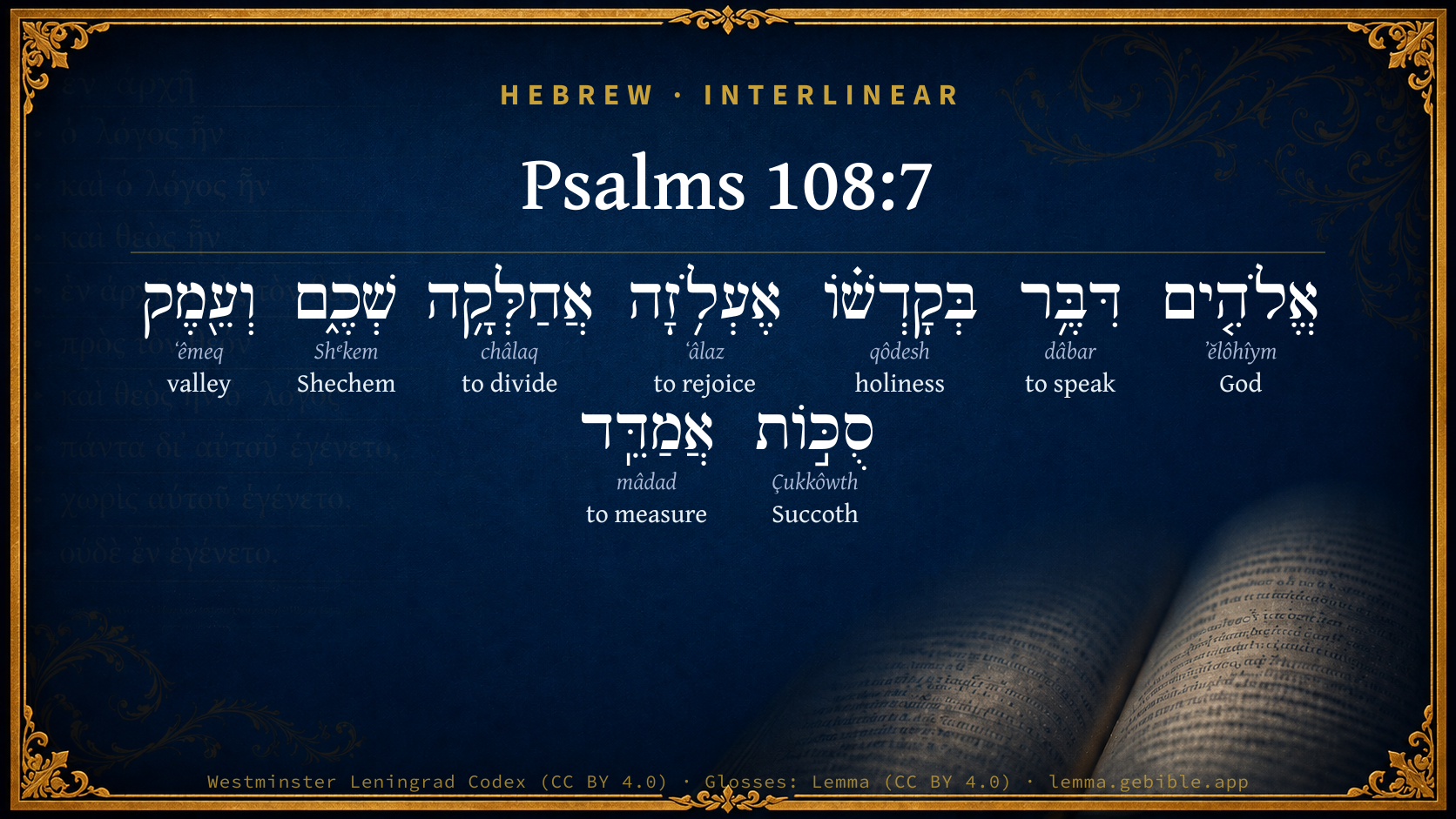
Psalms 108:7

Hebrew (Westminster Leningrad Codex) Psalms 108:7 appears in the Hebrew Old Testament. The text above is from the Westminster Leningrad Codex. Each word links to its Strong’s number, a concise gloss, and parsing drawn from the Open Scriptures Hebrew Bible morphology. Click any word for its full Brown-Driver-Briggs (BDB) entry.
Download image
Cite this verse

Psalms 108:7 (World English Bible). Public Domain. Lemma interlinear Bible study tool, https://lemma.gebible.app/v/psalms/108/7.

Show BibTeX & RIS
BibTeX
RIS
English Translation
God has spoken from his sanctuary: "In triumph, I will divide Shechem, and measure out the valley of Succoth.
World English Bible · Public Domain
Download a study sheet

One document with this verse’s original text, its word-by-word gloss line, the meaning frame, cross-references with their text, attributed commentary, and full source and license credits — printable, and it pastes into notes with its structure intact.

This verse Autodidact and up

Study sheet (.html) Plain text (.txt)

A passage Seminary Student

Up to 50 verses in one chapter. A passage sheet keeps up to 6 commentary sources and 12 cross-references per verse, in the order this page ranks them, and says so on the sheet whenever that leaves anything out. Ask for a single verse and you get the Autodidact verse sheet above.

Everything on this page stays free to read, with no account — the sheet is a download of what is already on screen, not access to it.

Want to remove ads? Support Godless Engineer
Compare translations 3

The same verse in 3 English versions, stacked beneath the original-language interlinear above. Click any original word for its lexicon entry.

Each is an independent rendering of the whole verse — the interlinear is not word-aligned to these translations.

Highlighted words mark where these versions differ — a whole-verse word diff, not a word-by-word alignment.

  • World English Bible Public Domain
    God has spoken from his sanctuary: "In triumph, I will divide Shechem, and measure out the valley of Succoth.
  • King James Version Public Domain
    God hath spoken in his holiness; I will rejoice, I will divide Shechem, and mete out the valley of Succoth.
  • unfoldingWord Literal Text CC BY-SA 4.0
    God has spoken in his holiness: “I shall rejoice; I shall divide Shechem and measure out the Valley of Succoth.

unfoldingWord Literal Text — © unfoldingWord, licensed CC BY-SA 4.0. Word-aligned USFM3 via Door43 (git.door43.org/unfoldingWord/en_ult).

Versions to compare (up to 4)

3 of 4 selected

Show all 18 translations

Every available English version of this verse, each an independent rendering of the whole verse.

  • World English Bible Public Domain
    God has spoken from his sanctuary: "In triumph, I will divide Shechem, and measure out the valley of Succoth.
  • Berean Standard Bible Public Domain
    God has spoken from His sanctuary: “I will triumph! I will parcel out Shechem and apportion the Valley of Succoth.
  • Majority Standard Bible Public Domain
    God has spoken from His sanctuary: “I will triumph! I will parcel out Shechem and apportion the Valley of Succoth.
  • King James Version Public Domain
    God hath spoken in his holiness; I will rejoice, I will divide Shechem, and mete out the valley of Succoth.
  • American Standard Version (1901) Public Domain
    God hath spoken in his holiness: I will exult; I will divide Shechem, and mete out the valley of Succoth.
  • Revised Version (1885) Public Domain
    God hath spoken in his holiness; I will exult: I will divide Shechem, and mete out the valley of Succoth.
  • Geneva Bible (1599) Public Domain
    God hath spoken in his holinesse: therefore I will reioyce, I shall deuide Shechem and measure the valley of Succoth.
  • Douay-Rheims (1899) Public Domain
    that thy beloved may be delivered. Save with thy right hand and hear me.
  • Young's Literal Translation Public Domain
    God hath spoken in His holiness: I exult, I apportion Shechem, And the valley of Succoth I measure,
  • Literal Standard Version CC BY-SA 4.0
    God has spoken in His holiness: I exult, I apportion Shechem, || And I measure the Valley of Succoth,
  • Unlocked Literal Bible CC BY-SA 4.0
    God has spoken in his holiness; “I will rejoice; I will divide Shechem and apportion out the Valley of Succoth.
  • unfoldingWord Literal Text CC BY-SA 4.0
    God has spoken in his holiness: “I shall rejoice; I shall divide Shechem and measure out the Valley of Succoth.
  • Darby Bible Public Domain
    God hath spoken in his holiness: I will exult, I will divide Shechem, and mete out the valley of Succoth.
  • World Messianic Bible Public Domain
    God has spoken from his sanctuary: “In triumph, I will divide Shechem, and measure out the valley of Succoth.
  • Webster's Bible Public Domain
    \\108:6\\That thy beloved may be delivered: save with thy right hand, and answer me.
  • Free Bible Version CC BY-SA 4.0
    God has spoken from his Temple: “Triumphantly I divide up Shechem, and portion out the Valley of Succoth.
  • Bible in Basic English Public Domain
    This is the word of the holy God: I will be glad; I will make Shechem a heritage, measuring out the valley of Succoth.
  • JPS Tanakh (1917) Public Domain
    (108-8) God spoke in His holiness, that I would exult; that I would divide Shechem, and mete out the valley of Succoth.

Literal Standard Version (2020), Covenant Press — licensed CC BY-SA 4.0. Text via the HelloAO Bible API (eBible.org). Unlocked Literal Bible (unfoldingWord) — licensed CC BY-SA 4.0. Text via the HelloAO Bible API (eBible.org). unfoldingWord Literal Text — © unfoldingWord, licensed CC BY-SA 4.0. Word-aligned USFM3 via Door43 (git.door43.org/unfoldingWord/en_ult). Free Bible Version, Dr. Jonathan Gallagher — licensed CC BY-SA 4.0. Text via the HelloAO Bible API (eBible.org).

Word by word

More ways to search: Search by grammar → Find every occurrence → Compare this word →

Practice this passage: Drill this verse → Learn its vocabulary →

About this verse

These counts appear in no published source. They are computed here, from the morphology-tagged text and Lemma’s own curated glosses. What Lemma adds →

9
words
9
distinct lemmas
Wisdom
section

Notable vocabulary

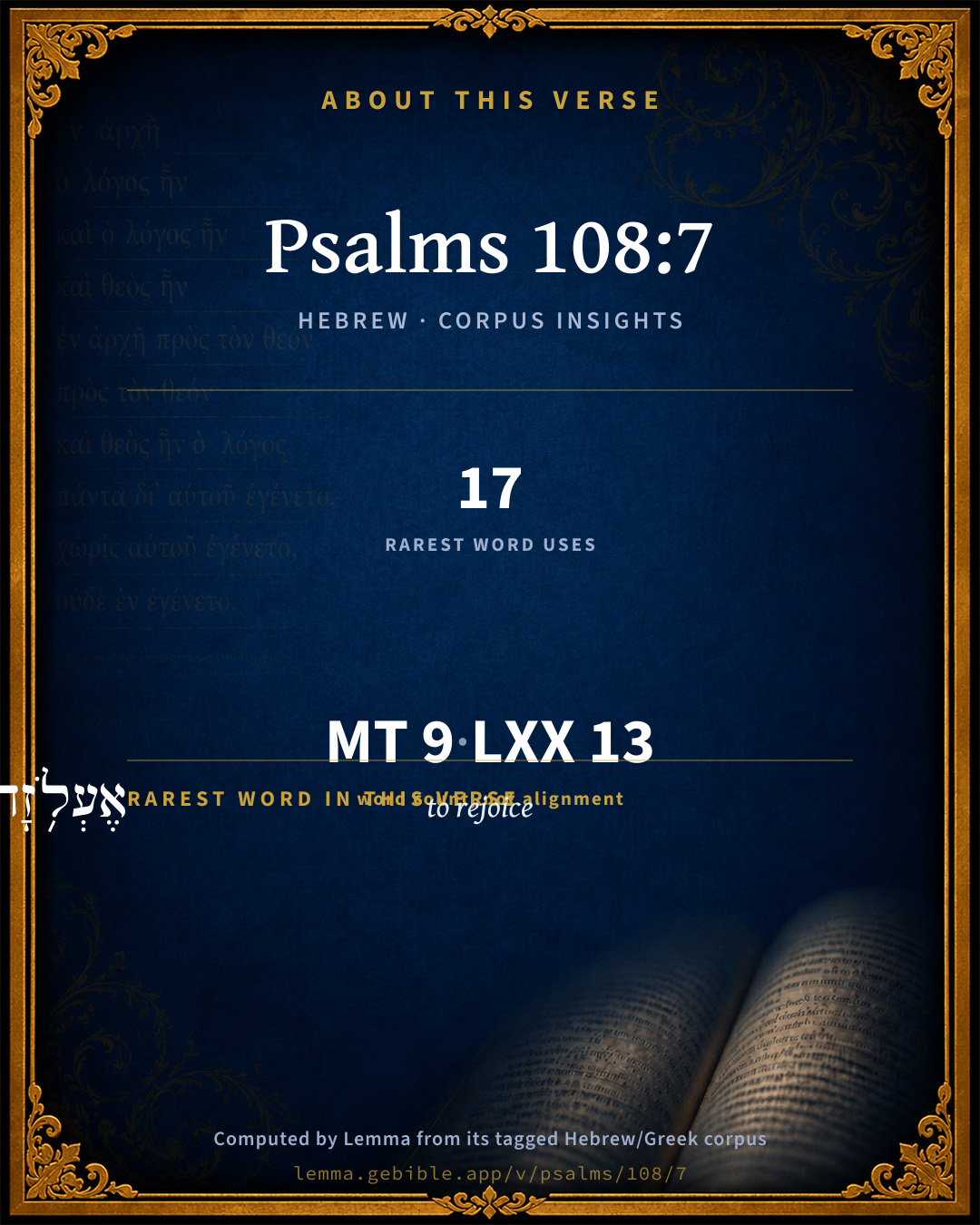
The rarest word here is אֶעְלֹ֥זָה to rejoice H5937 — appearing just 17 times in the whole Hebrew Bible.

Shared distinctive vocabulary

אֶעְלֹ֥זָה to rejoice H5937 occurs in 16 verses of the Hebrew Bible. Also found in:

Grammatical profile

  • 4 verbs
  • 5 nouns

Verb forms

  • דִּבֶּ֥ר Piel · Perfect
  • אֶעְלֹ֥זָה Qal · Cohortative
  • אֲחַלְּקָ֥ה Piel · Cohortative
  • אֲמַדֵּֽד Piel · Cohortative

Hebrew & Septuagint length

In English translation the verse runs 19 words from the Hebrew and 16 from the Septuagint (LXX English) — closely comparable.

A rough comparison of the two English renderings, which tokenize alike — not a word-level alignment.

Word counts can differ between the Hebrew and the Greek without any difference in meaning — e.g. the Hebrew direct-object marker אֵת has no separate Greek word, and Greek often adds the article ὁ.

In the original languages it is 9 Hebrew tokens and 13 Greek tokens — but the two are counted differently (Hebrew bundles its prefixes and suffixes into one token; the Greek is in lemma form), so that isn’t a like-for-like length.

Cross-references

12

Topical passages linked to Psalms 108:7 in the Treasury of Scripture Knowledge — connected by theme and wording, ordered by reader-vote popularity; previews shown in the World English Bible.

  • 1 Peter 1:8 whom not having known you love; in whom, though now you don't see him, yet believing, you rejoice greatly with joy unspeakable and full of glory--
  • Joshua 20:7 They set apart Kedesh in Galilee in the hill-country of Naphtali, and Shechem in the hill-country of Ephraim, and Kiriath Arba (the same is Hebron) in the hill-country of Judah.
  • 2 Peter 1:3–4 seeing that his divine power has granted to us all things that pertain to life and godliness, through the knowledge of him who called us by his own glory and virtue;
  • Joshua 17:7 The border of Manasseh was from Asher to Michmethath, which is before Shechem; and the border went along to the right hand, to the inhabitants of En Tappuah.
  • Joshua 24:1 Joshua gathered all the tribes of Israel to Shechem, and called for the elders of Israel, and for their heads, and for their judges, and for their officers; and they presented themselves before God.
  • Judges 8:5–6 He said to the men of Succoth, Please give loaves of bread to the people who follow me; for they are faint, and I am pursuing after Zebah and Zalmunna, the kings of Midian.
  • 2 Samuel 7:20–29 What can David say more to you? for you know your servant, Lord Yahweh.
  • Psalms 16:9–11 Therefore my heart is glad, and my tongue rejoices. My body shall also dwell in safety.
  • 1 Peter 1:3 Blessed be the God and Father of our Lord Jesus Christ, who according to his great mercy became our father again to a living hope through the resurrection of Jesus Christ from the dead,
  • Genesis 33:17 Jacob traveled to Succoth, built himself a house, and made shelters for his cattle. Therefore the name of the place is called Succoth.
  • Psalms 89:35–36 Once have I sworn by my holiness, I will not lie to David.
  • Amos 4:2 The Lord Yahweh has sworn by his holiness that behold, "The days shall come on you that they will take you away with hooks, And the last of you with fish hooks.

Cross-references courtesy of OpenBible.info (CC BY 4.0).

Hebrew and Greek witnesses Masoretic Hebrew ↔ Greek Septuagint

The same verse in the two great witnesses to the Old Testament, shown verse-for-verse.

You’re reading Greek Psalm 107 (Hebrew Psalm 108). The Septuagint counts the superscription, so verse numbers can differ from the Hebrew — chapter-level alignment, not verse-by-verse. Numbering follows Rahlfs.

These are two independent witnesses, not word-aligned to each other, and the Septuagint is shown in lemma (dictionary) form.

Hebrew Psalms 108:7 Masoretic · Westminster Leningrad Codex

אֱלֹהִ֤ים דִּבֶּ֥ר בְּקָדְשׁ֗וֹ אֶעְלֹ֥זָה אֲחַלְּקָ֥ה שְׁכֶ֑ם וְעֵ֖מֶק סֻכּ֣וֹת אֲמַדֵּֽד

God has spoken from his sanctuary: "In triumph, I will divide Shechem, and measure out the valley of Succoth.

World English Bible · Public Domain

Greek LXX Greek Psalm 107:7 Septuagint · lemma form

ὅπως ἄν ῥύομαι ὁ ἀγαπητός σύ σώζω ὁ δεξιός σύ καί ἐπιἀκούω ἐγώ

I will be exalted, and will divide Sicima, and will measure out the valley of tents.

LXX2012 (modern English Septuagint) · Public Domain

Hebrew: Westminster Leningrad Codex (CC BY 4.0). Greek: Septuagint (public domain); English from LXX2012 (modern English Septuagint) (Public Domain). How the Septuagint differs from the Hebrew →

Commentary

Notes on Psalms 108:7 from classic Christian and Jewish commentators (each source and its license shown beneath its notes). The classic Christian expositions comment on the surrounding passage and are grouped to its opening verse, so a note may address several verses; the Jewish commentaries on the Tanakh (Rashi and others) are per-verse, so they appear only where the commentator wrote on this verse.

Lemma curates 59 commentaries, every one of them public domain or Creative Commons licensed, each selected and text-cleaned for this edition rather than reprinted as found. About our sources →

J. A. Alexander on Psalms

Joseph Addison Alexander

8. (Psa 108:7) God hath spoken in his holiness (and therefore) I will triumph, I will divide Shechem, and the valley of Succoth I will measure. See above, on Psa 60:6, with which this verse agrees exactly.

Joseph Addison Alexander, The Psalms Translated and Explained (1850) — public domain. Text from a community e-Sword module.

Geneva Bible (1599)

Geneva Bible translators

As he hath spoken to Samuel concerning me, so will he show himself constant, and holy in his promise, so that these nations following shall be subject unto me.

Geneva Bible (1599) marginal notes — public domain. Text via Bolls.life.

Adam Clarke's Commentary

Verse 7. God hath spoken in his holiness] בקדשו bekodsho; some think this means in his Holy One, referring to the Prophet Jeremiah, who predicted the captivity, its duration of seventy years, and the deliverance from it.

Adam Clarke's Commentary on the Bible (1810–1826) — public domain. Text from a community e-Sword/MySword module.

The Cambridge Bible for Schools and Colleges

gen. ed. J. J. S. Perowne

7. in his holiness] Or, by his holiness, for ‘spoken’ is the equivalent of ‘promised’ or ‘sworn.’ Cp. Psa_89:35; Amo_4:2. God’s ‘holiness’ includes His whole essential nature in its moral aspect, and that nature makes it impossible for Him to break His promise (Num_23:19; Tit_1:2). It is equivalent to ‘Himself’ (Amo_6:8; Heb_6:13; Heb_6:17-18). In his sanctuary (cp. Psa_63:2) is a possible but less probable rendering.

I will rejoice] Better as R.V., I will exult. God is the speaker. The language is bold, but not bolder than that of Isa_63:1 ff. God is represented as a victorious warrior, conquering the land, and portioning it out to His people. He makes Ephraim the chief defence of His kingdom, and Judah the seat of government, while surrounding nations are treated as vassals. It is possible that the original Psalmist was quoting some actual oracle, but more probably he was reproducing freely in poetical form the drift of the great promise to David (2Sa_7:9-10). Cp. Psa_2:7; Psa_89:19. Though the words in their full meaning could no longer be applicable to the community of the Restoration, they would serve as an assurance of God’s purpose to establish them once more securely in His own land.

Shechem … the valley of Succoth] Shechem, as a central place of importance, represents the territory west of the Jordan; Succoth, ‘in the vale’ (Jos_13:27), somewhere to the south of the Jabbok, between Peniel and the Jordan, represents the territory east of the Jordan. These two places in particular may be named, because of their connexion with the history of Jacob, who halted first at Succoth and then at Shechem, when he returned to Canaan (Gen_33:17-18). God will fulfil His promise to Jacob, apportioning to His people the land in which their great ancestor settled.

The Cambridge Bible for Schools and Colleges (gen. ed. J. J. S. Perowne; Cambridge University Press, 1878–1918) — public domain. Text from a community e-Sword module.

Albert Barnes' Notes on the Bible

God hath spoken ... - This is taken, without change, from Psa 60:6. See the notes at that place.

Albert Barnes' Notes on the Bible (1834–1885) — public domain. Text from a community e-Sword/MySword module.

The Treasury of David

Charles H. Spurgeon

Ver. 7. God hath spoken in his holiness. Aforetime the Lord had made large promises to David, and these his holiness had guaranteed. The divine attributes were pledged to give the son of Jesse great blessings; there was no fear that the covenant God would run back from his plighted word.

I will rejoice. If God has spoken we may well be glad: the very fact of a divine revelation is a joy. If the Lord had meant to destroy us he would not have spoken to us as he has done. But what God has spoken is a still further reason for gladness, for he has declared "the sure mercies of David", and promised to establish his seed upon his throne, and to subdue all his enemies. David greatly rejoiced after the Lord had spoken to him by the mouth of Nathan. He sat before the Lord in a wonder of joy. See 1Ch 17:1-27, and note that in the next chapter David began to act vigorously against his enemies, even as in this Psalm he vows to do.

I will divide Shechem. Home conquests come first. Foes must be dislodged from Israel's territory, and lands properly settled and managed.

And mete out the valley of Succoth. On the other side Jordan as well as on this the land must be put in order, and secured against all wandering marauders. Some rejoicing leads to inaction, but not that which is grounded upon a lively faith in the promise of God. See how David prays, as if he had the blessing already, and could share it among his men: this comes of having sung so heartily unto the Lord his helper. See how he resolves on action, like a man whose prayers are only a part of his life, and vital portions of his action.

Ver. 7. God hath spoken the word of assurance. This refers to all the words in which the land of their inheritance was defined, especially Ge 15:18 Ex 23:31 De 11:24, and that remarkable prediction concerning the perpetuity of David's line, 2Sa 7:1-17, which must have made a deep impression on his mind. From these passages it is evident that Aram as well as Edom was included in the full compass of the territory designed for Israel, and that David felt himself to be in the path of destiny when he was endeavouring to extend his sway from the river of Egypt to the great river, even the Euphrates. In his holiness, in the immutable integrity of his heart, which was an infallible guarantee for the fulfilment of his promise. I will exult. This is the exclamation of the representative head of the people, when he ponders upon the divine utterance. James G. Murphy.

Ver. 7. Faith closing with a promise, will furnish joy to the believer before he enjoys the performance of it: God hath spoken, saith he, I will rejoice. David Dickson.

Ver. 7. He, the second David, had accomplished his warfare, and had crowned himself with victory. Henceforth he would apportion the kingdoms of the world and subdue them unto himself at his own holy will. Ephraim and Judah, Moab and Philistia, the Jew first and then the Gentile, were to be brought to confess him as their Lord. Plain Commentary.

Ver. 7. God's voice the cause of joy, the reason for action, the guarantee of success.

Psalms 108:8*

Charles H. Spurgeon's The Treasury of David (1869–1885) — public domain. Psalms only. Text from a community e-Sword/MySword module.

The Pulpit Commentary

Vers. 7, 8. God hath spoken, etc. Completely identical with Psa_60:6, Psa_60:7.

Conscious strength through God"s pledge.

The construction of this and the three following verses is somewhat difficult to trace. It may be that the verses are the things that God "spoke in his holiness." But it is simpler to treat the verses as expressions of what the psalmist feels he can do, and means to endeavor to do, basing his confidence on the fact that "God has spoken in his holiness" has made promise and pledge to him; and God"s pledges, he is sure, are holy, inviolate, certain of fulfillment. In relation to David, the promise to secure for him the full sovereignty of the nation is probably referred to (2Sa 7) "In his holiness" means, "in the immutable integrity of his heart," which was an infallible guarantee for the fulfillment of his promise. The key-note of this portion of the psalm is the fact that the promises of God sent by Nathan to David ensured the establishment of the Davidic dynasty over the kingdom of Israel. But when the original of the psalm was composed, David had all the work before him. The northern portion of Canaan had to be won; neighboring nations had to be subdued, or put under tribute. But the promise gave him conscious strength, made him feel superior to his responsibilities; able even to speak lightly, almost scornfully, of those whose conquest would involve hard toil and fighting (see figures of ver. 9).

I FROM HOLD OF GOD"S PROMISE GIVES US CONSCIOUS SUPERIORITY TO LIFE"S DIFFICULTIES. This is true, whether our difficulties come from our circumstances or our sins. We have Divine promises that we shall finally master both our surroundings and ourselves, winning the whole kingdom of our being for righteousness. What keeps us full of good cheer? Not our evident successes, but our grip of the Divine promises. In God"s word and pledge, we rise above our circumstances and above our sins. We feel no sort of fear; we shall "come off more than conquerors.

II FIRM HOLD OF GOD"S PROMISE GIVES US CONSCIOUS STRENGTH TO CARRY OUT OUR RESOLVES. David meant to win Moab, Edom, Philistia, etc.; and he knew he could because God had spoken. There is no sense of strength to accomplish life-purposes ever comes to a man like that he knows when he feels God is at his back. R.T.

The Pulpit Commentary (1880–1919), ed. H.D.M. Spence-Jones & Joseph S. Exell — public domain. Text from a community e-Sword module.

unfoldingWord translationNotes

Door43 World Missions Community

General Information:

These verses are the same as those in Psalms 60:6-7.

God has spoken in his holiness

Here David describes God speaking something because he is holy as speaking "in his holiness," as if his holiness were something that he was physically inside of. AT: "God, because he is holy, has said" (See: Metaphor)

I will divide Shechem and apportion out the Valley of Succoth

Here God is speaking about dividing the land of Shechem and the Valley of Succoth.

apportion

to divide into portions

Ephraim also is my helmet

God speaks of the tribe of Ephraim as if it were his army. The helmet symbolizes equipment for war. AT: "Ephraim is like a helmet I have chosen" or "The tribe of Ephraim is my army" (See: Metaphor)

helmet

a hard hat that soldiers wear to protect their heads from injury

Judah is my scepter

God chose men from the tribe of Judah to be the kings of his people, and he speaks of that tribe as if it were his scepter. AT: "The tribe of Judah is like my scepter" or "Judah is the tribe through whom I rule my people" (See: Metaphor)

translationWords

God

holy

joy

Shechem

Succoth

Gilead

Manasseh

Ephraim

Judah

scepter

unfoldingWord translationNotes — © Distant Shores Media and the Door43 World Missions Community, licensed CC BY-SA 4.0. Source: git.door43.org/Door43/en_tn.

Rashi

Rabbi Shlomo Yitzchaki (Rashi)

and answer me for all Your people and Your beloved ones are dependent upon me.

Rashi on the Tanakh — English translations: “The Judaica Press complete Tanach with Rashi, translated by A. J. Rosenberg” (CC BY 4.0); “Pentateuch with Rashi's commentary by M. Rosenbaum and A.M. Silbermann, 1929-1934” (public domain); “The Metsudah Tanach series, Lakewood, N.J” (CC BY 4.0); and “The Book of Joshua, Metsudah Publications, 1997” (CC BY 4.0). Text via Sefaria.

Lesson kit

Teaching starters — assembled from the data on this page, not authored interpretation. Every prompt links to the verse data it draws on. Edit before teaching.

Psalms, in the Wisdom, opens this verse with 9 words (9 distinct Hebrew lemmas). Its most distinctive word is ʻâlaz (“to rejoice”). A historical commentator’s framing appears above. Read the whole chapter for the surrounding context.

Discussion questions

  1. The word ʻâlaz carries the sense “to rejoice.” How does it shape the verse?
  2. 2 Samuel 1:20 shares the word «to rejoice» with this verse. How do the two illuminate each other?
  3. The translations on this page render this verse differently — a whole-verse word diff, not a word-by-word alignment. What might account for the different wordings?
  4. The verb «דִּבֶּ֥ר» is Piel Perfect. How does its form color the action?
  5. Reading how J. A. Alexander on Psalms and Geneva Bible (1599) read this verse, where do the two commentators agree and where do they part?

Things to notice

Reading settings

Reading text

Shown beneath each verse's original-language words.

Old Testament
Old Testament edition

Read the OT as the Masoretic Hebrew (MT) or the Greek Septuagint (LXX).

English shown for the Greek Septuagint (in the Hebrew ↔ Greek comparison).

Comparing translations? Open the Compare panel on any verse page to stack up to four side by side.