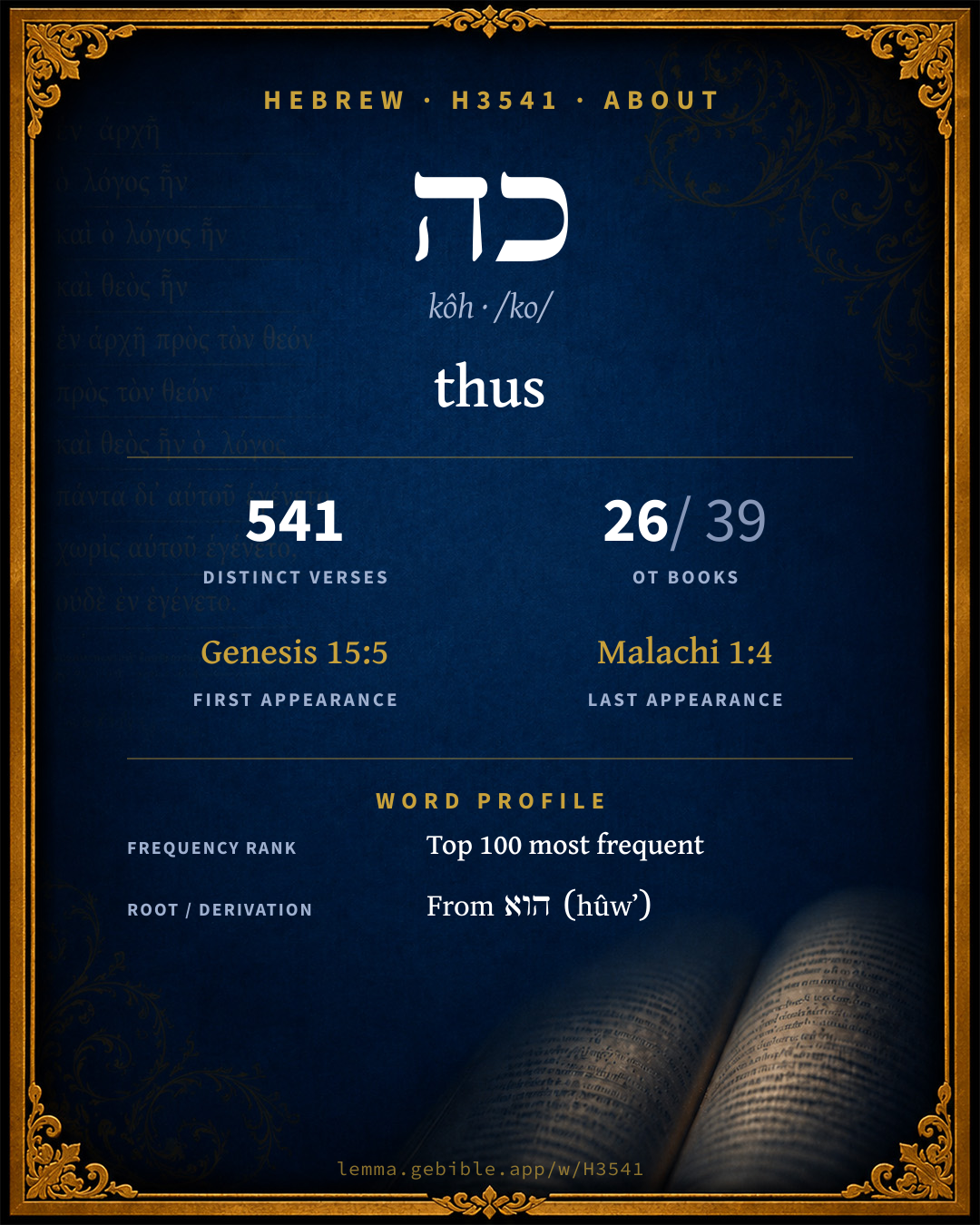
כֹּה
thus
also: here, in this manner fuller range ↓
Full lexicon entry — Brown-Driver-Briggs (BDB)
From Brown-Driver-Briggs (BDB)
Where this word appears
Grammar key — what these labels mean
Part of speech
- Adverb
- A word that modifies a verb, adjective, or other adverb.
Every verse where H3541 appears in the Book of Exodus — 18 distinct verses. Click any verse to open its interlinear word-by-word view. Verse text shown in the World English Bible for context — . Each verse’s Hebrew form is shown with its reference; the English is not keyword-highlighted, since the data carries no word-level English alignment. Use “Compare translations” on any verse to read it across multiple English versions. This concordance covers the Hebrew Bible; Septuagint (Greek Old Testament) occurrences are not indexed here.
Exodus
- Exodus 2:12 כֹּה֙ וָ/כֹ֔ה adv conj + adv He looked this way and that way, and when he saw that there was no one, he killed the Egyptian, and hid him in the sand.
- Exodus 3:14 כֹּ֤ה adv God said to Moses, "I AM WHO I AM," and he said, "You shall tell the children of Israel this: "I AM has sent me to you."
- Exodus 3:15 כֹּֽה adv God said moreover to Moses, "You shall tell the children of Israel this, 'Yahweh, the God of your fathers, the God of Abraham, the God of Isaac, and the God of Jacob, has sent me to you.' This is my name forever, and this is my memorial to all generations.
- Exodus 4:22 כֹּ֚ה adv You shall tell Pharaoh, 'Thus says Yahweh, Israel is my son, my firstborn,
- Exodus 5:1 כֹּֽה adv Afterward Moses and Aaron came, and said to Pharaoh, "This is what Yahweh, the God of Israel, says, 'Let my people go, that they may hold a feast to me in the wilderness.'"
- Exodus 5:10 כֹּ֚ה adv The taskmasters of the people went out, and their officers, and they spoke to the people, saying, This is what Pharaoh says: "I will not give you straw.
- Exodus 5:15 כֹ֖ה adv Then the officers of the children of Israel came and cried to Pharaoh, saying, "Why do you deal this way with your servants?
- Exodus 7:16 כֹּֽה adv You shall tell him, 'Yahweh, the God of the Hebrews, has sent me to you, saying, "Let my people go, that they may serve me in the wilderness:" and, behold, until now you haven't listened.
- Exodus 7:17 כֹּ֚ה adv Thus says Yahweh, "In this you shall know that I am Yahweh. Behold, I will strike with the rod that is in my hand on the waters which are in the river, and they shall be turned to blood.
- Exodus 8:1 כֹּ֚ה adv Yahweh spoke to Moses, Go in to Pharaoh, and tell him, "This is what Yahweh says, 'Let my people go, that they may serve me.
- Exodus 8:20 כֹּ֚ה adv Yahweh said to Moses, "Rise up early in the morning, and stand before Pharaoh; behold, he comes forth to the water; and tell him, 'This is what Yahweh says, "Let my people go, that they may serve me.
- Exodus 9:1 כֹּֽה adv Then Yahweh said to Moses, "Go in to Pharaoh, and tell him, 'This is what Yahweh, the God of the Hebrews, says: "Let my people go, that they may serve me.
- Exodus 9:13 כֹּֽה adv Yahweh said to Moses, "Rise up early in the morning, and stand before Pharaoh, and tell him, 'This is what Yahweh, the God of the Hebrews, says: "Let my people go, that they may serve me.
- Exodus 10:3 כֹּֽה adv Moses and Aaron went in to Pharaoh, and said to him, "This is what Yahweh, the God of the Hebrews, says: 'How long will you refuse to humble yourself before me? Let my people go, that they may serve me.
- Exodus 11:4 כֹּ֖ה adv Moses said, "This is what Yahweh says: 'About midnight I will go out into the midst of Egypt,
- Exodus 19:3 כֹּ֤ה adv Moses went up to God, and Yahweh called to him out of the mountain, saying, "This is what you shall tell the house of Jacob, and tell the children of Israel:
- Exodus 20:22 כֹּ֥ה adv Yahweh said to Moses, "This is what you shall tell the children of Israel: 'You yourselves have seen that I have talked with you from heaven.
- Exodus 32:27 כֹּֽה adv He said to them, "Thus says Yahweh, the God of Israel, 'Every man put his sword on his thigh, and go back and forth from gate to gate throughout the camp, and every man kill his brother, and every man his companion, and every man his neighbor."
About this entry
At a glance — auto-summarized from this page’s data, not written by a person. Every figure links to its source below. This summary describes the numbers; it doesn’t interpret them.
The Hebrew word כה centers on the idea of “thus.” Alongside “thus” the lexicon also lists “here” and “in this manner” — part of its full sense range. Spanning 541 verses in 26 books, it ranks among the most common words of the Hebrew Bible. Jeremiah dominates its distribution — 159 of 541 verses. Debuting at Genesis 15:5, it then recurs through the corpus. Dig into 541-verse concordance and the renderings breakdown below.
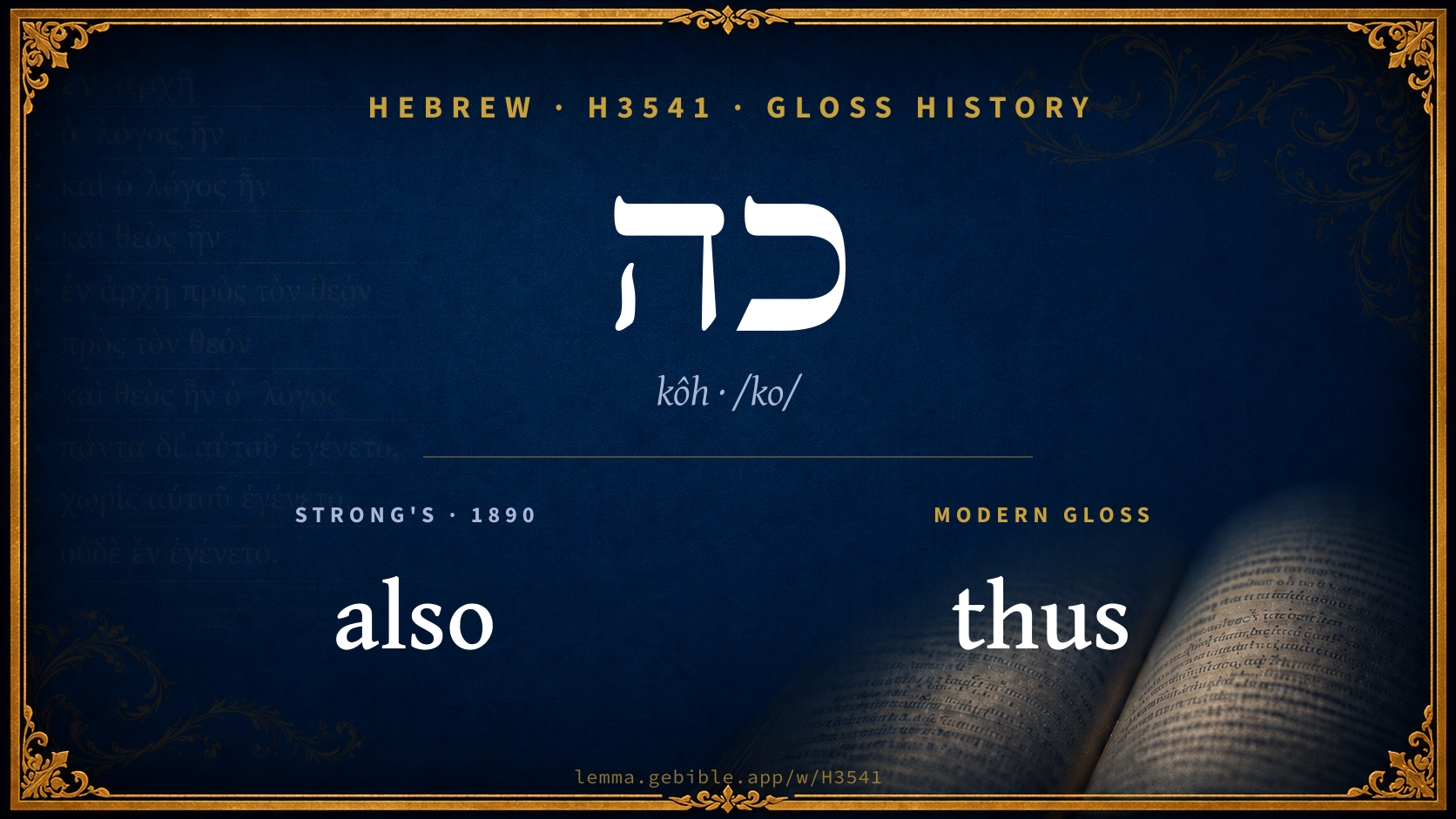
Gloss history
Strong's 1890 vs modern scholarship
About this word
Strong's H3541 catalogs a Hebrew word from the Hebrew Old Testament.
These counts are not copied from any lexicon or concordance. They are computed here, from the morphology-tagged Hebrew Old Testament. What Lemma adds →
- 541
- distinct verses
- The word appears in 541 distinct verses.
- 26 / 39
- OT books
- The word appears in 26 of 39 Old Testament books.
- #86
- by frequency
- Top 100 most frequent Hebrew words (rank 86 of 8,640 Hebrew words by occurrence).
View all 541 occurrences in the concordance →
By section of the Old Testament
By traditional corpus
Conventional, traditional groupings — biblical authorship is debated, so this is a traditional corpus grouping, not an authorship claim. Each share is this word’s portion of its verses in that division of the Hebrew canon. Each figure is a share of the word’s 541 distinct verses.
- Prophets (Nevi'im) 479 verses · 89%
- Torah (Pentateuch) 37 verses · 7%
- Writings (Ketuvim) 25 verses · 5%
How translations render this word
Counts come from each version’s own published word-to-Strong’s tagging or interlinear alignment — an approximate guide to how each version renders this word, not a word-level alignment the data otherwise carries. Because each total is that version’s own tagged count, the per-version totals vary from one another and need not match the appearance or distinct-verse counts above. These counts may also differ from a printed concordance because Lemma counts each distinctly tagged rendering and does not collapse phrase taggings into a single head-word total. This is a fixed set of word-tagged versions (KJV, ASV, BSB, ULT) and does not change with the reading translation you choose elsewhere. Each version’s license is shown beside its name below (and on Sources).
- King James Version: So 4×, Here 3×, Manner 2×
- American Standard Version: Thus 4×, Here 3×, Manner 2×
- Berean Standard Bible: Is what 452×, Thus 16×, This 13×
- unfoldingWord Literal Text: Thus 314×, This 135×, Is what 32×
King James Version Public Domain
Renders H3541 across 25 tagged occurrences — most commonly:
Plus 10 renderings that appear only once — usually multi-word phrases or single function words the recovered tagging swept in, not distinct renderings.
American Standard Version Public Domain
Renders H3541 across 25 tagged occurrences — most commonly:
Plus 12 renderings that appear only once — usually multi-word phrases or single function words the recovered tagging swept in, not distinct renderings.
Berean Standard Bible Public Domain
Renders H3541 across 534 tagged occurrences — most commonly:
Plus 13 renderings that appear only once — usually multi-word phrases or single function words the recovered tagging swept in, not distinct renderings. Not rendered by a distinct English word in 38 further occurrences.
unfoldingWord Literal Text CC BY-SA 4.0
Renders H3541 across 505 tagged occurrences — most commonly:
Plus 12 renderings that appear only once — usually multi-word phrases or single function words the recovered tagging swept in, not distinct renderings.
Senses in the full BDB
What do BDB’s symbols mean?
BDB uses these scholarly abbreviations:
| Symbol | Meaning |
|---|---|
| 𝔊 | the Septuagint (the ancient Greek translation, LXX) |
| 𝔙 | the Vulgate (the Latin translation) |
| 𝔖 | the Syriac version (the Peshitta) |
| 𝔗 | the Targum (the Aramaic translation) |
| ψ | the Psalms |
| √ | root (the underlying root or stem) |
| ‖ | parallel passage (a synonymous or contrasted parallel) |
| † | the dagger: every passage where the word occurs is cited |
The 5 senses and sub-senses the full Brown-Driver-Briggs lexicon distinguishes for this word, in lexicon order (not ranked by frequency), with BDB’s own verbatim wording and sub-sense lettering. Shown in Hebrew script with BDB’s own scholarly abbreviations. The condensed entry is in the Lexicon Entry tab. See also the Forms in the corpus table below.
- 1. of manner, thus (so most freq., and usually pointing to what is to follow, while כֵּן points commonly to what has preceded), Gn 15:5 כה יהיה זרעך thus shall thy seed be, Nu 6:23 1 K 2:30 כֹּה דִבֶּר יוֹאָב וְכֹה עָנָנִי, 5:25 Is 24:13 (answered by כְּ, as Je 23:29); with a subst. Is 20:6 הִנֵּה כֹה מַבָּטֵנוּ, Je 9:21 (si vera l.), 23:29 1 S 27:11. Mostly confined to particular phrases: thus e.g. Genesis 15:5
- a. with diff. forms of אמר, כה תאמר thus shalt thou say Ex 3:14, 15; 19:3; 20:22 etc.; especially כה אמר י״י thus saith (or said) י׳ Ex 4:22; 5:1; 7:17, 26; 8:16 etc.; and continually in the prophets, as Is 7:7; 8:11; 18:4 etc.; Je 2:2, 5; 4:27; 6:16 etc.; also in the idiom. formula אִם כֹּה יֹאמַר if he say (or used to say) (the words spoken following) †Gn 31:8 1 S 14:9, 10; 20:7 2 S 15:26. e.g. Exodus 3:14
- b. with עשׂה to do thus, Ex 5:15 Dt 7:5; pointing back, Nu 22:30 Jos 6:14 1 S 27:11 al.; especially in the phrase כה יעשׂה אלהים וכה יוסיף (with variations), 1 S 3:17 + (v. יסף), in which כֹּה points to an imprecation understood but not expressed. With בְּ prefixed †1 K 22:20 ויאמר זה בְּכֹה וזה אמר בְּכֹה and one spake in this wise, and another spake in that wise (‖ 2 Ch 18:19 כָּכָה … כָּכָה; prob. rightly). e.g. Exodus 5:15
- 2. of place, here (rare, chiefly in E), Gn 31:37 שִׂים כֹּה place it here before my brethren, Nu 23:15(×2) 2 S 18:30 Ru 2:8. Repeated, Ex 2:12 וַיִּפֶן כֹּה וָכֹה and he turned this way and that way; כֹּה … כֹּה on this side … on that side Nu 11:31. With עַד Gn 22:5 and we will go עַד־כֹּה as far as here (δεικτικῶς) i.e. yonder. e.g. Genesis 31:37
- 3. of time, עַד כֹּה hitherto, Ex 7:16 (cf. עַד־הֵנָּה), Jos 17:14; עַד־כֹּה וְעַד־כֹּה till now and till then, i.e. meanwhile, 1 K 18:45. e.g. Exodus 7:16
Senses from the full Brown-Driver-Briggs lexicon (Brown, Driver, Briggs; Oxford 1906 — public domain), digitized via Sefaria, supplemented by the OpenScriptures HebrewLexicon (CC BY 4.0). Full attribution on Sources.
Word origin
demonstr. adv. thus, here (BA כָּה; 𝔗 𝔖Jerus. Mand. כָּא here: in Syriac with prefixes ܠܟܳܐ hither, ܡܶܟܳܐ (𝔖Jerus. ܡܶܢ ܟܳܐ) hence, ܐܰܝܟܳܐ where? cf. אֵיכָה, p. 32, and Köii. 1, 252)—
— Brown-Driver-Briggs (Oxford 1906, public domain), digitized via Sefaria, supplemented by the OpenScriptures HebrewLexicon (CC BY 4.0). See Sources.
Derived from הוא (hûwʼ) (H1931) — he.
Jastrow Dictionary
A second Hebrew/Aramaic lexicon for comparison, covering Aramaic and post-biblical (Talmudic, Targumic, Midrashic) usage that the biblical-Hebrew BDB does not. Matched by lemma rather than by Strong’s number, so a lemma may carry more than one Jastrow headword (shown separately below), and the entries cover usage well beyond the Bible.
כָּא
- (b. h. כֹּה, v. preced.) adverb of place: here, v. הָכָא; of time: now. Targ. Gen. XXII, 5. Targ. Job XXXVIII, 11; a. fr.—Y. Ber. IV, 7ᶜ top וכא אמר הכין and here he says so? Ib. וכה; a. v. fr.—לְכָא hither; מִיכָּא from here. Targ. Josh. VIII, 20. Targ. Ex. XVII, 12; a. fr.—Y. Bets. V, 63ᵃ פצל … לכא ולכא skimmed the water in both directions. Y. B. Mets. VI, 11ᵃ top מיכא ללוד from here to Lydda; a. fr.—v. אִיכָּא, לִיכָּא &c.; כַּאַן, כַּן &c.
כֹּה
- (b. h.) here; thus. Gen. R. s. 56 (ref. to עד־כה, Gen. XXII, 5) נלך … בסופו של כה we shall go and see what will be the outcome of koh (the promise, ‘thus shall be thy seed’, Gen. XV, 5); Tanḥ. Vayera 23. e.g. Genesis 22:5
כָּה
- ch., v. כָּא
A Dictionary of the Targumim, the Talmud Babli and Yerushalmi, and the Midrashic Literature (Marcus Jastrow; London, Luzac, 1903) — Public Domain. Digitized via Sefaria. Digitized via Sefaria. Full attribution on Sources.
Forms in the corpus
The 31 distinct written forms H3541 takes in the Hebrew Bible, most frequent first — each parse links to that state’s occurrences in the concordance. Hebrew forms include their vowel points and cantillation, so a single lemma takes many written forms.
| Form | Parsing | Example | Uses |
|---|---|---|---|
| כֹּֽה | Adverb | Amos 5:16 | 161 |
| כֹּ֤ה | Adverb | Amos 3:11 | 80 |
| כֹּ֚ה | Adverb | Amos 1:3 | 66 |
| כֹּ֥ה | Adverb | Amos 4:12 | 64 |
| כֹּ֣ה | Adverb | Amos 7:7 | 50 |
| כֹּה | Adverb | Amos 7:17 | 33 |
| כֹ֣ה | Adverb | 2 Kings 3:17 | 19 |
| כֹּ֖ה | Adverb | Exodus 11:4 | 18 |
| וְ/כֹ֣ה | Adverb | 1 Kings 2:23 | 13 |
| כֹ֤ה | Adverb | Amos 5:3 | 11 |
| כֹ֨ה | Adverb | Ezekiel 14:21 | 11 |
| כֹ֥ה | Adverb | Amos 5:4 | 8 |
| כֹה֙ | Adverb | Amos 7:11 | 8 |
| וְ/כֹ֥ה | Adverb | 1 Kings 2:30 | 4 |
| כֹה֩ | Adverb | 1 Kings 11:31 | 4 |
| כֹּ֑ה | Adverb | Genesis 22:5 | 4 |
| כֹּה֮ | Adverb | Amos 3:12 | 4 |
| וְ/כֹֽה | Adverb | 2 Samuel 16:7 | 2 |
| כֹ֖ה | Adverb | Exodus 5:15 | 2 |
| כֹֽה | Adverb | Isaiah 30:15 | 2 |
| כֹּ֔ה | Adverb | Genesis 31:37 | 2 |
| כֹּ֗ה | Adverb | 1 Kings 18:45 | 2 |
| בְּ/כֹ֔ה | Adverb | 1 Kings 22:20 | 1 |
| בְּ/כֹֽה | Adverb | 1 Kings 22:20 | 1 |
| וְ/כֹ֖ה | Adverb | 2 Samuel 3:9 | 1 |
| וָ/כֹ֔ה | Adverb | Exodus 2:12 | 1 |
| כֹ֛ה | Adverb | Isaiah 21:16 | 1 |
| כֹ֧ה | Adverb | Jeremiah 23:29 | 1 |
| כֹּ֨ה | Adverb | 1 Samuel 14:10 | 1 |
| כֹּה֙ | Adverb | Exodus 2:12 | 1 |
| כֹּה֩ | Adverb | Ruth 1:17 | 1 |
Same root — word family
Other BDB entries built from the same root as H3541, grouped by Strong’s listed origin. These share a root / origin per the lexicon — not necessarily a shared meaning. Each links to that word’s own entry.
Derives from
Shares the same root
Derived from this word
Compare all same-root words → Showing 4 of 7 — not the complete family. They share a root, not necessarily a meaning.
Septuagint verse parallels
This word appears in 506 verses that also exist in the Greek Old Testament (Septuagint), out of the 541 Hebrew verses it occurs in. You can read those verses in Greek by switching the Old Testament edition to the Septuagint.
Read these verses in the Septuagint
- Genesis 15:5
- Exodus 2:12
- Numbers 6:23
- Deuteronomy 7:5
- Joshua 6:3
- Judges 6:8
- Ruth 1:17
- 1 Samuel 2:27
- 2 Samuel 3:9
- 1 Kings 2:23
- 2 Kings 1:4
- 1 Chronicles 17:4
This is a verse-level parallel only — the same verses exist in both the Hebrew and Greek Old Testaments. No word-level Hebrew↔Greek correspondence is claimed: the data carries no such alignment, so no Greek word is shown as this Hebrew word’s translation. Coverage is not total — the Septuagint omits the deuterocanon and renumbers the Psalms, so some Hebrew verses have no direct Greek parallel.