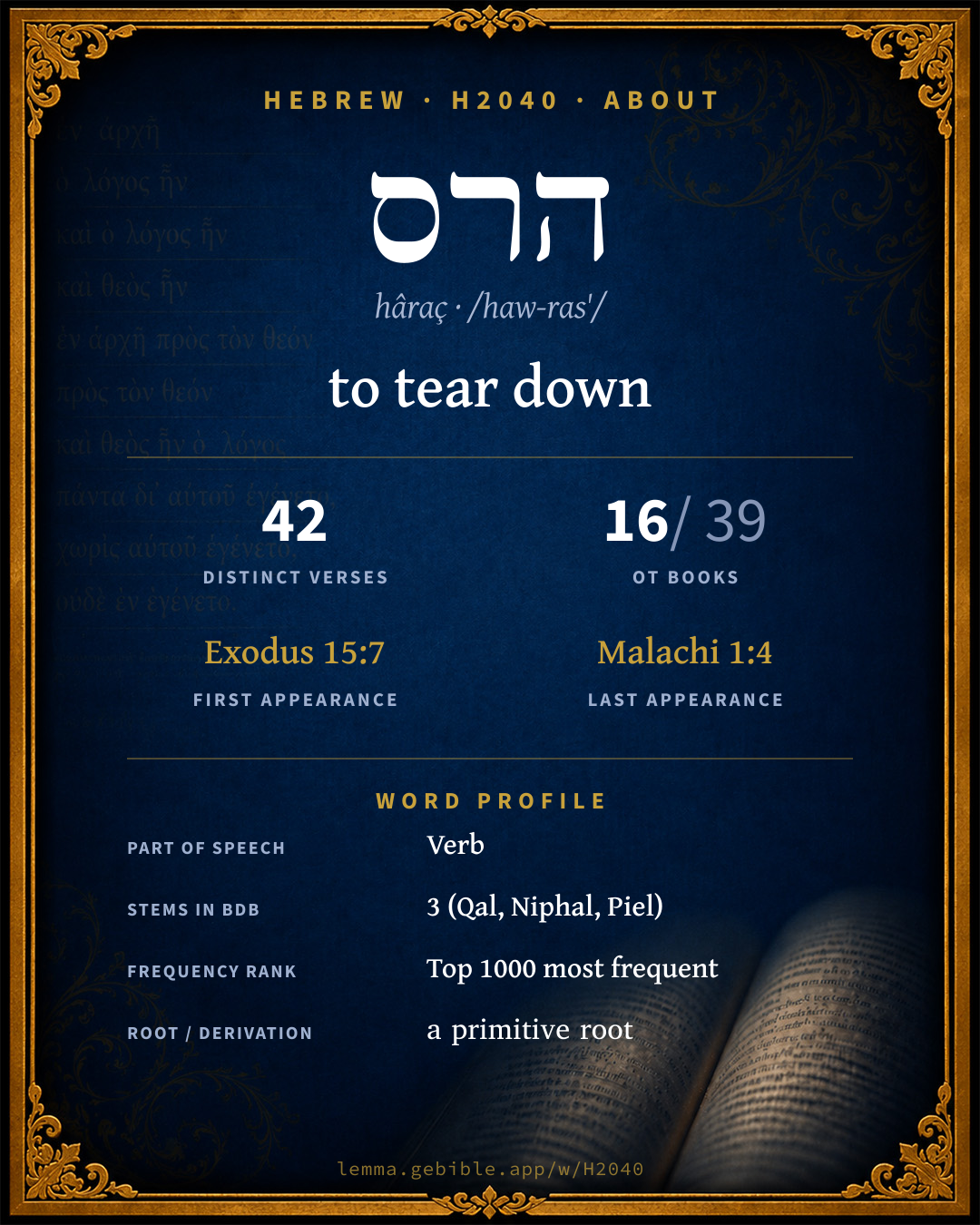
הָרַס
to tear down
‘to tear down’ is one of 2 main senses fuller range ↓
Full lexicon entry — Brown-Driver-Briggs (BDB)
From Brown-Driver-Briggs (BDB)
Where this word appears
See every Qal verb in the Hebrew Bible →
Grammar key — what these labels mean
Part of speech
- Verb
- An action or state-of-being word.
Stem
- Qal
- The basic, simple active stem — the plain form of the verb (“he wrote”). Here: ‘throw down’
- Niphal
- Usually the simple passive or reflexive of the Qal (“he was written”).
- Piel
- An intensive or resultative active stem.
Form
- Sequential Perfect
- A perfect with prefixed waw continuing a preceding imperfect or command (waw-consecutive perfect).
- Imperfect
- An incomplete, ongoing, or future action (“he will / would write”).
- Perfect
- A completed action or state — Hebrew marks aspect (completeness) more than strict tense (“he wrote”).
- Infinitive Construct
- A bound verbal noun, frequently with prepositions (“to write / in writing”).
- Participle Passive
- A verbal adjective expressing action received (“written”).
- Imperative
- A direct command (“write!”).
- Sequential Imperfect
- An imperfect with prefixed waw — the standard past-narrative form (waw-consecutive imperfect).
- Infinitive Absolute
- An unbound verbal noun, often intensifying or standing in for a finite verb.
- Participle Active
- A verbal adjective expressing ongoing or characteristic action (“writing / one who writes”).
- Jussive
- A third- or second-person volitional form expressing wish or command (“let him write”).
State
- Absolute
- The independent form of a noun, not bound to a following word.
- Construct
- A noun bound to a following noun in a possessive / “of” relationship (the construct chain).
Person
- 3rd Person
- The one spoken about (“he / she / it / they”).
- 1st Person
- The speaker (“I / we”).
- 2nd Person
- The one addressed (“you”).
Gender
- Common
- Either gender — not distinguished for this form.
- Masculine
- Grammatically masculine.
- Feminine
- Grammatically feminine.
Number
- Plural
- More than one (in Hebrew, generally three or more).
- Singular
- One.
Grammatical forms 26 distinct
- Verb, Qal, Imperfect, 3rd Person, Masculine, Singular 4 times (9%)
- Verb, Qal, Sequential Perfect, 3rd Person, Common, Plural 3 times (7%)
- Verb, Qal, Imperfect, 1st Person, Common, Singular 3 times (7%)
- Verb, Qal, Perfect, 3rd Person, Masculine, Singular 3 times (7%)
- Verb, Qal, Infinitive Construct 2 times (5%)
- Verb, Niphal, Sequential Perfect, 3rd Person, Common, Plural 2 times (5%)
- Verb, Qal, Sequential Perfect, 1st Person, Common, Singular 2 times (5%)
- Verb, Niphal, Perfect, 3rd Person, Common, Plural 2 times (5%)
+18 more forms (22 occurrences)
Parsed forms decoded from the imported morphology (morphhb / Westminster Leningrad Codex — WLC text public domain, morphhb tagging CC BY 4.0), counted across 43 parsed occurrences — not distinct verses.
Every verse where H2040 appears — 42 distinct verses across 16 books. Click any verse to open its interlinear word-by-word view. Verse text shown in the World English Bible for context — . Each verse’s Hebrew form is shown with its reference; the English is not keyword-highlighted, since the data carries no word-level English alignment. Use “Compare translations” on any verse to read it across multiple English versions. This concordance covers the Hebrew Bible; Septuagint (Greek Old Testament) occurrences are not indexed here.
Exodus 4 verses
- Exodus 15:7 תַּהֲרֹ֣ס Qal impf 2ms In the greatness of your excellency, you overthrow those who rise up against you: You send forth your wrath. It consumes them as stubble.
- Exodus 19:21 יֶהֶרְס֤וּ Qal impf 3mp Yahweh said to Moses, "Go down, charge the people, lest they break through to Yahweh to gaze, and many of them perish.
- Exodus 19:24 יֶֽהֶרְס֛וּ Qal juss 3mp Yahweh said to him, "Go down and you shall bring Aaron up with you, but don't let the priests and the people break through to come up to Yahweh, lest he break forth on them."
- Exodus 23:24 הָרֵס֙ תְּהָ֣רְסֵ֔/ם Piel inf.abs Piel impf 2ms + sfx pers 3mp You shall not bow down to their gods, nor serve them, nor follow their practices, but you shall utterly overthrow them and demolish their pillars.
Judges 1 verse
2 Samuel 1 verse
1 Kings 3 verses
- 1 Kings 18:30 הֶ/הָרֽוּס ptcl def.art + Qal ptcp.pass ms Elijah said to all the people, Come near to me; and all the people came near to him. He repaired the altar of Yahweh that was thrown down.
- 1 Kings 19:10 הָרָ֔סוּ Qal pf 3cp He said, I have been very jealous for Yahweh, the God of hosts; for the children of Israel have forsaken your covenant, thrown down your altars, and slain your prophets with the sword: and I, even I only, am left; and they seek my life, to take it away.
- 1 Kings 19:14 הָרָ֔סוּ Qal pf 3cp He said, I have been very jealous for Yahweh, the God of hosts; for the children of Israel have forsaken your covenant, thrown down your altars, and slain your prophets with the sword; and I, even I only, am left; and they seek my life, to take it away.
2 Kings 1 verse
1 Chronicles 1 verse
Job 1 verse
Psalms 3 verses
- Psalms 11:3 יֵֽהָרֵס֑וּ/ן Niphal impf 3mp + sfx n If the foundations are destroyed, What can the righteous do?
- Psalms 28:5 יֶ֝הֶרְסֵ֗/ם Qal impf 3ms + sfx pers 3mp Because they don't regard the works of Yahweh, Nor the operation of his hands, He will break them down and not build them up.
- Psalms 58:6 הֲרָס Qal impv 2ms Break their teeth, God, in their mouth. Break out the great teeth of the young lions, Yahweh.
Proverbs 4 verses
- Proverbs 11:11 תֵּהָרֵֽס Niphal impf 3fs By the blessing of the upright, the city is exalted, But it is overthrown by the mouth of the wicked.
- Proverbs 14:1 תֶהֶרְסֶֽ/נּוּ Qal impf 3fs + sfx pers 3ms Every wise woman builds her house, But the foolish one tears it down with her own hands.
- Proverbs 24:31 נֶהֱרָֽסָה Niphal pf 3fs Behold, it was all grown over with thorns. Its surface was covered with nettles, And its stone wall was broken down.
- Proverbs 29:4 יֶֽהֶרְסֶֽ/נָּה Qal impf 3ms + sfx pers 3fs The king by justice makes the land stable, But he who takes bribes tears it down.
Isaiah 3 verses
- Isaiah 14:17 הָרָ֑ס Qal pf 3ms who made the world as a wilderness, and overthrew the cities of it; who didn't let loose his prisoners to their home?"
- Isaiah 22:19 יֶהֶרְסֶֽ/ךָ Qal impf 3ms + sfx pers 2ms I will thrust you from your office; and from your station shall you be pulled down.
- Isaiah 49:17 מְהָֽרְסַ֥יִ/ךְ Piel ptcp.act mp cs + sfx pers 2fs Your children make haste; your destroyers and those who made you waste shall go forth from you.
Jeremiah 7 verses
- Jeremiah 1:10 וְ/לַ/הֲר֑וֹס conj + prep + Qal inf.cs behold, I have this day set you over the nations and over the kingdoms, to pluck up and to break down and to destroy and to overthrow, to build and to plant.
- Jeremiah 24:6 אֶהֱרֹ֔ס Qal impf 1cs For I will set my eyes on them for good, and I will bring them again to this land: and I will build them, and not pull them down; and I will plant them, and not pluck them up.
- Jeremiah 31:28 וְ/לַ/הֲרֹ֖ס conj + prep + Qal inf.cs It shall happen that, like as I have watched over them to pluck up and to break down and to overthrow and to destroy and to afflict, so will I watch over them to build and to plant, says Yahweh.
- Jeremiah 31:40 יֵהָרֵ֛ס Niphal impf 3ms The whole valley of the dead bodies and of the ashes, and all the fields to the brook Kidron, to the corner of the horse gate toward the east, shall be holy to Yahweh; it shall not be plucked up, nor thrown down any more forever.
- Jeremiah 42:10 אֶהֱרֹ֔ס Qal impf 1cs If you will still abide in this land, then will I build you, and not pull you down, and I will plant you, and not pluck you up; for I repent me of the evil that I have done to you.
- Jeremiah 45:4 הֹרֵ֔ס Qal ptcp.act ms Thus shall you tell him, Thus says Yahweh: Behold, that which I have built will I break down, and that which I have planted I will pluck up; and this in the whole land.
- Jeremiah 50:15 נֶהֶרְס֖וּ Niphal pf 3cp Shout against her round about: she has submitted herself; her bulwarks are fallen, her walls are thrown down; for it is the vengeance of Yahweh: take vengeance on her; as she has done, do to her.
Lamentations 2 verses
- Lamentations 2:2 הָרַ֧ס Qal pf 3ms The Lord has swallowed up all the habitations of Jacob, and has not pitied: He has thrown down in his wrath the strongholds of the daughter of Judah; He has brought them down to the ground; he has profaned the kingdom and the princes of it.
- Lamentations 2:17 הָרַ֖ס Qal pf 3ms Yahweh has done that which he purposed; he has fulfilled his word that he commanded in the days of old; He has thrown down, and has not pitied: He has caused the enemy to rejoice over you; he has exalted the horn of your adversaries.
Ezekiel 8 verses
- Ezekiel 13:14 וְ/הָ֨רַסְתִּ֜י conj + Qal wpf 1cs So will I break down the wall that you have daubed with whitewash, and bring it down to the ground, so that the foundation of it shall be uncovered; and it shall fall, and you shall be consumed in the midst of it: and you shall know that I am Yahweh.
- Ezekiel 16:39 וְ/הָרְס֤וּ conj + Qal wpf 3cp I will also give you into their hand, and they shall throw down your vaulted place, and break down your lofty places; and they shall strip you of your clothes, and take your beautiful jewels; and they shall leave you naked and bare.
- Ezekiel 26:4 וְ/הָֽרְסוּ֙ conj + Qal wpf 3cp They shall destroy the walls of Tyre, and break down her towers: I will also scrape her dust from her, and make her a bare rock.
- Ezekiel 26:12 וְ/הָֽרְסוּ֙ conj + Qal wpf 3cp They shall make a spoil of your riches, and make a prey of your merchandise; and they shall break down your walls, and destroy your pleasant houses; and they shall lay your stones and your timber and your dust in the midst of the waters.
- Ezekiel 30:4 וְ/נֶהֶרְס֖וּ conj + Niphal wpf 3cp A sword shall come on Egypt, and anguish shall be in Ethiopia, when the slain shall fall in Egypt; and they shall take away her multitude, and her foundations shall be broken down.
- Ezekiel 36:35 וְ/הַ/נֶּהֱרָס֖וֹת conj + ptcl def.art + Niphal ptcp.pass fp They shall say, This land that was desolate is become like the garden of Eden; and the waste and desolate and ruined cities are fortified and inhabited.
- Ezekiel 36:36 הַ/נֶּ֣הֱרָס֔וֹת ptcl def.art + Niphal ptcp.pass fp Then the nations that are left round about you shall know that I, Yahweh, have built the ruined places, and planted that which was desolate: I, Yahweh, have spoken it, and I will do it.
- Ezekiel 38:20 וְ/נֶהֶרְס֣וּ conj + Niphal wpf 3cp so that the fish of the sea, and the birds of the sky, and the animals of the field, and all creeping things who creep on the earth, and all the men who are on the surface of the earth, shall shake at my presence, and the mountains shall be thrown down, and the steep places shall fall, and every wall shall fall to the ground.
Joel 1 verse
Micah 1 verse
Malachi 1 verse
About this entry
At a glance — auto-summarized from this page’s data, not written by a person. Every figure links to its source below. This summary describes the numbers; it doesn’t interpret them.
הרס (hâraç) is a Hebrew verb most often rendered “to tear down.” It first appears in Exodus 15:7. The Hebrew Bible uses it across 42 verses — moderately common. As a verb its force shifts by stem, across 3 stems (Qal, Niphal, and more). Sharing its root, it stands alongside הריסה, הריסות and הרס. The sections below give every sense, occurrence, and version rendering.
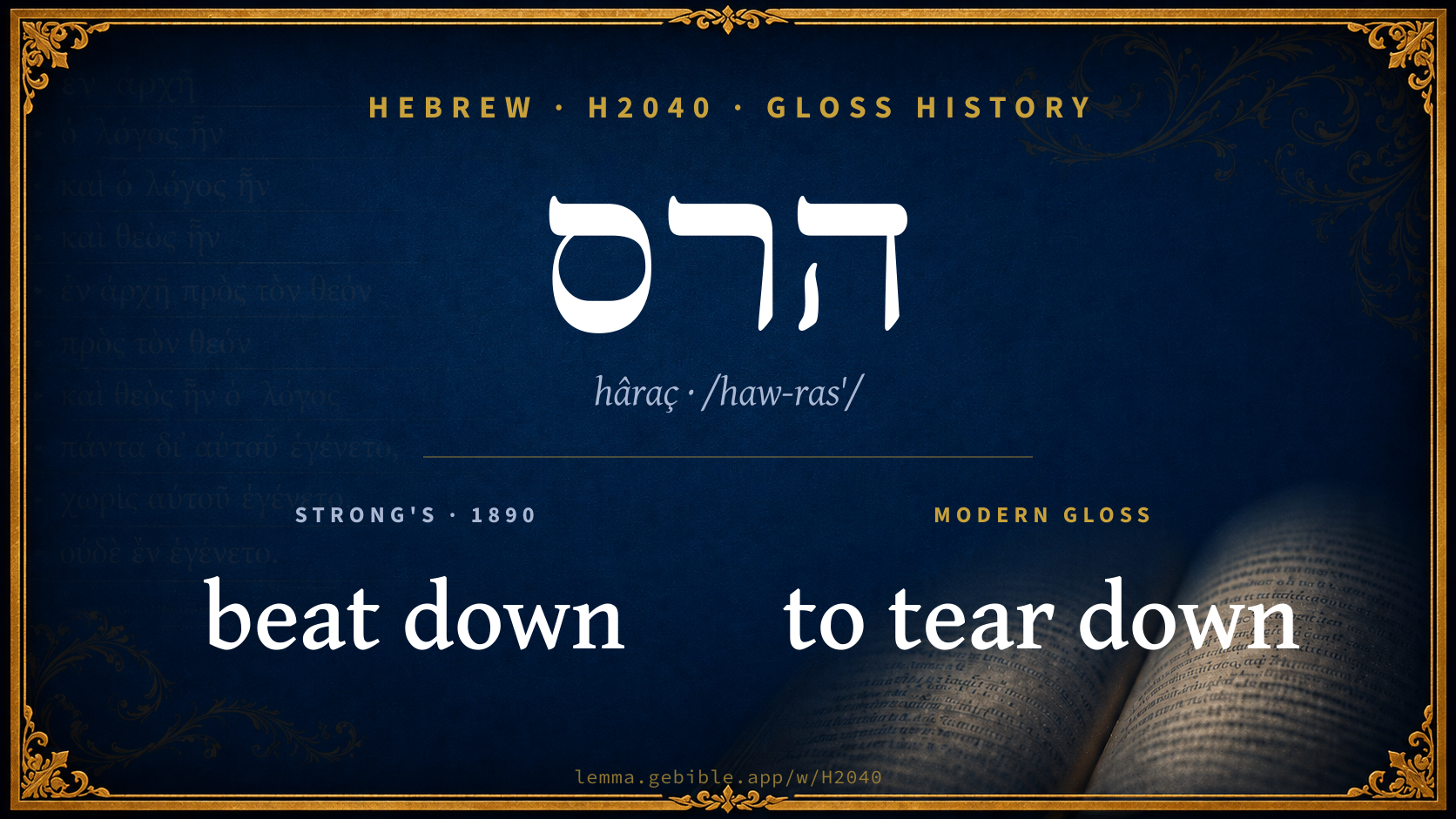
Gloss history
Strong's 1890 vs modern scholarship
About this word
Strong's H2040 catalogs a Hebrew word from the Hebrew Old Testament.
These counts are not copied from any lexicon or concordance. They are computed here, from the morphology-tagged Hebrew Old Testament. What Lemma adds →
- 42
- distinct verses
- The word appears in 42 distinct verses.
- 16 / 39
- OT books
- The word appears in 16 of 39 Old Testament books.
- #837
- by frequency
- Top 1000 most frequent Hebrew words (rank 837 of 8,640 Hebrew words by occurrence).
View all 42 occurrences in the concordance →
By section of the Old Testament
By traditional corpus
Conventional, traditional groupings — biblical authorship is debated, so this is a traditional corpus grouping, not an authorship claim. Each share is this word’s portion of its verses in that division of the Hebrew canon. Each figure is a share of the word’s 42 distinct verses.
- Prophets (Nevi'im) 27 verses · 64%
- Writings (Ketuvim) 11 verses · 26%
- Torah (Pentateuch) 4 verses · 10%
How translations render this word
Counts come from each version’s own published word-to-Strong’s tagging or interlinear alignment — an approximate guide to how each version renders this word, not a word-level alignment the data otherwise carries. Because each total is that version’s own tagged count, the per-version totals vary from one another and need not match the appearance or distinct-verse counts above. These counts may also differ from a printed concordance because Lemma counts each distinctly tagged rendering and does not collapse phrase taggings into a single head-word total. This is a fixed set of word-tagged versions (KJV, ASV, BSB, ULT) and does not change with the reading translation you choose elsewhere. Each version’s license is shown beside its name below (and on Sources).
- King James Version: Throw down 4×, Thrown down 3×, Destroyed 2×
- American Standard Version: Overthrow 4×, Thrown down 3×, He hath thrown down 2×
- Berean Standard Bible: Tear down 3×, Are torn down 2×, Break through 2×
- unfoldingWord Literal Text: He has torn down 2×, I will tear down 2×, Tears it down 2×
King James Version Public Domain
Renders H2040 across 43 tagged occurrences — most commonly:
Plus 26 renderings that appear only once — usually multi-word phrases or single function words the recovered tagging swept in, not distinct renderings.
American Standard Version Public Domain
Renders H2040 across 43 tagged occurrences — most commonly:
Plus 32 renderings that appear only once — usually multi-word phrases or single function words the recovered tagging swept in, not distinct renderings.
Berean Standard Bible Public Domain
Renders H2040 across 42 tagged occurrences — most commonly:
Plus 27 renderings that appear only once — usually multi-word phrases or single function words the recovered tagging swept in, not distinct renderings. Not rendered by a distinct English word in 1 further occurrence.
unfoldingWord Literal Text CC BY-SA 4.0
Renders H2040 across 42 tagged occurrences — most commonly:
Plus 34 renderings that appear only once — usually multi-word phrases or single function words the recovered tagging swept in, not distinct renderings.
Senses in the full BDB
Hebrew verbs can shift meaning by stem (binyan): Qal is the basic action, Niphal is often passive or reflexive, Piel often intensifies or makes it factitive, and Hiphil is typically causative. The senses below are grouped under the stem BDB assigns to each.
What do BDB’s symbols mean?
BDB uses these scholarly abbreviations:
| Symbol | Meaning |
|---|---|
| 𝔊 | the Septuagint (the ancient Greek translation, LXX) |
| 𝔙 | the Vulgate (the Latin translation) |
| 𝔖 | the Syriac version (the Peshitta) |
| 𝔗 | the Targum (the Aramaic translation) |
| ψ | the Psalms |
| √ | root (the underlying root or stem) |
| ‖ | parallel passage (a synonymous or contrasted parallel) |
| † | the dagger: every passage where the word occurs is cited |
The 6 senses and sub-senses the full Brown-Driver-Briggs lexicon distinguishes for this word, in lexicon order (not ranked by frequency), with BDB’s own verbatim wording and sub-sense lettering. Shown in Hebrew script with BDB’s own scholarly abbreviations. The condensed entry is in the Lexicon Entry tab. See also the Forms in the corpus table below.
Qal
- Pf. הָ׳ La 2:2, 17; הָרָ֑ס Is 14:17; וְהָרַסְתָּ֫ Ju 6:25 וְהָרַסְתִּ֫י Ez 13:14 Mi 5:10; וְהָֽרְסוּ Ez 16:39; 26:4, 12 הָרָ֑סוּ 1 K 19:10, 14; Impf. יַהֲרוֹס Jb 12:14; sf. יֶהֶרְסֶ֑ךָ Is 22:19; וַיֶּהֶרְסֶ֑הָ 1 Ch 20:1; יֶהֶרְסֶנָּה Pr 29:4 יֶהֶרְסֵם ψ 28:5; 3 fs. sf. 3 ms. תֶּהֶרְסֶנּוּ Pr 14:1; 2 ms. תַּהֲרֹס Ex 15:7; אֶהֱרֹם Je 24:6; 42:10 אֶהֱרוֹס Mal 1:4; 3 mpl. יֶהֶרְסוּ Ex 19:21, 24; יַהֲרֹ֑סוּ 2 K 3:25; Imv. הֲרָס־ ψ 58:7; sf. הָרְסָהּ 2 S 11:25; Inf. הֲרֹס Je 31:28, הֲרוֹס Je 1:10; Pt. act. הֹרֵס Je 45:4; pass. הָרוּס 1 K 18:30;— e.g. Lamentations 2:2
- 1. throw down, tear down, c. acc.: altar(s) Ju 6:25 1 K 18:30; 19:10, 14; height (גַּב, where idol-altar stood? cf. גַּב sub גבב) Ez 16:39; city (cities) Is 14:17 2 S 11:25 2 K 3:25 1 Ch 20:1 (cf. MI27) Mal 1:4 (obj. not expr.); wall(s) Ez 13:14; 26:12; house Pr 14:1 (fig. of foolish woman’s action); strongholds (מִבְצָרִים) La 2:2 Mi 5:10; tower(s) Ez 26:4; fig. overthrow (i.e. ruin) land Pr 29:4 (opp. יַעֲמִיד); obj. men Ex 15:7 (poem in E) Is 22:19 (cast down Shebna from office); fig., opp. building up, of Yahweh’s dealings with men ψ 28:5, cf. (without obj.) Je 24:6; 42:10; obj. indef. אשׁר בָּנִיתִי אֲנִי הֹרֵס Je 45:4; abs. Je 1:10; 31:28 La 2:17 Jb 12:14. e.g. Judges 6:25
- 2. break down, break away ה׳ שִׁנֵּימוֹ בְּפִימוֹ ψ 58:7 break away their teeth in their mouth! fig., addressed to God. e.g. Psalms 58:7
- 3. break through, intr., sq. אֶל־י׳ Ex 19:21; sq. לַעֲלֹת אֶל־י׳ v 24 (both J). e.g. Exodus 19:21
Niphal
- Pf. 3 fs. נֶהֱרָ֑סָה Pr 24:31; 3 pl. נֶהֶרְסוּ Je 50:15 Jo 1:17; וְנֶהֶרְסוּ consec. Ez 30:4; 38:20; Impf. יֵהָרֵס Je 31:40; 3 fs. תֵּהָרֵס Pr 11:11; יֵהָרֵס֑וּן ψ 11:3; Pt. הַנֶּהֱרָסוֹת Ez 36:35, 36;—be thrown or torn down; stones of wall Pr 24:31; wall of city Je 50:15; cities Ez 36:35 cf. v 36; fig. ruined Pr 11:11 (opp. תָּרוּם); foundations, יְסוֹדֹת Ez 30:4; שָׁתוֹת ψ 11:3; mountains Ez 38:20; storehouses מַמְּגֻרוֹת Jo 1:17 [v. מ׳]; valley E. of Jerus. לֹא־יִנָּתֵשׁ וְלֹא־יֵהָרֵס Je 31:40 it shall not be plucked up nor thrown down, appar. proverb. expression, implying destruction, removal. e.g. Proverbs 24:31
Piel
- Impf. 2 ms. sf. תְּהָֽרְסֵם Ex 23:24; Inf. abs. הָרֵס Ex 23:24; Pt. pl. sf. מְהָֽרְסַיִךְ Is 49:17;—over-throw, tear down הָרֵס תְּהָֽרְסֵם Ex 23:24 thou shalt utterly tear them down (JE; obj. = idols cf. Di); pt. destroyers, of Zion Is 49:17 (‖ מַחֲרִיבַיִךְ). e.g. Exodus 23:24
Senses from the full Brown-Driver-Briggs lexicon (Brown, Driver, Briggs; Oxford 1906 — public domain), digitized via Sefaria, supplemented by the OpenScriptures HebrewLexicon (CC BY 4.0). Full attribution on Sources.
Word origin
vb. throw down, break or tear down (MI הרס;? Arabic هَرَسَ, bruise, bray, pound, crush (grain))—
— Brown-Driver-Briggs (Oxford 1906, public domain), digitized via Sefaria, supplemented by the OpenScriptures HebrewLexicon (CC BY 4.0). See Sources.
Origin: a primitive root
Jastrow Dictionary
A second Hebrew/Aramaic lexicon for comparison, covering Aramaic and post-biblical (Talmudic, Targumic, Midrashic) usage that the biblical-Hebrew BDB does not. Matched by lemma rather than by Strong’s number, so a lemma may carry more than one Jastrow headword (shown separately below), and the entries cover usage well beyond the Bible.
הָרַס
- (b. h.)
- 1. to break, to destroy, demolish. Midr. Till. to Ps. IX, 7 הוא הוֹרֵס את וכ׳ He destroys your plans; Yalk. Mal. 587.—Part. pass. הָרוּס; f. הֲרוּסָה. Gen. R. s. 45; a. e.—Y. Ber. IV, 8ᵃ; a. e.
- 2. to break through, rush. Yalk. Ex. 284 (expl. פן יהרסו, Ex. XIX, 21) שמא ידחקו, v. דָּחַק; Mekh. Yithro, Baḥod., s. 4. e.g. Exodus 19:21
הֶרֶס
- (preced.) destruction. Men. 110ᵃ (interpret. עִיר הַהֶרֶס, Is. XIX, 18) קרתא … דעתידא למיחרב (v. Rabb. D. S. a. l.) the town of Beth Shemesh which is doomed to destruction; v. חֶרֶס. e.g. Isaiah 19:18
A Dictionary of the Targumim, the Talmud Babli and Yerushalmi, and the Midrashic Literature (Marcus Jastrow; London, Luzac, 1903) — Public Domain. Digitized via Sefaria. Digitized via Sefaria. Full attribution on Sources.
Forms in the corpus
The 39 distinct written forms H2040 takes in the Hebrew Bible, most frequent first — each parse links to that stem’s occurrences in the concordance. Hebrew forms include their vowel points and cantillation, so a single lemma takes many written forms.
Same root — word family
Other BDB entries built from the same root as H2040, grouped by Strong’s listed origin. These share a root / origin per the lexicon — not necessarily a shared meaning. Each links to that word’s own entry.
Derived from this word
Compare all same-root words → They share a root, not necessarily a meaning.
Septuagint verse parallels
This word appears in 41 verses that also exist in the Greek Old Testament (Septuagint), out of the 42 Hebrew verses it occurs in. You can read those verses in Greek by switching the Old Testament edition to the Septuagint.
Read these verses in the Septuagint
- Exodus 15:7
- Judges 6:25
- 2 Samuel 11:25
- 1 Kings 18:30
- 2 Kings 3:25
- 1 Chronicles 20:1
- Job 12:14
- Psalms 11:3
- Proverbs 11:11
- Isaiah 14:17
- Jeremiah 1:10
- Lamentations 2:2
This is a verse-level parallel only — the same verses exist in both the Hebrew and Greek Old Testaments. No word-level Hebrew↔Greek correspondence is claimed: the data carries no such alignment, so no Greek word is shown as this Hebrew word’s translation. Coverage is not total — the Septuagint omits the deuterocanon and renumbers the Psalms, so some Hebrew verses have no direct Greek parallel.