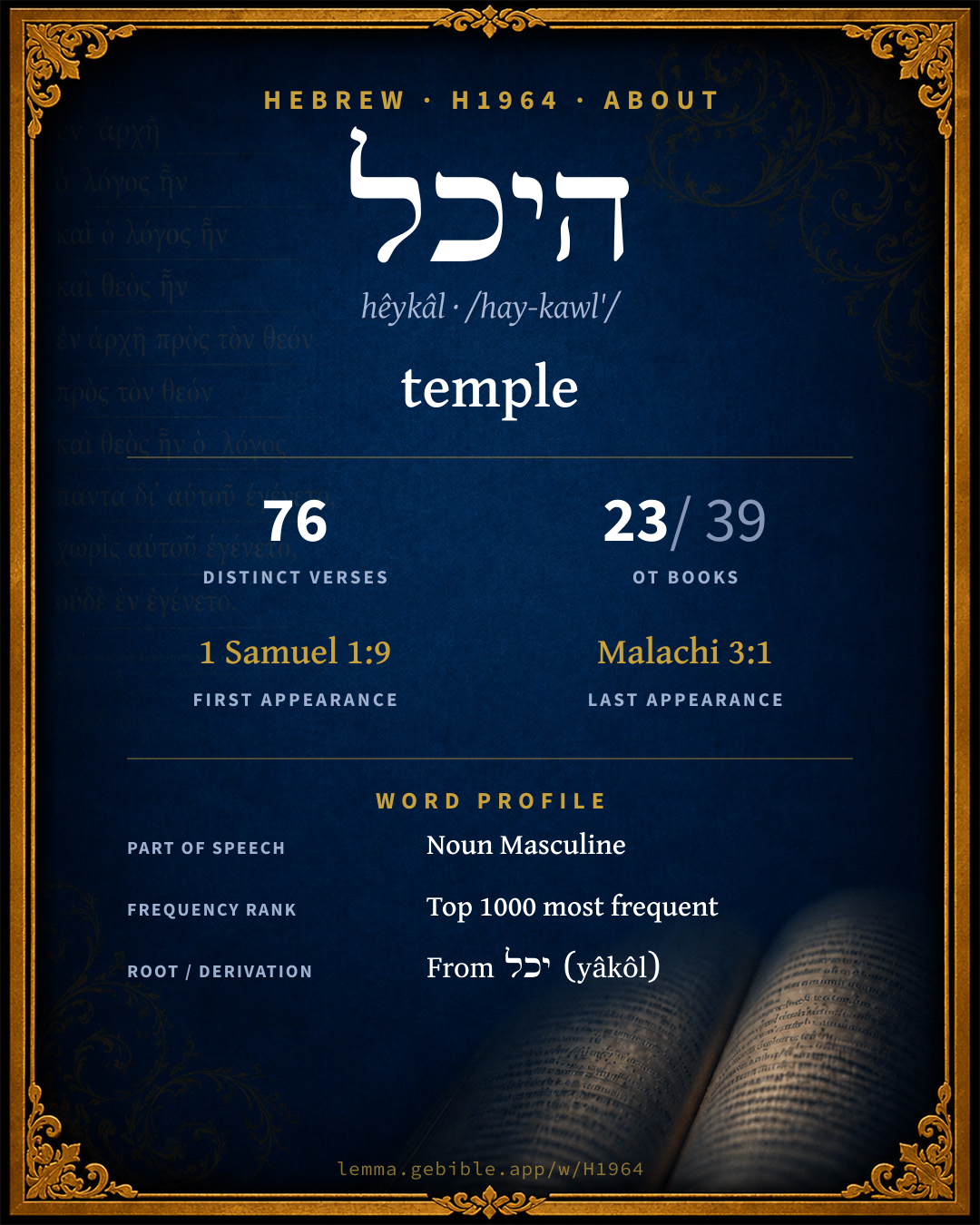
הֵיכָל
temple
also: palace, nave, sanctuary fuller range ↓
Full lexicon entry — Brown-Driver-Briggs (BDB)
From Brown-Driver-Briggs (BDB)
Where this word appears
See every Absolute-state word in the Hebrew Bible →
Grammar key — what these labels mean
Part of speech
- Noun
- A naming word — a person, place, thing, or idea.
Noun type
- Common
- A common noun — a general class of person, place, or thing (“king,” “city,” “water”), not a specific name.
State
- Construct
- A noun bound to a following noun in a possessive / “of” relationship (the construct chain).
- Absolute
- The independent form of a noun, not bound to a following word.
Gender
- Masculine
- Grammatically masculine.
Number
- Singular
- One.
- Plural
- More than one (in Hebrew, generally three or more).
1 verse where H1964 appears in the Construct state in the Book of Ezekiel. Filtered view — show all forms. Click any verse to open its interlinear word-by-word view. Verse text shown in the World English Bible for context — . Each verse’s Hebrew form is shown with its reference; the English is not keyword-highlighted, since the data carries no word-level English alignment. Use “Compare translations” on any verse to read it across multiple English versions. This concordance covers the Hebrew Bible; Septuagint (Greek Old Testament) occurrences are not indexed here.
Ezekiel
About this entry
At a glance — auto-summarized from this page’s data, not written by a person. Every figure links to its source below. This summary describes the numbers; it doesn’t interpret them.
היכל — transliterated hêykâl — is a Hebrew noun carrying the sense “temple.” It also covers “palace”, “nave”, and “sanctuary”, alongside “temple” — see its full sense range. Spanning 76 verses in 23 books, it ranks among the moderately common words of the Hebrew Bible. Debuting at 1 Samuel 1:9, it then recurs through the corpus. From the same root come יכל, יכל and כהל. See the sense tree, 76-verse concordance, and the renderings breakdown below.
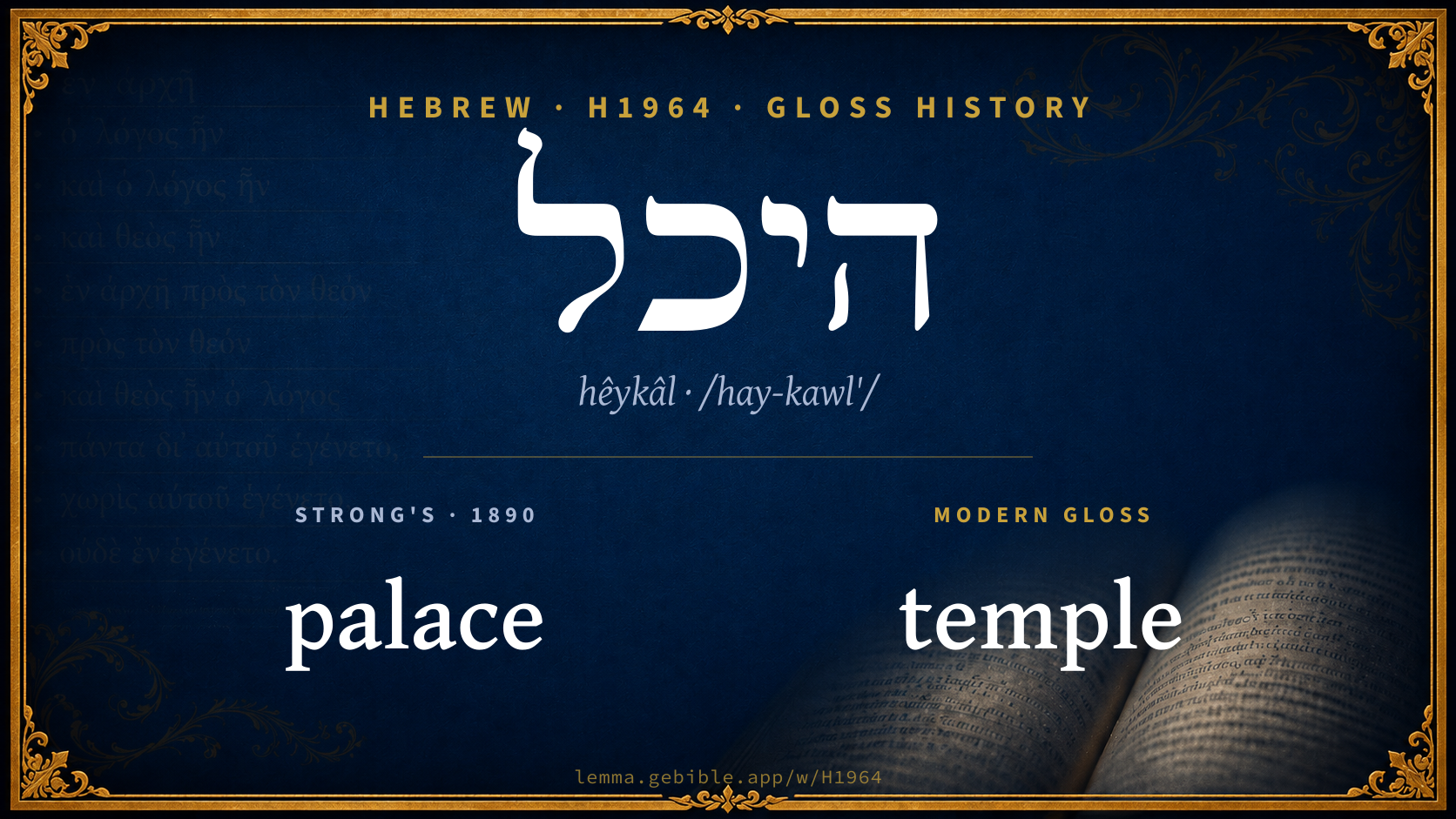
Gloss history
Strong's 1890 vs modern scholarship
About this word
Strong's H1964 catalogs a Hebrew word from the Hebrew Old Testament.
These counts are not copied from any lexicon or concordance. They are computed here, from the morphology-tagged Hebrew Old Testament. What Lemma adds →
- 76
- distinct verses
- The word appears in 76 distinct verses.
- 23 / 39
- OT books
- The word appears in 23 of 39 Old Testament books.
- #501
- by frequency
- Top 1000 most frequent Hebrew words (rank 501 of 8,640 Hebrew words by occurrence).
View all 76 occurrences in the concordance →
Most concentrated in
- Psalms 13 verses 17%
- Ezekiel 9 verses 12%
- 2 Chronicles 8 verses 11%
By section of the Old Testament
By traditional corpus
Conventional, traditional groupings — biblical authorship is debated, so this is a traditional corpus grouping, not an authorship claim. Each share is this word’s portion of its verses in that division of the Hebrew canon. Each figure is a share of the word’s 76 distinct verses.
- Prophets (Nevi'im) 48 verses · 63%
- Writings (Ketuvim) 28 verses · 37%
How translations render this word
Counts come from each version’s own published word-to-Strong’s tagging or interlinear alignment — an approximate guide to how each version renders this word, not a word-level alignment the data otherwise carries. Because each total is that version’s own tagged count, the per-version totals vary from one another and need not match the appearance or distinct-verse counts above. These counts may also differ from a printed concordance because Lemma counts each distinctly tagged rendering and does not collapse phrase taggings into a single head-word total. This is a fixed set of word-tagged versions (KJV, ASV, BSB, ULT) and does not change with the reading translation you choose elsewhere. Each version’s license is shown beside its name below (and on Sources).
- King James Version: Temple 64×, Palace 7×, Palaces 3×
- American Standard Version: Temple 53×, Palace 5×, Palaces 3×
- Berean Standard Bible: Temple 55×, Palace 7×, Outer sanctuary 5×
- unfoldingWord Literal Text: Temple 27×, Temple of 25×, Palace of 6×
King James Version Public Domain
Renders H1964 across 80 tagged occurrences — most commonly:
Plus 4 renderings that appear only once — usually multi-word phrases or single function words the recovered tagging swept in, not distinct renderings.
American Standard Version Public Domain
Renders H1964 across 80 tagged occurrences — most commonly:
Plus 15 renderings that appear only once — usually multi-word phrases or single function words the recovered tagging swept in, not distinct renderings.
Berean Standard Bible Public Domain
Renders H1964 across 78 tagged occurrences — most commonly:
Plus 5 renderings that appear only once — usually multi-word phrases or single function words the recovered tagging swept in, not distinct renderings. Not rendered by a distinct English word in 1 further occurrence.
unfoldingWord Literal Text CC BY-SA 4.0
Renders H1964 across 81 tagged occurrences — most commonly:
Plus 13 renderings that appear only once — usually multi-word phrases or single function words the recovered tagging swept in, not distinct renderings.
7 senses and sub-senses in the full BDB
What do BDB’s symbols mean?
BDB uses these scholarly abbreviations:
| Symbol | Meaning |
|---|---|
| 𝔊 | the Septuagint (the ancient Greek translation, LXX) |
| 𝔙 | the Vulgate (the Latin translation) |
| 𝔖 | the Syriac version (the Peshitta) |
| 𝔗 | the Targum (the Aramaic translation) |
| ψ | the Psalms |
| √ | root (the underlying root or stem) |
| ‖ | parallel passage (a synonymous or contrasted parallel) |
| † | the dagger: every passage where the word occurs is cited |
The 7 senses and sub-senses the full Brown-Driver-Briggs lexicon distinguishes for this word, in lexicon order (not ranked by frequency), with BDB’s own verbatim wording and sub-sense lettering. Shown in Hebrew script with BDB’s own scholarly abbreviations. The condensed entry is in the Lexicon Entry tab. See also the Forms in the corpus table below.
- 1. rather seld. (royal) palace (so alm. always in Assyrian); of Ahab 1 K 21:1, of king of Babylon 2 K 20:18 = Is 39:7, 2 Ch 36:7, cf. Dn 1:4, and pl. הֵיכְלֵי עֹנֶג Is 13:22 luxurious palaces; at Nineveh וְהַה׳ נָמוֹג Na 2:7; not clearly defined are הֵיכַל מֶלֶךְ ψ 45:16 and הֵיכְלֵי שֵׁן v 9; הֵיכָלוֹת Ho 8:14 (in N. Israel); vid. also וְהֵילִילוּ שִׁירוֹת הֵיכָל בַּיּוֹם הַהוּא Am 8:3 and palace-songs shall be howlings in that day; cf. also (prob.) of Phœnician palaces Jo 4:5; quite general הֵיכְלֵי מֶלֶךְ Pr 30:28, & תַּבְנִית הֵיכָל ψ 144:12 (sim. of well-proportioned daughters);—usual term for royal palace in Heb. is בֵּית הַמֶּלֶךְ, v. בית. e.g. 1 Kings 21:1
- 2. of palace of God considered as king, = house of God or of י׳, temple (cf. הַה׳ Is 6:1 e infr. where proph. sees אדני ישֵׁב עַל־כִּסֵּא): e.g. Isaiah 6:1
- a. of early, pre-Solomonic house at Shiloh הֵיכַל י׳ 1 S 1:9; 3:3 (= בֵּית י׳ 1:7; 3:15; פֶּתַח אֹהֶל מוֹעֵד 2:22 om. 𝔊 We Klo Dr) with doors (דלתות, 3:15) & a doorpost (מזוזה 1:9) (cf. 2 S 22:7 = ψ 18:7 e infr.). e.g. 1 Samuel 1:9
- b. of Solomon’s temple: specif. the hall or nave of the temple (the holy place, distinguished from the דְּבִיר the inner sanctuary, the Holy of Holies, and with this included in the more general term בֵּית י׳ or הַבַּיִת, 1 K 6:1, 2 + often) 1 K 6:17 (cf. v 19, 20 & v 2) also v 5, 33 1 K 7:50 = 2 Ch 4:22; further 2 Ch 4:7, 8; Ez 8:16(×2) הָאוּלָם עַל־פְּנֵי הֵיכַל הַבַּיִת 1 K 6:3; אֻלָם הַהֵיכָל 1 K 7:21 ‖ עַל־פְּנֵי הַהֵיכָל 2 Ch 3:17; הֵיכַל י׳ 2 K 18:16; also in wide sense (appar. = בֵּית י׳), הֵיכַל י׳ 2 K 23:4; 24:13 (‖ בֵּית י׳), Je 7:4(×3) (‖ בֵּית י׳ v 2), 24:1 v. also נִקְמַת הֵיכָלוֹ Je 50:28; 51:11 (both ‖ נִקְמַת י׳); 2 Ch 26:16; 27:2, cf. 29:16 (‖ פְּנִ֫ימָה בֵית י׳; opp. חֲצַר ב׳ י׳), in all three הֵיכַל י׳. e.g. 1 Kings 6:1
- c. hall or nave of Ezek.’s temple, the holy place (v. supr.) (included in הַבַּיִת, the general term embracing the whole group of buildings) Ez 41:1, 4, 15, 21, 23, 25 (cf. v 20) 42:8. e.g. Ezekiel 41:1
- d. general designation of 2nd temple, הַהֵיכָל Zc 8:9 (‖ בֵּית י׳ צְבָאוֹת); oftener הֵיכַל י׳ Hg 2:15, 18; Zc 6:12, 13, 14, 15; Ezr 3:6, 10, הֵיכָלוֹ Mal 3:1 ψ 27:4; בּוֹנִים הֵיכָל ליהוה אֱלֹהֵי יִשְׂרָאֵל Ezr 4:1; (הַ)הֵיכָל Ne 6:10(×2) (‖ בֵּית הָאֱלֹהִים), v 11; Is 44:28, cf. also 66:6.—הֵיכָל occurs occasionally in ψ, without conclusive evidence, in all cases, to what temple ref. is had; appar. distinguished from בֵּית י׳ (as sub b) ψ 5:8b (הֵיכַל קָדְשְׁךָ; v. בֵּיתֶ֑ךָ v 8a); perhaps also ψ 68:30 (disting. from Holy of Holies by De Che; yet verse obscure); but no distinction evident ψ 79:1; 138:2; Jon 2:5, 8 (all הֵיכַל קָדְשְׁךָ); cf. קְדֹשׁ הֵיכָלֶ֑ךָ ψ 65:5 (‖ בֵּיתֶ֑ךָ); as containing the worshipping assembly ψ 48:10. e.g. Zechariah 8:9
- e. of the heavenly temple where י׳ sits enthroned Is 6:1; his abode in the heavens 2 S 22:7 = ψ 18:7, ψ 11:4 (‖ שָׁמַיִם; cf. זְבֻל קָדְשׁוֹ Is 63:15, ‖ id.), 29:9; אֲדֹנָי מֵהֵיכַל קָדְשׁוֹ Mi 1:2, cf. Hb 2:20 ויהוה בְּהֵיכַל קָדְשׁוֹ. e.g. Isaiah 6:1
Senses from the full Brown-Driver-Briggs lexicon (Brown, Driver, Briggs; Oxford 1906 — public domain), digitized via Sefaria, supplemented by the OpenScriptures HebrewLexicon (CC BY 4.0). Full attribution on Sources.
Word origin
n.m. Na 2:7 (on Is 44:28 cf. Che Di) palace, temple (v. also NH id. temple, Aramaic הֵיכָלָא, הֵיכְלָא, ܗܰܝܟܰܠ, palace, temple, Palm. הכלא temple Vog 16; cf. Arabic هَيْكَلٌ (prob. Aramaic loan-wd. according to Frä 274), Ethiopic ሀይከል temple; Assyrian ekallu, palace, temple;—prob. loan-wd. from Sum. e-gal, great house, cf. SchrHI 148 COT 2 K 20:18 HptE-vowel 11 f. LehmannŠamaššumukîn 126, and on usage Dl 338; > from יכל (וכל) = כול contain Ew§ 162 b ThesAdd. 84; cf. Ol§ 191 b HoffmAGG xxxvi. Mai 1889, 25 DlW; from an orig. יכל LagBN 121, but cf. HomZMG 1890, 547) abs. ה׳ Am 8:3 + 27 times (הַה׳ 1 K 6:17 +); cstr. הֵיכַל Mi 1:2 + 35 times; sf. הֵיכָלֶ֑ךָ ψ 48:10 + 2 times; הֵיכָלוֹ Je 50:28 + 7 times; pl. הֵיכָלוֹת Ho 8:14; cstr. הֵיכְלֵי Is 13:22 + 2 times; sf. הֵיכְלֵיכֶם Jo 4:5;—never in Hex, rarely in S & pre-exile prophets; especially freq. in Ki Ez & late proph., also Chr; occasionally in ψ;—
— Brown-Driver-Briggs (Oxford 1906, public domain), digitized via Sefaria, supplemented by the OpenScriptures HebrewLexicon (CC BY 4.0). See Sources.
Derived from יכל (yâkôl) (H3201) — to prevail.
Jastrow Dictionary
A second Hebrew/Aramaic lexicon for comparison, covering Aramaic and post-biblical (Talmudic, Targumic, Midrashic) usage that the biblical-Hebrew BDB does not. Matched by lemma rather than by Strong’s number, so a lemma may carry more than one Jastrow headword (shown separately below), and the entries cover usage well beyond the Bible.
הֵיכָל
- (b. h.) palace, the Temple; esp. the Holy, the hall containing the golden altar &c., contrad. to the Holy of Holies, v. דְּבִיר. Midd. IV, 1; a. fr.—Ned. I, 3 כה׳ as forbidden as the offerings of the Temple (a vow formula). Y. Succ. V, 55ᶜ ומשחיתים לה׳ (not ומשתחוים, v. Rashi to Ez. VIII, 16) and offended the Temple (through indecency); a. fr.—Pl. הֵיכָלוֹת. Y. Shek. V, end, 49ᵇ (quot. fr. Hos. VIII, 14). e.g. Ezekiel 8:16
A Dictionary of the Targumim, the Talmud Babli and Yerushalmi, and the Midrashic Literature (Marcus Jastrow; London, Luzac, 1903) — Public Domain. Digitized via Sefaria. Digitized via Sefaria. Full attribution on Sources.
Forms in the corpus
The 48 distinct written forms H1964 takes in the Hebrew Bible, most frequent first — each parse links to that state’s occurrences in the concordance. Hebrew forms include their vowel points and cantillation, so a single lemma takes many written forms.
Same root — word family
Other BDB entries built from the same root as H1964, grouped by Strong’s listed origin. These share a root / origin per the lexicon — not necessarily a shared meaning. Each links to that word’s own entry.
Derives from
Shares the same root
Derived from this word
Proper names from this root
People and places named from this root — a name, not an additional meaning of the word.
Compare all same-root words → Showing 4 of 8 — not the complete family. 2 of the same-root words are proper names (people or places). They share a root, not necessarily a meaning.
Septuagint verse parallels
This word appears in 72 verses that also exist in the Greek Old Testament (Septuagint), out of the 76 Hebrew verses it occurs in. You can read those verses in Greek by switching the Old Testament edition to the Septuagint.
Read these verses in the Septuagint
- 1 Samuel 1:9
- 2 Samuel 22:7
- 1 Kings 6:3
- 2 Kings 18:16
- 2 Chronicles 3:17
- Ezra 3:6
- Psalms 5:7
- Proverbs 30:28
- Isaiah 6:1
- Jeremiah 7:4
- Ezekiel 8:16
- Daniel 1:4
This is a verse-level parallel only — the same verses exist in both the Hebrew and Greek Old Testaments. No word-level Hebrew↔Greek correspondence is claimed: the data carries no such alignment, so no Greek word is shown as this Hebrew word’s translation. Coverage is not total — the Septuagint omits the deuterocanon and renumbers the Psalms, so some Hebrew verses have no direct Greek parallel.