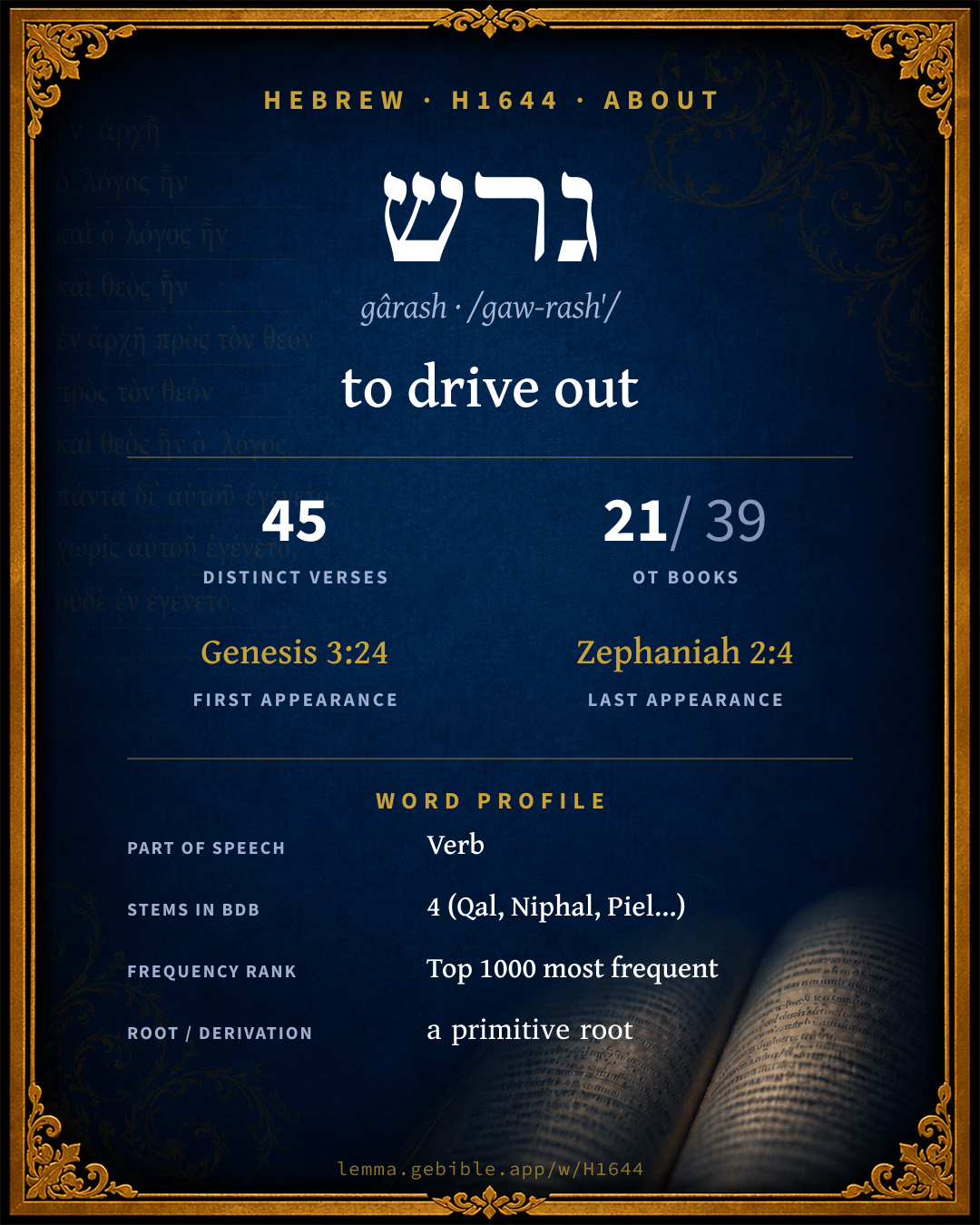
גָּרַשׁ
to drive out
also: expel, cast out, drive away, divorce fuller range ↓
Full lexicon entry — Brown-Driver-Briggs (BDB)
From Brown-Driver-Briggs (BDB)
Where this word appears
See every Piel verb in the Hebrew Bible →
Grammar key — what these labels mean
Part of speech
- Verb
- An action or state-of-being word.
Stem
- Piel
- An intensive or resultative active stem.
- Qal
- The basic, simple active stem — the plain form of the verb (“he wrote”).
- Niphal
- Usually the simple passive or reflexive of the Qal (“he was written”).
- Pual
- The passive counterpart of the Piel.
Form
- Sequential Imperfect
- An imperfect with prefixed waw — the standard past-narrative form (waw-consecutive imperfect).
- Participle Passive
- A verbal adjective expressing action received (“written”).
- Imperfect
- An incomplete, ongoing, or future action (“he will / would write”).
- Imperative
- A direct command (“write!”).
- Sequential Perfect
- A perfect with prefixed waw continuing a preceding imperfect or command (waw-consecutive perfect).
- Infinitive Construct
- A bound verbal noun, frequently with prepositions (“to write / in writing”).
- Perfect
- A completed action or state — Hebrew marks aspect (completeness) more than strict tense (“he wrote”).
- Participle Active
- A verbal adjective expressing ongoing or characteristic action (“writing / one who writes”).
- Infinitive Absolute
- An unbound verbal noun, often intensifying or standing in for a finite verb.
State
- Absolute
- The independent form of a noun, not bound to a following word.
Person
- 3rd Person
- The one spoken about (“he / she / it / they”).
- 1st Person
- The speaker (“I / we”).
- 2nd Person
- The one addressed (“you”).
Gender
- Masculine
- Grammatically masculine.
- Feminine
- Grammatically feminine.
- Common
- Either gender — not distinguished for this form.
Number
- Singular
- One.
- Plural
- More than one (in Hebrew, generally three or more).
Grammatical forms 27 distinct
- Verb, Piel, Sequential Imperfect, 3rd Person, Masculine, Singular 8 times (17%)
- Verb, Qal, Participle Passive, Feminine, Singular, Absolute 5 times (11%)
- Verb, Piel, Imperfect, 1st Person, Common, Singular 5 times (11%)
- Verb, Piel, Imperative, 2nd Person, Masculine, Singular 2 times (4%)
- Verb, Piel, Sequential Perfect, 1st Person, Common, Singular 2 times (4%)
- Verb, Piel, Sequential Imperfect, 3rd Person, Masculine, Plural 2 times (4%)
- Verb, Piel, Infinitive Construct 2 times (4%)
- Verb, Piel, Imperfect, 3rd Person, Masculine, Singular 2 times (4%)
+19 more forms (19 occurrences)
Parsed forms decoded from the imported morphology (morphhb / Westminster Leningrad Codex — WLC text public domain, morphhb tagging CC BY 4.0), counted across 47 parsed occurrences — not distinct verses.
Every verse where H1644 appears — 45 distinct verses across 21 books. Click any verse to open its interlinear word-by-word view. Verse text shown in the World English Bible for context — . Each verse’s Hebrew form is shown with its reference; the English is not keyword-highlighted, since the data carries no word-level English alignment. Use “Compare translations” on any verse to read it across multiple English versions. This concordance covers the Hebrew Bible; Septuagint (Greek Old Testament) occurrences are not indexed here.
Genesis 3 verses
- Genesis 3:24 וַ/יְגָ֖רֶשׁ conj + Piel wimpf 3ms So he drove out the man; and he placed Cherubs at the east of the garden of Eden, and the flame of a sword which turned every way, to guard the way to the tree of life.
- Genesis 4:14 גֵּרַ֨שְׁתָּ Piel pf 2ms Behold, you have driven me out this day from the surface of the ground. I will be hidden from your face, and I will be a fugitive and a wanderer in the earth. It will happen that whoever finds me will kill me."
- Genesis 21:10 גָּרֵ֛שׁ Piel impv 2ms Therefore she said to Abraham, "Cast out this handmaid and her son! For the son of this handmaid will not be heir with my son, even with Isaac."
Exodus 11 verses
- Exodus 2:17 וַ/יְגָרְשׁ֑וּ/ם conj + Piel wimpf 3mp + sfx pers 3mp The shepherds came and drove them away; but Moses stood up and helped them, and watered their flock.
- Exodus 6:1 יְגָרְשֵׁ֖/ם Piel impf 3ms + sfx pers 3mp Yahweh said to Moses, "Now you shall see what I will do to Pharaoh, for by a strong hand he shall let them go, and by a strong hand he shall drive them out of his land."
- Exodus 10:11 וַ/יְגָ֣רֶשׁ conj + Piel wimpf 3ms Not so! Go now you who are men, and serve Yahweh; for that is what you desire!" They were driven out from Pharaoh's presence.
- Exodus 11:1 גָּרֵ֛שׁ יְגָרֵ֥שׁ Piel inf.abs Piel impf 3ms Yahweh said to Moses, "Yet one plague more will I bring on Pharaoh, and on Egypt; afterwards he will let you go. When he lets you go, he will surely thrust you out altogether.
- Exodus 12:39 גֹרְשׁ֣וּ Pual pf 3cp They baked unleavened cakes of the dough which they brought forth out of Egypt; for it wasn't leavened, because they were thrust out of Egypt, and couldn't wait, neither had they prepared for themselves any food.
- Exodus 23:28 וְ/גֵרְשָׁ֗ה conj + Piel wpf 3fs I will send the hornet before you, which will drive out the Hivite, the Canaanite, and the Hittite, from before you.
- Exodus 23:29 אֲגָרְשֶׁ֛/נּוּ Piel impf 1cs + sfx pers 3ms I will not drive them out from before you in one year, lest the land become desolate, and the animals of the field multiply against you.
- Exodus 23:30 אֲגָרְשֶׁ֖/נּוּ Piel impf 1cs + sfx pers 3ms Little by little I will drive them out from before you, until you have increased and inherit the land.
- Exodus 23:31 וְ/גֵרַשְׁתָּ֖/מוֹ conj + Piel wpf 2ms + sfx pers 3mp I will set your border from the Red Sea even to the sea of the Philistines, and from the wilderness to the River; for I will deliver the inhabitants of the land into your hand, and you shall drive them out before you.
- Exodus 33:2 וְ/גֵֽרַשְׁתִּ֗י conj + Piel wpf 1cs I will send an angel before you; and I will drive out the Canaanite, the Amorite, and the Hittite, and the Perizzite, the Hivite, and the Jebusite:
- Exodus 34:11 גֹרֵ֣שׁ Qal ptcp.act ms Observe that which I command you this day. Behold, I drive out before you the Amorite, the Canaanite, the Hittite, the Perizzite, the Hivite, and the Jebusite.
Leviticus 3 verses
- Leviticus 21:7 גְּרוּשָׁ֥ה Qal ptcp.pass fs "'They shall not marry a woman who is a prostitute, or profane; neither shall they marry a woman divorced from her husband: for he is holy to his God.
- Leviticus 21:14 וּ/גְרוּשָׁה֙ conj + Qal ptcp.pass fs A widow, or one divorced, or a woman who has been defiled, or a prostitute, these he shall not marry: but a virgin of his own people shall he take as a wife.
- Leviticus 22:13 וּ/גְרוּשָׁ֗ה conj + Qal ptcp.pass fs But if a priest's daughter is a widow, or divorced, and has no child, and has returned to her father's house, as in her youth, she may eat of her father's bread: but no stranger shall eat any of it.
Numbers 3 verses
- Numbers 22:6 וַ/אֲגָרְשֶׁ֖/נּוּ conj + Piel impf 1cs + sfx pers 3ms Please come now therefore curse me this people; for they are too mighty for me: peradventure I shall prevail, that we may strike them, and that I may drive them out of the land; for I know that he whom you bless is blessed, and he whom you curse is cursed.
- Numbers 22:11 וְ/גֵרַשְׁתִּֽי/ו conj + Piel wpf 1cs + sfx pers 3ms Behold, the people that is come out of Egypt, it covers the surface of the earth: now, come curse me them; peradventure I shall be able to fight against them, and shall drive them out.
- Numbers 30:9 וּ/גְרוּשָׁ֑ה conj + Qal ptcp.pass fs But the vow of a widow, or of her who is divorced, [even] everything with which she has bound her soul, shall stand against her.
Deuteronomy 1 verse
Joshua 2 verses
- Joshua 24:12 וַ/תְּגָ֤רֶשׁ conj + Piel wimpf 3fs I sent the hornet before you, which drove them out from before you, even the two kings of the Amorites; not with your sword, nor with your bow.
- Joshua 24:18 וַ/יְגָ֨רֶשׁ conj + Piel wimpf 3ms and Yahweh drove out from before us all the peoples, even the Amorites who lived in the land: therefore we also will serve Yahweh; for he is our God.
Judges 5 verses
- Judges 2:3 אֲגָרֵ֥שׁ Piel impf 1cs Therefore I also said, I will not drive them out from before you; but they shall be [as thorns] in your sides, and their gods shall be a snare to you.
- Judges 6:9 וָ/אֲגָרֵ֤שׁ conj + Piel wimpf 1cs and I delivered you out of the hand of the Egyptians, and out of the hand of all who oppressed you, and drove them out from before you, and gave you their land;
- Judges 9:41 וַ/יְגָ֧רֶשׁ conj + Piel wimpf 3ms Abimelech lived at Arumah: and Zebul drove out Gaal and his brothers, that they should not dwell in Shechem.
- Judges 11:2 וַ/יְגָרְשׁ֣וּ conj + Piel wimpf 3mp Gilead's wife bore him sons; and when his wife's sons grew up, they drove out Jephthah, and said to him, You shall not inherit in our father's house; for you are the son of another woman.
- Judges 11:7 וַ/תְּגָרְשׁ֖וּ/נִי conj + Piel wimpf 2mp + sfx pers 1cs Jephthah said to the elders of Gilead, Didn't you hate me, and drive me out of my father's house? and why are you come to me now when you are in distress?
1 Samuel 1 verse
1 Kings 1 verse
1 Chronicles 1 verse
2 Chronicles 1 verse
Job 1 verse
Psalms 3 verses
- Psalms 34:1 וַֽ֝/יְגָרֲשֵׁ֗/הוּ conj + Piel wimpf 3ms + sfx pers 3ms I will bless Yahweh at all times. His praise will always be in my mouth.
- Psalms 78:55 וַ/יְגָ֤רֶשׁ conj + Piel wimpf 3ms He also drove out the nations before them, Allotted them for an inheritance by line, And made the tribes of Israel to dwell in their tents.
- Psalms 80:8 תְּגָרֵ֥שׁ Piel impf 2ms You brought a vine out of Egypt. You drove out the nations, and planted it.
Proverbs 1 verse
Isaiah 1 verse
Ezekiel 2 verses
- Ezekiel 31:11 גֵּרַשְׁתִּֽ/הוּ Piel pf 1cs + sfx pers 3ms I will even deliver him into the hand of the mighty one of the nations; he shall surely deal with him; I have driven him out for his wickedness.
- Ezekiel 44:22 וּ/גְרוּשָׁ֔ה conj + Qal ptcp.pass fs Neither shall they take for their wives a widow, nor her who is put away; but they shall take virgins of the seed of the house of Israel, or a widow who is the widow of a priest.
Hosea 1 verse
Amos 1 verse
Jonah 1 verse
Micah 1 verse
Zephaniah 1 verse
About this entry
At a glance — auto-summarized from this page’s data, not written by a person. Every figure links to its source below. This summary describes the numbers; it doesn’t interpret them.
“to drive out” is the headline sense of the Hebrew verb גרש (gârash). Read the stem: it spans 4 stems, including Qal and Niphal. The Hebrew Bible uses it across 45 verses — moderately common. Its earliest occurrence is Genesis 3:24. Related forms include גרש, גרשה and מגרש. The sections below give every sense, occurrence, and version rendering.
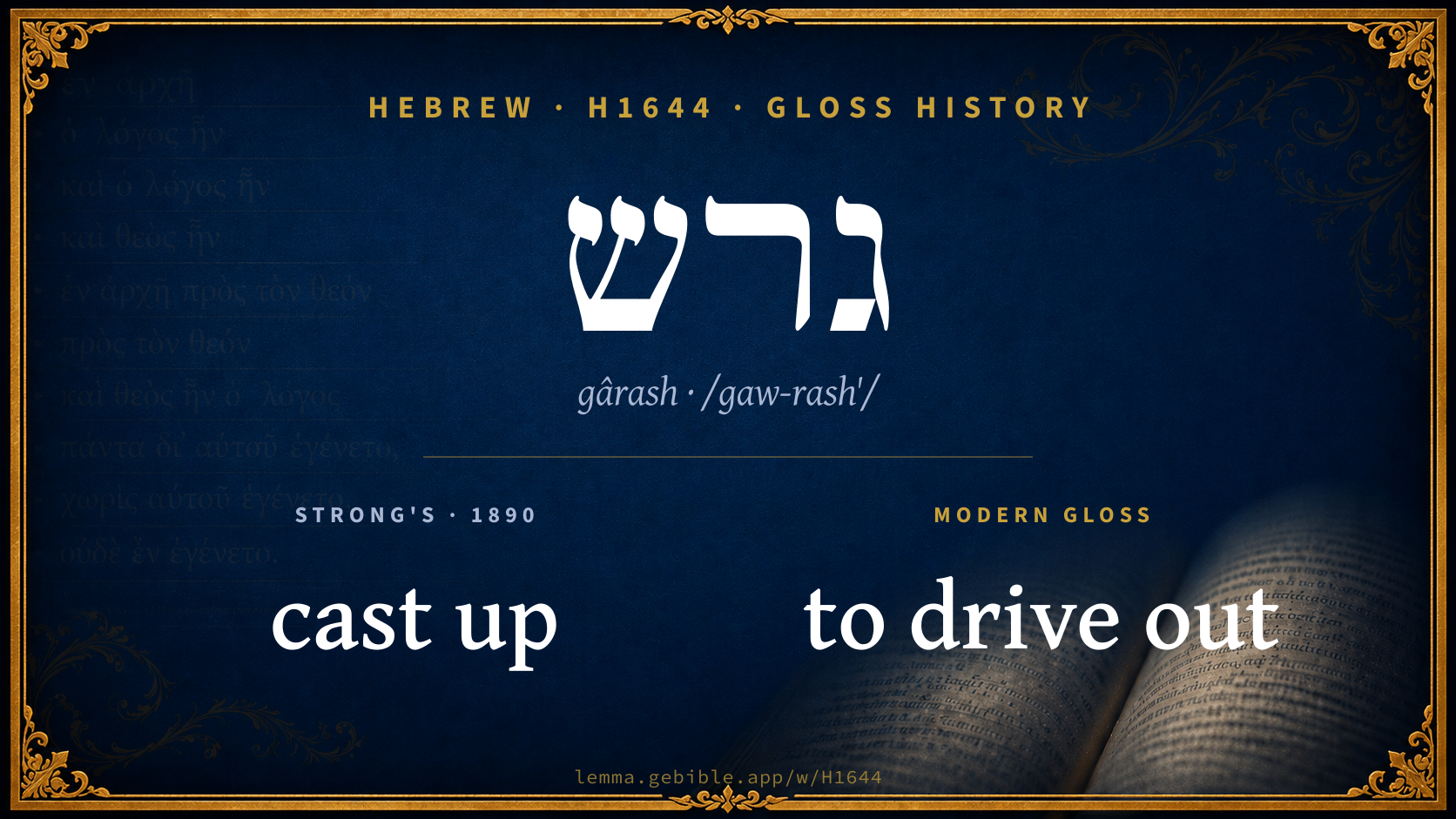
Gloss history
Strong's 1890 vs modern scholarship
About this word
Strong's H1644 catalogs a Hebrew word from the Hebrew Old Testament.
These counts are not copied from any lexicon or concordance. They are computed here, from the morphology-tagged Hebrew Old Testament. What Lemma adds →
- 45
- distinct verses
- The word appears in 45 distinct verses.
- 21 / 39
- OT books
- The word appears in 21 of 39 Old Testament books.
- #783
- by frequency
- Top 1000 most frequent Hebrew words (rank 783 of 8,640 Hebrew words by occurrence).
View all 45 occurrences in the concordance →
By section of the Old Testament
By traditional corpus
Conventional, traditional groupings — biblical authorship is debated, so this is a traditional corpus grouping, not an authorship claim. Each share is this word’s portion of its verses in that division of the Hebrew canon. Each figure is a share of the word’s 45 distinct verses.
- Torah (Pentateuch) 21 verses · 47%
- Prophets (Nevi'im) 17 verses · 38%
- Writings (Ketuvim) 7 verses · 16%
How translations render this word
Counts come from each version’s own published word-to-Strong’s tagging or interlinear alignment — an approximate guide to how each version renders this word, not a word-level alignment the data otherwise carries. Because each total is that version’s own tagged count, the per-version totals vary from one another and need not match the appearance or distinct-verse counts above. These counts may also differ from a printed concordance because Lemma counts each distinctly tagged rendering and does not collapse phrase taggings into a single head-word total. This is a fixed set of word-tagged versions (KJV, ASV, BSB, ULT) and does not change with the reading translation you choose elsewhere. Each version’s license is shown beside its name below (and on Sources).
- King James Version: Cast out 2×, I will drive them out 2×, I will not drive them out 2×
- American Standard Version: Behold 2×, Cast out 2×, Drove out 2×
- Berean Standard Bible: Drive out 2×, Drive them out 2×, Drove out 2×
- unfoldingWord Literal Text: Out 4×, And 3×, Dispossessed 2×
King James Version Public Domain
Renders H1644 across 47 tagged occurrences — most commonly:
Plus 39 renderings that appear only once — usually multi-word phrases or single function words the recovered tagging swept in, not distinct renderings.
American Standard Version Public Domain
Renders H1644 across 46 tagged occurrences — most commonly:
Plus 28 renderings that appear only once — usually multi-word phrases or single function words the recovered tagging swept in, not distinct renderings.
Berean Standard Bible Public Domain
Renders H1644 across 46 tagged occurrences — most commonly:
Plus 36 renderings that appear only once — usually multi-word phrases or single function words the recovered tagging swept in, not distinct renderings. Not rendered by a distinct English word in 1 further occurrence.
unfoldingWord Literal Text CC BY-SA 4.0
Renders H1644 across 62 tagged occurrences — most commonly:
Plus 43 renderings that appear only once — usually multi-word phrases or single function words the recovered tagging swept in, not distinct renderings.
Senses in the full BDB
Hebrew verbs can shift meaning by stem (binyan): Qal is the basic action, Niphal is often passive or reflexive, Piel often intensifies or makes it factitive, and Hiphil is typically causative. The senses below are grouped under the stem BDB assigns to each. This entry also uses Pual (the passive of Piel).
What do BDB’s symbols mean?
BDB uses these scholarly abbreviations:
| Symbol | Meaning |
|---|---|
| 𝔊 | the Septuagint (the ancient Greek translation, LXX) |
| 𝔙 | the Vulgate (the Latin translation) |
| 𝔖 | the Syriac version (the Peshitta) |
| 𝔗 | the Targum (the Aramaic translation) |
| ψ | the Psalms |
| √ | root (the underlying root or stem) |
| ‖ | parallel passage (a synonymous or contrasted parallel) |
| † | the dagger: every passage where the word occurs is cited |
The 4 senses and sub-senses the full Brown-Driver-Briggs lexicon distinguishes for this word, in lexicon order (not ranked by frequency), with BDB’s own verbatim wording and sub-sense lettering. Shown in Hebrew script with BDB’s own scholarly abbreviations. The condensed entry is in the Lexicon Entry tab. See also the Forms in the corpus table below.
Qal
- Impf. וַיִּגְרְשׁוּ Is 57:20; Inf. sf. מִגְרָשָׁהּ Ez 36:5 infr.; Pt. act. גֹּרֵשׁ Ex 34:11; pass. f. גְּרוּשָׁה Lv 21:7 + 4 times;—cast out, thrust out, י׳, the Amorites Ex 34:11 (JE; c. מִפְּנֵי); waters, mire and dirt רֶפֶשׁ וָטִיט Is 57:20; pass. only of divorced woman Lv 21:7 (sq. מֵאִישָׁהּ; elsewhere with אַלְמָנָה widow), v 14 22:13 (all H), Nu 30:10 (P) Ez 44:22. On מִגְרָשָׁהּ Ez 36:5 as Aramaic Inf. cf. Ges§ 45 e Köf. 166; Co del., on intern. grounds, cf. 𝔊. e.g. Isaiah 57:20
Niphal
- Pf. נִגְרָ֑שׁ Is 57:20; 3 fs. וְנִגְרְשָׁה consec. Am. 8:8; נִגְרַשְׁתִּי Jon 2:5;—be driven away, sq. מִנֶּגֶד עֵינֶיךָ, i.e. from the presence of Yahweh Jon 2:5; be driven, tossed, as the Nile Am 8:8; of the sea Is 57:20 rel. cl., אֲשֶׁר om., like the sea that is tossed. e.g. Isaiah 57:20
Piel
- Pf. 3 fs. וְגֵרְשָׁה consec. Ex 23:28; גֵּרַשְׁתָּ Gn 4:14, sf. 3 mpl. וְגֵרַשְׁתָּמוֹ consec. Ex 23:31; וְגֵרַשְׁתִּ֫י Ex 33:2, sf. גֵּרַשְׁתִּיהוּ Ez 31:11 (so 𝔗 𝔙, not 𝔊; cf. Co’s conj.); וְגֵּרַשְׁתִּיו consec. Nu 22:11; 3 pl. sf. גֵּרְשׁוּנִי 1 S 26:19 Impf. יְגָרֵשׁ Ex 11:1, וַיְגָ֫רֶשׁ Gn 3:24 + 6 times; sf. וַיְגָרֲשֵׁהוּ ψ 34:1, יְגָֽרֲשֵׁם Ex 6:1; 2 ms. תְּגָרֵשׁ ψ 80:9, וַתְּגָ֫רֶשׁ Jos 24:12; אֲגָרֵשׁ Ju 2:3, וָֽאֲגָרֵשׁ Ju 6:9; sf. 3 ms. אֲגָֽרְשֶׁנּוּ Ex 23:29, 30; Nu 22:6; אֲגָֽרֲשֵׁם Ho 9:15; וַיְגָֽרֲשׁוּ Ju 11:2; יְגָֽרֲשׁוּהָ Zp 2:4, וַיְגָֽרֲשׁוּם Ex 2:17; 2 mpl. תְּגָֽרֲשׁוּן Mi 2:9, וַתְּגָֽרֲשׁוּנִי Ju 11:7; Inf. cstr. לְגָרֵשׁ 1 Ch 17:21 + ‖ 2 S 7:23 Gei We Dr, for MT לארצך; לְגָֽרֲשֵׁנוּ 2 Ch 20:11; abs. id. Ex 11:1; Imv. גָּרֵשׁ Gn 21:10 Pr 22:10;—drive out, away, Hex all JE, incl. poem Dt 33; (י׳ subj.), Adam from garden Gn 3:24 cf. Cain Gn 4:14 (sq. מִן loc., & so 21 times), David (men subj.) 1 S 26:19, id. (Abimelech subj.) ψ 34:1 (title), Hagar (Abr. subj.) Gn 21:10 cf. scorner, Pr 22:10 daughters of Reuel (subj. shepherds) Ex 2:17; Moses and Aaron from Pharaoh’s presence (indef. subj.) Ex 10:11; Gaal etc. (subj. Zebul) Ju 9:41 (sq. מִן c. Inf.), Jephthah (Gil. subj.) Ju 11:2, 7; Abiathar (subj. Sol.) 1 K 2:27 (sq. מִן c. Inf.) wicked from temple (י׳ subj.) Ho 9:15; women from houses (nobles subj.) Mi 2:9; often of Canaanites (hornet subj.) Ex 23:28; Jos 24:12 cf. Ex 23:31 (Israel subj.); also (י׳ subj.; cf. MI19) Ex 23:29, 30; 33:2; Dt 33:27 Jos 24:18; Ju 2:3; 6:9 ψ 78:55; 80:9; 1 Ch 17:21; of Israel from Egypt (subj. Pharaoh) Ex 6:1; 11:1(×2); from land of Moab (subj. Balak) Nu 22:6, 11; Judah from Canaan (subj. Moab & Ammon) 2 Ch 20:11; Egypt from her land (י׳ subj.) Ez 31:11 (but cf. text, supr.); Ashdod (indef. subj.) Zp 2:4. e.g. Exodus 23:28
Pual
- Pf. גֹּרְשׁוּ subj. Israelites Ex 12:39; Impf. יְגֹרָ֑שׁוּ subj. despised and miserable outcasts Jb 30:5 both sq. מִן loc. e.g. Exodus 12:39
Senses from the full Brown-Driver-Briggs lexicon (Brown, Driver, Briggs; Oxford 1906 — public domain), digitized via Sefaria, supplemented by the OpenScriptures HebrewLexicon (CC BY 4.0). Full attribution on Sources.
Word origin
vb. drive out, cast out (NH id., Aramaic גְּרַשׁ Pa. Ithp. of divorce, MI19 ויגרשה)—
— Brown-Driver-Briggs (Oxford 1906, public domain), digitized via Sefaria, supplemented by the OpenScriptures HebrewLexicon (CC BY 4.0). See Sources.
Origin: a primitive root
Jastrow Dictionary
A second Hebrew/Aramaic lexicon for comparison, covering Aramaic and post-biblical (Talmudic, Targumic, Midrashic) usage that the biblical-Hebrew BDB does not. Matched by lemma rather than by Strong’s number, so a lemma may carry more than one Jastrow headword (shown separately below), and the entries cover usage well beyond the Bible.
גָּרַשׁ
- (b. h.)
- 1. to stir up, to set in commotion. Sifré Deut. 39; Yalk. ib. 859 יכול יהו מים גּוֹרְשִׁין את העפר ממקום בקעה וכ׳ you might suppose the (rain) water will stir up the (fat) ground of the valley, and thus the valley will lack (drinking) water.
- 2. (cmp. טָרַד) to banish; to send off, divorce (a wife).—Part. pass. גָּרוּשׁ, f. גְּרוּשָׁה q. v.
- to send off, banish. Gen. R. s. 21.—Esp. to give a letter of divorce. Gitt. IX, 1 הַמְּגָרֵשׁ וכ׳ if one divorces his wife and says, on handing her the letter, &c.; a. v. fr.—Ib. VI, 5 if one says (to his delegates) … גָּרְשׁוּהָ ga’rshuha, they are authorized to write and deliver to her a letter of divorce (geresh being the colloquial term for divorcing).
- to be banished, &c. Pirké d’R. El. ch. XIX; XX ג׳ ויצא וכ׳ he was banished and he left paradise.—Part. מְגוּרָשׁ, f. מְגוּרֶשֶׁת. Gitt. VII, 4 מג׳ ואינה מג׳ she is and is not divorced, i.e. her divorce is doubtful, and she has to suffer the disqualifications of a married and of a divorced woman. Ib. 5; a. v. fr.
- 1. to be banished; to be divorced. Midr. Till. to Ps. XCII. Gitt. 65ᵃ מִתְגָּרֶשֶׁת בקידושי וכ׳ she is entitled to receive a letter of divorce for herself even though her father had contracted the marriage in her behalf; a. v. fr. [
- 2. to be stirred up, become muddy, thick. Midr. d’R. Akiba, Alef (Jellinek Beth Hammidrash III, 13).]
גְּרַשׁ I
- Pa. גָּרֵישׁ. Pes. 110ᵇ דגָרְשָׁהּ לאיתתיה Ms. M. (ed. דגרשא, corr. acc.) who had divorced his wife. Ber. 56ᵃ תרי נשי מְגָרְשׁת it will be thy destiny to divorce two wives. Arakh. 23ᵃ דלִיגָרֵש לדביתהו that he should divorce &c. Ib. אטו כל דמִגָרֵשׁ וכ׳ does every one who divorces his wife, give divorce in court?; a. fr.
- , infin. אִיגְּרוּשֵׁי to be divorced. Gitt. 78ᵃ בת אי׳ in a fit condition to receive a letter of divorce.
*גְּרַשׁ II
- (cmp. גרר to drag) to hoist up. Y. Kil. IX, 32ᶜ top. Y. Keth. XII, 35ᵇ top [read:] ואין עניית אתון גרשין לי and if I call, ye will hoist me up; (Koh. R. to IX, 10 שרר; Mat. K. quotes גדש, v. גְּדַשׁ II).
גֶּרֶשׂ
- v. גָּרִיס) grits. Sifra Vayikra, N’dabah, ch. XIV, Par. 13 אפשר יקלנו ג׳ I might think he must roast it after being pounded; Men. 66ᵇ
A Dictionary of the Targumim, the Talmud Babli and Yerushalmi, and the Midrashic Literature (Marcus Jastrow; London, Luzac, 1903) — Public Domain. Digitized via Sefaria. Digitized via Sefaria. Full attribution on Sources.
Forms in the corpus
The 44 distinct written forms H1644 takes in the Hebrew Bible, most frequent first — each parse links to that stem’s occurrences in the concordance. Hebrew forms include their vowel points and cantillation, so a single lemma takes many written forms.
Same root — word family
Other BDB entries built from the same root as H1644, grouped by Strong’s listed origin. These share a root / origin per the lexicon — not necessarily a shared meaning. Each links to that word’s own entry.
Derived from this word
Proper names from this root
People and places named from this root — a name, not an additional meaning of the word.
Compare all same-root words → Showing 4 of 5 — not the complete family. 1 of the same-root words is a proper name (a person or place). They share a root, not necessarily a meaning.
Septuagint verse parallels
This word appears in 44 verses that also exist in the Greek Old Testament (Septuagint), out of the 45 Hebrew verses it occurs in. You can read those verses in Greek by switching the Old Testament edition to the Septuagint.
Read these verses in the Septuagint
- Genesis 3:24
- Exodus 2:17
- Leviticus 21:7
- Numbers 22:6
- Deuteronomy 33:27
- Joshua 24:12
- Judges 2:3
- 1 Samuel 26:19
- 1 Kings 2:27
- 1 Chronicles 17:21
- 2 Chronicles 20:11
- Job 30:5
This is a verse-level parallel only — the same verses exist in both the Hebrew and Greek Old Testaments. No word-level Hebrew↔Greek correspondence is claimed: the data carries no such alignment, so no Greek word is shown as this Hebrew word’s translation. Coverage is not total — the Septuagint omits the deuterocanon and renumbers the Psalms, so some Hebrew verses have no direct Greek parallel.