Micah 2:9

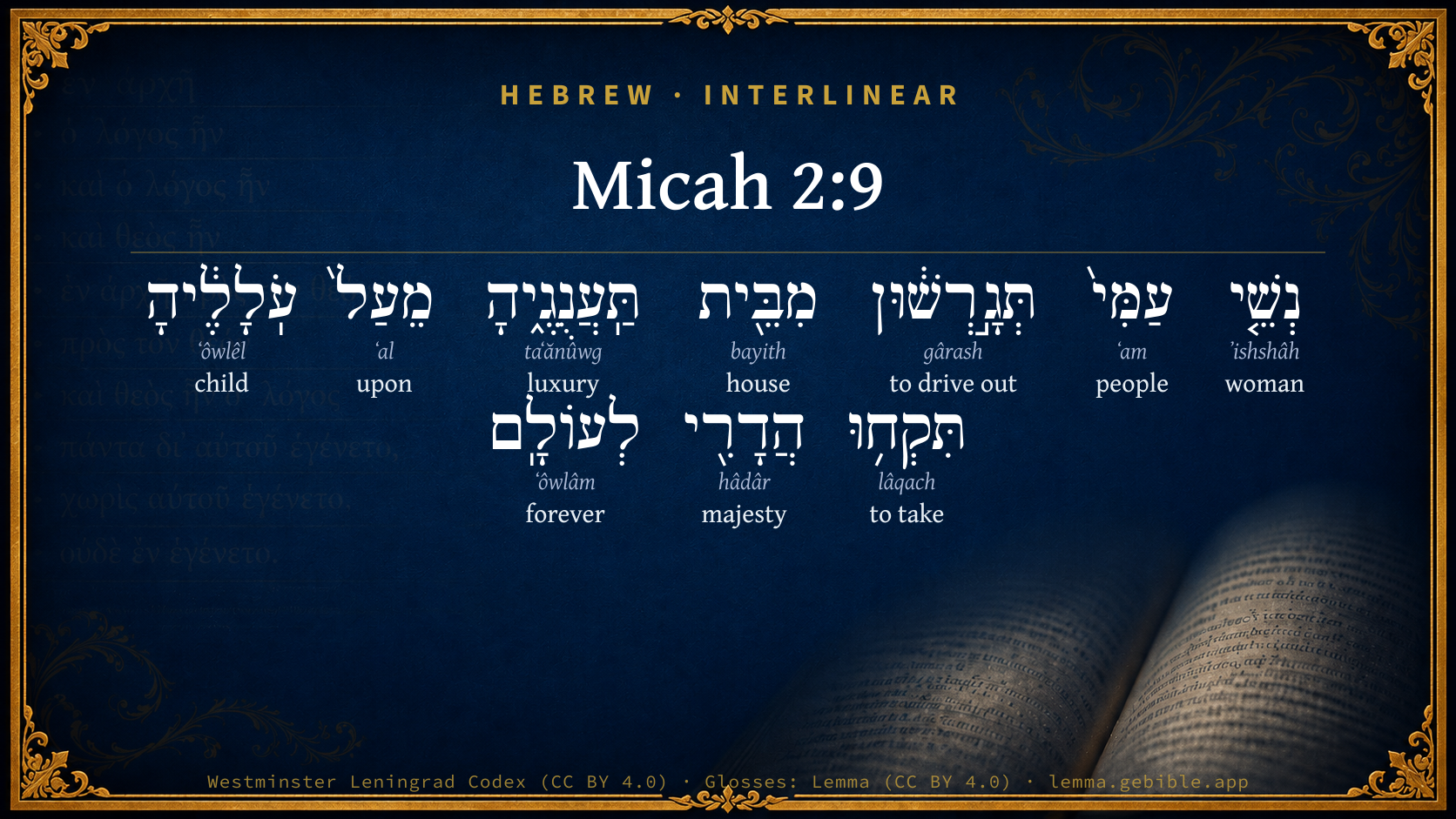
Hebrew (Westminster Leningrad Codex) Micah 2:9 appears in the Hebrew Old Testament. The text above is from the Westminster Leningrad Codex. Each word links to its Strong’s number, a concise gloss, and parsing drawn from the Open Scriptures Hebrew Bible morphology. Click any word for its full Brown-Driver-Briggs (BDB) entry.
Download image
Cite this verse

Micah 2:9 (World English Bible). Public Domain. Lemma interlinear Bible study tool, https://lemma.gebible.app/v/micah/2/9.

Show BibTeX & RIS
BibTeX
RIS
English Translation
You drive the women of my people out from their pleasant houses; From their young children you take away my blessing forever.
World English Bible · Public Domain
Download a study sheet

One document with this verse’s original text, its word-by-word gloss line, the meaning frame, cross-references with their text, attributed commentary, and full source and license credits — printable, and it pastes into notes with its structure intact.

This verse Autodidact and up

Study sheet (.html) Plain text (.txt)

A passage Seminary Student

Up to 50 verses in one chapter. A passage sheet keeps up to 6 commentary sources and 12 cross-references per verse, in the order this page ranks them, and says so on the sheet whenever that leaves anything out. Ask for a single verse and you get the Autodidact verse sheet above.

Everything on this page stays free to read, with no account — the sheet is a download of what is already on screen, not access to it.

Want to remove ads? Support Godless Engineer
Compare translations 3

The same verse in 3 English versions, stacked beneath the original-language interlinear above. Click any original word for its lexicon entry.

Each is an independent rendering of the whole verse — the interlinear is not word-aligned to these translations.

Highlighted words mark where these versions differ — a whole-verse word diff, not a word-by-word alignment.

  • World English Bible Public Domain
    You drive the women of my people out from their pleasant houses; From their young children you take away my blessing forever.
  • King James Version Public Domain
    The women of my people have ye cast out from their pleasant houses; from their children have ye taken away my glory for ever.
  • unfoldingWord Literal Text CC BY-SA 4.0
    The women of my people you drive out from the house of her delights; from upon her infants you take away my splendor forever.

unfoldingWord Literal Text — © unfoldingWord, licensed CC BY-SA 4.0. Word-aligned USFM3 via Door43 (git.door43.org/unfoldingWord/en_ult).

Versions to compare (up to 4)

3 of 4 selected

Show all 18 translations

Every available English version of this verse, each an independent rendering of the whole verse.

  • World English Bible Public Domain
    You drive the women of my people out from their pleasant houses; From their young children you take away my blessing forever.
  • Berean Standard Bible Public Domain
    You drive the women of My people from their pleasant homes. You take away My blessing from their children forever.
  • Majority Standard Bible Public Domain
    You drive the women of My people from their pleasant homes. You take away My blessing from their children forever.
  • King James Version Public Domain
    The women of my people have ye cast out from their pleasant houses; from their children have ye taken away my glory for ever.
  • American Standard Version (1901) Public Domain
    The women of my people ye cast out from their pleasant houses; from their young children ye take away my glory for ever.
  • Revised Version (1885) Public Domain
    The women of my people ye cast out from their pleasant houses; from their young children ye take away my glory for ever.
  • Geneva Bible (1599) Public Domain
    The women of my people haue ye cast out from their pleasant houses, and from their childre haue ye taken away my glorie continually.
  • Douay-Rheims (1899) Public Domain
    You have cast out the women of my people from their houses, in which they took delight: you have taken my praise for ever from their children.
  • Young's Literal Translation Public Domain
    The women of My people ye cast out from its delightful house, From its sucklings ye take away My honour to the age.
  • Literal Standard Version CC BY-SA 4.0
    The women of My people you cast out from its delightful house, || From its sucklings you take away My honor for all time.
  • Unlocked Literal Bible CC BY-SA 4.0
    You drive the women belonging to my people from their pleasant houses; you take my blessing from their young children forever.
  • unfoldingWord Literal Text CC BY-SA 4.0
    The women of my people you drive out from the house of her delights; from upon her infants you take away my splendor forever.
  • Darby Bible Public Domain
    The women of my people do ye cast out from their pleasant houses; from their young children do ye take away my magnificence for ever.
  • World Messianic Bible Public Domain
    You drive the women of my people out from their pleasant houses; from their young children you take away my blessing forever.
  • Webster's Bible Public Domain
    The women of my people have ye cast out from their pleasant houses; from their children have ye taken away my glory for ever.
  • Free Bible Version CC BY-SA 4.0
    You drive the women of my people from their comfortable homes; you have robbed their children of my blessings forever.
  • Bible in Basic English Public Domain
    The women of my people you have been driving away from their dearly loved children; from their young ones you are taking my glory for ever.
  • JPS Tanakh (1917) Public Domain
    The women of My people ye cast out from their pleasant houses; from their young children ye take away My glory for ever.

Literal Standard Version (2020), Covenant Press — licensed CC BY-SA 4.0. Text via the HelloAO Bible API (eBible.org). Unlocked Literal Bible (unfoldingWord) — licensed CC BY-SA 4.0. Text via the HelloAO Bible API (eBible.org). unfoldingWord Literal Text — © unfoldingWord, licensed CC BY-SA 4.0. Word-aligned USFM3 via Door43 (git.door43.org/unfoldingWord/en_ult). Free Bible Version, Dr. Jonathan Gallagher — licensed CC BY-SA 4.0. Text via the HelloAO Bible API (eBible.org).

Word by word

More ways to search: Search by grammar → Find every occurrence → Compare this word →

Practice this passage: Drill this verse → Learn its vocabulary →

תַּֽעֲנֻגֶ֑יהָ
taʻănûwg
H8588
“luxuries · her”
Noun, Common, Masculine, Plural, Construct + Suffix, Personal, 3rd Person, Feminine, Singular
Part of Speech
Noun
Type
Common
Gender
Masculine
Number
Plural
State
Construct
Full BDB Definition

Origin: from H6026

TWOT: 1648c

daintiness, luxury, exquisite delight, pleasantness, delight, comfort - luxury - dainty - delight
  1. נְשֵׁ֤י ʼishshâh H802 “women of” Noun, Common, Feminine, Plural, Construct
  2. עַמִּי֙ ʻam H5971 “people · my” Noun, Common, Masculine, Singular, Construct + Suffix, Personal, 1st Person, Common, Singular
  3. תְּגָ֣רְשׁ֔וּן gârash H1644 “to drive out” Verb, Piel, Imperfect, 2nd Person, Masculine, Plural + Suffix, n
  4. מִבֵּ֖ית bayith H1004 “from · house of” Preposition + Noun, Common, Masculine, Singular, Construct
  5. מֵעַל֙ ʻal H5921 “from · upon” Preposition + Preposition
  6. עֹֽלָלֶ֔יהָ ʻôwlêl H5768 “children · her” Noun, Common, Masculine, Plural, Construct + Suffix, Personal, 3rd Person, Feminine, Singular
  7. תִּקְח֥וּ lâqach H3947 “to take” Verb, Qal, Imperfect, 2nd Person, Masculine, Plural
  8. הֲדָרִ֖י hâdâr H1926 “majesty · my” Noun, Common, Masculine, Singular, Construct + Suffix, Personal, 1st Person, Common, Singular
  9. לְעוֹלָֽם ʻôwlâm H5769 “to/for · forever” Preposition + Noun, Common, Masculine, Singular, Absolute

About this verse

These counts appear in no published source. They are computed here, from the morphology-tagged text and Lemma’s own curated glosses. What Lemma adds →

10
words
10
distinct lemmas
Prophets
section

Notable vocabulary

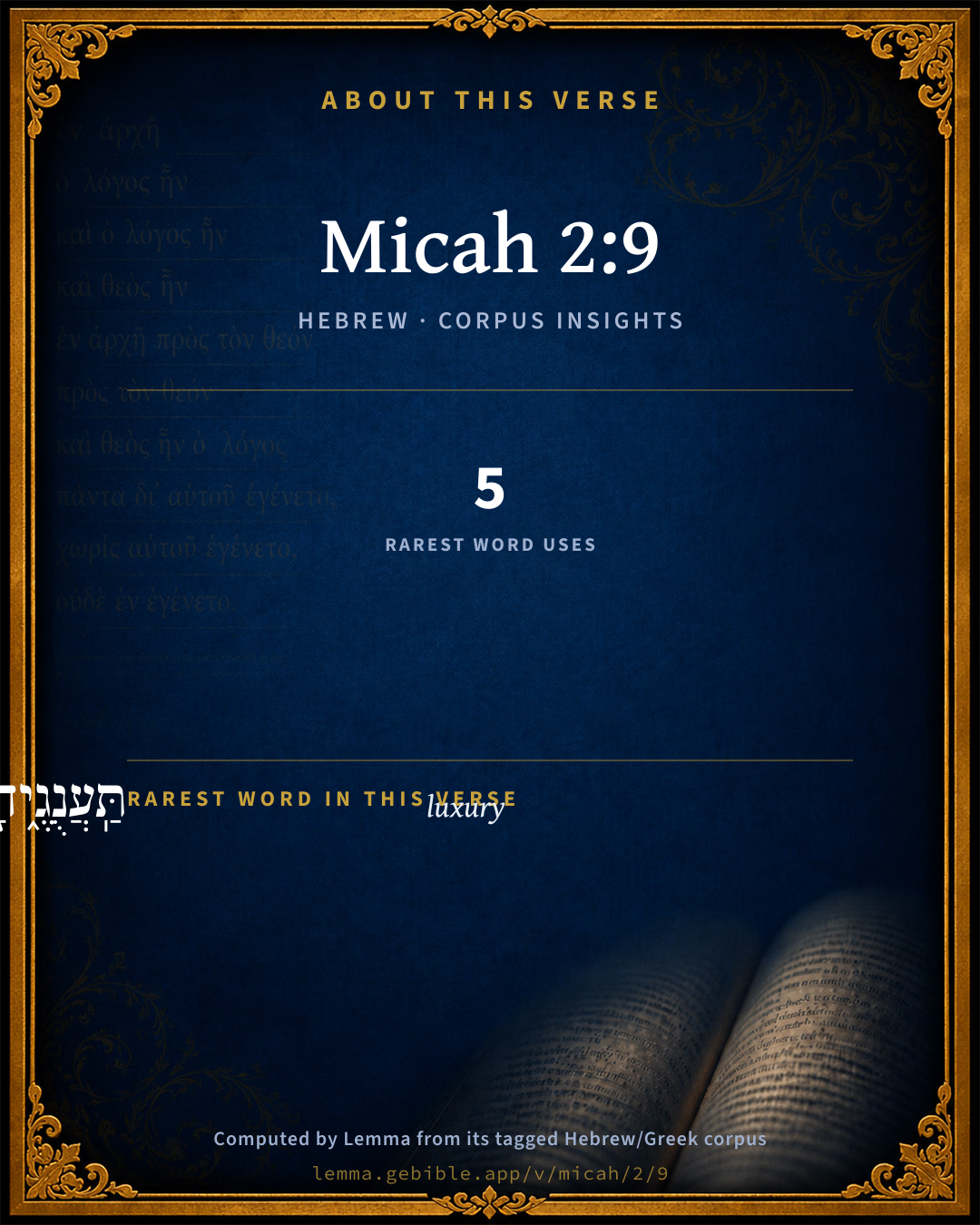
The rarest word here is תַּֽעֲנֻגֶ֑יהָ luxury H8588 — appearing just 5 times in the whole Hebrew Bible.

Shared distinctive vocabulary

תַּֽעֲנֻגֶ֑יהָ luxury H8588 occurs in 5 verses of the Hebrew Bible. Also found in:

Grammatical profile

  • 2 verbs
  • 7 nouns
  • 1 preposition

Verb forms

  • תְּגָ֣רְשׁ֔וּן Piel · Imperfect
  • תִּקְח֥וּ Qal · Imperfect

Hebrew & Septuagint length

In English translation the verse runs 22 words from the Hebrew and 28 from the Septuagint (LXX English) — closely comparable.

A rough comparison of the two English renderings, which tokenize alike — not a word-level alignment.

Word counts can differ between the Hebrew and the Greek without any difference in meaning — e.g. the Hebrew direct-object marker אֵת has no separate Greek word, and Greek often adds the article ὁ.

Cross-references

13

Topical passages linked to Micah 2:9 in the Treasury of Scripture Knowledge — connected by theme and wording, ordered by reader-vote popularity; previews shown in the World English Bible.

  • Ezekiel 39:21 I will set my glory among the nations; and all the nations shall see my judgment that I have executed, and my hand that I have laid on them.
  • Habakkuk 2:14 For the earth will be filled with the knowledge of the glory of Yahweh, as the waters cover the sea.
  • Luke 20:47 who devour widows' houses, and for a pretense make long prayers: these will receive greater condemnation."
  • 1 Samuel 26:19 Now therefore, please let my lord the king hear the words of his servant. If it be Yahweh that has stirred you up against me, let him accept an offering: but if it be the children of men, cursed be they before Yahweh: for they have driven me out this day that I shouldn't cling to Yahweh's inheritance, saying, Go, serve other gods.
  • Psalms 72:19 Blessed be his glorious name forever! Let the whole earth be filled with his glory! Amen and amen.
  • Jeremiah 10:20 My tent is destroyed, and all my cords are broken: my children are gone forth from me, and they are no more: there is none to spread my tent any more, and to set up my curtains.
  • Joel 3:6 And have sold the children of Judah and the children of Jerusalem to the sons of the Greeks, That you may remove them far from their border.
  • Micah 2:2 They covet fields, and seize them; And houses, and take them away: And they oppress a man and his house, Even a man and his heritage.
  • Zechariah 2:5 For I,' says Yahweh, 'will be to her a wall of fire around it, and I will be the glory in the midst of her.
  • Matthew 23:13 "Woe to you, scribes and Pharisees, hypocrites! For you devour widows' houses, and as a pretense you make long prayers. Therefore you will receive greater condemnation.
  • Mark 12:40 those who devour widows' houses, and for a pretense make long prayers. These will receive greater condemnation."
  • 2 Corinthians 3:18 But we all, with unveiled face beholding as in a mirror the glory of the Lord, are transformed into the same image from glory to glory, even as from the Lord, the Spirit.
  • 2 Corinthians 4:6 seeing it is God who said, "Light will shine out of darkness," who has shone in our hearts, to give the light of the knowledge of the glory of God in the face of Jesus Christ.

Cross-references courtesy of OpenBible.info (CC BY 4.0).

Hebrew and Greek witnesses Masoretic Hebrew ↔ Greek Septuagint

The same verse in the two great witnesses to the Old Testament, shown verse-for-verse.

These are two independent witnesses, not word-aligned to each other, and the Septuagint is shown in lemma (dictionary) form.

Hebrew Micah 2:9 Masoretic · Westminster Leningrad Codex

נְשֵׁ֤י עַמִּי֙ תְּגָ֣רְשׁ֔וּן מִבֵּ֖ית תַּֽעֲנֻגֶ֑יהָ מֵעַל֙ עֹֽלָלֶ֔יהָ תִּקְח֥וּ הֲדָרִ֖י לְעוֹלָֽם

You drive the women of my people out from their pleasant houses; From their young children you take away my blessing forever.

World English Bible · Public Domain

Greek LXX Micah 2:9 Septuagint · lemma form

διά οὗτος ἡγέομαι λαός ἐγώ ἀποῥίπτω ἐκ ὁ οἰκία τρυφή αὐτός διά ὁ πονηρός ἐπιτήδευμα αὐτός ἐκὠθέω ἐγγίζω ὄρος αἰώνιος

The leaders of my people shall be cast forth from their luxurious houses; they are rejected because of their evil practices; draw you⌃ near to the everlasting mountains.

LXX2012 (modern English Septuagint) · Public Domain

On this verse, The Pulpit Commentary discusses the Septuagint’s reading. Read the note in Commentary ↓

Hebrew: Westminster Leningrad Codex (CC BY 4.0). Greek: Septuagint (public domain); English from LXX2012 (modern English Septuagint) (Public Domain). How the Septuagint differs from the Hebrew →

Targum (Aramaic paraphrase)

1

The Targum is the ancient Jewish Aramaic paraphrase of the Hebrew Scriptures — an interpretive translation, not the Hebrew text itself. Onkelos (literal) and Pseudo-Jonathan (expansive) render the Torah, and Jonathan the Prophets. Coverage is partial: where no permissively-licensed English translation exists for a verse, only the Aramaic is shown. This is verse-level text, not a word-by-word alignment to the Hebrew.

  1. Targum Jonathan Prophets (Joshua–Malachi)
    כְּנִישַׁת עַמִי תְּתָרְכוּן מִבֵּית חֶדְוַתְהוֹן מִנְהוֹן בְּנֵיהוֹן דָבְרִין גְלָא יְקָרְהוֹן דַהֲווֹ אָמְרִין קְיַם לְעָלְמִין:

    (no public-domain English translation for this verse)

    Targum Jonathan — Aramaic: “Mikraot Gedolot” (public domain). English: “Sefaria Community Translation” (CC0 1.0 (public-domain dedication)); “London "Chaldee Paraphrase," 1871” (public domain). Text via Sefaria.

Commentary

Notes on Micah 2:9 from classic Christian and Jewish commentators (each source and its license shown beneath its notes). The classic Christian expositions comment on the surrounding passage and are grouped to its opening verse, so a note may address several verses; the Jewish commentaries on the Tanakh (Rashi and others) are per-verse, so they appear only where the commentator wrote on this verse.

Lemma curates 59 commentaries, every one of them public domain or Creative Commons licensed, each selected and text-cleaned for this edition rather than reprinted as found. About our sources →

Trapp's Complete Commentary

John Trapp

Mic 2:9 The women of my people have ye cast out from their pleasant houses; from their children have ye taken away my glory for ever.

Ver. 9. The women of my people] Or, the wives; once wives, but now widows, and therefore calamitous, friendless, comfortless, as a vine whose root is uncovered, as a wandering bird, or a nest forsaken, Isa 16:2.

Have ye cast out from their pleasant houses] Where they had long lived with their husbands in love, peace, and much sweetness, as good Naboth’s wife had. This was barbarous cruelty. God had taken order in the law, that none should harm a bird sitting upon her own nest, how much less a daughter of Abraham! Widows and orphans are his clients, Psa 146:9.

From their children have ye taken away my glory] i.e. My maintenance and that livelihood that I had allowed them for their better education, which might have redounded to my great glory. Whereas now, being by you bereft both of friends and means, gemunt, fremunt, vobis maledicunt, clamantque vindictam in coelum, saith Montanus, they groan, they moan, they curse you, they cry to me for vengeance.

John Trapp, A Commentary or Exposition upon All the Books of the Old and New Testament (1647–1656) — public domain. Text from a community e-Sword module.

Geneva Bible (1599)

Geneva Bible translators

That is, their substance and living, which is God’s blessing, and as it were part of his glory.

Geneva Bible (1599) marginal notes — public domain. Text via Bolls.life.

Jamieson, Fausset & Brown

Robert Jamieson, A. R. Fausset & David Brown

The women of my people--that is, the widows of the men slain by you (Mic 2:2) ye cast out from their homes which had been their delight, and seize on them for yourselves.

from their children--that is, from the orphans of the widows.

taken away my glory--namely, their substance and raiment, which, being the fruit of God's blessing on the young, reflected God's glory. Thus Israel's crime was not merely robbery, but sacrilege. Their sex did not save the women, nor their age the children from violence.

for ever--There was no repentance. They persevered in sin. The pledged garment was to be restored to the poor before sunset (Exo 22:26-27); but these never restored their unlawful booty.

Jamieson, Fausset & Brown — Commentary Critical and Explanatory on the Whole Bible (1871) — public domain (CC PDM 1.0). Text via the HelloAO Bible API.

Adam Clarke's Commentary

Verse 9. The women of my people] Ye are the cause of the women and their children being carried into captivity-separated from their pleasant habitations, and from my temple and ordinances-and from the blessings of the covenant, which it is my glory to give, and theirs to receive. These two verses may probably relate to the war made on Ahaz by Rezin, king of Syria, and Pekah, king of Israel. They fell suddenly upon the Jews; killed in one day one hundred and twenty thousand, and took two hundred thousand captive; and carried away much spoil. Thus, they rose up against them as enemies, when there was peace between the two kingdoms; spoiled them of their goods, carried away men, women, and children, till, at the remonstrances of the prophet Oded, they were released. See 2Ch 28:6, &c. Micah lived in the days of Ahaz, and might have seen the barbarities which he here describes.

Adam Clarke's Commentary on the Bible (1810–1826) — public domain. Text from a community e-Sword/MySword module.

John Calvin's Commentaries

He proceeds with the same subject, that they refrained from no acts of injustice. It was indeed a proof of extreme barbarity not to spare women and children, for they are both weak and helpless. Their sex exempts women from violence, and their age, children. Even in wars, women, and also children, escape in safety. We hence see that the Prophet, by stating a part for the whole, proves here that the people had addicted themselves to cruelty really barbarous; they were not restrained from exercising it, no, not even on women and children. Since it was so, it follows, that their boast of being the chosen people was vain and fallacious.

House of delights he ascribes to the women who, being the weaker sex, prefer being at home and in the shade, rather than going abroad. The more necessary it was that their recesses should remain safe to them. Now, what was taken away from the children, God calls it his ornament; for his blessing, poured forth on children, is the mirror of his glory: he therefore condemns this plunder as a sacrilege. The word לעולם, laoulam, designates the continuance of their crimes, as though he had said, that they were cruel without ever showing any repentance. Now it follows —

John Calvin's Commentaries (1540-1563) — public domain. Text from the Calvin Translation Society English edition (1840s-50s) via the Christian Classics Ethereal Library (ccel.org). Calvin's coverage is partial (roughly two-thirds of the Bible); uncommented books and verses are honest gaps, never fabricated. The 19th-century editor's footnotes and remarks are omitted so the notes are faithfully Calvin's own voice.

Ellicott's Commentary for English Readers

(9) The women of my people.—They spared not even the widows and fatherless, the objects of God’s tender care.

A Bible Commentary for English Readers, edited by Charles John Ellicott (1878–1897) — public domain. Text from a community e-Sword module.

The Cambridge Bible for Schools and Colleges

gen. ed. J. J. S. Perowne

9. The women of my people] i.e. the unprotected widows. A similar complaint is made in Isaiah (Isa_10:2).

my glory] i.e. the privileges which every Israelite possessed as a member of God’s people. The prophet implies that the children of the widows have been sold into foreign slavery, which virtually annulled their glorious birthright. ‘How could they sing the Lord’s song in a strange land?’

The Cambridge Bible for Schools and Colleges (gen. ed. J. J. S. Perowne; Cambridge University Press, 1878–1918) — public domain. Text from a community e-Sword module.

John Gill's Exposition

The women of my people have ye cast out from their pleasant houses,.... Not content to slay their husbands, they took their wives or widows captive, dispossessed them of their habitations, where they had lived delightfully with their husbands and children; so we find that, at the time before referred to, the people of Israel carried captive of their brethren two hundred thousand women, and brought them to Samaria, Ch2 28:8. Some understand this of divorce, which those men were the cause of, either by committing adultery with them, which was a just reason for their husband's divorcing them; or by frequenting their houses, which caused suspicion and jealousy:

from their children have ye taken away my glory for ever; that which God would have had glory from, and they would have given it to him on account of; as their being brought up in a religious way; their liberties, both civil and religious; their paternal estates and inheritances, and the enjoyment of their own land; and especially the worship of God in the temple, of which they were deprived by being carried away from their own country: or it may be understood of the glory that accrues to God by honourable marriage, and the bed undefiled; and the dishonour cast upon him by the contrary, as well as upon children, who may be suspected to be illegitimate.

John Gill's Exposition of the Whole Bible (1746–1763) — public domain (CC PDM 1.0). Text via the HelloAO Bible API.

Albert Barnes' Notes on the Bible

The women of my people have ye cast out from their pleasant houses - (literally, from her pleasant house,) each from her home. These were probably the widows of those whom they had stripped. Since the houses were their’s, they were widows; and so their spoilers were at war with those whom God had committed to their special love, whom He had declared the objects of His own tender care, “the widows and the fatherless.” The widows they “drove vehemently forth”, as having no portion in the inheritance which God had given them, as God had driven out their enemies before them, each “from her pleasant house,” the home where she had lived with her husband and children in delight and joy.

From (off) their (young) children have ye taken away My glory - Primarily, the glory, comeliness, was the fitting apparel which God had given them (as Hos 2:11), and laid upon them , and which these oppressors stripped off from them. But it includes all the gifts of God, wherewith God would array them. Instead of the holy home of parental care, the children grew up in want and neglect, away from all the ordinances of God, it may be, in a strange land. “For ever.” They never repented, never made restitution; but so they incurred the special woe of those who ill-used the unprotected, the widow, and the fatherless. The words “forever” anticipate the punishment. The punishment is according to the sin. They never ceased their oppression. They, with the generation who should come after them, should be deprived of God’s “glory,” and cast out of His land forever.

Albert Barnes' Notes on the Bible (1834–1885) — public domain. Text from a community e-Sword/MySword module.

Haydock's Catholic Bible Commentary

Cast out, &c. Either by depriving them of their houses; or, by your crimes, giving occasion to their being carried away captives, and their children, by that means, never learning to praise the Lord. (Challoner) --- The Jews accustomed them to sing God’s praises early, while they were still innocent, Psalm viii. 2. Misery might cause them to complain of Providence. Perhaps the prophet alludes to the custom of divorces, Malachias ii. 15.

George Leo Haydock (1774–1849), Haydock's Catholic Family Bible and Commentary, 1859 edition — public domain. Excludes Psalms (Douay-Rheims chapter numbering differs from Protestant) and Deuterocanonical books (Catholic canon only).

Matthew Poole's English Annotations

The women; the poor disconsolate widows, whose husbands you had first slain with the sword of war, or unjustly condemned to death; or else the wives of husbands whom you had oppressed, and by perverted judgment had condemned to forfeit their estates.

Of my people: this aggravates the sin, that this was done against Israelitish women, not strangers, against those that were by peculiar provision of God’s law to be tenderly and mercifully dealt with, Exo 22:22.

Cast out; disseised, and turned out, as if unworthy to dwell longer in their old habitations, which they pretend forfeited, as Paradise by Adam, who was therefore in this very word east out, Gen 3:24, or as Hagar out of Abraham’s family, Gen 21:14.

Pleasant houses; either pleasant for situation, such seats were to these as dangerous as Naboth’s vineyard was to him, or else pleasant to them because they were their own, where they enjoyed their husbands and children, and wished no more preferment, content with their beloved habitation, and domestic conveniencies,

From their children have ye taken away; you have by your violence and oppression ruined their posterity, turned their children out of houses and estates, which were secured by the law of God from any legal alienation and sale beyond the jubilee; you have confiscated them for ever.

My glory; which was the glory of my bounty to them, in use of which they did give glory to me, and by continuance of which they might have lived above contempt.

For ever; either continually you have done this, or what you have done you intend to stand for ever.

Matthew Poole's English Annotations on the Holy Bible (1683–1685) — public domain. Text from a community e-Sword/MySword module.

The Pulpit Commentary

The women of my people. The prophet refers to the widows, who ought to have been protected and cared for. (comp. Isa_10:2) The LXX, with which the Arabic agrees, renders, hgoumenoi laou mou , "the leaders of my people." Have ye cast out. The word expresses a violent expulsion, as Gen_3:24. Their pleasant houses; literally, the house of their delights. (Mic_1:16) The house which was very dear to them, the scene of all their joys. My glory. All the privileges which they enjoyed as God"s people and his peculiar care are called "the ornament" of the Lord. (comp. Eze_16:14) The "glory" is by some commentators, but not so appositely, referred to vesture exclusively. These fatherless children had been ruthlessly stripped of their blessings either by being forced to grow up in want and ignorance, or by being sold into slavery and carried away from their old religious associations. Forever. The oppressors never repented or tried to make restitution; and so they incurred the special woe of those who injure the poor, the fatherless, and the widow (Pusey). The Septuagint has no connection with the present Hebrew text of this verse, reading, Eggisate oresin aiwnioiv , "Draw ye near to the everlasting hills," and previously introducing a gloss, Dia ta ponhra epithdeumata autwn exwsyhsan , "They were rejected because of their evil practices." Jerome explains the Greek mystically, despairing of the literal interpretation in its present connection.

The Pulpit Commentary (1880–1919), ed. H.D.M. Spence-Jones & Joseph S. Exell — public domain. Text from a community e-Sword module.

John Wesley's Explanatory Notes

The women - The widows. Of my people - Of Israelites, not strangers, that were by peculiar provision from God's law, to be tenderly dealt with, Exod. xxii, 22. Cast out - You have turned out of their old habitations. From their children - You have turned their children out of their houses, and estates, which were secured by the law of God from any sale beyond the jubilee; yet you have confiscated them forever. My glory - Which was the glory of my bounty to them.

John Wesley, Explanatory Notes Upon the Whole Bible (1754–1765) — public domain. Text via the GEBible commentary corpus.

unfoldingWord translationNotes

Door43 World Missions Community

General Information:

Yahweh continues speaking to the wicked rich people in Israel.

you take my blessing from their young children forever

This refers, in general, to blessings God has given to his people. It might refer to 1) being landowners in Israel, 2) a promising future or 3) to the children's fathers, farmers who worked hard to establish the nation.

my blessing

Micah speaks as if he were Yahweh.

it is destroyed with complete destruction

This can be translated in active form. AT: "I will completely destroy it" (See: Active or Passive)

comes to you ... will prophesy to you

Micah is speaking to the people of Judah, so both instances of "you" are plural. (See: Forms of You)

he would be considered

This can be translated in active form. AT: "the people would consider him" or "you would consider him" (See: Forms of You)

translationWords

cast out

people of God

bless

eternity

clean

spirit

prophet

wine

strong drink

unfoldingWord translationNotes — © Distant Shores Media and the Door43 World Missions Community, licensed CC BY-SA 4.0. Source: git.door43.org/Door43/en_tn.

Rashi

Rabbi Shlomo Yitzchaki (Rashi)

The wives of My people you drive away from the house of her delights—For you slay their husbands, and they sit as widows. Alternatively: since you take their husband’s money, and they (the husbands) sit and grieve and do not bring joy to their wives.

Rashi on the Tanakh — English translations: “The Judaica Press complete Tanach with Rashi, translated by A. J. Rosenberg” (CC BY 4.0); “Pentateuch with Rashi's commentary by M. Rosenbaum and A.M. Silbermann, 1929-1934” (public domain); “The Metsudah Tanach series, Lakewood, N.J” (CC BY 4.0); and “The Book of Joshua, Metsudah Publications, 1997” (CC BY 4.0). Text via Sefaria.

Lesson kit

Teaching starters — assembled from the data on this page, not authored interpretation. Every prompt links to the verse data it draws on. Edit before teaching.

Micah, in the Prophets, opens this verse with 10 words (10 distinct Hebrew lemmas). Its most distinctive word is taʻănûwg (“luxury”). A historical commentator’s framing appears above. Read the whole chapter for the surrounding context.

Discussion questions

  1. The word taʻănûwg carries the sense “luxury.” How does it shape the verse?
  2. How does Proverbs 19:10, which shares the word «luxury», read alongside this verse?
  3. These translations render this verse differently; the difference is in the English rendering, not the original. What questions does that raise?
  4. «תְּגָ֣רְשׁ֔וּן» is a Piel Imperfect verb. How does that grammatical form shape the action described?
  5. Compare how Trapp's Complete Commentary and Geneva Bible (1599) read this verse. Where do they agree or differ?

Things to notice

Reading settings

Reading text

Shown beneath each verse's original-language words.

Old Testament
Old Testament edition

Read the OT as the Masoretic Hebrew (MT) or the Greek Septuagint (LXX).

English shown for the Greek Septuagint (in the Hebrew ↔ Greek comparison).

Comparing translations? Open the Compare panel on any verse page to stack up to four side by side.