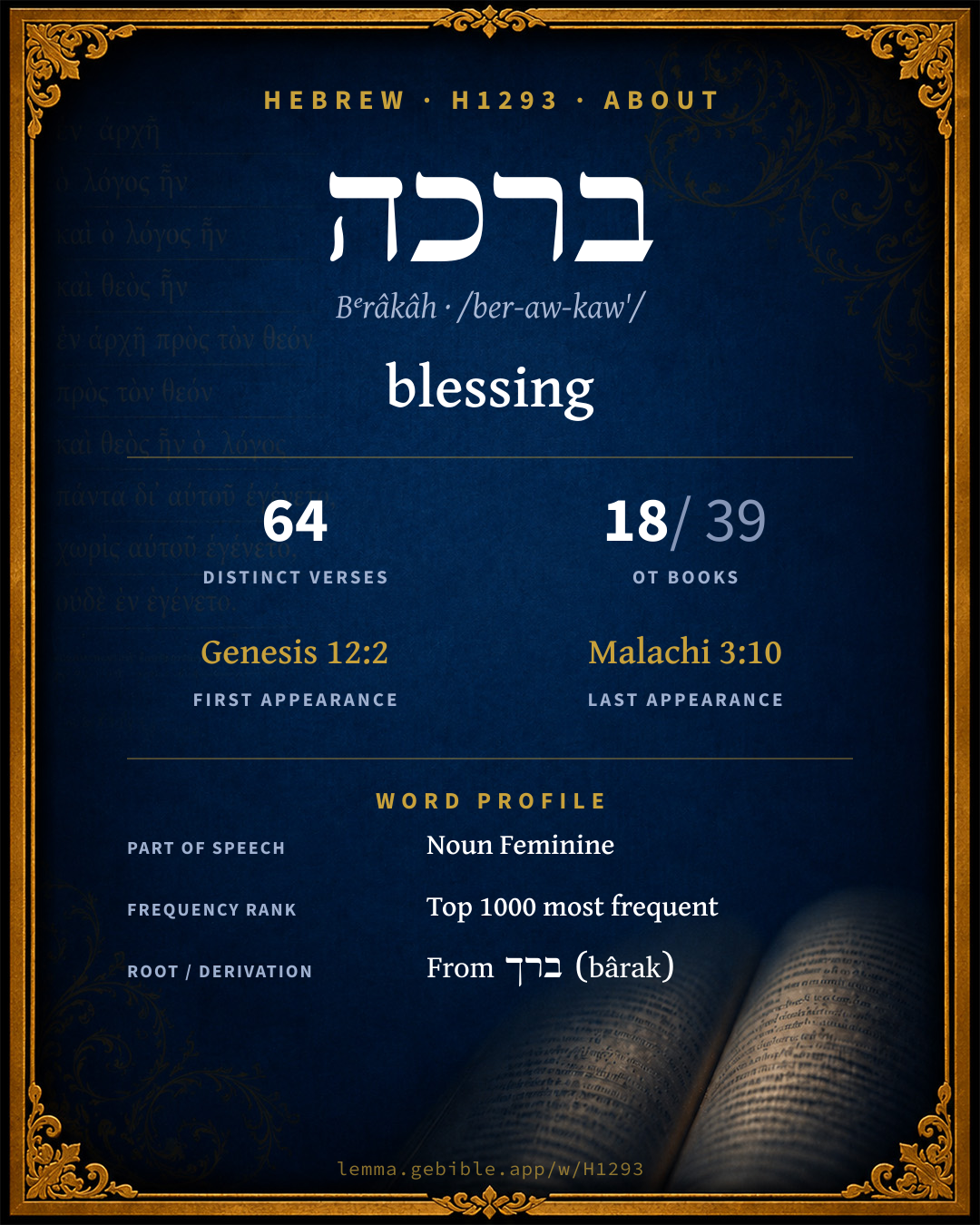
בְּרָכָה
blessing
‘blessing’ is one of 6 main senses fuller range ↓
Full lexicon entry — Brown-Driver-Briggs (BDB)
From Brown-Driver-Briggs (BDB)
Where this word appears
See every Construct-state word in the Hebrew Bible →
Grammar key — what these labels mean
Part of speech
- Noun
- A naming word — a person, place, thing, or idea.
Noun type
- Common
- A common noun — a general class of person, place, or thing (“king,” “city,” “water”), not a specific name.
State
- Absolute
- The independent form of a noun, not bound to a following word.
- Construct
- A noun bound to a following noun in a possessive / “of” relationship (the construct chain).
Gender
- Feminine
- Grammatically feminine.
Number
- Singular
- One.
- Plural
- More than one (in Hebrew, generally three or more).
Every verse where H1293 appears in the Book of Genesis — 12 distinct verses. Click any verse to open its interlinear word-by-word view. Verse text shown in the World English Bible for context — . Each verse’s Hebrew form is shown with its reference; the English is not keyword-highlighted, since the data carries no word-level English alignment. Use “Compare translations” on any verse to read it across multiple English versions. This concordance covers the Hebrew Bible; Septuagint (Greek Old Testament) occurrences are not indexed here.
Genesis
- Genesis 12:2 בְּרָכָֽה n c fs I will make of you a great nation. I will bless you, and make your name great. You will be a blessing.
- Genesis 27:12 בְרָכָֽה n c fs What if my father touches me? I will seem to him as a deceiver, and I would bring a curse on myself, and not a blessing."
- Genesis 27:35 בִּרְכָתֶֽ/ךָ n c fs cs + sfx pers 2ms He said, "Your brother came with deceit, and has taken away your blessing."
- Genesis 27:36 בִּרְכָתִ֑/י בְּרָכָֽה n c fs cs + sfx pers 1cs n c fs He said, "Isn't he rightly named Jacob? For he has supplanted me these two times. He took away my birthright. See, now he has taken away my blessing." He said, "Haven't you reserved a blessing for me?"
- Genesis 27:38 הַֽ/בְרָכָ֨ה ptcl inter + n c fs Esau said to his father, "Have you but one blessing, my father? Bless me, even me also, my father." Esau lifted up his voice, and wept.
- Genesis 27:41 הַ֨/בְּרָכָ֔ה ptcl def.art + n c fs Esau hated Jacob because of the blessing with which his father blessed him. Esau said in his heart, "The days of mourning for my father are at hand. Then I will kill my brother Jacob."
- Genesis 28:4 בִּרְכַּ֣ת n c fs cs and give you the blessing of Abraham, to you, and to your seed with you, that you may inherit the land where you travel, which God gave to Abraham."
- Genesis 33:11 בִּרְכָתִ/י֙ n c fs cs + sfx pers 1cs Please take the gift that I brought to you; because God has dealt graciously with me, and because I have enough." He urged him, and he took it.
- Genesis 39:5 בִּרְכַּ֤ת n c fs cs It happened from the time that he made him overseer in his house, and over all that he had, that Yahweh blessed the Egyptian's house for Joseph's sake; and the blessing of Yahweh was on all that he had, in the house and in the field.
- Genesis 49:25 בִּרְכֹ֤ת בִּרְכֹ֥ת בִּרְכֹ֥ת n c fp cs n c fp cs n c fp cs Even by the God of your father, who will help you, By the Almighty, who will bless you, With blessings of heaven above, Blessings of the deep that lies below, Blessings of the breasts, and of the womb.
- Genesis 49:26 בִּרְכֹ֣ת בִּרְכֹ֣ת n c fp cs n c fp cs The blessings of your father Have prevailed above the blessings of the ancient mountains, Above the bounty of the age-old hills. They will be on the head of Joseph, On the crown of the head of him who is separated from his brothers.
- Genesis 49:28 כְּ/בִרְכָת֖/וֹ prep + n c fs cs + sfx pers 3ms All these are the twelve tribes of Israel, and this is what their father spoke to them and blessed them. He blessed everyone according to his blessing.
About this entry
At a glance — auto-summarized from this page’s data, not written by a person. Every figure links to its source below. This summary describes the numbers; it doesn’t interpret them.
At its core, ברכה (Bᵉrâkâh) means “blessing.” Not a single-sense word: explore its full sense range. It appears 64 verses across 18 books of the Hebrew Bible, among its moderately common vocabulary. Scripture first uses it in Genesis 12:2. It clusters with ברך, ברך and ברך under a shared root. Dig into 64-verse concordance and the renderings breakdown below.
Gloss history
Strong's 1890 vs modern scholarship
About this word
Strong's H1293 catalogs a Hebrew word from the Hebrew Old Testament.
These counts are not copied from any lexicon or concordance. They are computed here, from the morphology-tagged Hebrew Old Testament. What Lemma adds →
- 64
- distinct verses
- The word appears in 64 distinct verses.
- 18 / 39
- OT books
- The word appears in 18 of 39 Old Testament books.
- #575
- by frequency
- Top 1000 most frequent Hebrew words (rank 575 of 8,640 Hebrew words by occurrence).
View all 64 occurrences in the concordance →
Most concentrated in
- Genesis 12 verses 19%
- Deuteronomy 12 verses 19%
- Psalms 9 verses 14%
By section of the Old Testament
By traditional corpus
Conventional, traditional groupings — biblical authorship is debated, so this is a traditional corpus grouping, not an authorship claim. Each share is this word’s portion of its verses in that division of the Hebrew canon. Each figure is a share of the word’s 64 distinct verses.
- Torah (Pentateuch) 26 verses · 41%
- Writings (Ketuvim) 20 verses · 31%
- Prophets (Nevi'im) 18 verses · 28%
How translations render this word
Counts come from each version’s own published word-to-Strong’s tagging or interlinear alignment — an approximate guide to how each version renders this word, not a word-level alignment the data otherwise carries. Because each total is that version’s own tagged count, the per-version totals vary from one another and need not match the appearance or distinct-verse counts above. These counts may also differ from a printed concordance because Lemma counts each distinctly tagged rendering and does not collapse phrase taggings into a single head-word total. This is a fixed set of word-tagged versions (KJV, ASV, BSB, ULT) and does not change with the reading translation you choose elsewhere. Each version’s license is shown beside its name below (and on Sources).
- King James Version: Blessing 37×, Blessings 7×, According to the blessing 2×
- American Standard Version: Blessing 28×, Blessings 6×, According to the blessing 2×
- Berean Standard Bible: Blessing 40×, Blessings 12×, Gift 3×
- unfoldingWord Literal Text: Blessing 39×, Blessings 10×, Blessing of 8×
King James Version Public Domain
Renders H1293 across 69 tagged occurrences — most commonly:
Plus 17 renderings that appear only once — usually multi-word phrases or single function words the recovered tagging swept in, not distinct renderings.
American Standard Version Public Domain
Renders H1293 across 69 tagged occurrences — most commonly:
Plus 27 renderings that appear only once — usually multi-word phrases or single function words the recovered tagging swept in, not distinct renderings.
Berean Standard Bible Public Domain
Renders H1293 across 69 tagged occurrences — most commonly:
Plus 10 renderings that appear only once — usually multi-word phrases or single function words the recovered tagging swept in, not distinct renderings.
unfoldingWord Literal Text CC BY-SA 4.0
Renders H1293 across 71 tagged occurrences — most commonly:
Plus 6 renderings that appear only once — usually multi-word phrases or single function words the recovered tagging swept in, not distinct renderings.
Senses in the full BDB
What do BDB’s symbols mean?
BDB uses these scholarly abbreviations:
| Symbol | Meaning |
|---|---|
| 𝔊 | the Septuagint (the ancient Greek translation, LXX) |
| 𝔙 | the Vulgate (the Latin translation) |
| 𝔖 | the Syriac version (the Peshitta) |
| 𝔗 | the Targum (the Aramaic translation) |
| ψ | the Psalms |
| √ | root (the underlying root or stem) |
| ‖ | parallel passage (a synonymous or contrasted parallel) |
| † | the dagger: every passage where the word occurs is cited |
The 2 senses and sub-senses the full Brown-Driver-Briggs lexicon distinguishes for this word, in lexicon order (not ranked by frequency), with BDB’s own verbatim wording and sub-sense lettering. Shown in Hebrew script with BDB’s own scholarly abbreviations. The condensed entry is in the Lexicon Entry tab. See also the Forms in the corpus table below.
- 1. n.pr.loc. Valley in wilderness by Tekoa 2 Ch 20:26(×2) mod. Bereikût cf. Be & reff. e.g. 2 Chronicles 20:26
- 2. n.pr.m. one of David’s band 1 Ch 12:3. e.g. 1 Chronicles 12:3
Senses from the full Brown-Driver-Briggs lexicon (Brown, Driver, Briggs; Oxford 1906 — public domain), digitized via Sefaria, supplemented by the OpenScriptures HebrewLexicon (CC BY 4.0). Full attribution on Sources.
Word origin
Derived from ברך (bârak) (H1288) — to bless.
Jastrow Dictionary
A second Hebrew/Aramaic lexicon for comparison, covering Aramaic and post-biblical (Talmudic, Targumic, Midrashic) usage that the biblical-Hebrew BDB does not. Matched by lemma rather than by Strong’s number, so a lemma may carry more than one Jastrow headword (shown separately below), and the entries cover usage well beyond the Bible.
בְּרָכָה
- 1. blessing, bestowal of prosperity, good wishes, choice, plenty. Keth. 5ᵃ הואיל … ב׳ לדגים because on it the blessing was given to the fish (Gen. I, 22, to be fruitful). Y. ib. I, beg. 24ᵈ אין כתיב ב׳ וכ׳ the blessing (Gen. II, 3) refers not to man but to the day.—Erub. 63ᵇ, a. fr. תבא עליו ב׳ blessing rest upon him (he acts rightly). Keth. 103ᵃ; B. Bath. 144ᵇ בִּרְכַת הבית ברובה the blessing of a house consists in the number of inmates (every member of a household contributes to its comfort); Tosef. Keth. XII, 3 ב׳ הבית מרובה. B. Mets. 42ᵃ אין הב׳ מצוייה וכ׳ blessing (unexpected supply, miraculous increase) will not take place in things which are weighed &c.; Taan. 8ᵇ; a. fr.—Pes. 50ᵇ, a. fr. אינו רואה סימן ב׳ לעולם will never see a sign of prosperity; a. fr. e.g. Genesis 1:22
- 2. benediction, prayer to be recited on certain occasions. Ber. 35ᵃ man must not taste anything בלא ב׳ without a blessing. Ib. 40ᵇ כל ב׳ שאין וכ׳ a benediction in which the Name of the Lord is not invoked, is no benediction; a. fr.—Pl. בְּרָכוֹת. 1) blessings, benedictions. Ib. 45ᵇ; a. v. fr.—Sabb. 115ᵇ כותבי ב׳ those who write out the formulas of prayer.—2) B’rakhoth, the first treatise of the Mishnah, Talmud, a. Tosefta.—Compounds: בִּרְכַת אבלים the prayer for consolation inserted in the mourners’ grace after meal. Keth. 8ᵇ; a. fr.—ב׳ ארוסין benediction preceding betrothal, v. אֵרוּסִין Ib. 7ᵇ.—ב׳ הארץ that portion of the grace after meal which refers to Palestine. Ib. 8ᵇ.—ב׳ הזבח the benediction before partaking of the festive offering (חֲגִיגָה) which accompanies the Paschal lamb. Pes. X, 9 (120ᵃ).—ב׳ הזימון the appeal to the partakers of a meal to say grace, common prayer. Ber. 45ᵇ.—ב׳ חתנים benediction on performing the marriage ceremony, also inserted in the grace after wedding meals during seven days. Keth. 8ᵇ.—ב׳ כהנים the priestly benediction (Num. VI, 24—26). Sot. VII, 6.—ב׳ המזון grace after meal. Keth. l. c.—ב׳ המצוות benediction on performing a divine command (of a symbolic nature). Ib. 7ᵇ.—ב׳ רחבה benediction of consolation pronounced in open air on the mourners’ return from burial (v. הַבְרָאָה). Ib. 8ᵇ.—ב׳ התורה benediction before and after reading the Law. Y. Ber. I, 3ᶜ.—[For other compounds see the respective determinants.] e.g. Numbers 6:24
- 3. blasphemy. בִּרְכַת השם. Snh. 56ᵃ sq.; (Tosef. Ab. Zar. VIII (IX), 4 קיללת).
A Dictionary of the Targumim, the Talmud Babli and Yerushalmi, and the Midrashic Literature (Marcus Jastrow; London, Luzac, 1903) — Public Domain. Digitized via Sefaria. Digitized via Sefaria. Full attribution on Sources.
Forms in the corpus
The 46 distinct written forms H1293 takes in the Hebrew Bible, most frequent first — each parse links to that state’s occurrences in the concordance. Hebrew forms include their vowel points and cantillation, so a single lemma takes many written forms.
Same root — word family
Other BDB entries built from the same root as H1293, grouped by Strong’s listed origin. These share a root / origin per the lexicon — not necessarily a shared meaning. Each links to that word’s own entry.
Derives from
Shares the same root
Proper names from this root
People and places named from this root — a name, not an additional meaning of the word.
- ברוך Bârûwk H1263 Baruch
- ברכאל Bârakʼêl H1292 Barachel
- יברכיהו Yᵉberekyâhûw H3000 Jeberechiah
- ברכה Bᵉrâkâh H1294 Berachah
Compare all same-root words → Showing 4 of 9 — not the complete family. 4 of the same-root words are proper names (people or places). They share a root, not necessarily a meaning.
Septuagint verse parallels
This word appears in 59 verses that also exist in the Greek Old Testament (Septuagint), out of the 64 Hebrew verses it occurs in. You can read those verses in Greek by switching the Old Testament edition to the Septuagint.
Read these verses in the Septuagint
- Genesis 12:2
- Exodus 32:29
- Leviticus 25:21
- Deuteronomy 11:26
- Joshua 15:19
- Judges 1:15
- 1 Samuel 25:27
- 2 Samuel 7:29
- 2 Kings 5:15
- Job 29:13
- Psalms 3:8
- Proverbs 10:6
This is a verse-level parallel only — the same verses exist in both the Hebrew and Greek Old Testaments. No word-level Hebrew↔Greek correspondence is claimed: the data carries no such alignment, so no Greek word is shown as this Hebrew word’s translation. Coverage is not total — the Septuagint omits the deuterocanon and renumbers the Psalms, so some Hebrew verses have no direct Greek parallel.