
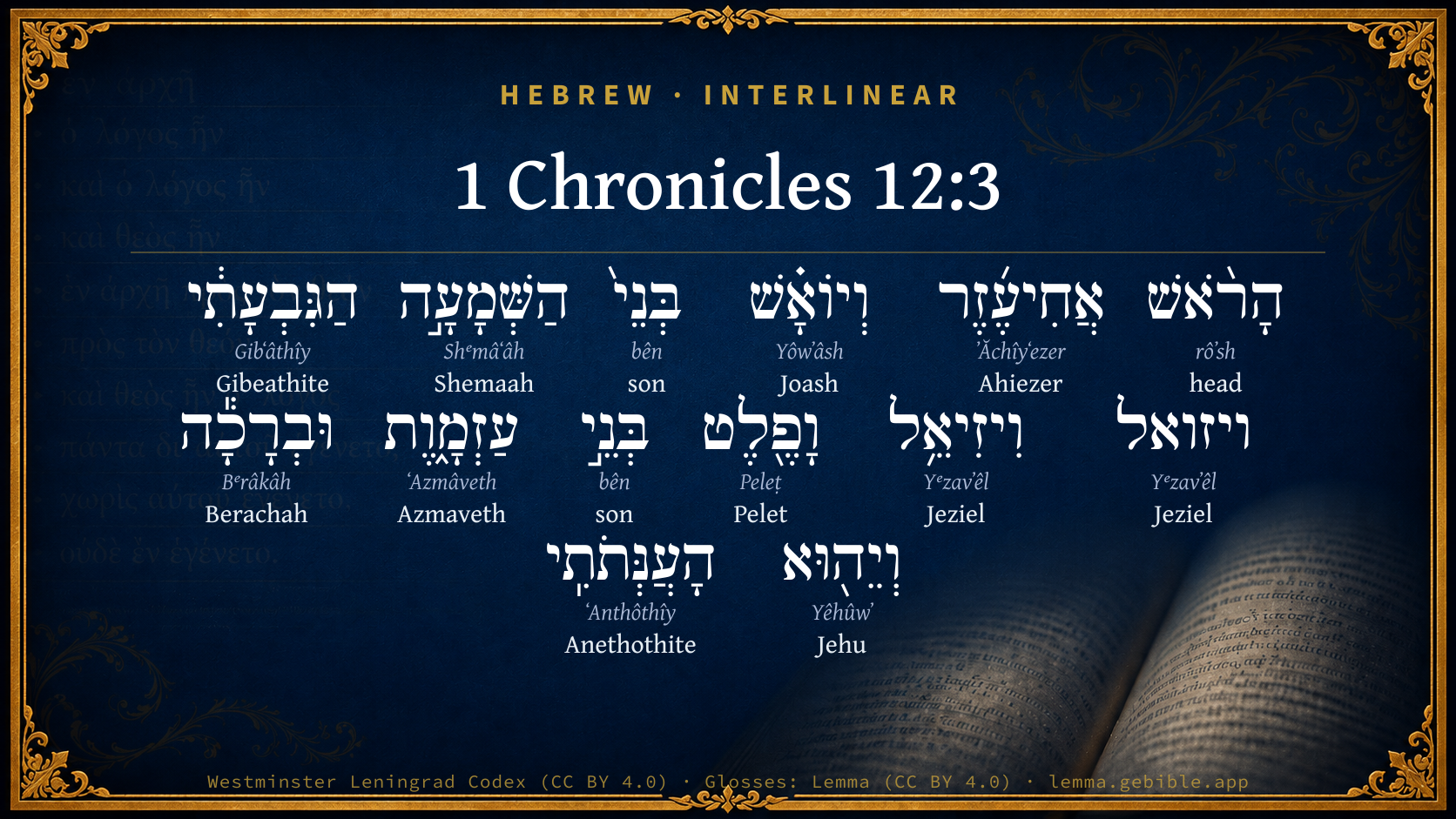
1 Chronicles 12:3

Hebrew (Westminster Leningrad Codex) 1 Chronicles 12:3 appears in the Hebrew Old Testament. The text above is from the Westminster Leningrad Codex. Each word links to its Strong’s number, a concise gloss, and parsing drawn from the Open Scriptures Hebrew Bible morphology. Click any word for its full Brown-Driver-Briggs (BDB) entry.
Download image
Cite this verse

1 Chronicles 12:3 (World English Bible). Public Domain. Lemma interlinear Bible study tool, https://lemma.gebible.app/v/1-chronicles/12/3.

Show BibTeX & RIS
BibTeX
RIS
English Translation
The chief was Ahiezer; then Joash, the sons of Shemaah the Gibeathite, and Jeziel, and Pelet, the sons of Azmaveth, and Beracah, and Jehu the Anathothite,
World English Bible · Public Domain
Highlights
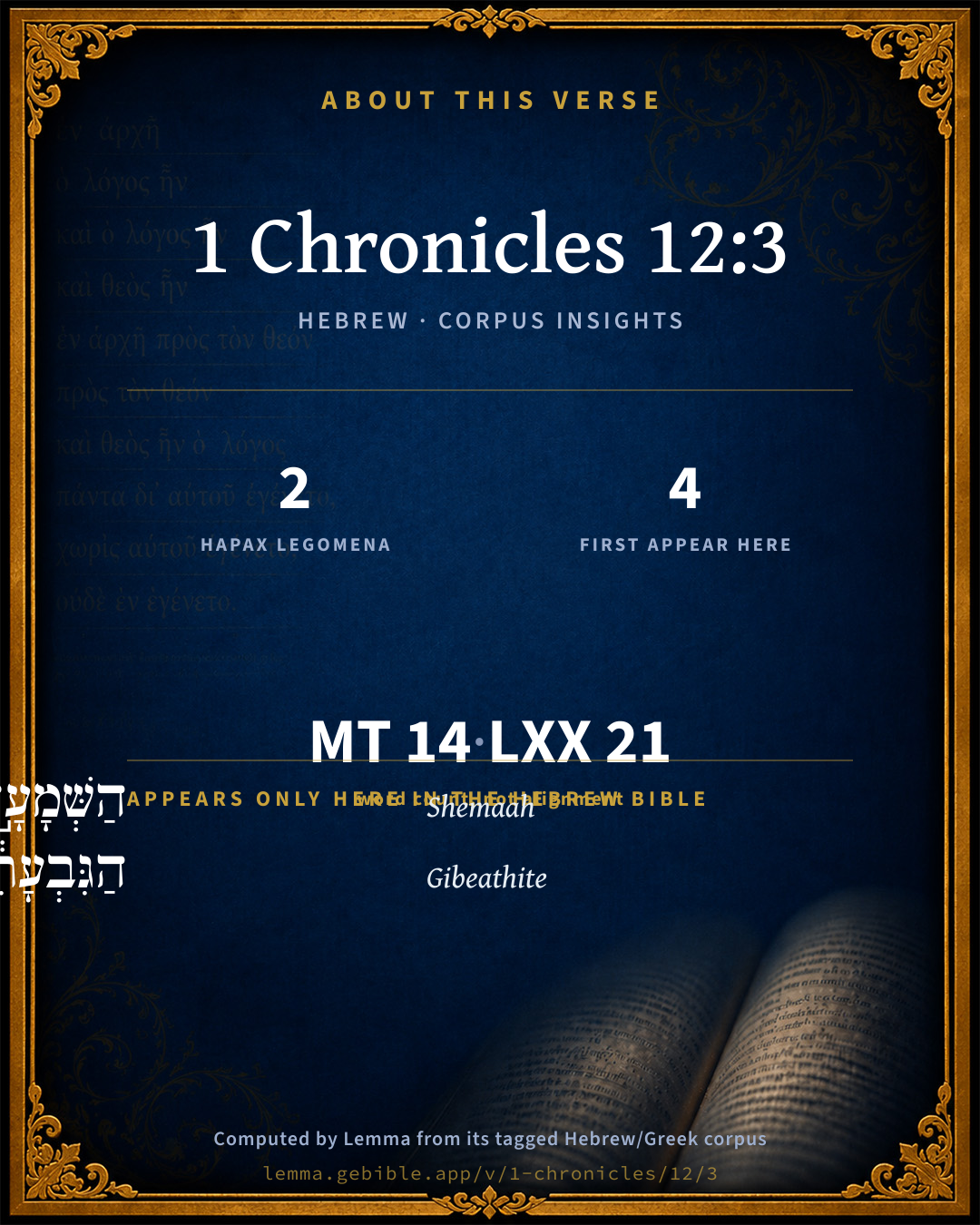
  • 2 hapax legomena — only here in the Hebrew Bible
  • 4 first appearances in the Hebrew Bible
Full analysis ↓
Download a study sheet

One document with this verse’s original text, its word-by-word gloss line, the meaning frame, cross-references with their text, attributed commentary, and full source and license credits — printable, and it pastes into notes with its structure intact.

This verse Autodidact and up

Study sheet (.html) Plain text (.txt)

A passage Seminary Student

Up to 50 verses in one chapter. A passage sheet keeps up to 6 commentary sources and 12 cross-references per verse, in the order this page ranks them, and says so on the sheet whenever that leaves anything out. Ask for a single verse and you get the Autodidact verse sheet above.

Everything on this page stays free to read, with no account — the sheet is a download of what is already on screen, not access to it.

Want to remove ads? Support Godless Engineer
Compare translations 3

The same verse in 3 English versions, stacked beneath the original-language interlinear above. Click any original word for its lexicon entry.

Each is an independent rendering of the whole verse — the interlinear is not word-aligned to these translations.

Highlighted words mark where these versions differ — a whole-verse word diff, not a word-by-word alignment.

  • World English Bible Public Domain
    The chief was Ahiezer; then Joash, the sons of Shemaah the Gibeathite, and Jeziel, and Pelet, the sons of Azmaveth, and Beracah, and Jehu the Anathothite,
  • King James Version Public Domain
    The chief was Ahiezer, then Joash, the sons of Shemaah the Gibeathite; and Jeziel, and Pelet, the sons of Azmaveth; and Berachah, and Jehu the Antothite.
  • unfoldingWord Literal Text CC BY-SA 4.0
    The head, Ahiezer, and Joash, sons of Shemaah the Gibeathite, and Jeziel and Pelet, sons of Azmaveth, and Berakah and Jehu the Anathothite

unfoldingWord Literal Text — © unfoldingWord, licensed CC BY-SA 4.0. Word-aligned USFM3 via Door43 (git.door43.org/unfoldingWord/en_ult).

Versions to compare (up to 4)

3 of 4 selected

Show all 18 translations

Every available English version of this verse, each an independent rendering of the whole verse.

  • World English Bible Public Domain
    The chief was Ahiezer; then Joash, the sons of Shemaah the Gibeathite, and Jeziel, and Pelet, the sons of Azmaveth, and Beracah, and Jehu the Anathothite,
  • Berean Standard Bible Public Domain
    Ahiezer their chief and Joash, who were the sons of Shemaah the Gibeathite; Jeziel and Pelet, the sons of Azmaveth; Beracah; Jehu the Anathothite;
  • Majority Standard Bible Public Domain
    Ahiezer their chief and Joash, who were the sons of Shemaah the Gibeathite; Jeziel and Pelet, the sons of Azmaveth; Beracah; Jehu the Anathothite;
  • King James Version Public Domain
    The chief was Ahiezer, then Joash, the sons of Shemaah the Gibeathite; and Jeziel, and Pelet, the sons of Azmaveth; and Berachah, and Jehu the Antothite.
  • American Standard Version (1901) Public Domain
    The chief was Ahiezer; then Joash, the sons of Shemaah the Gibeathite, and Jeziel, and Pelet, the sons of Azmaveth, and Beracah, and Jehu the Anathothite,
  • Revised Version (1885) Public Domain
    The chief was Ahiezer, then Joash, the sons of Shemaah the Gibeathite; and Jeziel, and Pelet, the sons of Azmaveth; and Beracah, and Jehu the Anathothite;
  • Geneva Bible (1599) Public Domain
    The chiefe were Ahiezer, and Ioash the sonnes of Shemaah a Gibeathite, and Ieziel, and Pelet the sonnes of Asinaueth, Berachah and Iehu the Antothite,
  • Douay-Rheims (1899) Public Domain
    The chief was Ahiezer, and Joas, the sons of Samaa of Gabaath, and Jaziel, and Phallet the sons of Azmoth, and Beracha, and Jehu an Anathothite.
  • Young's Literal Translation Public Domain
    The head `is' Ahiezer, and Joash, sons of Shemaab the Gibeathite, and Jeziel, and Pelet, sons of Azmaveth, and Berachah, and Jehu the Antothite,
  • Literal Standard Version CC BY-SA 4.0
    The head [is] Ahiezer, and Joash, sons of Shemaab the Gibeathite, and Jeziel, and Pelet, sons of Azmaveth, and Berachah, and Jehu the Antothite,
  • Unlocked Literal Bible CC BY-SA 4.0
    The chief was Ahiezer, then Joash, both sons of Shemaah the Gibeathite. There were Jeziel and Pelet, sons of Azmaveth. There were also Berakah, Jehu the Anathothite,
  • unfoldingWord Literal Text CC BY-SA 4.0
    The head, Ahiezer, and Joash, sons of Shemaah the Gibeathite, and Jeziel and Pelet, sons of Azmaveth, and Berakah and Jehu the Anathothite
  • Darby Bible Public Domain
    the chief Ahiezer, and Joash, the sons of Shemaah the Gibeathite; and Jeziel, and Pelet, the sons of Azmaveth; and Berachah, and Jehu the Anathothite,
  • World Messianic Bible Public Domain
    The chief was Ahiezer, then Joash, the sons of Shemaah the Gibeathite; Jeziel and Pelet, the sons of Azmaveth; Beracah; Jehu the Anathothite;
  • Webster's Bible Public Domain
    The chief was Ahiezer, then Joash, the sons of Shemaah the Gibeathite; and Jeziel, and Pelet, the sons of Azmaveth; and Berachah, and Jehu the Antothite,
  • Free Bible Version CC BY-SA 4.0
    Ahiezer was their leader, then Joash; the sons of Shemaah the Gibeathite; Jeziel and Pelet the sons of Azmaveth; Beracah; Jehu the Anathothite;
  • Bible in Basic English Public Domain
    Ahiezer was their chief, then Joash, the sons of Shemaah the Gibeathite; and Jeziel and Pelet, the sons of Azmaveth; and Beracah and Jehu the Anathothite;
  • JPS Tanakh (1917) Public Domain
    The chief was Ahiezer, then Joash, the sons of Shemaah the Gibeathite; and Jeziel, and Pelet, the sons of Azmaveth; and Beracah, and Jehu the Anathothite;

Literal Standard Version (2020), Covenant Press — licensed CC BY-SA 4.0. Text via the HelloAO Bible API (eBible.org). Unlocked Literal Bible (unfoldingWord) — licensed CC BY-SA 4.0. Text via the HelloAO Bible API (eBible.org). unfoldingWord Literal Text — © unfoldingWord, licensed CC BY-SA 4.0. Word-aligned USFM3 via Door43 (git.door43.org/unfoldingWord/en_ult). Free Bible Version, Dr. Jonathan Gallagher — licensed CC BY-SA 4.0. Text via the HelloAO Bible API (eBible.org).

Word by word

More ways to search: Search by grammar → Find every occurrence → Compare this word →

Practice this passage: Drill this verse → Learn its vocabulary →

הַשְּׁמָעָ֣ה
Shᵉmâʻâh
H8094
“the · Shemaah”
Particle, Definite Article + Noun, Proper
Part of Speech
Particle + Noun
Type
Proper
Full BDB Definition

Origin: for H8093

TWOT: None

Shemaah = "the rumour" - a Benjamite, the Gibeathite, father of Ahiezer and Joash, both mighty warriors of David who joined him at Ziklag
  1. הָרֹ֨אשׁ rôʼsh H7218 “the · head” Particle, Definite Article + Noun, Common, Masculine, Singular, Absolute
  2. אֲחִיעֶ֜זֶר ʼĂchîyʻezer H295 “Ahiezer” Noun, Proper
  3. וְיוֹאָ֗שׁ Yôwʼâsh H3101 “and · Joash” Conjunction + Noun, Proper
  4. בְּנֵי֙ bên H1121 “sons of” Noun, Common, Masculine, Plural, Construct
  5. הַגִּבְעָתִ֔י Gibʻâthîy H1395 “the · Gibeathite” Particle, Definite Article + Noun, Gentilic, Masculine, Singular, Absolute
  6. ויזואל Yᵉzavʼêl H3149 “and · Jeziel” Conjunction + Noun, Proper
  7. וִיזִיאֵ֥ל Yᵉzavʼêl H3149 “and · Jeziel” Conjunction + Noun, Proper
  8. וָפֶ֖לֶט Peleṭ H6404 “and · Pelet” Conjunction + Noun, Proper
  9. בְּנֵ֣י bên H1121 “sons of” Noun, Common, Masculine, Plural, Construct
  10. עַזְמָ֑וֶת ʻAzmâveth H5820 “Azmaveth” Noun, Proper
  11. וּבְרָכָ֕ה Bᵉrâkâh H1294 “and · Berachah” Conjunction + Noun, Proper
  12. וְיֵה֖וּא Yêhûwʼ H3058 “and · Jehu” Conjunction + Noun, Proper
  13. הָעֲנְּתֹתִֽי ʻAnthôthîy H6069 “the · Anethothite” Particle, Definite Article + Noun, Gentilic, Masculine, Singular, Absolute

About this verse

These counts appear in no published source. They are computed here, from the morphology-tagged text and Lemma’s own curated glosses. What Lemma adds →

14
words
12
distinct lemmas
Historical
section

Notable vocabulary

2 hapax legomena — words that appear only here in the entire Hebrew Bible:

  • הַשְּׁמָעָ֣ה Shemaah H8094
  • הַגִּבְעָתִ֔י Gibeathite H1395

First appearance in Scripture

These words make their first canonical appearance in the Hebrew Bible here:

  • הַשְּׁמָעָ֣ה Shemaah H8094
  • הַגִּבְעָתִ֔י Gibeathite H1395
  • ויזואל Jeziel H3149
  • וּבְרָכָ֕ה Berachah H1294

Grammatical profile

  • 14 nouns

Repetition

Words recur within this verse — often emphatic in Hebrew:

  • בְּנֵי֙ son H1121 ×2
  • ויזואל Jeziel H3149 ×2

Hebrew & Septuagint length

In English translation the verse runs 26 words from the Hebrew and 24 from the Septuagint (LXX English) — closely comparable.

A rough comparison of the two English renderings, which tokenize alike — not a word-level alignment.

Word counts can differ between the Hebrew and the Greek without any difference in meaning — e.g. the Hebrew direct-object marker אֵת has no separate Greek word, and Greek often adds the article ὁ.

In the original languages it is 14 Hebrew tokens and 21 Greek tokens — but the two are counted differently (Hebrew bundles its prefixes and suffixes into one token; the Greek is in lemma form), so that isn’t a like-for-like length.

Cross-references

4

Topical passages linked to 1 Chronicles 12:3 in the Treasury of Scripture Knowledge — connected by theme and wording, ordered by reader-vote popularity; previews shown in the World English Bible.

  • 1 Chronicles 11:28 Ira the son of Ikkesh the Tekoite, Abiezer the Anathothite,
  • 1 Samuel 11:4 Then came the messengers to Gibeah of Saul, and spoke these words in the ears of the people: and all the people lifted up their voice, and wept.
  • 2 Samuel 21:6 let seven men of his sons be delivered to us, and we will hang them up to Yahweh in Gibeah of Saul, the chosen of Yahweh. The king said, I will give them.
  • 1 Chronicles 11:33 Azmaveth the Baharumite, Eliahba the Shaalbonite,

Cross-references courtesy of OpenBible.info (CC BY 4.0).

Hebrew and Greek witnesses Masoretic Hebrew ↔ Greek Septuagint

The same verse in the two great witnesses to the Old Testament, shown verse-for-verse.

These are two independent witnesses, not word-aligned to each other, and the Septuagint is shown in lemma (dictionary) form.

Hebrew 1 Chronicles 12:3 Masoretic · Westminster Leningrad Codex

הָרֹ֨אשׁ אֲחִיעֶ֜זֶר וְיוֹאָ֗שׁ בְּנֵי֙ הַשְּׁמָעָ֣ה הַגִּבְעָתִ֔י ויזואל וִיזִיאֵ֥ל וָפֶ֖לֶט בְּנֵ֣י עַזְמָ֑וֶת וּבְרָכָ֕ה וְיֵה֖וּא הָעֲנְּתֹתִֽי

The chief was Ahiezer; then Joash, the sons of Shemaah the Gibeathite, and Jeziel, and Pelet, the sons of Azmaveth, and Beracah, and Jehu the Anathothite,

World English Bible · Public Domain

Greek LXX 1 Chronicles 12:3 Septuagint · lemma form

ὁ ἄρχων αχιεζερ καί ιωας υἱός ασμα ὁ γεβωθίτης καί ιωηλ καί ιωφαλητ υἱός ασμωθ καί βερχια καί ιηουλ ὁ αναθωθι

the chief was Achiezer, and Joas son of Asma the Gabathite, and Joel and Jophalet, sons of Asmoth, and Berchia, and Jeul of Anathoth,

LXX2012 (modern English Septuagint) · Public Domain

On this verse, The Cambridge Bible for Schools and Colleges discusses the Septuagint’s reading. Read the note in Commentary ↓

Hebrew: Westminster Leningrad Codex (CC BY 4.0). Greek: Septuagint (public domain); English from LXX2012 (modern English Septuagint) (Public Domain). How the Septuagint differs from the Hebrew →

Commentary

Notes on 1 Chronicles 12:3 from classic Christian and Jewish commentators (each source and its license shown beneath its notes). The classic Christian expositions comment on the surrounding passage and are grouped to its opening verse, so a note may address several verses; the Jewish commentaries on the Tanakh (Rashi and others) are per-verse, so they appear only where the commentator wrote on this verse.

Lemma curates 59 commentaries, every one of them public domain or Creative Commons licensed, each selected and text-cleaned for this edition rather than reprinted as found. About our sources →

Ellicott's Commentary for English Readers

(3) The chief was Ahiezer.—Captain of the band. Heb., head.

Shemaah.—Heb., Hashshemaah.

The Gibeathite.—Of “Gibeah of Saul,” between Ramah and Anathoth (Isa_10:29); also called “Gibeah of Benjamin” (1Ch_11:31; Jdg_20:4).

Jeziel.—So Hebrew margin; Hebrew text, Jezûel. (Comp. Peniel and Penuel.)

Azmaveth.—Perhaps the warrior of Bahurim (1Ch_11:33).

Jehu the Antothite—of Anathoth, now Anâta (1Ch_11:28).

A Bible Commentary for English Readers, edited by Charles John Ellicott (1878–1897) — public domain. Text from a community e-Sword module.

The Cambridge Bible for Schools and Colleges

gen. ed. J. J. S. Perowne

3. The chief was A., then J.] Read (cp. LXX.) A. the chief, J. the son (sing.) of Shemaah.

Jehu the Antothite] R.V. the Anathothite, i.e. man of Anathoth. See 1Ch_11:28, note.

The Cambridge Bible for Schools and Colleges (gen. ed. J. J. S. Perowne; Cambridge University Press, 1878–1918) — public domain. Text from a community e-Sword module.

John Gill's Exposition

The chief was Ahiezer, then Joash, the sons of Shemaah the Gibeathite,.... Who was of Gibeah, in the tribe of Benjamin, sometimes called Gibeah of Benjamin, and of Saul, it being his birthplace, see Sa1 11:4 and so these might be some of his kindred:

and Jeziel, and Pelet, the sons of Azmaveth; there is one of this name in the posterity of Jonathan, Ch1 8:36 who might be so called after some of his relations:

and Berachah, and Jehu the Antothite; or Anethothite, as the Vulgate Latin version, who was of Anathoth, a city in the tribe of Benjamin, the native place of Jeremiah the prophet.

John Gill's Exposition of the Whole Bible (1746–1763) — public domain (CC PDM 1.0). Text via the HelloAO Bible API.

The Pulpit Commentary

The sons of Shemaah the Gibeathite. The Peshito-Syriac has wOnB] instead of yneBe. This has the effect of making Joash the son of Ahiezer, and it makes Shemaah a third name in the list. This name has in the Hebrew the form for the article before it, and should appear in our version either as "Has-Shemaah," or "the Shemaah." The name, together with that of Azmaveth, is found in 1Ch_8:13, 1Ch_8:36, as belonging to the Benjamite tribe. The name Jeziel is omitted in the Syriac Version, and the two names Pelet and Berachah appear as sons of Azmaveth (1Ch_11:33; 2Sa_23:31, where the Baharmite means the Baharumite, i.e. the man of Bahurim, in Benjamin) The Antothite; that is, native of Anathoth. The place is not given in Joshua 18.; but it was a "priests" city" with "suburbs," belonging to Benjamin (1 Chronicles Jos_21:18; 1Ki_2:26; Jer_1:1 Jer_29:27)

The Pulpit Commentary (1880–1919), ed. H.D.M. Spence-Jones & Joseph S. Exell — public domain. Text from a community e-Sword module.

Keil & Delitzsch

C. F. Keil & F. Delitzsch

The chief was Ahiezer, then Joash, the sons of Shemaah the Gibeathite,.... Who was of Gibeah, in the tribe of Benjamin, sometimes called Gibeah of Benjamin, and of Saul, it being his birthplace, see Sa1 11:4 and so these might be some of his kindred:

and Jeziel, and Pelet, the sons of Azmaveth; there is one of this name in the posterity of Jonathan, Ch1 8:36 who might be so called after some of his relations:

and Berachah, and Jehu the Antothite; or Anethothite, as the Vulgate Latin version, who was of Anathoth, a city in the tribe of Benjamin, the native place of Jeremiah the prophet.

Keil & Delitzsch — Biblical Commentary on the Old Testament (1861–1891) — public domain (CC PDM 1.0). Text via the HelloAO Bible API. (Old Testament only.)

unfoldingWord translationNotes

Door43 World Missions Community

General Information:

This begins a list of the men from the tribe of Benjamin who joined David at Ziklag. (See: How to Translate Names)

the thirty

"the 30 soldiers" (See: Numbers)

translationWords

chief

Joash

Jehu

Gibeon

command

unfoldingWord translationNotes — © Distant Shores Media and the Door43 World Missions Community, licensed CC BY-SA 4.0. Source: git.door43.org/Door43/en_tn.

Lesson kit

Teaching starters — assembled from the data on this page, not authored interpretation. Every prompt links to the verse data it draws on. Edit before teaching.

1 Chronicles, in the Historical, opens this verse with 14 words (12 distinct Hebrew lemmas). Its most distinctive word is Shᵉmâʻâh (“Shemaah”). A historical commentator’s framing appears above. Read the whole chapter for the surrounding context.

Discussion questions

  1. The word Shᵉmâʻâh carries the sense “Shemaah.” How does it shape the verse?
  2. 2 words here appear nowhere else in the Hebrew Bible. Why might the author reach for such rare wording?
  3. 4 words make their first appearance in Scripture here. What does this debut establish?
  4. How does 1 Chronicles 11:28, which shares this passage’s theme, read alongside this verse?
  5. What does the repetition of “son” (2× in this one verse) do in this verse?
  6. These translations render this verse differently. What is at stake in choosing one wording over another?
  7. Compare how Ellicott's Commentary for English Readers and The Cambridge Bible for Schools and Colleges read this verse. Where do they agree or differ?

Things to notice

  • 2 words in this verse appear nowhere else in the Hebrew Bible.
  • 4 words make their first canonical appearance in Scripture here.
  • This verse counts 14 Hebrew ↔ 21 Greek words.
  • These translations choose different wording for 7 words in this verse.
  • “son” occurs 2× in this single verse.

Reading settings

Reading text

Shown beneath each verse's original-language words.

Old Testament
Old Testament edition

Read the OT as the Masoretic Hebrew (MT) or the Greek Septuagint (LXX).

English shown for the Greek Septuagint (in the Hebrew ↔ Greek comparison).

Comparing translations? Open the Compare panel on any verse page to stack up to four side by side.