
Philippians 1:10

Greek (Tischendorf 8th ed.) Philippians 1:10 appears in the Greek New Testament. The text above is from the Tischendorf 8th edition. Each word links to its Strong’s number and a concise gloss. Click any word for its full Thayer’s Greek Lexicon entry.
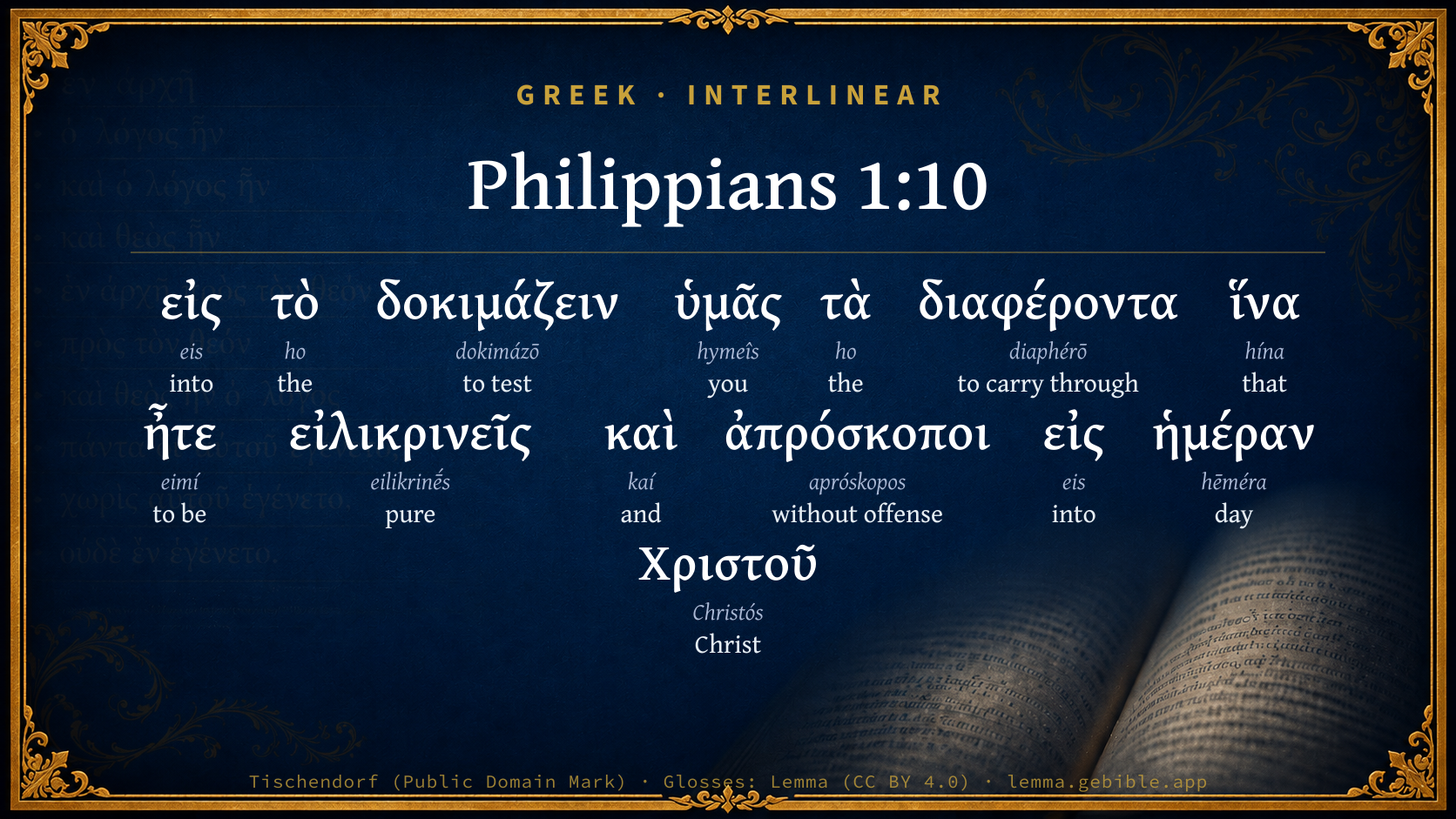
Download image
Cite this verse

Philippians 1:10 (World English Bible). Public Domain. Lemma interlinear Bible study tool, https://lemma.gebible.app/v/philippians/1/10.

Show BibTeX & RIS
BibTeX
RIS
English Translation
so that you may approve the things that are excellent; that you may be sincere and without offense to the day of Christ;
World English Bible · Public Domain
Highlights
  • 1 first appearance in the Greek New Testament
Full analysis ↓
Download a study sheet

One document with this verse’s original text, its word-by-word gloss line, the meaning frame, cross-references with their text, attributed commentary, and full source and license credits — printable, and it pastes into notes with its structure intact.

This verse Autodidact and up

Study sheet (.html) Plain text (.txt)

A passage Seminary Student

Up to 50 verses in one chapter. A passage sheet keeps up to 6 commentary sources and 12 cross-references per verse, in the order this page ranks them, and says so on the sheet whenever that leaves anything out. Ask for a single verse and you get the Autodidact verse sheet above.

Everything on this page stays free to read, with no account — the sheet is a download of what is already on screen, not access to it.

Want to remove ads? Support Godless Engineer
Compare translations 3

The same verse in 3 English versions, stacked beneath the original-language interlinear above. Click any original word for its lexicon entry.

Each is an independent rendering of the whole verse — the interlinear is not word-aligned to these translations.

Highlighted words mark where these versions differ — a whole-verse word diff, not a word-by-word alignment.

  • World English Bible Public Domain
    so that you may approve the things that are excellent; that you may be sincere and without offense to the day of Christ;
  • King James Version Public Domain
    That ye may approve things that are excellent; that ye may be sincere and without offence till the day of Christ.
  • unfoldingWord Literal Text CC BY-SA 4.0
    so that you may approve excels, so that you might be pure and blameless until the day of Christ,

unfoldingWord Literal Text — © unfoldingWord, licensed CC BY-SA 4.0. Word-aligned USFM3 via Door43 (git.door43.org/unfoldingWord/en_ult).

Versions to compare (up to 4)

3 of 4 selected

Show all 19 translations

Every available English version of this verse, each an independent rendering of the whole verse.

  • World English Bible Public Domain
    so that you may approve the things that are excellent; that you may be sincere and without offense to the day of Christ;
  • Berean Standard Bible Public Domain
    so that you may be able to test and prove what is best and may be pure and blameless for the day of Christ,
  • Majority Standard Bible Public Domain
    so that you may be able to test and prove what is best and may be pure and blameless for the day of Christ,
  • King James Version Public Domain
    That ye may approve things that are excellent; that ye may be sincere and without offence till the day of Christ.
  • American Standard Version (1901) Public Domain
    so that ye may approve the things that are excellent; that ye may be sincere and void of offence unto the day of Christ;
  • Revised Version (1885) Public Domain
    so that ye may approve the things that are excellent; that ye may be sincere and void of offence unto the day of Christ;
  • Geneva Bible (1599) Public Domain
    That ye may alowe those things which are best, that ye may be pure, and without offence vntill the day of Christ,
  • Douay-Rheims (1899) Public Domain
    That you may approve the better things, that you may be sincere and without offence unto the day of Christ,
  • Young's Literal Translation Public Domain
    for your proving the things that differ, that ye may be pure and offenceless -- to a day of Christ,
  • Literal Standard Version CC BY-SA 4.0
    for your proving the things that differ, that you may be pure and offenseless—to [the] Day of Christ,
  • Unlocked Literal Bible CC BY-SA 4.0
    I pray for this so that you may approve what is excellent, and so you may be sincere and without offense on the day of Christ.
  • unfoldingWord Literal Text CC BY-SA 4.0
    so that you may approve excels, so that you might be pure and blameless until the day of Christ,
  • Darby Bible Public Domain
    that ye may judge of and approve the things that are more excellent, in order that ye may be pure and without offence for Christ's day,
  • World Messianic Bible Public Domain
    so that you may approve the things that are excellent, that you may be sincere and without offense to the day of Messiah,
  • Webster's Bible Public Domain
    That ye may approve things that are excellent; that ye may be sincere and without offense till the day of Christ;
  • Free Bible Version CC BY-SA 4.0
    so that you can work out what's really important. That way you can be genuine and blameless when Christ returns,
  • Bible in Basic English Public Domain
    So that you may give your approval to the best things; that you may be true and without wrongdoing till the day of Christ;
  • Text-Critical English NT CC BY 4.0
    so that you may approve what is excellent in order to be pure and blameless in the day of Christ,
  • Tyndale New Testament (1534) Public Domain
    that ye myght accepte thinges most excellent that ye myght be pure and soche as shuld hurte no manes conscience vntyll the daye of Christ

Literal Standard Version (2020), Covenant Press — licensed CC BY-SA 4.0. Text via the HelloAO Bible API (eBible.org). Unlocked Literal Bible (unfoldingWord) — licensed CC BY-SA 4.0. Text via the HelloAO Bible API (eBible.org). unfoldingWord Literal Text — © unfoldingWord, licensed CC BY-SA 4.0. Word-aligned USFM3 via Door43 (git.door43.org/unfoldingWord/en_ult). Free Bible Version, Dr. Jonathan Gallagher — licensed CC BY-SA 4.0. Text via the HelloAO Bible API (eBible.org).

Word by word

More ways to search: Search by grammar → Find every occurrence → Compare this word →

Practice this passage: Drill this verse → Learn its vocabulary →

εἰλικρινεῖς
eilikrinḗs
G1506
“pure”
Adjective, Nominative, Plural, Masculine
Part of Speech
Adjective
Case
Nominative
Number
Plural
Gender
Masculine
Full Thayer's Definition

Origin: from heile (the sun's ray) and G2919

TDNT: 08:37,2

1. pure, sincere, unsullied 2. found pure when unfolded and examined by the sun's light
  1. εἰς eis G1519 “into” Preposition
  2. τὸ ho G3588 “the” Article, Accusative, Singular, Neuter
  3. δοκιμάζειν dokimázō G1381 “to test” Verb, Present, Active, Infinitive
  4. ὑμᾶς hymeîs G5210 “you” Personal pronoun, 2nd person, Accusative, Plural
  5. τὰ ho G3588 “the” Article, Accusative, Plural, Neuter
  6. διαφέροντα diaphérō G1308 “to carry through” Verb, Present, Active, Participle, Accusative, Plural, Neuter
  7. ἵνα hína G2443 “that” Conjunction
  8. ἦτε eimí G1510 “to be” Verb, Present, Active, Subjunctive, 2nd person, Plural
  9. καὶ kaí G2532 “and” Conjunction
  10. ἀπρόσκοποι apróskopos G677 “without offense” Adjective, Nominative, Plural, Masculine
  11. εἰς eis G1519 “into” Preposition
  12. ἡμέραν hēméra G2250 “day” Noun, Accusative, Singular, Feminine
  13. Χριστοῦ Christós G5547 “Christ” Noun, Genitive, Singular, Masculine

About this verse

These counts appear in no published source. They are computed here, from the morphology-tagged text and Lemma’s own curated glosses. What Lemma adds →

14
words
12
distinct lemmas
Pauline Epistles
section

Notable vocabulary

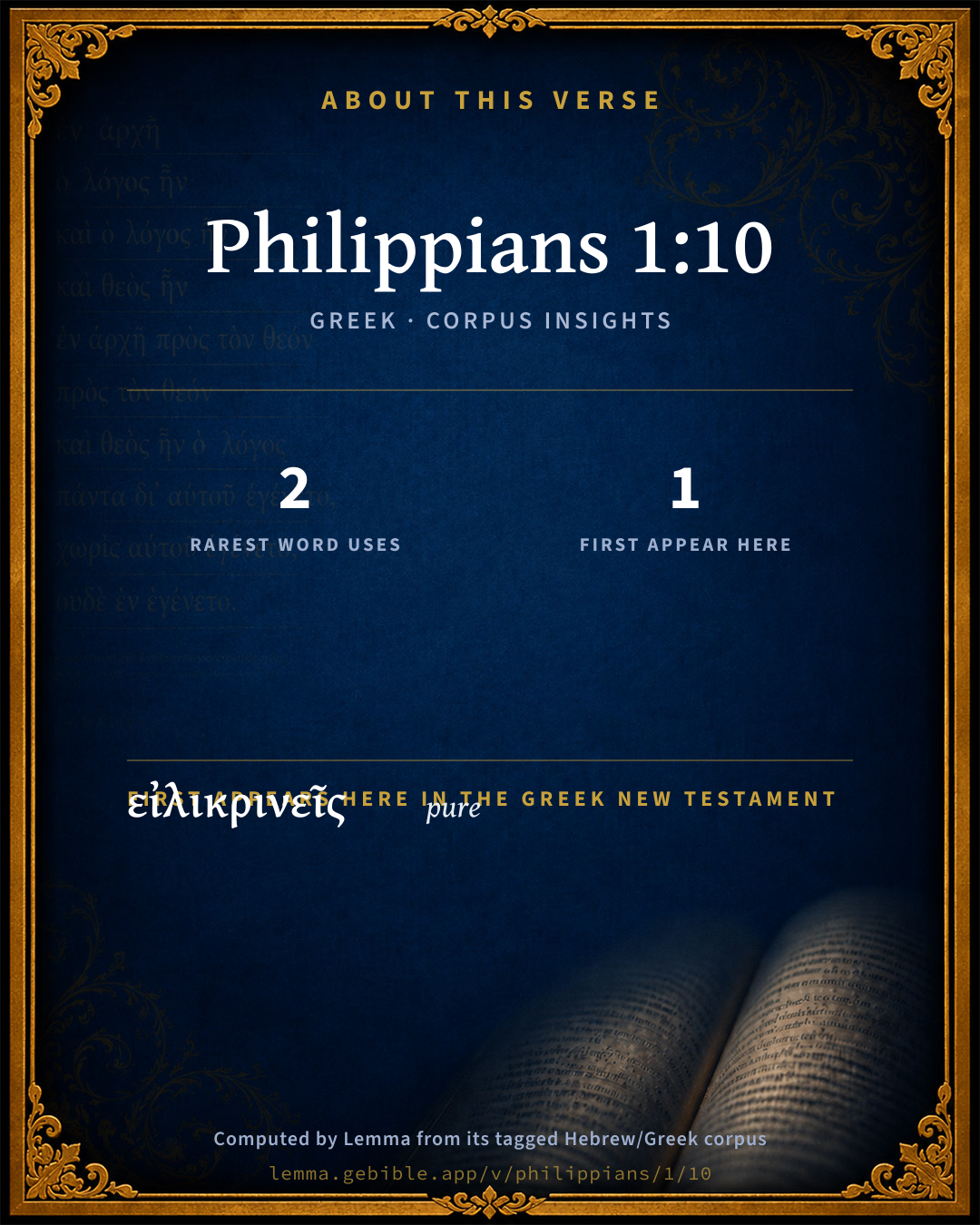
The rarest word here is εἰλικρινεῖς pure G1506 — appearing just 2 times in the whole Greek New Testament.

First appearance in Scripture

This word makes its first canonical appearance in the Greek New Testament here:

  • εἰλικρινεῖς pure G1506

Shared distinctive vocabulary

εἰλικρινεῖς pure G1506 occurs in 2 verses of the Greek New Testament. Also found in:
Repetition

Words recur within this verse:

Cross-references

42

Topical passages linked to Philippians 1:10 in the Treasury of Scripture Knowledge — connected by theme and wording, ordered by reader-vote popularity; previews shown in the World English Bible.

  • Romans 12:2 Don't be conformed to this world, but be transformed by the renewing of your mind, so that you may prove what is the good, well-pleasing, and perfect will of God.
  • 1 Thessalonians 3:13 to the end he may establish your hearts blameless in holiness before our God and Father, at the coming of our Lord Jesus with all his saints.
  • 1 Thessalonians 5:23 May the God of peace himself sanctify you completely. May your whole spirit, soul, and body be preserved blameless at the coming of our Lord Jesus Christ.
  • Romans 2:18 and know his will, and approve the things that are excellent, being instructed out of the law,
  • Ephesians 5:10 proving what is well-pleasing to the Lord.
  • 1 John 4:1 Beloved, don't believe every spirit, but test the spirits, whether they are of God, because many false prophets have gone out into the world.
  • Philippians 1:6 being confident of this very thing, that he who began a good work in you will complete it until the day of Jesus Christ.
  • 1 Thessalonians 5:21 Test all things, and hold firmly that which is good.
  • Matthew 16:23 But he turned, and said to Peter, "Get behind me, Satan! You are a stumbling-block to me, for you are not setting your mind on the things of God, but on the things of men."
  • 1 Corinthians 1:8 who will also confirm you until the end, blameless in the day of our Lord Jesus Christ.
  • Joshua 24:14 Now therefore fear Yahweh, and serve him in sincerity and in truth; and put away the gods which your fathers served beyond the River, and in Egypt; and serve you Yahweh.
  • Matthew 18:6–7 but whoever causes one of these little ones who believe in me to stumble, it would be better for him that a huge millstone should be hung around his neck, and that he should be sunk in the depths of the sea.
  • John 1:47 Jesus saw Nathanael coming to him, and said about him, "Behold, an Israelite indeed, in whom is no deceit!"
  • Romans 14:20–21 Don't overthrow God's work for food's sake. All things indeed are clean, however it is evil for that man who creates a stumbling block by eating.
  • Ephesians 5:27 that he might present the assembly to himself gloriously, not having spot or wrinkle or any such thing; but that it should be holy and without blemish.
  • Revelation 2:2 "I know your works, and your toil and perseverance, and that you can't tolerate evil men, and have tested those who call themselves apostles, and they are not, and found them false.
  • Genesis 20:5 Didn't he tell me, 'She is my sister?' She, even she herself said, 'He is my brother.' In the integrity of my heart and the innocence of my hands have I done this."
  • Job 12:11 Doesn't the ear try words, Even as the palate tastes its food?
  • Job 34:3 For the ear tries words, As the palate tastes food.
  • Isaiah 7:15–16 He shall eat butter and honey when he knows to refuse the evil, and choose the good.
  • Amos 5:14–15 Seek good, and not evil, That you may live; And so Yahweh, the God of hosts, will be with you, As you say.
  • Micah 3:2 You who hate the good, And love the evil; Who tear off their skin, And their flesh from off their bones;
  • Matthew 26:33 But Peter answered him, "Even if all will be made to stumble because of you, I will never be made to stumble."
  • Romans 8:7 because the mind of the flesh is hostile towards God; for it is not subject to God's law, neither indeed can it be.
  • Romans 12:9 Let love be without hypocrisy. Abhor that which is evil. Cling to that which is good.
  • 2 Corinthians 1:12 For our boasting is this: the testimony of our conscience, that in holiness and sincerity of God, not in fleshly wisdom but in the grace of God we behaved ourselves in the world, and more abundantly toward you.
  • 2 Corinthians 11:13–15 For such men are false apostles, deceitful workers, masquerading as Christ's apostles.
  • Hebrews 5:12–14 For when by reason of the time you ought to be teachers, you again need to have someone teach you the rudiments of the first principles of the oracles of God. You have come to need milk, and not solid food.
  • John 3:20 For everyone who does evil hates the light, and doesn't come to the light, lest his works would be exposed.
  • Acts 24:16 Herein I also practice always having a conscience void of offense toward God and men.
  • Romans 7:16 But if what I don't desire, that I do, I consent to the law that it is good.
  • Romans 7:22 For I delight in God's law after the inward man,
  • Romans 16:17 Now I beg you, brothers, look out for those who are causing the divisions and occasions of stumbling, contrary to the doctrine which you learned, and turn away from them.
  • 1 Corinthians 8:13 Therefore, if food causes my brother to stumble, I will eat no meat forevermore, that I don't cause my brother to stumble.
  • 1 Corinthians 10:32 Give no occasions for stumbling, either to Jews, or to Greeks, or to the assembly of God;
  • 2 Corinthians 2:17 For we are not as so many, peddling the word of God. But as of sincerity, but as of God, in the sight of God, we speak in Christ.
  • 2 Corinthians 6:3 We give no occasion of stumbling in anything, that our service may not be blamed,
  • 2 Corinthians 8:8 I speak not by way of commandment, but as proving through the earnestness of others the sincerity also of your love.
  • Galatians 5:11 But I, brothers, if I still preach circumcision, why am I still persecuted? Then the stumbling-block of the cross has been removed.
  • Ephesians 4:15 but speaking truth in love, we may grow up in all things into him, who is the head, Christ;
  • Ephesians 6:24 Grace be with all those who love our Lord Jesus Christ with incorruptible love. Amen.
  • Philippians 1:16 The former insincerly preach Christ from selfish ambition, thinking that they add affliction to my chains;

Cross-references courtesy of OpenBible.info (CC BY 4.0).

Commentary

Notes on Philippians 1:10 from classic Christian and Jewish commentators (each source and its license shown beneath its notes). The classic Christian expositions comment on the surrounding passage and are grouped to its opening verse, so a note may address several verses; the Jewish commentaries on the Tanakh (Rashi and others) are per-verse, so they appear only where the commentator wrote on this verse.

Lemma curates 59 commentaries, every one of them public domain or Creative Commons licensed, each selected and text-cleaned for this edition rather than reprinted as found. About our sources →

The Biblical Illustrator

Joseph S. Exell

Php_1:10

That ye may approve the things that are excellent

True religion is

I.

The highest intelligence.

II. The fairest accomplishment.

III. The most enduring possession. (J. Lyth, D. D.)

Life work

I. Respects judgment--motive--action.

II. Requires energy--till the day of Christ. (J. Lyth, D. D.)

Spiritual discrimination

I. Demands the exercise of the most intelligent and sensitive charity.

II. Commands a wide field of effort, viz., the bad, the good, the better, the best--in character, life, doctrine, practice, enjoyment, attainment.

III. Implies the admission and use of a noble liberty of thought, judgment, and action.

IV. Involves a weighty and far-reaching responsibility.

V. Is essential to a pure and blameless life. (G. G. Ballard.)

Discerning with a purpose

I. A suggestion that a spirit of discernment is required from believers in Christ Jesus. The reference is founded on the common action of comparing one thing with another, so as to find the best. A capability to prove which is best for us bodily in food, e.g., would save us from many physical ailments. How many spiritual troubles might be avoided if, in prayer and preaching, we always fixed upon what best presented the glory and grace of Christ. Possessing this faculty we should--

1. Know what course it would be right to take in spiritual difficulties. The banker draws his finger across a bank note and says, That is forged, or That is genuine. His senses are exercised to prove them. So we ought to be able to perceive the signs of evil, however covered up, and the marks of Gods will, however faint.

2. Understand the relation between duty and comfort.

II. A purpose placed in view of this spirit of discernment.

1. It has respect to the day of Christ, when every mans work will be tried.

(1) So we are not to purpose our own satisfaction. Many endeavour to attain certain excellencies so that they may stand well with themselves.

(2) We are not to purpose to be satisfied with the opinions of the world. There are men who think that if they secure the approbation of their neighbours, they are as good as they need be.

2. It has set before it sincerity and blamelessness.

(1) The Christian is seen standing in the light, and gives no occasion for others to stumble against him. Seeing him in family, business, party, or Church, they have no cause to say, He acts so as to stand between me and Christ.

(2) To be counted sincere and without offence is the proof of a high attainment. The Christian must not be behind, but before men of the world in good points of character and conduct. (D. G. Watt, M. A.)

The things that are excellent

Two things are necessary for all noble life.

1. That we have some ideal of duty.

2. That we are honest in trying to realize this ideal. The words before us suggest these necessities.

I. As Christians we ought to approve things that are excellent.

1. Not merely things which are opposed, or differ, as good and bad. It requires no gift of grace to do this. Natural conscience tells us what is right and wrong. All know that truth is better than falsehood. When men call good evil, they are condemned as much by the world as the Church. It is melancholy to think, however, that some have fallen as low as this in Christian communities, and make a gain of godliness.

2. Paul had a higher level of thought in view--a certain spiritual sensitiveness which recoils from evil, and is drawn to good.

3. We all fail more or less in the cultivation of this higher mindedness. The world is too much with us, weighing down our desires, and whispering a religion of convenience, rather than of aspiration. Our frequent failures, too, tend to keep us contented at a low level.

4. The fineness of spiritual perception is of value in the world. It is a key which unlocks secrets of character. It is not easily deceived. It knows what is true and excellent in art, literature, society, and politics, more readily than others who let their moral ideals grow dim.

II. The further necessity of our being sincere and without offence. Our life and thought must be knit together, our ideal translated into fact.

1. Sincerity is the basis of all good character. A man whose inner and outer life is a contradiction loses even the respect of the world. It would be better if all Christian Churches were more intent on the realities of Christian character; their reward would be greater, and their contentions less.

2. We are also to be without offence. (Principal Tulloch.)

Sincere and without offence

I. A few words against insincerity.

1. Against all forms of it. We are all in danger of it, and its sources are numberless, insidious, and within our own breast. It arises from the prevalent excitement; men pleasing, fiction, ritualism.

2. Against religious insincerity. Here the danger is greatest. Men dont counterfeit copper, but gold, He that takes a bad sovereign loses twenty times as much as he who takes a bad shilling. Hence the Word of God is singularly full, and strong against this evil, and religion is described as wisdom that cometh from above; without hypocrisy; faith unfeigned; unfeigned love of the brethren; love without dissimulation.

3. Remember our Lords conduct against it. Every other form of evil is condemned, but with pity and hope. Hypocrisy is branded as beyond the reach of mercy.

II. A few words to promote sincerity. A life sincere and without reproach is sure to be--

1. Harmless and useful. No stumbling block is more fatal than insincerity. We naturally trust the appearance of goodness; but if it proves rottennesss, and gives way, we stumble and hurt ourselves. Few things stagger young Christians more than the inconsistencies of older Christians. Sincerity, however, silences reproach, inspires confidence, commands respect, kindles affection, draws to fellowship.

2. Strong. St. James speaks of a double-minded man, i.e., a man with two souls--one his real self, the other what he pretends to be. These are sure to play at see-saw. Such a life resembles ploughing with an ox and an ass, always ungainly and inefficient. Such a life is sure to stifle prayer. Reuben was unstable as water, and he did not excel. In opposition to this, the Bible commends the single heart and the single eye. What a man sees clearly he can grip tightly: when he sees his course plainly he goes on confidently.

3. Happy. When conscience smiles all is sunshine; when it frowns it will be to a man what Mordecai was to Haman. Our rejoicing is this: the testimony of our conscience, etc.

4. Pre-eminently a life with God.

5. Will find its consummation in the coming of the Lord. (J. Aldis.)

Christian rectitude

The word sincere means a life which has the brightest light flung upon it, which is tried in that light, and approved as genuine. Christian rectitude consists in--

I. Internal sincerity. This involves--

1. A concentratedness of heart upon one object.

2. A thoroughness of lifes uniformity to that one object.

3. An unostentatious but manifest integrity.

4. The completeness of that manifestation shall be proportionate to the brightness of the testing light.

II. External blamelessness,

1. Without being found guilty of an offence.

2. Without giving one.

3. Without taking one.

III. A present state of life, with a glorious future destination. Then--

1. Life shall be judged.

2. Life shall be made manifest.

3. Rectitude of life shall be approved.

4. Rectitude of life shall be rewarded.

5. The good work begun in grace shall be crowned in glory. (G. G. Ballard.)

The discernment of things excellent

A housekeeper very rarely buys a supply of food without going through the process of noting different kinds so as to get that which is good. The man who works effectively on the Stock Exchange is the man who discerns the little differences which make one stock preferable to another, and who first observes the indications that a stock is about to take a more excellent place in the mart. I believe it is a habit of religions people, when they come into a new neighbourhood, to go from one place of worship to another, making comparisons amongst them, so as to prove that one which will best suit their temperaments--perhaps they would say, so as to approve that which is excellent. (J. Aldis.)

Discernment the result of experience

When offered food, a child takes palatableness only into account, and will as readily eat, if it be pleasant to the taste, what is unwholesome or even poisonous, as what is most nourishing. The power of discriminating, so as to refuse the evil and choose the good, comes by experience. Now the skill which experience, to a great extent unsought, thus gives in the physical sphere, must, in the spiritual, be sought by definite pursuit. Observation and reading, the reading particularly of the biographies of eminent Christians--and especially the Bible biographies, which have an absolute truthfulness seldom even approached in others--these will supply materials, the thoughtful and prayerful consideration of which will produce acuteness of moral perception. There are Christians in whom natural delicacy of feeling and accuracy of judgment, fostered by various helpful surroundings, give, from the very beginning of their religious life, a faculty of spiritual discrimination which acts almost with the readiness and certainty of an instinct. (R. Johnstone, LL. B.)

Sincere and without offence

Are words closely connected. Sincere seems to be an allusion to a practice common then and now. In the bazaars in the East goods are stored away in very obscure places, and persons go in to make their purchases, and purchase them in that dull light. Those who wish to know the matter thoroughly take the goods to the open space where the sunbeam plays, and then, under the full blaze of the light, if no flaw, and if no stain shall be revealed, the article is pronounced sincere in the sense of the text, and consequently without offence. He that walks in darkness knows not where he is going. He strikes against this, and he strikes against that, and he cannot understand it. He gets bewildered and ultimately overthrown. (J. Aldis.)

Sincerity

Some of us have seen the glorious blue of the Rhone, as it leaves the Lake of Geneva. A little way down, we have seen the Arve, loaded with mud, rush into the same channel. We have watched the two streams flow side by side, each in its own division of the channel, as if the pure could not permit the impure Co mingle with it. But the earthly insinuates itself fully at last, and the river flows on, its colour still blue, but sadly changed from the heaven-like blue of its beginnings. Have we not often mourned, brethren, to see something like this in a Christian life--the hue of earth spreading itself lamentably over the hue of heaven? Faith in Christ brings the water from the upper springs, to make the stream pure and sweet; but the muddy and bitter water from the world ever presses in, to mar and pollute. But love, abounding in knowledge and in all judgment, can keep the stream clear, so that it reveals itself truly as a branch of the pure river of the water of life, clear as crystal, which proceedeth out of the throne of God and of the Lamb. (R. Johnstone, LL. B.)

Sincerity

In the palmy days of Roman prosperity, when her merchants lived in their marble palaces on the banks of the Tiber, there was a sort of emulation in the grandeur and artistic adornment of their dwellings. Good sculptors were eagerly sought after and employed. But tricks were sometimes practised, then as now; thus, if the sculptor came upon a flaw in the marble, or chipped a piece out by accident, he had a carefully prepared wax, with which he filled in the chink, and so carefully fixed it as to be imperceptible. In process of time, however, heat or damp would affect the wax, and reveal its presence. The consequence was, that when new contracts were made for commissioned works of art, a clause was added to the effect that they were to be sine cera, or without cement. Hence we have a word picture of great significance. (J. Tesseyman.)

Sincere Christians

A flying fish sometimes attempts to fly, but it is no bird for all that. It only takes a little flight and then it is in the water again; but a true bird keeps on the wing, especially if it is such a bird as the eagle, whose untiring wing bears it above the clouds. Let us beware of prayers which leap up like a grasshopper and are soon down again. Let our prayers have the wings of a dove, let them fly away from earth and rest in God. Hypocrites pray by fits and starts; the genuine Christian prays without ceasing.

One fault may spoil a life

Did you ever write a letter, and just as you were finishing it let your pen fall on it, or a drop of ink blot the fair page? It was the work of a moment, but the evil could not be effectually effaced. Did you never cut, yourself unexpectedly and quickly? It took days or weeks to heal the wound, and even then a scar remained. It is related of Lord Brougham that one day he occupied a conspicuous place in a group to have his daguerreotype taken. But at an unfortunate moment he moved. The picture was taken, but his face was blurred. Do you ask what application we would make of these facts? Just this: It takes a lifetime to build a character; only takes one moment to destroy it.

Without offence

The word as used in the New Testament does not mean what we mean when we use the word now. You say you gave So-and-so offence. You mean you made him angry. Well, if you put anything in a mans way in the dark and he strikes against it and he falls over it and hurts himself, most likely he will be angry. But the Bible does not concern itself about feeling. That is of no consequence. The Bible concerns itself with a mans being hurt--the mischief done. Hence always in the New Testament it means, concerning a man himself, that in his conduct and temper and speech he should not put anything in his practical course of life that may cause him to stumble and fall, not because he would be irritated but because he would be hurt. And so, with regard to others, we are to do nothing which might prove as a stumbling block in a mans way as he is going on in his life, lest he also should strike against it and fall over it and be hurt. (J. Aldis.)

The day of Christ

It is striking to observe how diversified are the appellations given to that day: The day of judgment, the day of wrath, the day, that day, the great day, the last day, the day of God, the day of Christ. Here it is, the day of Christ--the day that is coming, when He will give the crown of righteousness to all them that love His appearing. The day of His finished work, when grace brightens into glory. The day of Christ, when His doctrines will be made clear, no longer veiled in mystery, or troubled by debate; when the merit of His righteousness and sacrifice will be shown forth in the safety and honour of His redeemed and justified; when the splendour of His example will shine out full-orbed in the millions of imitations of that example, each one peculiar, but each one by grace made perfect at last, and all its perfection being the harmony betwixt itself and the example that had been set. The day of Christ. The day of His triumph, every obstacle surmounted, every foe vanquished; the day of His recompense when He shall see of the travail of His soul, and shall receive the joy set before Him, and present to Himself a glorious Church not having spot or wrinkle, etc. (J. Aldis.)

The Biblical Illustrator, edited by Joseph S. Exell (c. 1880s–1900s) — public domain. Text from a community e-Sword module.

Bengel's Gnomon

Johann Albrecht Bengel

Php 1:10. Δοκιμάζειν) prove and embrace, Rom 12:2.—τὰ διαφέροντα, the things that are excellent) not merely good in preference to bad, but the best among those that are good, of which none but those of more advanced attainments perceive the excellence. Truly we choose accurately in the case of things external, why not among things spiritual? Comparative theology is of great importance [from which they are farthest distant, who cease not to inquire (who are always asking), how far they may extend their liberty without sin.—V. g.]—εἰλικρινεῖς, sincere) According to knowledge.—ἀπρόσκοποι, without offence) According to all sense or judgment.

Bengel's Gnomon of the New Testament — English translation (T&T Clark, Edinburgh, 1860) — public domain. Text from a community e-Sword module.

Meyer's Critical & Exegetical Commentary

Heinrich August Wilhelm Meyer

Php_1:10-11. Εἰς τὸ δοκιμάζειν κ.τ.λ.] states the aim of the περισσ. ἐν ἐπιγν. κ. π. αἴσθ., and in ἵνα ἧτε εἰλικρ. κ.τ.λ. we have the ultimate design. δοκιμάζειν τὰ διαφέροντα is to be understood, as in Rom_2:18 : in order to approve that which is (morally) excellent. So the Vulgate, Chrysostom, Theodore of Mopsuestia, Theophylact, Erasmus, Castalio, Grotius, Calovius, Estius, Bengel, Michaelis, Flatt, Rheinwald, Rilliet, Ewald, and others. See on διαφέρειν, praestantiorem esse (Dem. 1466. 22; Polyb. iii. 87. 1; Mat_10:31), and τὰ διαφέροντα, praestantiora (Xen. Hier. i. 3; Dio Cass. xliv. 25), Sturz, Lex. Xen. I. p. 711 f. Comp. διαφερόντως, eximie (Plat. Prot. p. 349 D, and frequently). For δοκιμάζ., comp. Rom_14:22, et al. Others understand it as a testing of things which are morally different (Theodoret, Beza, Grotius, Wolf, and others; also Matthies, Hoelemann, van Hengel, de Wette, Corn. Müller, Wiesinger, Weiss, Huther). In point of usage, this is equally correct; see on δοκιμάζ., in both senses, 1Th_2:4. But in our view the sense which yields a definition of the aim of the words περισσ. ἐν ἐπιγν. κ. π. αἰσθ., as well as the antecedent of the εἰλικρίνεια which follows, seems more consistent with the context. The testing of good and evil is not the aim, but the expression and function, of the ἐπίγνωσις and αἴσθησις. Looking at the stage of Christian life which must be assumed from Php_1:5; Php_1:7 (different in Rom_12:2), the former, as an aim, does not go far enough; and the εἰλικρίνεια is the result not of that testing, but of the approbation of the good. Hofmanns view is therefore unsuitable, that it means the proving of that which is otherwise; otherwise, namely, than that towards which the Christians love is directed. This would amount merely to the thought of testing what is unworthy of being loved (= τὰ ἕτερα)a thought quite out of keeping with the telic mode of expression.

εἰλικρινεῖς], pure, sincere = καθαρός; Plat. Phil. p. 52 D. Comp., on its ethical use, Plat. Phaedr. p. 66 A, and Stallbaum in loc., 81 C; 2Pe_3:1; 1Co_5:8; 2Co_1:12; 2Co_2:17; Wis_7:25, and Grimm in loc.

ἀπρόσκοποι] practical proof of the εἰλικρίνεια in reference to intercourse with others (2Co_6:3): giving no offence; 1Co_10:32; Ignat. Trall. interpol. 7; Suicer, Thes. s.v. As Paul decidedly uses this word in an active sense in 1 Cor. l.c. (comp. Ecclus. 35:21), this meaning is here also to be preferred to the in itself admissible intransitive,viz. not offending (Act_24:16; comp. Joh_11:9),in opposition to Ambrosiaster, Beza, Calvin, Hoelemann, de Wette, Weiss, Huther, Hofmann, and others.

εἰς ἡμέρ. Χ.], to, i.e. for, the day of Christ, when ye are to appear pure and blameless before the judgment seat. Comp. Php_2:16; Eph_4:30; Col_1:22; 2Pe_2:9; 2Pe_3:7; 2Ti_1:12; also Jud_1:24 f. These passages show that the expression is not equivalent to the ἄχρις ἡμέρας Χ. in Php_1:6 (Luther, Erasmus, and others), but places what is said in relation to the decision, unveiling, and the like of the day of the Parousia, which is, however, here also looked upon as near.

Php_1:11. πεπλ. καρπὸν δικ.] modal definition of the εἰλικριν. κ. ἀπρόσκ., and that from the positive side of these attributes, which are manifested and tested in this fruitfulnessi.e. in this rich fulness of Christian virtue in their possessors. καρπὸς δικαιοσ. is the fruit which is the product of righteousness, which proceeds from a righteous moral state. Comp. καρπ. τοῦ πνεύματος, Gal_5:22; κ. τοῦ φωτός, Eph_5:9; κ. δικαιοσύνης, Jam_3:18, Heb_12:11, Rom_6:21 f., Pro_11:30. In no instance is the genitive with καρπός that of apposition (Hofmann). The δικαιοσύνη here meant, however, is not justitia fidei (justificatio), as many, even Rilliet and Hoelemann, would make it, but, in conformity with Php_1:10, a righteous moral condition, which is the moral consequence, because the necessary vital expression, of the righteousness of faith, in which man now καρποφορεῖ τῷ Θεῷ ἐν καινότητι πνεύματος, Rom_7:5 f.; comp. Rom_6:2, Rom_8:2; Col_1:10. We must observe that the emphasis is laid not on δικαιοσύνης, but on καρπόν,which therefore obtains more precise definition afterwards,so that δικαιοσύνης conveys no new idea, but only represents the idea, already conveyed in Php_1:10, of the right moral condition. Comp. on δικαιοσύνη, Eph_5:9; Rom_6:13; Rom_6:18; Rom_6:20; Rom_14:17, et al.

On the accusative of the remote object, comp. Psa_105:40; Psa_147:14; Sir_17:6; Col_1:9 (not 2Th_1:11); Winer, p. 215 [E. T. 287]. A classical author would have used the genitive (Elz.) or the dative.

τὸν διὰ Ἰ. Χ.] sc. ὄντα, the more exact specific definition of this fruit, the peculiar sacred essence and dignity of which are made apparent, seeing that it is produced, not through observance of the law, or generally by human power, but through Christ, who brings it about by virtue of the efficacy of the Holy Spirit (Gal_2:20; Gal_3:22; Eph_4:7 f., 17; Joh_15:14, et al.).

εἰς δόξαν κ.τ.λ.] belongs to πεπληρ. κ.τ.λ., not specially to τὸν διὰ Ἰ. Χ. How far this fruitfulness tends to the honour of God (comp. Joh_15:8), see Eph_1:6-14. Gods δόξα is His majesty in itself; ἔπαινος is the praise of that majesty. Comp. Eph_1:6; Eph_1:12; Eph_1:14. This ἔπαινος is based on matter of fact (its opposite is ἀτιμάζειν τ. Θεόν, Rom_2:23), in so far as in the Christian moral perfection of believers Gods work of salvation in them, and consequently His glory, by means of which it is effected, are manifested. Comp. 1Co_6:20. The whole work of redemption is the manifestation of the divine δόξα. See Joh_12:27 f. The glory of God is, however, the ultimate aim and constant refrain of all Christian perfection, Php_2:11; 1Co_10:31; Eph_3:21; 1Pe_4:11; Rom_11:36.

Meyer — Critical and Exegetical Commentary on the New Testament — English translation by Peter Christie, edited by Frederick Crombie (T&T Clark, 1880) — public domain. Text from a community e-Sword module.

Expositor's Greek Testament

ed. W. Robertson Nicoll

Phi 1:10 . δοκ . τὰ διαφ . Cf. Rom 2:18 , δοκιμάζεις τὰ διαφ . Two possible renderings. (1) “Approve things that are excellent.” (2) “Test things that differ,” i.e. , good and bad. Lft [4] opposes (2) on the ground that “it requires no keen moral sense to discriminate between good and bad”. But was not this precisely the great difficulty for heathen-Christians? Theophyl. defines τὰ διαφ . by τί δεῖ πρᾶξαι καὶ τί δεῖ μὴ πρᾶξαι . The idea seems to be borne out by the following εἰλικρ . and ἀπρόσκ . We are therefore compelled to decide for (2). “The fundamental choice arrived at in believing has to be reiterated continually in a just application of it to a world of varying and sometimes perplexing cases” (Rainy, Expos. Bib. , p. 37). There are exx. of τὰ διαφ . in chap. 3 passim . Of course this δοκιμάζειν is made possible by the guidance of the indwelling Spirit. It shows us “the highest point which Paul reaches in his treatment of moral questions” (Hitzm., N.T. Theol. , ii., p. 149, who points out as instances of his delicate moral tact the precepts given in 1 Corinthians 8-10, Rom 14 ). εἰλικρ . κ . ἀπρόσκ . There is no warrant for adhering to the common derivation of εἰλικρ . from κρίνω compounded with either εἵλη (“heat of sun”) and so = “tested by sunbeam,” or εἵλη (= ἴλη “troops”) and so “separated into ranks”. The word is the equiv. of Lat. sincerus , “pure,” “unmixed”. A favourite term in Plato for pure intellect and also for the soul purged from sense. Cf. Phaedo , 66 [5] , 67 [6] , 81 B. Naturally transferred to the moral sphere. T. H. Green ( Two Sermons , p. 41) describes εἰλικρίνεια as “perfect openness towards God”. ἀπρόσκ . will then mean, in all probability, “not giving offence” to others, the obverse side of εἰλικρ . This sense seems to us to be proved by 1Co 10:32 with the context, which is simply an expansion of Paul’s thought here. Cf. also 1Jn 2:10 . εἰς ἡμέραν Χρ . εἰς has the meanings “with a view to” and “until,” which here shade off into each other. The conception of ἡμ . Χ . “grew in Paul’s hands to a whole æon, lasting from the παρουσία to the τέλος ” (Beysch., N.T. Th. , ii., p. 273).

[4] Lightfoot.

[5] Codex Alexandrinus (sæc. v.), at the British Museum, published in photographic facsimile by Sir E. M. Thompson (1879).

[6] Codex Alexandrinus (sæc. v.), at the British Museum, published in photographic facsimile by Sir E. M. Thompson (1879).

The Expositor's Greek Testament, edited by W. Robertson Nicoll (1897–1910) — public domain. Text from a community e-Sword module.

Jamieson, Fausset & Brown

Robert Jamieson, A. R. Fausset & David Brown

Literally, "With a view to your proving (and so approving and embracing) the things that excel" (Rom 2:18); not merely things not bad, but the things best among those that are good; the things of more advanced excellence. Ask as to things, not merely, Is there no harm, but is there any good, and which is the best?

sincere--from a Greek root. Examined in the sunlight and found pure.

without offence--not stumbling; running the Christian race without falling through any stumbling-block, that is, temptation, in your way.

till--rather, "unto," "against"; so that when the day of Christ comes, ye may be found pure and without offense.

Jamieson, Fausset & Brown — Commentary Critical and Explanatory on the Whole Bible (1871) — public domain (CC PDM 1.0). Text via the HelloAO Bible API.

Adam Clarke's Commentary

Verse 10. That ye may approve things that are excellent] Εις το δοκιμαζειν ὑμας τα διαφεροντα· To the end that ye may put to proof the things that differ, or the things that are in are more profitable. By the pure and abundant love which they received from God they would be able to try whatever differed from the teaching they had received, and from the experience they had in spiritual things.

That ye may be sincere] Ἱνα ητε ειλικρινεις. The word ειλικρινεια, which we translate sincerity, is compounded of ειλη, the splendour of the sun, and κρινω, I judge; a thing which may be examined in the clearest and strongest light, without the possibility of detecting a single flaw or imperfection. "A metaphor," says Mr. Leigh, "taken from the usual practice of chapmen, in the view and choice of their wares, that bring them forth into the light and hold up the cloth against the sun, to see if they can espy any default in them. Pure as the sun." Be so purified and refined in your souls, by the indwelling Spirit, that even the light of God shining into your hearts, shall not be able to discover a fault that the love of God has not purged away.

Our word sincerity is from the Latin sinceritas, which is compounded of sine, without, and cera, wax, and is a metaphor taken from clarified honey; for the mel sincerum, pure or clarified honey, is that which is sine cera, without wax, no part of the comb being left in it. Sincerity, taken in its full meaning, is a word of the most extensive import; and, when applied in reference to the state of the soul, is as strong as the word perfection itself. The soul that is sincere is the soul that is without sin.

Without offence] απροσκοποι. Neither offending God nor your neighbour; neither being stumbled yourselves, nor the cause of stumbling to others.

Till the day of Christ] Till he comes to judge the world, or, till the day in which you are called into the eternal world. According to this prayer, a man, under the power and influence of the grace of God, may so love as never to offend his Maker, to the latest period of his life. Those who deny this, must believe that the Spirit of God either cannot or will not do it; or, that the blood of Christ cannot cleanse from all unrighteousness. And this would be not only antiscriptural, but also blasphemous.

Adam Clarke's Commentary on the Bible (1810–1826) — public domain. Text from a community e-Sword/MySword module.

John Calvin's Commentaries

10 That ye may approve the things that are Here we have a definition of Christian wisdom — to know what is advantageous or expedient — not to torture the mind with empty subtleties and speculations. For the Lord does not wish that his believing people should employ themselves fruitlessly in learning what is of no profit: From this you may gather in what estimation the Sorbonnic theology ought to be held, in which you may spend your whole life, and yet not derive more of edification from it in connection with the hope of a heavenly life, or more of spiritual advantage, than from the demonstrations of Euclid. Unquestionably, although it taught nothing false, it well deserves to be execrable, on the ground that it is a pernicious profanation of spiritual doctrine. For Scripture is useful, as Paul says, in 2 Timothy 3:16, but there you will find nothing but cold subtleties of words.

That ye may be sincere. This is the advantage which we derive from knowledge — not that every one may artfully consult his own interests, but that we may live in pure conscience in the sight of God.

It is added — and without offense The Greek word ἀπροσκοποι is ambiguous. Chrysostom explains it in an active sense — that as he had desired that they should be pure and upright in the sight of God, so he now desires that they should lead an honorable life in the sight of men, that they may not injure their neighbors by any evil examples. This exposition I do not reject: the passive signification, however, is better suited to the context, in my opinion. For he desires wisdom for them, with this view — that they may with unwavering step go forward in their calling until the day of Christ, as on the other hand it happens through ignorance, that we frequently slip our foot, stumble, and turn aside. And how many stumbling blocks Satan from time to time throws in our way, with the view of either stopping our course altogether, or impeding it, every one of us knows from his own experience.

John Calvin's Commentaries (1540-1563) — public domain. Text from the Calvin Translation Society English edition (1840s-50s) via the Christian Classics Ethereal Library (ccel.org). Calvin's coverage is partial (roughly two-thirds of the Bible); uncommented books and verses are honest gaps, never fabricated. The 19th-century editor's footnotes and remarks are omitted so the notes are faithfully Calvin's own voice.

Ellicott's Commentary for English Readers

(10) That ye may be sincere and without offence.—This St. Paul contemplates as the result of thoughtful and discriminating judgment. The word “sincere” (used only here and in 2Pe_1:3), and the corresponding substantive, “sincerity” (1Co_5:8; 2Co_1:12; 2Co_2:17), although there is some uncertainty as to their derivation, undoubtedly signify purity tested and found clear of all base admixtures. The word “without offence” is used in Act_24:16 (“a conscience void of offence”) for that which is free from the stumbling of error; and in 1Co_10:32 (“giving none offence”) for that at which none will stumble. The latter sense (nearly equivalent to the “unreprovable” of Col_1:22) better suits this passage. For “sincere” describes the positive aspect of purity; “without offence” the more negative aspect, in which it is found to present no excuse for fault-finding or scandal. It is, therefore, the “sincerity,” not of unconscious innocence, but of well-tried and thoughtful purity, proof even against suspicion, which St. Paul describes as the perfect fruit of love “overflowing in knowledge.”

A Bible Commentary for English Readers, edited by Charles John Ellicott (1878–1897) — public domain. Text from a community e-Sword module.

The Cambridge Bible for Schools and Colleges

gen. ed. J. J. S. Perowne

10. That] Better, as better marking a close sequence on the last clause, so that.

approve] Better, in modern English, test. The spiritual “judgment” was to be thus applied.

things that are excellent] “the things, &c.” R.V. An alternative rendering is, that ye may prove (test) the things that differ; so margin R.V.; “that you may use your spiritual judgment in separating truth from its counterfeit, or distortion.” The two renderings come to much the same; for the “approval of the excellent thing” would be the immediate result of the “detection of its difference.” We prefer the margin R.V., however; first, as giving to the verb its rather more natural meaning, and then, as most congruous to the last previous thought, the growth of “judgment.”

that ye may be] It is implied that the process of “discernment” would never be merely speculative. It would be always carried into motive and conduct.

sincere] The idea of the Greek word is that of clearness, disengagement from complications. One derivation (favoured by Bp Lightfoot here) is military; from the orderly separateness of marshalled ranks. Another and commoner one is solar; from the detection of pollution by sunlight, with the thought of the clearness of what has passed such a test well.—The word “sincere” (from Lat. sincerus) has a possible connexion with “sin-gle,” and so with the idea of separation, disengagement, straightness of purpose. In Latin, it is the equivalent to our “unadulterated.”

without offence] I.e., “without stumbling-block” (Lat., offendiculum). Our common meaning of “offence,” with its special reference to grievances and pique, must be banished from thought in reading the English Bible. There these words are always used to represent original words referring to obstacles, stumbling, and the like. So e.g. 2Co_6:3, “giving no offence” means, presenting no obstacle such as to upset the Christian principle or practice of others.—“Without offence” here (one word in the Greek) may mean, grammatically, either “experiencing no such obstacle” or “presenting none.” The word occurs elsewhere only Act_24:16; 1Co_10:32; and the evidence of these passages is exactly divided. On the whole the context here decides for the former alternative. The Apostle is more concerned at present with the inner motives than the outer example of the Philippians: he prays that the simplicity (sincerity) of their spiritual relations with God may be such as never to “upset” the inner workings of will and purpose.—Tyndale and Cranmer render here, “that ye may be pure, and such as (should) hurt no man’s conscience;” Geneva, “that ye may be pure, and go forward without any let.” So Beza’s Latin version.

till the day of Christ] Lit. unto, &c.; “against, in view of, the great crisis of eternal award.” Son_2:16, where see note. On the phrase “the day of Christ” see note on Php_1:6, above.

The Cambridge Bible for Schools and Colleges (gen. ed. J. J. S. Perowne; Cambridge University Press, 1878–1918) — public domain. Text from a community e-Sword module.

John Gill's Exposition

That ye may approve things that are excellent,.... Or "try things that differ". There are some things that differ one from other; as morality and grace, earthly things, and heavenly things, carnal and spiritual, temporal and eternal things, law and Gospel, the doctrines of men, and the doctrines of Christ; all which differ as much as chaff and wheat, as gold, silver, precious stones, and wood, hay, stubble. These are to be tried and proved; they are not to be received without distinction, but should be examined, which is right and best to be chosen and preferred; and to such trial and examination it is necessary that a man should be transformed, by the renewing of his mind, that he should have spiritual light, knowledge, and experience, have his spiritual senses exercised to discern the difference of things, and also the guidance, direction, and influence of the Spirit of God: and this trial must be made, not according to carnal reason, and the judgment and dictates of it; for the most excellent things are above it, and out of its sphere, and therefore judged foolish, and rejected by it; but according to the word of God, the Scriptures of truth, in the light of the divine Spirit, and with spiritual judgment and sense; when some things will be found excellent, as Christ, and the knowledge of him in his person, offices, grace, righteousness, blood, sacrifice, and satisfaction, and the several truths of the Gospel relating to peace, pardon, justification, adoption, sanctification, and eternal life; and of the several doctrines of the Gospel, some will appear in their nature and use more excellent than others, more grand and sublime; such as concern the sovereign and distinguishing grace of God, the glory of Christ, and the salvation of the elect; some being milk for babes, others meat for strong men. And these being tried and proved, first by the word of God, and then by the experience of the saints, are to be approved above thousands of gold and silver, and esteemed more than our necessary food; even the sincere milk of the word, as it is by newborn babes, as well as the strong meat of it by the adult, and all to be highly valued and abode by, and held fast,

That ye may be sincere; or "pure", as the Syriac version renders it; pure as the sun, discerned and judged by the light of it, as the word signifies, which discovers motes, faults, and flaws; in which, some think, is a metaphor taken either from the eagle, which holds up its young against the sun, and such as can bear the light of it she retains as her own, but such that cannot she rejects as a spurious brood; or from persons in business, who hold up the goods they are buying to the sun, to see if they can observe any fault in them: so such may be said to be sincere, or pure, who are pure in heart, life, and conversation, whose principles and practices will bear the test of light; such are sincere, who are like honey without wax, and fine flour without leaven, that have no mixture of corruption in doctrine, life, or manners; whose grace is genuine and right; whose faith is unfeigned; whose love to God, and Christ, and one another, is without dissimulation; whose hope is lively, and of a soul purifying nature, and is built on a good foundation; and whose repentance is attended with genuine effects, and proper fruits; whose principles are unmixed; who do not corrupt or adulterate the word of God, but desire and retain the sincere milk of it, and hold the mystery of the faith in a pure conscience; whose worship is also pure and spiritual, who worship God in spirit and truth, under the influence, and by the assistance of the Spirit of God, and with their whole hearts and spirits, and according to the truth of the Gospel; who keep the ordinances as they were delivered, without any human inventions, corruptions, and mixtures; who are sincere in their hearts, pure and sound in heart, simple, plain hearted, and single eyed; choose to be good, rather than seem to be so; whose desires after God, and divine things, and whose affections for them, are true and real, and proceed from the bottom of their hearts; and who have their conversation in the world by the grace of God, in simplicity and godly sincerity; and such the apostle wishes these saints to be, and adds,

and without offence until the day of Christ; to God, as considered in the righteousness of Christ, in which they are perfectly without offence, and will always continue so; or in their walk and conversation before God, in which, though they may in many things offend, yet not be guilty of any notorious iniquity, and much less of living in it: and to themselves, to their own consciences, exercising a conscience void of offence towards God and men; acting according to that light they have received, and those principles they have embraced and professed; desiring to be kept from all evil, that it might not grieve and wound them; and doing nothing in things of an indifferent nature, with offence, or against the dictates of conscience, and to the violation of it: and also to others, to Jew or Gentile, to the world, or to the church of God, by avoiding every thing that is offensive to either; not good things, but evil ones, and those that are indifferent; that peace may be preserved, and their own good may not be evil spoken of; that the children of God may not be grieved, staggered, and stumbled, nor sinners hardened, or have any occasion to blaspheme. The phrase denotes an harmless life and conversation, and a continuance in it to the end, to the day of death, or coming of our Lord, which is to be loved, longed, wished, and looked for, and to be always had in view; and that to engage to a becoming life and conversation, with sincerity, and without offence, since in that day all hearts and actions will be exposed and laid open.

John Gill's Exposition of the Whole Bible (1746–1763) — public domain (CC PDM 1.0). Text via the HelloAO Bible API.

Trapp's Complete Commentary

John Trapp

10 That ye may approve things that are excellent; that ye may be sincere and without offence till the day of Christ;

Ver. 10. Approve the things] Or, try the things that differ, that ye be not cheated, and so undone, as many a man is by purchasing a counterfeit commodity at an unreasonable rate. A Bristol stone looks like a diamond, and many things glister besides gold.

John Trapp, A Commentary or Exposition upon All the Books of the Old and New Testament (1647–1656) — public domain. Text from a community e-Sword module.

Albert Barnes' Notes on the Bible

That ye may approve things - Margin, “Or, try.” The word used here denotes the kind of trial to which metals are exposed in order to test their nature; and the sense here is, that the apostle wished them so to try the things that were of real value, as to discern that which was true and genuine.

That are excellent - Margin: Or, “differ.” The margin here more correctly expresses the sense of the Greek word. The idea is, that he wished them to be able to distinguish between things that differed from each other; to have an intelligent apprehension of what was right and wrong - of what was good and evil. He would not have them love and approve all things indiscriminately. They should be esteemed according to their real value. It is remarkable here how anxious the apostle was not only that they should be Christians, but that they should be intelligent Christians, and should understand the real worth and value of objects.

That ye may be sincere - See the notes at Eph 6:24. The word used here - εἰλικρινής eilikrinēs - occurs nowhere else in the New Testament, except in 2Pe 3:1, where it is rendered “pure.” The noun εἰλικρίνεια eilikrineia, however, occurs in 1Co 5:8; 2Co 1:12; 2Co 2:17; in all which places it is rendered “sincerity.” The word properly means, “that which is judged in sunshine” εἵλῃ κρίνω heilē krinō; and then “that which is clear and manifest.” It is that over which there are no clouds; which is not doubtful and dark; which is pure and bright. The word “sincere” means literally without wax (sine cera); that is, honey which is pure and transparent. Applied to Christian character, it means that which is not deceitful, ambiguous, hypocritical; that which is not mingled with error, worldliness, and sin; that which does not proceed from selfish and interested motives, and where there is nothing disguised. There is no more desirable appellation that can be given to a man than to say that he is sincere - a sincere friend, benefactor, Christian; and there is nothing more lovely in the character of a Christian than sincerity. It implies:

(1)That he is truly converted - that he has not assumed Christianity as a mask;

(2)That his motives are disinterested and pure;

(3)That his conduct is free from double-dealing, trick, and cunning;

(4)That his words express the real sentiments of his heart;

(5)That he is true to his word, and faithful to his promises; and,

(6)That he is always what he professes to be. A sincere Christian would bear to have the light let in upon him always; to have the emotions of his heart seen; to be scanned everywhere, and at all times, by people, by angels, and by God.

And without offence - Inoffensive to others. Not injuring them in property, feelings, or reputation. This is a negative virtue, and is often despised by the world. But it is much to say of a man that he injures no one; that neither by example, nor opinions, nor conversation, he leads them astray; that he never does injustice to their motives, and never impedes their influence; that he never wounds their feelings, or gives occasion for hard thoughts; and that he so lives that all may see that his is a blameless life.

Till the day of Christ - See the notes at Phi 1:6.

Albert Barnes' Notes on the Bible (1834–1885) — public domain. Text from a community e-Sword/MySword module.

Matthew Poole's English Annotations

i.e. To the ends he subjoins, namely, that ye may approve things that are excellent; that upon a due expense of circumstances in a judicious trial, upon rightly discerning the differences of things not obvious to every eye, so as to choose and approve those things that are really to be preferred, being the best, Rom 2:18; 1Th 5:21 surpassing all desirable things besides, Eph 3:19, as being most acceptable unto God, Rom 12:2.

That ye may be sincere; and be upright, Pro 11:20. It is all emphatical word in the original here, being borrowed either from such things as are tried by being held up at the beams of the sun to see What faults or flaws are in them, whether without fraud, or else from such as are clarified by the heat of the sun; and notes here, that Paul would have them to be uncorrupt and impartial in heart and life, in faith and manners; free from prevailing corruptions, of pure minds, 2Pe 3:1; purged from the old leaven, 1Co 5:6-8; not suffering the knowledge of Christ to be mixed with traditions and human inventions, but endowed with evangelical simplicity in the sight of God, 2Co 1:12; 1Ti 1:5; 5:22.

And without offence; not erring from the main scope and design of Christianity, or stumbling, so as either actively or passively to trouble and offend either themselves or others in the heavenly course, but working so prudently, as to give no just occasion of scandal, or laying a snare for one or other, Mat 18:7; Act 24:16; 1Co 10:32; abiding blameless to the coming of Christ, 1Th 5:23.

Till the day of Christ: see on Phi 1:6; repeated here to engage them unto serious thoughtfulness of that day.

Matthew Poole's English Annotations on the Holy Bible (1683–1685) — public domain. Text from a community e-Sword/MySword module.

Whedon's Commentary on the Bible

Daniel D. Whedon

10. That ye may approve—Love thus balanced by intelligence and quick moral perception, and so increasing more and more, would render them prompt to distinguish between things that differ as to right and wrong, and so to approve the excellent, whether in opinions, measures of Christian work, men to do the work, or personal life. The application is very broad. The end sought by this increase goes deep and reaches far.

Sincere—Pure. The original means judged of in sunlight. In clear sunlight defects and flaws are easily detected. The soul that in the bright light of God’s presence shows no spot, is sincere in the sense of this passage.

Without offence—Blameless in external life, the previous term referring to the internal. This is a blessed state in which to live; a necessary state for the day of Christ. This, however, is only negative.

Daniel D. Whedon (gen. ed.), Commentary on the Old and New Testaments (1874–1909) — public domain. Text from a community e-Sword module.

The Pulpit Commentary

That ye may approve things that are excellent. Love, issuing in spiritual discernment, would enable them to recognize, to test, to prove things that are excellent; so Bengel," Non modo prae malts bona, seal in bonds optima." This seems better than the alternative rendering, "to prove the things that differ". (comp. Rom_2:18) That ye may be sincere and without offense till the day of Christ. Eilikrinhv according to the common derivation (from eilh , sunlight, and krinw), means "judged in the full light of the sun," that is, pure, true; comp. Joh_2:21, "He that doeth truth cometh to the light, that his deeds may be made manifest, that they are wrought in God." According to another possible derivation, the word would mean "unmixed," that is, genuine, sincere. "Without offense" may be taken actively or passively; without giving offense (causing stumbling) to others, or without stumbling themselves. Perhaps the latter sense is more suitable here. He prays that the Philippians may be true and pure inwardly, and blameless in their outward lives. "Till," rather, "against the day of Christ." The preposition eiv does not denote time only, as acriv in Ver. 6; it implies preparation.

The Pulpit Commentary (1880–1919), ed. H.D.M. Spence-Jones & Joseph S. Exell — public domain. Text from a community e-Sword module.

John Wesley's Explanatory Notes

That ye may try - By that spiritual sense. The things that are excellent - Not only good, but the very best; the superior excellence of which is hardly discerned, but by the adult Christian. That ye may be inwardly sincere - Having a single eye to the very best things, and a pure heart. And outwardly without offense - Holy, unblamable in all things.

John Wesley, Explanatory Notes Upon the Whole Bible (1754–1765) — public domain. Text via the GEBible commentary corpus.

The People's New Testament

B. W. Johnson

10. That ye may approve. This increase in knowledge and judgment would lead them to approve what is really excellent. How often men approve what does not bless them! How often the judgment errs! Without offense. Without leadings others to stumble.

B. W. Johnson's The People's New Testament with Notes (1889–1891) — public domain. Electronic text from the Christian Classics Ethereal Library (CCEL) ThML edition.

Cambridge Greek Testament for Schools and Colleges

10. εἰς τὸ δοκιμάζειν. “With a view to (to qualify you for) testing.”

τὰ διαφέροντα. See Rom 2:18 for the same phrase.—Τὰ διαφέροντα may be either “the things which excel,” or “the things which differ” (as in margin R.V.). On the whole we prefer this latter, partly as agreeing better with the (scanty) use of the verb in older Biblical Greek and in most of the N.T. examples; and more, as more obviously agreeing with the just previous thought of a growth of “judgment.” The Greek commentator Theophylact (cent. xi.) explains the words by τί δεῖ πρᾶξαι καὶ τί δεῖ μὴ πρᾶξαι.

ἵνα ἦτε. The “judgment” was always to issue in character and conduct.

εἰλικρινεῖς. “Pure, singlehearted.” Three derivations of εἰλικρινής (occasional in Attic; in N.T. only here and 2Pe 3:1) are suggested; (1) εἴλη, κρίνειν: a test by sunlight; (2) εἴλειν, κρίνειν: a test by rolling or racking; (3) εἴλη (ἴλη), κρίνειν: a separation, or assortment, as in ranks or troops, with the thought of the disentanglement, simplification, of motive and conduct. This latter is favoured by Lightfoot. The Latin rendering is sinceri (“unadulterated”); and it is worth while to notice that this has a possible linguistic connexion with “sin-gle.”

ἀπρόσκοποι. The word may mean either (1) “feeling no stumbling-block” (προσκοπή, πρόσκομμα; Lat. offendiculum, whence our word “offence” in its antiquated meaning), or (2) “laying no stumblingblock” in the way of others. The word is not classical, and nowhere common. The only two other N.T. examples, Act 24:16; 1Co 10:32 (both Pauline); are exactly divided as evidence for the meaning here; and thus we are left to the context. This on the whole decides for (1); the Apostle is mainly concerned with the inward life of the Philippians; he prays that they may be so “sincere” with God as never to “stumble over” a wrong motive.

εἰς ἡμέραν Χριστοῦ. “Unto the day”; against it, in view of it, as the crisis of absolute disclosure. Son 2:16, where see note. On the phrase ἡμέρα Χ. see above on Php 1:6.

Cambridge Greek Testament for Schools and Colleges (Cambridge University Press, 1896; 21 vols, various authors incl. Carr, Maclear, Plummer, Farrar, Lumby, Moule, M. R. James, Simcox) — public domain. Text from a community e-Sword module.

Alford’s Greek Testament

Henry Alford

10.] Purpose of the increase in knowledge and perceptiveness: with a view to your distinguishing things that are different, and so choosing the good, and refusing the evil. Meyer’s objection to this rendering—that the purpose is, not such distinction, but the approval of the good, is, after all, mere trifling: for the former is stated as implying the latter. He would render with Vulg., E. V., Chr. (τὰ διαφέροντα, τουτέστι, τὰ συμφέροντα), Thl., Erasm., Grot., Est., Beng., al., ‘approving (or, as Ellic., with Syr., æth., ‘proving,’ ‘bringing to the test’) things that are excellent,’ which certainly is allowable, such sense of διαφέρω being justified by Mat 10:31, and τὰ διαφέροντα for præstantiora occurring Xen. Hier. i. 3; Dio Cassius xliv. 25. But the simpler and more usual meaning of both verbs is preferable, and has been adopted by Thdrt. (διακρίσεως, ὥστε εἰδέναι τίνα μὲν καλά, τίνα δὲ κρείττονα, τίνα δὲ παντάπασι τὰ διαφορὰν πρὸς ἄλληλα ἔχοντα), Beza, Wolf, all., Wies., De Wette, al.

εἰλικρινεῖς] pure,—a double derivation is given for the word. (1) εἵλη, κρίνω that which is proved in the sunlight,—in which case it would be better written as it is often in our manuscripts, εἱλ.: and (2) εἶλος (εἰλεῖν, ἴλλειν), κρίνω: that which is proved by rapid shaking, as in sifting. This latter is defended by Stallbaum on Plato, Phæd. p. 66 A, where the word occurs in an ethical sense as here (εἰλικρινεῖ τῇ διανοίᾳ χρώμενος αὐτὸ καθʼ αὑτὸ εἰλικρινὲς ἕκαστον ἐπιχειροίη θηρεύειν τῶν ὄντων): see also ib., p. 81 c: and cf. Ellic.’s note here.

ἀπρόσκοποι] here as in ref. Acts, used intransitively, void of offence,—without stumbling; so Beza, Calv., De W., Wies., al. The transitive meaning, ‘giving no offence’ (see ref. 1 Cor.), is adopted by Chr. (μηδένα σκανδαλίσαντες), Thdrt. (?), al., Meyer, al.: but it has here no place in the context, where other men are not in question.

εἰς ἡμέραν χριστοῦ] See above on ver. 6: but εἰς is not exactly = ἄχρι; it has more the meaning of ‘for,’—‘so that when that day comes, ye may be found.’ Our temporal use of ‘against’ exactly gives it.

Henry Alford, The Greek Testament (1849–1861) — public domain. Text from a community e-Sword module.

International Critical Commentary

10. εἰς τὸ δοκιμάζειν ὑμᾶς τὰ διαφέροντα: ‘That you may put to the proof the things that differ.’

Εἰς governing the infin. with τὸ is frequent in Paul. (See Rom 1:11, Rom 1:3:26, Rom 1:8:29; Eph 1:12.)

Δοκιμάζειν in class. Gk. of assaying metals. (Comp. LXX, Pro 8:10, Pro 8:17:3; Sir. 2:5; also 1Co 3:13; 1Pe 1:7.) In class. the technical word for testing money (Plato, Tim. 65, c.). Δοκιμάζειν and πυροῦσθαι occur together (Jer 9:7; Psa_12 (11):6, 66 (65):10). Generally, ‘to prove,’ ‘examine,’ as 1Co 11:28; Gal 6:4; 1Th 5:21. ‘To accept’ that which is proved to be good. This and the more general sense appear together in 1Co 16:3; 2Co 8:22; 1Th 2:4.

τὰ διαφέροντα: Διαφέρειν, in class. and N.T., means both ‘to excel’ (Mat 6:26, Mat 6:10:31, Mat 6:12:12; Luk 12:7, Luk 12:24), and ‘to differ’ (1Co 15:41; Gal 4:1, Gal 2:6).

Expositors are divided between two renderings. 1. ‘To put to the proof the things that differ,’ and so discriminate between them (so Alf., Ead., Lips., Kl., De W., Weiss, Hack.). 2. ‘To approve the things that are excellent’ (so Ellic., Mey., Beet, Lightf., Vulg., R.V., but with 1 in marg.). The difference is not really essential, since, in any case, the result contemplated is the approval of what is good. But 1 agrees better with what precedes, especially with αἴσθησις. Paul is emphasising the necessity of wisdom and discrimination in love. This necessity arises from circumstances which present moral problems, and develop differences of view, and give room for casuistry. The discrimination of love applies tests, and makes distinctions impossible to the untrained moral sense. Therefore the Romans are urged to be ‘transformed by the renewing of their mind,’ in order that they may prove (δοκιμάζειν) the good and acceptable and perfect will of God (Rom 12:2). Paul illustrates this discrimination in the matter of eating meat offered to idols (1 Cor. 8., 10:19-33). In that case love abounds, not only in knowledge, but in perception of a delicate distinction between an act which is right in itself, and wrong in the light of the obligation to the weak conscience. The αἴσθησις of love is the only sure guide in questions which turn upon things morally indifferent. Thus the whole thought is as follows: ‘May your love increase and abound in ripe knowledge and perceptive power, that you may apply the right tests and reach the right decisions in things which present moral differences.’ (Comp. Eph 5:10; 1Th 5:21; Heb 5:14.)

The majority of the Greek fathers explained the differences as those between believers and unbelievers, heretics or errorists, or between true and false doctrine; many of the moderns of the difference between right and wrong. (See Klöpper on this pass.)

ἵνα ἦτε εἰλικρινεῖς καὶ ἀπρόσκοποι:

There is good ancient authority for ειλικ., both with and without the aspirate. (See WH. N. T. Append. sub ‘breathings.’) The word only here and 2Pe 3:1. The kindred noun εἰλικρίνεια in 1Co 5:8; 2Co 1:12, 2Co 2:17. The meaning is ‘pure,’ ‘sincere.’

None of the etymologies are satisfactory. The usual one is εἵλη, ‘tested by the sunlight,’ but εἵλη means the heat of the sun.

Lightf. suggests a probable(?) derivation from εἵλη, ‘a troop’; others, from εἴλω or ἴλλω, ‘to turn round,’—hence ‘judged by turning round,’ or ‘sifted by revolution.’

ἀπρόσκοποι: Either (1) ‘not causing others to stumble’ (Lips., Mey., Ead.), or (2) ‘not stumbling’ (Alf., Ellic., Kl., Weiss, Lightf.). For 1, see 1Co 10:32; and comp. Rom 14:13; 2Co 6:3; for 2, Act 24:16. The former meaning is clearly preferable, as related to what precedes. The discernment of love is especially demanded in adjusting a Christian’s true relations to his brethren. Lightf.’s reason for adopting 2 is that the question is solely that of the fitness of the Philippians to appear before the tribunal of Christ, and that therefore any reference to their influence upon others would be out of place. How influence upon others can be left out of the question of such fitness, it is not easy to see. Certainly, if we are to believe Christ himself, the awards of the day of Christ will be determined quite as much by the individual’s relations to his fellow-men as by his personal righteousness, if the two can be separated, as they cannot be. Christ’s thought on that point is unmistakably expressed in Mat 25:40; and Paul furnishes his own interpretation of ἀπρόσκοποι in Rom 14:13; 1Co 10:32; 2Co 4:3; and especially 1Co 8:13.

εἰς ἡμέραν Χριστοῦ:

εἰς, not ‘till,’ as A.V., but ‘for,’ ‘against,’ as those who are preparing for it. For this sense of εἰς, comp. 2:16; Eph 4:30; 2Ti 1:12.

International Critical Commentary — older volumes (1896–1929), various authors — public domain. Text from a community e-Sword module.

Vincent's Word Studies in the New Testament

Marvin R. Vincent

Approve [δοκιμαζειν] . Sanction on test. See on 1Pe 1:7.

Things which are excellent [τα διαφεροντα] . Unnecessary difficulty has been made in the explanation of this phrase. Love displays itself in knowledge and discernment. In proportion as it abounds it sharpens the moral perceptions for the discernment of what is best. The passage is on the line of 1Co 12:31, "Covet earnestly the best gifts," and the "more excellent way" to attain these gifts is love (ch. 13.). See on Rom 2:18, where the same phrase occurs, but with a different meaning. Some explain things which are morally different.

Sincere [ειλικρινεις] . See on pure, 2Pe 3:1.

Without offense [απροσκοποι] . See on Act 24:16. It may be explained, not stumbling, or not causing others to stumble, as 1Co 10:32. Both senses may be included. If either is to be preferred it is the former, since the whole passage contemplates their inward state rather than their relations to men.

Till the day, etc. [εις] . Rev., unto. Better, against; with a view to.

Marvin R. Vincent, Word Studies in the New Testament (1887–1900) — public domain. Text from a community e-Sword/MySword module.

Lesson kit

Teaching starters — assembled from the data on this page, not authored interpretation. Every prompt links to the verse data it draws on. Edit before teaching.

Philippians, in the Pauline Epistles, opens this verse with 14 words (12 distinct Greek lemmas). Its most distinctive word is eilikrinḗs (“pure”). A historical commentator’s framing appears above. Read the whole chapter for the surrounding context.

Discussion questions

  1. What does “pure” (eilikrinḗs) contribute to the verse as a whole?
  2. This is the first place “pure” appears in Scripture (first appears here). What does its debut here establish?
  3. How does 2 Peter 3:1, which shares the word «pure», read alongside this verse?
  4. What does the repetition of “into” (2× in this one verse) do in this verse?
  5. These translations render this verse differently; the difference is in the English rendering, not the original. What questions does that raise?
  6. Compare how The Biblical Illustrator and Bengel's Gnomon read this verse. Where do they agree or differ?

Things to notice

  • 1 word makes its first canonical appearance in Scripture here.
  • These translations choose different wording for 13 words in this verse.
  • “into” occurs 2× in this single verse.
  • 12 distinct Greek lemmas span 14 words in this verse.

Reading settings

Reading text

Shown beneath each verse's original-language words.

Old Testament
Old Testament edition

Read the OT as the Masoretic Hebrew (MT) or the Greek Septuagint (LXX).

English shown for the Greek Septuagint (in the Hebrew ↔ Greek comparison).

Comparing translations? Open the Compare panel on any verse page to stack up to four side by side.