Philippians 1:26

Greek (Tischendorf 8th ed.) Philippians 1:26 appears in the Greek New Testament. The text above is from the Tischendorf 8th edition. Each word links to its Strong’s number and a concise gloss. Click any word for its full Thayer’s Greek Lexicon entry.
Download image
Cite this verse

Philippians 1:26 (World English Bible). Public Domain. Lemma interlinear Bible study tool, https://lemma.gebible.app/v/philippians/1/26.

Show BibTeX & RIS
BibTeX
RIS
English Translation
that your rejoicing may abound in Christ Jesus in me through my presence with you again.
World English Bible · Public Domain
Download a study sheet

One document with this verse’s original text, its word-by-word gloss line, the meaning frame, cross-references with their text, attributed commentary, and full source and license credits — printable, and it pastes into notes with its structure intact.

This verse Autodidact and up

Study sheet (.html) Plain text (.txt)

A passage Seminary Student

Up to 50 verses in one chapter. A passage sheet keeps up to 6 commentary sources and 12 cross-references per verse, in the order this page ranks them, and says so on the sheet whenever that leaves anything out. Ask for a single verse and you get the Autodidact verse sheet above.

Everything on this page stays free to read, with no account — the sheet is a download of what is already on screen, not access to it.

Want to remove ads? Support Godless Engineer
Compare translations 3

The same verse in 3 English versions, stacked beneath the original-language interlinear above. Click any original word for its lexicon entry.

Each is an independent rendering of the whole verse — the interlinear is not word-aligned to these translations.

Highlighted words mark where these versions differ — a whole-verse word diff, not a word-by-word alignment.

  • World English Bible Public Domain
    that your rejoicing may abound in Christ Jesus in me through my presence with you again.
  • King James Version Public Domain
    That your rejoicing may be more abundant in Jesus Christ for me by my coming to you again.
  • unfoldingWord Literal Text CC BY-SA 4.0
    so that in me your boasting in Christ Jesus might abound through my coming to you again.

unfoldingWord Literal Text — © unfoldingWord, licensed CC BY-SA 4.0. Word-aligned USFM3 via Door43 (git.door43.org/unfoldingWord/en_ult).

Versions to compare (up to 4)

3 of 4 selected

Show all 19 translations

Every available English version of this verse, each an independent rendering of the whole verse.

  • World English Bible Public Domain
    that your rejoicing may abound in Christ Jesus in me through my presence with you again.
  • Berean Standard Bible Public Domain
    so that through my coming to you again your exultation in Christ Jesus will resound on account of me.
  • Majority Standard Bible Public Domain
    so that through my coming to you again your exultation in Christ Jesus will resound on account of me.
  • King James Version Public Domain
    That your rejoicing may be more abundant in Jesus Christ for me by my coming to you again.
  • American Standard Version (1901) Public Domain
    that your glorying may abound in Christ Jesus in me through my presence with you again.
  • Revised Version (1885) Public Domain
    that your glorying may abound in Christ Jesus in me through my presence with you again.
  • Geneva Bible (1599) Public Domain
    That ye may more aboundantly reioyce in IESVS CHRIST for me, by my comming to you againe.
  • Douay-Rheims (1899) Public Domain
    That your rejoicing may abound in Christ Jesus for me, by my coming to you again.
  • Young's Literal Translation Public Domain
    that your boasting may abound in Christ Jesus in me through my presence again to you.
  • Literal Standard Version CC BY-SA 4.0
    that your boasting may abound in Christ Jesus in me through my coming again to you.
  • Unlocked Literal Bible CC BY-SA 4.0
    so that in me you may have increasing reasons to boast in Christ Jesus when I come to you again.
  • unfoldingWord Literal Text CC BY-SA 4.0
    so that in me your boasting in Christ Jesus might abound through my coming to you again.
  • Darby Bible Public Domain
    that your boasting may abound in Christ Jesus through me by my presence again with you.
  • World Messianic Bible Public Domain
    that your boasting may abound in Messiah Yeshua in me through my presence with you again.
  • Webster's Bible Public Domain
    That your rejoicing for me may be more abundant in Jesus Christ by my coming to you again.
  • Free Bible Version CC BY-SA 4.0
    so that when I see you again your praise to Christ Jesus may be even greater because of me.
  • Bible in Basic English Public Domain
    So that your pride in me may be increased in Christ Jesus through my being present with you again.
  • Text-Critical English NT CC BY 4.0
    so that your boasting may abound in Christ Jesus because of me when I come to you again.
  • Tyndale New Testament (1534) Public Domain
    that ye maye moare aboundantly reioyce in Iesus Christ thorowe me by my comminge to you agayne.

Literal Standard Version (2020), Covenant Press — licensed CC BY-SA 4.0. Text via the HelloAO Bible API (eBible.org). Unlocked Literal Bible (unfoldingWord) — licensed CC BY-SA 4.0. Text via the HelloAO Bible API (eBible.org). unfoldingWord Literal Text — © unfoldingWord, licensed CC BY-SA 4.0. Word-aligned USFM3 via Door43 (git.door43.org/unfoldingWord/en_ult). Free Bible Version, Dr. Jonathan Gallagher — licensed CC BY-SA 4.0. Text via the HelloAO Bible API (eBible.org).

Word by word

More ways to search: Search by grammar → Find every occurrence → Compare this word →

Practice this passage: Drill this verse → Learn its vocabulary →

καύχημα
kaúchēma
G2745
“boasting”
Noun, Nominative, Singular, Neuter
Part of Speech
Noun
Case
Nominative
Number
Singular
Gender
Neuter
Full Thayer's Definition

Origin: from G2744

TDNT: 13:45,4

1. that of which one glories or can glory, matter or ground of glorying 2. a glorying or boasting
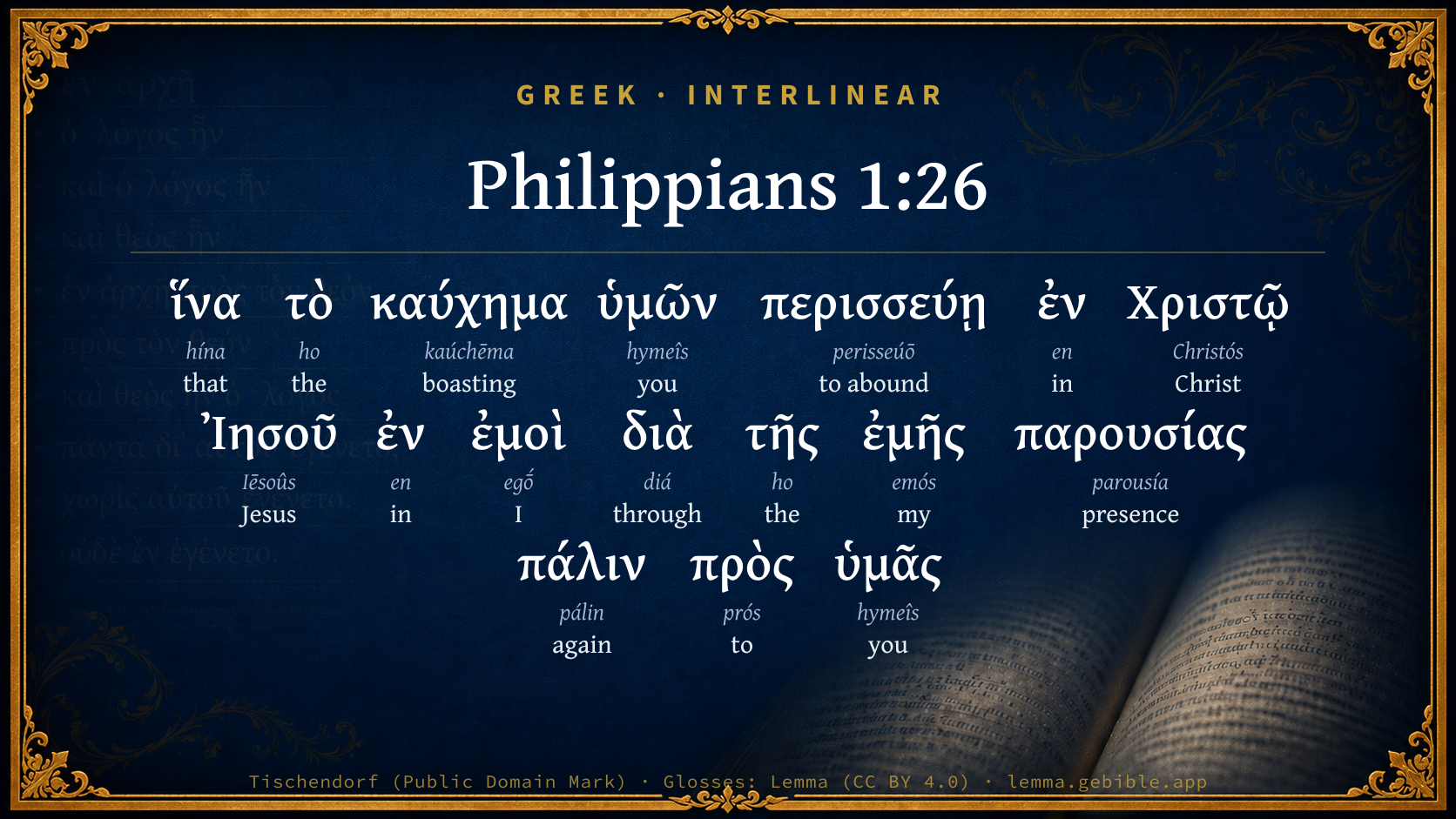
  1. ἵνα hína G2443 “that” Conjunction
  2. τὸ ho G3588 “the” Article, Nominative, Singular, Neuter
  3. ὑμῶν hymeîs G5210 “you” Personal pronoun, 2nd person, Genitive, Plural
  4. περισσεύῃ perisseúō G4052 “to abound” Verb, Present, Active, Subjunctive, 3rd person, Singular
  5. ἐν en G1722 “in” Preposition
  6. Χριστῷ Christós G5547 “Christ” Noun, Dative, Singular, Masculine
  7. Ἰησοῦ Iēsoûs G2424 “Jesus” Noun, Dative, Singular, Masculine
  8. ἐν en G1722 “in” Preposition
  9. ἐμοὶ egṓ G1473 “I” Personal pronoun, 1st person, Dative, Singular
  10. διὰ diá G1223 “through” Preposition
  11. τῆς ho G3588 “the” Article, Genitive, Singular, Feminine
  12. ἐμῆς emós G1699 “my” Possessive pronoun, 1st person, Genitive, Singular, Feminine
  13. παρουσίας parousía G3952 “presence” Noun, Genitive, Singular, Feminine
  14. πάλιν pálin G3825 “again” Adverb
  15. πρὸς prós G4314 “to” Preposition
  16. ὑμᾶς hymeîs G5210 “you” Personal pronoun, 2nd person, Accusative, Plural

About this verse

These counts appear in no published source. They are computed here, from the morphology-tagged text and Lemma’s own curated glosses. What Lemma adds →

17
words
14
distinct lemmas
Pauline Epistles
section

Notable vocabulary

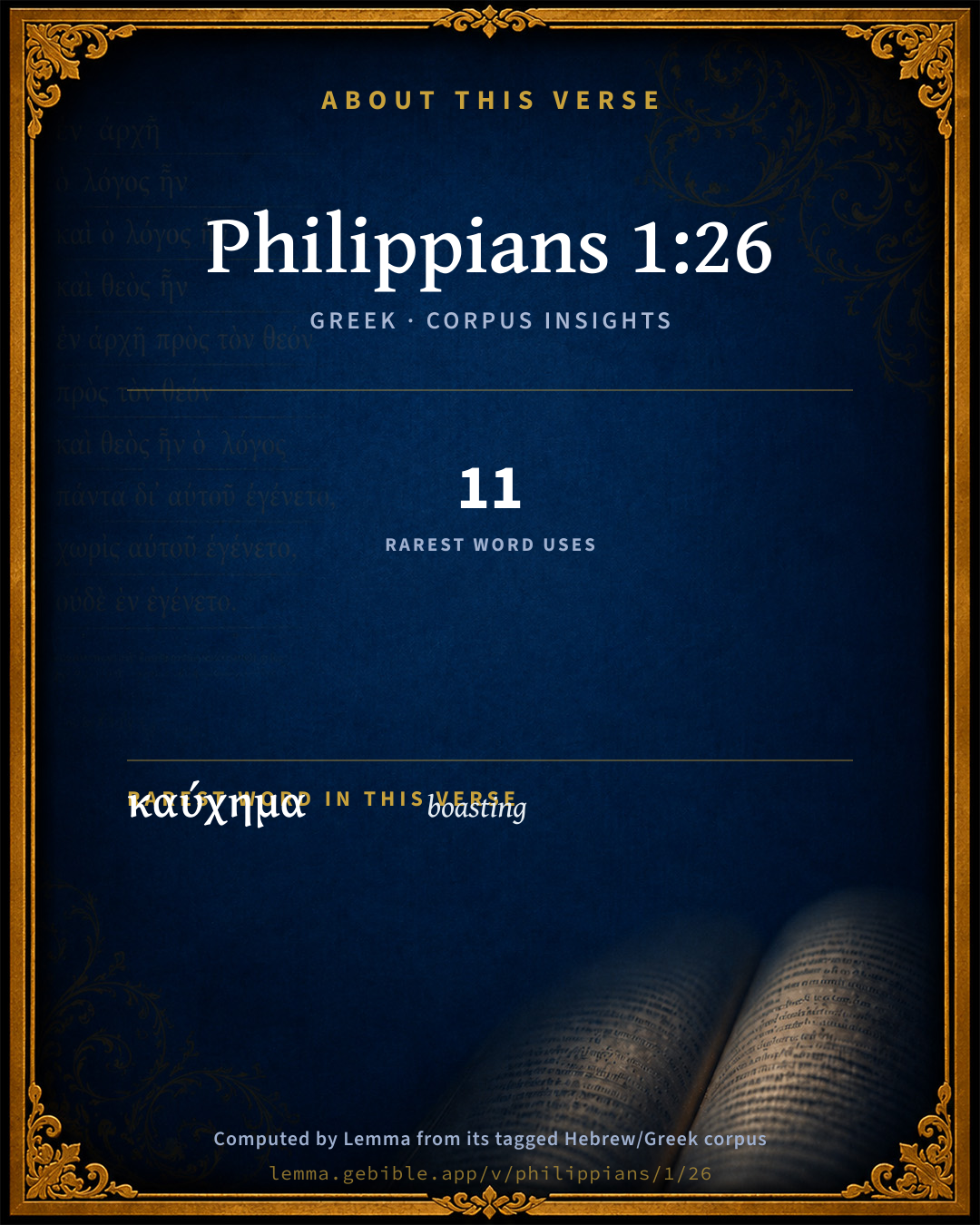
The rarest word here is καύχημα boasting G2745 — appearing just 11 times in the whole Greek New Testament.

Shared distinctive vocabulary

καύχημα boasting G2745 occurs in 11 verses of the Greek New Testament. Also found in:

Repetition

Words recur within this verse:

Cross-references

11

Topical passages linked to Philippians 1:26 in the Treasury of Scripture Knowledge — connected by theme and wording, ordered by reader-vote popularity; previews shown in the World English Bible.

  • 2 Corinthians 1:14 as also you acknowledged us in part, that we are your boasting, even as you also are ours, in the day of our Lord Jesus.
  • 2 Corinthians 5:12 For we are not commending ourselves to you again, but speak as giving you occasion of boasting on our behalf, that you may have something to answer those who boast in appearance, and not in heart.
  • Philippians 3:3 For we are the circumcision, who worship God in the Spirit, and rejoice in Christ Jesus, and have no confidence in the flesh;
  • Philippians 4:4 Rejoice in the Lord always! Again I will say, Rejoice!
  • Song of Solomon 5:1 I have come into my garden, my sister, my bride. I have gathered my myrrh with my spice; I have eaten my honeycomb with my honey; I have drunk my wine with my milk. Friends Eat, friends! Drink, yes, drink abundantly, beloved. Beloved
  • John 16:22 Therefore you now have sorrow, but I will see you again, and your heart will rejoice, and no one will take your joy away from you.
  • John 16:24 Until now, you have asked nothing in my name. Ask, and you will receive, that your joy may be made full.
  • 2 Corinthians 7:6 Nevertheless, he who comforts the lowly, God, comforted us by the coming of Titus;
  • Philippians 2:16–18 holding up the word of life; that I may have something to boast in the day of Christ, that I didn't run in vain nor labor in vain.
  • Philippians 3:1 Finally, my brothers, rejoice in the Lord. To write the same things to you, to me indeed is not tiresome, but for you it is safe.
  • Philippians 4:10 But I rejoice in the Lord greatly, that now at length you have revived your thought for me; in which you did indeed take thought, but you lacked opportunity.

Cross-references courtesy of OpenBible.info (CC BY 4.0).

Commentary

Notes on Philippians 1:26 from classic Christian and Jewish commentators (each source and its license shown beneath its notes). The classic Christian expositions comment on the surrounding passage and are grouped to its opening verse, so a note may address several verses; the Jewish commentaries on the Tanakh (Rashi and others) are per-verse, so they appear only where the commentator wrote on this verse.

Lemma curates 59 commentaries, every one of them public domain or Creative Commons licensed, each selected and text-cleaned for this edition rather than reprinted as found. About our sources →

Bengel's Gnomon

Johann Albrecht Bengel

Php 1:26. Τὸ καύχημα ὑμῶν, your glorying [rejoicing]) concerning my restoration to you, who were praying for that very thing. It is correlative to the words, to my rejoicing [glorying over you], Php 2:16. Glory is joy, proceeding from virtue; glorying is the expression of joy, an affection full of joy: from virtue, either true or false; whence glorying is also true or false; comp. Isa 57:12, where righteousness is called, though it is falsely so called, righteousness.

Bengel's Gnomon of the New Testament — English translation (T&T Clark, Edinburgh, 1860) — public domain. Text from a community e-Sword module.

Expositor's Greek Testament

ed. W. Robertson Nicoll

Phi 1:26 . “In order that your ground of glorying may increase in Christ Jesus through me, by reason of my,” etc. Their καύχημα is their knowledge and possession of the Gospel. Christ Jesus is the sphere in which this blessing is enjoyed. Cf. Sir 9:16 , ἐν φόβῳ Κυρίου ἔστω τὸ καύχημά σου . ἐν ἐμοί is defined by the following clause. Paul looks on his presence with them as an occasion of advance in their Christian calling. ἐν , which here denotes strictly the basis , may be translated “through”. This passage bears out the favourable turn which Paul’s affairs have taken. He looks forward to rejoining them.

The Expositor's Greek Testament, edited by W. Robertson Nicoll (1897–1910) — public domain. Text from a community e-Sword module.

Jamieson, Fausset & Brown

Robert Jamieson, A. R. Fausset & David Brown

Translate, "That your matter of glorying (or rejoicing) may abound in Christ Jesus in me (that is, in my case; in respect to me, or for me who have been granted to your prayers, Phi 1:19) through my presence again among you." ALFORD makes the "matter of glorying," the possession of the Gospel, received from Paul, which would abound, be assured and increased, by his presence among them; thus, "in me," implies that Paul is the worker of the material of abounding in Christ Jesus. But "my rejoicing over you" (Phi 2:16), answers plainly to "your rejoicing in respect to me" here.

Jamieson, Fausset & Brown — Commentary Critical and Explanatory on the Whole Bible (1871) — public domain (CC PDM 1.0). Text via the HelloAO Bible API.

Adam Clarke's Commentary

Verse 26. That your rejoicing may be more abundant] Men rejoice more in recovering a thing that was lost, than they do in a continual possession of what is of much greater value.

Adam Clarke's Commentary on the Bible (1810–1826) — public domain. Text from a community e-Sword/MySword module.

John Calvin's Commentaries

26 That your glorying. The expression which he employs, ἐν ἐμόι, I have rendered de me (as to me,) because the preposition is made use of twice, but in different senses. No one assuredly will deny that I have faithfully brought out Paul’s mind. The rendering given by some — per Christum, (through Christ,) I do not approve of. For in Christ is employed in place of Secundum Christum, (According to Christ,) or Christiane, (Christianly,) to intimate that it was a holy kind of glorying. For otherwise we are commanded to glory in God alone. (1 Corinthians 1:31.) Hence malevolent persons might meet Paul with the objection, How is it allowable for the Philippians to glory as to thee? He anticipates this calumny by saying that they will do this according to Christ — glorying in a servant of Christ, with a view to the glory of his Lord, and that with an eye to the doctrine rather than to the individual, and in opposition to the false apostles, just as David, by comparing himself with hypocrites, boasts of his righteousness. (Psalm 7:8.)

John Calvin's Commentaries (1540-1563) — public domain. Text from the Calvin Translation Society English edition (1840s-50s) via the Christian Classics Ethereal Library (ccel.org). Calvin's coverage is partial (roughly two-thirds of the Bible); uncommented books and verses are honest gaps, never fabricated. The 19th-century editor's footnotes and remarks are omitted so the notes are faithfully Calvin's own voice.

Ellicott's Commentary for English Readers

(26) That your rejoicing may be more abundant.—The word translated “rejoicing” is that favourite word of St. Paul, which signifies a ground of “boasting,” or exultation. It is used both of blessing beyond strict necessity, and of service beyond legal duty; in both of which there is ground for joy and thankfulness. This is, perhaps, best seen in 1Co_9:15-18, where he declares that the simple preaching of the gospel is “nothing to boast of,” but that the preaching it without cost is “the boasting,” of which he says that he would “rather die than that any man should make it void.” (Comp. also the use of the same word in Php_2:16, and in Rom_4:2; 1Co_5:6; 2Co_1:14; 2Co_5:12; 2Co_9:3.) Here, therefore, St. Paul speaks of them as having in him, and in their connection with him, a cause of boasting, or rejoicing, just as in 2Co_1:14 (“We are your rejoicing, even as ye also are ours”), and declares that this will become “more abundant” by his coming to them again.

In Jesus Christ for me.—The original runs, “in Christ Jesus in me.” The parallelism is instructive: all Christian rejoicing, or confidence, is primarily “in Christ Jesus,” even if it be secondarily “in” His servants. The suggestion of this idea here softens the apparent self-consciousness of the previous words. Comp., in 2 Corinthians 11, 12, his declaration of reluctance and distaste for the “boasting” of his apostolic authority and work, which was forced upon him.

By my coming to you again.—See in 1Ti_1:3 the evidence of the fulfilment of this confident expectation.

A Bible Commentary for English Readers, edited by Charles John Ellicott (1878–1897) — public domain. Text from a community e-Sword module.

The Cambridge Bible for Schools and Colleges

gen. ed. J. J. S. Perowne

26. rejoicing] Better, with R.V., glorying; not the same word as that just previous, nor akin to it. The Greek word is a favourite with St Paul, especially in the Epistles to the Romans, Corinthians, and Galatians. This fact is an item in the evidence for the time of writing of this Epistle. See Introduction, p. 14.

may be more abundant] On the Greek word thus rendered we may make the same remark precisely as on “glorying”; see last note.

in Jesus Christ] Read, with all the evidence, in Christ Jesus; and see note on Php_1:1 above.—Observe here, as so often (see above, on Php_1:8), how the whole action of the Christian’s life is carried on “in Christ.” This glad exultant pleasure, this “glorying,” was to be experienced as by men in vital union with their Lord by the Spirit.

for me] Lit. and better, in me.—Here, on the other hand, “in” bears its frequent meaning of “in the case of,” “on occasion of.” Cp. e.g. Gal_1:24 (not Gal_1:16) and 2Th_1:4, a close parallel. This change of interpretation of the same preposition in one passage is not arbitrary. The phrase “in Christ” is, so to speak, stereotyped; not so this latter.—St Paul was to be their occasion for “glorying,” as a living example of the Lord’s faithfulness and love, restoring him to the needing disciples.

by my coming to you] R.V., “through my presence with you.” Better, perhaps, through my coming to you. The word (parousia) rendered “coming” is lit. “presence”; but by usage it very frequently means “coming to be present,” as especially in the case of the “Parousia” of the Lord at the Great Day.

The Cambridge Bible for Schools and Colleges (gen. ed. J. J. S. Perowne; Cambridge University Press, 1878–1918) — public domain. Text from a community e-Sword module.

John Gill's Exposition

That your rejoicing may be more abundant,.... They had rejoiced greatly on his account already, blessing God that ever they had seen his face, or heard his voice; as they had great reason to do, he being the happy instrument of first bringing the Gospel to them, and of their conversion; and now he hoped he should be delivered out of prison, and see them again, that their joy might be increased and abound yet more and more, upon his deliverance, they had so earnestly prayed and so much longed for, and at the sight of him they so dearly loved: and yet to show that this their joy was not looked upon by him as a carnal one, or as arising from a natural affection, he observes that it was

in Jesus Christ; though they rejoiced in him as an instrument, and therefore he adds,

for me; yet it was on account of Jesus Christ, the subject of his ministry; their joy did not centre in the apostle, but had Christ for its object, whose person, righteousness, and salvation were held forth by him to their view and comfort; and though they would still more and more rejoice should he return to them once more,

by my coming to you again; yet still it would he in Christ, and because of the fulness of the blessing of the Gospel of Christ, in which he should come to them.

John Gill's Exposition of the Whole Bible (1746–1763) — public domain (CC PDM 1.0). Text via the HelloAO Bible API.

Trapp's Complete Commentary

John Trapp

26 That your rejoicing may be more abundant in Jesus Christ for me by my coming to you again.

Ver. 26. That your rejoicing] Gr. Your glorying or exulting in this, that God hath given me in, as an answer to your prayers. It is surely a sweet thing to bear from heaven. David often boasts of it, Psa 6:8-9; Psa 66:19-20.

John Trapp, A Commentary or Exposition upon All the Books of the Old and New Testament (1647–1656) — public domain. Text from a community e-Sword module.

Albert Barnes' Notes on the Bible

That your rejoicing may be more abundant in Jesus Christ - Through the mercy and grace of Christ, If he was spared, his deliverance would be traced to Christ, and they would rejoice together in one who had so mercifully delivered him.

For me by my coming to you again - Their joy would not only be that he was delivered, but that he was permitted to see them again.

Albert Barnes' Notes on the Bible (1834–1885) — public domain. Text from a community e-Sword/MySword module.

Matthew Poole's English Annotations

Here, in confidence of being again with them, and staying with them, he expresseth an admirable affection to them, that he can be content for a time to be deprived of the glorious sight of Christ, that he might see and serve them, and that under persecution; that they might, upon his return to them, more abundantly glory together, not in themselves, but, Christian-like, in Christ Jesus, the author of that doctrine he had preached to them, the Captain of their salvation, and the common Head of Christianity.

Matthew Poole's English Annotations on the Holy Bible (1683–1685) — public domain. Text from a community e-Sword/MySword module.

Whedon's Commentary on the Bible

Daniel D. Whedon

26. Affliction—The explanation of the not sincerely is their thinking to add affliction to his bonds, making worse his condition, which was already bad enough. The precise nature of the affliction is not clear. Alford supposes it to be “trouble of spirit,” which hardly consists with Php_1:18. With Ellicott and others, we refer it to outward trouble, by exciting his enemies, either pagans or Jews, and perhaps both, against him, thus putting his life in greater peril, as is evident from his regarding his death (Php_1:20) as the possible result of their machinations. Critical texts invert the order of Php_1:16-17.

26. That your rejoicing—Such an increase of faith and joy because of his coming again, would be good ground for their abundant joy in fellowship with Christ, whose servant he was, whom they were permitted again to see and hear. The apostle, in saying “I know,” should not be understood as assured by revelation or prophetic insight into his own future, but rather as expressing the deep persuasion and earnest hope of his own mind, because his liberation seemed to him so important for the Church. In Php_2:17, he seems less confident. There is no record of a visit to Philippi after this period, but the probability of such a visit depends upon the decision of the question whether he was released from his present imprisonment. See Introduction to 1 Timothy.

Daniel D. Whedon (gen. ed.), Commentary on the Old and New Testaments (1874–1909) — public domain. Text from a community e-Sword module.

The Pulpit Commentary

That your rejoicing may be more abundant in Jesus Christ for me by my coming to you again. Glorying or boasting (kauchma), not rejoicing. Perhaps rather, as Meyer," That the matter in which you have to glory i.e. the bliss in which you rejoice as Christians may increase abundantly in Christ Jesus as the element or sphere of the glorying in me as the instrument or cause."

The Pulpit Commentary (1880–1919), ed. H.D.M. Spence-Jones & Joseph S. Exell — public domain. Text from a community e-Sword module.

Godbey's Commentary on the New Testament

William B. Godbey

ARGUMENT 3

SECOND IMPRISONMENT

26. “In order that your rejoicing may abound in Christ Jesus, in me through my coming again unto you.” I believe with Dean Alford and the abler critics, that Paul passed through two distinct imprisonments at Rome. All the Roman authorities in Judea, Lysias, Felix, and Agrippa, pronounced a verdict of innocence in behalf of Paul, certifying to his legal manumission so far as the criminal charges against him were concerned, as they consisted only in accusations of disharmony with Jewish laws and customs, which had no criminal signification in Roman jurisdiction. The only reason for which he was carried a prisoner to Rome, was because he had appealed to Caesar. This he did, not because he cared anything about Caesar’s tribunal, but that he might verify his long-cherished aspiration of preaching the gospel in the world’s capital and metropolis, that the light of God’s truth, radiating from the center, might shine out into every land. His rights as a Roman citizen entitled him to an appeal to Caesar, thus forcing his enemies to defray his traveling expenses all the way from Jerusalem to Rome, a journey at that time greater than the circumnavigation of the globe at the present day. When finally he stood at Caesar’s tribunal, as he was charged with nothing criminal in Roman law, they could but acquit him. This took place about A.D. 63 or 64; after which he returned to Asia, visiting the Churches the last time. Having crossed the Aegean Sea again, he lands in Greece, where he wrote the first letter to Timothy and Titus, expecting to spend the winter of A.D. 68 at Nicopolis, in Southern Macedonia. About that time a great fire sweeps over Rome, wrapping the city in an ocean of flame six days and seven nights. When I was there my guide showed me the old tower on which Nero sat during the conflagration, playing his fiddle, and singing the destruction of Troy.

Though all the people believed that the wicked emperor had ordered the conflagration, he charged the Christians with that dark iniquity, lighting on it as a pretext for issuing that bloody edict which caused them to bleed and burn three hundred years. Though Paul was not at Rome during the conflagration, when this high crime is saddled on the Christians, they have him arrested about Nicopolis in Greece, because he was a prominent leader of the Nazarenes. Upon his second arrest and transportation to Rome, he was incarcerated in that loathsome old Mamertine prison, not as a mere disturber of the Jewish religion, as in the first imprisonment, but as “an evil doer.” (2Ti 2:9.) Kakourgos, from kakos, evil, and ergos, work, is the word here applied to him in his second imprisonment. It is because they accused him of burning Rome, which was a crime of the darkest dye. From this prison led out, he was tried by Nero, and condemned to decapitation. This locates his martyrdom about A.D. 68.

William B. Godbey, Commentary on the New Testament (1896–1900) — public domain. Text from a community e-Sword module.

The People's New Testament

B. W. Johnson

26. That your rejoicing. Nay, he is assured that the Philippians will rejoice over a visit from him. There is every reason to believe that his confidence was justified; that he was released and did again visit Philippi.

B. W. Johnson's The People's New Testament with Notes (1889–1891) — public domain. Electronic text from the Christian Classics Ethereal Library (CCEL) ThML edition.

Cambridge Greek Testament for Schools and Colleges

26. καύχημα. A favourite word with St Paul, and especially in Romans, Corinthians, and Galatians; a fact bearing on the date of this Epistle. See Introduction, ch. ii. Καύχημα is an act of exultation, of glorying; or otherwise (see Lightfoot on Gal 6:4) a ground for exultation, as distinct from καύχησις, the exultation itself. This distinction however must not be over-drawn, as there is a tendency, in later Greek especially, to blend the meanings of nouns in -μα and -σις.

περισσεύῃ. Again a favourite word with St Paul, and in the Epistles named in the last note.

ἐν Χριστῷ Ἰησοῦ. The “glorying,” like all the actions of the Christian’s spirit, was to be conditioned by his life in Christ.

ἐν ἐμοὶ. Here ἐν doubtless means “in the case of,” “on occasion of.” Cp. Gal 1:24, and (a close parallel) 2Th 1:4, ὥστε ἡμᾶς … ἐν ὑμῖν καυχᾶσθαι. This variation in the rendering of ἐν (see last note) is not capricious. The phrase ἐν Χριστῷ was, so to speak, stereo-typed in its reference to the mystical Union; this phrase was familiar in another reference. St Paul was to be their occasion of “glorying,” because his restoration to them would be an example of their Lord’s faithful love to them.

διὰ τῆς ἐμῆς παρουσίας πάλιν πρὸς ὑμᾶς. We may paraphrase, “through my return (πάλιν, rursus) to you and presence with you.” R.V., “through my presence with you again.” Yet the A.V., “by my coming to you again,” is probably better as a short rendering. Παρουσία is literally “presence,” but by usage it often denotes a coming into presence, so as almost to absorb the thought of “presence” in that of “coming.” Cp. e.g. 1Th 4:16, where the subject is the great παρουσία τοῦ κυρίου, the hope of the Church.

Cambridge Greek Testament for Schools and Colleges (Cambridge University Press, 1896; 21 vols, various authors incl. Carr, Maclear, Plummer, Farrar, Lumby, Moule, M. R. James, Simcox) — public domain. Text from a community e-Sword module.

Alford’s Greek Testament

Henry Alford

26.] that your matter of boasting (not, as Chr., ‘mine in you:’ nor, as commonly rendered, ‘your boasting’ (καύχησις). Their Christian matter of boasting in him was, the possession of the Gospel, which they had received from him, which would abound, be assured and increased, by his presence among them) may abound in Christ Jesus (its field, element of increase, it being a Christian matter of glorying) in me (its field, element, of abounding in Christ Jesus, I being the worker of that which furnishes this material) by means of my presence again with you.

Henry Alford, The Greek Testament (1849–1861) — public domain. Text from a community e-Sword module.

International Critical Commentary

26. ἵνα τὸ καύχημα ὑμῶν περισσεύῃ: ‘that your glorying may abound.’ Ἵνα marks the ultimate aim of μενῶ καὶ παραμενῶ, and the clause defines more specifically the general statement εἰς τὴν ὑμ. προκ., etc. Καύχημα is the matter or ground of glorying, not the act of glorying, which would be καύχησις, as Rom 3:27; 2Co 1:12. (Comp. Rom 4:2; 1Co 9:15; Gal 6:4.)

Ὑμῶν is subjective: Not ‘my ground of glorying in you,’ but ‘your ground of glorying.’

ἐν Χριστῷ Ἰησοῦ: With περισσεύῃ, not with καύχημα. (Comp. 1:9; Rom 3:7; Col 2:7.) Christ is the element or sphere in which the abounding develops. Christ is always needed to control, no less than to promote, overflow. The abundant glorying does not take place in the sphere of human ambition, like that of the Jew in his law and his nationality,—the ‘boasting according to the flesh’ (2Co 11:18); ‘in men’ (1Co 3:21); ‘in appearance’ (2Co 5:12).

ἐν ἐμοὶ: The immediate occasion of the glorying would be Paul. The ground of boasting would attach specially to him as the representative of the cause which was the great matter of glorying. Ἐν ἐμοὶ is a special cause or ground within the sphere designated by ἐν ΧἸ.

διὰ τῆς ἐμῆς παρουσίας πάλιν πρὸς ὑμᾶς: Connect with ἐν ἐμοὶ as a special instance. The ground of glorying is first, and comprehensively, in Christ; then in Paul as representing Christ; then in Paul’s personal presence again with them. Παρουσίας, in its ordinary sense, as 2:12; 1Co 16:17, etc. There is a slight emphasis on the word as contrasted with letters or messages. How far Paul’s confidence in his liberation and future personal intercourse with the Philippians was justified, it is impossible to determine without more knowledge concerning the latter portion of his career.

He now proceeds to give his readers some practical exhortations. Until he can personally minister to their faith, he must content himself with writing to them. Their standard of Christian consistency and efficiency must not be regulated by his personal presence or absence.

International Critical Commentary — older volumes (1896–1929), various authors — public domain. Text from a community e-Sword module.

Vincent's Word Studies in the New Testament

Marvin R. Vincent

Rejoicing [καυχημα] . The matter of rejoicing, wrought through your faith.

In Christ Jesus for me [εν χριστω ιησου εν εμοι] . Construe in Christ Jesus with may abound, not with rejoicing. Christ is conceived as the element in which the matter of rejoicing grows and abounds. For me, better, as Rev, in me. The conjunction of the two phrases in Christ, in me, is somewhat confusing Paul 's presence is the immediate cause of their christian joy; hence in me; but their rejoicing in Paul is in Christ - a joy evolved within the sphere of life in Christ, and peculiar to those only to whom to live is Christ.

Coming [παρουσιας] . Rev., better, presence.

Marvin R. Vincent, Word Studies in the New Testament (1887–1900) — public domain. Text from a community e-Sword/MySword module.

Lesson kit

Teaching starters — assembled from the data on this page, not authored interpretation. Every prompt links to the verse data it draws on. Edit before teaching.

Philippians, in the Pauline Epistles, opens this verse with 17 words (14 distinct Greek lemmas). Its most distinctive word is kaúchēma (“boasting”). A historical commentator’s framing appears above. Read the whole chapter for the surrounding context.

Discussion questions

  1. What does “boasting” (kaúchēma) contribute to the verse as a whole?
  2. Romans 4:2 shares the word «boasting» with this verse. How do the two illuminate each other?
  3. “the” occurs 2× in this one verse. What is the effect of the repetition?
  4. The translations on this page render this verse differently — a whole-verse word diff, not a word-by-word alignment. What might account for the different wordings?
  5. Reading how Bengel's Gnomon and Expositor's Greek Testament read this verse, where do the two commentators agree and where do they part?

Things to notice

Reading settings

Reading text

Shown beneath each verse's original-language words.

Old Testament
Old Testament edition

Read the OT as the Masoretic Hebrew (MT) or the Greek Septuagint (LXX).

English shown for the Greek Septuagint (in the Hebrew ↔ Greek comparison).

Comparing translations? Open the Compare panel on any verse page to stack up to four side by side.