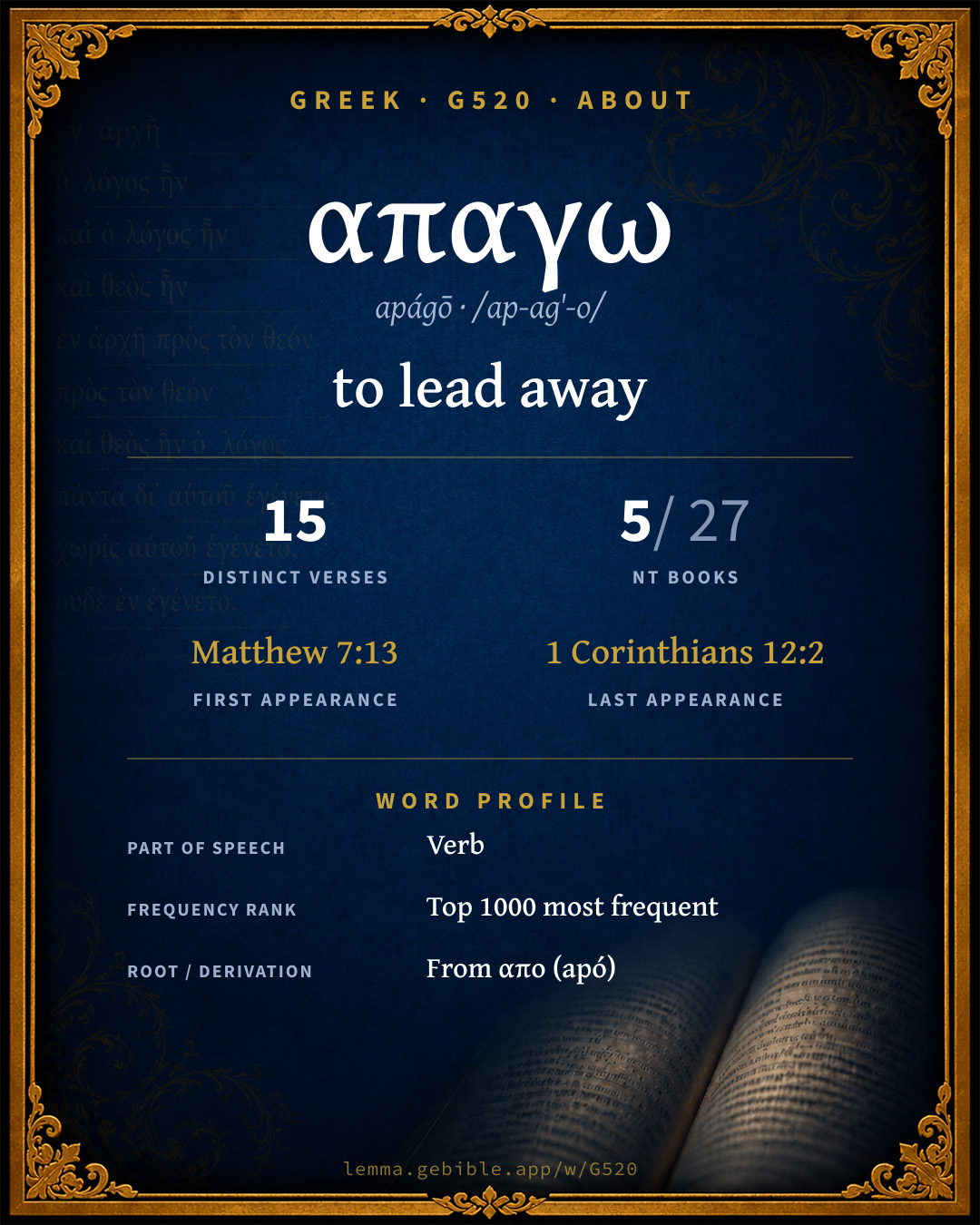
ἀπάγω
to lead away
Full lexicon entry — Thayer's Greek Lexicon
From Thayer's Greek Lexicon
Where this word appears
See every Aorist-tense verb in the Greek New Testament →
Grammar key — what these labels mean
Part of speech
- Verb
- An action or state-of-being word.
Tense
- Aorist
- Action viewed as a simple whole, without regard to duration — often past (perfective aspect).
- Present
- Ongoing or general action in present time (imperfective aspect).
Voice
- Active
- The subject performs the action.
- Passive
- The subject receives the action.
Mood
- Indicative
- States a fact or asks a factual question (the mood of reality).
- Participle
- A verbal adjective (“writing,” “having written”).
- Infinitive
- A verbal noun (“to write”), unmarked for person or number.
- Imperative
- Expresses a command or request.
Case
- Nominative
- The case of the subject (and the predicate nominative).
- Accusative
- The case of the direct object and of extent.
Person
- 3rd person
- The one spoken about (“he / she / it / they”).
- 2nd person
- The one addressed (“you”).
Gender
- Feminine
- Grammatically feminine.
- Masculine
- Grammatically masculine.
Number
- Plural
- More than one.
- Singular
- One.
2 verses where G520 appears in the Aorist tense in the Book of Mark. Filtered view — show all forms. Click any verse to open its interlinear word-by-word view. Verse text shown in the World English Bible for context — . Each verse’s Greek form is shown with its reference; the English is not keyword-highlighted, since the data carries no word-level English alignment. Use “Compare translations” on any verse to read it across multiple English versions. This concordance covers the Greek New Testament; Septuagint (Greek Old Testament) occurrences of this word are not indexed here.
Mark
About this entry
At a glance — auto-summarized from this page’s data, not written by a person. Every figure links to its source below. This summary describes the numbers; it doesn’t interpret them.
“to lead away” is the headline sense of the Greek verb απαγω (apágō). First canonically at Matthew 7:13, it enters the text early. It appears 15 verses across 5 books of the Greek New Testament, among its uncommon vocabulary. More than a third of its appearances fall in Matthew. Related forms include απο, απαγγελλω and απαγχομαι. The sections below give every sense, occurrence, and version rendering.
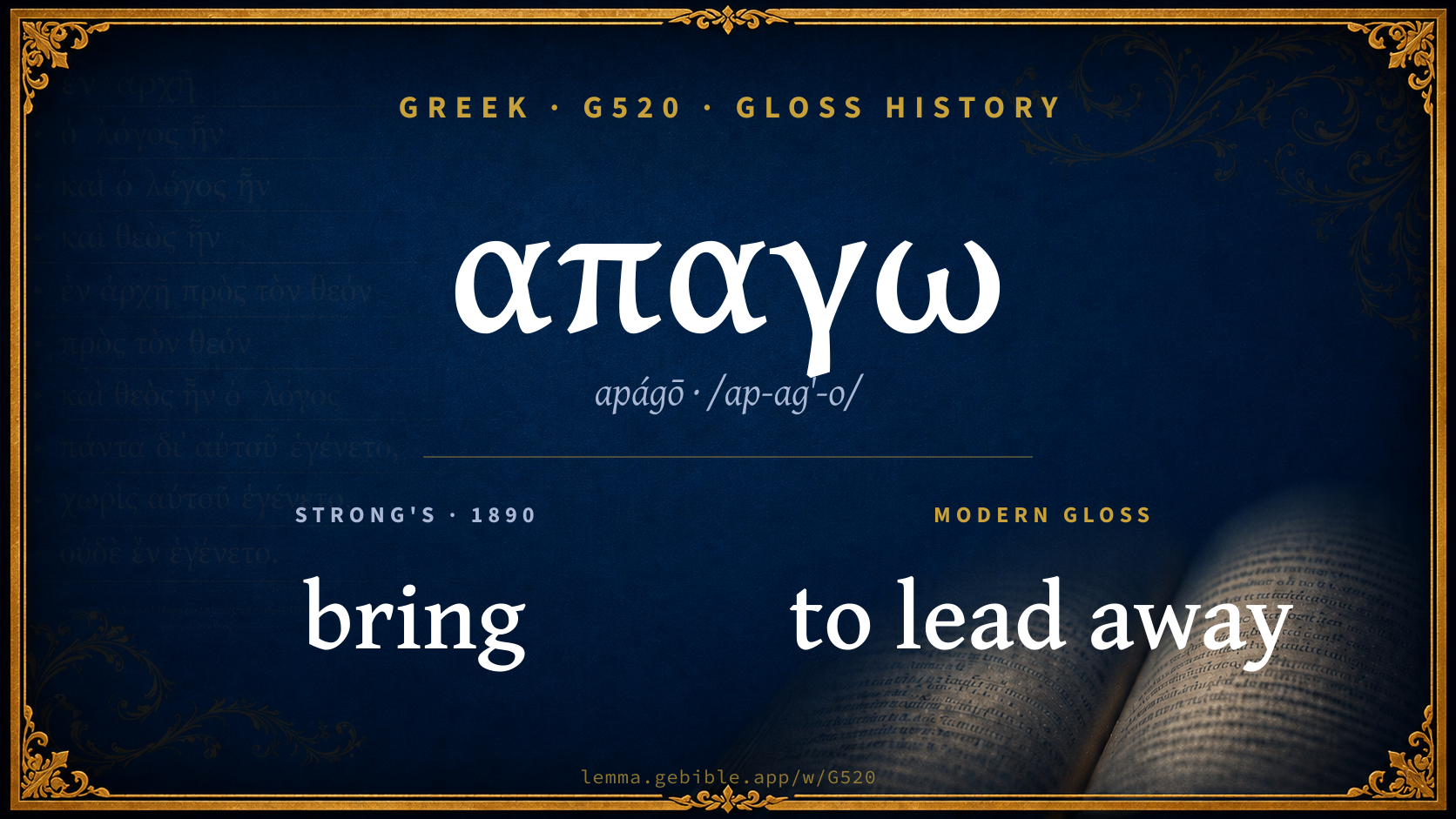
Gloss history
Strong's 1890 vs modern scholarship
About this word
Strong's G520 catalogs a Greek word from the Greek New Testament.
These counts are not copied from any lexicon or concordance. They are computed here, from the morphology-tagged Greek New Testament. What Lemma adds →
- 15
- distinct verses
- The word appears in 15 distinct verses.
- 5 / 27
- NT books
- The word appears in 5 of 27 New Testament books.
- #768
- by frequency
- Top 1000 most frequent Greek words (rank 768 of 5,347 Greek words by occurrence).
View all 15 occurrences in the concordance →
By section of the New Testament
By traditional corpus
Conventional, traditional groupings — biblical authorship is debated, so this is a traditional corpus grouping, not an authorship claim. Some books belong to more than one corpus (Luke is in both the Gospels and the Lukan corpus, and so on), so these shares overlap and need not total 100%. Each figure is a share of the word’s 15 distinct verses.
- Gospels 12 verses · 80%
- Lukan (Luke–Acts) 6 verses · 40%
- Pauline corpus 1 verse · 7%
How translations render this word
Counts come from each version’s own published word-to-Strong’s tagging or interlinear alignment — an approximate guide to how each version renders this word, not a word-level alignment the data otherwise carries. Because each total is that version’s own tagged count, the per-version totals vary from one another and need not match the appearance or distinct-verse counts above. These counts may also differ from a printed concordance because Lemma counts each distinctly tagged rendering and does not collapse phrase taggings into a single head-word total. This is a fixed set of word-tagged versions (KJV, ASV, BSB, ULT) and does not change with the reading translation you choose elsewhere. Each version’s license is shown beside its name below (and on Sources).
- King James Version: Away 5×, Led 3×, Lead him away 2×
- American Standard Version: Away 8×, Led 5×, Lead 2×
- Berean Standard Bible: Led away 3×, Leads 2×, They led 2×
- unfoldingWord Literal Text: Away 7×, Led 4×, They led 4×
King James Version Public Domain
Renders G520 across 21 tagged occurrences — most commonly:
Plus 5 renderings that appear only once — usually multi-word phrases or single function words the recovered tagging swept in, not distinct renderings.
American Standard Version Public Domain
Renders G520 across 22 tagged occurrences — most commonly:
Plus 3 renderings that appear only once — usually multi-word phrases or single function words the recovered tagging swept in, not distinct renderings.
Berean Standard Bible Public Domain
Renders G520 across 15 tagged occurrences — most commonly:
Plus 8 renderings that appear only once — usually multi-word phrases or single function words the recovered tagging swept in, not distinct renderings.
unfoldingWord Literal Text CC BY-SA 4.0
Renders G520 across 25 tagged occurrences — most commonly:
Plus 8 renderings that appear only once — usually multi-word phrases or single function words the recovered tagging swept in, not distinct renderings.
Senses in Thayer's
The 1 sense Thayer's distinguishes for this word, in lexicon order (not ranked by frequency or importance). The full entry — with sub-senses — is in the Lexicon Entry tab.
- esp. of those who are led off to trial, prison, or punishment
Word origin
Derived from απο (apó) (G575) — from.
Forms in the corpus
The 8 distinct written forms G520 takes in the Greek New Testament, most frequent first — each parse links to that tense’s occurrences in the concordance.
| Form | Parsing | Example | Uses |
|---|---|---|---|
| ἀπήγαγον apḗgagon | Verb, Aorist, Active, Indicative, 3rd person, Plural | Matthew 26:57 | 7 |
| ἀπάγουσα apágousa | Verb, Present, Active, Participle, Nominative, Singular, Feminine | Matthew 7:13 | 2 |
| ἀπάγετε apágete | Verb, Present, Active, Imperative, 2nd person, Plural | Mark 14:44 | 1 |
| ἀπαγαγὼν apagagṑn | Verb, Present, Active, Participle, Nominative, Singular, Masculine | Luke 13:15 | 1 |
| ἀπαγομένους apagoménous | Verb, Present, Passive, Participle, Accusative, Plural, Masculine | Luke 21:12 | 1 |
| ἀπαγόμενοι apagómenoi | Verb, Present, Passive, Participle, Nominative, Plural, Masculine | 1 Corinthians 12:2 | 1 |
| ἀπαχθῆναι apachthē̂nai | Verb, Aorist, Passive, Infinitive | Acts 12:19 | 1 |
| ἄπαγε ápage | Verb, Present, Active, Imperative, 2nd person, Singular | Acts 23:17 | 1 |
Same root — word family
Other Thayer's entries built from the same root as G520, grouped by Strong’s listed origin. These share a root / origin per the lexicon — not necessarily a shared meaning. Each links to that word’s own entry.
Derives from
Shares the same root
- απαγγελλω apangéllō G518 to report
- απαγχομαι apánchomai G519 to strangle
- απαιρω apaírō G522 to take away
- απαιτεω apaitéō G523 to demand back
- απαλγεω apalgéō G524 to cease grieving
- απαλλασσω apallássō G525 to depart
- απαλλοτριοω apallotrióō G526 to estrange
- απανταω apantáō G528 to meet
- απαρνεομαι aparnéomai G533 to deny
- απαρτι apárti G534 henceforth
- απαρχη aparchḗ G536 to offer firstfruits
- απαυγασμα apaúgasma G541 brightness
- απειδω apeídō G542 to look away
- απειμι ápeimi G548 to depart
- απειμι ápeimi G549 to depart
- απειπομην apeipómēn G550 to declare
- απεκδεχομαι apekdéchomai G553 waiting for
- απεκδυομαι apekdýomai G554 to despoil
- απελαυνω apelaúnō G556 to drive away
- απελεγμος apelegmós G557 censure
- απελευθερος apeleútheros G558 freedman
- απελπιζω apelpízō G560 not despairing
- απεναντι apénanti G561 opposite
- απερχομαι apérchomai G565 to depart
+85 more words share this root (not shown).
Compare all same-root words → Showing 4 of 111 — not the complete family. They share a root, not necessarily a meaning.
Septuagint usage
The same Greek word απαγω appears 32 times in the Greek Old Testament (Septuagint), across 31 verses in 13 books.
- 32
- LXX occurrences
- Tagged occurrences of this Greek word in the Septuagint.
- 31
- verses
- Distinct Septuagint verses containing this word.
- 13 / 39
- OT books
- The word appears in 13 of the 39 Old Testament books.
Sample Septuagint occurrences
- Genesis 31:18 ἀποἄγω
- Exodus 14:6 ἀποἄγω
- Deuteronomy 28:36 ἀποἄγω
- 1 Samuel 6:7 ἀποἄγω
- 1 Kings 1:38 ἀποἄγω
- 2 Kings 6:19 ἀποἄγω
- 2 Chronicles 36:6 ἀποἄγω
- Job 21:30 ἀποἄγω
- Psalms 59:11 ἀποἄγω
- Proverbs 16:25 ἀποἄγω
- Isaiah 16:3 ἀποἄγω
- Lamentations 3:2 ἀποἄγω
Septuagint occurrences (same lexeme)
Every verse where the same Strong’s number (G520) appears in the Greek Septuagint. Verse text shown in the World English Bible for context; the Greek form is the matched word — the English is not keyword-highlighted.
- Genesis 31:18 ἀποἄγω and he carried away all his cattle, and all his substance which he had gathered, the cattle of his getting, which he had gathered in Paddan Aram, to go to Isaac his father to the land of Canaan.
- Genesis 31:26 ἀποἄγω Laban said to Jacob, "What have you done, that you have deceived me, and carried away my daughters like captives of the sword?
- Genesis 39:22 ἀποἄγω The keeper of the prison committed to Joseph's hand all the prisoners who were in the prison. Whatever they did there, he was the doer of it.
- Genesis 40:3 ἀποἄγω He put them in custody in the house of the captain of the guard, into the prison, the place where Joseph was bound.
- Genesis 42:16 ἀποἄγω Send one of you, and let him get your brother, and you shall be bound, that your words may be tested, whether there is truth in you, or else by the life of Pharaoh surely you are spies."
- Genesis 42:19 ἀποἄγω If you are honest men, then let one of your brothers be bound in your prison-house; but you go, carry grain for the famine of your houses.
- Exodus 14:6 ἀποἄγω He made ready his chariot, and took his army with him;
- Deuteronomy 28:36 ἀποἄγω Yahweh will bring you, and your king whom you shall set over you, to a nation that you have not known, you nor your fathers; and there shall you serve other gods, wood and stone.
- Deuteronomy 28:37 ἀποἄγω You shall become an astonishment, a proverb, and a byword, among all the peoples where Yahweh shall lead you away.
- 1 Samuel 6:7 ἀποἄγω Now therefore take and prepare yourselves a new cart, and two milk cattle, on which there has come no yoke; and tie the cattle to the cart, and bring their calves home from them;
- 1 Samuel 23:5 ἀποἄγω David and his men went to Keilah, and fought with the Philistines, and brought away their cattle, and killed them with a great slaughter. So David saved the inhabitants of Keilah.
- 1 Samuel 30:20 ἀποἄγω David took all the flocks and the herds, [which] they drove before those [other] cattle, and said, This is David's spoil.
- 1 Samuel 30:22 ἀποἄγω Then answered all the wicked men and base fellows, of those who went with David, and said, Because they didn't go with us, we will not give them anything of the spoil that we have recovered, except to every man his wife and his children, that he may lead them away, and depart.
- 1 Kings 1:38 ἀποἄγω So Zadok the priest, and Nathan the prophet, and Benaiah the son of Jehoiada, and the Cherethites and the Pelethites, went down, and caused Solomon to ride on king David's mule, and brought him to Gihon.
- 2 Kings 6:19 ἀποἄγω Elisha said to them, This is not the way, neither is this the city: follow me, and I will bring you to the man whom you seek. He led them to Samaria.
- 2 Kings 11:4 ἀποἄγω In the seventh year Jehoiada sent and fetched the captains over hundreds of the Carites and of the guard, and brought them to him into the house of Yahweh; and he made a covenant with them, and took an oath of them in the house of Yahweh, and shown them the king's son.
- 2 Kings 17:27 ἀποἄγω Then the king of Assyria commanded, saying, Carry there one of the priests whom you brought from there; and let them go and dwell there, and let him teach them the law of the god of the land.
- 2 Kings 24:15 ἀποἄγω He carried away Jehoiachin to Babylon; and the king's mother, and the king's wives, and his officers, and the chief men of the land, carried he into captivity from Jerusalem to Babylon.
- 2 Kings 25:20 ἀποἄγω Nebuzaradan the captain of the guard took them, and brought them to the king of Babylon to Riblah.
- 2 Chronicles 36:6 ἀποἄγω Against him came up Nebuchadnezzar king of Babylon, and bound him in fetters, to carry him to Babylon.
- 2 Chronicles 36:17 ἀποἄγω Therefore he brought on them the king of the Chaldeans, who killed their young men with the sword in the house of their sanctuary, and had no compassion on young man or virgin, old man or gray-headed: he gave them all into his hand.
- Job 21:30 ἀποἄγω That the evil man is reserved to the day of calamity? That they are led forth to the day of wrath?
- Job 24:3 ἀποἄγω They drive away the donkey of the fatherless, And they take the widow's ox for a pledge.
- Psalms 59:11 ἀποἄγω Don't kill them, or my people may forget. Scatter them by your power, and bring them down, Lord our shield.
- Psalms 107:11 ἀποἄγω Because they rebelled against the words of God, And condemned the counsel of the Most High.
- Psalms 124:5 ἀποἄγω Then the proud waters would have gone over our soul.
- Psalms 136:3 ἀποἄγω Give thanks to the Lord of lords; For his loving kindness endures forever:
- Proverbs 16:25 ἀποἄγω There is a way which seems right to a man, But in the end it leads to death.
- Isaiah 16:3 ἀποἄγω Give counsel, execute justice; make your shade as the night in the midst of the noonday; hide the outcasts; don't betray the fugitive.
- Lamentations 3:2 ἀποἄγω He has led me and caused me to walk in darkness, and not in light.
- Daniel 4:18 ἀποἄγω This dream I, king Nebuchadnezzar, have seen; and you, Belteshazzar, declare the interpretation, because all the wise men of my kingdom are not able to make known to me the interpretation; but you are able; for the spirit of the holy gods is in you.
These are occurrences of the same Greek lexeme (G520) in the Septuagint — not a translation of any one Hebrew word. The store carries no word-level Hebrew↔Greek alignment, so no Hebrew original is asserted here. Counts come from the recovered LXX Strong's tagging — high-frequency vocabulary is well covered, while rare or late forms may be untagged — so they reflect tagged occurrences and may slightly undercount.