
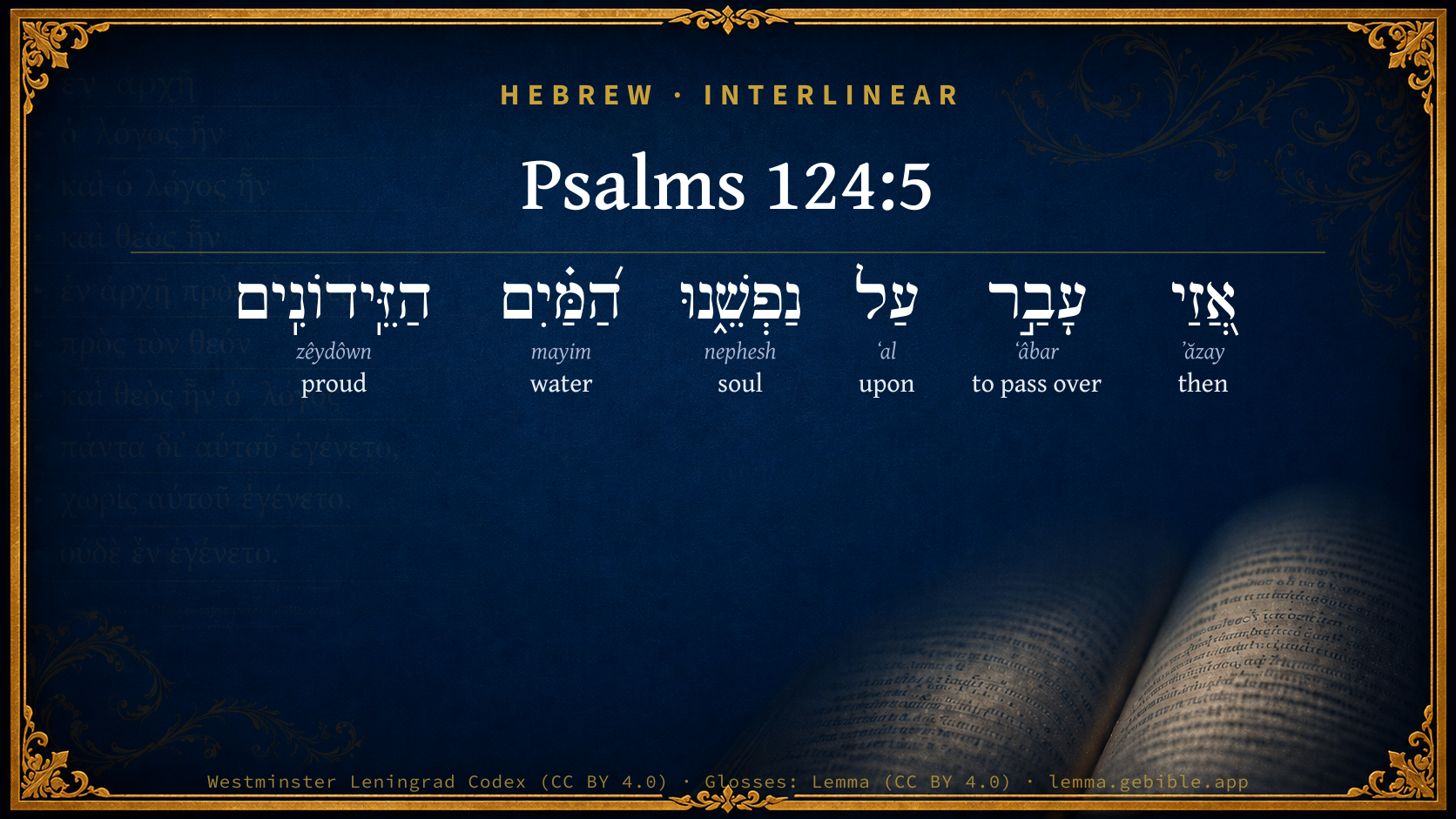
Psalms 124:5

Hebrew (Westminster Leningrad Codex) Psalms 124:5 appears in the Hebrew Old Testament. The text above is from the Westminster Leningrad Codex. Each word links to its Strong’s number, a concise gloss, and parsing drawn from the Open Scriptures Hebrew Bible morphology. Click any word for its full Brown-Driver-Briggs (BDB) entry.
Download image
Cite this verse

Psalms 124:5 (World English Bible). Public Domain. Lemma interlinear Bible study tool, https://lemma.gebible.app/v/psalms/124/5.

Show BibTeX & RIS
BibTeX
RIS
English Translation
Then the proud waters would have gone over our soul.
World English Bible · Public Domain
Highlights
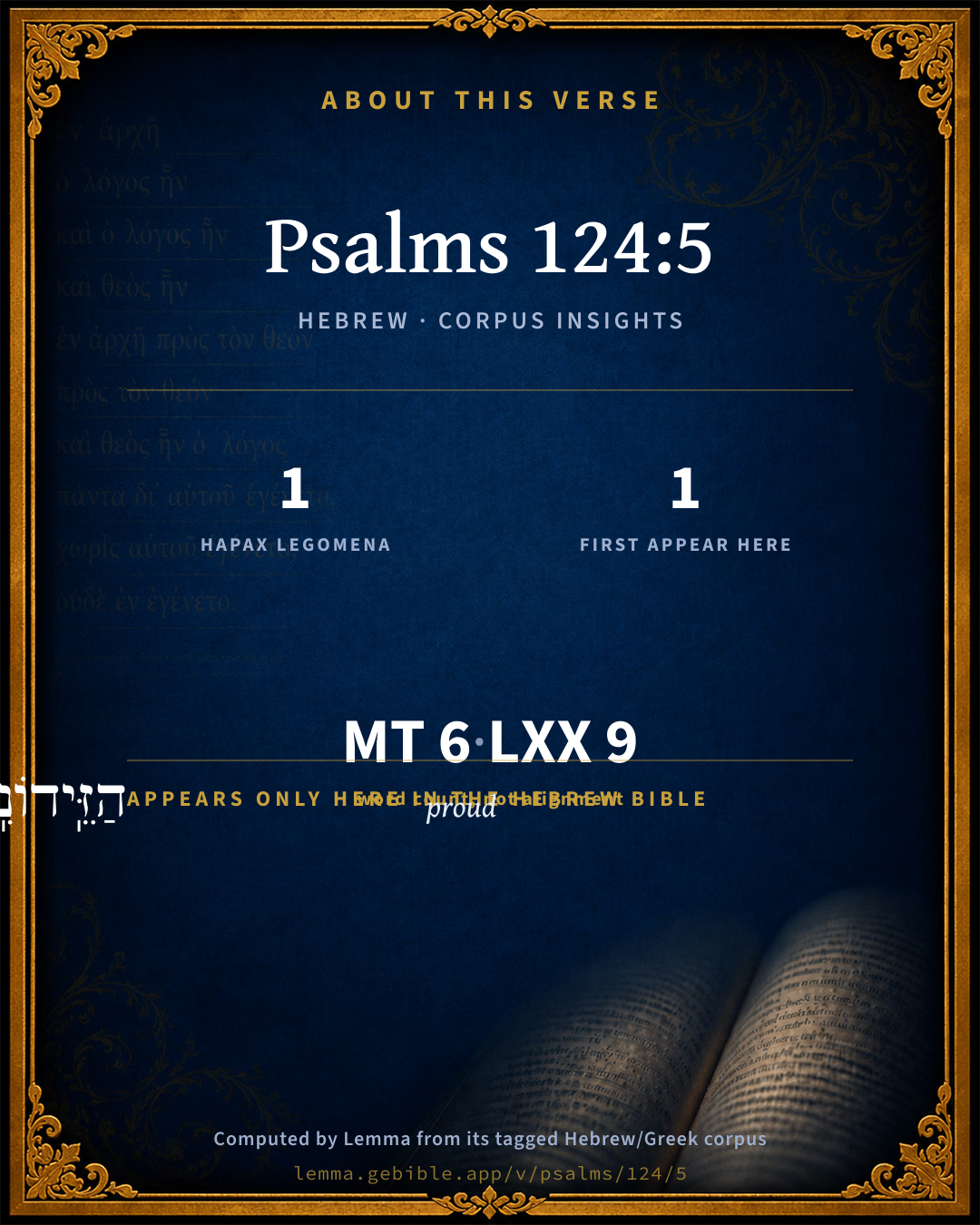
  • 1 hapax legomenon — only here in the Hebrew Bible
  • 1 first appearance in the Hebrew Bible
Full analysis ↓
Download a study sheet

One document with this verse’s original text, its word-by-word gloss line, the meaning frame, cross-references with their text, attributed commentary, and full source and license credits — printable, and it pastes into notes with its structure intact.

This verse Autodidact and up

Study sheet (.html) Plain text (.txt)

A passage Seminary Student

Up to 50 verses in one chapter. A passage sheet keeps up to 6 commentary sources and 12 cross-references per verse, in the order this page ranks them, and says so on the sheet whenever that leaves anything out. Ask for a single verse and you get the Autodidact verse sheet above.

Everything on this page stays free to read, with no account — the sheet is a download of what is already on screen, not access to it.

Want to remove ads? Support Godless Engineer
Compare translations 3

The same verse in 3 English versions, stacked beneath the original-language interlinear above. Click any original word for its lexicon entry.

Each is an independent rendering of the whole verse — the interlinear is not word-aligned to these translations.

Highlighted words mark where these versions differ — a whole-verse word diff, not a word-by-word alignment.

  • World English Bible Public Domain
    Then the proud waters would have gone over our soul.
  • King James Version Public Domain
    Then the proud waters had gone over our soul.
  • unfoldingWord Literal Text CC BY-SA 4.0
    Then the raging waters would have passed over our soul.

unfoldingWord Literal Text — © unfoldingWord, licensed CC BY-SA 4.0. Word-aligned USFM3 via Door43 (git.door43.org/unfoldingWord/en_ult).

Versions to compare (up to 4)

3 of 4 selected

Show all 17 translations

Every available English version of this verse, each an independent rendering of the whole verse.

  • World English Bible Public Domain
    Then the proud waters would have gone over our soul.
  • Berean Standard Bible Public Domain
    then the raging waters would have swept us away.
  • Majority Standard Bible Public Domain
    then the raging waters would have swept us away.
  • King James Version Public Domain
    Then the proud waters had gone over our soul.
  • American Standard Version (1901) Public Domain
    Then the proud waters had gone over our soul.
  • Revised Version (1885) Public Domain
    Then the proud waters had gone over our soul.
  • Geneva Bible (1599) Public Domain
    Then had the swelling waters gone ouer our soule.
  • Young's Literal Translation Public Domain
    Then passed over our soul had the proud waters.
  • Literal Standard Version CC BY-SA 4.0
    Then proud waters had passed over our soul.
  • Unlocked Literal Bible CC BY-SA 4.0
    Then the raging waters would have drowned us.”
  • unfoldingWord Literal Text CC BY-SA 4.0
    Then the raging waters would have passed over our soul.
  • Darby Bible Public Domain
    Then the proud waters had gone over our soul.
  • World Messianic Bible Public Domain
    Then the proud waters would have gone over our soul.
  • Webster's Bible Public Domain
    Then the proud waters had gone over our soul.
  • Free Bible Version CC BY-SA 4.0
    They would have rushed over us like raging waters, drowning us.
  • Bible in Basic English Public Domain
    Yes, the waters of pride would have gone over our soul.
  • JPS Tanakh (1917) Public Domain
    Then the proud waters had gone over our soul.'

Literal Standard Version (2020), Covenant Press — licensed CC BY-SA 4.0. Text via the HelloAO Bible API (eBible.org). Unlocked Literal Bible (unfoldingWord) — licensed CC BY-SA 4.0. Text via the HelloAO Bible API (eBible.org). unfoldingWord Literal Text — © unfoldingWord, licensed CC BY-SA 4.0. Word-aligned USFM3 via Door43 (git.door43.org/unfoldingWord/en_ult). Free Bible Version, Dr. Jonathan Gallagher — licensed CC BY-SA 4.0. Text via the HelloAO Bible API (eBible.org).

Word by word

More ways to search: Search by grammar → Find every occurrence → Compare this word →

Practice this passage: Drill this verse → Learn its vocabulary →

About this verse

These counts appear in no published source. They are computed here, from the morphology-tagged text and Lemma’s own curated glosses. What Lemma adds →

6
words
6
distinct lemmas
Wisdom
section

Notable vocabulary

1 hapax legomenon — a word that appears only here in the entire Hebrew Bible:

  • הַזֵּֽידוֹנִֽים proud H2121

First appearance in Scripture

This word makes its first canonical appearance in the Hebrew Bible here:

  • הַזֵּֽידוֹנִֽים proud H2121

Shared distinctive vocabulary

אֲ֭זַי then H233 occurs in 3 verses of the Hebrew Bible. Also found in:

Grammatical profile

  • 1 verb
  • 2 nouns
  • 1 adjective
  • 1 preposition
  • 1 adverb

Verb forms

  • עָבַ֣ר Qal · Perfect

Hebrew & Septuagint length

In English translation the verse runs 10 words from the Hebrew and 10 from the Septuagint (LXX English) — the same length.

A rough comparison of the two English renderings, which tokenize alike — not a word-level alignment.

Word counts can differ between the Hebrew and the Greek without any difference in meaning — e.g. the Hebrew direct-object marker אֵת has no separate Greek word, and Greek often adds the article ὁ.

In the original languages it is 6 Hebrew tokens and 9 Greek tokens — but the two are counted differently (Hebrew bundles its prefixes and suffixes into one token; the Greek is in lemma form), so that isn’t a like-for-like length.

Cross-references

3

Topical passages linked to Psalms 124:5 in the Treasury of Scripture Knowledge — connected by theme and wording, ordered by reader-vote popularity; previews shown in the World English Bible.

  • Job 38:11 And said, 'Here you may come, but no further; Here shall your proud waves be stayed?'
  • Jeremiah 5:22 Don't you fear me? says Yahweh: won't you tremble at my presence, who have placed the sand for the bound of the sea, by a perpetual decree, that it can't pass it? and though the waves of it toss themselves, yet they can't prevail; though they roar, yet they can't pass over it.
  • Psalms 93:3–4 The floods have lifted up, Yahweh, The floods have lifted up their voice. The floods lift up their waves.

Cross-references courtesy of OpenBible.info (CC BY 4.0).

Hebrew and Greek witnesses Masoretic Hebrew ↔ Greek Septuagint

The same verse in the two great witnesses to the Old Testament, shown verse-for-verse.

You’re reading Greek Psalm 123 (Hebrew Psalm 124). The Septuagint counts the superscription, so verse numbers can differ from the Hebrew — chapter-level alignment, not verse-by-verse. Numbering follows Rahlfs.

These are two independent witnesses, not word-aligned to each other, and the Septuagint is shown in lemma (dictionary) form.

Hebrew Psalms 124:5 Masoretic · Westminster Leningrad Codex

אֲ֭זַי עָבַ֣ר עַל נַפְשֵׁ֑נוּ הַ֝מַּ֗יִם הַזֵּֽידוֹנִֽים

Then the proud waters would have gone over our soul.

World English Bible · Public Domain

Greek LXX Greek Psalm 123:5 Septuagint · lemma form

ἄρα διαἔρχομαι ὁ ψυχή ἐγώ ὁ ὕδωρ ὁ ἀνυπόστατος

Yes, our soul would have gone under the overwhelming water.

LXX2012 (modern English Septuagint) · Public Domain

Hebrew: Westminster Leningrad Codex (CC BY 4.0). Greek: Septuagint (public domain); English from LXX2012 (modern English Septuagint) (Public Domain). How the Septuagint differs from the Hebrew →

Commentary

Notes on Psalms 124:5 from classic Christian and Jewish commentators (each source and its license shown beneath its notes). The classic Christian expositions comment on the surrounding passage and are grouped to its opening verse, so a note may address several verses; the Jewish commentaries on the Tanakh (Rashi and others) are per-verse, so they appear only where the commentator wrote on this verse.

Lemma curates 59 commentaries, every one of them public domain or Creative Commons licensed, each selected and text-cleaned for this edition rather than reprinted as found. About our sources →

Trapp's Complete Commentary

John Trapp

Psa 124:5 Then the proud waters had gone over our soul.

Ver. 5. Then the proud waters, &c.] The same again, to note the greatness both of the danger and of the deliverance. And it may teach us not lightly to pass over God’s great blessings, but to make the most of them.

John Trapp, A Commentary or Exposition upon All the Books of the Old and New Testament (1647–1656) — public domain. Text from a community e-Sword module.

J. A. Alexander on Psalms

Joseph Addison Alexander

5. (Psa 124:5) Then had passed over our soul the waters, the proud (waters). The waters are so described, partly because of the ideas suggested by their swelling (Psa 89:10), partly because they represent dangers arising from the selfish pride of human enemies. Some, without necessity, recur to the primary meaning of the root, and explain the adjective to mean boiling, effervescing.

Joseph Addison Alexander, The Psalms Translated and Explained (1850) — public domain. Text from a community e-Sword module.

Adam Clarke's Commentary

Verse 5. Then the proud waters] The proud Haman had nearly brought the flood of desolation over our lives.

Adam Clarke's Commentary on the Bible (1810–1826) — public domain. Text from a community e-Sword/MySword module.

Ellicott's Commentary for English Readers

(5) Proud.—The Hebrew presents a rare form, which is considered indicative of later composition. For the epithet, comp. Æschylus, Prom. Vinct. 717:

“And you will reach the scornful river—well it deserves

the name.”

A Bible Commentary for English Readers, edited by Charles John Ellicott (1878–1897) — public domain. Text from a community e-Sword module.

The Cambridge Bible for Schools and Colleges

gen. ed. J. J. S. Perowne

5. the proud waters] Cp. the “proud waves” of the sea in Job_38:11 : here the epithet is especially suitable, as suggesting the insolence of the enemy.

The Cambridge Bible for Schools and Colleges (gen. ed. J. J. S. Perowne; Cambridge University Press, 1878–1918) — public domain. Text from a community e-Sword module.

John Gill's Exposition

Then the proud waters had gone over our soul. The wicked, who, through their pride, persecute the poor saints: these proud tyrants and persecutors would prevail over them, to their ruin and destruction; who, for their number, force, and strength, and especially for their pride and haughtiness, are like to the strong, boisterous, and swelling waves of the sea, were they not stopped and bounded by him who has said, Thus far shall ye go, and no farther, Job 38:11.

.

Psalms 124:6

psa 124:6

psa 124:6

psa 124:6Blessed be the Lord,.... Here begins the church's thanksgiving for deliverance from all their enemies, their proud persecutors; and from all afflictions and troubles by them; which they could never have been delivered from, had not the Lord appeared for them; and therefore it is but just that he should have all the glory of it, and be blessed and praised on account thereof;

who hath not given us as a prey to their teeth; the teeth of wicked men are like spears and arrows, like swords and knives, to devour good men; their passions are strong, and their desires very vehement after their ruin; and, if suffered, the saints would fall an easy prey to them: but God will not give them up to them, either to Satan the devouring lion, or to any of his emissaries; nay, when they have seized them, and got them in their mouths, they shall be snatched from them, as the lamb out of the mouth of the lion and the bear by David; see Psa 57:4, Pe1 5:8.

John Gill's Exposition of the Whole Bible (1746–1763) — public domain (CC PDM 1.0). Text via the HelloAO Bible API.

Albert Barnes' Notes on the Bible

Then the proud waters had gone over our soul - Over us. The word proud here is applied to the waters as if raging, swelling, rolling, tumultuous; as if they were self-confident, arrogant, haughty. Such raging billows, as they break and dash upon the shore, are a striking embIem of human passions, whether in an individual, or in a gathering of men - as an army, or a mob. Compare Psa 65:7. This is again an amplification, or an ascent of thought. See the notes at Psa 124:2. It is, however, nothing more than a poetical embellisment, adding intensity to the expression.

Albert Barnes' Notes on the Bible (1834–1885) — public domain. Text from a community e-Sword/MySword module.

Matthew Poole's English Annotations

Our enemies, compared to

proud waters, for their great multitude, and swelling rage, and mighty force.

Matthew Poole's English Annotations on the Holy Bible (1683–1685) — public domain. Text from a community e-Sword/MySword module.

The Treasury of David

Charles H. Spurgeon

Ver. 5. Then the proud waters had gone over our soul. The figure represents the waves as proud, and so they seem to be when they overleap the bulwarks of a frail bark, and threaten every moment to sink her. The opposition of men is usually embittered by a haughty scorn which derides all our godly efforts as mere fanaticism or obstinate ignorance. In all the persecutions of the church a cruel contempt has largely mingled with the oppression, and this is overpowering to the soul. Had not God been with us our disdainful enemies would have made nothing of us, and dashed over us as a mountain torrent sweeps down the side of a hill, driving everything before it. Not only would our goods and possessions have been carried off, but our soul, our courage, our hope would have been borne away by the impetuous assault, and buried beneath the insults of our antagonists. Let us pause here, and as we see what might have been, let us adore the guardian power which has kept us in the flood, and yet above the flood. In our hours of dire peril we must have perished had not our Preserver prevailed for our safe keeping.

Ver. 5. Then the proud waters had gone over our soul. The same again, to note the greatness both of the danger and of the deliverance. And it may teach us not lightly to pass over God's great blessings, but to make the most of them. John Trapp.

Ver. 5.

"When winds and seas do rage,

And threaten to undo? me,

Thou dost their wrath assuage,

If I but call unto thee.

A mighty storm last night

Did seek my soul to swallow;

But by the peep of light

A gentle calm did follow.

What need I then despair

Though ills stand round about me;

Since mischiefs neither dare

To bark or bite without thee?"

Robert Herrick, 1591-1674.

Psalms 124:6*

Charles H. Spurgeon's The Treasury of David (1869–1885) — public domain. Psalms only. Text from a community e-Sword/MySword module.

The Pulpit Commentary

Then the proud waters had gone over our soul. "Proud" of effecting our destruction.

The Pulpit Commentary (1880–1919), ed. H.D.M. Spence-Jones & Joseph S. Exell — public domain. Text from a community e-Sword module.

John Wesley's Explanatory Notes

The proud - Our enemies, compared to proud waters, for their great multitude and swelling rage.

John Wesley, Explanatory Notes Upon the Whole Bible (1754–1765) — public domain. Text via the GEBible commentary corpus.

Lesson kit

Teaching starters — assembled from the data on this page, not authored interpretation. Every prompt links to the verse data it draws on. Edit before teaching.

Psalms, in the Wisdom, opens this verse with 6 words (6 distinct Hebrew lemmas). Its most distinctive word is zêydôwn (“proud”). A historical commentator’s framing appears above. Read the whole chapter for the surrounding context.

Discussion questions

  1. How does “proud” (zêydôwn) shape what this verse is saying?
  2. This verse holds 1 word here found nowhere else in the Hebrew Bible. What might the rare word draw attention to?
  3. The word “proud” first appears here in Scripture. What is being introduced at this debut?
  4. Psalms 124:3 shares the word «then» with this verse. How do the two illuminate each other?
  5. The translations on this page render this verse differently — a whole-verse word diff, not a word-by-word alignment. What might account for the different wordings?
  6. The verb «עָבַ֣ר» is Qal Perfect. How does its form color the action?
  7. Reading how Trapp's Complete Commentary and J. A. Alexander on Psalms read this verse, where do the two commentators agree and where do they part?

Things to notice

Reading settings

Reading text

Shown beneath each verse's original-language words.

Old Testament
Old Testament edition

Read the OT as the Masoretic Hebrew (MT) or the Greek Septuagint (LXX).

English shown for the Greek Septuagint (in the Hebrew ↔ Greek comparison).

Comparing translations? Open the Compare panel on any verse page to stack up to four side by side.