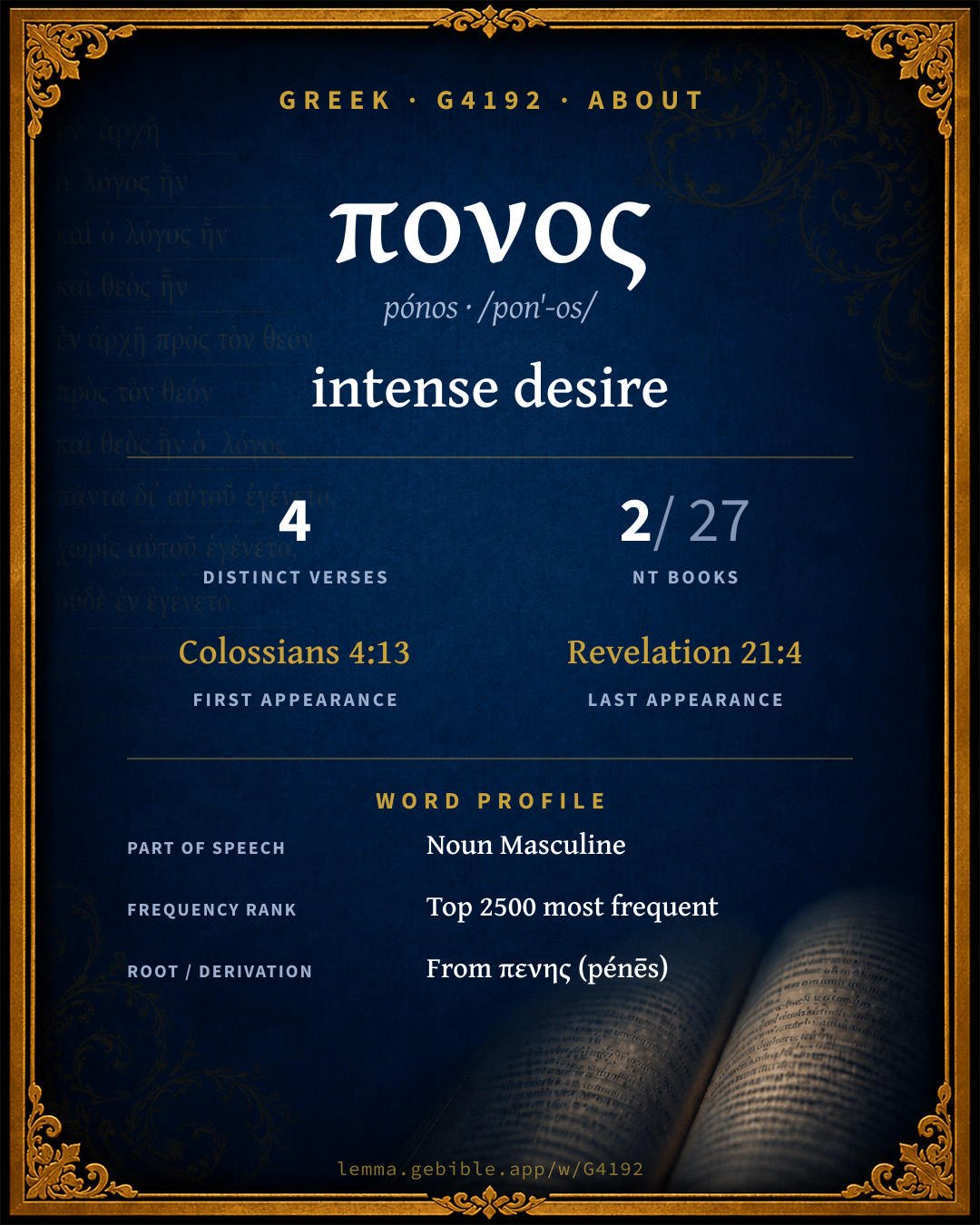
πόνος
intense desire
‘intense desire’ is one of 2 main senses fuller range ↓
Full lexicon entry — Thayer's Greek Lexicon
From Thayer's Greek Lexicon
Where this word appears
See every Genitive-case word in the Greek New Testament →
Grammar key — what these labels mean
Part of speech
- Noun
- A naming word — a person, place, thing, or idea.
Case
- Accusative
- The case of the direct object and of extent.
- Genitive
- The case of source, possession, or “of” — answers “whose / from what.”
- Nominative
- The case of the subject (and the predicate nominative).
Gender
- Masculine
- Grammatically masculine.
Number
- Singular
- One.
- Plural
- More than one.
1 distinct verse where G4192 appears in the Nominative case, across 1 book. Filtered view — show all forms. Click any verse to open its interlinear word-by-word view. Verse text shown in the World English Bible for context — . Each verse’s Greek form is shown with its reference; the English is not keyword-highlighted, since the data carries no word-level English alignment. Use “Compare translations” on any verse to read it across multiple English versions. This concordance covers the Greek New Testament; Septuagint (Greek Old Testament) occurrences of this word are not indexed here.
Revelation 1 verse
About this entry
At a glance — auto-summarized from this page’s data, not written by a person. Every figure links to its source below. This summary describes the numbers; it doesn’t interpret them.
The Greek noun πονος centers on the idea of “intense desire.” It is rare — just 4 verses in the entire Greek New Testament. The word gravitates to Revelation (75%), then Colossians. Debuting at Colossians 4:13, it then recurs through the corpus. Thayer's distinguishes 2 senses for it. Dig into 4-verse concordance and the renderings breakdown below.
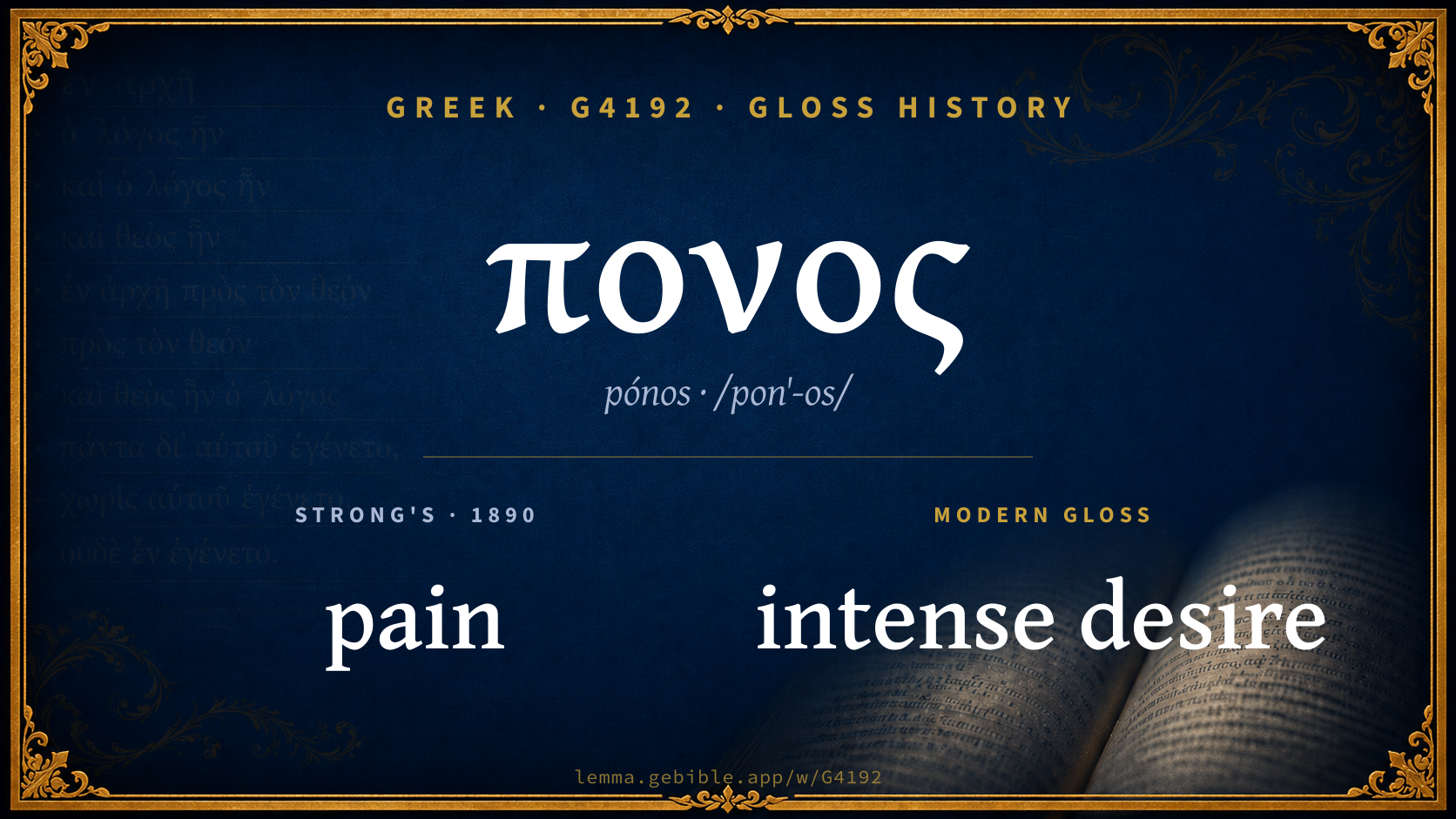
Gloss history
Strong's 1890 vs modern scholarship
About this word
Strong's G4192 catalogs a Greek word from the Greek New Testament.
These counts are not copied from any lexicon or concordance. They are computed here, from the morphology-tagged Greek New Testament. What Lemma adds →
- 4
- distinct verses
- The word appears in 4 distinct verses.
- 2 / 27
- NT books
- The word appears in 2 of 27 New Testament books.
- #1,877
- by frequency
- Top 2500 most frequent Greek words (rank 1,877 of 5,347 Greek words by occurrence).
View all 4 occurrences in the concordance →
Most concentrated in
- Revelation 3 verses 75%
- Colossians 1 verse 25%
By section of the New Testament
By traditional corpus
Conventional, traditional groupings — biblical authorship is debated, so this is a traditional corpus grouping, not an authorship claim. Some books belong to more than one corpus (Luke is in both the Gospels and the Lukan corpus, and so on), so these shares overlap and need not total 100%. Each figure is a share of the word’s 4 distinct verses.
- Johannine 3 verses · 75%
- Revelation 3 verses · 75%
- Pauline corpus 1 verse · 25%
How translations render this word
Counts come from each version’s own published word-to-Strong’s tagging or interlinear alignment — an approximate guide to how each version renders this word, not a word-level alignment the data otherwise carries. Because each total is that version’s own tagged count, the per-version totals vary from one another and need not match the appearance or distinct-verse counts above. These counts may also differ from a printed concordance because Lemma counts each distinctly tagged rendering and does not collapse phrase taggings into a single head-word total. This is a fixed set of word-tagged versions (KJV, ASV, BSB, ULT) and does not change with the reading translation you choose elsewhere. Each version’s license is shown beside its name below (and on Sources).
- King James Version: Pain 2×
- American Standard Version: Pain 2×
- Berean Standard Bible: Pains 2×
- unfoldingWord Literal Text: Pain 3×
King James Version Public Domain
Renders G4192 across 3 tagged occurrences — most commonly:
Plus 1 rendering that appears only once — usually multi-word phrases or single function words the recovered tagging swept in, not distinct renderings.
American Standard Version Public Domain
Renders G4192 across 3 tagged occurrences — most commonly:
Plus 1 rendering that appears only once — usually multi-word phrases or single function words the recovered tagging swept in, not distinct renderings.
Berean Standard Bible Public Domain
Renders G4192 across 4 tagged occurrences — most commonly:
Plus 2 renderings that appear only once — usually multi-word phrases or single function words the recovered tagging swept in, not distinct renderings.
unfoldingWord Literal Text CC BY-SA 4.0
Renders G4192 across 4 tagged occurrences — most commonly:
Plus 1 rendering that appears only once — usually multi-word phrases or single function words the recovered tagging swept in, not distinct renderings.
Senses in Thayer's
The 2 senses Thayer's distinguishes for this word, in lexicon order (not ranked by frequency or importance). The full entry — with sub-senses — is in the Lexicon Entry tab.
- great trouble, intense desire
- pain
Word origin
Derived from πενης (pénēs) (G3993) — poor.
From the base of G3993 ; toil that is (by implication) anguish : - pain.
— Strong’s Exhaustive Concordance (1890), public domain.
Forms in the corpus
The 4 distinct written forms G4192 takes in the Greek New Testament, most frequent first — each parse links to that case’s occurrences in the concordance.
| Form | Parsing | Example | Uses |
|---|---|---|---|
| πόνον pónon | Noun, Accusative, Singular, Masculine | Colossians 4:13 | 1 |
| πόνος pónos | Noun, Nominative, Singular, Masculine | Revelation 21:4 | 1 |
| πόνου pónou | Noun, Genitive, Singular, Masculine | Revelation 16:10 | 1 |
| πόνων pónōn | Noun, Genitive, Plural, Masculine | Revelation 16:11 | 1 |
Same root — word family
Other Thayer's entries built from the same root as G4192, grouped by Strong’s listed origin. These share a root / origin per the lexicon — not necessarily a shared meaning. Each links to that word’s own entry.
Derives from
Shares the same root
Derived from this word
Compare all same-root words → Showing 4 of 5 — not the complete family. They share a root, not necessarily a meaning.
Septuagint usage
The same Greek word πονος appears 53 times in the Greek Old Testament (Septuagint), across 53 verses in 18 books.
- 53
- LXX occurrences
- Tagged occurrences of this Greek word in the Septuagint.
- 53
- verses
- Distinct Septuagint verses containing this word.
- 18 / 39
- OT books
- The word appears in 18 of the 39 Old Testament books.
Sample Septuagint occurrences
- Genesis 34:25 πόνος
- Exodus 2:11 πόνος
- Numbers 23:21 πόνος
- Deuteronomy 28:33 πόνος
- 1 Samuel 15:23 πόνος
- 1 Kings 8:37 πόνος
- 1 Chronicles 10:3 πόνος
- 2 Chronicles 6:28 πόνος
- Job 2:9 πόνος
- Psalms 7:15 πόνος
- Proverbs 3:9 πόνος
- Isaiah 1:5 πόνος
Septuagint occurrences (same lexeme)
Every verse where the same Strong’s number (G4192) appears in the Greek Septuagint — showing the first 50 of 53. Verse text shown in the World English Bible for context; the Greek form is the matched word — the English is not keyword-highlighted.
- Genesis 34:25 πόνος It happened on the third day, when they were sore, that two of Jacob's sons, Simeon and Levi, Dinah's brothers, each took his sword, came upon the unsuspecting city, and killed all the males.
- Genesis 41:51 πόνος Joseph called the name of the firstborn Manasseh, "For," he said, "God has made me forget all my toil, and all my father's house."
- Exodus 2:11 πόνος It happened in those days, when Moses had grown up, that he went out to his brothers, and looked at their burdens. He saw an Egyptian striking a Hebrew, one of his brothers.
- Numbers 23:21 πόνος He has not saw iniquity in Jacob; Neither has he seen perverseness in Israel: Yahweh his God is with him, The shout of a king is among them.
- Deuteronomy 28:33 πόνος The fruit of your ground, and all your labors, shall a nation which you don't know eat up; and you shall be only oppressed and crushed always;
- 1 Samuel 15:23 πόνος For rebellion is as the sin of witchcraft, and stubbornness is as idolatry and teraphim. Because you have rejected the word of Yahweh, he has also rejected you from being king.
- 1 Kings 8:37 πόνος If there be in the land famine, if there be pestilence, if there be blasting [or] mildew, locust [or] caterpillar; if their enemy besiege them in the land of their cities; whatever plague, whatever sickness there be;
- 1 Chronicles 10:3 πόνος The battle went sore against Saul, and the archers overtook him; and he was distressed by reason of the archers.
- 2 Chronicles 6:28 πόνος If there be in the land famine, if there be pestilence, if there be blasting or mildew, locust or caterpillar; if their enemies besiege them in the land of their cities; whatever plague or whatever sickness there be;
- Job 2:9 πόνος Then his wife said to him, "Do you still maintain your integrity? Renounce God, and die."
- Job 3:10 πόνος Because it didn't shut up the doors of my mother's womb, Nor did it hide trouble from my eyes.
- Job 4:5 πόνος But now it is come to you, and you faint; It touches you, and you are troubled.
- Job 5:6 πόνος For affliction doesn't come forth from the dust, Neither does trouble spring out of the ground;
- Job 15:2 πόνος "Should a wise man answer with vain knowledge, And fill himself with the east wind?
- Psalms 7:15 πόνος He has dug a hole, And has fallen into the pit which he made.
- Psalms 7:17 πόνος I will give thanks to Yahweh according to his righteousness, And will sing praise to the name of Yahweh Most High.
- Psalms 9:28 πόνος
- Psalms 9:35 πόνος
- Psalms 77:46 πόνος
- Psalms 77:51 πόνος
- Psalms 89:10 πόνος You have broken Rahab in pieces, like one of the slain. You have scattered your enemies with your mighty arm.
- Psalms 104:36 πόνος
- Psalms 104:44 πόνος
- Psalms 108:11 πόνος Haven't you rejected us, God? You don't go forth, God, with our armies.
- Psalms 127:2 πόνος It is vain for you to rise up early, To stay up late, Eating the bread of toil; For he gives sleep to his loved ones.
- Proverbs 3:9 πόνος Honor Yahweh with your substance, With the first fruits of all your increase:
- Proverbs 5:10 πόνος Lest strangers feast on your wealth, And your labors enrich another man's house.
- Proverbs 6:8 πόνος Provides her bread in the summer, And gathers her food in the harvest.
- Proverbs 16:22 πόνος Understanding is a fountain of life to one who has it, But the punishment of fools is their folly.
- Proverbs 24:2 πόνος For their hearts plot violence, And their lips talk about mischief.
- Proverbs 31:7 πόνος Let him drink, and forget his poverty, And remember his misery no more.
- Isaiah 1:5 πόνος Why should you be beaten more, That you revolt more and more? The whole head is sick, And the whole heart faint.
- Isaiah 49:4 πόνος But I said, I have labored in vain, I have spent my strength for nothing and vanity; yet surely the justice [due] to me is with Yahweh, and my recompense with my God.
- Isaiah 53:4 πόνος Surely he has borne our sickness, and carried our suffering; yet we considered him plagued, struck by God, and afflicted.
- Isaiah 53:11 πόνος He shall see of the travail of his soul, [and] shall be satisfied: by the knowledge of himself shall my righteous servant justify many; and he shall bear their iniquities.
- Isaiah 59:4 πόνος None sues in righteousness, and none pleads in truth: they trust in vanity, and speak lies; they conceive mischief, and bring forth iniquity.
- Isaiah 65:14 πόνος behold, my servants shall sing for joy of heart, but you shall cry for sorrow of heart, and shall wail for vexation of spirit.
- Isaiah 65:22 πόνος They shall not build, and another inhabit; they shall not plant, and another eat: for as the days of a tree shall be the days of my people, and my chosen shall long enjoy the work of their hands.
- Isaiah 66:7 πόνος Before she travailed, she brought forth; before her pain came, she was delivered of a man-child.
- Jeremiah 4:14 πόνος Jerusalem, wash your heart from wickedness, that you may be saved. How long shall your evil thoughts lodge within you?
- Jeremiah 4:15 πόνος For a voice declares from Dan, and publishes evil from the hills of Ephraim:
- Jeremiah 6:7 πόνος As a well casts forth its waters, so she casts forth her wickedness: violence and destruction is heard in her; before me continually is sickness and wounds.
- Jeremiah 14:18 πόνος If I go forth into the field, then, behold, the slain with the sword! and if I enter into the city, then, behold, those who are sick with famine! for both the prophet and the priest go about in the land, and have no knowledge.
- Jeremiah 20:5 πόνος Moreover I will give all the riches of this city, and all the gains of it, and all the precious things of it, yes, all the treasures of the kings of Judah will I give into the hand of their enemies; and they shall make them a prey, and take them, and carry them to Babylon.
- Jeremiah 20:18 πόνος Why came I forth out of the womb to see labor and sorrow, that my days should be consumed with shame?
- Jeremiah 51:33 πόνος For thus says Yahweh of hosts, the God of Israel: The daughter of Babylon is like a threshing floor at the time when it is trodden; yet a little while, and the time of harvest shall come for her.
- Ezekiel 23:29 πόνος and they shall deal with you in hatred, and shall take away all your labor, and shall leave you naked and bare; and the nakedness of your prostitution shall be uncovered, both your lewdness and your prostitution.
- Hosea 12:9 πόνος "But I am Yahweh your God from the land of Egypt. I will yet again make you to dwell in tents, As in the days of the solemn feast.
- Obadiah 1:13 πόνος Don't enter into the gate of my people in the day of their calamity. Don't look down on their affliction in the day of their calamity, neither seize their wealth on the day of their calamity.
- Habakkuk 1:3 πόνος Why do you show me iniquity, and look at perversity? For destruction and violence are before me. There is strife, and contention rises up.
These are occurrences of the same Greek lexeme (G4192) in the Septuagint — not a translation of any one Hebrew word. The store carries no word-level Hebrew↔Greek alignment, so no Hebrew original is asserted here. Counts come from the recovered LXX Strong's tagging — high-frequency vocabulary is well covered, while rare or late forms may be untagged — so they reflect tagged occurrences and may slightly undercount.