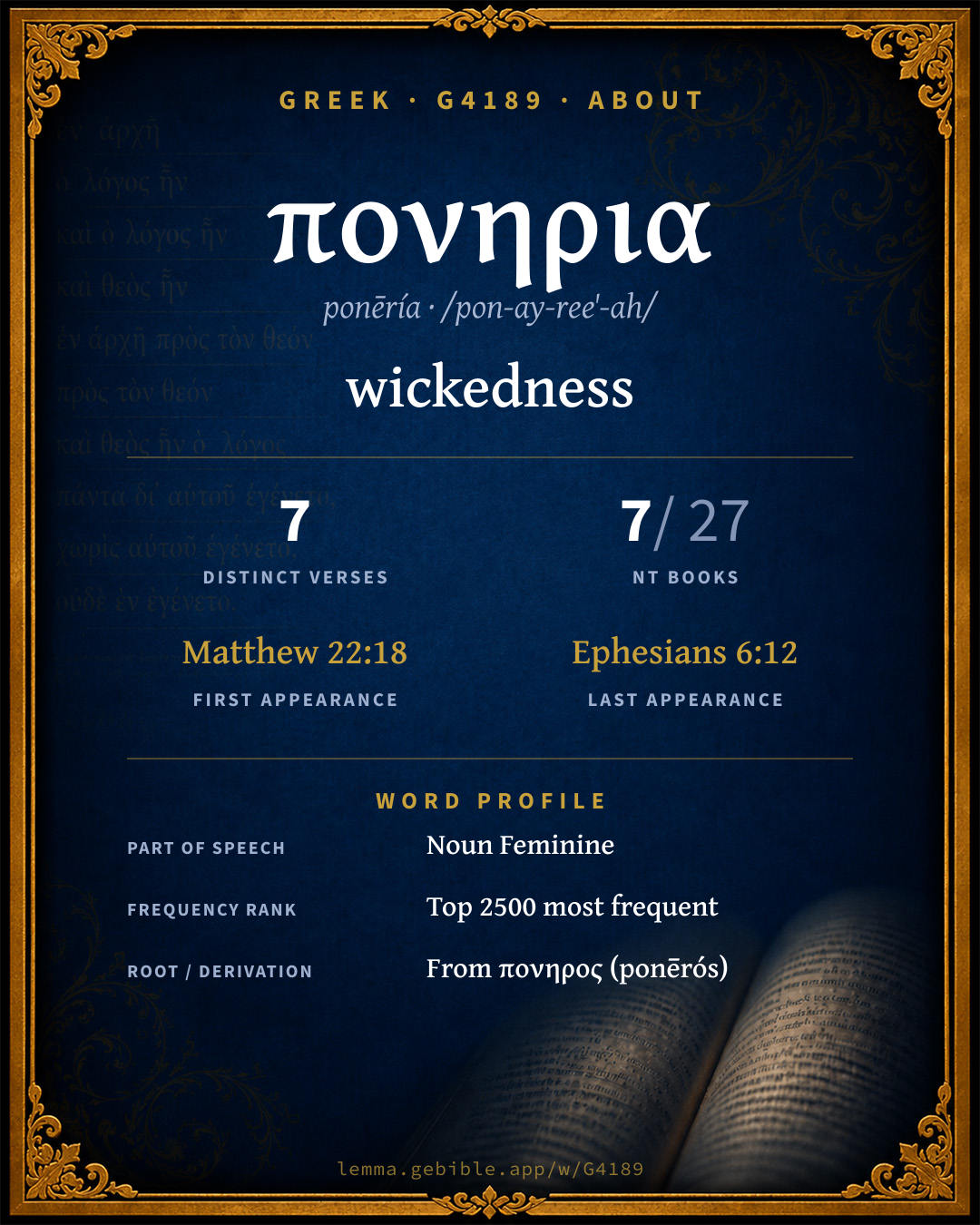
πονηρία
wickedness
also: depravity, iniquity fuller range ↓
Full lexicon entry — Thayer's Greek Lexicon
From Thayer's Greek Lexicon
Where this word appears
Grammar key — what these labels mean
Part of speech
- Noun
- A naming word — a person, place, thing, or idea.
Case
- Genitive
- The case of source, possession, or “of” — answers “whose / from what.”
- Accusative
- The case of the direct object and of extent.
- Dative
- The case of the indirect object, means, or location — “to / for / with / in.”
- Nominative
- The case of the subject (and the predicate nominative).
Gender
- Feminine
- Grammatically feminine.
Number
- Singular
- One.
- Plural
- More than one.
Every verse where G4189 appears in the Book of Romans — 1 distinct verse. Click any verse to open its interlinear word-by-word view. Verse text shown in the World English Bible for context — . Each verse’s Greek form is shown with its reference; the English is not keyword-highlighted, since the data carries no word-level English alignment. Use “Compare translations” on any verse to read it across multiple English versions. This concordance covers the Greek New Testament; Septuagint (Greek Old Testament) occurrences of this word are not indexed here.
Romans
About this entry
At a glance — auto-summarized from this page’s data, not written by a person. Every figure links to its source below. This summary describes the numbers; it doesn’t interpret them.
The Greek noun πονηρια centers on the idea of “wickedness.” Debuting at Matthew 22:18, it then recurs through the corpus. It appears 7 verses across 7 books of the Greek New Testament, among its uncommon vocabulary. Thayer's distinguishes 3 senses; alongside “wickedness” it spans “depravity” and “iniquity”. It shares a root with πονηρος and πονηροτερος. For the data behind this summary, explore the sense tree and the renderings breakdown below.
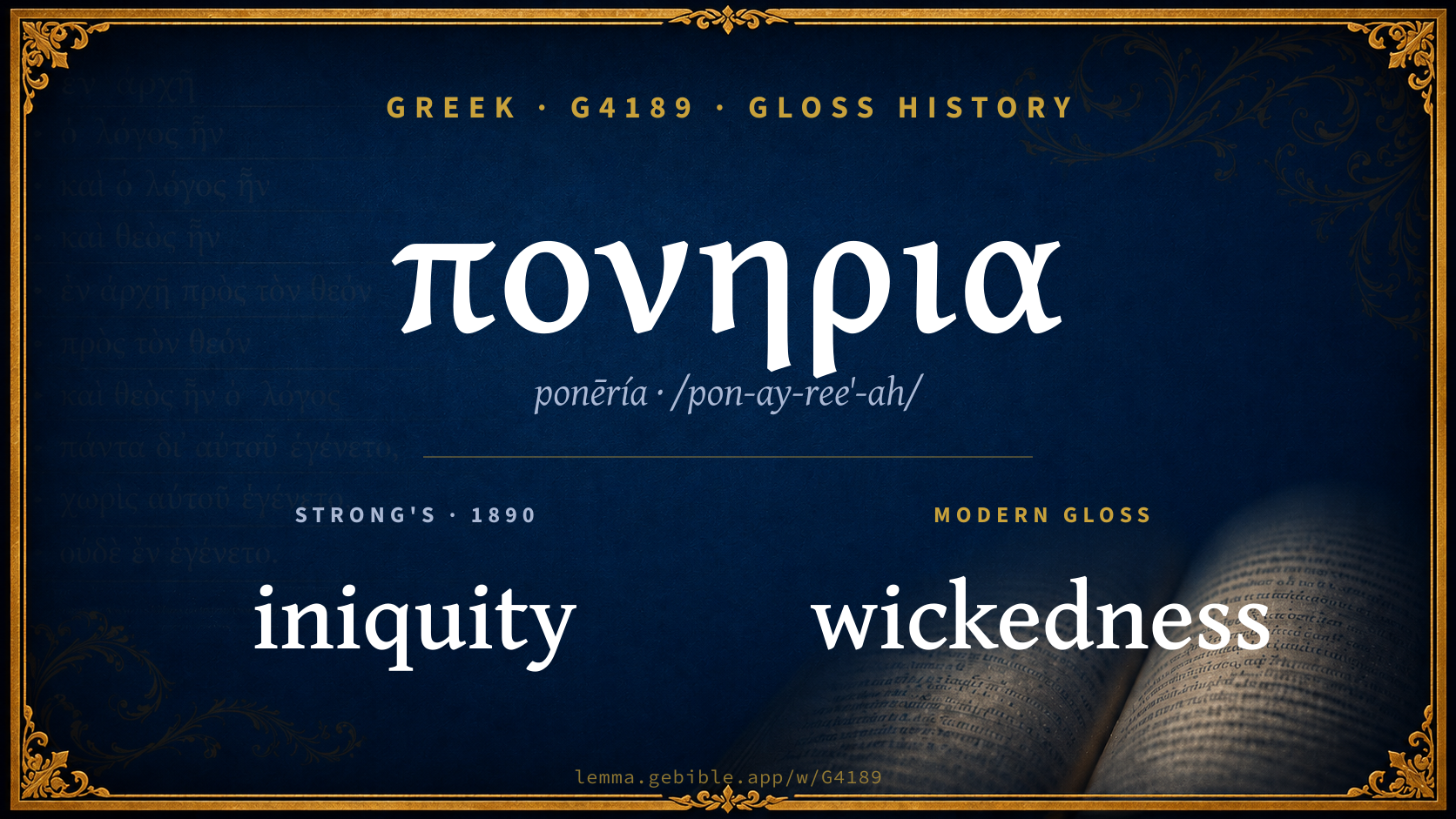
Gloss history
Strong's 1890 vs modern scholarship
About this word
Strong's G4189 catalogs a Greek word from the Greek New Testament.
These counts are not copied from any lexicon or concordance. They are computed here, from the morphology-tagged Greek New Testament. What Lemma adds →
- 7
- distinct verses
- The word appears in 7 distinct verses.
- 7 / 27
- NT books
- The word appears in 7 of 27 New Testament books.
- #1,358
- by frequency
- Top 2500 most frequent Greek words (rank 1,358 of 5,347 Greek words by occurrence).
View all 7 occurrences in the concordance →
By section of the New Testament
By traditional corpus
Conventional, traditional groupings — biblical authorship is debated, so this is a traditional corpus grouping, not an authorship claim. Some books belong to more than one corpus (Luke is in both the Gospels and the Lukan corpus, and so on), so these shares overlap and need not total 100%. Each figure is a share of the word’s 7 distinct verses.
- Gospels 3 verses · 43%
- Pauline corpus 3 verses · 43%
- Lukan (Luke–Acts) 2 verses · 29%
How translations render this word
Counts come from each version’s own published word-to-Strong’s tagging or interlinear alignment — an approximate guide to how each version renders this word, not a word-level alignment the data otherwise carries. Because each total is that version’s own tagged count, the per-version totals vary from one another and need not match the appearance or distinct-verse counts above. These counts may also differ from a printed concordance because Lemma counts each distinctly tagged rendering and does not collapse phrase taggings into a single head-word total. This is a fixed set of word-tagged versions (KJV, ASV, BSB, ULT) and does not change with the reading translation you choose elsewhere. Each version’s license is shown beside its name below (and on Sources).
- King James Version: Wickedness 6×
- American Standard Version: Wickedness 4×
- Berean Standard Bible: Wickedness 3×, Evil 2×
- unfoldingWord Literal Text: Wickedness 5×, Evil 2×
King James Version Public Domain
Renders G4189 across 7 tagged occurrences — most commonly:
Plus 1 rendering that appears only once — usually multi-word phrases or single function words the recovered tagging swept in, not distinct renderings.
American Standard Version Public Domain
Renders G4189 across 8 tagged occurrences — most commonly:
Plus 4 renderings that appear only once — usually multi-word phrases or single function words the recovered tagging swept in, not distinct renderings.
Berean Standard Bible Public Domain
Renders G4189 across 7 tagged occurrences — most commonly:
Plus 2 renderings that appear only once — usually multi-word phrases or single function words the recovered tagging swept in, not distinct renderings.
unfoldingWord Literal Text CC BY-SA 4.0
Renders G4189 across 7 tagged occurrences — most commonly:
Senses in Thayer's
The 3 senses Thayer's distinguishes for this word, in lexicon order (not ranked by frequency or importance). The full entry — with sub-senses — is in the Lexicon Entry tab.
- depravity, iniquity, wickedness
- malice
- evil purposes and desires
Word origin
Derived from πονηρος (ponērós) (G4190) — evil.
From G4190 ; depravity that is (specifically) malice ; plural (concretely) plots sins : - iniquity wickedness.
— Strong’s Exhaustive Concordance (1890), public domain.
Forms in the corpus
The 5 distinct written forms G4189 takes in the Greek New Testament, most frequent first — each parse links to that case’s occurrences in the concordance.
| Form | Parsing | Example | Uses |
|---|---|---|---|
| πονηρίας ponērías | Noun, Genitive, Singular, Feminine | Luke 11:39 | 3 |
| πονηρίαι ponēríai | Noun, Nominative, Plural, Feminine | Mark 7:22 | 1 |
| πονηρίαν ponērían | Noun, Accusative, Singular, Feminine | Matthew 22:18 | 1 |
| πονηρίᾳ ponēría | Noun, Dative, Singular, Feminine | Romans 1:29 | 1 |
| πονηριῶν ponēriō̂n | Noun, Genitive, Plural, Feminine | Acts 3:26 | 1 |
Same root — word family
Other Thayer's entries built from the same root as G4189, grouped by Strong’s listed origin. These share a root / origin per the lexicon — not necessarily a shared meaning. Each links to that word’s own entry.
Derives from
Shares the same root
Compare all same-root words → They share a root, not necessarily a meaning.
Septuagint usage
The same Greek word πονηρια appears 47 times in the Greek Old Testament (Septuagint), across 45 verses in 9 books.
- 47
- LXX occurrences
- Tagged occurrences of this Greek word in the Septuagint.
- 45
- verses
- Distinct Septuagint verses containing this word.
- 9 / 39
- OT books
- The word appears in 9 of the 39 Old Testament books.
Sample Septuagint occurrences
- Exodus 10:10 πονηρία
- Deuteronomy 31:21 πονηρία
- Judges 9:56 πονηρία
- Ezra 11:3 πονηρία
- Psalms 7:10 πονηρία
- Proverbs 26:25 πονηρία
- Ecclesiastes 2:21 πονηρία
- Isaiah 1:16 πονηρία
- Jeremiah 4:4 πονηρία
Septuagint occurrences (same lexeme)
Every verse where the same Strong’s number (G4189) appears in the Greek Septuagint. Verse text shown in the World English Bible for context; the Greek form is the matched word — the English is not keyword-highlighted.
- Exodus 10:10 πονηρία He said to them, "Yahweh be with you if I will let you go with your little ones! See, evil is clearly before your faces.
- Exodus 32:12 πονηρία Why should the Egyptians speak, saying, 'He brought them forth for evil, to kill them in the mountains, and to consume them from the surface of the earth?' Turn from your fierce wrath, and repent of this evil against your people.
- Deuteronomy 31:21 πονηρία It shall happen, when many evils and troubles are come on them, that this song shall testify before them as a witness; for it shall not be forgotten out of the mouths of their seed: for I know their imagination which they frame this day, before I have brought them into the land which I swore.
- Judges 9:56 πονηρία Thus God requited the wickedness of Abimelech, which he did to his father, in killing his seventy brothers;
- Judges 9:57 πονηρία and all the wickedness of the men of Shechem did God requite on their heads: and on them came the curse of Jotham the son of Jerubbaal.
- Judges 11:27 πονηρία I therefore have not sinned against you, but you do me wrong to war against me: Yahweh, the Judge, be judge this day between the children of Israel and the children of Ammon.
- Judges 15:3 πονηρία Samson said to them, This time shall I be blameless in regard of the Philistines, when I do them a mischief.
- Judges 20:3 πονηρία (Now the children of Benjamin heard that the children of Israel had gone up to Mizpah.) The children of Israel said, Tell us, how was this wickedness brought to pass?
- Judges 20:12 πονηρία The tribes of Israel sent men through all the tribe of Benjamin, saying, What wickedness is this that is happen among you?
- Judges 20:13 πονηρία Now therefore deliver up the men, the base fellows, who are in Gibeah, that we may put them to death, and put away evil from Israel. But Benjamin would not listen to the voice of their brothers the children of Israel.
- Judges 20:41 πονηρία The men of Israel turned, and the men of Benjamin were dismayed; for they saw that evil had come on them.
- Ezra 11:3 πονηρία
- Ezra 12:2 πονηρία
- Ezra 12:17 πονηρία
- Ezra 16:2 πονηρία
- Ezra 23:7 πονηρία
- Ezra 23:27 πονηρία
- Psalms 7:10 πονηρία My shield is with God, Who saves the upright in heart.
- Psalms 27:4 πονηρία One thing I have asked of Yahweh, that I will seek after, That I may dwell in the house of Yahweh all the days of my life, To see Yahweh's beauty, And to inquire in his temple.
- Psalms 54:16 πονηρία
- Psalms 72:8 πονηρία He shall have dominion also from sea to sea, From the River to the ends of the earth.
- Psalms 93:23 πονηρία
- Psalms 140:4 πονηρία Yahweh, keep me from the hands of the wicked. Preserve me from the violent men who have determined to trip my feet.
- Proverbs 26:25 πονηρία When his speech is charming, don't believe him; For there are seven abominations in his heart:
- Ecclesiastes 2:21 πονηρία For there is a man whose labor is with wisdom, with knowledge, and with skillfulness; yet he shall leave it for his portion to a man who has not labored for it. This also is vanity and a great evil.
- Ecclesiastes 6:1 πονηρία There is an evil which I have seen under the sun, and it is heavy on men:
- Ecclesiastes 10:5 πονηρία There is an evil which I have seen under the sun, the sort of error which proceeds from the ruler.
- Ecclesiastes 11:10 πονηρία Therefore remove sorrow from your heart, And put away evil from your flesh; For youth and the dawn of life are vanity.
- Isaiah 1:16 πονηρία Wash yourselves, make yourself clean. Put away the evil of your doings from before my eyes; Cease to do evil.
- Isaiah 7:16 πονηρία For before the child knows to refuse the evil, and choose the good, the land whose two kings you abhor shall be forsaken.
- Isaiah 10:1 πονηρία Woe to those who decree unrighteous decrees, and to the writers who write perverseness;
- Isaiah 47:10 πονηρία For you have trusted in your wickedness; you have said, None sees me; your wisdom and your knowledge, it has perverted you, and you have said in your heart, I am, and there is none else besides me.
- Isaiah 59:7 πονηρία Their feet run to evil, and they make haste to shed innocent blood: their thoughts are thoughts of iniquity; desolation and destruction are in their paths.
- Jeremiah 4:4 πονηρία Circumcise yourselves to Yahweh, and take away the foreskins of your heart, you men of Judah and inhabitants of Jerusalem; lest my wrath go forth like fire, and burn so that none can quench it, because of the evil of your doings.
- Jeremiah 6:29 πονηρία The bellows blow fiercely; the lead is consumed of the fire: in vain do they go on refining; for the wicked are not plucked away.
- Jeremiah 9:6 πονηρία Your habitation is in the midst of deceit; through deceit they refuse to know me, says Yahweh.
- Jeremiah 23:11 πονηρία for both prophet and priest are profane; yes, in my house have I found their wickedness, says Yahweh.
- Jeremiah 24:2 πονηρία One basket had very good figs, like the figs that are first-ripe; and the other basket had very bad figs, which could not be eaten, they were so bad.
- Jeremiah 24:3 πονηρία Then said Yahweh to me, What see you, Jeremiah? I said, Figs; the good figs, very good; and the bad, very bad, that can't be eaten, they are so bad.
- Jeremiah 24:8 πονηρία As the bad figs, which can't be eaten, they are so bad, surely thus says Yahweh, So will I give up Zedekiah the king of Judah, and his princes, and the residue of Jerusalem, who remain in this land, and those who dwell in the land of Egypt,
- Jeremiah 31:16 πονηρία Thus says Yahweh: Refrain your voice from weeping, and your eyes from tears; for your work shall be rewarded, says Yahweh; and they shall come again from the land of the enemy.
- Jeremiah 39:32 πονηρία
- Jeremiah 40:5 πονηρία Now while he was not yet gone back, Go back then, [said he], to Gedaliah the son of Ahikam, the son of Shaphan, whom the king of Babylon has made governor over the cities of Judah, and dwell with him among the people; or go wherever it seems right to you to go. So the captain of the guard gave him food and a present, and let him go.
- Jeremiah 51:3 πονηρία Against [him who] bends let the archer bend his bow, and against [him who] lifts himself up in his coat of mail: and don't you spare her young men; destroy you utterly all her host.
- Jeremiah 51:22 πονηρία and with you will I break in pieces the chariot and him who rides therein; and with you will I break in pieces man and woman; and with you will I break in pieces the old man and the youth; and with you will I break in pieces the young man and the virgin;
These are occurrences of the same Greek lexeme (G4189) in the Septuagint — not a translation of any one Hebrew word. The store carries no word-level Hebrew↔Greek alignment, so no Hebrew original is asserted here. Counts come from the recovered LXX Strong's tagging — high-frequency vocabulary is well covered, while rare or late forms may be untagged — so they reflect tagged occurrences and may slightly undercount.