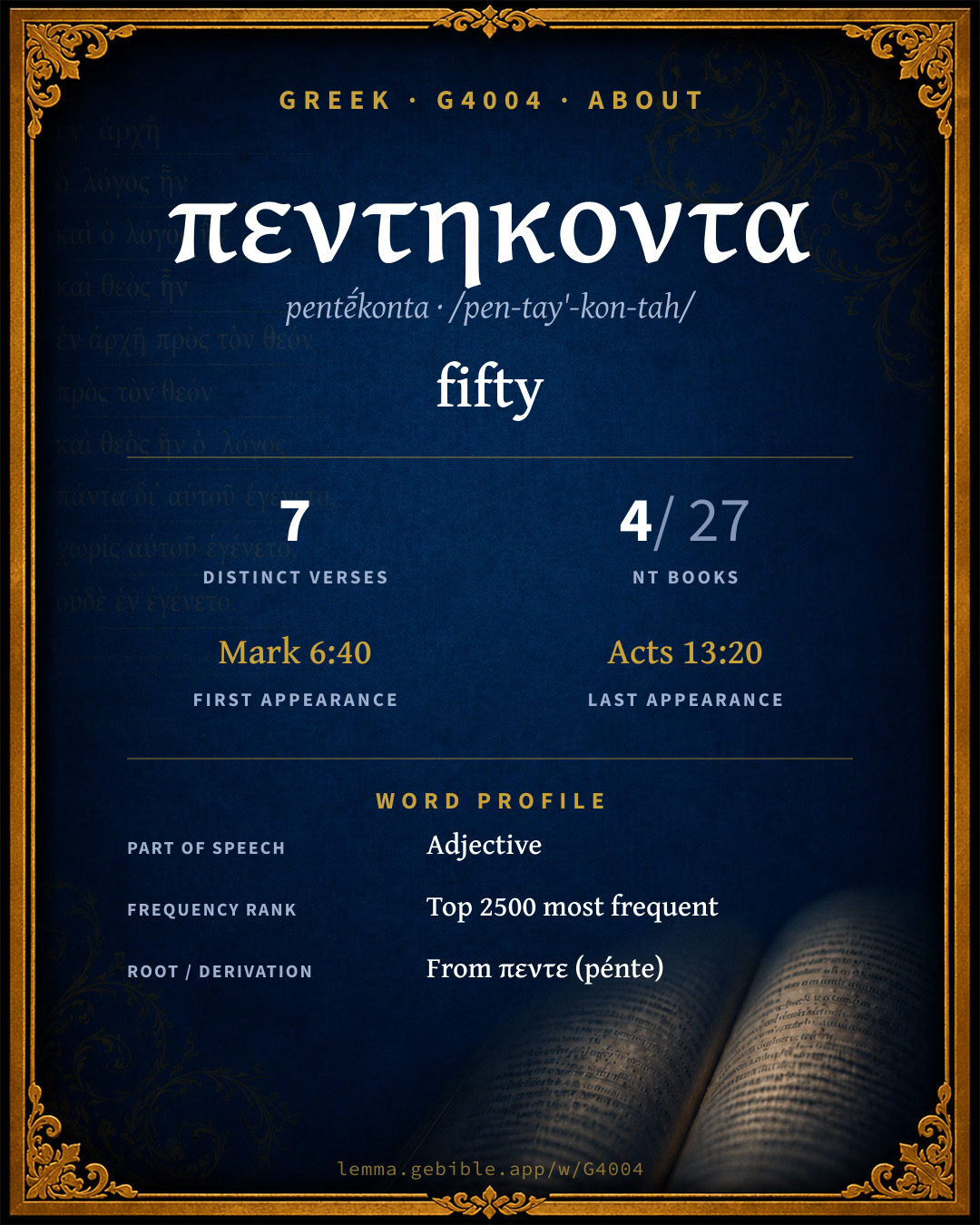
πεντήκοντα
fifty
Full lexicon entry — Thayer's Greek Lexicon
From Thayer's Greek Lexicon
Where this word appears
Every verse where G4004 appears in the Book of Acts — 1 distinct verse. Click any verse to open its interlinear word-by-word view. Verse text shown in the World English Bible for context — . Each verse’s Greek form is shown with its reference; the English is not keyword-highlighted, since the data carries no word-level English alignment. Use “Compare translations” on any verse to read it across multiple English versions. This concordance covers the Greek New Testament; Septuagint (Greek Old Testament) occurrences of this word are not indexed here.
Acts
About this entry
At a glance — auto-summarized from this page’s data, not written by a person. Every figure links to its source below. This summary describes the numbers; it doesn’t interpret them.
πεντηκοντα (pentḗkonta) is a Greek adjective most often rendered “fifty.” It first appears in Mark 6:40. Spanning 7 verses in 4 books, it ranks among the uncommon words of the Greek New Testament. Luke dominates its distribution — 3 of 7 verses. Related forms include πεντε, πεμπτος and πεντακις. The sections below give every sense, occurrence, and version rendering.
Gloss history
Strong's 1890 vs modern scholarship
About this word
Strong's G4004 catalogs a Greek word from the Greek New Testament.
These counts are not copied from any lexicon or concordance. They are computed here, from the morphology-tagged Greek New Testament. What Lemma adds →
- 7
- distinct verses
- The word appears in 7 distinct verses.
- 4 / 27
- NT books
- The word appears in 4 of 27 New Testament books.
- #1,358
- by frequency
- Top 2500 most frequent Greek words (rank 1,358 of 5,347 Greek words by occurrence).
View all 7 occurrences in the concordance →
By section of the New Testament
By traditional corpus
Conventional, traditional groupings — biblical authorship is debated, so this is a traditional corpus grouping, not an authorship claim. Some books belong to more than one corpus (Luke is in both the Gospels and the Lukan corpus, and so on), so these shares overlap and need not total 100%. Each figure is a share of the word’s 7 distinct verses.
- Gospels 6 verses · 86%
- Lukan (Luke–Acts) 4 verses · 57%
- Johannine 2 verses · 29%
How translations render this word
Counts come from each version’s own published word-to-Strong’s tagging or interlinear alignment — an approximate guide to how each version renders this word, not a word-level alignment the data otherwise carries. Because each total is that version’s own tagged count, the per-version totals vary from one another and need not match the appearance or distinct-verse counts above. These counts may also differ from a printed concordance because Lemma counts each distinctly tagged rendering and does not collapse phrase taggings into a single head-word total. This is a fixed set of word-tagged versions (KJV, ASV, BSB, ULT) and does not change with the reading translation you choose elsewhere. Each version’s license is shown beside its name below (and on Sources).
- King James Version: Fifty 5×, Fifties 2×
- American Standard Version: Fifty 4×
- Berean Standard Bible: Fifty 3×
- unfoldingWord Literal Text: Fifties 1×
King James Version Public Domain
Renders G4004 across 7 tagged occurrences — most commonly:
American Standard Version Public Domain
Renders G4004 across 7 tagged occurrences — most commonly:
Plus 3 renderings that appear only once — usually multi-word phrases or single function words the recovered tagging swept in, not distinct renderings.
Berean Standard Bible Public Domain
Renders G4004 across 5 tagged occurrences — most commonly:
Plus 2 renderings that appear only once — usually multi-word phrases or single function words the recovered tagging swept in, not distinct renderings. Not rendered by a distinct English word in 2 further occurrences.
unfoldingWord Literal Text CC BY-SA 4.0
Renders G4004 across 1 tagged occurrence — most commonly:
Not rendered by a distinct English word in 6 further occurrences.
Senses in Thayer's
The 1 sense Thayer's distinguishes for this word, in lexicon order (not ranked by frequency or importance). The full entry — with sub-senses — is in the Lexicon Entry tab.
- fifty
Word origin
Derived from πεντε (pénte) (G4002) — five.
Multiplicative of G4002 ; fifty : - fifty.
— Strong’s Exhaustive Concordance (1890), public domain.
Same root — word family
Other Thayer's entries built from the same root as G4004, grouped by Strong’s listed origin. These share a root / origin per the lexicon — not necessarily a shared meaning. Each links to that word’s own entry.
Derives from
Shares the same root
- πεμπτος pémptos G3991 fifth
- πεντακις pentákis G3999 five times
- πεντακοσιοι pentakósioi G4001 five hundred
- πεντεκαιδεκατος pentekaidékatos G4003 fifteenth
Proper names from this root
People and places named from this root — a name, not an additional meaning of the word.
Compare all same-root words → Showing 4 of 7 — not the complete family. 1 of the same-root words is a proper name (a person or place). They share a root, not necessarily a meaning.
Septuagint usage
The same Greek word πεντηκοντα appears 142 times in the Greek Old Testament (Septuagint), across 130 verses in 17 books.
- 142
- LXX occurrences
- Tagged occurrences of this Greek word in the Septuagint.
- 130
- verses
- Distinct Septuagint verses containing this word.
- 17 / 39
- OT books
- The word appears in 17 of the 39 Old Testament books.
Sample Septuagint occurrences
- Genesis 5:31 πεντήκοντα
- Exodus 26:5 πεντήκοντα
- Leviticus 23:16 πεντήκοντα
- Numbers 1:23 πεντήκοντα
- Deuteronomy 22:29 πεντήκοντα
- Joshua 7:21 πεντήκοντα
- Judges 7:11 πεντήκοντα
- 1 Samuel 6:19 πεντήκοντα
- 2 Samuel 15:1 πεντήκοντα
- 1 Kings 1:5 πεντήκοντα
- 2 Kings 1:9 πεντήκοντα
- 1 Chronicles 5:21 πεντήκοντα
Septuagint occurrences (same lexeme)
Every verse where the same Strong’s number (G4004) appears in the Greek Septuagint — showing the first 50 of 130. Verse text shown in the World English Bible for context; the Greek form is the matched word — the English is not keyword-highlighted.
- Genesis 5:31 πεντήκοντα All the days of Lamech were seven hundred seventy-seven years, then he died.
- Genesis 6:15 πεντήκοντα This is how you shall make it. The length of the ark will be three hundred cubits, the breadth of it fifty cubits, and the height of it thirty cubits.
- Genesis 7:24 πεντήκοντα The waters prevailed on the earth one hundred fifty days.
- Genesis 8:3 πεντήκοντα The waters receded from off the earth continually. After the end of one hundred fifty days the waters decreased.
- Genesis 9:28 πεντήκοντα Noah lived three hundred fifty years after the flood.
- Genesis 9:29 πεντήκοντα All the days of Noah were nine hundred fifty years, then he died.
- Genesis 18:24 πεντήκοντα What if there are fifty righteous within the city? Will you consume and not spare the place for the fifty righteous who are therein?
- Genesis 18:26 πεντήκοντα Yahweh said, "If I find in Sodom fifty righteous within the city, then I will spare all the place for their sake."
- Genesis 18:28 πεντήκοντα What if there will lack five of the fifty righteous? Will you destroy all the city for lack of five?" He said, "I will not destroy it, if I find forty-five there."
- Exodus 26:5 πεντήκοντα You shall make fifty loops in the one curtain, and you shall make fifty loops in the edge of the curtain that is in the second coupling. The loops shall be opposite one to another.
- Exodus 26:6 πεντήκοντα You shall make fifty clasps of gold, and couple the curtains one to another with the clasps: and the tent shall be a unit.
- Exodus 26:10 πεντήκοντα You shall make fifty loops on the edge of the one curtain that is outmost in the coupling, and fifty loops on the edge of the curtain which is outmost in the second coupling.
- Exodus 26:11 πεντήκοντα You shall make fifty clasps of brass, and put the clasps into the loops, and couple the tent together, that it may be one.
- Exodus 27:12 πεντήκοντα For the breadth of the court on the west side shall be hangings of fifty cubits; their pillars ten, and their sockets ten.
- Exodus 27:13 πεντήκοντα The breadth of the court on the east side eastward shall be fifty cubits.
- Exodus 27:18 πεντήκοντα The length of the court shall be one hundred cubits, and the breadth fifty every where, and the height five cubits, of fine twined linen, and their sockets of brass.
- Exodus 30:23 πεντήκοντα "Also take fine spices: of liquid myrrh, five hundred shekels; and of fragrant cinnamon half as much, even two hundred and fifty; and of fragrant cane, two hundred and fifty;
- Exodus 37:10 πεντήκοντα He made the table of acacia wood. Its length was two cubits, and its breadth was a cubit, and its height was a cubit and a half.
- Exodus 37:11 πεντήκοντα He overlaid it with pure gold, and made a gold molding around it.
- Exodus 39:3 πεντήκοντα They beat the gold into thin plates, and cut it into wires, to work it in the blue, in the purple, in the scarlet, and in the fine linen, the work of the skillful workman.
- Leviticus 23:16 πεντήκοντα even to the next day after the seventh Sabbath you shall number fifty days; and you shall offer a new meal offering to Yahweh.
- Leviticus 27:3 πεντήκοντα Your valuation shall be of a male from twenty years old even to sixty years old, even your valuation shall be fifty shekels of silver, after the shekel of the sanctuary.
- Leviticus 27:16 πεντήκοντα "'If a man dedicates to Yahweh part of the field of his possession, then your valuation shall be according to the seed for it: the sowing of a homer of barley shall be valued at fifty shekels of silver.
- Numbers 1:23 πεντήκοντα those who were numbered of them, of the tribe of Simeon, were fifty-nine thousand three hundred.
- Numbers 1:27 πεντήκοντα those who were numbered of them, of the tribe of Judah, were sixty-four thousand six hundred.
- Numbers 1:29 πεντήκοντα those who were numbered of them, of the tribe of Issachar, were fifty-four thousand four hundred.
- Numbers 1:37 πεντήκοντα those who were numbered of them, of the tribe of Benjamin, were thirty-five thousand four hundred.
- Numbers 1:43 πεντήκοντα those who were numbered of them, of the tribe of Naphtali, were fifty-three thousand four hundred.
- Numbers 1:46 πεντήκοντα even all those who were numbered were six hundred three thousand five hundred fifty.
- Numbers 2:6 πεντήκοντα His division, and those who were numbered of it, were fifty-four thousand four hundred.
- Numbers 2:8 πεντήκοντα His division, and those who were numbered of it, were fifty-seven thousand four hundred.
- Numbers 2:13 πεντήκοντα His division, and those who were numbered of them, were fifty-nine thousand three hundred.
- Numbers 2:15 πεντήκοντα His division, and those who were numbered of them, were forty-five thousand six hundred fifty.
- Numbers 2:16 πεντήκοντα "All who were numbered of the camp of Reuben were one hundred fifty-one thousand four hundred fifty, according to their hosts. They shall set out second.
- Numbers 2:30 πεντήκοντα His division, and those who were numbered of them, were fifty-three thousand four hundred.
- Numbers 2:31 πεντήκοντα "All who were numbered of the camp of Dan were one hundred fifty-seven thousand six hundred. They shall set out last by their standards."
- Numbers 2:32 πεντήκοντα These are those who were numbered of the children of Israel by their fathers' houses. All who were numbered of the camps according to their hosts were six hundred three thousand five hundred fifty.
- Numbers 3:34 πεντήκοντα Those who were numbered of them, according to the number of all the males, from a month old and upward, were six thousand two hundred.
- Numbers 4:3 πεντήκοντα from thirty years old and upward even until fifty years old, all who enter into the service, to do the work in the Tent of Meeting.
- Numbers 4:36 πεντήκοντα Those who were numbered of them by their families were two thousand seven hundred fifty.
- Numbers 16:2 πεντήκοντα and they rose up before Moses, with certain of the children of Israel, two hundred fifty princes of the congregation, called to the assembly, men of renown;
- Numbers 16:17 πεντήκοντα and take every man his censer, and put incense on them, and bring you before Yahweh every man his censer, two hundred fifty censers; you also, and Aaron, each his censer.
- Numbers 16:35 πεντήκοντα Fire came forth from Yahweh, and devoured the two hundred fifty men who offered the incense.
- Numbers 26:10 πεντήκοντα and the earth opened its mouth, and swallowed them up together with Korah, when that company died; what time the fire devoured two hundred fifty men, and they became a sign.
- Numbers 26:31 πεντήκοντα and [of] Asriel, the family of the Asrielites; and [of] Shechem, the family of the Shechemites;
- Numbers 26:38 πεντήκοντα The sons of Benjamin after their families: of Bela, the family of the Belaites; of Ashbel, the family of the Ashbelites; of Ahiram, the family of the Ahiramites;
- Numbers 31:30 πεντήκοντα Of the children of Israel's half, you shall take one drawn out of every fifty, of the persons, of the oxen, of the donkeys, and of the flocks, [even] of all the cattle, and give them to the Levites, who keep the charge of the tent of Yahweh.
- Numbers 31:47 πεντήκοντα even of the children of Israel's half, Moses took one drawn out of every fifty, both of man and of animal, and gave them to the Levites, who kept the charge of the tent of Yahweh; as Yahweh commanded Moses.
- Numbers 31:52 πεντήκοντα All the gold of the heave-offering that they offered up to Yahweh, of the captains of thousands, and of the captains of hundreds, was sixteen thousand seven hundred fifty shekels.
- Deuteronomy 22:29 πεντήκοντα then the man who lay with her shall give to the lady's father fifty [shekels] of silver, and she shall be his wife, because he has humbled her; he may not put her away all his days.
These are occurrences of the same Greek lexeme (G4004) in the Septuagint — not a translation of any one Hebrew word. The store carries no word-level Hebrew↔Greek alignment, so no Hebrew original is asserted here. Counts come from the recovered LXX Strong's tagging — high-frequency vocabulary is well covered, while rare or late forms may be untagged — so they reflect tagged occurrences and may slightly undercount.