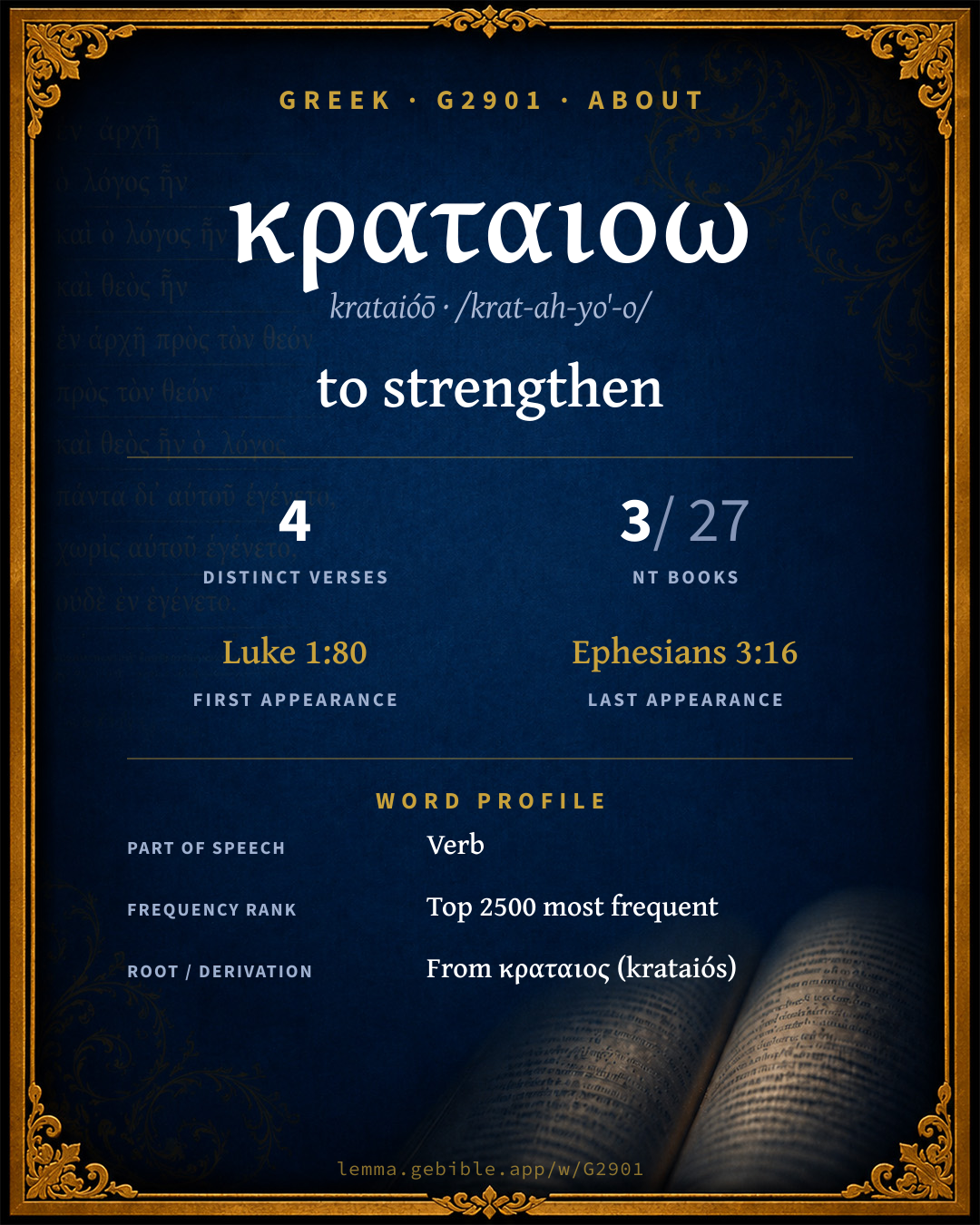
κραταιόω
to strengthen
‘to strengthen’ is one of 2 main senses fuller range ↓
Full lexicon entry — Thayer's Greek Lexicon
From Thayer's Greek Lexicon
Where this word appears
Grammar key — what these labels mean
Part of speech
- Verb
- An action or state-of-being word.
Tense
- Imperfect
- Continuous or repeated action in past time (“was writing”).
- Aorist
- Action viewed as a simple whole, without regard to duration — often past (perfective aspect).
- Present
- Ongoing or general action in present time (imperfective aspect).
Voice
- Passive
- The subject receives the action.
Mood
- Indicative
- States a fact or asks a factual question (the mood of reality).
- Infinitive
- A verbal noun (“to write”), unmarked for person or number.
- Imperative
- Expresses a command or request.
Person
- 3rd person
- The one spoken about (“he / she / it / they”).
- 2nd person
- The one addressed (“you”).
Number
- Singular
- One.
- Plural
- More than one.
Every verse where G2901 appears in the Book of 1 Corinthians — 1 distinct verse. Click any verse to open its interlinear word-by-word view. Verse text shown in the World English Bible for context — . Each verse’s Greek form is shown with its reference; the English is not keyword-highlighted, since the data carries no word-level English alignment. Use “Compare translations” on any verse to read it across multiple English versions. This concordance covers the Greek New Testament; Septuagint (Greek Old Testament) occurrences of this word are not indexed here.
1 Corinthians
About this entry
At a glance — auto-summarized from this page’s data, not written by a person. Every figure links to its source below. This summary describes the numbers; it doesn’t interpret them.
“to strengthen” is the headline sense of the Greek verb κραταιοω (krataióō). It is rare — just 4 verses in the entire Greek New Testament. More than half of its appearances fall in Luke. It first appears in Luke 1:80. Its lexical range runs to 2 senses. The sections below give every sense, occurrence, and version rendering.
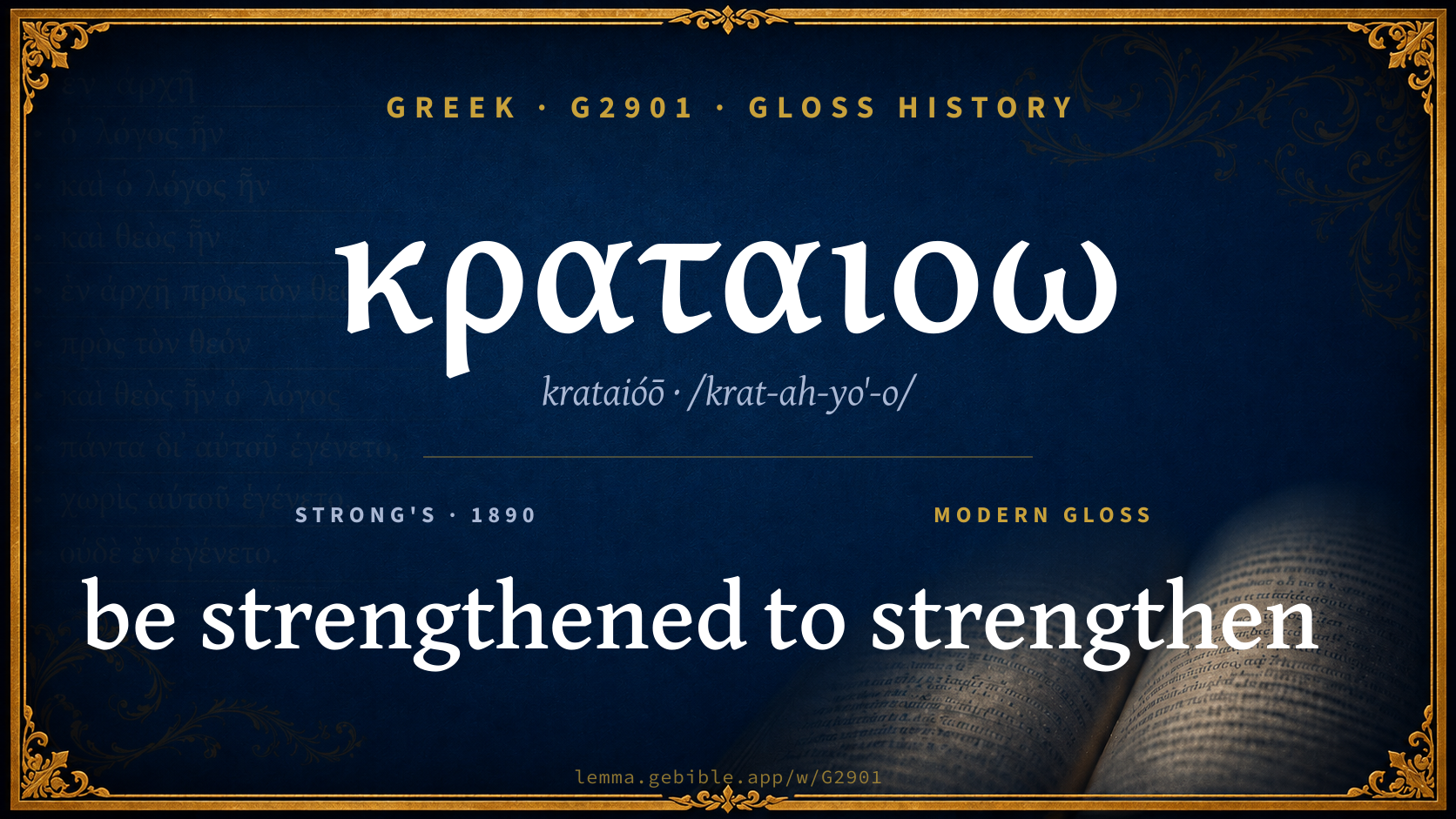
Gloss history
Strong's 1890 vs modern scholarship
About this word
Strong's G2901 catalogs a Greek word from the Greek New Testament.
These counts are not copied from any lexicon or concordance. They are computed here, from the morphology-tagged Greek New Testament. What Lemma adds →
- 4
- distinct verses
- The word appears in 4 distinct verses.
- 3 / 27
- NT books
- The word appears in 3 of 27 New Testament books.
- #1,877
- by frequency
- Top 2500 most frequent Greek words (rank 1,877 of 5,347 Greek words by occurrence).
View all 4 occurrences in the concordance →
Most concentrated in
- Luke 2 verses 50%
- 1 Corinthians 1 verse 25%
- Ephesians 1 verse 25%
By section of the New Testament
By traditional corpus
Conventional, traditional groupings — biblical authorship is debated, so this is a traditional corpus grouping, not an authorship claim. Some books belong to more than one corpus (Luke is in both the Gospels and the Lukan corpus, and so on), so these shares overlap and need not total 100%. Each figure is a share of the word’s 4 distinct verses.
- Gospels 2 verses · 50%
- Lukan (Luke–Acts) 2 verses · 50%
- Pauline corpus 2 verses · 50%
How translations render this word
Counts come from each version’s own published word-to-Strong’s tagging or interlinear alignment — an approximate guide to how each version renders this word, not a word-level alignment the data otherwise carries. Because each total is that version’s own tagged count, the per-version totals vary from one another and need not match the appearance or distinct-verse counts above. These counts may also differ from a printed concordance because Lemma counts each distinctly tagged rendering and does not collapse phrase taggings into a single head-word total. This is a fixed set of word-tagged versions (KJV, ASV, BSB, ULT) and does not change with the reading translation you choose elsewhere. Each version’s license is shown beside its name below (and on Sources).
- King James Version: Waxed strong 2×
- American Standard Version: Be strong 1×, Strong 1×, Waxed strong 1×
- Berean Standard Bible: Became strong 2×
- unfoldingWord Literal Text: Be strengthened 1×, Be strong 1×, Was being strengthened 1×
King James Version Public Domain
Renders G2901 across 4 tagged occurrences — most commonly:
Plus 2 renderings that appear only once — usually multi-word phrases or single function words the recovered tagging swept in, not distinct renderings.
American Standard Version Public Domain
Renders G2901 across 4 tagged occurrences — most commonly:
Berean Standard Bible Public Domain
Renders G2901 across 4 tagged occurrences — most commonly:
Plus 2 renderings that appear only once — usually multi-word phrases or single function words the recovered tagging swept in, not distinct renderings.
unfoldingWord Literal Text CC BY-SA 4.0
Renders G2901 across 4 tagged occurrences — most commonly:
Senses in Thayer's
The 2 senses Thayer's distinguishes for this word, in lexicon order (not ranked by frequency or importance). The full entry — with sub-senses — is in the Lexicon Entry tab.
- to strengthen, make strong
- to be made strong, to increase in strength, to grow strong
Word origin
Derived from κραταιος (krataiós) (G2900) — mighty.
From G2900 ; to empower that is (passively) increase in vigor : - be strenghtened be (wax) strong.
— Strong’s Exhaustive Concordance (1890), public domain.
Forms in the corpus
The 3 distinct written forms G2901 takes in the Greek New Testament, most frequent first — each parse links to that tense’s occurrences in the concordance.
| Form | Parsing | Example | Uses |
|---|---|---|---|
| ἐκραταιοῦτο ekrataioûto | Verb, Imperfect, Passive, Indicative, 3rd person, Singular | Luke 1:80 | 2 |
| κραταιοῦσθε krataioûsthe | Verb, Present, Passive, Imperative, 2nd person, Plural | 1 Corinthians 16:13 | 1 |
| κραταιωθῆναι krataiōthē̂nai | Verb, Aorist, Passive, Infinitive | Ephesians 3:16 | 1 |
Septuagint usage
The same Greek word κραταιοω appears 56 times in the Greek Old Testament (Septuagint), across 53 verses in 12 books.
- 56
- LXX occurrences
- Tagged occurrences of this Greek word in the Septuagint.
- 53
- verses
- Distinct Septuagint verses containing this word.
- 12 / 39
- OT books
- The word appears in 12 of the 39 Old Testament books.
Sample Septuagint occurrences
- Judges 3:10 κραταιόω
- Ruth 1:18 κραταιόω
- 1 Samuel 4:9 κραταιόω
- 2 Samuel 1:23 κραταιόω
- 1 Kings 21:22 κραταιόω
- 2 Kings 3:26 κραταιόω
- 1 Chronicles 21:4 κραταιόω
- 2 Chronicles 21:4 κραταιόω
- Ezra 6:22 κραταιόω
- Job 36:19 κραταιόω
- Psalms 9:20 κραταιόω
- Lamentations 1:16 κραταιόω
Septuagint occurrences (same lexeme)
Every verse where the same Strong’s number (G2901) appears in the Greek Septuagint — showing the first 50 of 53. Verse text shown in the World English Bible for context; the Greek form is the matched word — the English is not keyword-highlighted.
- Judges 3:10 κραταιόω The Spirit of Yahweh came on him, and he judged Israel; and he went out to war, and Yahweh delivered Cushan Rishathaim king of Mesopotamia into his hand: and his hand prevailed against Cushan Rishathaim.
- Ruth 1:18 κραταιόω When she saw that she was steadfastly minded to go with her, she left off speaking to her.
- 1 Samuel 4:9 κραταιόω Be strong, and behave yourselves like men, O you Philistines, that you not be servants to the Hebrews, as they have been to you: quit yourselves like men, and fight.
- 1 Samuel 23:16 κραταιόω Jonathan, Saul's son, arose, and went to David into the wood, and strengthened his hand in God.
- 1 Samuel 30:6 κραταιόω David was greatly distressed; for the people spoke of stoning him, because the soul of all the people was grieved, every man for his sons and for his daughters: but David strengthened himself in Yahweh his God.
- 2 Samuel 1:23 κραταιόω Saul and Jonathan were lovely and pleasant in their lives, In their death they were not divided: They were swifter than eagles, They were stronger than lions.
- 2 Samuel 2:7 κραταιόω Now therefore let your hands be strong, and be you valiant; for Saul your lord is dead, and also the house of Judah have anointed me king over them.
- 2 Samuel 3:1 κραταιόω Now there was long war between the house of Saul and the house of David: and David grew stronger and stronger, but the house of Saul grew weaker and weaker.
- 2 Samuel 10:11 κραταιόω He said, If the Syrians be too strong for me, then you shall help me; but if the children of Ammon be too strong for you, then I will come and help you.
- 2 Samuel 10:12 κραταιόω Be of good courage, and let us play the man for our people, and for the cities of our God: and Yahweh do that which seems him good.
- 2 Samuel 11:23 κραταιόω The messenger said to David, The men prevailed against us, and came out to us into the field, and we were on them even to the entrance of the gate.
- 2 Samuel 11:25 κραταιόω Then David said to the messenger, Thus shall you tell Joab, Don't let this thing displease you, for the sword devours one as well as another; make your battle more strong against the city, and overthrow it: and encourage you him.
- 2 Samuel 13:14 κραταιόω However he would not listen to her voice; but being stronger than she, he forced her, and lay with her.
- 2 Samuel 22:18 κραταιόω He delivered me from my strong enemy, From those who hated me; for they were too mighty for me.
- 2 Samuel 23:3 κραταιόω The God of Israel said, The Rock of Israel spoke to me: One who rules over men righteously, Who rules in the fear of God,
- 1 Kings 21:22 κραταιόω and I will make your house like the house of Jeroboam the son of Nebat, and like the house of Baasha the son of Ahijah for the provocation with which you have provoked me to anger, and have made Israel to sin.
- 1 Kings 21:23 κραταιόω Of Jezebel also spoke Yahweh, saying, The dogs shall eat Jezebel by the rampart of Jezreel.
- 1 Kings 21:25 κραταιόω (But there was none like Ahab, who did sell himself to do that which was evil in the sight of Yahweh, whom Jezebel his wife stirred up.
- 2 Kings 3:26 κραταιόω When the king of Moab saw that the battle was too severe for him, he took with him seven hundred men who drew sword, to break through to the king of Edom; but they could not.
- 2 Kings 12:7 κραταιόω Then king Jehoash called for Jehoiada the priest, and for the [other] priests, and said to them, Why don't you repair the breaches of the house? now therefore take no [more] money from your acquaintance, but deliver it for the breaches of the house.
- 2 Kings 12:8 κραταιόω The priests consented that they should take no [more] money from the people, neither repair the breaches of the house.
- 2 Kings 12:13 κραταιόω But there were not made for the house of Yahweh cups of silver, snuffers, basins, trumpets, any vessels of gold, or vessels of silver, of the money that was brought into the house of Yahweh;
- 2 Kings 12:15 κραταιόω Moreover they didn't demand an accounting from the men into whose hand they delivered the money to give to those who did the work; for they dealt faithfully.
- 2 Kings 22:6 κραταιόω to the carpenters, and to the builders, and to the masons, and for buying timber and hewn stone to repair the house.
- 1 Chronicles 21:4 κραταιόω Nevertheless the king's word prevailed against Joab. Therefore Joab departed, and went throughout all Israel, and came to Jerusalem.
- 2 Chronicles 21:4 κραταιόω Now when Jehoram was risen up over the kingdom of his father, and had strengthened himself, he killed all his brothers with the sword, and various also of the princes of Israel.
- 2 Chronicles 23:1 κραταιόω In the seventh year Jehoiada strengthened himself, and took the captains of hundreds, Azariah the son of Jeroham, and Ishmael the son of Jehohanan, and Azariah the son of Obed, and Maaseiah the son of Adaiah, and Elishaphat the son of Zichri, into covenant with him.
- 2 Chronicles 34:8 κραταιόω Now in the eighteenth year of his reign, when he had purged the land and the house, he sent Shaphan the son of Azaliah, and Maaseiah the governor of the city, and Joah the son of Joahaz the recorder, to repair the house of Yahweh his God.
- 2 Chronicles 35:22 κραταιόω Nevertheless Josiah would not turn his face from him, but disguised himself, that he might fight with him, and didn't listen to the words of Neco from the mouth of God, and came to fight in the valley of Megiddo.
- Ezra 6:22 κραταιόω and kept the feast of unleavened bread seven days with joy: for Yahweh had made them joyful, and had turned the heart of the king of Assyria to them, to strengthen their hands in the work of the house of God, the God of Israel.
- Ezra 7:28 κραταιόω and has extended loving kindness to me before the king, and his counselors, and before all the king's mighty princes. I was strengthened according to the hand of Yahweh my God on me, and I gathered together out of Israel chief men to go up with me.
- Ezra 12:18 κραταιόω
- Ezra 16:9 κραταιόω
- Job 36:19 κραταιόω Would your wealth sustain you in distress, Or all the might of your strength?
- Job 36:22 κραταιόω Behold, God is exalted in his power. Who is a teacher like him?
- Psalms 9:20 κραταιόω Put them in fear, Yahweh. Let the nations know that they are only men. Selah.
- Psalms 26:14 κραταιόω
- Psalms 30:25 κραταιόω
- Psalms 37:20 κραταιόω But the wicked shall perish. The enemies of Yahweh shall be like the beauty of the fields. They will vanish-- Vanish like smoke.
- Psalms 63:6 κραταιόω When I remember you on my bed, And think about you in the night watches.
- Psalms 68:5 κραταιόω A father of the fatherless, and a defender of the widows, Is God in his holy habitation.
- Psalms 73:13 κραταιόω Surely in vain I have cleansed my heart, And washed my hands in innocence,
- Psalms 79:16 κραταίοω
- Psalms 79:18 κραταίοω
- Psalms 88:14 κραταιόω Yahweh, why do you reject my soul? Why do you hide your face from me?
- Psalms 102:11 κραταίοω My days are like a long shadow. I have withered like grass.
- Psalms 104:4 κραταιόω He makes his messengers winds; His servants flames of fire.
- Psalms 104:24 κραταίοω Yahweh, how many are your works! In wisdom have you made them all. The earth is full of your riches.
- Psalms 116:2 κραταιόω Because he has turned his ear to me, Therefore I will call on him as long as I live.
- Psalms 138:6 κραταιόω For though Yahweh is high, yet he looks after the lowly; But the proud, he knows from afar.
These are occurrences of the same Greek lexeme (G2901) in the Septuagint — not a translation of any one Hebrew word. The store carries no word-level Hebrew↔Greek alignment, so no Hebrew original is asserted here. Counts come from the recovered LXX Strong's tagging — high-frequency vocabulary is well covered, while rare or late forms may be untagged — so they reflect tagged occurrences and may slightly undercount.