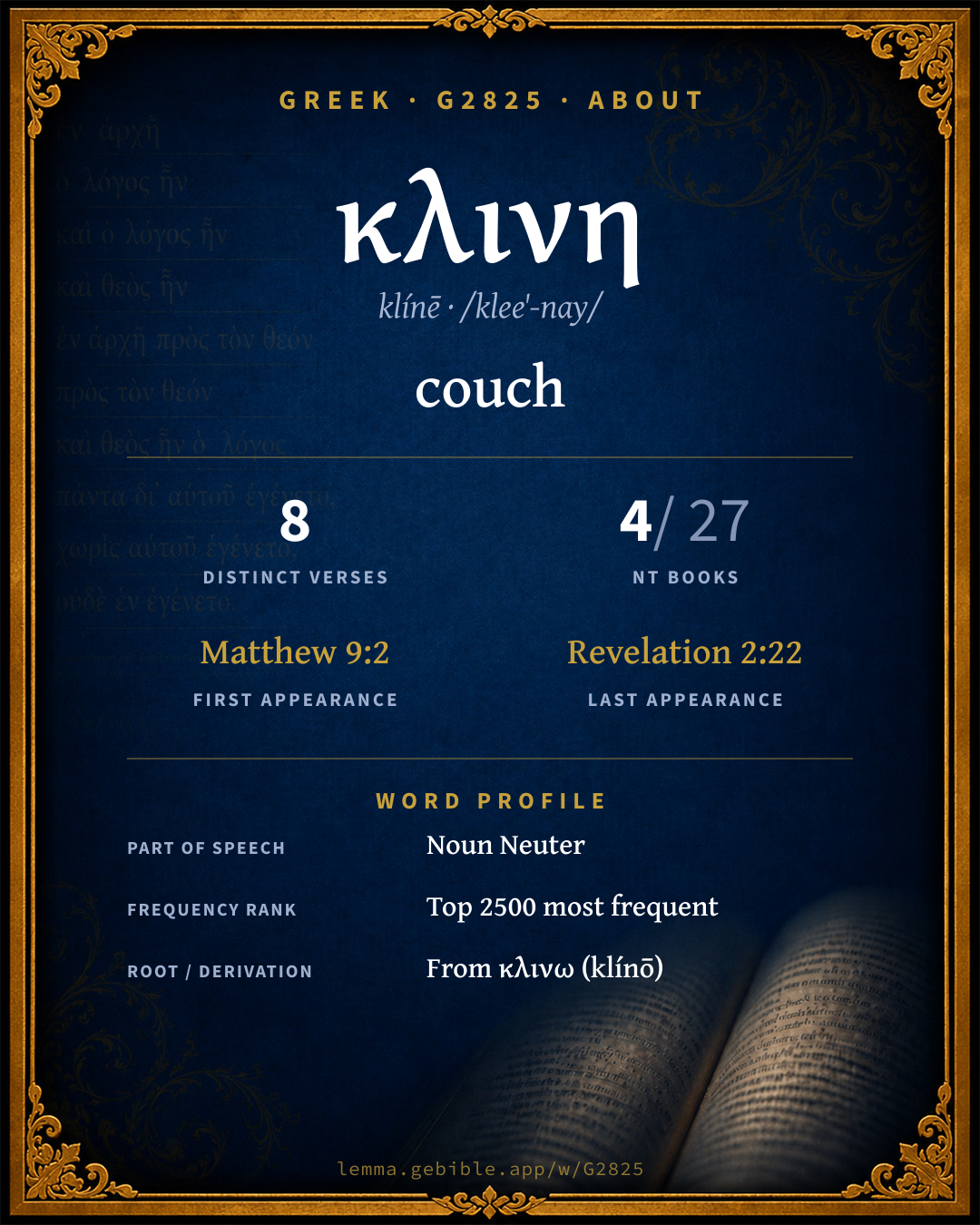
κλίνη
couch
‘couch’ is one of 3 main senses fuller range ↓
Full lexicon entry — Thayer's Greek Lexicon
From Thayer's Greek Lexicon
Where this word appears
See every Accusative-case word in the Greek New Testament →
Grammar key — what these labels mean
Part of speech
- Noun
- A naming word — a person, place, thing, or idea.
Case
- Accusative
- The case of the direct object and of extent.
- Genitive
- The case of source, possession, or “of” — answers “whose / from what.”
Gender
- Feminine
- Grammatically feminine.
Number
- Singular
- One.
Grammatical forms
- Noun, Accusative, Singular, Feminine 4 times (50%)
- Noun, Genitive, Singular, Feminine 4 times (50%)
Parsed forms decoded from the imported morphology (Robinson–Tischendorf, public domain), counted across 8 parsed occurrences — not distinct verses.
Every verse where G2825 appears — 8 distinct verses across 4 books. Click any verse to open its interlinear word-by-word view. Verse text shown in the World English Bible for context — . Each verse’s Greek form is shown with its reference; the English is not keyword-highlighted, since the data carries no word-level English alignment. Use “Compare translations” on any verse to read it across multiple English versions. This concordance covers the Greek New Testament; Septuagint (Greek Old Testament) occurrences of this word are not indexed here.
Matthew 2 verses
- Matthew 9:2 κλίνης n gen sg fem Behold, they brought to him a man who was paralyzed, lying on a bed. Jesus, seeing their faith, said to the paralytic, "Son, cheer up! Your sins are forgiven you."
- Matthew 9:6 κλίνην n acc sg fem But that you may know that the Son of Man has authority on earth to forgive sins..." (then he said to the paralytic), "Get up, and take up your mat, and go up to your house."
Mark 2 verses
Luke 3 verses
- Luke 5:18 κλίνης n gen sg fem Behold, men brought a paralyzed man on a cot, and they sought to bring him in to lay before Jesus.
- Luke 8:16 κλίνης n gen sg fem "No one, when he has lit a lamp, covers it with a container, or puts it under a bed; but puts it on a stand, that those who enter in may see the light.
- Luke 17:34 κλίνης n gen sg fem I tell you, in that night there will be two people in one bed. The one will be taken, and the other will be left.
Revelation 1 verse
About this entry
At a glance — auto-summarized from this page’s data, not written by a person. Every figure links to its source below. This summary describes the numbers; it doesn’t interpret them.
The Greek noun κλινη centers on the idea of “couch.” First canonically at Matthew 9:2, it enters the text early. It turns up in 8 verses across 4 books, an uncommon footprint. The word gravitates to Luke (38%), then Matthew and Mark. Lexicons map it across 3 senses. For the data behind this summary, explore the sense tree and the renderings breakdown below.
Gloss history
Strong's 1890 vs modern scholarship

About this word
Strong's G2825 catalogs a Greek word from the Greek New Testament.
These counts are not copied from any lexicon or concordance. They are computed here, from the morphology-tagged Greek New Testament. What Lemma adds →
- 8
- distinct verses
- The word appears in 8 distinct verses.
- 4 / 27
- NT books
- The word appears in 4 of 27 New Testament books.
- #1,240
- by frequency
- Top 2500 most frequent Greek words (rank 1,240 of 5,347 Greek words by occurrence).
View all 8 occurrences in the concordance →
By section of the New Testament
By traditional corpus
Conventional, traditional groupings — biblical authorship is debated, so this is a traditional corpus grouping, not an authorship claim. Some books belong to more than one corpus (Luke is in both the Gospels and the Lukan corpus, and so on), so these shares overlap and need not total 100%. Each figure is a share of the word’s 8 distinct verses.
- Gospels 7 verses · 88%
- Lukan (Luke–Acts) 3 verses · 38%
- Johannine 1 verse · 13%
- Revelation 1 verse · 13%
How translations render this word
Counts come from each version’s own published word-to-Strong’s tagging or interlinear alignment — an approximate guide to how each version renders this word, not a word-level alignment the data otherwise carries. Because each total is that version’s own tagged count, the per-version totals vary from one another and need not match the appearance or distinct-verse counts above. These counts may also differ from a printed concordance because Lemma counts each distinctly tagged rendering and does not collapse phrase taggings into a single head-word total. This is a fixed set of word-tagged versions (KJV, ASV, BSB, ULT) and does not change with the reading translation you choose elsewhere. Each version’s license is shown beside its name below (and on Sources).
- King James Version: Bed 8×
- American Standard Version: Bed 8×
- Berean Standard Bible: Bed 4×, Mat 3×
- unfoldingWord Literal Text: Bed 5×, Mat 3×
King James Version Public Domain
Renders G2825 across 10 tagged occurrences — most commonly:
Plus 2 renderings that appear only once — usually multi-word phrases or single function words the recovered tagging swept in, not distinct renderings.
American Standard Version Public Domain
Renders G2825 across 9 tagged occurrences — most commonly:
Plus 1 rendering that appears only once — usually multi-word phrases or single function words the recovered tagging swept in, not distinct renderings.
Berean Standard Bible Public Domain
Renders G2825 across 9 tagged occurrences — most commonly:
Plus 2 renderings that appear only once — usually multi-word phrases or single function words the recovered tagging swept in, not distinct renderings.
unfoldingWord Literal Text CC BY-SA 4.0
Renders G2825 across 8 tagged occurrences — most commonly:
Senses in Thayer's
The 3 senses Thayer's distinguishes for this word, in lexicon order (not ranked by frequency or importance). The full entry — with sub-senses — is in the Lexicon Entry tab.
- a small bed, a couch
- a couch to recline on at meals
- a couch on which a sick man is carried
Word origin
Derived from κλινω (klínō) (G2827) — to recline.
From G2827 ; a couch (for sleep sickness sitting or eating): - bed table.
— Strong’s Exhaustive Concordance (1890), public domain.
Forms in the corpus
The 2 distinct written forms G2825 takes in the Greek New Testament, most frequent first — each parse links to that case’s occurrences in the concordance.
| Form | Parsing | Example | Uses |
|---|---|---|---|
| κλίνην klínēn | Noun, Accusative, Singular, Feminine | Matthew 9:6 | 4 |
| κλίνης klínēs | Noun, Genitive, Singular, Feminine | Matthew 9:2 | 4 |
Same root — word family
Other Thayer's entries built from the same root as G2825, grouped by Strong’s listed origin. These share a root / origin per the lexicon — not necessarily a shared meaning. Each links to that word’s own entry.
Derives from
Shares the same root
Derived from this word
Compare all same-root words → Showing 4 of 5 — not the complete family. They share a root, not necessarily a meaning.
Septuagint usage
The same Greek word κλινη appears 35 times in the Greek Old Testament (Septuagint), across 34 verses in 16 books.
- 35
- LXX occurrences
- Tagged occurrences of this Greek word in the Septuagint.
- 34
- verses
- Distinct Septuagint verses containing this word.
- 16 / 39
- OT books
- The word appears in 16 of the 39 Old Testament books.
Sample Septuagint occurrences
- Genesis 48:2 κλίνη
- Exodus 7:28 κλίνη
- Deuteronomy 3:11 κλίνη
- Judges 7:5 κλίνη
- 1 Samuel 19:13 κλίνη
- 2 Samuel 3:31 κλίνη
- 1 Kings 17:19 κλίνη
- 2 Kings 1:4 κλίνη
- 2 Chronicles 16:14 κλίνη
- Esther 1:6 κλίνη
- Job 7:13 κλίνη
- Psalms 6:7 κλίνη
Septuagint occurrences (same lexeme)
Every verse where the same Strong’s number (G2825) appears in the Greek Septuagint. Verse text shown in the World English Bible for context; the Greek form is the matched word — the English is not keyword-highlighted.
- Genesis 48:2 κλίνη Someone told Jacob, and said, "Behold, your son Joseph comes to you," and Israel strengthened himself, and sat on the bed.
- Genesis 49:33 κλίνη When Jacob made an end of charging his sons, he gathered up his feet into the bed, and yielded up the spirit, and was gathered to his people.
- Exodus 7:28 κλίνη
- Deuteronomy 3:11 κλίνη (For only Og king of Bashan remained of the remnant of the Rephaim; behold, his bedstead was a bedstead of iron; isn't it in Rabbah of the children of Ammon? nine cubits was the length of it, and four cubits the breadth of it, after the cubit of a man.)
- Judges 7:5 κλίνη So he brought down the people to the water: and Yahweh said to Gideon, Everyone who laps of the water with his tongue, as a dog laps, him shall you set by himself; likewise everyone who bows down on his knees to drink.
- 1 Samuel 19:13 κλίνη Michal took the teraphim, and laid it in the bed, and put a pillow of goats' [hair] at the head of it, and covered it with the clothes.
- 1 Samuel 19:15 κλίνη Saul sent the messengers to see David, saying, Bring him up to me in the bed, that I may kill him.
- 1 Samuel 19:16 κλίνη When the messengers came in, behold, the teraphim was in the bed, with the pillow of goats' [hair] at the head of it.
- 2 Samuel 3:31 κλίνη David said to Joab, and to all the people who were with him, Tear your clothes, and gird you with sackcloth, and mourn before Abner. King David followed the bier.
- 2 Samuel 4:7 κλίνη Now when they came into the house, as he lay on his bed in his bedchamber, they struck him, and killed him, and beheaded him, and took his head, and went by the way of the Arabah all night.
- 1 Kings 17:19 κλίνη He said to her, Give me your son. He took him out of her bosom, and carried him up into the chamber, where he abode, and laid him on his own bed.
- 1 Kings 20:4 κλίνη The king of Israel answered, It is according to your saying, my lord, O king; I am yours, and all that I have.
- 2 Kings 1:4 κλίνη Now therefore thus says Yahweh, You shall not come down from the bed where you are gone up, but shall surely die. Elijah departed.
- 2 Kings 1:6 κλίνη They said to him, There came up a man to meet us, and said to us, Go, turn again to the king who sent you, and tell him, Thus says Yahweh, Is it because there is no God in Israel, that you send to inquire of Baal Zebub, the god of Ekron? therefore you shall not come down from the bed where you are gone up, but shall surely die.
- 2 Kings 1:16 κλίνη He said to him, Thus says Yahweh, Because you have sent messengers to inquire of Baal Zebub, the god of Ekron, is it because there is no God in Israel to inquire of his word? therefore you shall not come down from the bed where you are gone up, but shall surely die.
- 2 Kings 4:10 κλίνη Let us make, Please, a little chamber on the wall; and let us set for him there a bed, and a table, and a seat, and a lamp stand: and it shall be, when he comes to us, that he shall turn in there.
- 2 Kings 4:21 κλίνη She went up and laid him on the bed of the man of God, and shut [the door] on him, and went out.
- 2 Kings 4:32 κλίνη When Elisha was come into the house, behold, the child was dead, and laid on his bed.
- 2 Kings 11:2 κλίνη But Jehosheba, the daughter of king Joram, sister of Ahaziah, took Joash the son of Ahaziah, and stole him away from among the king's sons who were slain, even him and his nurse, [and put them] in the bedchamber; and they hid him from Athaliah, so that he was not slain;
- 2 Chronicles 16:14 κλίνη They buried him in his own tombs, which he had hewn out for himself in the city of David, and laid him in the bed which was filled with sweet odors and various kinds [of spices] prepared by the perfumers' are: and they made a very great burning for him.
- 2 Chronicles 22:11 κλίνη But Jehoshabeath, the daughter of the king, took Joash the son of Ahaziah, and stole him away from among the king's sons who were slain, and put him and his nurse in the bedchamber. So Jehoshabeath, the daughter of king Jehoram, the wife of Jehoiada the priest (for she was the sister of Ahaziah), hid him from Athaliah, so that she didn't kill him.
- 2 Chronicles 24:25 κλίνη When they were departed for him (for they left him very sick), his own servants conspired against him for the blood of the sons of Jehoiada the priest, and killed him on his bed, and he died; and they buried him in the city of David, but they didn't bury him in the tombs of the kings.
- Esther 1:6 κλίνη [There were hangings of] white [cloth], [of] green, and [of] blue, fastened with cords of fine linen and purple to silver rings and pillars of marble: the couches were of gold and silver, on a pavement of red, and white, and yellow, and black marble.
- Esther 7:8 κλίνη Then the king returned out of the palace garden into the place of the banquet of wine; and Haman was fallen on the couch whereon Esther was. Then said the king, Will he even force the queen before me in the house? As the word went out of the king's mouth, they covered Haman's face.
- Job 7:13 κλίνη When I say, 'My bed shall comfort me, My couch shall ease my complaint;'
- Psalms 6:7 κλίνη My eye wastes away because of grief; It grows old because of all my adversaries.
- Psalms 40:4 κλίνη Blessed is the man who makes Yahweh his trust, And doesn't respect the proud, nor such as turn aside to lies.
- Psalms 131:3 κλίνη Israel, hope in Yahweh, From this time forth and forevermore.
- Proverbs 7:16 κλίνη I have spread my couch with carpets of tapestry, With striped cloths of the yarn of Egypt.
- Proverbs 26:14 κλίνη As the door turns on its hinges, So does the sluggard on his bed.
- Song of Solomon 1:16 κλίνη Behold, you are beautiful, my beloved, yes, pleasant; And our couch is verdant. Lover
- Song of Solomon 3:7 κλίνη Behold, it is Solomon's carriage! Sixty mighty men are around it, Of the mighty men of Israel.
- Ezekiel 23:41 κλίνη and sit on a stately bed, with a table prepared before it, whereupon you did set my incense and my oil.
- Amos 6:4 κλίνη Who lie on beds of ivory, And stretch themselves on their couches, And eat the lambs out of the flock, And the calves out of the midst of the stall;
These are occurrences of the same Greek lexeme (G2825) in the Septuagint — not a translation of any one Hebrew word. The store carries no word-level Hebrew↔Greek alignment, so no Hebrew original is asserted here. Counts come from the recovered LXX Strong's tagging — high-frequency vocabulary is well covered, while rare or late forms may be untagged — so they reflect tagged occurrences and may slightly undercount.